Out of Despair 4 – The Railway Tracks

Let me tell you about something I call the railway tracks. It is something I have struggled with for many, many years. I get stuck. I plan my life, and those plans are like tracks laid out before me. In good times, they are a guide. I stick to them, but I can also get off them, make detours, follow impulses, go where the moon calls me. In bad times, I am trapped by them, no deviation, no way out. Rewind 5 years. I’ve driven into the city to go to a church service that evening. I’m trying to make new friends. I know I’m multiple but I’ve told almost no one. I’m exploring an idea that if we don’t switch, if we take the same part to church each time, we might have a better chance at making friends. It’s sort of working but also not. Driving home late at night, there’s a sudden yearning inside to go home via the beach instead. The night is cold and clear and the moon is bright silver and I’m terribly lonely and lost. I want to do this so badly, but I can’t. The plan was to go to church and come home. The beach isn’t in the diary, isn’t on the schedule. I fight very hard but I cannot make myself drive there. I go home instead. This is the railway tracks.

At the time I dig into it enough to realise that I suffered from it because it supported my functioning in another way. I didn’t exemplify the chaos that is common in someone who has parts, because we all stuck to an agreed schedule. The downside was this lack of freedom to be spontaneous. That was upsetting but an acceptable trade off. Over time, the schedule – and this whole approach, the group being bound to decisions made previously, a rigid adherence to agreements, inflexibility, feeling trapped and locked in, has degenerated into severe depression. Hence, the letting go of it all, the following of small voices, listening to immediate needs and wants. The tracks are suddenly gone. The sense of living my life by constantly bullying myself into doing things I desperately did not want to do, being so far outside of my comfort zone I couldn’t remember the last time I had seen it, of holding myself down, holding my hand in the fire, holding the feelings at bay, that has gone. The boulders on my heart have lifted. The despair is still there, the screaming pain, the loneliness, the scars, the terror, the years of torment and loss. But the crushing destruction of motivation, initiative, emotion, that has gone, for now at least. The tracks are gone. I can do what I wish, make impulse decisions. Turn right instead of left. Stand at the edge of the world and watch the ships.

Suddenly I’m walking Zoe because I want to, because I love her, because I love going out in the night and the cold where I have the world to myself, not because I have to, not out of guilt or obligation.

Suddenly I’m realising that this freedom is the key to attachment, to connection, to love. That this isn’t just how I want to look after my dog, it’s the kind of parent I want to be. Connected. Let off the hook for not being perfect. Working with what I have. It’s the kind of partner, friend, person, I want to be.

Stronger members of my system have allowed themselves to be bound by the needs and fears of more vulnerable members. It’s been critical for cohesion. We’ve been very good at presenting only one face to the world. We’re united by a set of values, and the primary need to survive. This leashing also strips us of much of our strength, passion, fire, and zest for life. You cannot dream when your dreamers are locked in stone. There’s a cold war between those who hope and those who despair. We are changing this. We are loosening leashes. I don’t know what will happen. That’s precisely the frightening and wonderful thing. I don’t know what my future holds.

Out of Despair Part 1 – Language is Powerful

Part 2 – Frameworks Free and Bind

Part 3 – The Tribe

Part 5 – The Cave Dwellers and the Golden Light

Out of Despair 3 – The Tribe

This change of approach is everywhere in my life at the moment. I have an analogy. Picture a tribe of people, living together. Now bomb the region. Nuclear! Wasteland, devastation, loss. The tribe are alive but wounded. Some are sick, some are weak, some are young. They band together to get out of the wasteland. The journey is very, very long. They don’t know how long it will take. Somewhere it must end, somewhere there must be clean water and trees. It’s an act of faith to go on, to keep believing that all the world is not like this. As they journey, some members cannot go on. They become exhausted, or too wounded, or they die. The tribe buries them, or leaves them in caves or burrows. They promise that when they find a good place, they will return. They keep on. Sometimes one member leads, sometimes another. Sometimes they fight. They learn a lot about living together and looking after each other. They leave a trail behind them, footsteps in blood, bodies under hummocks of sand and ash.

The tribe is smaller now, leaner, wiser, older. They find the edge of the wastes, there is grass again, water, food. They can make a home. They can make a life. They can sleep indoors.

The whole world of mental health now says to me – set up home. Focus on the present moment. Be happy. Be well.

My wastes are full of wailing, angry ghosts. I’m haunted by who I used to be. I owe debts. I’ve made promises.

So I look sick instead of successful, as I go back to the burrows and rouse them, the lonely, wounded, angry ones, and promise them the world now has trees in it. As I go and wake my dead, gather the bones and bring life back into them. It looks like depression. It looks like crashing, like getting sick. I don’t look like a successful, recovered patient.

But there’s life again! There’s many voices. There’s feeling in my skin. Where my routines and plans had become empty, there’s passion. Where I’ve closed my ears to the cries and done what needed to be done, now is a time to open my ears, to sit and listen, to make a fire, to share bread, to tell the stories, to bring back together what has been divided. Dark and light, old and young, bold and timid, hope and despair, conventional and misfit, to be a tribe again, to each have a voice. We all need to have a voice to dream of a new future for us all.

And here comes the next part – the dreaming. It cannot be something that suits one, or a few. Parenthood must not be something only one or two desire. A home is not a home unless we all belong there, strange as we are. If the dark wild ones need trees to climb there must be trees. We need all of us to dream, to yearn, to share in a future together.

Without all the voices we have no balance. We are divided, unstable, without constraint. The human spirit is made to be pulled in different directions, this is our pain and our beauty, we find balance between conflicting needs. I am divided, we must work together for there to be balance, wholeness, real hope. There has been rising hope and despair, in conflict, this year. To undo the conflict and find harmony, we must undo the framework.

Out of Despair Part 1 – Language is Powerful

Part 2 – Frameworks Free and Bind

Part 4 – The Railway Tracks

Out of Despair 2 – Frameworks free and bind

I’ve been doing a big shift in frameworks lately. I was conceiving of my severe bouts of depression and the fibro flare this year as an indication I was doing something wrong. I couldn’t work out what it was, what I needed, where I’d stuffed up. Framing the problem like this was immobilizing me.The mental health framework was offering me another idea, that of ‘depression’. It was presented as a mysterious, incomprehensible illness, striking randomly without warning, disabling and destroying. One you cannot fight, cannot understand. There are meds, there is waiting it out. That is all. This bogeyman was preying on my mind. It loomed larger and larger in my thoughts, bringing with it an incapacitating terror. What if nothing I try works? What if this is part of my life now? What if I never feel better?

These are the frameworks we give to people with psychosis; that it is insanity, incomprehensible, impossible to interact with. Pointless to attempt to understand. Endure. Take your meds. Endure. Hope. Lower your expectations. Don’t listen to the voices.

(I’m not anti meds. You do what works. I work a lot with people they don’t work for. There needs to be more than one approach.)

The framing of the problem was killing me. I tried turning it all around. What if getting sick and being depressed doesn’t mean I’ve done anything wrong? What if I’ve made excellent choices in difficult circumstances? What if my circumstances have changed now and the approach I’ve been using isn’t working anymore? What if I stop everything, let go of all of it, and go back to listening to myself? This letting go has been the most miraculous thing. My heart is singing again. I feel alive, my emotional connections have returned. There’s certainty and focus and hope, where there was terror, confusion, and despair. Language has power. You cannot find the answer when you’re asking a question that don’t permit that answer.

I’m ignoring the bogeyman of ‘Depression’. I’m embracing the idea of letting go, of a retreat, of a cocoon, to build something new. To reconnect with the heart of me.

Take friends. I’ve been a desperately lonely child and young person. I craved human connection and contact, dreamed about having friends I could hug, talk to about things that scared me, people who would support me when I was hurting, remember my birthday, be happy to see me, miss me when I was away. I’ve carefully worked on friendship networks over years and had something catastrophic – like PTSD – suddenly open a Gap I can’t bridge and take them all away. My multiplicity has deeply and strangely affected my relationships. I have trouble building relationships with parts of other, so called normal people, they usually keep buried. I also tended to push relationships hard. There was a big hole at the middle of my life, where very close relationships were meant to be. I took wonderful friendships and destroyed them by trying to make them closer than they were ever going to be. It’s like there was a black hole in the middle of me, and I couldn’t stop it drawing people inwards to something more personal, vulnerable, and intense, than they wanted. So I had nothing instead.

Several years I realised that this loneliness, this yearning need, was killing my friendships. So I disconnected from it. I changed focus and deliberately started seeking out acquaintances. From those, I started to make some slightly more close friends, and so on. I’ve reached a place now where I have a whole network full of really awesome people, more than I can keep up with. For a weird, lonely, mentally ill freak, I’ve been astonishingly successful at rebuilding social support. And I’ve hit a wall, where I can’t let anyone closer.

Because this approach is goal-oriented, top-down, intellectual, disconnected from that lonely, yearning, intense heart of me. Shielding people from it has been effective, it’s helped me build good caring relationships where I don’t bleed all over them, where I’m not raw, prickly, angry, scary, or in their face, most of the time. It’s helped me put my best foot forwards. But it also keeps at bay those I have come to love, walls them off from my vulnerability, cuts me off from my own yearning. So the time has come to let go of one approach, and grasp another.

Out of Despair Part 1 – Language is Powerful

Out of Despair Part 3 – The Tribe

Out of Despair 1 – Language is Powerful

I’ve undergone a massive change in my mental landscape in the past month. Against a background of a bad flare in my chronic pain condition, and severe bouts of my first experiences of depression, I’ve finally found a way through. It’s difficult to communicate but I wanted to share. I’ve tried to put my thoughts in order and broken them up into 6 separate posts to make it easier to read and pick out only the bits you might useful. I hope it might be helpful to someone.

So many of my experiences in life have been so different, so alien and without words, I’ve struggled to even think about them in a coherent way, let alone communicate about them to other people. I’ve found lose frameworks and sketchy lexicons to at least be able to have a dialogue with my selves about my life. They’ve been useful but also limiting – as frameworks tend to be. So for example, as a young person, functioning in a way entirely differently from all my peers, I needed ways to describe and explain this to myself. One of the concepts I came up with is that I was a poet and they were not. This was, generally speaking, true. It also encompassed other ideas – that I was a highly creative person in a non-creative environment where sports was the focus. It spoke to a sensitive, observant nature. It had connotations far beyond that of a wordsmith – poet, and became instead Poet – a term that encompassed someone profoundly out of step with contemporaries, who spent much time up trees, on roofs, and in rivers. Who dressed primarily in velvet when given a choice, wore a knife on a belt when at home, cried most days, was desperately lonely, and carried around a journal like it was her own soul.

It was startling to meet other poets and discover that while most are misfits in some way, they are not necessarily misfits in the same way as I was. I was using the term to encompass ideas that did, and did not fit within it.

When I was first presented with the idea of dissociation it seemed primitive to me. I made no connection at all between the clinical terminology and my own experiences. I had become so accustomed to living a double life – the things we speak of and the things we do not, that starting to dig into my own fractured state in therapy deeply troubled me. I have come to accept that dissociation is the term for what I experience – a division of personality into separate parts, and at times a tenuous connection with ‘reality’. But there’s more to the story than this. Multiplicity is a big part of what makes me different. Being queer is another part. Odd developmental patterns is another – I was far ahead of my peers in some areas as a child/teen, and very behind in others. Being highly creative instantly put me at odds with systems, structures, routines, and traditions. Being highly traumatised changed how I felt, thought, and reacted. What made me feel different, and be identified by my peers as different, is far more complex than a mental illness. And to collapse some of my differences and challenges under the framework of mental illness does them a disservice.

Language is important. It shapes how we think. It provides frameworks, and frameworks are both useful and limiting. They can also be incomplete, unsophisticated, erroneous. The first times as a teenager that I went along to poetry gatherings I was deeply disappointed. I had been hoping to find people like me. People full of yearning and loneliness, who were deeply moved by life and had made the great effort to find words for experiences that defied language. People who craved connection and intensity. I felt instead, lost, lonely, confused. My frameworks were insufficient. ‘Poet’ was part of the picture but not the whole picture.

Dissociation and multiplicity are part of the picture but not the whole picture. The language of social workers and psychologists reminds me of butterfly collectors, who kill what they revere. Who have board of lifeless wings with which they cannot possibly understand the glory of flight. When lost for words, I always return to poetry. There are things you cannot understand without experiencing them as they are. Science turns on the lights and drags up the strange creatures from the deeps. It’s valuable. But it’s also limited.

Some days the single most lethal idea we’ve ever come up with, is that we are normal people, leading ordinary lives. The world is not what we think it is. Our ideas about it are a structure, a framework we’ve laid over it, to make sense of it and understand it. They are not ‘truth’, and they are not ‘reality’. Rejecting the ideas of your own culture does not mean you are rejecting reality. Being able to step outside of the roles you fill in your life can be a terrifying experience. It can also be a way of touching your soul.

Language is precious. I’m frustrated by people who say that language destroys what it seeks to describe, who believe that life cannot be communicated about. It is imperfect, which is why it should not be static. It is fluid, we change it, we add new words, we change the meanings of words, we shift it around. We lose words, we reclaim words – like queer, like mad, like freak.

I’m still partly a child. Literally and metaphorically. I’m hypersensitive, at times profoundly insecure, confused by the world. I lack filters. When I read a book or watch a movie, I live in it. I cry, I love, I feel deeply for the characters. They have been my friends when I didn’t have any. I learn quickly, the way a child does, soaking up information, mimicking instructions. The other day, I switched to a part who’s about 13. I was co conscious and could see and feel what she did. It was like peeling back so many years of my life and tossing them away for a night. Memories of those early years were as strong as a yesterday. The world shifted, shadows deepened, all the words meant something different to me. I was light as air, laughing, I was free in the night, full of mischief and uncertainty. When I’m near the beach, a poet often comes out, full of lonely yearning. She is much younger, she stands by the water at the edge of the world and watches the ships out at sea. I used to spend a lot of time in Salisbury. One of the shopping complexes has been build around an old graveyard. Between council buildings, the library, cinema, grocery store, there is a tiny plot of gravestones. Everyone walks around them as if they are not there. I used to stand among them, memorizing the names. Noticing the babies who lived only hours or days, the women who died after long, long lives. We walk around these things as if they are not there. We get stuck in our frameworks and cannot see beyond them or think beyond them. I love my little yearning girl who lives by the sea. To call her a part of my mental illness is to miss entirely who she is and what she means to me. It is to obscure and deny.

Language can kill you. After being homeless years ago, I moved into a borrowed caravan and a caravan park. It was a time of absolutely disarray in my life, every plan I’d ever made or hope I’d ever had was utterly disrupted. I was chronically physically unwell and in constant pain. My marriage had collapsed, my friendship networks were gone, my life had burned to the ground. I was living among some of the poorest members of our community.

I found myself  in the ‘white trash’ bracket of our culture. People were confused, uncomfortable, curious, weirdly sympathetic. I tried to get involved in life again but found that my address held me back. I offered to help raise a puppy for a local guide dog organisation. I asked at the information session if living in a caravan park – a pet friendly one that allowed small fenced areas around each van – would be an issue. They said of course not! I went through the training and the home inspection and failed. Someone higher up the hierarchy I’d never met had decided that a caravan was ‘not an appropriate environment for our expensive puppies’. I wasn’t really a person anymore.

That could have crushed me. I felt the impact of it, the weight of it, on my spirit. I finally turned it around by tapping into the gypsy culture in my mind. Finding a different way to see my situation, different words to use about it. Now that I’m living in a unit, I miss my van some nights. I like to sleep outdoors, to feel the rain and hear the wind and watch the moon rise. I found new words, ones that didn’t cut into me.

If dissociation is the word we’re using to describe what I feel when I’m walking through the frameworks of our culture and finding my own language instead, then it can’t be only negative, can’t be ‘illness’. It’s also freedom. There is a tremendous power in being able to define ourselves and our own lives in ways that are meaningful to us.

Out of Despair Part 2 – Frameworks Free and Bind
Staying safe in a crisis

I’m still in crisis mode here, working on staying safe until I’m in a better head space. I haven’t worked out what’s triggered this mess – that can happen and it can take some time to put things together. The task at the moment is staying safe. I have at least one severely depressed part, which is new territory for us. Anxiety is also sky high, I’m struggling to eat (or keep food down), fighting off a cold and sinus infection, and feeling very unsafe about self harm.

If the mental health system was less toxic, I’d be in care. But because it’s such a mix of good care and abuse, it’s high risk. For someone like me with my diagnoses, it’s likely that I’ll struggle to get any care at all, and that’s not a struggle I have energy for. On one occasion previously when homeless, on the run from domestic violence, exhausted at caring for another mentally ill family member, and seriously suicidal I turned up to ACIS and asked for help… I was told that I had a better chance of surviving alone than I did with their assistance because they do not treat people with DID well.

So that leaves me with trying to manage using my own resources and networks, to create something as safe as I can in my own life. I shut down to the bath if the self harm impulse is overwhelming. I’ve borrowed two bags of books from the library. This gives me something else to focus on. Sometimes they’re a useful escape. Sometimes I read things that help me in some way. There needs to be something to ease that dangerous, frantic despair, the kind that has you running into the night looking for anything that might make you feel differently. I also have movies to watch, preferably long involved ones I already know. The flavour of the week is Harry Potter movies.

Sleep and food are critical. If they are both interrupted I will degenerate into severe dissociation and borderline psychosis. I’m fortunate at the moment in that I’m sleeping. Keeping food happening is more challenging currently. When you’re very anxious your digestion shuts down, the thought, smell, and taste of food becomes unappealing. If I force myself to eat I will vomit. So I have to find small, filling meals of things that tempt me, where the smell or texture don’t turn my stomach. Sometimes this means I eat the same thing every meal – like a bowl of cereal. Sometimes this means I need a different flavour and texture for every meal for a while. This gets very difficult if you’re not well enough to drive and stock the fridge. I need to drink enough fluid that I’m not dehydrating.

I need to keep enough admin going that my life doesn’t crash. This one is hard. I’ve cancelled almost every appointment this week. I’m getting by at the moment. Yesterday I was up to cleaning all the rotten food out of the fridge. I’m keeping up with feeding the pets and sorting out the cat litter tray. I’ve paid my bills. I’ve actually contacted people to cancel appointments instead of just not turning up. I’ve taken the dog to the vet when she was ill. I’ve removed all the clothes and linen the cat has peed on to a big pile in the laundry. I try not to think about all the big things worrying me about my life plans for the next few months or years, or I become hysterical. The goal is just one day at a time. Today I’m hoping to buy milk, cordial, and maybe hang out with some friends this evening if I feel safe enough to drive and have a chance of passing for normal.

I try and stay in touch a little with other people. Facebook can be good for this, if you’re comfortable with that and know how to use your privacy settings. It gets hard to communicate. I’m mixed up. I stood at my kitchen window yesterday and simultaneously felt rigid, bitter despair about my life, and simple childlike joy. That’s hard to explain to other people. In between jags of the kind of distressed crying that we never see on TV because it involves a truly horrifying amount of snot, I look fine. Maybe a bit tired and jumpy. I spent 5 hours yesterday morning trying to work out how to reply to a text from Rose asking me how I was, while she got increasingly concerned. Don’t do that. We’ve since decided that an empty text with an asterisk in it means ‘I’m not about to kill myself, but I’m not very good and I can’t think straight enough to write to you. But I am awake and alive.’ In between thinking about dying, I’m okay, just very flat and tired. There’s even been some confusing but welcome good hours where someone happy turns up. After the first few days I’ve stopped hoping that this means the whole mess is over and getting devastated when I go down again. I also have to be careful because when I don’t feel like a complete mess, it’s easy to over reach and take risks I actually can’t afford to manage at the moment.

I’m short fused and low on tolerance. It’s important to stay away from people and situations that stress me, whether that’s unwelcome advice, overbearing cheerfulness, people who don’t get that I’m touch sensitive when stressed, whatever. Kindness goes a hell of a long way, as does feeling like it’s okay that at the moment, you’re a useless friend and a mess.

I need to not listen to the internal chatter that says things like “You’re just lazy and weak and pathetic and useless and looking for attention and could snap out of it if you really tried”. It helps when I can share that with someone who doesn’t believe it. There’s a sting in being able to confess stuff like this with someone who can say ‘well so what if it is true? I still love you’ and bring you an icecream.

I need space to be honest. My journal, a shrink, friends, somewhere I can pour out all of how messed up I really am feeling, instead of sticking to how I am being told I *should* feel in the hope that will help. Even if that means pouring out pages of reasons I’m a failure or why I hate myself. I need to be damn careful not to drown any one person in this stuff, especially not anyone who’s already vulnerable themselves – or anyone’s who’s inclined to argue about it instead of just being kind, because I might throw things at them.

I need to make sure if I can that at least one other person knows what’s really going on so that if it turns out that my assessment of where I’m up to is really off, someone else will step in.

I need a backup plan and other options in case this doesn’t work. In my case at the moment if next week is still bad I’ll be talking to my shrink. I also run a scale of stress-reduction behaviour according to degree of harm. So for example at the moment I’m struggling with a strong drive to self harm. I’m managing this using distraction, writing, wrist poems, hanging with other people when I don’t feel safe to be alone, and long baths. If I become seriously suicidal and can’t get help, I’ll change focus and let myself self harm if that reduces enough stress and generates enough dissociation to reduce the risk of a suicide attempt. I keep shifting the goals as I need to. If I’m having a good day I try to connect to my networks, get urgent admin done, and go somewhere nice. If I’ve fallen apart I consider that if I’m still breathing at the end of the day that’s a success. In the middle there is an attempt to self care and reduce stress with as little damage to myself, my relationships, and my life as possible.

On that note I’m going to fill a water bottle and watch the Order of the Phoenix.

Homophobia & despair

I’m tired. It’s been a very difficult couple of days and I’ve shut down. Depression is protective sometimes, when the alternatives are frantic and destructive.

I’m 4 months in to a 10 year lease, signed with Housing SA for my lovely unit. That followed a 1 year probationary lease. I’ve had hassles with a neighbour since moving in, which despite my best efforts have escalated into minor vandalism, and harassment in the form of hostile letters and verbal abuse. There’s a history of difficulties between other tenants and this neighbour, some of which is frighteningly dangerous (none of which involves witnesses or can be proved). Last night blew up badly, she harassed me persistently as I ignored her and tried to get from my car into my house. For the first time I lost my cool and shouted at her to leave me alone. She dumped a tirade of homophobia on me. She told me I was a dirty, filthy, deviant, freak lesbian, who should be exterminated.

I waited a very long time to get into this unit. Years of unstable housing and periodic homelessness, waiting for the dream of a home of my own. Somewhere safe and permanent, to plant my roses. Somewhere I could have a dog and a cat, work on my degree and my business, bring home a date in peace. This dream of security is being destroyed.

The reality is that my circumstances – female, disabled, poor, queer, make me vulnerable. I don’t have money to fix problems like this. Our safety net services don’t protect people like me very well. I remember when homeless, sitting outside a shelter that could not accommodate my electric scooter, having been kicked out for the cleaners to come in, and told to walk into town. I was too sick to walk to the end of the street. I sat in the gutter and wept. There is no security. Life turns on a dime.

This is the first time I’ve been personally abused since coming out. Oh, there’s been issues here and there. A waitress so uncomfortable with Rose and I that she could not make eye contact and avoided our table. An intimidating group of guys that prompted us to drop hands and walk home faster. People in our close circles who still refuse to meet the girlfriend. Friendships that randomly blew up after we started dating. A training facilitator asking us to ‘stop obviously being in a relationship’ during classes. But this, to have someone spitting with loathing as they tell me I should die, this is a first.

It’s horrific.

I feel dead inside. Because I have to. Because the alternatives were unsafe. The scream rising in my chest, the images in my mind, of running into the night, of slashing my arms and smearing the blood on her door, the despair that having run from the threat of violence and homophobia years ago, I’m still not safe. That I pay such very high prices to be safe in my life, and safety eludes me.

Last year a very dear friend of mine was attacked by a group of strangers who assumed they were gay. They escaped, hurting themself in the process. Their car was burned to the ground. This is the stuff of nightmares, the stuff that has you waking up screaming. It’s real and it’s still happening now. This is the world I live in, and the world my children would live in.

I’m used to mindless vandalism  I once lived in a unit where every week, something would be stolen from my yard. I made a game of it, bringing home broken or misshapen statues from my work to leave in the front yard to be stolen. One mother’s day, half of my irises were dug out and stolen overnight. It’s demoralizing.  It’s also not so hard to pity the person so broke and hopeless that stolen irises are their gift for mother’s day. This is different because it’s personal. It’s not mindless, it’s malicious. The intention is to hurt, the motivation is a narcissistic belief that they have the right to punish. It’s gutting. It’s impossible to know what it feels like to be hated if you’ve never been hated.

I have been hated and abused before. I’ve been threatened, I’ve been hurt, I’ve been screamed at, had property damaged or stolen, been touched when I said no, been told the world would be a better place without me. I’ve been given all the advice – hit them back, ignore it, don’t show fear, report it, record it, move away, try to befriend them, try to scare them, try to humanise yourself to them, fight back, turn the other cheek, disengage, empathise, deescalate, don’t make yourself a target.

I’ve followed it all, at one time or another. I’ve frozen. I’ve not shown fear or pain. I’ve cried. I’ve cut myself. I’ve reported and recorded. I’ve downplayed it and hated myself for being over sensitive. I’ve protected their reputation and kept the secrets. I’ve run.

I’ve been told “Until they touch you, we can’t intervene” (not unless, but until). I’ve been told “without witnesses it’s just your word against theirs”. I’ve been told “you bring it on yourself”. I’ve been told “it takes two to tango”. I’ve been told “you need to toughen up”.

They’re wrong, of course. It’s always easiest to blame the person being hurt, to make not being hurt again their responsibility, to offload the anger and frustration that powerlessness makes us feel onto the easiest target.

Abuse has only ended two ways for me – someone with power came along and decided I had enough value to protect me, or I ran. Hence the homelessness. I wonder, at times like this, if it was worth running if this is where I have run to? I have sacrificed so much following a dream of a life without violence or abuse, when that dream evades me like the end of the rainbow. There’s a scream in my chest that’s so loud it would tear the world in two. Not only for me, but for all those like me. The ones I’ve outlived, and the ones who live maimed by memories of torture and terror. Why run, if there is no safety? Because you cannot stay without imbibing the belief that you deserve this. That they are right, that you are perverted, pathetic, vile. That the world would be better off without you. When I ran, when I lost everything, I gained back the self respect that denies all those claims.

I don’t know what I’m going to do yet. My options are limited. Both Housing SA and the police have been involved, neither are offering me answers. I am vulnerable, and I am hated by some people, for things I cannot change or help, for things I do not wish to conceal, for things about myself that are not flaws or failings or perversions. This used to be my whole world, growing up. Now it’s a vicious corner of my universe. Those invited into my world love and respect me. It’s the uninvited who are doing the poisoning.

Rose and I are reeling, quietly. Hurt, scared, stressed. I’ve a lot of face painting coming up, which will be a welcome relief from thinking about this. Making kids happy – there’s no better thing. Admin is on hold, plans of all kinds are on hold. I’m just putting one foot in front of the other. I need to eat, Zoe needs a walk, I need a shower. I feel dead. On the phone to lifeline last night I moved out of hysterical and into numb. They were pleased and moved on to more urgent cases. In my mind I’m back at school again and I can’t escape, back in relationships that terrified me. In my mind I feel the despair settling in – that nothing works out for me, that everything falls apart, that there is no real hope.

There’ll be a way through this, somehow. I’m creative and resilient and I have much better networks these days, friends who care, counselors. But I think that dream of reaching a safe place some day, I think that’s gone. Nowhere is ever really safe like that. And that feeling – it’s like being profoundly homesick. The loss of that dream aches so badly, like a child longing for a home that has burned.

Looking for self compassion

A few hours ago, I was sitting on the floor of my psychologist’s office, choking on tears as I talked about what it felt to like to want to hurt myself. Something that started at 10 as a way of escaping the unrelenting misery of my experiences at school has stayed with me throughout life. My longest stretch without cutting or burning myself is 8 years. I was devastated when I fell off that wagon, and even more so to realise that for me, denying the impulse does not stop me wanting it. A desire that divides people immediately – those who simply cannot grasp the sense of need, the intensity of the urge, and those who have felt it too. It’s difficult to explain to anyone who hasn’t been there.

I remember the first time I went and bought blades. The build up was appalling. I was in year 12, under massive pressure, with no opportunity to find emotional support. I had PTSD but had been offered no treatment and no possibility for recovery. That day I walked to the newsagents and I didn’t feel broken by pain. I felt powerful, I floated. I had found another way out of the trap, of the pain of bullying and loneliness and alienation, of being forced to spend hours a day in a place I hated, where I felt without value, where I longed at times for the physical abuse because at least that left a mark I could show. At least that garnered a response from the adults. I couldn’t escape my situation, but I stumbled onto a way out where my body stayed but I broke out of the rules instead. The rules about decorum and what is appropriate, about how to live and what to value and that the little people must learn to ‘take it’. Alone at night my body became my thing again, mine to do with as I chose, to use as an instrument on which to play out my pain, to prove my agony. I felt powerful and defiant. I felt less suicidal. It was a way to stay, to settle into the trap and obey the path I’d been given to walk. I felt above pain.

There have been days when I wake up and look at my wrists and feel so revolted by myself, such intense shame and self loathing that self harm is not enough, I want to annihilate myself entirely. There are days my wrists feel so naked and vulnerable, shivering before my rage, that I have to cover them. I wear sleeves or gloves or cuffs. I sit and find my fingers stroking stroking stroking the skin, like you stroke a distressed child or a hurt animal – it’s okay, it’s okay, it’s okay, I won’t hurt you. There are days when I see self harm marks on someone else and there’s such a leap of longing inside me, such desperation – ‘how come they get to do it?’ ‘How come they can be hurt and they are still loved?’ And then I feel so very small, and ugly, and alone.

I’m so tired of the struggle. I’m tired of the shame. Trying to walk carefully around the things that trigger the impulse, trying to find other ways to ease the pain. I sat on the floor today and talked about what it was like to be at school, what it was like to be so desperate to escape it that at 10 years old I was bashing my writing hand with a brick so that I wouldn’t have to go in. “It’s still so raw” she said to me. Yes.

Somewhere, between a house to live in, and pets and friends and a garden and a wonderful girlfriend, I feel like I’ve lost the rights to my own pain. How can I paint scenes of anguish and despair now? How can I write? Too many confidences to betray. Too many people looking to me to see if it’s possible for life to get better. So instead, there’s the longing for blood, the need to see scars, to prove pain, to connect to it and disconnect from it. To find a way not to drown in the pit of self hatred. I’ve lived my hell in the daylight, in a world oblivious to it. “You survived” she said to me. “Parts of me died!” I snarled. “Things were taken from me they had no right to take.” Nothing makes up for that.

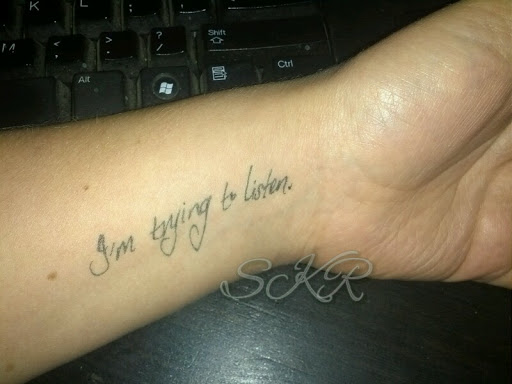
There’s good days. There’s so many good days, things I’m excited about, new hopes and dreams. How quickly we begin to speak the language of the daylight, to conceal the wounds, to deny the pain that lingers. I’m trying to listen. I’m still here. I’m looking for self compassion beneath the fear. I don’t want to go down. I need a better way through this. I’m looking. Ink, not blood.

Should we be afraid of mental illness?

Being a peer worker in mental health I’m often caught in a certain tension between the reality of my own experiences, and the ‘party line’ I often feel a certain pressure to toe. One of the areas this occurs in is the many current efforts to reduce the stigma associated with mental illness.

A couple of years ago I listened to a presentation about research and psychosis that was very interesting. After the talk, I asked the presenter what I, as a ‘consumer’ could do to help. He told me that research indicated that stigma reduction campaigns that relied on increased education actually often backfired. Giving people more information about the nature of experiences such as psychosis sometimes just gave people more information about something they were already really frightened of. What did help was humanising these experiences. Putting a face to these conditions helped people to see that we are still human, that we are deserving of care and dignity, and there is so much more to us than ‘illness’. This conversation was one of the motivations for my passion for peer work.

Currently I’ve been aware of an attitude I feel I’m supposed to express, along the lines of “Mental illness is nothing to be afraid of”. Slogans like this are really difficult to get right, because you are trying to sum up a huge concept and idea into a phrase. This is like trying to communicate advanced physics concepts through haiku. It takes rare talent!

I get where this idea is coming from.

I just find it difficult to subscribe to.

I live in a funny corner of the world where most of my personal networks are peopled with people who experience, or support someone who experiences, a mental illness. In my world, issues are the norm. This is cool, I prefer it. I fit in, I get the people, we speak our own shorthand language, complain about sleep deprivation, are sensitive about touch, navigate life with a painful awareness of our own vulnerabilities. I get that the idea of telling people not to be scared is what I’m trying to communicate when I give mental health talks and say – so, guess what, I have multiple personalities and none of them are axe murderers! It’s what I’m trying to say when I give talks about voice hearing and try to get across the message that we are not some strange, terrifying, alien species; we are regular folk, who happen to hear voices. What we’re all trying to say with messages like this is that common myths about violence, insanity, psychopathy, do us harm. They’re needless and harmful fears. They alienate and damage whole groups of our communities, leaving them alone with their demons, without help or comfort. Mental illness is nothing to be afraid of.

Here’s the other side though, I know what it’s like to be suicidal, constantly, deeply, permanently thinking of death. I know what it’s like to be afraid of myself. I know the shame of waking up and finding fresh self harm wounds. I know the misery of panic attacks, of ‘ugly days’, of ‘non-food’ days. I care deeply for others who battle things like this. I’ve been the full time carer of someone who spent 6 months in hospital in a state of intense emotional distress and a constant drive to die. I’ve cared for friends who cut, or starve, who hate themselves, who experience paralyzing depressions, horrific trauma stress, chronic nightmares… To tell you the truth, ‘mental illness’ our strange, impersonal term for so much hurt and suffering, scares the hell out of me. I don’t want it, and I don’t wish it on any of the wonderful people I care about. Watching people you love suffer, watching the cycles, the decent into their own personal hell, it’s terrifying, and it’s painful.

Here’s the thing, the people are nothing to be afraid of. They’re still people. If they were assholes before, I doubt that a mental illness has improved matters. If they were decent people, in many cases it makes them difficult to live with, but not dangerous. There’s nothing to fear from them. There’s much to fear for them. And even there – there’s hope. There’s paths through these things. There’s ways to reduce their impact, to limit their capacity to destroy lives. People change, grow, heal. It’s not a life sentence. Mental illness isn’t the grave of all our dreams for our lives.

But people suffer. And people die. You can’t work in this field and not be aware of it. The situations some families are living in is horrifying. When we paint a rosy image, when we put photos of calm, happy, beautiful people on our banners and pamphlets and say – mental illness is nothing to be afraid of, we deny the reality of a lot of people who are suffering terribly. Their pain is devastating and it is something to be afraid of. Not the kind of fear that paralyses, the kind that makes us speak up about better resources. The kind that makes us research our options, get help early and get good help, look after ourselves, stay connected with our mates, fight stigma and discrimination, count our blessings.

People are suffering, and people are dying. I think it’s okay to be afraid of this. I think that in the face of this fear, we chose to act and live with courage.

Quietness

This morning I remember things I had forgotten. I remember that when we are hurting, and try to be strong, everything becomes brittle, frantic, and broken. I remember that fears we are too afraid to voice, those that stick in the throat like fishbones, they tears holes in us, through which strength bleeds. I remember that if I do not try to hold off the storm, but bow before it, speaking truths that burn my throat and blister my tongue, then it passes. It passes and I find mornings like this. Waking late, to a white sky and the wind gentle plaiting and unplaiting the slender branches of the tree outside my window. My hands feel like doves, laid gently by my face in rest, in my lap in wakefulness. There’s silence and thoughtfulness, my mind moves gently like a woman combing the beach after a storm, lifting a shell here, a branch of wood for the fire. I drink tea and eat porridge, and in their simpleness there is a peace. No more the screaming excesses. The burden has passed, the pain has eased.

Today I shall do what I can and no more. I shall work with my hands to make my world whole, to sew up the tears and sweep out the shadows that cloy at the mind. I had a nightmare, and it came over my face and my eyes, it screamed and would not stop screaming. I screamed within it and my world went dark, full of fire and fear. It bound me a future I could not bear, to a fate that twisted me, a destiny that compelled me to become a twisted thing. Such is the burden of those who have been wounded as I have, such are the shadows that follow at our heels. When we name them truly, they run from us, for a time. Today I can see clearly. There’s a wind in my soul, a peace in my heart. All is as it should be. I rest my heart in the hollow of the hill.

Safe Sex 4. Take Your Time

There’s a lot of skills involved in the process of making sex emotionally safer, particularly for those of us who have experienced relationship violence, or sexual abuse, or emotional abuse about our appearance or bodies. We need to learn how we work, what we need, where our own limits are. It’s a process of trial and error to find the line between anxiety that’s background noise and anxiety that needs attending to. It also takes time to learn how to communicate about things like ‘please don’t touch me that way, I like to be touched like this’ or how you can best be supported during a flashback. It takes time to learn how to communicate about your needs and preferences. There’s often pressure to ‘finish what we start’, but when there’s stress about sex this pressure isn’t helpful. Building all this self awareness, ability to communicate, and sensitivity to your partner takes time, attention, thoughtfulness, and dedication. 

Breaking the experience down into smaller components can help to keep the stress manageable. So you have a partner and you’re both keen to have sex but one or both of you is really stressed. Moving very slowly gives you both time to get used to each other, to take in the experience, to learn what is and isn’t enjoyable. Maybe you start with massages or with sleepovers in pajamas. One night there’s some skin to skin contact, hugs and kisses. Another night there’s nakedness. No sex, just nakedness. Getting comfortable with each other, with being seen, with seeing. Maybe you shower or bathe together, or cuddle under a blanket and watch a movie. Maybe you ask what they think of your body, or show them your scars and tell the stories about them. You experience intimacy as safe, as something you control, where you have rights, where your feelings count, where nobody makes you do anything you don’t want to, where nobody treats you with anything less than respect and care.

You also have a chance to see how you and your partner cope in the charged space of physical intimacy. Some people don’t handle this space well, it’s intense and deeply personal and they’re not comfortable with it. Sometimes otherwise decent and caring people react badly in this space, they snipe about you or belittle you or intimidate you or pressure you. Sometimes you may find that you are not handling it well and are doing or saying things you wouldn’t otherwise. Moving slowly gives you both a chance to see how safe you are about sex. It gives you time to see whether you can handle their anxiety graciously or if you get angry with them about it. It gives you time to see if they are safe to be naked and vulnerable with or if they will make humiliating remarks about your body. It also gives you an opportunity to see how well your communication, negotiation, and boundary setting skills hold up. Sometimes you find that you may have a superb skill in one area of your life that seems to go completely missing in another area.

There are some dumb ideas about sex floating around many cultures. One of them is the idea that you are innately good or bad at sex. You find someone, have sex to see what it’s like, and are either excited or disappointed by it and nothing can be done about that. New couples are often under pressure to have sex and share the details with friends. Newlyweds in many cultures are expected to go from minimal physical contact to sex overnight, with little to no education or support or chance to become comfortable with each other. Sex that is safe, loving, enjoyable, and fun takes skills, and skills take time to create. It takes time to learn the needs of a partner, and it takes maturity to be a safe and sensitive partner. Sometimes there’s a gap between how we want to be and the skills we currently have. We love the idea of being caring and supportive about our partners physical disability, but we’re scared to death we’ll do or say something wrong and instead come across as defensive and uncaring.

Time isn’t seen as sexy in our culture but it can be just what you need to blossom into a wonderful sexual partner, and to make sure the person you’re thinking of having sex with is safe and trustworthy. There’s actually something deeply erotic about languid afternoons in bed giving massages and talking through things that make you nervous without any pressure. When you prepare the context so well, sex when it blossoms can be amazing.

Time can help make things safer, but there’s also a place for jumping in and I don’t want anyone to think I’m judging those who find that approach empowering. Sometimes the opposite helps us, there’s a wall of terror between us and sex. Some of us dismantle it brick by brick, some of us pole-vault it. Whatever helps you navigate your stress is a good idea, with two caveats – that you’re not setting yourself up for bad experiences (see, I knew all women were heartless, or men are brutes, or whatever), and that you’re not harming anyone. My observation has been that even those who find pole vaulting more to their nature often need to come back and kick a few bricks out of that wall at some point. It’s much easier to have sex without the hangups that stress us out, than it is to keep having to find ways around them. Give yourself permission to take your time to make sex safer and as the things that are stressing you get resolved sex can feel less like a 3 mile crawl through barbed wire on the promise of something better up ahead, and more like a soaring inside, a desire that calls you on and draws you towards another person.

This article is part of a series about emotionally safer sex. Try also reading

Safe Sex 3. Bringing down the Stakes

If stress or anxiety about sex is intense, then ignoring that and going ahead anyway can make sex emotionally unsafe. The stakes are very high under these circumstances. Some stress is okay, it can co-exist. Loads pulls you into a place where you’re not listening to yourself or keeping yourself safe when all your internal sirens are screaming. You may be safe – with a loving person you trust, in a beautiful safe environment, in a situation where you are very keen to have sex such as a night away you’ve been planning together. But if you’re screaming with distress inside and not doing anything to settle that, you’re at risk of blowing your circuits – whether that’s through a big overload like a panic attack, short circuiting through major dissociation and numbing, or a subtle effect such as exhaustion from working so hard to suppress such strong emotions so often. Being overwhelmed emotionally makes it harder to connect with and be sensitive to your partner, and often more difficult to focus on the moment and feel pleasure. Anything that is experienced as a failure to protect yourself or a betrayal of yourself is risky.

What brings down the stakes? It depends on what things are driving your anxiety. It might be one thing or a whole knot of them. A lot of what drives up the stakes in sex are when we are using it to answer a whole bunch of questions about our lives – Am I too damaged to have sex? Are they really attracted to me? Is our relationship on the rocks? If I really want it does that make me a slut? Does not liking this particular thing mean I’m weird? Am I ugly? Marty Klein goes into this in excellent detail in his book Sexual Intelligence. His assertion is that sex is about pleasure and closeness. Everything else you can’t answer through sex – you have to work it out in your head, with your shrink, a good friend, or by talking it through with your partner. You bring down the stakes and help sex to be safe by getting back to those two things – pleasure and closeness – and clearing the rest of the clutter out of the way.We stop having sex, or wind up having sex that doesn’t feel safe or good when the stakes are too high. If you’re terrified your partner won’t like your body, or won’t be comfortable with your disability, or will be hurt if you ask them to stop, or might have a panic attack… if there’s a whole bunch of ways you feel like you could ‘fail’ at sex, and the outcome would be really painful – rejection, distance, an argument, embarrassment, then sex is scary. It doesn’t take many of these experiences to shut us down. People are left thinking longingly about how wonderful sex might be, but bitten once and twice shy about how painful it can also be. Even between caring partners, when the stakes are high, sex can be lonely, depressing, humiliating, and miserable.

Part of what’s raising the stakes is this idea of failure. Sex is not a sport. You don’t win or lose at it. This is another area Klein explores in his book, and something I found very useful to think about. It’s worth thinking your ideas about what sex is ‘supposed to be’, and what ‘failure’ means to you. If you can expand the first category, and collapse the second, you bring down the stakes. If there’s lots of ways sex can happen that are good outcomes, and the idea of failure is reduced to the Big Deal stuff – coercion, manipulation, belittling, cruelty, then sex becomes a whole lot safer. If you can’t fail through any of the things that make you anxious about sex – your appearance, ‘performance’, confidence, stamina, and so on, sex can become something fun to explore instead of a stressful ‘moment of truth’ where you succeed or fail. If you can’t fail (because you’re not about to harm your partner) then sex isn’t risky. You can go chasing that good feeling and that closeness, and however it works out it will be okay. The stakes are back to something manageable and the outcome isn’t so potentially frightening.

This has been a helpful concept for me, and now whenever my anxiety spikes I think about what’s raising the stakes for me and what I can do to bring them down. Some really helpful conversations have come out of this and I’ve been able to ease that frozen place inside me and find lightness and joy. Bringing down the stakes feels like being able to breathe again, being able to fly again. It brings me closer to delight and helps me to nest sex into a space that is very safe, very intimate, beautiful and fun.

This article is part of a series about emotionally safer sex. Try also reading


Safe Sex 2. Expectations

You don’t need to have a completely perfect stage set for sex to be safe. There can be awkwardness, embarrassment, anxiety, body memories, little flashbacks, all going on like background noise. It’s okay to be aware of them and still be following that thread of desire. You don’t need a completely empty mind, free of memories or triggers to have sex that feels safe, loving, intimate, joyful, and amazing. These things can all co-exist. I think a lot of us trauma survivors don’t get this idea. We feel – dirty – damaged – soiled. We think to have good sex we have to get back to something resembling ‘purity’. We work very hard on ourselves hoping to get to a place where we have eradicated our past. It’s devastating when it intrudes.

It doesn’t need to be like this. Ever had great sex while you were injured in some way? A twisted ankle or stitched up hand or just an elbow that was protesting because you’ve been leaning on it for too long? There was pain – in the background – not intense pain like a migraine or calf muscle cramping, but there and present. Then there was also pleasure, in the foreground, consuming your attention. They can co-exist. I live with a chronic pain condition so this something I really understand. It’s the same with emotional pain, with memories and anxiety. If they’re not intense they can be background noise. If they become intense, they need some attention.

The form this attention takes might be as simple as changing what you’re doing because the anxiety has become high or body memories have become strong and confusing. I get this problem, sometimes they’re so intense that I can’t work out anymore what’s happening now and what is just a memory. (or to use the clinical terms – a tactile hallucination) So I move away from touch in that area and find somewhere else that feels nice to have touched. Sometimes those of us who struggle with stress about sex find that some things are higher risk than others – things that make you feel exposed, or feel trapped, or new things that make you feel uncertain and so on. Sometimes you may find that there are certain positions, acts, and locations that can become your safer sex to retreat back to if you’ve tried something else and become stressed.

Sometimes it means pausing for a little while to settle whatever has been stirred up. This isn’t a bad thing – it’s a chance for healing. Having feelings and memories come to the surface gives you a chance to address them and to break cycles of ignoring and depriving yourself. This time everything stops the moment you want it to. This time you can ask for non-sexual contact while you settle. This time you wont be hurt, ignored, or abused. Maybe you realise that a certain touch is making you struggle, or that the music on the radio is triggering you.  If your stress isn’t about abuse, this is a chance for growth. You have a clash between some things you believe (such as sex has to be perfect, or that you are ugly, or that you’re not good at sex, or that you’ll be rejected by your partner) and what you want to experience. You’re giving yourself a chance to develop a different way of approaching sex and navigating the stress. Maybe you sit together and talk for a bit. Maybe you put things aside for that night, or only for 20 minutes while you settle. Maybe you go watch a DVD or find some icecream in the freezer. There’s no rule that says sex has to happen all within a certain time frame. There’s nothing wrong with breaks to get something to drink, empty your bladder, change the CD, find a snack, have a giggle or a cry, get a hug, and start again later. This whole experience is intimacy, safety, and care. Our culture has a very crude idea of what constitutes sex, but it doesn’t have to be broken up into a single act like that. Sex can be woven through the whole evening, it can be the back rub when you have a cry, it can be your partner ducking to the shops for a new packet of condoms, it can be you understanding that a shower will help them feel more comfortable or that keeping a sheet over them will make them feel safer. It doesn’t have to be perfect to be safe and wonderful. You don’t need a perfect body, you don’t need ‘movie sex’ where no one gets the giggles, or drops anything, or farts, or needs to rush off for a pee, you don’t need an entirely clear mind. You can have trauma issues, anxiety, and all kinds of mental health challenges that may certainly complicate sex as well as the rest of your life, but if you can make a space in your mind to accept that your sex life will include having a panic or needing to stop or lots of showers etc and that is okay! then you can work to create a safe space to have a  good sex life.

This is part of a series of posts about emotionally safer sex.

Safe sex 1. Checking In

I want to put aside for a moment the important considerations of STI’s, unwanted pregnancy and so on, and share for a moment some thoughts about making sex emotionally safe. I find myself having a lot of conversations about sex at the moment, partly because I’m very frustrated by the lack of these conversations in mental health! I’m not some kind of expert. I’m certainly not someone who has everything together. In fact, my knowledge base and my passion for this topic comes from being a person who’s had some terrible sexual experiences, huge distress about my own sexuality and identity, and who has big struggles in this area. I’ve gone into sexual health counselling to get support through accepting myself, coming out, learning how to navigate my distress, and my first gay relationship. I’ve very carefully ended many years of voluntary celibacy because I finally felt that I had enough tools and had done enough work for this to be a positive experience. I’ve read a lot of books and done a lot of talking and thinking. I’ve also done a lot of listening and what I’m hearing distresses me.

I’m hearing a lot of confusion, pain, grief, and resignation. I’m hearing people who do not believe it is possible to ever have good sex after rape or abuse. I’m hearing people who do not believe sex can be anything other than a manic, shame-based compulsion. I’m hearing massive anxiety about how to communicate about sexual things or during sex. I’m hearing people who feel stuck with sex that is empty, painful, lonely, violent, or emotionally abusive. I’m hearing people who feel broken, scared, ashamed, repulsed by themselves or their desires. People who feel rejected, guilty, beholden, that they ‘owe’ sex to their partner, and that they are failures. I’m hearing people for whom sex is a secret topic of personal torment and misery.

So I want to talk about it. I want it not to be secret anymore. I want to challenge the mental health system that pretends these are not important issues for us. I want to challenge those terrible fears that for such as we, the ruined ones, there is no possibility of a healthy sex life. When I’ve talked about the idea of emotionally safe sex, I’ve had people tell me there is no such thing. This breaks my heart. I want to tell people this is not true.

I’ve done a lot of thinking about the ways I’ve worked to make sex emotionally safer for me. I’ve been able to come up with a specific set of ideas I want to share in case they’re useful to someone else. There’s a few of them so I’ll break them up into different posts. The very first one is how you make the call that you’re going to have sex.

1. Checking In
Think about the ways you’re assessing whether you have sex. You’re checking in with yourself, noticing how the idea makes you feel. You’re probably asking yourself questions inside your mind. This is a great process to use to work out what you do and don’t want. For some of us, this process of checking in with ourselves is quite long and thought through. For others of us, it’s a split second instinctive glance at some internal alarms just long enough to notice that none of them seem to be screaming. For some of us, we’ve been trained through trauma or abuse that our needs, wishes, and preferences don’t matter, so we’ve never really developed the skill to do this check in with ourselves in the first place.

Babette Rosthchild’s book 8 Keys to Safe Trauma Recovery has a chapter about developing this kind of check in skill to help you make decisions. If you’re feeling in the dark about this skill you can borrow it from many libraries including my own. For those of us who have some capacity to do this, I’d still suggesting fine tuning the process a bit. For example, if you’re trying to decide if you want to have sex, try picturing in your mind the details of your choices – in this place, with this person, in this way, and see how it makes you feel.

Pay attention to the kinds of questions you may ask yourself during this check in. I noticed a little while ago that my standard internal question when making this decision was ‘Can I handle this?’ – a question clearly born out of my own trauma history. Answering ‘yes’ to this question does not make sex safe! It doesn’t mean I want to be involved, doesn’t mean I will enjoy it! In fact it’s a set up for high risk sex – the kind that often leaves me feeling lonely, scared, or empty, even with a loving partner. I’ve changed this question now – to ‘What do I feel like?’ I may be feeling anxious but there’s also that impulse to kiss that soft skin in the fold of their elbow, or that hope that they’ll take off my top. If the anxiety is low I can follow these impulses.

The questions you ask yourself are a powerful way to set you up for safe sex or risky sex. Learning to check in with yourself is also part of how we follow our own pleasure. It’s not something to be done once at the start of things, it’s an ongoing process of listening to ourselves and noticing what we do and don’t want or like. People who are stressed about sex can be so numbed, so anxious, so overwhelmed by what’s going on in their mind that they can’t feel what’s happening in their body. Checking in is about noticing that this kind of touch makes your skin tingle, or that your knee is starting to get achy and needs to be shifted. Being focused on your feelings is how you will discover what you like. It’s a good skill to work on.

Checking in only really works for us if we have the ability to follow what we want and need. If we know we don’t want something but we can’t say no, there’s a miserable sense of betrayal and failure that only adds distress to a situation we didn’t want in the first place. It takes strength and commitment to notice how we feel and act on it – whether that’s saying “I don’t feel like this”, or saying “You look amazing tonight, can I kiss you?”. But it all starts with connecting to yourself and noticing how you’re feeling, and asking yourself what you feel like. It’s also really important to check in with your partner and find out where they are at, even if you are ‘the one with the problem’ in your relationship.

This article is part of a series about emotionally safer sex. Try also reading

Flour on my hands

I’ve had a good day. Which is especially nice as my life has been rather up and down lately. I’m writing now in the peace and quiet of the early hours of the morning. I have a load of freshly washed laundry hanging about the house and smelling clean and wonderful. I’m showered and enjoying actually being able to wear my warm winter robe as the weather has been perfectly cool today. Sarsaparilla is being smoochy and trying to head rub my keyboard. I’ve washed all my dishes and my kitchen is clean. My dining table is clear, my bedroom is tidy, the study room has been sorted.

I cooked today. I’m so pleased, it’s been ages since I cooked. By which I mean something more complicated than toast. I made ham and zucchini pasta for dinner, and brownies for dessert.

It’s been an erratic start to the year for me. The past couple of months have been tiring and challenging. My fibro flares quickly at the moment so I’ve been in a fair amount of pain many days. I’ve also been anxious and stressed. A lot of my friends have been struggling with their mental or physical health, I’ve been rocky and getting overwhelmed. Some nights are pretty peaceful with decent sleep, others have been terrible. My girlfriend told me recently that sometimes when I’m having nightmares, I moan in my sleep, recoil if touched, and weep. That’s the saddest image in my mind, it seems so lonely to be crying in your sleep, sailed out in a world of dreams, beyond comfort.

I had such a rough day the other day, I worked out afterwards that I’d spent 7 (non-consecutive) hours in a 24 hour period crying. Some days everything is too much. I’m tired, tired in my aching bones, tired in my soul. There’s no strength left in my spirit, no hope left to light my lamps, no inspiration in my hands to paint or sculpt or tend. There’s yearning and grief and fear for my future.

So I cry. I hurt, weep, curl up in bed and hold my broken heart in my hands. My tears, they slowly dull the edges of the broken glass in my chest. I cry the despair out of me. I speak the black things that are gnawing on my bones, that have teeth sunken deep into my heart. Desperate to be hopeful, to be bright with joy, to be at peace in the dawn, I name my demons instead. I still my hands, I let the depression take me. It’s a blessing. It keeps me safe, the lethal lethargy eases me from frantic need. I seek no relief, blades do not tempt me, the sirens of death are far off. Here is just the frozen despair, the paralysing sense of inadequacy, the raw, overwhelming awareness of pain.

Then the tide goes out and the fire dies down, the pain ebbs. I get a day like today where I wake and my mind is quiet and clear. The rain falls softly on my face, washing away self-loathing, easing the grief. I walk without pain. There’s no burning in my skin, my eyes don’t throb, the knives that were in my muscles have fallen out overnight. I can dance. I can dream. There’s delight in simple things. I watch a favourite French movie (La tete en friche), I get flour on my hands, I let the rain scented air into my home. And it’s okay again, it’s okay, I remember life’s sweetness, I remember the songs of the little birds in the morning.

Poem – In The Paper Moat

In bed
I build
A little fort of books
To keep away
The bad dreams
And the memories.

My paper moat
Is filled with people of courage
Compassion
In the face of brutality
Wisdom,
Patient rage,
Love-
All the things that are monsters
To the monsters that hunt me.

Here I lay, naked
In the dark, and alone
But not without defence
My authors speak on my behalf
When I am lost with weeping
They shape the dark
Give it name
Whisper to me
The limits of its lies.

Recovery from Trauma – Touch

This has been a huge area for me, one I’ve had to re-negotiate throughout my life so far to try and find something that works for me. A lot of us who come through interpersonal trauma – where other people hurt us, are left with major struggles about touch. For me, I found that I’ve suffered when I’m touched, and I’ve suffered from being touch-starved. If you imagine for a moment that in your mind and body, there are three basic types of touch that you register and react to. One is touch that makes you feel good – a little baby holding on to your finger or a kiss from your lover or a hug from a friend. The next is touch that makes you feel bad, such as being hurt or invaded. The last is neutral touch, that doesn’t make you feel good or bad, inconsequential things like sitting against someone on the bus or brushing hands with a checkout operator handing you your bags.

I found this last category of touch collapsed completely for me and has been by far the hardest to get back. When I’m really struggling good touch goes too, but a lot of days when I can still enjoy good touch I can’t cope with neutral touch. I’m very sensitive to touch and it’s like my brain can’t work out how to handle neutral touch and does a very basic ‘what kind of touch is this?’ assessment that goes

    1. ‘does this feel good?’ 
    2. ‘no’ 
    3. right then – ‘BAD TOUCH’

I’ve had to talk myself through re building a sense of neutral touch. It rests on feeling reasonably safe and calm, and for me at least, part of a community. Strangers don’t bother me if I am feeling content and like we’re all just people. Being able to cope with neutral touch is an important key for me to cope with medical and dental appointments, travelling on public transport and in lifts, accessing crowded places, using supermarkets – basic functioning in life.

Touch is actually a crucially important aspect of being human. Newborns need touch after being born. Untouched, they will simply die. Touch changes us on a physiological level, massages support immune function and health for example. Touch is crucial in attachment, in bonding, and in social connection. Touch communicates affection, loathing, power, or love.

As a child and teenager I was ostracised and bullied at school. Touch became a key issue. I struggled to define moral responses to abuse and contempt. I developed a basic set of parameters – that until another person touched me, I would manage the situation verbally. If they initiated contact physically, then I would defend myself physically. It became generally known in the school that I was not to be touched. This decision was to some extent effective in that it relieved me of the chronic anxiety and distress around how I was to respond to relentless bullying. However the unintended downside of this was that I struggled alone, untouched and without comfort. Following a major trauma I was diagnosed with PTSD and in that space – traumatised, alienated, chronically suicidal, and devoured by nightmares, my world without touch became surreal and terrifying. I craved touch, longed to be hugged, my self-made wall designed for protection left me free-falling, alone and outcast. I no longer felt part of the world or of humanity, without touch to connect me. With no anchors, I floated into surreal dissociative states, feeling unreal and chronically numb, punctuated by intense fury, distress, and self loathing.

A few years ago, I turned up to the Mental Illness Fellowship SA activity centre. My life had burned down and I was extremely isolated at the time. I sat on a couch, nervous in a room full of strangers. Someone sat down next to me and I concentrated on not flinching. As I sat there stiffly and awkward and silent, the whole side of my body next to the stranger began to warm. This yearning for contact came unbidden from deep inside me and I realised how solitary my world had become. The loneliness was profound.

Touch is powerful, and for some of us, touch has been withheld and we have starved without it, or touch has been used to wound us and now we struggle to define our relationship with it. Touch often defines power in our relationships – I’ve felt trapped at times with people who refuse me the right to withdraw from touch I do not want. I’ve become more assertive these days as I’ve discovered that if I protect my right to control touch, then my relationship with touch becomes less ambivalent and stressed. My good friends know to check before hugs, and not to take it personally if I don’t want to be hugged that day. Likewise, I do this for them. Because of this, touch has more and more of a place in my life now, which delights me.

People who don’t get this and fight my right to choose who and when and how I am touched are usually excluded from my networks. Some of them are simply bullies. Some are too naturally dominating to consider someone else’s needs. Some are under the illusion that if they impose touch upon me, I will ‘realise’ that it is safe and my boundaries are silly and unnecessary. Some take a preference not to be touched as a personal insult to them. The occasional few are sadists who enjoy touching someone who clearly is uncomfortable with it but lacks the social power to tell them to stop. I have a strong commitment in my life now; that loneliness is better than torture. People who don’t respect me, don’t get close to me.

Developing that power and honouring that need to protect myself has given me a lot more freedom. If I trust myself to protect myself (and my system trusts me to protect them – no accepting hugs if they’re screaming inside me) then suddenly neutral touch isn’t such a big deal. I’m not small and powerless any more, I’m a member of the community. I have a voice and I can take care of myself, which means I can engage. I don’t have to hide, or run, or fight. I can be part of the world when I want to. I talk about the mental flip from seeing other people as inherently dangerous to just regular people in my article Using Public Transport. Here’s an example:

I was on the bus the other day and a man was standing in the aisle next to me when I noticed that he had a big mop of long fluffy white cat fur stuck to his nice dark pants! I suspect he has a lovely white persian cat at home that had been sleeping next to him on the couch. It suddenly flipped how I saw him – from being a threatening man standing too close to me, to just a regular guy with  a cat and not someone to be afraid of.

I crave this freedom. When the PTSD is too bad for me to handle crowds, strangers, confined spaces, being a passenger in someone else’s car, being out after dark, having other people in my home, being touched, new environments, loud environments, and so on, my world is very small, very painful, very lonely. I hate this place, it’s like being in a coffin.

There’s a thrill to being able to reclaim my place in the community. The more I protect myself and make myself feel safe, the more ‘risks’ I can take, like going to a concert I love. As I learn to reclaim touch it helps me manage experiences that typically are nightmares for me – like dental or medical appointments. It also frees me to have the ability to offer touch to someone else in need, to give a hug to a friend who is struggling or hold the hand of a psychiatric patient who is confused and distressed.

Touch is powerful. It can be my biggest trigger for anxiety and dissociation, such as when I get hugs following my talks at big conferences (see The Voices Vic Conference). It is also one of my strongest grounding techniques during anxiety attacks or major dissociative episodes. It’s a powerful way of communicating between people – acceptance, or rejection, affection or loathing, mutuality or domination. If touch is an area that has been damaged for you too, you can change how touch works in your life. You have the right to use it as a tool, to protect yourself from it, to seek out good touch, to be aware of the messages you send and accept through touch. There are more, and better, options than being touch starved or having to put up with touch that you find distressing and disempowering.

Relationships and trauma

One member of a relationship with a trauma background is a challenge. For the non-trauma partner, there is the hurdle of trying to understand and connect with experiences and reactions that are difficult to relate to. Applying the kind of personal wisdom that helps you get through less extreme situations, such as ‘just get on with it’ can cause a lot of stress for people who are struggling with severe after affects of major trauma. There’s two languages being spoken and a lot of work has to be done to get the translation working well and calm the anxieties of both parties. The person with the trauma background often feels ashamed, worried they are too much hard work, scared to trust, scared of being left, worried they’re making a big fuss about nothing, scared of turning their partner off, or of being pressured, that being vulnerable will engender disgust, or that being cared for will make them weak… The non-trauma partner often has anxieties such as wondering if their partner will ever come back from this world of trauma reactions, scared of saying or doing the wrong thing and triggering them, scared of not being strong enough to handle what they’re going through, scared of getting stuck having to care for them, anxious about their moodiness, unpredictability, mania, depression, or temper, anxious about leaning on them too much for day to day issues, and so on. Both partners can easily feel very alone, misunderstood, unsupported, under pressure, and afraid. It takes love, commitment, and skill to navigate complex trauma. I talk about this more in Supporting someone after Trauma.

Two of the biggest issues I observe about this kind of relationship is the difficulty communicating – eg. If I say to a friend who is a fellow trauma survivor or has a mental illness that I’ve had a rough week – they usually get what that means. We’re speaking the same language. Outside of that world, I find I have to spell things out much more strongly. To other friends I may have to directly explain that I’ve been in a self-harm crisis all week and haven’t left the house, or indeed, my bed. The other major issue I see a lot is the risk of the carer dynamic. Having a relationship polarise into the well one and the sick one, the strong/weak, the giver/receiver, the provider/needy can be very destructive for both people. That’s not to say that caring for a partner in distress is not a deeply beautiful and loving act. But rather that those dynamics come with risks that need to be navigated. I talk about this more in Caring for someone who’s suicidal.

Having said that, these relationships can be powerfully strong. The person with the trauma background learns to communicate about their needs and experiences, and has the experience of developing trust, being comforted, and having someone walk with them through their pain. The person without the trauma background learns the nuances of trauma language, how to be with someone in a very painful and vulnerable place, learns to connect more deeply in that very privileged space. These bonds can be strong, having worked hard to build language and connection and safety and fairness, powerful healing and hope can be created.

There’s another kind of relationship with different challenges, and that is where both members have a trauma background (or to a certain extent, a mental illness). Survivor/survivor pairings are not uncommon, and while some issues remain the same – such as feeling alone, others are quite different. I’ve been with my girlfriend for over three months now and it’s been an intensive time of sharing, learning, and finding ways through obstacles. We both have trauma histories. At times, those histories are in the far distant past. At other times, they are painfully present through flashbacks, nightmares, body memories, sensitivity to triggers, and so on. There are advantages in that there is a more common shared language. There’s less work to try and explain what these things are or what they feel like. There’s also more role swapping between who cares and who receives care depending on whose need is greatest at the time. But with this compatibility comes other risks – both are wounded people with needs and limitations. Sometimes the particular vulnerabilities create a painful feedback loop where nightmares in one trigger nightmares in the other, where dissociation in one feeds dissociation in the other and so on. Sometimes both parties are more comfortable giving than receiving care, or vice versa, and struggle to develop skills across both roles. Sometimes competitive comparisons of trauma lead to one person being invalidated and silenced because their experiences are not seen as significant. Sometimes the trauma bond is so intense two hurt people merge into one enmeshed person and neither keep growing back into whole separate people. Sometimes the needs brought into the relationship exceed the capabilities of the relationship. There’s risks.

A big part of the key of what seems to be working for us is being aware that there are a lot of ways our relationship could founder, and talking about them. We know that love is essential but also insufficient. There needs to be enough skills, mental health, and support also. We know that we cannot be ‘enough’ for each other, we need outside supports – friends, professional support. The brutal reality is that with trauma comes limitations. There are times we cannot be there for each other. We are going to let each other down. But there are also skills. People survive different kinds of trauma by developing different skills. Those of us who are more fortunate have a good match between our innate talents and the kinds of trauma we were subjected to. In my case, I’m sensitive in relationships. I read people well. I’m good at helping stressed people to feel safer. (this isn’t some kind of superpower and certainly doesn’t work with everyone) I’m a good communicator. The very history that leaves me with the limitations and vulnerabilities that make it more likely my close relationships will fail, also leaves with me the kinds of skills and capabilities that strengthen and support relationships. Survivor/survivor relationships can also work very well, with deep connections and strength and humility and respect.

We can’t know that our relationship will work out, we can only gently and lovingly build good foundations and try to create safe exits if things become dangerous or destructive. We talk of the future, about hopes and dreams together. We also talk about how to break up the least traumatically if we need to, how to ask for time apart, how to help during a bad night, what our biggest triggers are, who else we have permission to talk about each others past with, how to get through if we’re both in a bad space. It’s not a guarantee, but here and now it’s creating something beautiful and meaningful. There’s safety, awareness, freedom, and love. Trauma takes a lot away from all of us, but there’s still hope for our dreams and things we can do to make that hope stronger.

Shattered

There’s a deep, miserable despair when you’ve been pushing yourself hard, finally get some time off to sleep, and find yourself snatching only hours before nightmares shake you awake. A psychological ambush (just when you thought it was safe to go back in the water) places that should be safe (bed, sleep, your own mind) turn out to be full of monsters. It’s exhausting. Here in the night you remember that you’re wounded too, and without the day, without the structures of the day,the frameworks and suggestions and strategies that belong to the daylight world, there is instead poetry and terror.

There is no betrayal yet I feel betrayed. That rest does not await me, that I do not sleep the sound sleep of the innocent, that there is more to ask of me yet and more to endure. But this is the place where I go to the underworld, and mine is stuffed with nightmares and horrors. This is the price to pay for the daylight hours.

I’m dating :)

It’s been a mammoth week here for me, and with 2 exhibition launches this week and a major sculpture project due on Monday… it’s not going to ease up anytime soon. It’s getting challenging to find time to write the blog! Over this last week I’ve had the wedding of two dear friends (to each other), a friends mental health crisis, vandalism happening around my home, and I’ve officially started dating a wonderful woman I first met in the online dating scene. We’ve been talking and catching up for almost 4 weeks now and we’ve just done the big status change on facebook. 🙂

Needless to say, I’m feeling slightly dazed! On top of the world, anxious, excited, exhausted, frustrated, happy… I think I’ve hit every emotional note and then some this week.

Dating as a multiple is complicated. My girlfriend knows of my situation and we’re doing a lot of talking. I’m learning a lot and my system is adjusting to the new circumstances. I’m working on foreseeing and avoiding at least the obvious possible problems (such as leaving the other person feeling rejected when some parts need time to themselves), and discovering that being a multiple in a relationship doesn’t all have to be trauma and downsides… in fact it can be fun, silly, enjoyable, slightly bizarre, and always interesting! There’s a lot of role swapping and different kinds of bonds being formed as different parts turn up to say hello.

So, that’s been my week. Off to The Knack tonight, hope your week is going well!

Adaptation and Control

The capacity to adapt is one my strengths, and it’s a very common one for dissociative multiples. Chameleon like, we often switch to new parts to manage new environments or situations. People who are rigid and inflexible in the way they approach the world usually struggle during times of change or through experiences of trauma. Adaptation has tremendous power to help us navigate complex circumstances and draw upon different personal attributes in different situations.

However, too much adaptation can become destructive. This is something I have really struggled with. The metaphor I use is of having my feet welded to railway tracks. I am not a free agent who can go where they wish, rather I only travel the tracks laid out for me. What this means practically is that I can really struggle to run my own life when I’m stressed. I lose my capacity to initiate anything. I am adept at coping with adapting to what other people around me choose to do, but making choices of my own has been very challenging. I’ve worked very hard to manage these problems and feel more in control of my own life.

For me, I spent a great many years in various stressful situations where I could not escape, and I could not control what was happening. I did not have the power to make major decisions about my life. I could not choose where or with whom I lived, not to go to school, or to influence any of the decisions the adults in my life made. Because many of my experiences were traumatic, this basically trained me that life is something I adapt to, not something I control. I try to carve enough breathing room from the space that is left after everyone else has made their choices. I have been conditioned to be compliant (or passive aggressive) rather than free.

As an adult, this is a useless framework. It severely limits my freedoms, stops me taking charge of my own life, and has tended to play into abusive relationships. I have had to work hard to retrain myself to be the person in charge of my own life. Even now, when I’m very tired or run down, I feel those old train tracks under my feet, and that sense of being trapped by my choices and unable to make changes.

There are many things I’ve done to break this training. The first step for me has been recognising it. There is a particular grief that I feel when I’m trapped in it, a horrible, paralyzing depression that I have learned to recognise means I have lost control of my own choices. Many things can trigger that loss of control. Some common ones for me have been:

    • being dependent on someone else for a basic resource like housing
    • feeling trapped by difficult circumstances such as caring for someone with severe mental illness
    • feeling trapped by choices made by other parts that are not what I would have chosen
    • being paralysed by fear or guilt in a relationship
    • not standing up for myself in a power struggle
    • not saying what I really think or feel
    • feeling betrayed by a part in some way eg. sharing my journal entry without permission, talking in a derogatory way about me to someone, giving away my clothes or belongings

Once we’d started to tease out what sets off this experience, we’ve all started to work on each of the issues. Mandating system wide that no one is to be abusive or disrespectful to anyone else, or to throw out anyone’s belongings was a fairly easy process for us. Learning to say what we really think or feel has been much slower and longer. Many parts have excellent skills in that area and are comfortable and confident. However many are crippled by social anxiety, a desire to please, a fear of abuse, and really struggle to clearly define themselves. We’ve taken a two pronged approach to this – firstly to support all parts to be able to learn these skills as they can, and secondly to switch to more confident parts if they are being overwhelmed and crashing. Both have taken time to develop, and a safe place to retreat back to, to process all the complex feelings associated with it. This process brought up a lot of intense feelings, fear that I was being mean, fear of being perceived as selfish, fear of arguments or hostility, struggling to learn how to disagree in a warm and friendly way, struggling to learn how to set boundaries before I’d become furious and resentful. (or switched to someone furious and resentful!) It was amazing the sense of freedom that came from being able to do very little things like say warmly ‘That’s not been my experience’ in a situation where I felt dominated and everyone else in the room agreed with each other. Just a tiny little sentence like that would lift the sense of crushing weight, of being trapped and owned, and suddenly we were Sarah again, and could breathe.

Most of these issues for me/us have taken a lot of work and a long time, but even very small gains have been powerful. I’m not finished yet, some areas are very strong now and some are much more fragile and rocky, but enough work has been done that I am able to exercise a lot of control in my life now, to make big independent decisions about what I do with my time, who I spend time with, what degree to pursue, how to run my house. I am gradually learning the skills to be the leader in my life, practicing through things like training a strong willed dog, forcing myself to make decisions without checking them out with anyone for their approval, learning how to be more adaptive to internal needs and conflicts instead of accidentally trapping a whole system of parts into choices only a few of us want.

This issue of over-adapting and losing initiative is a very common one for those of us who have been traumatised, particularly through abusive relationships. Breaking the training that making independent decisions is profoundly dangerous can be tricky and take lots of time. But it certainly is possible. If this is a difficult area for you, perhaps a similar approach will be useful – notice what makes it worse and work on those issues. Some days you’ll make progress and other’s you’ll crash and burn, but it’s surprising how it does all add up over time. Everytime you look after yourself, speak up for yourself, make a decision in your own best interest, you exercise a little more power over your own life, you reclaim a little more freedom. And that experience is so thrilling, so liberating, so nourishing, that it all snowballs and becomes easier and easier. If you’re at the start of that process, take heart. 😀


Sex and mental illness

I’ve never heard anyone discuss this topic. It’s a non topic, like the whole disability sector I think the assumption is that if you’ve got a mental illness, you’re not having sex, you’re no longer even a sexual person. It is a non issue in your life, to the extent that you also have not noticed that other people have sex, so you don’t even have feelings about that. (this is starting to change in disability) There are incredibly thorny issues here that people are struggling to navigate alone, often without information, without language, without the ability to communicate about it. This makes me furious!

Imagine your partner has bipolar. Part of mania can be an increased libido. Is sex during mania ethical? Is refusing it on the basis of your assessment of their manic state rejection? Your partner is a multiple. You have a romantic, sexual relationship with the part who is out most of the time. A different part comes out one night and wants to be sexual. Where do you stand? (more information on Multiplicity and Relationships) Your partner has depression. You want to comfort them. Is sex okay? What about if you have to coax them into it? People everywhere, every day are trying to navigate these kinds of dilemmas, and are doing so in a culture that refuses to discuss any of this. We talk about sex incessantly, but we so rarely get beyond ‘nudge nudge, wink wink’. In mental health we don’t talk about it at all.How do you navigate issues of consent and coercion with people (or as people) who are at times, not in their right minds? How do you even determine when that might be? What about with those who have been sexually traumatised? Who are often so deeply ashamed, feel so profoundly broken and guilty, and desperate to ‘make it up to’ their partner, that the power imbalance makes genuine consent almost impossible to determine? What do you do if they have a panic attack during sex? If a child part comes out? If they dissociate or become catatonic? If they weep? If they pressure you? If they want you to re-enact a sexual trauma with them? (more information on Intimacy after Abuse)

All of these things need communication. For many of these issues, there is not a one-size-fits-all answer, there is a unique and deeply personal understanding between those involved about what constitutes love, fidelity, betrayal. One person coming down off a manic high may feel abused by sexual contact during the mania, while another person may feel patronised and humiliated by rejection. Too many people don’t find this out until after making difficult decisions on the fly. It doesn’t need to be this way, and in mental health I believe we should be starting these conversations. We should be opening that door and helping people to think about these things before they find themselves in a catch-22 situation. We should be talking about meds and libido. About cardio-vascular health and sexual function. About diverse sexuality and gender. About unwanted celibacy, which is an agonising result of chaotic behaviour for some people with mental illness. About sustaining emotional and sexual intimacy through episodes of illness. About the risks of the carer role, parent-child dynamics, the loss of erotic interest in the ‘sick’ partner, and how to reverse it. About sex post-PTSD. These are deep and critical aspects of people’s lives and we have no right to pretend they are not relevant. We deserve honest, open, caring conversations about them.

I’ve now written a series of articles about emotionally safer sex that’s relevent for people with anxiety, trauma, or mental illness struggles. It starts with Safe Sex 1. Checking In.

Poem – Advice for mental health consumers

To be heard by those with power you must
Strip your insights of
100% rage (bury it deep)
90% pain (show them just a taste so 
They can feel proud of their ability to empathise)
Learn their language; use their words (they do not translate, they speak only their own language)
Dress like them (no green hair or tatts on display)
Learn to make them feel comfortable (project warmth, try not to
Flinch when they touch you)
Learn to imitate their casual way of handling power and judgement (vomiting or crying
For private toilets only)
And lastly
Try not to say
Anything they don’t
Want to hear.

Healing

Things have been going so well lately. Not perfect, (not manic), not without some confusion and struggle, but still; flying. Being ‘out’, especially as bi, is finally not just traumatic. It is liberating. I’m having positive dreams! Beautiful dreams, sad dreams, dreams of how things might have been for me growing up, if it had been safe to fall in love with women. Dreams that make my heart ache, make me cry when I wake up, curl back the curtain and cry in the golden light that spills onto my bed. Dreams of spring, blossoms on tree branches, light falling through orchards and curtains rippling in the cool air. Dreams that heal.

I’ve written before here about having ‘ugly days’, where my self perception is so destroyed I hate and loathe myself with an unbearable intensity.

I’ve been having ‘beautiful days’. Days I love what I see in the mirror, days where I dance, where my heart soars.

I feel like a little battery hen that has come at last to a world of green grass and blue sky and endless horizons.

It’s been a week since the psychosis workshop with Rufus May and my voice has been so quiet, but I can feel her, there’s no sense of absence or loss, I can feel her like a warmth in my chest, like a cat curled up tight around my heart. I am ecstatic.

I’m under no illusions, the work with this voice may not be done, there will be backsteps and bad days and times again of confusion and distress.

But, to make such a giant leap forward, after so many years of struggle… empowered really isn’t a strong enough word for how I feel. Perhaps hope is.

There’s been a lot of work happening over the past few weeks, so much thinking and remembering and making connections. Unpicking locks and following string into labyrinths. Coming to understand the things that trap me, the monsters that savage me, the ties that bind. Moving further into freedom and health. Feeling the sun on my face and the rain on my skin and being able to smell the cut grass in my yard. Washing off layers of secrets and shame like oil slicks. Feeling my system come alive, like a carousel turning with music and lights, that deep dreaming start up again, the wells flow with poems.

My personal experience of Voice Hearing

I came home from the Psychosis workshop by Rufus May the other day and recorded this clip about my experiences of the workshop and how it has changed my understanding of a voice that I hear. I’m hoping this will help people who don’t hear voices to better understand the experience, and give hope to those who do. I will be writing more about voice hearing, psychosis, and this workshop. 🙂