Using Sensory Supports

Some of us who struggle with chronic dissociation find that we can borrow ideas from those living with autism or sensory processing disorders. Certain types of stimulation of the senses can be grounding techniques that relax us and reduce stress. People with PTSD may also find that some of these approaches can help to reduce symptoms such as hypervigilence.One that I have used with great success is ‘white noise’ when I’m sleeping. I’m very sensitive to sounds and particularly when stressed I cannot tune out my environment. A neighbour a few houses down taking in their wheelie bin will wake me up, a dog barking, birds singing, traffic passing… White noise is any non-rhythmic sound, such as the sound of radio static. You can buy white noise generators such as this one, or create your own. I like to use a fan running by my bed. In summer it blows onto me and cools me down, in winter I point it to the wall and just use the noise to help me sleep. There are also a number of phone apps that generate white noise, rain sounds, or other soothing noises to aid sleep. Some of these such as the white noise one I’ve linked also have beautiful sounds that can aid meditation such as the sound of the wind, or a Tibetan singing bowl.

Smells are often helpful, particularly once they become associated with feeling safe and settled. I have a fairly extensive collection of perfumes, aromatherapy oils, essences, and bath gels. Having my home, clothes, bed, skin, or hair smell familiar and good is calming and comforting, particularly because the smell of strangers is one of the things that makes crowded places like public transport sometimes challenging for me. I have an acute sense of smell and find the scent of a whole bus of people’s perfume, cologne, shampoo, deodorant, and sweat a lot to cope with when I’m stressed. Having my own perfume or scent handy to drown the rest out can really help.

Fidgets are another common tool that can be helpful – that is, something tactile to play with in the hands. Some people find that having something to do with their hands helps them to think more clearly, to focus, or to calm when they’re stressed and dissociating. These can be anything, I know some people who play with sprung clothes pegs, others who keep tiny soft toys in pockets and bags. I used to carry a little purse with three pebbles in it, one smooth and two rough.

Weight in the form of blankets or jackets can be settling for some people. I don’t personally use this approach as I find that prolonged weight tends to just set off joint pain for me, and I tangle in bedclothes especially if I’m having nightmares. However I know other people who find weighted blankets incredibly settling when they’re distressed and dissociative. It’s important to be a little careful about this tool, you don’t want to use a blanket that is too heavy and restrictive, especially for someone young or sick. You can buy these or make your own, this page has instructions for a simple blanket, this page has instructions for a blanket that can have the weights easily adjusted. When you feel like you’re floating or fraying apart being contained under gentle weight can be very grounding and reassuring. Another way of using this technique is having a long full body hug, or a cuddle with a pet who sits on you. Some psychiatric assistance dogs are actually trained to sit on the chest of their owner if they start to have a panic attack, because the weight and warmth and connection can be very calming and reduce anxiety.

I find it sad that because we have these labels to which we’re all very sensitive, often wonderful resources get locked up in an area and so many other people who might benefit from them don’t hear about them. There is an amazing wealth of information, tools, resources, strategies, and ideas out there about how to live more comfortably, manage health challenges, adapt to limitations, and make the most of your abilities. Don’t ever be afraid to dig into something labelled entirely differently from what you are experiencing, you might find a brilliant idea that makes all the difference to your world. 🙂

For more resources around sensory supports:

Trauma Recovery Resources

While I was at Victim Support Services the other day, I was thrilled to discover their library! Books are free for members to borrow, and membership is free. They had an excellent range of books on subjects such as recovering from domestic abuse, sexual assault, dealing with grief, anger, anxiety, and a small but growing area about dissociation. They also have a number of fact sheets here and links to many other support services here. If you are looking for more books in the trauma and recovery field I would highly recommend dropping in to their Halifax Street office. I wish I’d discovered this a number of years ago when I was trawling libraries trying to find these kinds of resources!

The Disability Tango

There are two sides to Sarah. No, this is not a declaration of multiplicity, rather a tension that I live with as person with a disability. One side of me is my potential. The talent and skills I have, my character strengths, experience, learning, everything I bring to my life that is an asset. Another side of me is my limitations. These are my illnesses, harm left by a history of chronic trauma, character weaknesses, things I struggle with. Something I’ve noticed that constantly frustrates me is that often people can see and relate to only one of these sides at a time. This results in a really unbalanced perception of who I am and often, a really unhelpful approach in relating to me.

Those who perceive only my potential often relate to me with frustration. A lot of pressure characterises these interactions. These people can see where I could go, and think that I am holding myself back or just need some encouragement to get there. They simply cannot conceive of my limitations, how real and binding they are. They push me to get into higher education, to write books, travel, give more talks, do more. They can’t see that I am already at my limit, doing as much as I can, as fast as I can. The effort it is taking to manage the cultural divides, to walk the world of community services when I am, at heart, a strange poet creature, the freak factor. The effort it is taking to disguise and contain the harm left by chronic trauma and abuse. I have had a personal goal not to cry at work, I don’t think I’ve ever made it more than three weeks without falling apart. So many triggers, coping with the bad days, trying to fit in, protect my credibility, look normal, contain my distress, not show the scars, do enough things that feed and nourish me so that I can handle the things that exhaust and deplete me. I am always at maximum output, because I have very big dreams and I have started a long way behind. It is very difficult for someone to come from where I have been and get to where I want to go.

So I work incredibly hard, and I live my life on the edge of a catastrophe curve, way out of my comfort zone, because that is where the change and growth happens. The level of pressure I put myself under is ridiculous and destructive, and the drivenness I live with is dangerously destabilising. Every strength run to excess becomes a weakness. My drivenness has got me through and kept me going when the world burnt down to the ground, but it is also volatile and costly and needs careful handling. But, and this is the important bit – it is still an asset, and it is a part of who I am now – I can no more get rid of it than you would pluck out your eye. I live with it and I try to live with it well. I will get better at it.

On the other hand, those who perceive only my limitations react to me with anxiety. Our conversations are frustrating because their reaction to every speed wobble is to tell me to slow down. Take on less, do less, cancel projects, rest more. What they don’t perceive is that when I was doing less, when I had almost nothing to occupy my time and no projects to pour my heart out into, I was not content. I was profoundly miserable. I need a sense of meaning in my life. I need projects to mull over, I need intellectual stimulation, I need things to do. I describe this to my friends using a dog analogy – my brain is like a dog, one of those really big, clumsy, active dogs. If it gets bored, it starts chewing on the furniture, digging up the garden, and inventing amusing games where it tears all the orange coloured clothes off the washing line because the neighbour rode his bike this morning and left the car behind. I need to keep it busy or it keeps me busy with amusingly intricate symptoms of mental illness, where I find myself re-categorising my freezer contents or developing new and interesting tics. Down that road, peace and harmony do not lie. Doing less is rarely the answer for me, and I feel incredibly frustrated by how often people want to slow me down – with the best of intentions! Want to send me back to bed, have me content living on my pension, resting comfortably within my limitations, pushing nothing, risking nothing, trying nothing, and never finding out just what I really can achieve. It’s stifling, patronising, and phenomenally dangerous.

Sometimes I fall apart because of things that would make anyone fall apart – I get sick, life crashes, pets die. It wouldn’t matter if I had spent the previous month working on my tan instead, these things would still bowl me over. They are nothing to do with my hard work or lifestyle. Sometimes, it’s true, I crash and burn because I’ve pushed things too hard. You know what? It’s MY life! I’m allowed to! If I accept that the occasional crash is the price I pay for pushing myself hard into recovery and growth and learning, then I’m allowed to pay it. My choice. I’m the one who lands in bed with headaches and joint pain and hallucinations, and I know this isn’t neat and tidy, but growth isn’t. It’s messy and strange and you learn on the fly. The thing is too, this isn’t my first rodeo. I’ve been really damn sick. I’ve been so severely dissociative that I’m blind and cannot feel touch. I’ve been so disabled by pain and fatigue that I’ve been in a wheelchair. I have learned the roller-coaster of chronic relapse because I pack a months worth of longing and dreams into the one good day I get and wind up in bed for weeks afterwards. I’ve been here, I’ve been on this carousel a lot. I’ve learned a lot. I’m a lot more tuned in, a lot more caring of myself, and a lot better than I was then. A day of pain and headaches as pay off for a week of accomplishments? You’ve got to be kidding, I used to pay a fortnight of agony for one trip to the doctor where I couldn’t get a close enough park. I am used to paying very high prices for the opportunity to live, walk places, be able to think clearly enough to read. This is nothing. And I have lost years of my life, I cannot wait any longer. Carpe diem quam minimum credula postero. Memento mori.

Health for me has been a complex balancing act, I’ve had to learn not to push the good days too far, setting myself back. I’ve had to learn that emotional stress costs me in illness, and that self care is not self indulgence. I’ve had to learn that intellectually understanding my trauma history in no way reduces it’s impact. I’ve had to learn that taking on board the cultural reactions to me; as a crazy person, white trash homeless, a battered wife, or a disabled person – will kill my spirit. I’ve also had to learn that if I become afraid of pain I will never push my limits and never get any better. I live with a degree of incapacity, pain, and distress, in order to live. Trading off painlessness and stillness for not accomplishing any of my dreams is a fraud.

The people who relate to me best are those who see both sides of me, my potential and my limitations. They don’t try to stop me working the way I work, they try to support me. Even if at times I drive them nuts, worry them silly, or get really snappy when they try to advise me. I’ve been alone an awful lot, I’m not used to community yet. I’m used to only relying on myself, and some days politely telling a well intentioned person to hang on to their advice because I don’t want it is stretching my patience.

What’s helpful is when people show me more efficient ways to do what I’m trying to do, and get it when sometimes options that seem easy and obvious to them are not workable for me. Some days I take the stairs despite the joint pain, because the PTSD is too bad to handle the lift. Almost all of my limitations are invisible, but I can tell you from inside here that there is always a reason I am doing things ‘the long way round’. And some of us have to learn things the hard way, we are stubborn and independent and scared of burdening other people. Don’t forget that’s part of why you love us in the first place! And think for a second what we would be like with the limitations and disadvantages we face if we weren’t so pig-headed. Believe me, this is the better of the options. If all else fails, remember you’re not perfect either and people still love you. 🙂

See more like this:

RIP Charlie

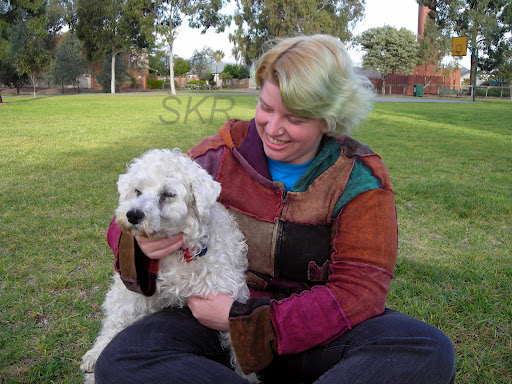
Charlie died at 4.15 on Tuesday. The decision to put him down was incredibly difficult to make. It was very quick and very peaceful, I stayed with him the whole time. He wasn’t stressed or upset and was happy gobbling treats from my hand. An overdose of anaesthetic stopped his heart. I miss him terribly.

The last week we spent together was very precious to me. We spent a lot of time in the sunshine down at the local parks, going for walks, or snuggled on the couch watching movies. I knew at the outset that once I’d decided I could no longer leave him at home alone and needed to put him down that I wanted to spend a last week with him. I often waver on those kind of gut instincts, I feel pretty strongly about following through on things I’ve said I’ll do. I’m so glad I didn’t this time.

I wanted to get him groomed and cleaned before the end, it took quite a bit to find someone who could fit him in and checks back and forth with the vet about his health and making sure it wouldn’t stress him. In the end the lovely people at Doghouse Daycare bent over backwards to look after him and treat him gently. I stayed with him as he was washed and trimmed. This made it easier for me to keep him clean and dry over the last few days.

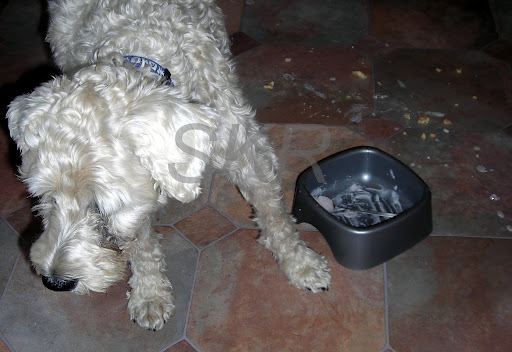
He was such a funny little chap. I got him when he was 3 years old, as his owners were moving overseas and couldn’t take him. I took him off to the vet worried about his eyesight because he was running into things – trees, walls, posts. They had a look into his eyes and did some tests and said they were working just fine. As they were telling me this, he tried to walk straight off the examination table! The conclusion was that he was just a bit daft.

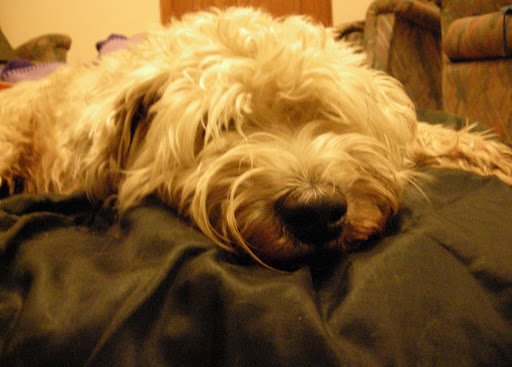
He had a tendency to explore life with his face, stuffing his nose into everything. Because he’s a schnauzer cross, he has lovely long whiskers and eyebrows, which he would constantly fill up with prickles and burrs.

After a bath when his coat was long, he looked a bit like a sheep with a static charge. The first time I got him clipped they did a very short cut all over and I didn’t even recognise him afterwards! He has a very fine pointed terrier nose under all that fuzz!

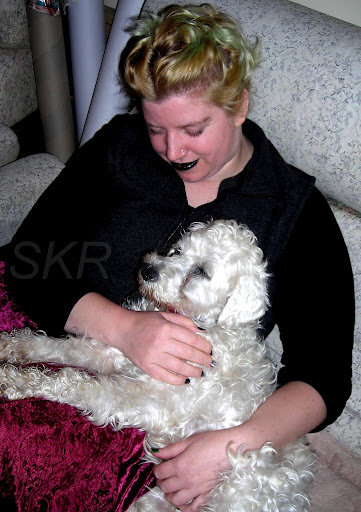
It’s been a very disrupted relationship, with the chronic homelessness I’ve experienced I’ve had and lost him many times. I gave up on ever seeing him again last year and was surprised to suddenly have the opportunity to get him back last December, and then horrified at the terrible condition he (and Loki) were in. It’s been really strange and stressful. I love him to bits but the bond between us got jammed. Mostly I felt overwhelmed by guilt and stress and wished I’d been able to give him a better life. I’ve known for the last several months that I’m kind of numb about him but I didn’t know how to fix it. This last week was very precious because it finally clicked. I haven’t been handling him very much, between pain, arthritis, incontinence and infection I’ve been fairly hands off. I mean, I’d scratch his ears and give him baths, but he wasn’t allowed on the couch because I’d have to keep washing the cushions, as it was I’ve been doing a couple of loads of laundry a week, most of them old soiled towels. He didn’t get a lot of cuddles and I don’t spend much time on the floor because my joints hurt. This week I threw all that out of the window. He got wrapped in towels and cuddled on the couch for hours. He went everywhere I went in the car. I sat on the grass in the park and played with him. I discovered he could still ‘dance’ when you played with him, pushing him over to rub his tummy. The extra affection really made him happy. He’d lie on the lawn in the backyard in the sun, chewing a bone and radiating contentment. When he was anxious he wouldn’t just come and find me, he’d learn against my leg and beg to sit on my lap. When I gave him a cuddle he’d snuggle his face against mine. It was like the difference between a baby who snuggles into your arms and one with autism who lies stiff against your hold. He felt loved and he snuggled, and when he snuggled all my numbness disappeared and I finally felt bonded. Too brief! But I’m so glad it happened.

Somewhere in the mess and pain of the last few years I seemed to have turned off the attachment part of me to stop being overwhelmed. But that’s not how I want to live, it’s eerie and painful to feel like there’s a layer of thick glass between you and those you love. I’m glad I accidentally stumbled onto what I needed to connect, even though I now feel heartbroken at losing him, at having so little time with him. I’m also so grateful. I’m going to dig back through the books and information I have on attachment. I need this back.

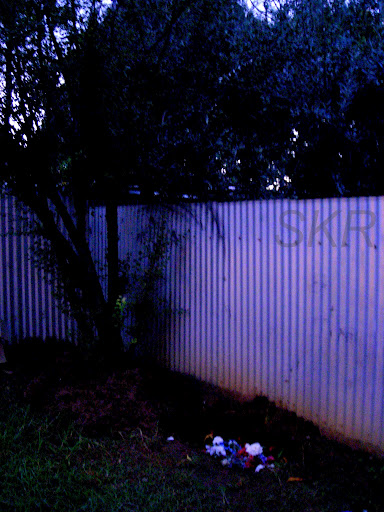
I dug (with help) a grave for him in my backyard. We filled it with autumn leaves and then covered him with flowers and buried him. I’m going to plant my bay tree there.

I wish we’d had longer, more years in the sun. Less pain and confusion. His life was harder than it should have been, but it still had value. He was loved, he is missed. RIP xxx

I hate myself

Self loathing is vicious, seductive, persistent, and something I fight. When I’m struggling, “I hate myself” is what I hear in my head. This voice may speak once or twice. It may loop over and over again for days. The intensity of the rage and loathing I feel for myself is difficult to communicate or comprehend. It permeates me and threatens to tear me apart.

About four years ago I made the call that the single biggest internal factor that was holding me back and crippling my life was self-loathing. So I set out to understand it better, to fight it, and to starve it. These days it’s not with me all the time. I have whole weeks where I can just live and enjoy my life and it doesn’t bite at all. But I still have the bad days here and there where it wells up strong and I have to work really hard just to stay still. These are days I fight self harming compulsions. They are days I can’t look in the mirror, can’t eat, can’t bear to be touched. Human contact is intolerable, indifference leaves me drowning, criticism cuts into me, and praise only makes it more intense. I have learned when to fight it and when to endure it.

Self loathing is difficult to wrap your brain around if you don’t experience it to this extent. It runs so counter to our self-protective instincts and the usual human preference to think of ourselves as decent people. I can’t speak for anyone else, but I have been able to untangle some of the things that drive self loathing in me. One of them, and it’s a big one, is siding with someone else’s perspective about you. If you’ve been degraded by someone who treated you as pathetic, inhuman, revolting, contemptible, useless, or unlovable, then in the dark times when your reserves are low, you may wonder if they were right. I was bullied a lot at school, so in my case self-loathing was just taking the side of the majority opinion that I’m a freak and deserve everything that happened to me. We don’t like to back the losing horse, and when abusive people are in the majority or more powerful than us, it’s not uncommon to lose our own perspective and take on theirs instead.

Another thing that feeds self-loathing is the deep desire to not be vulnerable to harm again. In the aftermath of trauma or abuse, we may assess ourselves as inadequate and use self-loathing as a tool for self-improvement, thinking that we will make ourselves stronger, more resilient, and more impervious to harm in the future. It’s a seductive idea, but the reality is that we carry on the work of abusers long after they have gone, and cut ourselves away from the very things we need to be able to grow strong – compassion, truth, love. We become brittle and damaged by a campaign of relentless self modification that leaves us disconnected from our sense of self or self-worth.

This inclination towards self modification can also come from a sense of worthlessness. Self-loathing can be the rage that results when we perceive ourselves as fundamentally inadequate in some way. We often judge ourselves harshly when the outcomes of our efforts have been poor. Despite everything we tried, we could not stop them, or we could not keep them, or we could not make them love us, or make it better, or make the dreams come true. Facing our powerlessness is so devastating we turn on ourselves instead, with all the viciousness of someone with a deeply broken heart. And we resolve that next time, we will make ourselves into someone who would be loved, who would get the happy ending and would deserve it.

Self loathing can be used a powerful motivational tool. We gear towards punishment and talk harshly to ourselves to drive us through all the things we don’t want to do, to overcome the depressive reluctance to engage with our lives. We make ourselves keep getting up in the morning, keep working, studying, breathing, fighting for a better life. We do what works, and self loathing does work, for a while. When the alternative is curling up to sleep in a house on fire, we generate change and cling to life with whatever we have. But at some point we have to stop using such a savage implement on ourselves because it will warp and destroy us.

Self loathing often has a very close relationship to shame. Many of us carry secrets about which we are deeply ashamed, an internal list of how hideous and unlovable we are. These may be things we regret, our failings as parents, partners, children, or friends, things done to us about which we take on shame, and about which our culture shames us. We hold these things very tightly to us, and in the dark they fester, they grow in magnitude. We may be unable to forgive ourselves for our own powerlessness, for times we’ve been selfish, cruel, indifferent, lazy. We may be trapped by a need to hold an abuser to account, and find that our thinking twists so that we cannot accept our own fallibility without somehow saying their actions were not that important. We may fear exposure of things that other people would shame us about, sexuality, abuse, gender issues, mental illness… We cannot be reconciled to who we are in some way, and so we suffer, and we hate ourselves for our suffering.

Sometimes we hate ourselves because we’re the safest person to hand. We don’t feel safe to be angry with people or about situations in our life so we direct it all inwards. The rage victims feel towards abusers can be frighteningly intense, and many people conclude that the safest, moral choice is to take that rage out on themselves instead of risking acting out revenge fantasies on another person. The cycle of trauma continues and the person is left weakened and desolate by these attacks on themselves, as well as furiously angry about the self loathing on top of the original harm. People will also turn rage inwards when they don’t feel they’re allowed to be angry, for example a woman who gives birth to a child with severe illness may come to the conclusion that she has ‘failed’ to bear a healthy child. In a position where she feels that she cannot express her anger and disappointment without being seen as a bad mother, she may soothe those feelings by savaging herself instead, in ways that seem deeply irrational to those around her.

Self loathing, oddly enough, can feel safe. Where the alternatives, like being angry at someone powerful and well protected, or deciding to accept our own weaknesses, can feel terrifyingly risky. They may even be incredibly risky. Retreating into a dark hole to gnaw on our own flesh and bones seems to us like a victimless crime, the lesser of many possible evils. As a child, one of the things I feared most was not being destroyed by the bullies, but becoming one of them. I craved the power to protect myself but deeply feared that this meant I would hurt someone else instead. When forced to confront this ambivalence, my reaction was suicidal. Self loathing gave me a way to try and improve my life while feeling safer that I was not blithely exchanging roles. Criticism – legitimate or otherwise, feeds it, and praise also leaves me afraid that I have tricked people into thinking I’m an okay person when deep down I’m convinced I’m not. There’s something alarmingly soothing about retreating from the world back to my dark cave of self loathing.

The cost is very, very high. Intense self loathing leaves me with a profound sense of not being safe anywhere, ever, because one of the people I’m most afraid of is myself. Without safety, recovery is nearly impossible. I become the monster that hides under the bed and stalks me from room to room. There is no escape. I undermine my own efforts, sabotage safety, blossoming friendships, destroy good things in my life I’m convinced I don’t deserve or will ‘weaken’ me. It quickly becomes a spiral, as I act out my feelings I have ever more fuel for my rage at myself and ever more evidence of my own intolerable flaws. The difficulty is that refusing to act upon such strong feelings leaves me with an incredible tension – where the difference between how I’m feeling and the outward appearance of my life is so vast it is actually painful. There’s such an intense need to show some of my feelings, and to discharge some of the intensity. I use journals, inks, symbols that I have imbued with personal meaning to stop me resorting to more drastic measures. I fight the impulse to unmake them all, the despise all my protections, to wake the next day and feel humiliated. I nail my colours to the mast and when needing an answer to the question “What does it mean?” in the aftermath of torment, insist on only one answer “That I am human” and turn all the rest aside.

So I starve my self loathing. It can’t grow strong if I don’t feed it on twisted thinking and fears. If I am loving to myself and let others be kind to me, I grow stronger and my thinking grows clearer. I insist on treating myself the way I treat others, and being kind to my vulnerabilities instead of harsh. I am cultivating healthy entitlement, and taking the risk that through care and kindness I will grow, rather than through drivenness and self hate. Initially these choices were very difficult, and felt terribly risky. They get easier. I am committed to good principles of hope, healing, joy, respect, fairness, even if I can’t live them every day.

When the bad days happen I argue with the voice in my head and I say to it “I don’t hate myself, I’m just stressed.” I cancel classes and stay home. I stay away from the mirror. I let myself go without food for a day if I have to. I try not to claw at my skin. I put the knives out of sight. I write. I paint. I try to hang onto memories of being loved. I let the images of mutilation and destruction flow through my brain and turn my face from their allure. I find somewhere to cry I hope the neighbours wont hear. I let the pain and the rage be there and I hold my fingers tight and refuse to act on it. I follow the pain down and face the horror that has incapacitated me. Slowly, the desire to tear all the skin off my body will ease. Slowly, the images of breaking all my own fingers will settle like leaves on water. The urgent need to act will pass and the sense of rawness will curl back under my skin. The fire in my brain will go back to coals, the stars come out, the planet turns, that which consumed me passes on, and I’m free of the demon again. Just a little more breathing room, just a little stronger.

More info about self loathing here.

See more like this:

Finding your sense of fun

In Bridges this week one of the topics discussed was how to let go and have fun again. Many of us find ourselves spending so much of our time being grown up, responsible, organising our lives, managing our illness, eating well, getting enough sleep, and generally being adult that fun becomes an alien concept.

Some of us (ahem, ahem) can get so stuck in adult mode that even when we make time for fun things, we ruin the fun aspect of them. I can go on a holiday with a to do list that reads “relax, eat healthy food, read 16 books, swim every day” and all through my day off be thinking things like “Am I relaxing?”, “Am I relaxing enough“, “Oooh that’s handy, this playing chasey is really good exercise”. Most of us are familiar with the idea of having an inner critic (see Reclaiming Creativity). This is a bit different. This impulse I call my inner social worker.

Inner social workers are a good thing. They’re the voice that says “go and eat something!”, “clean that bathroom”, “you haven’t walked your dog in a week”, they are sensible, practical, and very focused on self care and accomplishment. The problem is that these attitudes are complete anathemas to having fun. When you’re stuck in adult mode with your inner social worker along for the ride, the most outrageous fun somehow gets turned into work. I remember being at a talk once where the speaker said “Look, I know many of you find art helpful, but for god’s sake don’t tell them that! They’ll turn it into art therapy.” Now, I quite like art therapy, but I got where he was coming from. Something emotional and spontaneous being turned into something functional by the imposition of social worker goals and language. The minute someone uses words like “a recovery focused program of increased self -awareness through artistic expression in a goal-oriented 6-week structured course designed to enhance independence”, all the magic drains out of the art room. Or maybe that’s just me?

Anyway. Having fun, I mean really shucking the adult role for a while and being able to enjoy yourself for the sheer fun of it, involves banishing your inner social worker. Some people describe letting go of their adult or parent side for a bit, personally I prefer to box them for the duration, rather the way you banish a big dog to the backyard while you have a tea party with the fine china. Except in this case, it’s kind of the reverse! Fun is about reconnecting to your inner child. Kids know how to have fun instinctively. They live wholly in the present moment, are ecstatic about small joys like icecream, a trip to the park, or being able to stay up late, and never spoil it all by trying to turn it into something productive.

So, you’ve boxed your inner social worker and determined that the next several hours will in no way be productive, what then? Spontaneity is one of the big aspects of fun. It doesn’t have to be, kids have a ball when a trip to the pool has been planned for a week, but if you’re struggling I’d suggest getting as far away from adult as you can. Wake up on a wet day and decide to go to the beach, romp about on the grass with your dog at the park, invite a friend around and make chocolate fudge cake. Deliberately try things that feel childish, give finger painting a go, eat a cheesecake without forks, go build a sand castle, dance around your living room to loud music, cook popcorn and leave the lid off the pot. If you get really dried out and can’t think of anything creative and interesting to do, try keeping lists of ideas you might like to try the next time you have an afternoon free. Get ideas from books or sites suggesting activities to keep kids occupied during the holidays. Build a fort out of your sofa cushions, dye easter eggs, go join a costume society or build a model train set. Hanging out with kids can be an amazing way to find your sense of fun again.

Breaking the rules is part of why things can be fun, suspending the normal world for a moment and entering a place where anything might happen. For this to work you need some safe rules to break. We’re not talking rules like “don’t play on the road”, but rules like “we eat at the table”, “you can’t get wet in your clothes”, “bedtime by 11pm”, “dinner before dessert”, or “no flooding the bathroom”. If you don’t have some safe rules to break, make some, stick to them most of the month, then have a night off where you break all of them. Midnight feasts are fun because they’re against the rules, but not actually dangerous in any way. Suspending the normal structure or your life to go and ride motorbikes, learn surfing, or lie on your lawn eating mangoes under a sprinkler can be the release from the adult world that you need to feel rejuvenated.

Friends are another big part of having fun. A strong sense of fun involves a sense of humour and a strong vitality. A love of life, an attraction to the ridiculous, indifference about looking like an idiot, and an aversion to monotony. Some people have these characteristics in spades, and if they were marooned on an island, would still set up a practical joke shop and make a brisk trade selling brilliant ideas to themselves. The rest of us often find that we need other people to bounce off, that our sense of fun is at times very strong, and at others, totally battered by all kinds of things going on in our lives. There are times when we are the spark that lights the fire for our weary friends and starts an evening of rolling around on the floor laughing through a game of pictionary. There are times it’s our friends that invite us to go on a zombie walk through the city covered in green facepaint and fake blood. This mutuality prevents one person doing all the inspiring and the other/s enjoying being inspired but never working out how to start that fire themselves. You don’t want to find yourself in a situation where you are the only one with a fire and everyone else is happy to warm their hands at it, but in your dark nights they have nothing to offer or are just irritated with you that you aren’t still providing the lovely fire for them. Friends who get it and bring their own love for life to the party are a joy, and you often develop an ‘in-crowd’ language about these kinds of times spent together, where one of you can ring the other up and say “lavender socks” and have them burst into laughter and clear their evenings plans.

Fun is magically restorative, it eases all those knotted muscles, relaxes our facades of respectability, lets us open up to life and feel and breathe and live. It’s not all there is, pleasure, quieter joys, melancholy, curiosity, contentment, so many things are important to a full, rich life. Fun gives us our childhood back, grass stains on the knees, chocolate frosting on one ear and sprinkles on the other. Somewhere along the line a lot of us lose our sense of fun and adult fun becomes about breaking taboos of sex or drugs, or getting drunk enough to lower inhibitions. It doesn’t have to be this way, your brain can create that heightened, giggly, tipsy state all by itself without spending lots of money or getting plastered. Some of us have just forgotten how for a while. But it’s like riding a bike, we never truly forget.

About Multiplicity

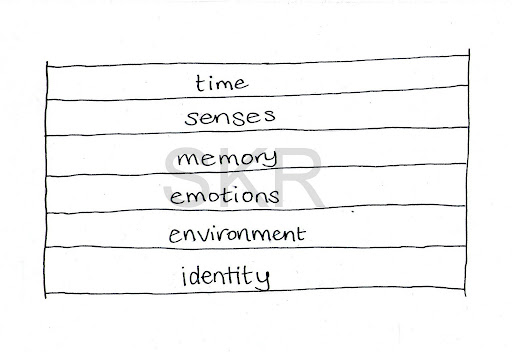
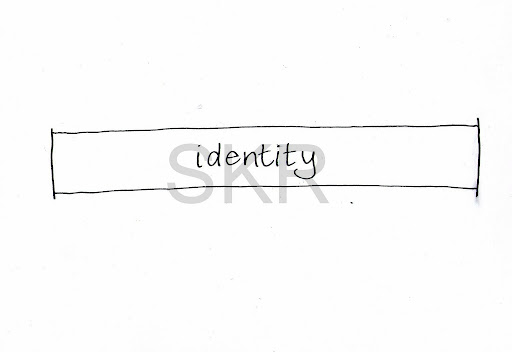
Multiplicity describes a form of dissociation that happens in the area of identity. Dissociation can happen in many different areas, of which identity is one.

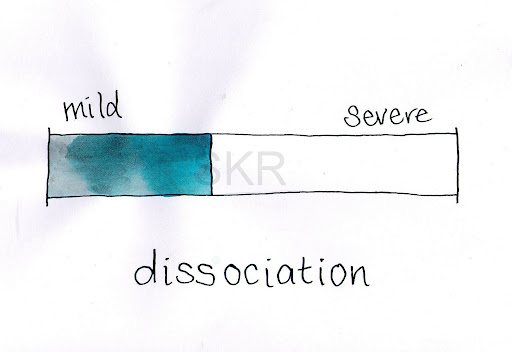
To start with a broader understanding of dissociation read About Dissociation. Dissociation describes a disconnection of some kind. Disconnection in the area of identity can occur in a very mild and commonly experienced way, or be quite extensive and severe. We tend to think of multiplicity as being a distinct category of its own, something you either have, or don’t have. Dissociation occurs in degrees of severity in any area, including identity.

People also often use the diagnosis of Dissociative Identity Disorder (DID) as a shorthand term for the concept of multiplicity. DID describes very high levels of dissociation in the areas of both identity and memory. It is possible to experience multiplicity without memory loss (in fact, this is sometimes part of the goal of therapy for people who have DID) and people with that experience may instead be given the diagnosis of Dissociative Disorder not otherwise specified (DDnos). People with multiplicity issues may also be diagnosed as schizophrenic, psychotic, or other conditions, or not given any diagnosis or framework to make sense of their experiences.

Right down the ‘normal’ end of this spectrum, we all have ‘parts’ if you want to look at things that way.

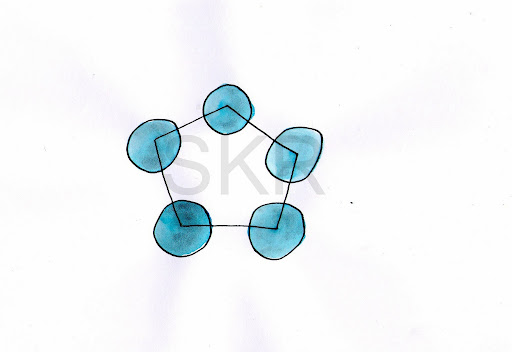
We all play different roles in different areas of our lives. We show different sides of ourselves in different relationships – with our co-workers, our friends, and our children. Some theories of personality and identity development now conceive of the idea that everybody is an integrated network of sub-personalities, united by a single sense of consciousness. So, to a certain extent, we can all relate to the concept of multiplicity. We know what it feels like to be in two minds about something, to have conflict between aspects of ourselves “Part of me wants to go out tonight, and part of me wants to stay home.” We may also have experienced spending time with a new friend, who bring out a side of ourselves we hadn’t known was there. We may feel like we leave parts of ourselves behind – perhaps the part that loves to study and research is left behind as we throw ourselves into parenthood, or our fun and silly part is forgotten about as we try to manage a large company. We may also recover and reconnect with these parts later in life. All of these parts are ‘us’; they are all facets of a single, whole personality, and there is a high degree of connection and cohesion between these parts.

In multiplicity, there are dissociative barriers between these parts, like walls that disconnect them from each and keep them separate. The degree of multiplicity is determined by the extent of this disconnection. So, what are some ways multiplicity might present?

The Doubled Self

This is a really common form of mild multiplicity, particularly for people who have come through some kind of trauma. People talk about ‘the me that’s talking to you now’ and ‘the me that went through that’. They are both the same person, there is a single sense of consciousness and a unified self. There can be a sense of living in two worlds, and that even when the trauma is over, part of them is still stuck in the trauma world. For example, some people describe themselves as having been ‘the day child and the night child’. This is not DID and does not necessarily mean you have a mental illness or need to feel worried. It’s a common form of disconnection.

Rational-Emotional Split

Another really common mild form of dissociation in identity, people can experience a disconnection between their ‘mind’ and ‘heart’. For example, they can remember the facts, dates, information about a traumatic event, or they can feel the emotions associated with it, but not both at the same time. Depending on how this presents, it may be dissociation in the area of emotion, but where it is associated with feeling like there are two distinct parts of you then it may be more useful to consider it a form of mild dissociation in the area of identity.

Like all forms of dissociation, these are not necessarily pathological. In fact some therapeutic interventions, such as the mindfulness approach of developing the ‘observing self’ may be conceived of as a form of mild functional multiplicity that supports and enhances people’s ability to gain useful perspective on themselves and their situation.

My Voices

Some people who hear voices understand their voices as being parts. This is particularly so when the voices have stable personalities of their own and have been heard by the person for a while. The framework of multiplicity is not appropriate or useful for all voice hearers however! There are many other ways of making sense of voices. (see Hearing Voices Links and Information for some resources) But for some people, it helps to think of their voices as parts of them-self, or parts their mind has created. For these people, their relationship with their voices is often the key to whether their voices are comforting assets or disabling and destructive. There is a common idea that how people experience voices is diagnostic; that people who hear voices in their mind have a dissociative condition, while people who hear them through their ears (as if someone else is standing behind them talking) have a psychotic condition. This would be a convenient distinction but research doesn’t support it.

Parts that Affect My Mind

These parts have the ability to affect how someone thinks and feels. They may be able to block memories, take away words, flash images into the person’s mind, block or trigger emotions. These kinds of experiences are often considered to be part of the Schneiderian First Rank Symptoms (FRS), and to mean that the person has schizophrenia. However people who do not have schizophrenia may also experience FRS, and some research suggestions that FRS are actually more common for people who have DID than people who have schizophrenia. The person in this illustration does not have DID, as they do not switch and they do not experience amnesia (dissociation in memory). However, their experiences can be understood as being a form of multiplicity rather than psychosis. Their parts may talk to them (as voices) or be completely outside of their awareness.

Parts that Affect My Body

These parts have the capacity to affect the person’s body (another FRS). People who experience this may describe watching their own hand write in a different handwriting, or having a voice that can move their body and make them safe when they freeze in dangerous situations. This can also be really frightening and people may feel possessed and like they are fighting for control of their own body. They may or may not hear these parts as voices, and may or may not be aware of them or know what they are fighting for control with. If people interpret this experience through a spiritual framework, such as demons possessing them, they may become extremely distressed.

Co-conscious Switching

This person has a high level of multiplicity with at least one self contained, separate part that at times ‘switches’ and operates the body with complete control. Even when the other part is out, this person is still aware of what is happening, or they are filled in on what has been going on. This kind of awareness is called co-consciousness, it means there isn’t amnesia (dissociation in memory) happening for them.

Amnesiac Switching

Dissociative Identity Disorder is the diagnosis for people who experience amnesiac switching. This means that when they switch and another part is out, controlling the body and going about their day, then they are not aware of what is happening. They don’t experience themselves as switching, their perception is that they ‘lose time’ or have blackouts. Minutes, hours, days, weeks, or even years may go by without them knowing what is going on. When they come back out they may discover they’re wearing clothes they would never choose, or that major life changes – house, job, partner, have happened while they were gone.
Where there is more than one other part in a system, there may be different levels of awareness and multiplicity between the parts. For example, imagine a multiple with four parts, Greg, Graham, Greg 2, and Pearl. Greg is amnesiac when Greg 2 or Pearl are out, Pearl is amnesiac for everyone else and doesn’t know she has parts, but Greg 2 is aware of everyone and what is happening all the time. Graham never comes out, he is a part that speaks to Greg or Greg 2, but he doesn’t know about Pearl and Pearl can’t hear him. These things may not be fixed either, perhaps if Pearl was in a situation of terrible danger she might suddenly be able to hear Graham telling her to run to safety. Over time things can change.
Some multiples are in fact highly fluid, with such constant changes that system mapping is impossible and pointless until some degree of stability has been created. On the other hand, some multiples are so fixed that they find their parts are all playing roles and trying to manage people and circumstances that have long since changed. The best functioning – as with all people – seems to be a balance between flexibility (adaptation, growth) and stability.
As with all other psychological symptoms, different things can cause them, including physical illnesses and problems. If you suddenly develop parts or any other form of dissociation it is important not to presume that a psychological process is always at work. Symptoms may in fact be due to an infection or kidney problems for example.
Multiplicity can be both under, over, and misdiagnosed, as with all psychological conditions. There are other psychological processes that can seem similar to multiplicity – such as rapid cycling Bipolar, (where mood changes may be mistaken for different parts) or chronic identity instability as part of Borderline Personality Disorder (where the issue is more a disconnection from a sense of coherent self rather than the division of the self into parts). People who have a high level of adaptation to different environments may seem to ‘change personalities’ in different situations but this relates more to issues around ego boundaries rather than a divided self. Other forms of dissociation can be mistaken for multiplicity, such as when people experience severe levels of amnesia and it is assumed that this must mean that another part has been out, whereas they may not have any multiplicity at all, only memory issues. Ego states are a way of describing ‘normal parts’ and sometimes these will be mistaken for DID when inexperienced people think that feeling like a child again when you’re around your parents, for example, means that you are a multiple. Multiplicity is only one framework among many, if it doesn’t fit or isn’t helping, keep looking. There are many other ways of understanding your experiences, spiritual, social, mood related, biological, and so on. It is also possible that more than one thing is going on, for example you may have multiplicity and bipolar. In that case bipolar symptoms may occur across all your parts, or perhaps only 2 parts have bipolar and the rest do not.
It is really common for people struggling with multiplicity issues to be given many different diagnoses and spend many years in the mental health system before somebody considers dissociation as a possibility. A lack of training and awareness about these issues, as well as sensationalism and controversy have unnecessarily clouded this field and made life a lot more difficult for many people. People with parts are not more special than anyone else, and although multiplicity can seem startling at first, it is really no stranger than the experiences of people who have psychotic episodes, mania, or compulsions. There is a high level of stigma and freak factor around multiplicity that can cause a lot of problems for people who experience this and can make it very difficult to think clearly about. If you’re trying to work this out it can be tough, hang in there and be nice to yourself. You may it helpful to read How do I know I’m multiple?
Whatever is going on for you, there is hope for recovery. What that looks like is different for different people, rather the way it is for voice hearers – when ‘well’ some don’t hear voices any more, other still hear voices but they are positive, others still hear difficult voices but have learned to manage them. Some multiples work on improving communication between parts to be more of a team, or rebuilding connections to function in a less divided way. Some people integrate, where the dissociative barriers come down so that every part is ‘out’ all the time. There’s tremendous variety, and it’s important to note that the degree of multiplicity is not necessarily indicative of loss of functioning. A person with very high levels of multiplicity may function better than someone with none at all. A disability model may fit better than the medical ‘mental illness’ framework, where multiples may live differently to other people but are part of the diversity of human experience rather than ‘sick’ or ‘impaired’. Having said that, for many people dissociation of any form can be extremely challenging, distressing, and disabling. There is tremendous need for more information and support to help people with these experiences to manage them the best they can.

You can find some more information I’ve written here at Multiplicity Links, or over at the website of the Dissociative Initiative. Good luck and take care.

Supporting someone after trauma

I get asked this question from time to time, often by distressed family members after something terrible has happened to someone they care about, occasionally by concerned mental health staff wanting to better support some of the people they see in their work. It’s quite heartbreaking to witness someone’s anguish in the aftermath of trauma and one of the most common responses we have is to feel terribly helpless.

That feeling is based on the reality that we cannot change that something awful has happened. We cannot reduce the losses, take away the pain, or suffer it on their behalf. We are limited in what we can do. But we are not actually helpless. Research and experience shows over and over again that many traumatised people are equally, or even more, traumatised and distressed by the way other people react to them than they are by the original trauma. One of the most powerful examples of this I’ve come across is in Victor Frankl’s Man’s Search for Meaning. People who had survived the Nazi camps and were at last free were devastated to have so many people in their community react indifferently to their suffering. Many people’s attitude was one of denial, along the lines of ‘so what, we’ve been in a war too you know’. People who had been holding on, craving freedom and ecstatic to get out of their horrific circumstances were crushed by these attitudes.

How we respond to and support someone after trauma can have a profound impact on their lives. When I have been in serious trouble, reaching someone on Lifeline who speaks kindly to me, or having someone in my life who makes time to listen compassionately to me has helped keep my heart safe. So one of the most important things you can do when supporting someone, is to make room for that feeling of helplessness. Accept it, ignore it, and don’t let it drive you into discouragement or into trying to ‘fix’ them.

Control
What a traumatised person has lost is their control. Whatever it is that happened, they were not able to prevent it. They might have been able to escape, to fight, to react well, to protect themselves, but they couldn’t stop the situation happening in the first place -whether it was a flood, assault, or car accident. The more they were able to maintain some control in the situation, often the less challenging their recovery will be. To be made to feel utterly helpless and completely vulnerable has a profound impact on people’s sense of being in control of their own lives. Most traumatised people are very sensitive to issues around control, whether they are hypersensitive to losing it even in the smallest of ways, or whether they have collapsed into defeat and cannot summon the hope to direct any aspect of their lives.

Sensitivity to this area is really important, especially because in our zeal to help and protect someone, it is really easy to accidentally disempower them even further. We may be furious at someone who has hurt them, and insist that they take the matter to court – taking away their choice. We may start to determine what they can and can’t do, what might be too risky. It is very common for victims of sexual assault to be put under tremendous pressure to see a counsellor, by worried friends and family who do not understand that this pressure is part of the problem. Supporting the person to regain a sense of being in some control in their own lives is really important. It will help if you ask them what they want and explore options with them. It will help if you share your opinion and perspective but do not try to impose it. It will help if you continue to treat them as if they are capable of running their own life – even if you are worried about them. You cannot know the best recovery path for them. Wherever possible control should be restored to the person.

Safety
Safety is another critical area that traumatised people often struggle with. This issue is twofold – actually doing whatever needs to happen to make sure the person is safe, and also trying to support the process of regaining a sense of safety emotionally. Badly traumatised people can carry this feeling of not being safe into all areas of their lives. This can be really frustrating for you to watch, it’s easy to see how irrational some of these fears are – but the problem is that the traumatised person usually already knows this and feels stressed and humiliated by it. A good rule of thumb is that whatever can be adapted to easily, just do it. As quickly as you can support them to regain some sense of safety somewhere in their lives will help to settle the intense anxiety and the irrational fears.

It’s very important to try and be a safe person for them to be around. This doesn’t mean always getting it right – that is completely impossible. What it does mean is accepting that sometimes you will get it completely wrong – and being okay with acknowledging that. So if they say ‘It’s really not helpful when you do x’, you can go ‘sure, I’ll stop’ instead of launching into 300 brilliant reasons why you thought x was a good thing to do and why any sane person would have appreciated it. It’s also helpful to keep in mind that sometimes there is no right answer. The person is just stressed out and overwhelmed and not coping, and anything you do will be wrong. Don’t sign up for abuse about this, but don’t rake yourself over the coals for it either. As the stress and intensity settle down this should be less of an issue.

Another big part of being a safe person is not putting pressure on them to recover. Victims of assault for example, may find their partners deeply frustrated with their changed needs, feelings and behaviour, and constantly asking when they are going to be ‘back to normal’. Other people desperately need to move on and feel normal again and are under pressure from well meaning friends to open up and talk about it all. This brings me to the next critical area:

Balance
People who have been traumatised often express intense ambivalence. There are many double binds where they feel conflicting needs very strongly such as I want to talk about/I never want to talk about it. It can be very difficult to find a balance between the need to honour the events of the past, to speak about it, feel heard and validated, and have it recognised; and the need to escape it, to move on from it, to connect to the present moment and plan for the future. Different people have different needs and gravitate towards or away from their trauma at different times. Often from outside, we can perceive the lack of balance in their response. We are concerned by obsessive reliving of the event, or anxious about their intense avoidance of it. We can try to intervene and restore balance by pulling the person back in the other direction, but often this is merely perceived as an attempt to control. I would recommend instead trying to support the person and trust their own instincts about what they need and when they need it. When they have met one need, they will naturally swing towards the other. No one goes through this on some kind of ‘perfect’ arc, struggling to process trauma in an unbalanced way is the norm. Over time and with work and love, these things settle down. Be guided by their instincts, and never, ever forget, just how powerful it is to feel heard. When all else fails, or if you’re not sure what to do, your default stance is to listen compassionately. Sometimes the less you say or try to do, the less you fix, rescue, hover and fret, and the more you just hear the person, the better.

Another really important area around balance is to be aware of the changes that trauma makes to your relationship. It can temporarily shift you both into a carer/caree dynamic. This kind of dynamic is very powerful, to set aside your needs and make sacrifices to support and nurture another person is an incredible demonstration of love. But the unbalanced nature of this relationship, where you give care and they need care, can also cause problems. Healthy relationships are very fluid, there is a constant exchange of roles between who listens and talks, who sacrifices, who nurtures, who protects, who advises. This mutuality is a key to trust, respect, and mutual contentment. The carer dynamic can undermine that. I advise you to wear the roles lightly. Look for opportunities to share your vulnerabilities too, to allow them to support you as they are able to. If you can remember that the person is far more than their trauma, you will help them to remember that also. The natural response of relationships to trauma and intensity is to polarise into opposite, rigid roles. This is stifling and destructive, so be aware of it and encourage natural growth back towards mutuality.

Looking after yourself
Lastly, it is really important to recognise that when someone you care about is hurt, you are hurt too. You also need care and support and to take care of yourself. You may find yourself feeding off their anxiety and dissociation, feeling chronically irritable, frustrated, or depressed. Debriefing can be very helpful – if the person you care about is sharing deeply personal information with you, you can become very stressed by the need to keep secret things that are really upsetting you. In this instance confidential counselling of some kind can be really helpful. A sense of humor can also help to reduce the impact of trauma, breaking tension and relieving stress. Sometimes there is nothing better in the world someone can offer me than to come round and watch some Monty Python. 🙂

I hope there’s a few suggestions in there that are useful to you. In a nutshell I would suggest that you listen a lot, be guided by what they ask for and want, and hang in there. Research consistently shows that social support is one of the biggest factors in how resilient people are to the effects of trauma. Your care and sensitivity can make a tremendous difference.

To see these ideas in action in a personal case study, please read 5 hours after an an assault.

Reviews, notices, upcoming events

The Fringe event I was recently a part of has been very favourably reviewed here! Whee!

Bridges is not on this Friday as Mifsa will be closed due to the public holiday. More information here.

This Tuesday there is a free workshop I’ll be attending about Vicarious Traumatisation (this is the stress and distress that being exposed to other people’s stories and bad experiences can cause you).

Coming up later this month Cary and I will be giving a free talk about Managing Dissociation at Mifsa.

I’ve just discovered that the Voice Hearer’s Network is offering free support packs to individual voice hearers or larger packs for groups of voice hearers. I will be asking for a pack for Sound Minds, the group I help facilitate. If you hear voices and don’t have a group nearby, you can ask them for a resource pack here.

I have finally downloaded and installed the Adobe Creative Suite with In Design! Now that the Tafe holidays are here I am very excited about learning to use this software and starting to lay out my very first booklet for publication!! At last!

I am also entering the ninth month of this blog, and I am very pleased with well it has progressed. I have passed the 11,000 pageviews mark and have really enjoyed the discipline of writing a post every day. I have also written more than 60,000 words in mental health articles alone, which makes me feel a lot more confident about tackling postgraduate work, or writing a book. Don’t forget about the Blogging Workshop coming up, I’ll show you how to start your own blog and share some tips.

A couple of folks and myself are going to be interviewed by Peter Goers about this Blogging Workshop on ABC Radio Monday evening the 9th of April. I’m a little nervous because he seems a bit intimidating but I figure he’ll have to be nice to me or I’ll cry on his show. 🙂

Details for all these events are at What’s On!

Trauma Informed Care

Today wrapped up the Tafe directed component of the Cert IV in Mental Health Peer Work! It was a fantastic session, we’ve been talking about trauma lately which obviously is a topic very close to my heart considering that I have PTSD. One of the areas we talked about today is a concept called Trauma Informed Care TIC). I’ve heard this term bandied about a bit but I’ve never read anything that really broke down what exactly this model proposes and recommends. I was particularly taken by these key principles:

    • That recovery is possible, and that healing occurs in healthy and supportive relationships
    • Supporting control, choice and autonomy
    • Focusing on strengths

These principles are demonstrated through practices such as

    • Respect for individual choice
    • Recognition that treatment and service delivery may be traumatising
    • Avoiding shaming and humiliation at all times

I am delighted by this model! I have had some very unsuccessful arguments with various services over the years about these concepts but lacked a model to refer to specifically. I often encounter myths such as “very few people with mental illnesses have experienced trauma” (by far the opposite is true, the majority of people in the mental health system have experienced trauma or abuse).

I am particularly taken with how well this TIC model dovetails with the values and principles of the Recovery model. One of the things I have also been trying to communicate is that TIC is not inappropriate for the untraumatised! It is helpful for everyone to be treated with respect, given choice, and supported to exercise control over their own life. People who have experienced trauma tend to have extra sensitivities in areas such as control, proximity and touch, confinement, new people and environments, and trust. 

Certainly in the areas I’m involved in as a Peer Worker it is crucial that services are trauma-informed. I am really pleased that Bridges has been operating from TIC principles and I’m keen to do more reading in this area and make sure that all Dissociative Initiative resources and services operate in this way.

For more information about TIC, here is a lovely talk by Dr Warrick Middleton, an Australian psychiatrist and the Director of the Trauma and Dissociation Unit at Belmont Hospital in Queensland. I love his approach to trauma, dissociation, and borderline personality disorder, incredibly respectful! The talk is in three parts:

Adult Survivors of Child Abuse (ASCA) have a wonderful page full of resources about TIC here.

There is a government training powerpoint about TIC that is nice and easy to read here.

This document is much more dense, but I particularly like the distinction between Trauma Informed Care and Trauma Specific Services on page 15.

There is a brief clear overview of the need for TIC in this newsletter.

Here is a brief video about TIC particularly with children.

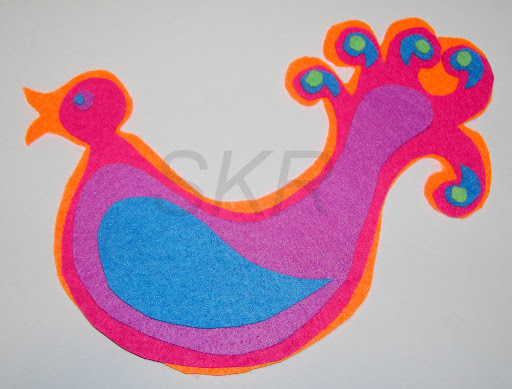
I’m very excited by this area. Today’s Tafe lecture was wrapped up by sharing about Recovery and asking everyone in the class to create something that represented recovery for them. Here is my rainbow bird, made out of sheets of felt:

The rainbow bird for me represents wholeness, diversity, community, creativity and joy. All the colours are distinct but together form a whole, complementing each other. This resembles my dear friendships with such diverse people who nevertheless all contribute so much to my life and together create a community. The tail feathers resemble tears because for me, grief and pain are intrinsically linked to my experiences of joy and wholeness. They are not forgotten and not hidden, but instead are part of the beauty and authenticity of the whole person. The brightness of the colours and the rainbow represents creativity, expressiveness, imagination, dreaming, and joy; each of which have been essential components of my own recovery.

Coping with Nightmares 2

In Coping with Nightmares 1, I’ve written a little about common causes of nightmares and how working on those directly can help. Here I’ve roughly grouped most of my own strategies, the suggestions of other people, or some ideas I’ve read into two different approaches; engaging with the nightmares, or working to reduce their impact. You may find one of these approaches more effective than the other, you may find that some ideas are no help at all to you, or it may be that combining both approaches works best for you. Sometimes it’s not that one approach is or isn’t helpful for you, but getting the timing right, or alternating strategies so you don’t unbalance. I describe this process of picking up and putting down emotionally charged material more here.

Engaging with Nightmares:

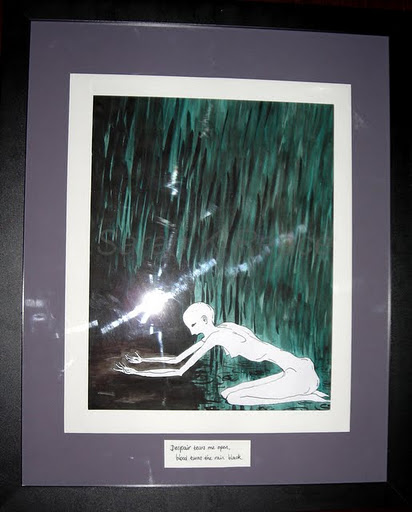
Sometimes the most effective way to help your mind stop sending you nightmares is to engage with the content, process, express, or defuse it. I find this is particularly helpful for recurring nightmares on the same themes. One technique I stumbled upon a few years ago is to paint the scene from the nightmare that has the most emotional weight, the most intensity to it. I’ve found that if I get this out of my head and onto the page, I tend to stop having the nightmare. Here’s one of the milder examples of this type of painting.

I didn’t need to look at the paintings or hang them anywhere. I found them profoundly disturbing and hated the sight of them. Once they were finished I would put them out of sight and only after a lot of time had passed would I take them out and have a look at them. I found just being able to get this feeling or fear or image out of my own head and safely recorded somewhere else was often enough to stop the nightmare.

For nightmares that aren’t recurring I find I need a different approach. There may be a common underlying theme, like being pursued, but the content of each nightmare is quite unique. In this case I find journalling is more useful. Sometimes I find words most useful to explore and express concepts and feelings, and other times visual images have more power for me. Sometimes I find that having written them, I can see themes and symbols more clearly in the content and make sense of what the underlying fears are. Here’s an example from my journal:

31 October 2007
I had one of my only reoccurring dreams – that the world was ending. I have these fairly frequently. They take different forms by the end of the world is always signalled by all the stars falling from the sky. Sometimes it is peaceful and beautiful, sometimes violent and terrifying, where the earth cracks open and monsters come out and devour everyone. Sometimes the stars take hours to all fall, sometimes they come down in a single storm of light, often there’s some kind of pattern, like all the stars falling in a perfect spiral, starting from the centre of the sky and moving down to those by the horizon. It always takes my breath away and fills me with such awe, such a sense of smallness and powerlessness. It’s the most beautiful thing I’ve ever seen.

In this dream, the stars suddenly started to fall from a dark sky, like huge drops of bright rain, leaving only the black void behind them. But as they fell to earth, they suddenly took off in all directions. The truth is, they were enemy spaceships, all this time, and now they are attacking. I call to my crew and launch my spaceship to fight them but I do so with cold despair because I know there are far too many of them and we are doomed to be destroyed. I am so sad and shocked that the stars we’ve always admired and dreamed about were really enemies, watching and waiting, all this time.

And then I wake… I am realising my dreams are not just an escape from reality, but also a form of communication inside me. I’m not too concerned about what they mean so much as letting myself know I accept them. I’m listening. The dreams about the end of the world might seem to be obviously about fear but I think they’re about destruction as much as change. This is not the end of everything, in the dreams, it is the end of everything I have ever known, of how things have always been… Sometimes this transition is peaceful and sometimes it is violent and terrifying, but it’s always frightening, inevitable, and out of my control.

In this case, this was the last dream I have had so far about the end of the world. The dreams progressed until this final one where the stars were revealed to be enemies, and I’ve never had them again. I had worked through and communicated to myself what I needed to. Journaling can be a powerful way to record and contemplate dreams and nightmares.Developing the capacity to lucid dream may also help you to engage with your nightmares in a productive way. There are some suggestions about how to develop the capacity to lucid dream here. Simply put, lucid dreaming is being able to be aware that you are having a dream while you’re in it, and then to change and affect the dream. Personally I don’t find this so useful. I can lucid dream (not always) but I find that my nightmares adapt to my attempts to control them and my subconscious is far more powerful than I am when it comes to changing a dream. If I can create bridges to escape on, my mind can set them on fire. If I can imagine a safe place to hide in, it floods with black water and drowns me. I am not afraid of being physically harmed, but the psychological stress and trauma that come with living through these mock executions is massive. In some of my worst nightmares terrible things happen to me while I desperately try to scream myself awake or cause myself sufficient pain to wake me and it does not work. But for other people, being able to tell the difference between a dream and real life dramatically reduces their distress and may open the way for many other creative options in engaging a nightmare.

Engaging the content of the dream like this can also be done in real life. If you have painted a nightmare, you can respond to that painting with something that is meaningful and comforting to you. Paint in wings to carry you to safety, a sword or lion to protect you, whatever fits and feels right. You can write the dream out and then rewrite the ending in a way that fits. You can treat these re-visioning of your dreams as a way to talk back to your subconscious and tell it what would happen this time if you were in that kind of terrible situation. If you can make yourself feel heard and then engage with the distress, your mind may stop bringing up the nightmares.

Sometimes dreams speak to us of things we have deeply buried. This suppressed material – memories, knowledge, feelings, fears, hopes, can torment us at night when we cannot keep it contained. Sometimes it is not writing about the nightmares that helps, but writing about the memory or fear or aspect of ourselves we hate that helps. Being able to accept the reality of these things instead of fighting and suppressing them can reduce nightmares about them.

Reducing the Impact

In a completely different approach, these strategies are all about reducing your focus on the nightmares and reducing their power to affect you. For example, if you wake following a nightmare, instead of journalling and contemplating it, get straight out of bed, put on some music, make breakfast, engage in other distracting activities before the dream has settled into your memory. Creating a good bedroom space can greatly diminish the distress that nightmares cause. It needs to be a space that is safe and comfortable. Clutter, frightening pictures or shadows, tangling in bedclothes and sheets can all increase the impact of nightmares. Since childhood I haven’t been able to sleep with a cupboard door open in the room. I experience mild stress-related hallucinations and following a nightmare if the wrong cues are around me I will hallucinate the nightmare content in that dazed state between dreaming and awake. Open cupboards for me are portals that things come through. If your bedroom is setting you off, you may need to sleep elsewhere during bad nightmare cycles. You may also find that some approaches that soothe many people with autism who get easily overloaded by sensory input may help you. An easy one to adapt to the bedroom is a weighted blanket. Many people (and most animals) find being gently but firmly held, or nestled under heavy blankets to be calming and reassuring. Another common one I use is white noise to help me tune out other sounds and stay asleep. You can buy devices like this one, or find your own. I like a fan running by my bed for the sound it makes. This site has many other suggestions and ideas for people who have difficult with sensory overload or crave extra sensory stimulation to help them feel calm.

Many people have a strong preference for sleeping with the lights on or off, follow your own even if you feel a bit silly. I cannot sleep with the lights on because then I feel exposed and vulnerable. Try playing music especially sleep inducing music at bedtime. This kind is designed to gently slow your heartbeat and relax you, it can help when you wake panicked too. Reduce your access to the kinds of things that increase your nightmares such as violent movies. Try adding in some neutral content immediately before sleeping so that your brain has something else to form dreams about instead of your own subconscious. I always read in bed before going to sleep, always no matter what. This is essential to reduce the intensity and amount of the nightmares that I have. It doesn’t stop them but it dials them down a bit. Don’t stay up late working, studying, doing housework or arguing. Make sure the bedtime routine has wind-down time in it, a bath, episode of Blackadder, massage, whatever you find relaxing. Grounding techniques can help a lot before sleep or when waking up from nightmares. Consider sleeping with someone else in the bed or nearby to soothe you, or with a companion of some kind. I have a big hairy toy dog. A pet can also be an incredibly non-judgmental and nurturing companion in the night for those of us prone to waking up screaming and distressed.

If you are waking other people up by screaming or struggling, you can quickly get into a miserable feedback loop where you feel so embarrassed or anxious about the effect you’re having on them that your stress level increases and the nightmares get worse. This especially applies if you have young children in the house who are getting scared. Talk to them about what is going on, let them comfort you, and look after yourself. Any general stress reduction techniques that work for you are a good idea, do more of all of them for yourself and anyone else in your house. You need extra time having fun together in these kinds of situations.

You may want to seek counselling or therapy of some kind if you’re having a lot of trouble with nightmares. PTSD is very responsive to good therapy, hypnosis can be very useful, and good emotional support can make a big difference. I hope you’ve found some useful suggestions in these posts. There are some more ideas about managing nightmares here, and there are many books and websites on the topic. If you’re struggling or my strategies aren’t working very well for you, go have a look at what other people are finding effective and hopefully you’ll come across some ideas that make a difference. Good luck.

Coping with Nightmares 1

In Bridges this week we talked about ways we cope with nightmares. Nightmares can be a big problem for me, something I’ve shared about before on this blog in NightmaresListening to your Dreams, and The Gap. Today I particularly want to share some ideas about how to handle it when nightmares are causing you anguish.Firstly, a little information: nightmares are very common in children and much less so in adults. Some people have no recollection of their dreams or nightmares, most probably because they wake up from a different sleep state. Most dreaming happens during the REM part of your sleep cycle. If you wake up out of a different part of the cycle it is much less likely you will recall your dreams. In real time, dreams can last only seconds or up to about twenty minutes. In dream time, anything is possible. The longest time period I have dreamed was about 4 years. When I woke up I had to reverse my way through those 4 years to work out at what point the dreaming had started. Dreams can be incredibly surreal, or so vividly real that you have trouble distinguishing them from real life. For those of us who find dissociation or psychosis can make our daily lives deeply surreal, dreaming and being awake can be difficult to separate. (one way of viewing psychotic experiences is that they are ‘dreaming while awake’)

There’s a lot of speculation as to why we dream and what dreams mean. Every culture and time has come up with their own answers about these things. Personally I conceive of dreams as a connection point between my conscious and subconscious mind, kind of like my conscious self going diving into my subconscious for a time. There are a lot of myths about the nature of dreams, a common one is the idea that if you die in a dream, you will die in real life. That can add a  lot of terror to nightmare experiences. I’ve died in my dreams many times. It’s frightening but it doesn’t hurt me in real life. If we assume for a moment that dreams are the voice of our subconscious, the language it speaks is not literal. Dreams communicate through feelings, symbols and metaphors.

Causes:
There are a number of things that can cause nightmares. The strategy you use to cope with your nightmares may change depending on what is setting them off for you. Illness can generate nightmares, particularly common is sickness that involves fever. Fevers can also generate hallucinations and other psychotic experiences where the line between sleep and awake is blurred and confused. Some medications and substances are known to increase the likelihood of vivid dreams and nightmares, or some medication interactions can set this off. People who have experienced trauma are typically more vulnerable to nightmares following the incident/s. Nightmares are a common symptom of PTSD. More generally, stress can also increase the incidence of nightmares. So, if your nightmares have suddenly flared following starting or withdrawing from a new medication, you may need to consider adjusting your meds. If you’re going through a lot of stress at work or in a troubled relationship, then stress reduction techniques may be more effective in reducing your nightmares.

Cycles:
Nightmare cycles can leave you really exhausted and distressed. I’ve had trouble with this where intense chronic nightmares can leave me badly sleep deprived. Nightmares that are derived from trauma can have a ‘stuck’ quality to them where they loop on the same theme over and over without resolving. I have trouble with re-occurring dreams that replay the same scenario over and over. I’ve also had trouble with cycles where everytime I fall asleep I have intense nightmares that wake me up. My sleep is very broken and not restful, and after a few nights of this I become frightened of sleeping. Sleep deprivation is a common way to set off dissociation, so my waking hours become more fragmented and confusing, and I also find that sleep deprivation makes me more likely to have nightmares. This can become a horrific spiral that shatters my mental health. Breaking this cycle is really important. One thing I use is a high strength sleeping medication to give me a chance to rest. Sleeping meds are not a good long term solution, most are addictive, lose their potency over time, and can leave you feeling pretty terrible the next day. I use a high strength sleeping pill very occasionally (no more than once a year) to help break out a nightmare cycle that has developed into chronic insomnia and severe dissociation. It leaves me exhausted for several days, unsafe to drive or cook, dizzy, and unsteady on my feet. It does however, get me a nights deep sleep and help me recharge.

Another method I’ve found helpful in breaking out of cycles is to express the distress of the nightmares in another way. If the nightmares are my mind screaming about fear or grief or shame, I have found that trying to suppress this can makes the nightmares more entrenched. I have actually broken out of bad cycles just by letting myself fall to pieces and cry about everything that’s overwhelming me. That’s so ridiculously simple it seems mad that it could work, but in a nightmare cycle I know I’m at high risk and I’m working really hard to keep it all together. Falling apart even temporarily is the last thing I want to do but it can express and defuse some of that intense distress and my dreams settle down.

Part 2 tomorrow 🙂

What’s the point of therapy?

I get asked this quite a bit. I also get asked the counterpart – can I get better without therapy? I think the point of therapy is to have someone else to support you to problem solve, look at different perspectives, help you access information and resources, to be with you and walk along side you whatever it is you are struggling with or going through. I think that the process of therapy is a craft rather than a science; that is the skills of empathic listening, building rapport, timing, pacing, imparting information, connecting, modelling good boundaries and communication are skills that must be learned and honed. Therapy is a relationship with someone, not something you do to them.

Good therapy comes in many different forms, because different therapists have their own unique personality, skill sets, interests, and communication style. This diversity is a wonderful thing because the people who look for therapy are very diverse and what makes one person feel comfortable and grow is an approach another person may find unhelpful. Having said that, good therapists do their best to adapt to clients and to find an approach that is helpful, or to help people find someone else to work with who has a more appropriate style or better experience. Therapists often specialise in certain areas – childhood development, family therapy, psychotic illnesses, etcetera. There is a common misconception out there that all psychologists know about mental illness for example, but this isn’t really the case. It depends on their interests and training, and it is often more useful to ask when making an appointment to check if that therapist has any experience in the area you are looking for support in. Given a choice though, I would take a caring, invested therapist with no experience in your area over a disinterested, dominating, or inappropriate therapist who is an expert in that field!

Therapists cannot fix people or make pain or mental illness go away. If you are expecting this from your therapist you may become very disappointed and frustrated. It’s pretty common for therapists to have to try and explain that these things are not within their power, that they are not withholding anything from you, they simply cannot do what you would like them to do.

The therapeutic relationship is a very unusual one, probably unlike any other relationship we will have in our lives. It is a rather artificial relationship in that it is constrained by clear boundaries that do not usually change over time, and a high level of intimacy is expected very quickly. This is contrast to most of our other relationships which develop slowly with gradually deepening intimacy and boundaries that change and evolve over time. There are advantages and limitations to the therapeutic relationship. The major advantage is that very little is asked of you to sustain the relationship. In good therapy you make an effort to communicate clearly, to be honest (including about problems and disagreements), to turn up on time, pay your bill, and respect the boundaries (no calling at 2 in the morning). Apart from that, it is entirely about your needs. You never have to listen to the therapists marriage struggles, wriggle out of having to babysit their kids, or worry about remembering their birthday. They are here to support you and help you meet your needs. The boundaries of the therapeutic relationship are designed to protect you, they recognise that being in therapy is vulnerable, that there is a power imbalance inherent in sharing personal information when the other person is not reciprocating, and that you deserve to have the space kept entirely for your interests. They are not supposed to mean that there is no real connection, the therapeutic relationship is supposed to have the capacity for great depth, empathy, respect, and warmth.

These therapeutic boundaries also limit what therapy can provide. Therapy is a very poor substitute for many losses in life. Therapy does not replace friends, family, lovers, meaningful work, community, the affection of children, having stable housing, or being free from sickness and pain. There are many things we need in life that cannot be found in therapy. Good therapy can help us to grieve their loss, to work through trauma, to create healthy substitutes or build new relationships, but therapy in that instance is a bridge back to the things that give our lives meaning and hope. It cannot hope to replace them.

Therapy can help you to

  • Talk about and work through really private things you don’t want to share with other people
  • Learn better communication and relationship skills
  • Get a new perspective on your situation. Sometimes it’s very hard to see things clearly because we are so close to it and so emotionally involved. A second opinion can be really helpful.
  • Learn more about our situation/condition/illness and access resources about it
  • Find hope, meaning, self-worth, a capacity for love and joy when you have lost them
  • Have a safe space to grieve, hurt, be overwhelmed, not have the answers
  • Experience care and kindness
  • Get the push you need to really face and deal with the things that are holding you back
  • Feel heard and validated
  • Hear hard truths
  • Have the courage to tackle difficult things
  • Work towards your goals, recover from mental illness

As you can see from this list, a lot of what is helpful about therapy can be found elsewhere in your life. For a list of 50 benefits of having a therapist, written by trauma specialist Kathy Broady go here. In therapy, you are the one who does the growing, in a sense you are the one doing most of the work. (not to pretend that therapists don’t work hard!) So, if you cannot afford therapy, or find a therapist to work with, don’t be disheartened!

There’s a lot of books and articles that say that you must get therapy if you have DID, that therapy is always long, intensive, and difficult if you have a trauma history. I disagree! I think therapy can be a wonderful blessing, but I also know that so much growth happens in our day to day lives and our regular, ‘natural’ relationships. Sometimes we take into therapy needs that simply can’t be met there, and we’re much better off looking to other areas of our lives.

Personally I am deeply grateful to my groups, especially the first I was involved in Sound Minds. I so badly needed friends, a community, people to talk with, feel heard by, have round for a movie, share birthday celebrations with. I have learned so much from them, developed better relationship skills, and taken those skills and good experiences into other areas in my life. I have been amazed at how many of my symptoms reduced or disappeared when I started to make friends and rebuild my social networks. Things I had been struggling with and making little progress about in therapy resolved as my life circumstances improved. I didn’t need to work on them specifically, they were an outworking of isolation, disconnection, loneliness, a lack of affection, acceptance, respect and support. The beauty of our friendships is the mutual nature of them, we give and we receive. Some days we support them, other days they support us. This kind of relationship is consistently described by people with a mental illness as the most crucial one to aid recovery.

You can to some extent, be your own therapist. There are some good books out there about this, in a nutshell, this is about making time and space to focus on your life, your needs, your own growth instead of suppressing, avoiding, denying and downplaying your struggles. You can read about your condition or experiences, join a self-help group or chat room, start a journal, listen to your dreams, develop your self-awareness, make a big effort to take care of yourself. This is pretty difficult at crisis points, but what I’m trying to say is that all is not lost without a therapist. 🙂 Certainly I would suggest that not having a therapist is a far better option than being on the receiving end of bad therapy. Which I realise begs the question, what is bad therapy? That could be a really long list! Some basic issues are:

  • The therapist violates boundaries; such as breaking confidentially (apart from mandatory reporting or other relationships covered by confidentiality such as their own supervisor), making sexual advances, being physically abusive etc.
  • The therapist pushes their own agenda; they try to convert you to their religion, they coerce, dominate, control, or manipulate you
  • The therapist has no respect for you; they denigrate you, are irritated by you, interrupt you, are scornful of your feelings, dismiss your ideas, call you derogatory names, miss appointments, roll their eyes, fall asleep during appointments, can’t remember your name or any details about your situation
  • The therapist has poor relationship skills; they react badly to conflict, become defensive or hostile, need to portray themselves as a good therapist even if that means making any problems your fault, can’t negotiate, listen, reflect, or communicate clearly
  • The therapist cannot see any of your good points; they relate to you as if you are your illness and have no skills, strengths, abilities, insights or contributions to make, they destroy your self confidence, blame you for your problems, take all the credit for any good outcomes of therapy, or create dependence and fear of making your own decisions
  • The therapist is afraid of relationships; they are cold, distant, brutal, callous or indifferent
  • The therapist is sadistic; they are a predator who uses therapy to access vulnerable people the same way predators get into the boy scouts, or become priests, teachers, or police. The therapist humiliates, abuses, undermines, exposes, or torments
  • The therapist lacks confidence; they allow you to violate boundaries, to manipulate them, humiliate them, abuse them, destroy their reputation, intimidate them, play out all your weaknesses and issues in the therapeutic relationship in a way that is destructive to both of you
  • The therapist is burnt out; they express hopelessness, exhaustion, confusion, cynicism, apathy
  • The therapist is incapacitated by their own issues; your struggles and the therapists are too similar for them to have any perspective, or they are unwell and lacking insight and balance, or temporarily overwhelmed by circumstances in their own life and unable to really concentrate on your situation

‘Bad therapy’ ranges from the therapist is good and other people really love working with them, but their style is not a good fit for you or their speciality is not appropriate for your needs, all the way through to the therapist is extremely dangerous and inappropriate and their behaviour is very destructive to their clients. Fortunately the latter are pretty rare, but like any profession they are out there. It can be really tough to figure out if the therapy is inappropriate or if it is just pushing some buttons or setting off some vulnerabilities you have. If you’re prone to black and white thinking, you will probably have days where you idealise your therapist and sing their praises to everyone, and others where you demonise them and do the opposite. Being uncomfortable in therapy is not always a sign that the therapy is bad!

Some people worry about becoming dependent upon a therapist. A good therapist will allow a close relationship to develop if that is what you want, but not encourage dependence on their perspective or decision making. My observation has been that most of the people who are really concerned about becoming dependent are those who are least likely to be at risk of this. I also find it a little hypocritical that the medical model often expresses concern about dependence on therapy, while telling people they will need medication for the rest of their lives! If you need to see a therapist for the rest of your life (and you can afford it) to keep you stable and coping – who cares! I don’t care if you need to keep a pet hedgehog (and seriously, they are cute!) do ten handstands a day, do six impossible things before breakfast, and wear green nailpolish to feel good about yourself and your life. If that’s working for you, go for it!

Hope there’s been some food for thought in here. As usual, these are just my opinions and experiences, and this is only a blog post, it really isn’t a comprehensive assessment of the topic. If you’re looking for a therapist, I hope this might give you some confidence to work out if the therapy is a good fit. If you don’t have a therapist I hope you feel more encouraged that you can still grow, learn, and recover. If you’re struggling or have struggled with bad therapy, I hope you can talk about your needs and concerns with the therapist and work them out, or walk away if you need to. Good luck!

Coping with medical touch

For those of us with trauma histories, dealing with medical appointments that involve touching can be incredibly difficult. Touch is often an area of great difficulty once it has been used to hurt you in some way. I’ll write more about the whole area later, today I want to talk about medical touch as this was the area we discussed in Bridges recently.

You may feel like you are the only person out there who is so stressed by medical touch that you’d rather have severe infections than go to the dentist, or risk cancer than get intimate checkups at the doctors, but far from it! Most people find these procedures stressful to some extent, and a pretty significant percentage of people are soo stressed and phobic that they avoid them altogether, sometimes with terrible consequences. However alone you may feel, however ashamed and humiliated, you are part of a whole crowd of people feeling the same way. That realisation alone can make a big difference. You are not weak or stupid or pathetic, and being stressed out by these things is nothing to be ashamed of.

You can avoid all the procedures involving touch. The consequences of this choice can range from negligible to catastrophic. This is a very common approach. Many people go down this road, and something I’ve observed is that if this is what you do, you will often stop going back to medical people for anything else either, because you can’t handle the pressure to get your over due extraction/breast exam/prostate check done. Please, don’t do this! If you have to tell your people that you cannot cope with touch but are working on it, please not to harass you, then do it. Unfortunately medical people are not always sensitive to these issues and they may interpret their duty of care as reminding you and pressuring you to have check-ups whenever they see you. Try not to let touch issues cut you off from access to health care in all areas – you need to be able to get medical certificates when you’re sick, pain relief, advice on new symptoms, moles kept an eye on, and so on. Try to limit the possible losses.

If you’re going to have a procedure that involves touch, some planning can make a lot of difference to how you feel about it. Take a bit of time to get to know yourself and work out what will be most calming for you. Will you find it easier to do all the touch things in one hit, or to break them up and spread them out? I’m a n all-in-one-hit kind of person, some of my friends are break-things-up people. Is one gender of doctor easier for you to cope with? Would it help to have a friend drive you home if you’re feeling wobbly afterwards? Are there things you can do to heavily compartmentalise whatever bad memories you’re trying not to stir up before you have the procedure? Can you distract yourself during; by listening to an MP3 player, playing with your bracelet, reciting the periodic table, composing a sonnet (ha ha)? Would it be comforting to take along a soothing item like a teddy, or would that make you feel more childlike and vulnerable? Would having the procedure done by a stranger be easier than going with your regular doctor?

If you’re a multiple, there may be someone in your system who isn’t as bothered about these things. Can you ask them to handle it? Do you need to do or take anything with you to help keep them out? What will you do if they switch?

You always have the right to walk away. Unless the situation is life threateningly urgent, if things start to go badly, say stop, get out, go home, put yourself together and try again another time. If the situation is critical and you are at total overload point, can you use dissociation to dull everything and cope with it? Sometimes creative visualisations can help to disconnect you from intense experiences. This is a little akin to self hypnosis. One I used to use a lot when my pain condition was severe and without relief (I am allergic to most painkillers stronger than paracetamol) is to picture my pain as an oil slick, burning on the surface of water. My body is half submerged and the oil is burning all over me. Then, I would slowly sink deeper and deeper into the water, leaving the burning oil up on the surface. Eventually I would be completely underwater, watching the flames burn on the surface. For me this helped to dull my perception of the pain I was in. It was still there, but a little distant. These kinds of ideas can sometimes help you to pull back from you intense awareness of touch and that agonising sensitivity your skin and body can have when deeply afraid.

Trying things from another angle, sometimes you can reduce the distress by talking yourself through the experience and using intellectual grounding techniques. These are things that help to orient you in time and space, so that you are able to stay in the present instead of getting caught up in flashbacks or emotions associated with bad memories. If  you talk gently and firmly to yourself as if you were a traumatised child, you may be able to start to break the link between touch and painful memories. Explain what is happening to yourself, tell yourself that this person is a doctor/dentist/surgeon/whoever, what they are doing and why. This simply strategy can be surprisingly powerful.

Try to avoid the things that recreate the initial bad memories, whatever they are. The sense of powerlessness that knowing you must have a procedure done even though you absolutely fear and hate the idea can be a strong link to original feelings of powerlessness. Whatever you need to do or say to yourself to break that link will probably help to reduce your stress. You want to try and prevent feeling trapped, helpless, terrorised, violated, overpowered, and abused. You are not going in for a procedure because your doctor is making you (I hope). You are choosing to go in even though you hate it, because you have a health problem that needs taking care of and you are the kind of person who looks after yourself. Same issue, different way of framing it.

You may want to consider recruiting your medical people to help you out in these situations. Hope over at The Road to Understanding DID and Me describes doing this for her recent stressful medical procedure, using a modified letter from the book Got Parts. This won’t always work, depending on the sensitivity of the doctor in question, but it can be very powerful to change the professional involved from a stand in for the abuser, to an ally in helping you get through something difficult as well as possible.

Depending on the procedure and situation, sometimes you may have an easier time if you go to a specialist who does lots of those procedures instead of sticking with a family GP who might do a few a year. Rather the way that blood bank nurses are often the most adept at drawing blood painlessly, the same kind of skill and experience can make things easier for you. For example, for sexual and reproductive health, here in SA we have ShineSA who have doctors and nurses who can perform tests for STI’s, pap smears, and provide information about contraceptive options for you. If the person who is touching you is professional and comfortable with what they are doing, rather than inexperienced and nervous, that can make a big difference to your stress levels.

Anything you can do to create a distinction in your own mind between kinds of bad touch – ‘I’m not very comfortable with this but it is not abuse and is necessary for my good health’ and ‘abuse kinds of touch’ will help. All these different types of touch tend to collapse in together and being able to start to differentiate between them and untangle them from each other can make a huge difference to how you experience and cope with medical touch.

A quick note – sometimes medical people have their own problems, and these are best avoided if at all possible. I mean, drive to the next town rather than let these people touch you. If your doctor is disgusted by touching you, curls their lip in distaste and makes you feel dirty and inferior, don’t let them near you. You do not need anyone who is intimately familiar with you to communicate disgust or revulsion about your body or it’s processes in any way. I mean that even if you have genital warts, scaly infected skin, open sores, whatever. A good medical professional knows you probably feel deeply humiliated and they help you to unplug from that shame and feel more normal about whatever the issue is. They model to you a caring and un-entangled relationship to your body and processes. Some medical folks – like some folks of all professions, have issues around sex themselves. They may behave inappropriately, be flirtatious, drop innuendo, and generally blur boundaries. Don’t let these ones touch you either. Get out, and make a complaint if you can. If you like them, that’s cool – date them, but don’t let them be your doctor! It does not help to collapse and confuse types of touch even further.

Lastly, timing is everything. I once had a doctor ask me about my relationship with my father right before a pap smear. This is not a good thing. If you decide to bring up trauma history or discuss things, try not to do this in the same appointment as the procedure involving touch.

I hope there’s some useful suggestions in there for you, you may have to try a few different approaches before you’re able to find ones that really work for you. Good luck, take care, and go gently.

News and events

Righto, there are things coming up you should know about! Firstly, I’m going to be performing as part of the Fringe this year, in the Cracking Up Comedy team. I can’t tell you what I’ll be doing exactly because I haven’t written it yet! It will almost certainly involve poetry. It will be good, because I don’t go through the stress of getting on stage to perform something I don’t think is good. Come along! Details on What’s On. You can see a pic of me on the flyer on the main page of the Mental Health Coalition of SA. (just scroll down)

Also, I have heard recently about a retreat for people who have experienced childhood trauma or abuse. It will be in April at Swan Hill in Victoria. There is a cost involved but it’s pretty minimal for the time you’re there being fed and housed. I can’t personally vouch for this, I have never been on it, and I don’t personally know the people running it. I have heard some positive things second hand, and also been assured that at least one of the support people there is familiar with dissociation and DID, so please do some research if you think this might be useful for you. All the details on What’s On.

I have a poem in an exhibition in Broken Hill called Plastic Lives, written for an artwork that will be displayed in the gallery there. The opening is Friday 9th March with a poetry reading on Sat 10th I’d like to be able to get to. If you’d like any details, email me.

In other news, my TMJ pain has settled considerably since I got my night guard from the dentist. This week I’m trialling going off the new meds to see if I can do without them now. As they dry my mouth out (sounds innocuous, but it’s not – causes me severe dental decay) I’d prefer to do without them.

Charlie is…. still in a difficult spot. His ears are dreadful and the new meds haven’t yet done any magic. They are also very expensive, the new regime costs me $80 per 12 days and I’ve been told I may need to keep this up for 3 months. I’m not yet thinking about how I’m going to be able to keep that up. He has stopped howling at night which is a huge blessing, but I can hear him start up as I drive off, so I’m still very concerned about that. I have some sedating pain relief for him which I’m hoping will help. His new meds don’t taste very good as I found out the hard way the other night. Usually I can crush pills, mix them with yoghurt and he’ll gobble them. Not this time!! I had to spoon every last drop into him as he fussed and bubbled and sprayed me and the kitchen with gritty yoghurt. I had to change and mop afterwards!

We’ll get there somehow. Vet checkup next week to see how his ears and eyes are doing. I’m thinking of writing an open letter to my neighbours to let them know what’s going on.

Black humour

A sense of humour is one of the big keys that can help reduce traumatisation and increase resilience. Some survivors of trauma develop a very black sense of humour that can be incomprehensible to people on the outside, but is actually a really useful survival strategy. A number of years ago I was seeing a shrink who would be startled on occasion that I would come in, talk about something really dark and frightening, cry and get really emotionally intense about it, then when enough stress had been discharged, start cracking very black jokes about the situation. He advised me to hang on to my sense of humour and told me it would help get me through. He was right.

One of the things about crises I’ve noticed is they build momentum over time. There’s a sense of situations, problems and experiences all stacking up on top of one another until the whole situation is so huge and exhausting I can’t cope anymore. Humour is great because it can interrupt that process. Instead of being stuck on train tracks speeding downhill, watching the crash coming and being unable to stop it, humour can lift you off the tracks and take you sideways – somewhere else entirely. The problems are still there and the pain is still there, but you get a breather and a different perspective. Often humour in these situations is dark because that’s what you have to draw upon. The same things that hurt you can also be darkly funny in certain lights.

Obviously, this isn’t about humiliating someone else, and not everyone is comfortable with this kind of humour. There is a crowd who will get jokes about psychosis, catheters, and all the things that we also cry about on other occasions.

A few years ago I was in a really difficult place in my life. My housing was unsuitable and deeply stressful, my family had broken down, my mental health was crashing badly and one night I was really in trouble. I was self harming, feeling constantly suicidal, suffering severe insomnia and dissociation and pretty desperate. I’d had a frightening and exhausting day and it was about 3am. I hadn’t slept in a few days and I was becoming really scared about my state of mind. I sat on the floor and called Lifeline, hoping a friendly voice might help get me through the night without hurting myself.

Lifeline are really busy outside of business hours, because most people feel in crisis and need to call at the points when all their usual supports – doctors, clinics, friends – are asleep and unavailable. I always expect at least a 1/2 wait to get through if I call at this kind of hour.

I huddled against the wall, listening to the hold music on loop and jumping everytime it sounded like my call was being picked up, only to hear a recorded message about how busy they were. The suicidal feelings were increasing as I waited and I was trying to calm myself down and talk myself through them without much success. I felt trapped, exhausted, and totally overwhelmed.

Finally my call connected, the guy on the phone said hello, and then accidentally disconnected my call.

In the swirl of numbness and desperation I had a moment to decide which way to fall. It was like a see-saw balanced perfectly in the middle for just a second. I laughed. The sheer stupid ironic ‘Murphy’s Law’ nature of the whole situation made me laugh. I was going to laugh or I was going to self destruct, and laughing saved me. I shook my head in disbelief at my total inability to catch a break and gave up on getting any help that night. I crawled back into my bed and left it all as a problem for another day.

So, if you find a sense of humour helps – and sometimes the weirder or darker the better – make sure you keep reminders around you that sometimes life makes no sense and if your options are to be crushed by it or to laugh at it, it’s better to laugh. I keep Monty Python movies around, tack up comic strips I like, and have a few mates with a wild sense of humour who help to keep me from cracking up. There’s a time and a place for offloading and honesty and emotional expression too of course, but I find it also helps to laugh until your kidneys hurt from time to time. It might be the thing that gets you through.

Building social support

Some of us find ourselves in a place where we are deeply isolated in our lives. This is sadly a common problem for many people with ongoing mental health problems. Social support is one of the factors that help to build our resilience – our ability to handle difficulties. Isolation has been a major problem for me most of my life, and in my opinion certainly contributed in a big way to the mental health problems I was suffering as a young child. There are many different things that can contribute to becoming isolated, which can change the kind of approach you may find most effective in overcoming it. In my case, some of the things behind my isolation were very simple ones – such as being a creative arty person in a small school with a strong sports focus. Others were compounding issues such as developing PTSD in my teens and finding my peer group weren’t able to support me – their withdrawal distinctly increased my symptoms and distress which only made me more different and awkward and therefore more isolated. This kind of spiral – the experience of mental illness and/or trauma makes you behave differently and need different things, which can lead to your social support withdrawing, which can make the illness and distress worse – is a common one for many people. In addition, withdrawal from social contact is a pretty common symptom in many mental illnesses, so your social network can fall apart or move on while you’re hunkered down in a burrow somewhere. When you start to feel better and look around, it’s a bit like Rip Van Winkle coming home to find the whole world changed and his children grown. But too, for a lot of us isolation is part of the landscape in which vulnerability to trauma and mental illness is then grown.

I’ve rebuilt my life on more than occasion only to have it all burn again, and I’ve learned a few things from mistakes I’ve made over the years. Maybe some of these will be helpful to you.

  1. Sometimes you have to leave. I could bend myself into pretzel shapes trying to make friends at school, but really what I needed is to look elsewhere. There’s a few reasons for this – one of which is that having been targeted by bullies, even students who liked me were afraid of also being bullied if they spent time with me. But that’s another story! It would have been better for me to have been home-schooled and looked for mates in after school drama classes and activities like that.
  2. Borrowing the social network of a friend or romantic interest. It’s nice to be invited out and have people to hang around with. But if things go pear shaped you’ll be left picking yourself up on your own. Some of the energy you’ve invested into those relationships could have been spent making mates of your own.
  3. Putting up with very unequal relationships. It can get tempting to take what you can get and accept some miserable relationships when it seems that nothing else is on offer. I don’t mean never care about anyone else, or don’t be kind to your elderly stroppy neighbour. I mean taking on someone and treating them like your best friend when that’s really not what they are. Confiding personal information that is later used for gossip, nursing them through heartbreak when they never show on your bad days, always paying for the night out when they could afford to shout it now and then.
  4. Expecting more of your mates than they’ve got. When I was a teenager dealing with PTSD my mates at the time freaked out and distanced themselves. That was really painful and unhelpful, but I do get that a bunch of 15 year olds really weren’t equipped or supported to know how to relate to me. They had no idea why I was so reactive and overloaded, and frankly if I’d been given good support from other adults they might have had a model to emulate. Most of us don’t have friends who are deeply educated and experienced in mental health and trauma sensitivity. They are going to get it wrong. (frankly, even if they have loads of information and experience they will still get it wrong! That’s just the nature of being human I’m afraid) I use a lovely quote by Barbara Kingsolver as my own guide:

The friend who holds your hand and says the wrong thing is made of dearer stuff than the one who stays away

We all need contact with other people to maintain mental health. There may be different quantities for different people – some of us need more social contact than others. We also need a range of different kinds of relationships in our lives, from the barest acquaintances to the closest of kindred spirits. Sometimes we may be better at maintaining one kind of relationship than others. Some of us have a couple of really close mates but almost no one else in our lives. It doesn’t matter how awesome the friend is, you still need other layers in your life. Others of us maintain a healthy bunch of friends we see now and then, but never seem to find anyone really close. Some of us find ourselves in a pretty bleak space where we don’t really have anyone.

I started rebuilding my own networks from the outside in. That is, I started looking for acquaintances and people I might hang out with occasionally before I went looking for closer friends. There’s less being asked of someone at this level, so a lot more people will make great acquaintances. A few years back I started going to Mifsa (Mental Illness Fellowship of SA) looking for company. When I first walked in to the activity centre and looked around, I was really disappointed. No one else there seemed to be like me at all. Many of the other people openly asked what I was diagnosed with when they first met me, which I found really confronting. I was at the time very closeted about my mental illnesses and I refused to disclose. On one occasion another participant took this as a challenge and told me they’d be watching me to work out what I had! This wasn’t a great start and I stopped going.

Then it occurred to me that there could have been a whole stream of people like me, with my interests or similar experiences coming through the activity centre over the years – but until one of us stayed put we were never going to meet each other. So I decided to keep going anyway. It helped to have somewhere, however imperfect. Access to resources such as the internet, landline phone, cheap meals and food bank helped get me through some really tough times. And although I wasn’t close to most of the other people there, they were company, someone to play pool with or watch a movie with. Just that basic friendliness meet a need for me.

Sound Minds (Voice Hearers Group) was  a real turning point for me. Again, initially it was less than ideal. I was the only person there with a dissociative diagnosis, and at that time Mifsa had no books, fact sheets, experience or resources of any kind geared to dissociation. I had to explain myself a lot and I was very stressed and sensitive about my diagnosis. But I was accepted, and they let me come and be upset about my life without telling me I should look on the bright side. Out of this the Dissociative Initiative was born and now things are changing. Sound Minds was also originally geared towards education. The first time I went along and shared that I was lonely, the room went quiet. Several other people then shared that they were lonely too, and it was just something to get used to. I went home and decided that a room full of lonely people was daft. Gradually the group became more social, and now I have the whole bunch round to my place for a camp fire catch up regularly.

I’ve started to build networks through the mental health community by turning up to lots of events and being friendly and talking with other people. I’m starting to get to know people. I also want to make connections through different networks – which is part of the motivation for the mad amount of study I do in different areas. But I started much smaller – by looking in places where I had interests (such as art) or felt accepted despite challenges (walking into a building marked “Mental Illness Fellowship”).

I have also found online communities at times to be very supportive. Facebook helps keep me in touch with people I don’t get to see often or those I don’t know well enough to give my details to. Skype keeps me linked in to people a long way away. Some nights just being able to find someone else awake and have a quick chat even if about nothing personal has helped take the edge off. I’ve been part of online groups through Yahoo which helped me to understand a lot more about my mental health and have other people to talk to.

For relationships that have been intense and distant, as in the instance of some family members, I’ve read about relationships under stress and learned about boundaries, polarising, and other common issues. I’ve worked on lowering the intensity and reactivity in these relationships, resetting back to friendly acquaintance if I can and re-growing things gently. I’ve also done a lot of work on myself, accepting myself, learning assertiveness, better communication, and how to better contain the kinds of symptoms that cause me problems in my relationships – such as raw emotional intensity, impatience, ambivalence, emotional disconnection and preoccupation, irritability, and… you get the picture. I’ve had to do a lot of building a better relationship with myself instead of trying to resolve emotional pain through company. Having said that, I’ve been quite stunned at the incredible difference having some emotional and social support has made for me. A lot of that emotional reactivity and instability have settled by themselves. It is too damn hard to do this all by yourself.

I’ve had to let go of some relationships that were really important to me because they weren’t working and sometimes I am just too fragile to handle it. I’ve also had to learn how to accept a relationship that isn’t quite what I wanted or that changes over time. Sometimes you end up in a relationship where you are treating the other person as a best friend and they are treating you as an acquaintance – so you do a lot more nurturing and being involved then they do. It’s been a hard lesson to learn that sometimes if that’s the level of relationship they want or are comfortable with, that’s what it needs to be. Very close friends take time and energy to maintain, and there’s only room for so many in our lives sadly. Sometimes you think someone is awesome but so do a few other folks and they’ve already got their complement of close mates. It’s okay, keep looking, if you’re a good friend and you let things develop at a good gentle pace, you’ll make them.

Conflicting Needs

Feeling absolutely stuck is a pretty common experience for many of us with mental health challenges. Sometimes we feel stuck because nothing we’re trying is working. Sometimes the limitations brought about by chronic difficulties such as severe anxiety or dissociation can make us feel absolutely trapped. In some cases we feel stuck when we have more than one conflicting need. Feeling pulled strongly in very different directions, we’re under constant pressure we can’t seem to alleviate. Moving in any direction makes the pull from the opposite even worse. It’s a difficult place to be in.

Image courtesy of Adrian van Leen, rgbstock.com

People in chronic emotional pain and those who’ve been traumatized often struggle with these kinds of polarizations. There are many paired and opposing needs, that when felt strongly at the same time can immobilize us. It’s deeply frustrating and upsetting and can lead to a spiral of intense distress and chronic anxiety that makes it even more difficult to think clearly or communicate about. Some common examples are the need to talk about something and an equally strong need to keep it secret. A need for social contact and a need to be alone. A need to break out of the routine and a need to stay with the familiar.

Something I found helpful when this gives me trouble is to realise that paired contradictory needs are actually common to all people. Granted, most people don’t feel them quite so strongly at the same time, but all people need things like social contact and time alone at different times and in different amounts. Some of the child development frameworks (particularly the attachment ones) talk about two of the basic needs of growing children; a need to explore, experiment, try new things, and a need to be nurtured, to feel safe, to be bonded. Children routinely switch between these two needs, how much of either they need is determined by their temperament, the environment, parenting approach, and experiences.

Children who are frightened, stressed, or traumatized will often experience less interest in exploring, and a much stronger need for nurturing and safety. Sometimes they will ‘regress’ to an earlier level of development for a time, they might stop speaking or sleeping independently. Usually once the stress has passed that need to adventure will come back and they will regain those skills and set out to investigate their world again.

I found it very helpful to realise that not only are contradictory pairs of needs quite normal, but that both are equally important to meet. In fact, their contradictory nature is actually complementary – they balance each other out. If children didn’t feel a drive to explore and master, to taste, hold, throw, build, dig, investigate, and learn they wouldn’t grow up and develop into adults. If they didn’t feel a need for safety, security, familiarity, nurture and bonding they wouldn’t learn empathy, love, social connection and kindness. These needs balance each other out.

With that in mind I found myself looking at this stuck place in a different way. Instead of asking myself which need should be met, I started to look for ways to meet both of them. I know that it can feel completely impossible to do that! Sometimes one could be met in a small way, then a little of the other, then back to the first. Children run out to explore, then come back to check family are still there, then run off again. It’s absolutely fine to take turns. Part of the nature of those of us who are in chronic pain is to start to think in very absolute terms. It can be difficult to think in small steps – today I’ll go out to that art opening and see people, then this evening I’ll turn off my phone and stay in and read.

Sometimes it takes some really creative ideas to find ways to meet opposing needs. Sometimes the way the needs are framed makes it impossible, but if you can dig a little, you might find another way to look at them. For example – ‘I want to see a therapist/I don’t want to see a therapist’. They can perhaps be expressed as ‘I need some help/I need to stay safe’. Once you reframe them that way it starts to become possible to meet both – for example going to see a new therapist, but deciding not to talk about certain things until you get to know them and develop some trust. Promising yourself that you wont keep going if they are not safe, or that you will look for another therapist instead of opening up is one way of meeting both needs. Or deciding that for the moment, seeing a therapist would be too distressing, and deciding to use anonymous helplines on occasion, or read a book about your difficulties instead are other ways of meeting both needs; getting help and staying safe.

Once you start to move out of the either/or mindset and see both needs as important, you can start to unpick the knots that keep you feeling stuck and find a way to move forwards. Over time I’ve found that my brain has come to understand this approach and work with me much more. As long as I’m reliable about doing things like taking turns which need I’ll meet, the intense feelings start to settle down. It’s a little like having two dogs that can’t be walked together. At first when you take one out, the other barks and whines and makes a huge fuss. But if you’re reliable about taking the second one for a walk too, after a while the one left home trusts that you will come back for it and it settles down and lets you get on with things in peace.

People with parts can sometimes find that different needs are compartmentlised within different parts, which can set the scene for a lot of internal conflict. Treating all these needs as valid and valuable, and understanding that a lack of balance is the result when they get cut off from each other can make a big difference to restoring some calm and safety to warring multiple systems.

A final note – we can also get very stuck when one of a complementary set of needs is completely suppressed. If we only feel the need for safety and familiarity, and never the need to adventure our world can become very small. If we only feel the need to be social and never to be alone with our thoughts we can lose our chance to learn about and care for ourselves. Again, small steps towards the other need can be better than huge changes. Little moves in the other direction can help to unfreeze us and wake up that other need in us. We all naturally have a different balance of needs as part of our personality. Some people love comfortable holidays in five star hotels, others spend their free time white water rafting. There’s nothing wrong with this, it’s part of the marvellous diversity that makes up the human race. But if you’re feeling unbalanced and stuck, it might help to spend some time with or read about people who exemplify the need you’ve lost touch with. Just a little love of home can stabilize chaotic wanderlust, just a little curiosity can inspire a recluse to try something new, just a little sharing can reconnect someone isolated by secrets.


Nesting

Nesting is an idea that may be useful for you to explore if feeling chronically unsafe is part of your life. This may be as part of an anxiety disorder, a dissociative condition, for someone with self harm issues or who is highly reactive to triggers, and so on. The idea of a nest is to create for yourself a bolt hole to retreat to when you are feeling very unsafe and overwhelmed. Kids often instinctively do this, they may hide under the bed or in a cupboard or up a tree when they are scared. If you did this as a kid it may be you can replicate a similar sense of safety for yourself now by tapping into that good memory. I used the term nesting to describe this behaviour because it is so strongly linked in to your environment rather than other techniques that may be about self talk or moving your body in calming ways for example. That’s not to suggest this is in some way a better approach – there’s a lot of options out there and by no means do they all work for everyone. Nesting is also often the term used when a parent prepares a room or nursery for a child, and that has a similar concept behind it – to make a safe, comfortable pleasant place.

For many people, their home is their nest and they feel safe there and don’t need to think any further about it. To them, the idea of creating a nest for yourself may seem a bit ridiculous or childish. But many of us who feel chronically unsafe don’t find our home serves this purpose, and sometimes harking back to childhood and finding a way to calm our ‘inner child’ is more effective than efforts to maintain a mask of being ‘grown up and coping’.

If you can make your home feel safe that would be fantastic. If you live alone, it may be that you need good bolts on your windows, a lovely big dog, your own posters on the walls or music playing to help you feel like you belong and this is your space. If you’ve been burgled or assaulted in your home, this might be a real challenge. It can feel like the walls were torn apart and your sense of security turned out to be an illusion. The memories of people who came into your space may linger and torment you. You can over time reclaim your own space and drive these memories out. But if you’re having trouble with this, you might find it easier to start with something smaller.

It can be ideal if your bedroom is a safe place for you, especially as we spend so many hours sleeping and vulnerable there. For some of us though, the bedroom is the most tainted and difficult room in the house. If this is causing you major problems, don’t be afraid to rearrange. It doesn’t matter if you sleep on the couch or drag your mattress into the kitchen. Whatever you need to do to start to feel a little safe is worth trying. Once you can find a toehold on safety, it may be then that you can start to reclaim more and more territory. Sometimes it’s just finding that first toehold that gets everything started.

Follow your instincts in creating your own nest. If the wardrobe was a safe spot as a child, it may be that you can put a pillow, some stuffed animals, a flashlight and a book in there and hide out whenever the dissociation/flashbacks/panic attacks/urge to self harm etc gets bad. When I was a little kid, I read a book about meteors. It told the unfortunate true story of a woman who went to sleep one night in her rocking chair and was struck by a meteorite and killed. Being a highly stressed child with a vivid imagination, I linked her death to the act of sleeping and developed a terror of sleeping in my bed. For many months I went to bed obediently, then dragged my blankets off to the bottom of my wardrobe where I figured the meteorites wouldn’t be expecting me!

This little story is a great illustration of the kind of logic we have as children, and this kind of logic can sometimes be in play for those of us under high stress. Sometimes if we can put aside our need to look ‘normal’ we can speak our own emotional language and meet those needs. Whenever we do things that communicate to our self that we are looking after ourselves and working to make things safe we’re sending good messages. Sometimes that alone is enough.

One of my ‘nests’ is my bath. It eases joint pain, it wasn’t a tainted location for me, and I find it comforting and safe. My preference is to set up candles and oils and music and nest in properly. I keep topping up warm water and stay there as long as I need to. I find putting my ears underwater where I can’t hear anything but my heartbeat is very soothing. I’ve had some struggles with self harm when I’ve felt very unsafe, and there have been days where I’ve crawled out of bed and into the bath – with clothes or PJ’s still on, and just stayed there until I was safe to walk past the knife block in the kitchen. I think 9 hours was my longest stay. I might feel stupid or really annoyed with myself but I get out of those situations safely and that’s often more than the ER can offer me.

I’ve also used my computer space as a nest sometimes. Surfing the net can be quite trance inducing, hours pass without you really noticing. I’ve used this to reduce building panic or wait out dangerous situations too. When my bedroom has been simply impossible to cope with, I’ve dragged the mattress out into any other room and slept there that night. My bedroom has posters of my favourite artworks, an oil burner, music player, my journals, everything in it that I can use to make myself feel safe and at home. I put the kind of thought into it that expecting parents put into a nursery, and I keep playing around with the contents and arrangement until I find a set up that mostly works. It has to be familiar and to speak to me specifically. I often put up quotes and poems that I find inspiring or reassuring, and I keep my favourite books by my bed where I can reread them whenever I need to. Bolting back to a familiar environment is one of the keys of a good nest. For some people it might be their craft space, their kitchen, their shed, their garden… the possibilities are endless. All it needs to be is close by and some place that feels safe.

Fear and stress often have a regressive effect on us, and this can be really challenging to deal with. We are often deeply committed to our idea of ourselves as rational adults, and when we suddenly present with the emotional logic of a traumatised child it can take a lot of courage to face and meet those needs. But the pay-off can be huge. There’s a lot of ways to work on increasing a sense of safety, nesting is just one suggestion. If it doesn’t appeal to or work for you, try not to be too disheartened. You will find what you need. If you hadn’t thought of it but if it strikes a chord, you might want to go look at your environment with new eyes and see where your nest – or burrow, or eyrie, might be.

Artificial skin

No, I’m not talking about the burns unit, rather skin in a psychological sense. You may have noticed the idea of needing protection from the world turns up in my work on this blog, I thought I’d take some time to elaborate. I’ve often felt like I was thin-skinned – or even missing skin entirely. I’ve since discovered this can be quite a common experience for many people – especially in the trauma recovery or mental illness communities. I am sensitive to my environment, strongly affected by things and people around me. I feel emotions intensely and seem to lack a lot of the psychological buffers that help people shake things off. A lot of my life I’ve felt tossed about by emotional storms I can’t prevent but have to ride out. I’ve been missing some emotional skin – some of the personal boundaries that help to separate us from our environment and the people around us. I’m highly adaptive to different environments, and sometimes even to the people I spend time with, identity becomes blurred as I unconsciously take on their perspectives, mannerisms, language. I lacked defences to unfair criticism, being assailed with severe self doubt – what psychologists call ‘poor ego strength’. There is an inclination to obedience and submission that meant hours, days, or weeks could go by before triggered emotions turned up – ‘actually I feel really angry about that situation last week’, well past the point where those feelings could protect me or I could act on them.

This sense of lacking skin is linked for me to feeling raw, and chronically unsafe. Heightened sensitivity, perception, adaptation, and damaged boundaries all combine to create a painful state where I feel like all my nerves are exposed and I’m permanently vulnerable. One result of this state for me was to feel intense ambivalence about other people – both craving and deeply fearing contact. Another was difficulty with intense emotions, feeling ‘flooded’ and profoundly different from other people most of whom seemed unconcerned by events and experiences that I felt deeply.

I don’t feel so raw over the last few years, developing skin has been something I’ve been working on. I don’t mean I wish to be less sensitive or passionate, but in less pain, less overwhelmed by the world. There are tremendous positives to characteristics like sensitivity and adaptation. But without protection, without some buffering, it seems to me that they leave you vulnerable to exhaustion and despair.

I’ve found that I need artificial skin to survive. One of the first ways I started to create this was through my journals. I started writing when I was introduced to the idea of poetry as a kid. At about 15 I was carrying a big blue binder around with me everywhere and stuffing it with poems, notes and drawings. My level of trust was very low so it didn’t leave my side. Since then I’ve always kept a journal, usually of poems. This private space was my voice, a receptacle for all my intense feelings and a place I could be honest. There’s a fairy tale about a woman tricked into a horrific situation and forced to be silent. In it she digs a hole and screams all her agony into the earth. My journals are that earthen hole for me. Over time as I reread I learn about myself, I start to see patterns and needs. What was only a scream once has become a dialogue with myself.

Years later when I moved into a caravan, that also became part of my artificial skin. I’ve found I must have time alone to process or I do not function well. I also need my own space, a room or home that is mine alone, with no intrusion, no compromise, no sharing. This became the place I returned to from the world, to check in with myself. When I was caught up, over adapting, losing myself and my own perspective, the caravan was like a hermit crab returning to their shell. In it I felt safe enough to work out what I thought, I felt, a distance from the world that was essential to have the strength to disagree, to know myself and have my own voice. I was curious to later read Julie Gregory describing a similar process in Sickened where she lives alone in a house full of mirrors, learning who she is and what she needs.

Self talk has also become part of my artificial skin. Without the automatic buffering afforded by a ‘strong ego’, I have to talk myself through rocky situations. I coax, coach, and reassure myself deliberately when I encounter a situation that needs skin. I don’t just mean bad situations either, for example, I gave a talk in Melbourne last year that was very well received. I got a lot of hugs afterwards, which was enough to blow all my fuses and induce massive dissociation. I ended up hiding in the toilets talking reassuringly to myself, waiting for everyone to move on to the next talk and to be able to stop shaking and start to feel my feet on the floor again. Talking myself through that, and also finding someone else who knew me to take me for a coffee and just chat about ordinary things, served as my skin and helped to buffer me.

This brings up an important part of skin – other people. There are many ways people create skin, some of them have terrible costs. Some people emotionally numb, dissociate, or desensitize to distress around them, becoming cold or indifferent. There are a lot of forms of artificial skin that deaden you or are like armour covered in spikes that hurt people who move close. True artificial skin should ideally replicate as close as possible the natural kind – a permeable barrier that separates you from the world but does not leave you invulnerable to it, or inflict harm. Other people and how we are treated are an important part of our psychological skin. For me, becoming involved with the groups Sound Minds and Bridges exposed me to a whole room of people who treated me in a respectful, caring manner. Experiences of kindness and love build our self worth, and when we feel we are worth something it’s easier to protect and care for ourselves.

I’ve also done a lot to try and make peace with my nature. I’m always going to be someone who feels things intensely, who is affected by things around me. I have learned I need to hang on to the upsides of these qualities, to seek out role models who are also intense emotional people, and get less angry at myself for my weaknesses and limitations. Instead of blazing at myself with frustration and burning with fury that I’m weak, emotional, pathetic, always the drama queen – my journals have a lot of this kind of self hate in them – I try to be unsurprised and accepting of the downsides, and to enjoy and embrace the upsides. So I cried at work again – oh well. I write poetry that I like, I care deeply about other people (although being sensitive is no guarantee of always getting it right sadly, I still regularly miss the mark and feel upset about that), I live an intense passionate life full of art and depth and mood. These are things I value. If they mean I’m sensitive to criticism, vulnerable to being overwhelmed, and need to maintain an artificial skin to buffer the world, I can be okay with that.

If you feel that you’re missing some psychological skin too, perhaps some of these ideas might be useful to you, or get you thinking about the kinds of artificial skin you need. We don’t have to accept things the way they are. People with sensitive natures and boundary issues can still be resilient and learn how to protect themselves. The things that make you vulnerable are often also the very qualities that give life such depth and help you endure the hard times. Take care.

Survival lessons

Some time ago I became curious about what qualities and skills people use to survive extremely harsh environments, such as polar expeditions. I wondered if there was any overlap with the kind of skills needed to survive harsh environments closer to home, such as an abusive family or chronic serious illness.

I’ve read a couple of books about factors that influence survival and come across some interesting ideas, such as the notion that survivors of extreme circumstances seem to share an unrelenting will to live. It seems that perhaps some people reach a point where the cost to keep living is too high. The pain is too great, or the despair, the things they would have to do are too awful or exhausting. Others drive to live is so strong they will severe trapped limbs, drink their own urine, stagger for hundreds of miles. That’s not to suggest that the will to survive is the only factor – luck, skill, experience also play roles. Sometimes it doesn’t matter how hard you try, you simply can’t find your way back to safety. I’m also not suggesting that those who curl up and surrender to overwhelming circumstances are weaker or inferior. Both defiance and acceptance have their place in how we respond to the world. Sometimes those who defy, triumph, other times they do terrible things in their determination to live. Sometimes we mourn those who gave up before help arrive, other times we venerate those who refused to be dehumanised, who gave up their food or wrapped the last blanket around someone else. Sometimes we just mourn the loss of someone who faced hopeless and overwhelming circumstances.

It seems to me that there’s a lot of parallels between situations involving starvation, hypothermia, drowning, being lost or cut off from safety in an inhospitable environment, and those many of us face in our personal lives, children who are being abused, people living in violent homes, a family member struggling with a life threatening illness, those of us who instead face loneliness, humiliation, shame, grief, misery, hopelessness, or fear. The nature of the threat may be very different but the need to find a way through it, ways and reasons to endure or escape, and a way to balance survival and morality, these seem very similar to me.

I once watched a documentary, the name of which escapes me, about how men in the polar regions coped with such a difficult environment. It put forward an interesting idea that stuck with me, that the key to navigating a stressful environment with chronic unpredictable crises, is to be able to respond very quickly to the development of a crisis, and then to wind down afterwards equally quickly. They had as an example a fire in the campsite. A fire in the poles is incredibly dangerous, most of the water is frozen ice or snow so it can be difficult to put out, and all supplies are terribly precious and difficult to replace, possibly the difference between life and death. Men who had been dozing, reading or relaxing playing cards were shown rushing to action. In a heartbeat they ran out to the fire and efficiently had it under control. Having responded to the emergency, they came back to their quarters and returned to dozing, reading and playing cards. They said these were key survival skills, to respond very quickly, and to get out of crisis mode very quickly. Sustained crisis mode is very dangerous, burning energy very fast like running on turbo. You can’t afford to be depleted in a survival situation.

When I thought about how I manage crises like this I decided I do pretty well at responding quickly. I tend to be the first person to spring into action in a first aid situation, I’ve helped out at fires, talked to suicidal people, nursed dying pets to the vet, and so on. I’m good at recognising and quickly responding. I’m not so good at the wind down afterwards. Having gone into high alert crisis mode, I tend to stay there for hours or days. I find it really difficult to wind back down to regular functioning. I think cats are amazing at this, they go from sleeping to manic to sleeping again with barely a pause between. One of the things I’ve noticed for me is that staying in crisis mode exhausts me. It also ‘stacks’ the crises, instead of separating them into distinct experiences. What I mean is that without getting any downtime between events, each crisis feels worse than the one before. Each exhausts me further, leaves me more depleted and discouraged, life starts to feel like I’m under siege, an army camped at my gates, staring at a larder of dwindling supplies.

Working on coming down between crises can be hard. Once you’re all wound up and on high alert and running on adrenaline, there can be a warped logic that says ‘Oh we’re here now, might as well stay here, the next crisis wont be far off anyway’. Without downtime though, you never get to restock your larder. You are like an engine in neutral with the pedal to the floor, accomplishing nothing but burning fuel. We can’t function well when we don’t get the chance to take breaks, wind down to normal functioning, and take something in. Whatever nourishes you – reading, touching base with a friend, gardening, playing music, having a bath, going for a run, having a good laugh, playing with kids, sports… whatever it is you need it. You have to take time out of crisis mode and take in some sustenance. It doesn’t matter what the nature of your difficult environment is, whether it’s something you’re working to change or something you can’t, whether the stress is physical illness, abuse, mental illness, family breakdown, financial crisis, housing stress… one of the things that may help you get through is to resolve that every minute that something terrible is not happening right now you will wind down and replenish. It doesn’t matter if you’re having Monty Python film nights between visits to the hospital, or snatching 20 minutes to tend a garden, anything that breaks up the unrelenting stress and nourishes you will help you survive, endure or escape.

Anything in your life that you can enjoy or appreciate will nourish your spirit. In times when I’ve been struggling with suicidal feelings I’ve reminded myself of prisoners of war starving, of their joy when released at such ordinary luxuries as salt on their food or soap when bathing. Not to belittle my own struggles or make me feel guilty, but to remind me to tune in to these things. To feel the softness of soap bubbles on my hands, the cool clean water running through my fingers. How good it feels to drink when you’re thirsty, to wash your face when you’re hot and tired, to stand barefoot in the warm dust, in the cold mud, on the cool earth.

They don’t make up for the pain of whatever you’re going through, maybe nothing can do that. But they break the pain down into parts, the crises into mouthfuls instead of unrelenting distress that goes on for weeks, months, years, and strips every resource, every last bit of energy, hope, optimism and tenderness from us. Just a moment can give us a little sustenance, and can break up the bad times. You don’t want to have bad years. You can break it down to bad hours, bad days, bad times, with good times between, with peaceful times, with a little pleasure or silliness or rest. Last year for me was a very bad year. It was also a very good year, because I’ve been fortunate enough to have opportunities arise, people who care about me, and because I work on snatching back any moment I can to get out of crisis mode. I’ve written more about this idea in Self Care and a Myth of Crisis Mode.

If we can teach soldiers and explorers skills to cope with harsh environments, I can’t see why the rest of us can’t borrow some of the ideas and apply them to our own lives.

Do you have to remember/talk about trauma?

A query that sometimes comes up is whether healing from trauma means having to dig up all your most painful memories. This is a bit of a trauma myth too, in that plenty of people, sometimes including those who work in mental health, are under the impression that is what healing from trauma is all about. I would certainly dispute that, as would many of those who work and write in the trauma field. In my experience, memory work is often handled poorly. There are therapists who start therapy with asking a client to talk about their most painful memories. They tend to skip the most important first stages of building rapport, developing trust, establishing the primary symptoms and/or diagnosis, establishing safety, and developing considerable self care skills. Without this foundation, digging into painful memories may demolish someone’s ability to function and stay safe.

I’ve had many first appointments with mental health professionals over the years, so I’ve had some time to learn the standard assessments that psychiatrists and other professionals are taught to give. It’s always very interesting to me how each person interprets this, and I’m always curious to see which symptoms are inquired about and which are ignored. For example, I’ve never been asked any questions related to dissociative symptoms, and the entire psychotic spectrum are sometimes forgotten as well. There are occasionally enquiries about  trauma and these tend to be the most insensitive and unhelpful possible. I was once asked by a psychiatrist to rank each of my traumatic experiences in order of most to least traumatic. I explained that this was not possible, that I had more than one incident that was for me a 10/10. This particular doctor seemed quite irritated by this and explained to me that as my “life has been a train wreck” he had no interest in working with me. The feeling at that point was rather mutual. These kind of first appointments invariably left me quite shattered, the effort of talking about traumatic events with no care or concern on the part of the doctor, trying to recall precise factual details and dates and not cry or express unwanted emotion was extremely unhelpful. I had to space out these kind of appointments with weeks or months between as they left me extremely raw and shaken.

Likewise, there has to be a purpose and a gentleness to going over trauma memories. Talking about them does not in and of itself, magically heal anything! Talking about them when you don’t really want to, when the timing and choice are not yours, and in an environment or to a person who does not feel safe and caring may actually only traumatise you further. This is important to keep in mind, as quite a lot of the harm that many traumatised people experience isn’t just due to the actual events, but also to how they are treated after the incident/s or when they seek support.

Talking about what happened can help, but the reason this helps is because of things like – having a chance to express how you felt about things, feeling heard by another person, having someone else help you to reframe the experience (‘you did nothing wrong and have nothing to feel ashamed about’ for example), getting the opportunity to think through and make sense of things that at the time were chaotic and surreal, starting to be able to orient the memories in the past so they feel like they happened rather than are happening to you… Some people with amnesia for traumatic events find that remembering can be a relief in a way, to know what happened and not be wondering. On the other hand, others find that their focus is in the here and now, building a good life, and that process shouldn’t be disrupted to go hash over the very life they’ve just escaped from. Trauma work of any kind is supposed to support and complement the work you are doing in your life and your focus of energy, not interrupt and divert it. Everything has its own time and that time is different for everyone. Talking about memories because you feel you have to, because you’re afraid you won’t get better otherwise, with someone you don’t connect with, in a way that makes you feel more shameful, more hurt, and more alone isn’t going to make anything any better!

One of the most common feelings that many traumatised people have is ambivalence. That doesn’t mean not being sure what you feel, it means feeling more than one contradictory feeling. You may want to talk and not talk, or to remember and not remember, both very strongly. It can be really difficult at times to work out which feeling to follow, which instinct is taking you in the right direction, and which will lead you to an unsafe place. I sympathise! I’ve found that over time with some thinking about it, I can start to unpick what drives each feeling, the wanting to talk may be motivated by fear that I wont make progress, even though I feel really unsafe with the person I’m going to talk to. In that case I’d not share. Or it might be that the wanting not to talk is being driven by old childhood fears that telling secrets will get me into trouble. I can’t give you a way to easily work out which impulse to follow, only to say that if you’re unsure, wait a while, and if need be mentally try on each idea for a little while and see how it feels. If you find your stress going through the roof and all your symptoms increasing – maybe that’s not the way to go. If on the other hand some internal distress settles and you feel less overwhelmed – that sounds like the right path for you at the moment.

If you can’t work it out, perhaps don’t act on either and see if time changes things or things become clearer. If you just feel stuck, perhaps try to act out each impulse in a very small way – if it becomes clear that one road is not helpful you haven’t done anything too wildly disruptive and should be able to ride out the distress, gather yourself, and give the other road a try. This isn’t an all or nothing deal either, it might be that you feel okay talking about x and y but z is completely off limits at the moment. That’s okay – you’re the one responsible for taking care of you. It’s also pretty common for us traumatised folks to do things at the extreme and think of things in polarised way – either I tell all or nothing, either that person is 100% safe or completely unsafe. Most of life and a lot of trauma work is about being able to reclaim a bit of grey and try out small steps instead of swinging wildly from one extreme to another. It’s okay to take these things slowly, and if you try something that doesn’t work, oh well. We’ve all been there. Hang tight and settle and give something else a go.

If you’re in a spot in your life where it feels like digging into memories wouldn’t be helpful, I’d like to recommend considering taking a look at 8 Keys to Safe Trauma Recovery by Babette Rothschild. She has a whole chapter about how it’s entirely up to you whether you feel remembering and talking about the trauma would help, and some ideas on how to talk to a therapist about your feelings and choices, and other things you can do to support yourself instead. If you are in a place where you feel a need to talk about what happened, to feel heard and be able to express how it felt and you’d like to learn more about how this process might happen and how it could help, you might find Facing the Wolf by Theresa S Alexander a useful resource. It details eight sessions of working through painful memories from the perspective of both the therapist and client. (of course, please be aware that this does involve memories of child physical/emotional abuse and neglect) I’d also like to mention that if you do not have a therapist, or do not have a good relationship with one, don’t forget that a friend, helpline, or your own journal can all be places where memory work happens. While therapy can be a wonderful support, a great deal of our healing and hope is also developed in the rest of our lives. Good luck with whatever you decide to do. 🙂

Trauma Myths – there’s not many of us

There’s a few common myths about trauma that I come across pretty regularly, and this is one of them. In mental health, the role of trauma is one that is debated all over the place. For example, there’s people who argue that Borderline Personality Disorder is caused by childhood trauma, and those who argue that it is likely a genetic predisposition to an emotionally reactive way of relating to people (among other issues). Personally, I think that it’s entirely possible that there is more than one way to end up developing a mental illness – for example some people with a psychotic disorder have their first episode in the wake of a major life stress, others were just minding their own business and the world turned upside down. What we do know is that some things can be inherited, and the combination of an inherited vulnerability with a high risk environment is exactly the kind of circumstances where people are most at risk of manifesting a mental illness. Nature and nurture both play a role, and traumatic events are one of the things that can make someone more vulnerable to mental illness. While trauma is always at play in a condition like PTSD, it may or may not have a role in causing some other mental illnesses.

Some mental health staff have taken this to mean that learning about trauma and how to work with traumatised people is a specialised field that is useful for only a very few participants. That’s not my perspective. For a start, when we look at the statistics of people who are the most severely impacted by their mental illness, such as inpatient populations, the numbers of those who’ve experienced major trauma are very much higher than the general population. These traumas may not have had a role in causing their mental illness, but they can certainly make it much more difficult to manage one! So trauma sensitivity has a real relevance in mental health.

Another thing is that having a mental illness can be very traumatic in and of itself. One of our great fears is that we are going insane. Madness holds a terror for most of us, and developing a mental illness can feel like we’re going mad. We may have terrible fears about our state of mind, our experiences, trying to keep our job, worrying about how we’ll raise our children. Experiences such as being chronically suicidal can leave us afraid of ourselves, mistrusting our own mind. It’s not like this for everyone, some people become very unwell without realising it, others may be caught up in their experiences (such as delusions or mania) and even enjoy them. But for many of us mental illness involves severe emotional pain and fear.

Various interventions can also be traumatic. Being confined to a hospital, room, or bed, being medicated without any choice, not being allowed to smoke, to drink, to wear your own clothes, be with your family or pets, have internet access or your phone is effectively being kidnapped. I’m not suggesting that the intention is to traumatize people through ‘assertive engagement’. And I’m not saying that some people who are desperately unwell and a danger to themselves don’t appreciate being kept safe for a time. But the loss of control experienced in severe mental illness, and the loss of control that comes with experiences like being shackled to a bed, even when it’s done by kind and caring people, can be traumatizing, and can also replay earlier traumas.

Not everyone’s experiences getting help in the mental health system are good either. Imagine waking up in hospital from a suicide attempt to be told by the nurse that it would have been better if you’d died because they need the bed for people with real illnesses. Imagine being told by your doctor that your condition is incurable and degenerative and you will likely become less and less lucid and be unable to live independently. Imagine being told that you are faking your condition to get attention, that unless you follow through and kill yourself nobody will believe that you are genuine, and even then you would just be proving that you were a hopeless case. The oath to first do no harm is not always upheld, and some people are caused terrible suffering by the people who are supposed to help them.

When you include experiences of stigma or discrimination, attempts at disclosure that go badly, the grief and loss of having relationships break down under the strain, giving up study or losing employment because of the mental illness, the idea that there’s quite a few people with trauma issues of one kind or another really makes a lot of sense to me.

The other aspect to this is that behaving in a way that is appropriate for a traumatized person isn’t inappropriate for an un-traumatized person. Being sensitive to issues of control, proximity, touch, pacing of treatment, confinement, respect, and the need to listen doesn’t go astray for anyone. Being sensitive to the possibility of trauma is being sensitive and engaged, taking your cue from the other person and adapting to what is helping and working for them. There’s nothing inappropriate about that! Even when the condition isn’t a trauma origin one, and you haven’t been told the person has a trauma history I’d be careful in assuming that trauma isn’t relevant. There’s a lot of people for whom it is, and thoughtful sensitive support can make a big difference!


Feeling chronically suicidal

Wow, another big topic! I simply cannot do justice to these in a blog post, so please don’t be under the impression that my notes are in any way definitive. I just hope to share a few thoughts and ideas and maybe they’ll be useful to someone else. If not, there are a lot of books out there, and good support too (although you may have to look hard for it) so please don’t be discouraged, keep hunting for what you need.

Feeling suicidal has been something I’ve lived with for most of my life. I was first seriously making attempts on my life when I was 10 years old, feeling totally alone and overwhelmed and desperate not to suffer anymore. Since then it’s been a companion I’ve had to learn to live with, a shadow I can’t shake. It sits on my shoulder and whispers into my ear, weakens my courage and resolve, tells me that things will not get better. So how am I still here?

There’s a few nasty traps with feeling suicidal that I’ve been able to see and to some extent avoid. The first one is the idea that if you are sick enough, or in enough pain, that someone else will come and help you. This is a powerful rescue fantasy that the mental health system often inadvertently plays into, which is heartbreaking because no one can sweep in on a white horse and take your pain away. I once spoke with a young woman who tried to admit herself to hospital as she was feeling suicidal. They told her unless she hurt herself they couldn’t help her. So she did. Mental health staff will often draw distinctions between degrees of suicidiality – the occasional thought, feeling it strongly, making plans. Between so called ‘passive’ and ‘active’ attempts (those you have a good chance of recovering from and those you don’t). In my experience this is often done quite without any awareness that in an attempt to be taken seriously and gain the help they think is on offer, people often steadily graduate up the ranks to higher and higher degrees of suicidiality. What agitates me so much about this, is that a cross-wiring of kinds is happening here – good healthy impulses to get help and get better are being cross-wired into self-destructive acts. Now both the healthy and the unhealthy impulses are driving the person down into suicide – what hope do they have then?

Sadly, the line between the people not sick enough to need help, and those so sick they are considered beyond help is very fine in some circumstances. People find themselves unable to access services as their situation is not serious enough, and then unable to access them as they are too high a risk. A long time ago I discovered that my learned pessimism about other people’s power or willingness to help me actually stopped me getting worse in a misguided attempt to get support. It’s not an easy one to stay out of for me, a bit like a whirlpool that pulls at me. I have to mentally remind myself a lot that my energy must go into getting better and taking care of myself, that getting sicker to get help is like going deeper into the desert following a mirage of water. No hope lies that way.

Another trap I’ve noticed is using symptoms to express pain. The mental health system is at times very poorly set up to support people who’ve experienced trauma. Sometimes the number and severity of your symptoms are used to ‘grade’ how severe the experience you’ve come through is. This penalises you for being resilient, and leaves you caught between getting validation and acknowledgement for your trauma, or functioning to the best of your capacity. People with trauma can start to speak ‘the language of symptoms’, in inpatient settings they may compare severity of illness to rank their trauma along side each other and compete for the highest severity, comparing scars, numbers of diagnoses, amount of time in hospital, number of suicide attempts. Especially when your trauma is being denied or downplayed by those closest to you, the need to have it acknowledged can be so profound that people self destruct seeking that validation. This can be hard to understand if you’ve not experienced it. The language of symptoms is subtle and insidious and once you start speaking it it’s very hard to break. In this language suicide is seen as the ultimate way to express pain, to reject terrible circumstances, to show that you were a victim, and that your situation was so severe it was not possible to survive it. The way out of this is to refuse to rank trauma, to validate all harm and all pain, to take away the burden of ‘proving pain’ from people who are hurting.

The lure of safety is a trap that can make death seem enticing. People who’ve been badly wounded and broken can be willing to hide out in any port to escape the storm. It’s hard to keep hoping that tomorrow will be better when all your hopes are dashed. It’s hard to find strength when the bad days are horrific and completely outnumber the good. We can get to a point where we just want it to stop and will do anything to make it go away.

I turn these thoughts on their head whenever I can. Instead of seeing death as a peace that I am denied, I find anger in my heart at the thought that my story would end in such a miserable place. I use everything I have already survived as impetus to keep me going on – if I was going to give up, I should have done it 10 crises ago. I’ve already come this far now, nothing will take me down now. I find that it is crucial to reframe the seductive nature of the traps and find a way to think of things where continuing to live is being brave, is bearing witness, is triumphing over abusers, is having a voice, is all the things I long for. If you allow suicide to be framed in a way that it seems to contain the things your heart deeply longs for, then you are incredibly vulnerable to it because it will take all your strength to deny yourself what you so deeply desire and have within your power, and none of us can be strong all the time. For me it’s key to see these things as tricks and deceits, like sweet voiced sirens that will sing me onto the rocks if I listen to them.

I also hold onto many things that help to keep me in life and wanting to live. I do not have one precious thing, for that would make me terribly vulnerable to losing it. I have lost so many things dear to me in my life. I have many things, big reasons and little reasons that hold me here and keep me fighting for life. Some are huge ones – I want to write books, who would care for my pets, my family needs and loves me. Some are little ones – I’d planned to feed the ducks this evening, I haven’t finished making that birthday gift, the moon is so beautiful tonight, perhaps I’ll watch it set. They are my talismans against the dark, and they fail when the darkness is great. I hold one until its light goes out, then I put it back and take out another. The power of feeling suicidal is that it strips meaning from that which means most to us. In a black, fey mood, the thought that our children would miss us is suddenly hollow and devoid of power. I have learned to expect this and not be dismayed by it or blame myself for it. I rotate my reasons to keep going, and never hold onto one past its usefulness. In time it will regenerate and I’ll be able to use it again.

I also now know that there are times when all my reasons fail. When I am joyless and without love of life, when I have no hope for a future and can find no meaning in my pain. When to ask me to live is to ask to me to submit to torture and anguish. In these times I pour the pain out of me, into journals, I weep for hours, days, months, I scream myself to sleep. I accept that I am without hope, without reasons, and I put myself at the mercy of the world. If I am to die, then kill me, but it will not be by my hand. And if there will one day be a reason for me to have endured this, then spare me. I will wait for it. One day there will be reasons and meaning and hope and I will be glad to have endured.

I have also learned that not all change and help comes from within me. When I am deeply broken, I bind myself to stillness to keep me safe from my reckless longings, and I wait. I have learned that if I wait patiently, with my eyes open and my ears pricked and my heart ready, then something will change around me. I will read a book that speaks to me, or someone will say something that unlocks a peace in me, or some circumstance will change and give me hope. Sometimes my desire to be the agent of change, to fix the pain and put the world to rights is the very part of me that is most dangerous in despair. I hold myself still and wait for hope.

I also find hope in my ignorance. I remind myself how many books I have not read, the degrees I do not have, all the millions of people in the world with thoughts and ideas and theories and experiences I’ve never heard of. When I can find no way to patch together any hope with what I know, I go hunting for information and I tell myself that I will find it again. My knowledge is such a speck in the universe, and how much my world has changed with powerful books, good friends, sound advice, how much my inner life has grown and my strength increased as I’ve learned and understood more. And yet still I know so little. I cannot pronounce the certainty of despair when I have only the tiniest fraction of all the knowledge in the world. Other people have found hope, I will sit at their feet, I will watch their lives, I will find foundations for my own.

I abandon reason when reason drives me to despair. There have been times in my life when the anguish was so unbearable that I have broken inside and decided that it was no longer fair to ask me to endure it. That if love of my family kept me here, than that love was cruel. I have taken my hits and bled my last drop and no more can asked of me. I had no reason to expect that my life would become any different to how it has always been. In this place I cast about desperately for a reasonable response and could not find one. In the end I sidestepped the question entirely and concluded that if hope was foolishness and staying alive was madness than I would be a fool. A little madness can be a refuge from the relentless logic of such thoughts.

At times it is helpful to remind myself that there are those, only a very very few, who have hurt me for the sake of the pleasure of hurting me. That they would gain delight in knowing that I continued to inflict pain on myself long after they had gone. That dying by my own hand would be murder from an untraceable distance. I am a profoundly stubborn person. I decided if they wanted me dead, they were going to have to do it themselves. If there are black days where I live only to spite those who’ve hurt me, then so be it.

Feeling chronically suicidal can become a mental habit whenever things go wrong. Your brain tosses it up as an option like a big dumb dog dragging something horrible on to your bed. If you’re used of thinking of suicide when you’re stuck, it may help to talk back to your brain (politely) and tell it you don’t want this option at the moment. You want other suggestions and ideas about how to improve things. You may even write a list of all the various options open to you, and number them ahead of suicide in your list of ways to respond to your life. So perhaps suicide ends up being at option number 467, after

  • 452. Move to Japan and take up kite making
  • 231. Eat everything you can find in the fridge
  • 93. Call a helpline

I run my proverbial list in order from most to least likely to help, easiest to most drastic, and least to most harmful. Even self harm, total isolation, or an eating disorder are before suicide on my list. They I can heal from later, suicide I can’t. Some things – like harming someone else – are after it. It doesn’t have to be a good reason (although a good reason is better) it just has to be enough to get you through. Almost anything you do with your life should be above suicide on your list of options.

So the rope I have cast over this pit is woven from many different things, stubbornness, folly, faith, patience, experience and a deep love for life. No one thing alone could keep me safe, but between all of these things a kind of armour is made that helps to protect me from despair, a kind of path that walks me through the darkness.

I imagine that the things we each make this path from may be different for us all. It doesn’t matter if it makes sense to no one else, if it’s patchworked together, a jumble of contradictions, badly worn thin and with holes you have to leap over. It doesn’t have to be perfect, it only has to be enough to get you through this night. Tomorrow can take care of itself.

I hope you may find something here useful or thought-provoking. If you are feeling suicidal yourself, please take good care of yourself. Call someone if that may be helpful, do those things that keep you safe and give you hope, reframe it, wait it out, find someone to hold you, find reasons to endure, and walk gently. There is hope for us.

Australian 24 hr phone services:
Lifeline: 13 11 14
ACIS: 13 14 65
Suicide call back service: 1300 659 467


Big news!

Well, just when I was getting back into the swing of things, I’ve had some great news that has bowled me over and thrown all my new plans and routines out the window – I’ve been offered a unit through Housing SA!

It’s absolutely gorgeous, close to the city, ground floor (no steps or stairs – important when you have a fluctuating joint pain issue) with a little backyard that’s fully fenced, so my dog can come. There’s a small garden patch out the front that I’m thinking may become a veggie patch. It has two bedrooms, a master that will make a great art studio, and a small secondary that will be used as a bedroom. There is a bath, which makes me very happy, a large loungeroom, a dining area and a kitchen, a small laundry, and a garden shed out the back. The stove and water system are on gas, and it has a double sink in the kitchen. There’s a huge peppercorn tree in the backyard for shade. The area is very mixed with some new homes, some very old ones, and a bit of industrial as well, but it has a great arty feel to it. My moving date is next friday – the 13th – most auspicious 🙂

I am so very excited and fortunate. This has been a very long road. I left home at 18 to live independently, but had to return at 19 when I became very ill and unable to care for myself. A few years later I had to run from an abusive relationship and found myself homeless. Unfortunately, at that time I was advised not to bother getting my name on the Housing SA list as the waiting times were so long it was pointless. How I regretted that! I didn’t realise that once you’ve become homeless once, you are very vulnerable. A lot has to go wrong in your life for you to be homeless, a lot of security, stability, finances and social connections fall apart. Places that help homeless people often make a distinction between those who are homeless, and those who are roofless. The roofless are those we tend to think of, they are sleeping rough on the streets, in squats, abandoned buildings, skips, anywhere they can find. The homeless on the other hand usually have a roof over their head of some kind – in a shelter, a vehicle, a caravan, couch surfing and taking up with anyone available. This is an important distinction to make, as those who are homeless but not sleeping on the streets are essentially an invisible population. There are few supports and resources as few people realise the extent of this problem. People with disabilities and mental illnesses and young people particularly struggle with this kind of homelessness. There is no security, you move often. You often lose most or all of your possessions. You live in unsuitable conditions because you have no choices. There are many predators out there who take advantage of the homeless. You can’t keep up with your mail, with Centrelink, with work or study. You have no privacy, you have no idea where you will be from week to week, if there is an abusive ex stalking you the fear and stress are even higher. You are a very vulnerable person in this situation, easy to exploit.

I have found myself repeatedly homeless since that first flight out of danger. It cost me far more than I thought it would to escape. I became suicidal and struggled with self harm. I was exhausted moving my gear from place to place and seriously tempted to destroy it all instead. I used up all my savings, had to give up my pets, my diet become unhealthy and erratic and my health struggled. Shelters are not the panacea they are widely held to be, and I didn’t qualify for any of the support out there for homeless people, due to age and disability. I was told by one youth service that “no one cares if 26 year olds are homeless” when I begged them for help. Not only was it my fault I was homeless, it was my fault I didn’t have the social support to ease it. I’ve bounced all over the place and tried many things to create more stability in my life. I’ve lived in a caravan park which was awesome in some respects and scary in others. I’ve slept in my vehicle, in backpackers, at other people’s places, in a shelter, in group housing, in a lovely unit with a mate helping me with the rent, with family, on couches.

I found there was a tremendous tension in being homeless between trying to adapt to my new circumstances, the world I had found myself in, and trying to maintain a toehold in the world I wanted to get back to. They were very incompatible goals. Trying to do both was extremely difficult. For example, one way of adapting to chronic homelessness is to drastically reduce your belongings down to something you can carry. This makes all the moving much less exhausting. It is emotionally painful, especially when you don’t have family backup. Most young adults don’t carry around all their precious memorabilia, the vase they inherited from their Great Grandma, the scarf their Nan knitted, it’s stashed with their parents for a later date. Anything I had a connection to, dreamed of one day putting on display or showing my kids had to come with me or be stashed with a friend for a little while. If you do carve back your belongings to a bag, and then rent a place, you have nothing to put in it. Even with what I did bring, on the occasion I was able to rent a unit for a while, I struggled to afford furniture. I ended up borrowing a van and collecting most of what I needed out of the hard waste collections around the city. To be broke, short of friends, and short of resources is to be in a really difficult place. Without having someone to borrow the van from, I simply wouldn’t have had a bed or a table or a couch. And for someone who’s been roofless – who cares! You’re safe and dry. But if you’re trying to climb out of that underworld, you need to look like the people with homes. You need to be clean, to smell nice and have cut hair and wear clothes that are fresh and unrumpled. You can’t get jobs without these things. To be a student you need a basic level of mental health and emotional stability, you need space, time and quiet to study, you need sleep and food regularly and to be able to get to and from the uni without being totally exhausted or financially crippled. To maintain your own mental health you need to hang on to your poetry and your artwork. The more you adapt to homelessness, the more it becomes normal to skip meals, baths, sleep, to eat anything you find, to be grateful for blankets, to not care about how you look, to be used to being completely uncontactable, no phone, email, or address, the harder it becomes to pass yourself off as part of the rest of society. You become feral as far as they are concerned, and rather than admiring your will to survive, they are generally repulsed. There is no adapting to you. If you can’t attend that Centrelink appointment you will have no money.

So I’ve tightrope walked between the two worlds, I’ve discovered that people think that folks with disabilities never become homeless and never need to leave abusive relationships. I’ve found that shelters seem to think that being homeless is a weakness of character, proof of your failure to manage your own life properly. I’ve learned that people think the homeless are lazy and disorganised, and that it isn’t a big deal. I’ve found that people who choose to explore an alternative lifestyle can be the harshest to those who live in similar circumstances, but do not have the networks or support to choose any other way when they wish to. I’m furious that we think of homelessness only as being roofless, and that being roofless is effectively illegal. That we cannot pitch tents on parks or beaches, cannot squat in buildings, cannot build our own homes as our ancestors did. That we can be moved on from any place, kept out of sight, in the cold places and in the shadows where no one has to see us or know about us or feel guilty about us. I’m furious at ads offering rooms for sex, at turning up to my 100th open inspection on a flat to find there are 50 people applying, at applying to rent an old office and corridor with electric fry pan (the ‘kitchen’) for more than I can afford to pay. It’s been a long road.

So here I am, about to move into my own place, probably on a 1 year lease, which I hope will be renewed for something a bit longer next year. (they no longer offer lifetime leases) I’ll be taking my little blind dog and two cats with me so we’ll be quite the little family together. I’m sad that the next month looks like a lot of packing and unpacking boxes and not much art, but the timing is perfect as I’m not yet embroiled in training and work. I’ll have to take extra care of myself as I find moving difficult with the dissociation and the effort of moving myself and exhaustion will probably take a toll on my physical health too. But it is such a wonderful thing to be in my own home and I cannot wait to have it all set up.