Lamps that light us home

The rain falls steadily outside, through white mist. It runs down the eaves of my house and drips through the gaps in the deck. Underneath the deck waits a partly finished painting, of an Orca in multicoloured waves. I started it with my friends on my birthday, thinking of the last time I started a community artwork on my birthday. I remember my friend Andrew expressing delight at being invited. I don’t recall which part of the artwork was his. He passed away a few years ago. He was kind and generous when I was stuck in my art and very overwhelmed by a challenging work project. I learned a lot from him. I hold a piece of him here. All these people who exist on the periphery of our lives. I think he struggled a great deal and I don’t think he knew me well enough to reach out.

Raising young children can be a strange kind of loneliness. I am not isolated the way I once was, where days might pass before I realised I had not spoken. I run into a hundred people across the day and see so many lives through the screen on my phone. But so much of it feels brief and disconnected, a performance at daycare, at the chemist, on the phone. I have felt very isolated with my precious ones, their strange needs and vulnerabilities and my own keeping us in a place where I’m always busy and always surrounded by people but always in a role, often far away in my mind planning and problem solving and managing, rarely as present or connected as I hoped to be.

I remember my parents when I was young, the grinding poverty and the exhausting search for viable work. I recall how skilled they were, how dedicated and devoted, and how much it occupied every moment. Work stole my father from me, a little more every year, like a tide going out. I was always chasing and always grieving.

I have signed up to Inklings, a somewhat controversial program intended to support communication and connection between parents and young ones. As with many such things I strongly suspect it’s highly dependent on the relationship between the person delivering it and the parent. I like my person, I feel comfortable with her. I watch Calliope and notice things I haven’t seen before. I gear away from solving all the problems and towards being present. I put music on and simply sit with her and Little Bear, in the rare luxury of cuddles I don’t have to rush away from to do tasks and get to appointments on time.

I was diagnosed with burnout again last year, after a series of crises. Trying to understand burnout through a group lens, through the roles and ways we connect, the culture we create, the values we espouse, and then struggle to live up to. I have been thinking a lot about burnout recovery, and about these tiny moments, micro moments, my speech path calls them, of connection or creativity or rest or pleasure. It’s pausing dinner for just a minute to respond to the child showing me something. It’s holding Nightingale for just a moment before the rush of the morning. It’s watching the mint grow.

I didn’t sleep well last night, despite my exhaustion. Nightingale is in hospital, Calliope is suddenly night weaning, and I’m trying to hold the sky up as best I can. It’s a kind of race, trying to catch the crucial things – ordering more of the essential medication before it runs out, keeping the fridge stocked, remembering to cancel that appt I can’t make, closing the loop on a difficult conversation with a client. It’s often my worst scenario – simultaneous inputs across multiple domains. My brain doesn’t deal with that elegantly, I will simply meltdown however hard I’m trying.

But I’ve been thinking a lot about culture, about how to move away from a culture that accidentally creates burnout, that pushes through and puts needs on the backseat, and links care and altruism to exploitation and exhaustion. I’ve been thinking a lot about workplace culture and how to better name and communicate mine. I’ve been working a lot on our document suite about who we are and how we do things, and why we do them that way. I’ve been thinking about cultures that assume failure and build in fail-safes and protections, rather than requiring perfection. It’s occurred to me that, as I’ve transitioned from an unemployed nobody who couldn’t get a job, through a series of often highly challenging and exploitative working arrangements, through to running my own business and employing a small team, that I’ve stumbled into gaps. I went chasing information on how to be a good boss with disabilities and struggled to find anything. I fell into dilemmas such as – I want to model vulnerability and authenticity, but by the nature of the power I hold in this situation, my own vulnerability lands differently – it can destabilise and stress a team who rely on me for their livelihood, and it can make them less likely to be vulnerable if they’re worried about leaning on me. These are not easy dilemmas to manage.

I have recently come to realise that one of the most destructive elements of the role I have created for myself is that I have built the values of trauma-informed care into every other role except mine. It’s explicitly part of how we engage with clients and how I support staff. It has never been applied to me. I’ve never even heard of the idea that someone with the power, someone at the top is also at risk of trauma. In my case, the gulf between my values and what I actually have power over can kill me. The gap between my aspiration and capacity can be lethal. I have some power, but not all power. I still have to function in devastatingly broken systems, in abusive power structures and the grinding harm of late-stage capitalism. I cannot make things as I wish them to be. I am often heavily constrained from doing good in the world by the very systems set up to protect people. Staff ask for accommodations that I am forbidden to provide. The constraints are also internal. I wish to be someone I cannot always be. I fall short. I have to find ways to embody my values there too, how to be humble, honest, and authentic. How to permit myself the grace I offer to others. I have to accept the imperfections of my own work, and avoid the false promises of purity in favour of the dirtier and more humble path of imperfect learning. I have found this notion of a trauma-informed approach to being the boss a liberating perspective. Gradually, I begin to fold myself into the same category as my staff, deserving of the same protections and the same care. Not pretending that my role or my vulnerability is the same as theirs, but acknowledging it is still real. Power is only one protective factor, against the scars of my lived experience, against the survivor’s guilt, against the constraints of my capacity and my circumstances; there are still rocks to be dashed against and shipwrecked upon.

I woke up at 4am. Calliope has started to settle at nights now, a week away from Nightingale who is in hospital. Poppy is with Rose. We muddle through. I wilt under the bright hospital lights, the sensory assault, the fatigue and demands and painful lapses of good medical care. I crash, and rest, and pick myself up and keep going. I couldn’t sleep but I could light a black candle and listen to the rain. Fold myself under warm blankets and nestle next to Calliope. Think of Nightingale, far from home. Think of the painting waiting for me. The small moments of soul that I am strewing across my path like flower petals. The tiny lamps that light my way home.
Lived Experience Research

Hello, lovely people. I’m in NSW for work today,  I spent a pretty gruelling 8 hours travelling yesterday, then had the privilege of picking back up something I used to love to do, back in the before-covid years – lived experience research. I am so passionate about this type of work. There’s skill and care needed to create the conditions where people are willing to share, able to do with some level of richness and detail, and to then gather it well enough to not distort it when it’s being synthesised into group feedback or reports or wherever it’s going. People feel safe to talk in different places and in different ways. I belong to a lot of marginalised groups and that gives me a small advantage in trying to understand those needs and meet those conditions.

I was once explaining my role to a group – that my job here was to listen to understand – that if I could explain their opinions or experiences back to them accurately, I was doing it right, and then to make sure it was heard back at whatever head office had hired me. “Oh, you’re a nerd translator!” they responded. I was thrilled. What a fabulous description of a role that can otherwise sound incredibly simple and dry.

Lived experience research can open doors closed to people outside the community. It can shape the language of the questions. It can work from some level of shared experience and understanding. I find elegant lessons and dovetails with other passions of mine – narrative therapy approaches remind us that the way we frame the questions constrains or liberates the possible answers. Open dialogue tells us that consensus can collapse nuance, that there’s value in permitting polyphony.

You might think the lengthy travel would mean I slept well, but instead I was over-preparing for the work, and developing wild hives to something in my motel room. I’ve started using the sunflower lanyard in airports, on the few occasions I fly, to signal I have an invisible disability. It has made life a lot easier. I find flying physically pretty hard and the sensory stress is also high. I had a whole toolkit ready after my trip to Prague last year for the World Hearing Voices Congress; everything is a lot easier compared to that incredibly long flight. I promised myself during it that absolutely no more often than once a year was this an option. I was thrilled when the 2026 congress was going to be hosted in Australia, and now that it’s been moved to Copenhagen, which I’m confident is delightful, I’ve been sulking and quietly hiding away from it for a little while, because I just can’t manage that trip again yet. I wish I could sleep on planes, but it’s rare. Trains are a different matter! Delightful to sleep in. Cars I can pass out in. Planes are tiny itchy boxes of suppressed needs to stretch, flex, lie down, and fully breathe in. But also, how beautiful, flying over the silvery water and NSW with all the rivers and dams and at this time of year, the vivid green rolling hills. Finding quirky little spots to eat in. I’m pretty lucky.

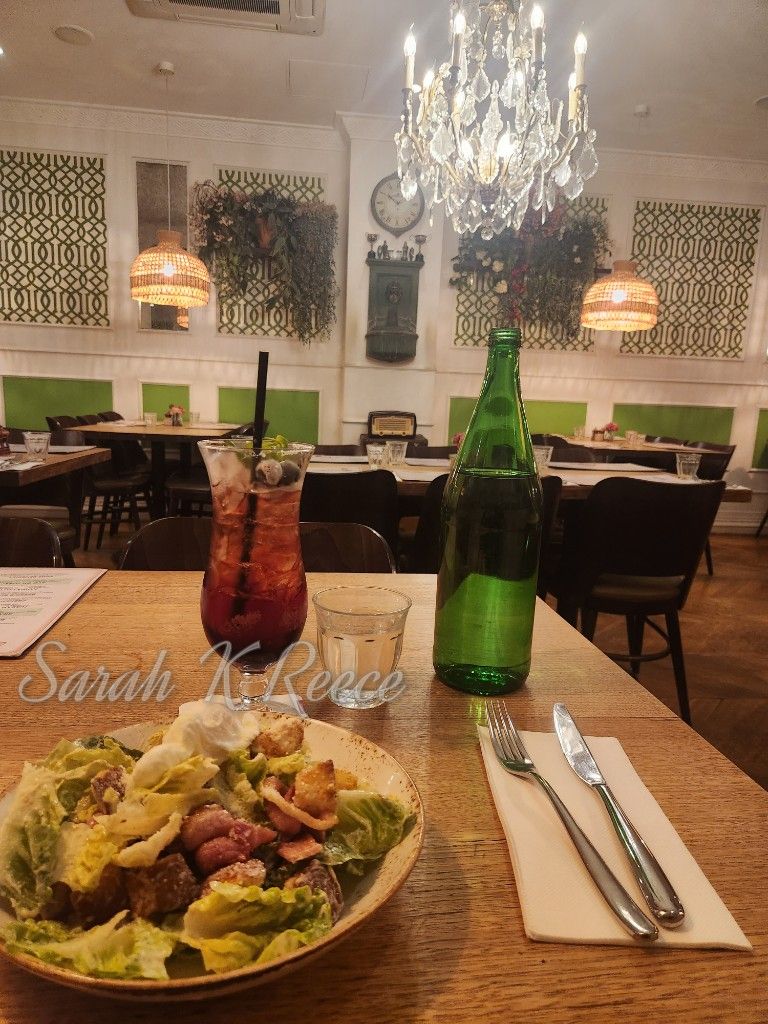
ID A meal at a table in a restaurant. The decor is green, vintage cottage style with a chandelier.  The meal is a Caesar salad, a sour cherry soda in a tall glass,  and there’s a green bottle of water. 

It was hard to go. Nightingale is not well, 3 of the four kids are having a hard time. It’s hard to predict the timing on these things and this one turned out pretty rough. I’m not coming home refreshed and ready for the challenge, I’m coming home pumped full of antihistamines, sleep deprived, and looking forward to my own bed, my own food, and snuggling my family. I’m glad we’ve done so much work on what my own access needs are, what helps make it possible for me to show up and use these skills. It’s strange wearing the lanyard and noticing how people treat me differently, feeling myself moulding into that role in weird and uncomfortable ways. But also, when my bags got flagged going through security on the flight home and everything had to be unpacked because my lovely heavy metal fidgets were showing up on the xray as concerning, and the person looking at them didn’t know what they were, the lanyard gave me the benefit of the doubt while someone else came over and explained what fidgets are. The entire plan had boarded by the time I was free to dash off to it which was wildly unsettling but all was well. I was able to hold the spaces I wanted to hold, Nightingale held the sky up at home, and I’m heading back now having rekindled a small welcome fire.

I love my client work and deeply value my NDIS business but I’ve also been horribly restricted and I’ve terribly missed the opportunity to stretch all these other capacities. It’s very sweet to be starting to reconnect again.

I’m Presenting in Prague

I’ve just arrived in beautiful Prague today.  I’ll be presenting an online keynote and workshop at the International Hearing Voices Congress 2025 for Intervoice Day on the 9th Oct. You are welcome to attend that day online for free by contacting Kellie Stastny (Chair of Intervoice) at her email: kelnco87@gmail.com.

I haven’t been to a Hearing Voices Congress since 2013 when it was held in Melbourne. Back then I presented Introducing Multiplicity explaining the different ways people experience voice hearing, dissociation, and multiplicity/plurality, and a second talk about using the Hearing Voices peer based group model to support people with other experiences with my co-presenter Jenny who passed away recently. We used to facilitate the local hearing voices group Sound Minds together.

This time the conference is themed around the topic of supporting young people. I’ll be delivering a keynote called Gary: supporting young people with complicated minds, and then in the afternoon holding space in a workshop about finding hope when supporting people with ’embodied voices’ – all kinds of multiplicity and plurality. 

I used to exclusively support adults in the community services sector, but NDIS has brought me into contact with many families, children, and young adults over the past 5 years, and as a parent of 5 kids, and someone who was themselves a ‘Complex’, ‘at risk’ kid, I’ve learned a lot. There’s always so much more to learn, but I also recognise that a child who hears voices or switches between different personalities is for most people so far outside of their comfort zone they don’t know where to start. I certainly don’t have all the answers but I do know where to start.

I was once that strange child who felt possessed. I’m still ‘possessed’ in that we’re still multiple/plural, we’ve grown up but we’re still a group. We are married and own a house and raise our children and run a business and employ a team of people. I have supported other people and families and witnessed from afar even more people finding good lives. It isn’t hopeless and it doesn’t have to stay scary.

So, I’ve created a collection of new ink paintings in purple and black ink and put them into a powerpoint, printed out a stack of Welcome Packs about multiplicity and dissociation, brought warmer trousers and packed melatonin and sensory items.

ID ink painting in dark purple of a downcast young adult with an arrow in their chest, pinning a card to them with the word Complex on it. Their dark hair tapers into fern like curls, which are also the pattern on their pants.

I’m so looking forward to meeting familiar faces again and getting to know some new people. This movement is precious and they sheltered me when everyone else rejected me. They saw capacity when everyone else was consumed by my limitations. They welcomed me to grow in the local group and then use it as the fertile soil in which to plant my own strange ideas and grow resources for others out there on the margins who were also excluded and alone. They’re messy and imperfect and certainly not a Utopia in any way, but their values are excellent and the observations and knowledge and hope they hold for people written off as crazy and doomed is unparalleled.

It’s a big deal to come here, it’s expensive and time consuming and it means a week without my family, with my beautiful wife holding the fort with the kids and the business. We talked about it for months, going back and forth about the value of it and the cost and the potential risks. During that time, we also had 4 funerals over 5 weeks, one of them Jenny’s. She was an unfailingly kind soul, who welcomed everyone and spent years spreading her story of acceptance and hope. I carry that story with me, alongside so many others.

Nightingale and I found ourselves asking what we will have wished we had done with them if we knew we only had a year or two left ourselves? Our children are our world and everything is wrapped around our family, as it should be in our circumstances. But my world pre and post covid looks vastly different and I am aware of the losses, the things I used to do and the voice I used to use. Movements struggle when people can’t show up for them. Nightingale and I keep coming back to this – finding safe and accessible ways to share this kind of information. Making the terrifying understandable, the unspeakable bearable. Facilitating conversations. Holding hope. Diversity like this has a suffocating weight and people – and children – around the world are drowning under it. They don’t need to be alone.

Empowering therapists and parents and partners and doctors to become comfortable with people like me, hearing stories of hope and meaningful lives, having a language for experiences so you can share them, and meeting others like yourself are powerful antidotes to isolation, darkness, and terror. So I’ve flown half way around the world to reconnect with a movement I believe in and add my small candle to all the lights people are holding out there in that darkness.

Disability Support Workers, Autism and Self Care

Speaking as an autistic person, the parent of autistic children, and the organiser of supports for autistic folks, it is desperately important not to assume anything when it comes to self-care. Some autistic people have no issues in this area, but many of us have struggles! Self-care gets used to mean a few different things such as activities of daily life which are the things we need to do regularly to look after our bodies like hygiene and grooming, and mental/emotional self-care which are things we need to do to look after our mental and emotional wellbeing such as things we enjoy and find meaningful. Autistic folks can have struggles with both, in this instance I’m going to discuss physical self-care.

Culturally we are accustomed to children needing monitoring and support for self-care, but autistic children will often need more of both, and tailored to their particular challenges. We are less familiar with able-bodied adults of normal or high IQ needing assistance with self-care. This means we may fail to ask simple questions, we may miss signs of problems, and we may accidentally add to shame and secrecy.

Examples of Self Care Challenges

I have spent a lot of time in emergency departments with an autistic person in crisis, with doctors doing all kinds of tests before someone realises the primary issue is one of self-care, or that a lack of self-care is exacerbating and complicating the issues. We can have a lot of difficulty with activities of daily life such as

  • Drinking too much or too little water
  • Restricted eating, compulsive eating
  • Forgetting to or struggling to shower or bathe
  • Difficulty brushing teeth
  • Difficulty managing head, body, or facial hair
  • Difficulty trimming nails
  • Difficulty managing splinters, wound care
  • Difficulty managing periods
  • Not taking medications correctly
  • Not enough/too much/other sleep disorders
  • Dressing appropriately for the weather, managing dirty clothes
  • Managing continence
  • Managing pets and animals in our homes
  • Managing domestic tasks

Why are there difficulties?

These challenges can arise for many reasons. Autism can come with intense sensory attractions and avoidance. Some autistic people have a hypersensitive awareness of some body functions, and little or no awareness of others. Many can have difficulty with executive functioning which can make remembering and doing self-care tasks difficult. Sometimes people have never been taught self-care skills. Sometimes people have grown up in disrupted environments such as poverty, foster care, or homelessness where self-care was not modelled and they’ve normalised the lack. Often these issues become more pronounced when self-care isn’t adequate – the executive functioning is worse when people forget to eat, the mouth sensory aversions are even more intense when someone hasn’t brushed their teeth or seen a dentist in 10 years.

What can the outcomes be?

All of these can cause trouble – for example, one person may forget to drink because they never ‘feel’ thirsty. Another may drink far too much because the sensation of thirst is intensely unpleasant to them. Self-care challenges can have serious consequences for people, and in some cases can be life-threatening. It is absolutely possible even for educated, well-off, well-presented adults to have severe self-care challenges that they do not disclose. This is an interesting case study of a late-diagnosed 18 year old where self-care difficulties caused serious medical complications.

The consequences can also be more subtle and hard to see – for example someone who stops leaving the house because they are worried they may smell. People lose out on social and work opportunities and can become painfully restricted in their lives due to these challenges.

The role of shame and confusion

Many people carry intense shame and confusion about why they are struggling with these things. This is often even more severe for those who are diagnosed late and don’t have a framework to understand that their challenges are part of a disability, not a personality flaw. For example, someone may have perfectly physically functional capacity for continence, but have frequent toilet accidents because when they notice they need to use the bathroom they are unable to interrupt what they are doing and give that task a higher priority. They will continue to do the task in front of them – perhaps with overwhelming panic and dread, knowing they are not going to be finished in time to get to the bathroom but stuck and unable to switch tasks. If this person has never had this explained to them, the shame can be intense.

It’s also common to have many factors in play – for this example maybe we add in an experience of sexual trauma that adds shame fear and confusion to all things related to gentials, and a sensory aversion to the smell of urine making bathrooms difficult to spend time in, and a sensory aversion to wet hands making the task of toileting hard to manage.

Secrecy and putting it out of mind is a common way of coping with these issues. Unless directly questioned, many autistic folks with self-care challenges simply don’t volunteer the information, and in some cases are not aware that other struggles are linked to them and may simply endure or spend many hours and a lot of money trying to find causes for illnesses that are actually things like dehydration.

What does good support look like?

Sometimes disability support workers are the ones who notice a problem. We might be the first people who are spending enough time with a person to realise that they never drink, and that they often overdress in hot weather and have frequent headaches, nosebleeds, and fainting episodes. We might be the first people let in on the scary secret. We are sometimes the ones who help make sure the right people are linked into the information – I’ve sat in on more than one Functional Capacity Assessment and had someone breeze right past all their self-care struggles and forget to pass on information like their clinical malnutrition. I’ve also sat through assessments by people with no training in neurodivergence who spent the entire time focusing on the clients physical capacity and completely ignoring these hidden challenges. This is unfortunately common in the medical profession and adds a lot to shame and misery.

We can help by reducing shame and being safe to hold such personal information about someone. When we are supportive, we go at the person’s pace. If they are not ready to tell people like their GP, we build that trust. We accept that this is hard, and that being open about it is in some ways even harder. Sometimes people are very accurate in their fears about how the information would be received, and we can help them find safer people to ask for help.

We can normalise the challenges and keep them linked to the disability, not the person’s character. Disabilities can be tough to manage. Peers and peer experiences can somtimes help a lot. Anything we can do to help someone feel less alone and less freakish can be useful.

We can help externalise the challenges. Drawing a distinction between the person as a problem, and the person dealing with a problem. When we team up to deal with a problem, it’s less personal. We can recruit other safe people for the team too – Occupational Therapists or Speech Therapists with experience in Autism can be very helpful in understanding why some of these are so hard and helping figure out work-arounds.

  • We can help with prompting when the issues are around remembering and initiating tasks.
  • We can body double when the issues are feeling overwhelmed and not being able to focus
  • We can take notes in useful appointments and help people remember the strategies suggested
  • We can help make aversive tasks less difficult or stressful by telling jokes, playing music, planning nice things afterwards, breaking them down into little steps
  • We can remind people to tackle hard things slowly, to take breaks, to be kind to themselves
  • We can be companionable such as sharing lunch time together for someone who struggles to eat
  • We can check in to see how things are going in an unintrusive way
  • We can shut up and back off when the person is feeling swamped
  • We can plan ahead for the next time things are hard – for example if someone has struggles with self harm and wound care, we can help them find a good caring local nurse, make sure their first aid kit is well equipped, and normalise asking casually and privately about self harm during shifts to help reduce severe infections and scarring.
  • We can educate and remind people eg. I wonder if you feel awful because you’ve forgotten your meds?
  • We can accept rigid thinking, validate feelings, and help people care for themselves without directly arguing with them eg. I know it’s very annoying the doctor insists you eat something with this medication, do you feel more like cheese and crackers or yogurt?

Really good support in these areas is built on a solid relationship. The person with the challenges needs to feel somewhat safe and respected. Sometimes they will not see their challenge as a problem which can mean that for them they have to put up with people around them ‘making a fuss about nothing’. This can be managed where there’s some trust. I support someone who has no sense of food safety at all, but accepts that I ‘fuss’ about things like chicken that’s been left on the bench overnight. To them it’s a needless annoying trait of mine, but they value the support I provide enough to put up with my ‘foilbles’ about food safety. I accept that this is their perspective even as I ask them to ‘bear with me’ while I replace bacteria laden chicken with a fresh meal.

People are more likely to hide, lie, or shut down and forget these issues when they don’t see a way of handling things that preserves their sense of dignity. For them, the trade-off simply isn’t worth it. They’ve already tried and failed to do any better at managing it than they are, the last thing they want is for it to have a massive social cost too. It’s often up to support people to make sure it doesn’t. A lot of health and healing comes from finding ways to bring the unspeakable out into the open in safe places, whether that is ‘psychotic voices’, disordered eating, or incontinence. When we work so closely with people in their homes, we can be a huge part of helping make at least that space one in which it is safe for them to have the disability and the challenges that they have, and to still be seen and celebrated as whole people.

Mental Health Master Class

Hey lovely folks! I’m thrilled to be getting back into my workshops. I shut down all my public speaking, workshops, and consulting when the pandemic took hold and it’s absolutely wonderful to be dusting it all off and getting back into it. Keeping my clients alive and figuring out how to hire folks to be their teams was absolutely consuming and I simply couldn’t juggle anything else for the last couple of years. Yet I have missed it so much, there’s a special kind of magic in these spaces you don’t get in one to one work. Groups have so much power to validate and support each other. Nightingale is kindly sorting out the important things like room bookings and dates so things actually happen and I will be turning up to the correct location and on the right day!

This time I’m running a session on mental health on Friday 3rd of March, so if you’re interested share this post. This is a fabulous introductory price so grab your tickets asap. 

You will get to spend a day redefining mental health from my unique perspective. Mental health training is all too often divorced from the real world. Services are imperfect, frameworks have limitations, and sometimes our madness is what saves us. Embrace the contradictions and find hope rather than confusion in the complexity. Support others to find their own meaning and discover the most useful resources they navigate a mad world.

When: Friday 3rd March, 10am – 4pm 
Where: 19 On Green*
How Much: $300** (GST included)
If you don’t have NDIS funds and are experiencing financial hardship, please contact us. Some reduced price tickets available. 
admin@sarahkreece.com
Where to Book: https://www.eventbrite.com.au/e/545817403547

*Fully mobility accessible venue with breakout room.
**NDIS payment accepted for self and plan managed participants, please contact us if you need an invoice sent to your plan manager. 

I would love to see you there. This is suitable for people with no experience at all, or those who work in mental health but would value a fresh perspective. Carers and people with lived experience are very welcome.