Recovery approach to Risk Workshop

Tuesday, I was fortunate enough to be given a free spot (as a broke, voluntary peer worker) in Mary O’Hagan‘s workshop at the MHCSA. Ah! So wonderful! Inspiring me that I’m on an important path with my passion for Peer Work, and challenging me to take my thinking even further. She conceptualized a much broader perspective of risk than we usually see in Mental Health Services – not just that people are at risk perhaps of self harm or suicide, but also at risk of hopelessness, disempowerment, loneliness… subtle but powerful risks we all face. She also encouraged us to examine the risks of a risk adverse approach to life, what that costs us and the constricted lives we lead when we become afraid of risks and thus unable to grow.

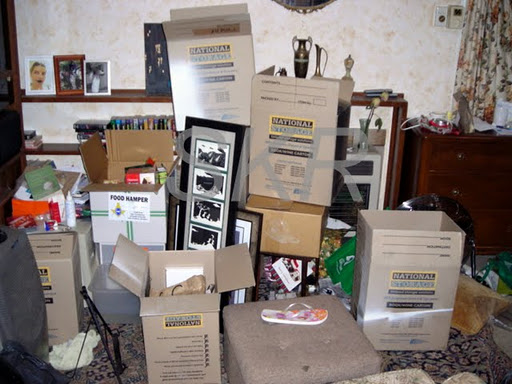
I was so excited I felt like Hermione wanting to leap out of her seat with her hand in the air at every question! Some of the practical tools about how to engage risk and engage at risk people without just giving up on them or taking control away from them were really fantastic. I wish we had had another couple of days to explore these concepts in more depth because the paradigm shift is quite profound. At one point my table was given an exercise, described a woman in a really difficult catch 22 situation and asked how we would intervene. The scenario is that the woman was hoarding ‘junk’ which was a serious immediate fire risk (eg papers stashed over the pilot light on the gas stove), a health hazard with degrading and composting items, causing serious trouble with her neighbours due to the smell, and going to get her evicted very shortly. She was completely against having anything removed or even moved around to safer places within the apartment and continuing to add to the hoard on a regular basis.

At first I just felt hopeless, I know that the situation is desperately urgent and the woman is at risk of losing her hoard and becoming homeless which may very well set off a profound mental health crisis. The need for urgent change combined with what sounded to me like an extremely high need for control over her environment are such an impossible conflict. My first thoughts were of removing her from the house to hospital or another place and fixing and cleaning it for her. The pointless and desperate power play we would be caught in at that point would almost certainly end with the woman self destructing in some way.

Then we started to think more creatively about it and break it down into different areas. Some issues – like the fire hazard, were urgent and non negotiable. Clear, immediate change was needed. But even there we didn’t have to do the obvious and force her to clear the stove. Someone in the group suggested turning off the pilot light or temporarily disconnecting the gas to her apartment. That’s one urgent problem solved without dominating her. The next step I felt was to get her some support for whatever was driving the behaviour – anxiety, grief, trauma issues, OCD… if we made the issue the behaviour we were pretty doomed, if we could get help for what was driving the behaviour maybe we could settle it down. The high need for control always sparks concerns for me about possible trauma history – and at that point I’m looking for ways to help meet that need, exaggerated though it may be, rather than trample it.

I felt that a peer relationship would be crucial, I suggested calling around the peer networks to see if we could find someone who had themselves had trouble with hoarding and was doing better to call in and befriend this woman. Many people who struggle with behaviours like this are deeply ashamed, isolated, and confused by their own behaviour. Having the experience normalised, having someone else around who ‘gets it’ and can also incidentally, probably offer some great suggestions to us as the workers, can make all the difference in the world.

We also suggested that framing any change or intervention should be done not through the lens of our perception of the needs and risks (her relationship with her neighbours is going to collapse, she is going to become homeless, she is at risk of a breakdown of some kind), but within the framework of her goals and what is important to her – so instead of talking about keeping her house we would be talking about helping her keep her belongings (which of course she would lose with her house). That is currently her goal and focus – it may change over time, but at the moment that is what is important to her.

Suddenly we had an approach that was not controlling or coercive, that took the situation seriously and managed the high immediate risks, and that had a change of success. I was really excited about this! We were also asked what the risk to her might be resulting from our intervention. I felt that the biggest risk of this approach might be that working around her high need for control may inadvertently re-enforce the need and make the behaviour worse. I don’t think there would be a very high chance of that, generally I’ve found that people with exaggerated needs of some kind get a great deal of relief when they are accommodated and learn how to meet those needs while living in a less than ideal world – there’s a lot of negotiation and creative problem solving involved in that! There can be such a huge relief in being allowed to have a struggle or challenge of some kind instead of just being under constant pressure to get over it and have it sorted out. But people do react differently to things and I felt if what she needed was reassurance, was someone to come in and help her contain her behaviour, then treating her as if her anxiety were legitimate or her compulsion reasonable may possible amplify it.

I am so excited by these ideas around the opportunities that risks present us, around the understanding that freedom, dignity, and reciprocal relationships are foundations of mental health and if we want to support people’s recovery we have to find better ways of building these into our services! My experience as a ‘consumer’ has frequently been that dignity is the price at the door for any support or assistance you get. Freedom and equal, mutual relationships are also pretty rare finds and very precious when you do find them in mental health services. I am more committed to Peer Work than ever.

I had a very busy, exciting and inspiring day! I had some wonderful conversations with people, there’s the possibility of a few opportunities opening up – like perhaps a chance to give a talk with Tafe. I also rabbited about the Dissociative Initiative and talked to Mary about our groups Bridges and Sound Minds – she’s interested in the framework we’re using as she’s involved in trying to set up some peer groups back in New Zealand. Goodness gracious, how strange the world is when the movers and shakers of the mental health world want my opinion about something!!

I also have very exciting art news – I’m going to be in the Fringe!! The Cracking Up comedy show needed another person and I’ve been invited on board. I’m so excited! I get a badge! I get passes to events! I get something great on my art resume! I get some training! I get to perform with some really awesome people!

I’ve flown to Melbourne safely and landed, all is well except for the slight hiccup that I’ve had a very busy week, I’m quite sleep deprived, fairly dissociative and somewhere between exuberant and hypomanic which is far too wired and excited to sleep. I wish all the good news and exciting possibilities didn’t happen at once like this, it completely fries my brain and I can hardly take any of it in. One really exciting event per week please, certainly not 6 in a day! Still, as far as life goes, it’s a pretty damn awesome problem to have.

My talk on Thursday is progressing well, the powerpoint is set and done, I reordered a bit to make sure it would all make sense to people totally new to dissociation. I still can’t seem to get it down below the 25 minute mark (I only have 20 mins) which is deeply frustrating. I’ve already badly condensed talking about my personal experiences and cut out the poems. It’s being forced to be more a clinical talk than I want – the personal side of it is so important. But, without the clinical framework, the personal information can just become sensational and not educational which is absolutely not what I want. Essentially I’m trying to cram four talks into one here – Introducing Dissociation, Introducing DID (or Multiplicity), Managing Dissociation, and My Personal Story. Each of those could comfortably be a an hour talk or a days! One day when I offer to give a talk they’ll give me a whole day to do a workshop instead of accepting the abstract and knocking down my allocated time! 🙂 Not that I’m whining, I’m so terribly excited to be here, to have the abstracts accepted and the conference fees waived and Mifsa have agreed to reimburse my travel costs and I’m being kindly hosted by a friend for the duration – otherwise it simply wouldn’t be possible with bills to pay off. All day I’ve been thoroughly enjoying saying “I’m flying to Melbourne tonight to give a talk”. 🙂

Mad Monday

Busy today! The Mental Health Peer Work Cert IV started today and occupied 9.30am – 4pm. There was a lot of talking about cultural sensitivity and an hour DVD about racism that I found deeply disturbing in that I’m not convinced that reversing power roles and swapping who gets betlittled and humiliated is the best way to create harmony between people of different races.

Dashed home to work more on the talk for Melbourne this week – re ordered the content to help it make more sense to someone who doesn’t know anything about dissociation or multiplicity, cut out the poems, and managed in the end to only reduce it by 1 minute running time… I still have to cut another 5 minutes from somewhere. Deeply frustrated!

Then ran off again to Radio Adelaide for more training. Did my first interview with a hand held recorder standing on North Terrace and trying to block out the traffic noise. Fun! Really enjoying this course.

Home again to work more on the talk, print up travel passes, pack, fire off last minute emails, and get ready to go.

Tuesday is a full day of training with Mary O’Hagan at a ‘Recovery approach to Risk’ workshop I have been fortunate enough to get into. I’m very excited about it! That’s a full day, I’ll munch down some dinner, grab my gear and head off to the airport to go to Melbourne after.

Charlie is looking a lot better and booked in to the vet for a checkup on Wednesday… another fortnight’s pay demolished!

And today a big chunk of a molar that’s been slowly dying fell off, leaving a sharp jagged edge that’s cutting into my tongue. The quickest appt I could get with my (superb) dentist is mid March… I hope I don’t get a big ulcer just before having to do these talks!

When I get back I’m going to polish up the Dissociation Link website and launch that with a new newsletter for this month, print new business cards with those details on it, do my Radio Adelaide homework, and book in some nights off to relax. So far I’m keeping all the balls in the air and still eating two meals a day at least and wearing clean socks. I suspect by the end of this week I’m going to be ready to wipe out… although the nervous energy following the talks might keep me wired until a crash on Sunday.

Hope you’re having a good week too. 🙂

Working on my talk for Melbourne

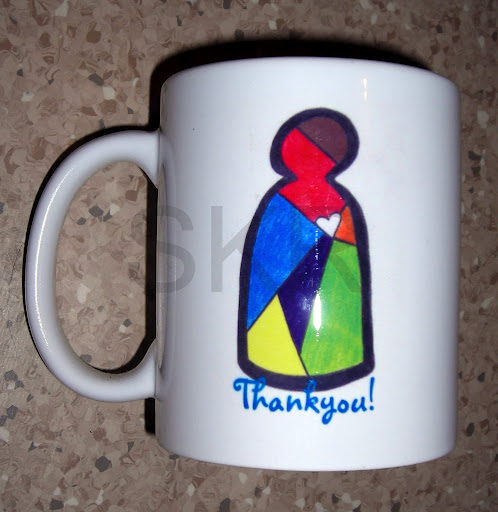
I’ve been working hard this week on putting together my talk for Melbourne. Today I’ve polished the last of the plan, selected some short poems, and painted nearly 30 ink paintings to illustrate various concepts I’ll be talking about. For example:

Illustrating a common split in traumatized people, between heart and mind, or to put it another way, between their emotions and their intellect.

I like using pictures particularly in a situation like this, where the content could happily fill a week of day long workshops but I’ve only been allocated 20 minutes.

One day, I’m going to be better known as a speaker and when I ask for an hour to do a talk I’ll get it!! Considering that nearly every talk I do has to have the basic ‘What is dissociation’ intro to it – and that to properly answer that question would take at least 20 minutes, my job is a hard one!

This is the first time I’ll be doing a talk with such personal content without sharing the spotlight with Cary… I don’t like it! It’s nice to have another person with a dissociative disorder to shoulder the load and ease the freak factor a bit. So, I’ve re-dyed my hair instead which oddly enough is making me feel better about it.

Back to it, still have four more images to paint and then need to rehearse it all and check my time.

The Afternoon Tea was great

*my pdf hosting site scribd is down for maintenance so most of these links won’t work at the moment. It’ll be up in a day so I’ll be back to fix them!

I was really pleased with it. It was really nice to take a moment to celebrate what we’ve been able to accomplish! About two years ago Ben, Cary, and myself starting meeting up to talk about the lack of resources for people who experience dissociation.Cary and I were (to my knowledge) the only two people in Mifsa with a dissociative disorder, both of us had started as participants and had to explain our condition to every support work or staff member involved with us. Initially we talked about how frustrating we found this. Then we started to investigate how we could start to change things.

We ended up holding some ‘community consultations’ where we asked other people who experience dissociation what their experiences in mental health services have been like (mixed – a lot of bad stories, the occasional really great therapist or worker) and what resources they really need. We then had a look at what, practically we could actually get set up.

The greatest ask was for a support type group. Most people with a dissociative disorder have never even had the chance to meet someone else with the same experience. The isolation was extreme, and the level of stigma and discrimination also. Many people talked about being thrown out of hospital while in crisis, told their condition doesn’t exist or they are faking it for attention. The level of anxiety in this population is the highest of any group I’ve ever worked with. The need for sensitivity and confidentiality is also very high. Some people have been told by their support workers that they will lose their support if they ever ‘research’ their condition, as that will be seen as proof they are making it up. The result of this is often deeply internalised self-stigma, and an inability to access information, community, and resources – which are the very things anyone with a mental illness needs. Even the process of community consultation was both confronting and a huge relief for many of the people who came. There have been tears as for the first time people hear someone else talk about something they’ve experienced and kept secret for so long. It’s very powerful and deeply moving to be part of.

So we decided to set up Bridges and put a lot of time and research into deciding on a good format and making sure we could sustain it over time. We launched a new flyer for the group, which has the answers to the most common questions we’re asked about it printed on the flyer here.

The other resources people asked for that we felt we could get up and running without too much trouble was fact sheets that broke down dissociation and multiplicity into simple everyday language so people could take them home to family or friends or in to doctors. The burden of constantly having to try and explain confusing experiences we may not understand ourselves is a huge one and some paper resources can help. At the Afternoon Tea we launched two fact sheets that will be made available at the front desk (on display behind the receptionists). You can download your own in pdf form, one is Introducing DID, the second is Managing Dissociation.

Access to books to read about dissociation was another request we’ve been able to start on. I’ve made my personal library available to anyone at Bridges, and now opened it up broader to anyone who needs some more information be they family, friend, or staff working people who experience dissociation. I do need a deposit to help me replace books that don’t get returned, but it is refunded on return of the book. You can find a list of my personal library here.

We’ve recently been very fortunate to have several books about dissociation from my wishlist donated to the Mifsa library! The admin team are now creating a brand new area the library, Dissociation, and putting the new books into it! I’m so excited about this, when I first came along to Mifsa I looked for information about dissociation in the fact sheets and the library and was deeply disappointed that there weren’t any. Now there are both! The Mifsa library books are free to borrow for Mifsa members (which only costs $10 a year conc), just take the book to the reception and they’ll sort you out. 🙂

Most of the people attending the Afternoon Tea were from organisations outside of Mifsa, which was really good to see. A couple of people came along to ask about Bridges and seek support which I’m always really glad about. I bought along a little gift for myself, Ben and Cary to thank each of us for the work we’ve put into this. I think it’s really important to make time to celebrate and appreciate people, and when there are a lot of voluntary hours involved that is doubly true!

So there we go, done and dusted and now I can work on finishing the powerpoint for my talk in Melbourne this week – it’s almost upon me! I leave Tuesday evening to give me Wednesday to chill out a bit and then both talks I’m doing are on Thursday. Lots of busy-ness will be happening in the next couple of days!

Helping out at Mindshare

I’ve taken on a voluntary role with Mindshare, helping to upload and manage the Writing area of the site. 🙂 I’ve been involved as a contributor since the site was launched, you can see some of my work here. I really like the ethos of the site, the idea of giving people a voice and developing an online community. They also have facebook page here.

“mindshare is a unique space that allows mental health consumers and their supporters a place to creatively tell their stories. It is a community dedicated to de stigmatising mental illness through shared experiences” 

– Louise Pascale, Digital Media Officer.

Those of us involved had a meet up on Monday to talk about the site and possible improvements. One of the downsides of the lovely uncluttered front page they have is that while new blog posts are always posted on the front page, the other new creative content such as photos, writing or music don’t always show on the front page, so please have to go looking to see if there’s new content. Unfortunately there’s no way with the website structure to automate a front page update, but one of the volunteers is going to try and manually rotate all the new content through the front page when they can to help people find it. Another new development was opening up comments on all of the content – previously comments were restricted only to blogs. It can be a little disheartening to send work out and not get any response, so I hope this step will help to strengthen the sense of community on the site.

So, for all those of you with something to say – a story to share, a poem, an experience to write about, a complaint, an idea, a suggestion, type it up and send it in. (to the Mindshare email please, not directly to me!) We need posts for the blog, we need music, art, photos, poems, whatever you have that’s in digital format. We love to be posting several new things every day so we need people to send us new material. All the details are on their Get involved page. You can be anonymous if you wish, just chose a pen name and send in your work with that name on it. If you’d like to add a short biography of who you are, we’d love to attach it. If you have a website or blog of your own, we’re happy to put a link to it, just let us know.

For those of you thinking about Peer Work, this is another great opportunity to tell your story and reach a large audience. I promise that writing an article is a lot less stressful than giving a talk! For those of you thinking about starting your own blog, this is a great chance to hone your skills and become familiar with the format before you jump into managing your own.

On that note, we are planning to offer a workshop soon on how to write for a blog, and I plan to offer a quick walk through of starting a new blog of your own with the Blogger platform. There’s also talk about new training to learn how to use different technology and be able to make your own movies, vlogs, and podcasts, which I am very excited about! Stay tuned for further details!

And a last quick reminder about the SmART training this week – get in quick if you were thinking about it! See all the details at What’s On.

Training at Radio Adelaide

Yesterday I started my Radio Adelaide training and I loved it! I am doing the ROCC, (Radio and Online Contributors Course), which is part of a Cert III in Media if I wish to take it further. I’m thinking yes! Today we learned a bit about the instrument panel in the studios, and I recorded my first interview! It was fun! The sound of your own voice in your headphones is slightly weird, but I really enjoyed myself. I’ve been feeling a bit down and tired since the move – possibly still recovering from that, maybe the new meds, who knows. I’ve been concentrating on better separating my work and play times and making sure I actually go and do something I enjoy for my relax times instead of just zoning out and letting the hours go by. This afternoon in between two different training sessions I took time off and played computer games, and I felt a lot better afterwards, more energized. But getting into the Radio Adelaide training was even better yet, I love learning new skills, I love a challenge, I felt my brain wake up and focus and take everything in – this doesn’t always happen, but it’s magic when it does.

I remembered that so far my new study has been admin and paperwork, which grinds me down, but that soon it will be new skills and being stretched and exposed to new ideas and I will feel excited and enthused about it. That was very encouraging. I remember why I had been so excited about all my new study!I’m going to learn how to use WordPress – Radio Adelaide are setting up a blog for interesting stories and interviews to be hosted on and as part of this training we have to learn how to use it and upload content to it. I’ll also be learning how to podcast – hurrah! We’re working with Adobe Audition which so far has been delightfully easy to use. I love it when programs use similar commands and hot keys. We did basic editing of a sound file using the Ctrl+C, Ctrl+V cut and paste commands! Couldn’t be simpler. Wheee!

What awesome skills to develop as a Peer Worker! I don’t know exactly how or where I’ll use them, but I am very excited by all the possibilities. I did an impromptu interview with fellow trainee Gary, he elected to be asked about his carbon footprint and chatted about bike riding and recycling, and I elected to to talk about some of my earliest memories (these were the only options we had) and chatted about how excited I was as a little girl about wearing my new red sandals for the first time, and the experience of being accidentally smacked in the noggin with a gold club – which I think for the duration of the interview I called a ‘golf stick’ whoops. But there you have it, two vivid early memories of mine. I like the sound of the voices in the microphones, you have to get very close to them and the voice kind of burrs, become softer and base-y, it’s oddly intimate sitting in a studio with a stranger asking questions about their life. I imagine it would be easy to become comfortable with the other person and forget this was going to be aired to the rest of Adelaide!

Sound editing! Recording processes! Absolutely fascinating. Apparently next week we will be learning how to use a portable recorder for interviews outside the studio, and possibly how to edit multi-track files – where you have more than one layer – say the voices for your interview is one, then maybe some music fading in is a second layer, or some sound affects a third. Just think of the possibilities! Some poets record their poems and post the sound file alongside the written form – very useful for those with a print handicap of some kind, and sometimes reading a poem can bring it to life. I certainly enjoy reading mine, such as at the Broken Hill event recently, and listening to a well read poem is a joy. New horizons beckoning.

Working on dissociative resources

I’ve been working hard on more resources for people who experience dissociation and those who support us. I’ve been doing this for a couple of years now, and strangely enough instead of getting tired of it all I feel even more motivated and urgent about doing more.

Part of this is that between the group Bridges, and taking various support calls and emails, I am finding myself hearing confidential stories of people’s pain and distress. This is really making me aware just how great the need is on a very personal level. It’s very difficult when I so often encounter apathy about the lack of dissociation appropriate resources – the assumption is that very few people experience dissociation. Even if that were true, we still need support! Feeling like I’m one of the few people who knows how urgent the need is, is making me incredibly driven to do more. It’s taking a lot of effort to slow myself down and look after myself too.

One of the things that really helps me is the Dissociative Initiative, because then I’m not alone in my concerns and my passion to change things for the better. It really helps to have other people share this frustration and the dream. We met up again recently, and trialled for the first time using Skype to include an off-location member. I was thrilled with how well it worked, we can now explore using this technology to help rural people access Bridges! We planned the Afternoon Tea this Friday (see What’s On for details and a pdf invite – all welcome!), new resources we will have ready in time to launch at it, and some upcoming talks.

I’m doing a couple of talks about dissociation soon in Melbourne for the Voice hearer’s conference, and Cary and myself will giving a talk at Mifsa on March 28th. We’ve decided to deliver the talk we gave at TheMHS last year, as that venue was only open to people who could pay the fee, whereas this Forum will be free for everyone. So we’ll be sharing our personal Grounding Kits and explaining strategies we use to help manage dissociation!

We’re also talking about ways to develop some support for carers and family. We’ve noticed that some of the information and support we’re providing is for professionals who are inexperienced at supporting people who experience dissociation and looking for good resources and suggestions about how to help. So we’re thinking about ways to support the support people too. 🙂 One of the great results of this is that we can have a much greater impact by helping other people provide support, than what we can do only by ourselves.

One very big exciting development is a new blog! We run a mailing list for people who like to be kept updated with our newsletter and any news about Bridges, but as it’s getting bigger manually emailing everyone is becoming burdensome. We’ve thought of a few ways of managing this while keeping the list strictly confidential, and for the moment we’re going to try using a new blog and the ‘Follow by email’ option to manage the mailing list on our behalf. Every month when we upload a new Dissociation Link newsletter (see back issues on my Articles page), the blog will automatically send everyone on the mailing list an email about it, with no possibility of me accidentally giving one person’s details out to someone else. That thought makes me very happy!

I also like the idea of people being able to read about Bridges, check times and dates, download their own flyer or factsheets, and gather some real information about who we are and what we do before making contact. Some people are very anxious and I think not having to ask for this information would be helpful, especially if they’ve already asked but forgotten (common with dissociation) and feel too embarrassed to ask again. 🙂 Plus, it will give people interested in learning about the Dissociative Initiative the option not to have to wade through my personal blog full of art and poetry and pictures of cats etc. to find it. 🙂 So this week is going to be busy while I pull everything together ready for Friday. I’ll keep you posted and create links here when things are ready to go.

In the meantime, SmART training about how to do grant applications starts this week – get in quick if you were interested! I’m hoping this will come in handy for applying for support to self publish a booklet, and other projects of the DI (Dissociative Initiative). There’s a few other groups and resources I’ve heard about on my What’s On page too, so have a look, I update it regularly.

Black humour

A sense of humour is one of the big keys that can help reduce traumatisation and increase resilience. Some survivors of trauma develop a very black sense of humour that can be incomprehensible to people on the outside, but is actually a really useful survival strategy. A number of years ago I was seeing a shrink who would be startled on occasion that I would come in, talk about something really dark and frightening, cry and get really emotionally intense about it, then when enough stress had been discharged, start cracking very black jokes about the situation. He advised me to hang on to my sense of humour and told me it would help get me through. He was right.

One of the things about crises I’ve noticed is they build momentum over time. There’s a sense of situations, problems and experiences all stacking up on top of one another until the whole situation is so huge and exhausting I can’t cope anymore. Humour is great because it can interrupt that process. Instead of being stuck on train tracks speeding downhill, watching the crash coming and being unable to stop it, humour can lift you off the tracks and take you sideways – somewhere else entirely. The problems are still there and the pain is still there, but you get a breather and a different perspective. Often humour in these situations is dark because that’s what you have to draw upon. The same things that hurt you can also be darkly funny in certain lights.

Obviously, this isn’t about humiliating someone else, and not everyone is comfortable with this kind of humour. There is a crowd who will get jokes about psychosis, catheters, and all the things that we also cry about on other occasions.

A few years ago I was in a really difficult place in my life. My housing was unsuitable and deeply stressful, my family had broken down, my mental health was crashing badly and one night I was really in trouble. I was self harming, feeling constantly suicidal, suffering severe insomnia and dissociation and pretty desperate. I’d had a frightening and exhausting day and it was about 3am. I hadn’t slept in a few days and I was becoming really scared about my state of mind. I sat on the floor and called Lifeline, hoping a friendly voice might help get me through the night without hurting myself.

Lifeline are really busy outside of business hours, because most people feel in crisis and need to call at the points when all their usual supports – doctors, clinics, friends – are asleep and unavailable. I always expect at least a 1/2 wait to get through if I call at this kind of hour.

I huddled against the wall, listening to the hold music on loop and jumping everytime it sounded like my call was being picked up, only to hear a recorded message about how busy they were. The suicidal feelings were increasing as I waited and I was trying to calm myself down and talk myself through them without much success. I felt trapped, exhausted, and totally overwhelmed.

Finally my call connected, the guy on the phone said hello, and then accidentally disconnected my call.

In the swirl of numbness and desperation I had a moment to decide which way to fall. It was like a see-saw balanced perfectly in the middle for just a second. I laughed. The sheer stupid ironic ‘Murphy’s Law’ nature of the whole situation made me laugh. I was going to laugh or I was going to self destruct, and laughing saved me. I shook my head in disbelief at my total inability to catch a break and gave up on getting any help that night. I crawled back into my bed and left it all as a problem for another day.

So, if you find a sense of humour helps – and sometimes the weirder or darker the better – make sure you keep reminders around you that sometimes life makes no sense and if your options are to be crushed by it or to laugh at it, it’s better to laugh. I keep Monty Python movies around, tack up comic strips I like, and have a few mates with a wild sense of humour who help to keep me from cracking up. There’s a time and a place for offloading and honesty and emotional expression too of course, but I find it also helps to laugh until your kidneys hurt from time to time. It might be the thing that gets you through.

Building social support

Some of us find ourselves in a place where we are deeply isolated in our lives. This is sadly a common problem for many people with ongoing mental health problems. Social support is one of the factors that help to build our resilience – our ability to handle difficulties. Isolation has been a major problem for me most of my life, and in my opinion certainly contributed in a big way to the mental health problems I was suffering as a young child. There are many different things that can contribute to becoming isolated, which can change the kind of approach you may find most effective in overcoming it. In my case, some of the things behind my isolation were very simple ones – such as being a creative arty person in a small school with a strong sports focus. Others were compounding issues such as developing PTSD in my teens and finding my peer group weren’t able to support me – their withdrawal distinctly increased my symptoms and distress which only made me more different and awkward and therefore more isolated. This kind of spiral – the experience of mental illness and/or trauma makes you behave differently and need different things, which can lead to your social support withdrawing, which can make the illness and distress worse – is a common one for many people. In addition, withdrawal from social contact is a pretty common symptom in many mental illnesses, so your social network can fall apart or move on while you’re hunkered down in a burrow somewhere. When you start to feel better and look around, it’s a bit like Rip Van Winkle coming home to find the whole world changed and his children grown. But too, for a lot of us isolation is part of the landscape in which vulnerability to trauma and mental illness is then grown.

I’ve rebuilt my life on more than occasion only to have it all burn again, and I’ve learned a few things from mistakes I’ve made over the years. Maybe some of these will be helpful to you.

  1. Sometimes you have to leave. I could bend myself into pretzel shapes trying to make friends at school, but really what I needed is to look elsewhere. There’s a few reasons for this – one of which is that having been targeted by bullies, even students who liked me were afraid of also being bullied if they spent time with me. But that’s another story! It would have been better for me to have been home-schooled and looked for mates in after school drama classes and activities like that.
  2. Borrowing the social network of a friend or romantic interest. It’s nice to be invited out and have people to hang around with. But if things go pear shaped you’ll be left picking yourself up on your own. Some of the energy you’ve invested into those relationships could have been spent making mates of your own.
  3. Putting up with very unequal relationships. It can get tempting to take what you can get and accept some miserable relationships when it seems that nothing else is on offer. I don’t mean never care about anyone else, or don’t be kind to your elderly stroppy neighbour. I mean taking on someone and treating them like your best friend when that’s really not what they are. Confiding personal information that is later used for gossip, nursing them through heartbreak when they never show on your bad days, always paying for the night out when they could afford to shout it now and then.
  4. Expecting more of your mates than they’ve got. When I was a teenager dealing with PTSD my mates at the time freaked out and distanced themselves. That was really painful and unhelpful, but I do get that a bunch of 15 year olds really weren’t equipped or supported to know how to relate to me. They had no idea why I was so reactive and overloaded, and frankly if I’d been given good support from other adults they might have had a model to emulate. Most of us don’t have friends who are deeply educated and experienced in mental health and trauma sensitivity. They are going to get it wrong. (frankly, even if they have loads of information and experience they will still get it wrong! That’s just the nature of being human I’m afraid) I use a lovely quote by Barbara Kingsolver as my own guide:

The friend who holds your hand and says the wrong thing is made of dearer stuff than the one who stays away

We all need contact with other people to maintain mental health. There may be different quantities for different people – some of us need more social contact than others. We also need a range of different kinds of relationships in our lives, from the barest acquaintances to the closest of kindred spirits. Sometimes we may be better at maintaining one kind of relationship than others. Some of us have a couple of really close mates but almost no one else in our lives. It doesn’t matter how awesome the friend is, you still need other layers in your life. Others of us maintain a healthy bunch of friends we see now and then, but never seem to find anyone really close. Some of us find ourselves in a pretty bleak space where we don’t really have anyone.

I started rebuilding my own networks from the outside in. That is, I started looking for acquaintances and people I might hang out with occasionally before I went looking for closer friends. There’s less being asked of someone at this level, so a lot more people will make great acquaintances. A few years back I started going to Mifsa (Mental Illness Fellowship of SA) looking for company. When I first walked in to the activity centre and looked around, I was really disappointed. No one else there seemed to be like me at all. Many of the other people openly asked what I was diagnosed with when they first met me, which I found really confronting. I was at the time very closeted about my mental illnesses and I refused to disclose. On one occasion another participant took this as a challenge and told me they’d be watching me to work out what I had! This wasn’t a great start and I stopped going.

Then it occurred to me that there could have been a whole stream of people like me, with my interests or similar experiences coming through the activity centre over the years – but until one of us stayed put we were never going to meet each other. So I decided to keep going anyway. It helped to have somewhere, however imperfect. Access to resources such as the internet, landline phone, cheap meals and food bank helped get me through some really tough times. And although I wasn’t close to most of the other people there, they were company, someone to play pool with or watch a movie with. Just that basic friendliness meet a need for me.

Sound Minds (Voice Hearers Group) was  a real turning point for me. Again, initially it was less than ideal. I was the only person there with a dissociative diagnosis, and at that time Mifsa had no books, fact sheets, experience or resources of any kind geared to dissociation. I had to explain myself a lot and I was very stressed and sensitive about my diagnosis. But I was accepted, and they let me come and be upset about my life without telling me I should look on the bright side. Out of this the Dissociative Initiative was born and now things are changing. Sound Minds was also originally geared towards education. The first time I went along and shared that I was lonely, the room went quiet. Several other people then shared that they were lonely too, and it was just something to get used to. I went home and decided that a room full of lonely people was daft. Gradually the group became more social, and now I have the whole bunch round to my place for a camp fire catch up regularly.

I’ve started to build networks through the mental health community by turning up to lots of events and being friendly and talking with other people. I’m starting to get to know people. I also want to make connections through different networks – which is part of the motivation for the mad amount of study I do in different areas. But I started much smaller – by looking in places where I had interests (such as art) or felt accepted despite challenges (walking into a building marked “Mental Illness Fellowship”).

I have also found online communities at times to be very supportive. Facebook helps keep me in touch with people I don’t get to see often or those I don’t know well enough to give my details to. Skype keeps me linked in to people a long way away. Some nights just being able to find someone else awake and have a quick chat even if about nothing personal has helped take the edge off. I’ve been part of online groups through Yahoo which helped me to understand a lot more about my mental health and have other people to talk to.

For relationships that have been intense and distant, as in the instance of some family members, I’ve read about relationships under stress and learned about boundaries, polarising, and other common issues. I’ve worked on lowering the intensity and reactivity in these relationships, resetting back to friendly acquaintance if I can and re-growing things gently. I’ve also done a lot of work on myself, accepting myself, learning assertiveness, better communication, and how to better contain the kinds of symptoms that cause me problems in my relationships – such as raw emotional intensity, impatience, ambivalence, emotional disconnection and preoccupation, irritability, and… you get the picture. I’ve had to do a lot of building a better relationship with myself instead of trying to resolve emotional pain through company. Having said that, I’ve been quite stunned at the incredible difference having some emotional and social support has made for me. A lot of that emotional reactivity and instability have settled by themselves. It is too damn hard to do this all by yourself.

I’ve had to let go of some relationships that were really important to me because they weren’t working and sometimes I am just too fragile to handle it. I’ve also had to learn how to accept a relationship that isn’t quite what I wanted or that changes over time. Sometimes you end up in a relationship where you are treating the other person as a best friend and they are treating you as an acquaintance – so you do a lot more nurturing and being involved then they do. It’s been a hard lesson to learn that sometimes if that’s the level of relationship they want or are comfortable with, that’s what it needs to be. Very close friends take time and energy to maintain, and there’s only room for so many in our lives sadly. Sometimes you think someone is awesome but so do a few other folks and they’ve already got their complement of close mates. It’s okay, keep looking, if you’re a good friend and you let things develop at a good gentle pace, you’ll make them.

How to call Mental Health Crisis Services

Mental Health Triage is our Crisis service in SA, and whilst they have an incredibly important job, they can at times be difficult to interact with. Sometimes this is just determined by who you get on the other end of the phone and how bad a night they’ve had so far. I’ve had to call them as a carer or friend on a great many occasions, and I’ve learned a few strategies that seem to make things a bit easier for me. Your mileage may vary, but here’s my tips:

1. Have a clear goal in mind
Before you start the call, work out why you are calling them. I know this can be difficult when things are in crisis, but if you don’t know what you want, you’re not all that likely to get it. Are you updating them with important information? Do you need them to speak to the person you’re worried about? Are you hoping for a visit from their staff? Do you think the person urgently needs hospital? Do you need police support? Work this out before picking up the phone if you can.

2. Gather the person’s information
I can never remember everything I was going to say once I’m on the phone. Write down a list, and tick them off as you go. Having everything in the one spot means less fuss running to check the name of the current treating doctor, or what dosage of medications they’re on this week. The more chaos and change in the person’s life, the more important it is you take a few moments to check all your information. You may need to know the person’s

  • current diagnosis
  • medications
  • treating doctors/therapists
  • hospital ID numbers
  • full name
  • address
  • date of birth
  • phone number
  • dates of important events (eg. she was last in hospital on…, he stopped taking his medication on…)

You can still call if you don’t have these – eg. you’ve just stepped in to help a stranger in crisis on the train – but if you can put this information together first it will help smooth things.

3. Lay out the situation really clearly and simply
Mental Health Triage get millions of phone calls from desperate, incoherent, stressed out people. Assume for a moment they have no files whatsoever on your person, even if they do or should have. Give them the dot-point version (that you’ve already written down) of what’s going on and explain very, very clearly why you are concerned. For example:

I’m calling on behalf of my friend Lauren. She has schizophrenia and becomes suicidal when she is unwell. I’ve just discovered she stopped taking her antipsychotics on Tuesday, she’s not eaten in several days. She’s just phoned me very upset because she thinks her neighbours are trying to kill her. She is barricading her apartment.  I’m concerned that she is a danger to herself and unable to care for herself at the moment. Can you please speak with her or send someone to her apartment.

Don’t assume anything. Don’t assume that it’s obvious you would want the police to come, or that the person clearly needs hospital. Don’t assume that saying something like “He’s becoming very withdrawn and won’t speak to me” will ring the kind of alarm bells for them that it does for you. You need to tell them that the last time he did that, x happened. Tell them what you need and explain why.

4. Cry some place else
That sounds pretty harsh, but I’ve found that if I keep really clear in my mind that Mental Health Triage are a crisis response service, not a counselling one, I have an easier time in conversations with them. Very occasionally a lovely person will look out for you and let you talk for a moment about how you’re feeling and coping. But going in, I assume that they are not there to meet my emotional needs. I am as calm, clear, and professional as possible.

This doesn’t mean your emotional needs aren’t important! On the contrary they are extremely important and it’s best to take them to safer places they are more likely to get met. If you need to follow or precede a call to Mental Health Triage with one to Lifeline, a good friend, your Mum, whoever, then do it. But in all crises, there’s a time to cry and shake and feel things, and a time to call the police and clearly tell them your address – or whatever. Don’t get them mixed up if you can.

5. Recruit help
Sometimes in a developing crisis you have your hands so full with the person you don’t have the energy or time to make phone calls as well. If a couple of you can work as a team that can take a lot of the pressure off. I’ve done this quite a bit, someone sits with and calms down the person, someone else makes the important calls. Doing it all yourself is a recipe for burnout.

Also use this technique if for some reason Crisis Services aren’t taking you seriously. I’m sorry to say that as the carer/family/friend your experience and opinion often count for very little. If you are looking out for someone with high risk issues such as a person with Borderline Personality Disorder, there will be times when you really struggle to get the help that’s needed. Persistence is the key. Keep calling them, and get everyone else who’s worried to call them too. There are resources and supports out there, but unfortunately they tend to go to the squeaky wheels. Don’t suffer in silence, squeak as loud as you can. There’s a lot of decisions made that are more about personality than anything else – sometimes one staff member will block all access but if you call back in 6 hours the next will be on board. Sometimes you only get the service your person needs because they are fed up with dealing with the calls, and while that is awful it’s better than nothing.

6. Do without them wherever you can
Especially if your person if in chronic distress, try not to escalate a situation by jumping for Mental Health Triage every time they wobble. Look at the patterns – eg issues with medications etc. and expect more of the same. Try to take as much of it in your stride as you can. There isn’t a magic fix for these kinds of issues. As much as we told to ‘ask for help’, there is no quick way to take away emotional pain. A lot of the help and healing your person needs is probably not going to be found in the crisis services. They can hospitalise or medicate, but that’s about it really. Sometimes that’s life saving, and sometimes it’s just more running around only to have them back home in the same mess in a week, or two days, or 6 hours. It’s not always worth it.

Concentrate your energy whenever you can on the other supports – finding a good doctor, a therapist, social support, maintaining stable housing etc. Be aware of the limitations of crisis services and don’t get hooked on the idea they can offer a solution that they can’t.

7. Give them feedback when you can
Crisis services can be frankly a horrible place to work. Any kind of front-line work like this has a lot of people having the worst days of their lives, feeling totally overwhelmed and miserable. If you have a positive experience, be sure to let that person or the service know that what they’ve done has made a difference. Treat them with respect and dignity. We need to look after the good folks in these kinds of roles so they stay around and look after the next person. On the flipside, if you have a terrible experience and have the time/energy, make a complaint. Be clear about what you wanted and what you didn’t like. It won’t change the world, but it can be part of culture changes.

8. Maintain credibility
As a friend, family member, or carer, you may be quite surprised to find how little your opinion counts. This holds true in my experience, even if you have extensive experience and qualifications in mental health. That can be a shock. If Mental Health Triage or any other service decides that you are overly anxious/unreliable it will be next to impossible to get them to take you seriously. The heart-wrenching thing is that there is basically no accountability in mental health. If your person kills themselves after you spent days arguing they should be in hospital, it is extremely unlikely anyone will be held to account for it. Additionally, we are in a no-win situation where suicide is often considered to be proof the person was beyond assistance anyway. This means you are far more invested in the outcome then nearly anyone else you will speak to – often including the person you’re worried about.

It’s not unusual to find that one minute you are told your person is not unwell enough to be offered a service and the next to be told they are too unwell. You may also discover processes that make your person much more unwell and distressed such as turning them away from services and telling them “until they actually self harm (instead of thinking about it), or have active suicidal ideation (instead of ‘passive’ thoughts) they can’t receive help”. Many people in distress start self harming or planning suicide due to situations like this. Many also become aware that the services are actually harming them and refuse to engage anymore, even with the good useful ones. It’s a crazy-making process and there’s nothing wrong with you if this stresses you out terribly too – but be careful of letting them see the impact on you. It’s a normal response to cry and yell but in mental health and crisis services will be seen as a sign of you ‘not coping’ and being mentally unwell, and therefore unreliable as a reporter of whatever is going on.

You need to do whatever you can to retain what little credibility you have. That means working with the system and accepting it as it is, instead of being fooled by the packaging into thinking it’s going to adapt to you. The more you can mimic their behaviour and speak their language – detached, professional, calm, courteous – the better chance you have of being taken seriously. As much as you can, make them like you and want to help you. Don’t let them write you off as emotionally unbalanced when the stakes are this high.

9. Ignore useless advice
As a carer/friend/whatever, you will get a lot of contradictory, useless and unhelpful advice. The crisis services are really good at this in my experience. Boiled down most of the bad kind turns out to actually be something like this: “If you were less involved, no one would be ringing me about this difficult person and my job would be easier”.

I’ve had the bizarre experience of being told off by one staff member for being over-involved and not involved enough in someone’s care within the same conversation. If it can be made to be your fault somehow you will probably hear about it at some point. A lot of people who know nothing about you or your caree will tell you how to care for them and let you know they think you’re doing a pretty lousy job.

Others will laud you and invite you to collude with them in how awful the person you care about is, or offload their frustration or distress onto you. Not your job.

I’ve also had experiences of emotional blackmail from crisis services, including Mental Health Triage, for example being told “But what if someone else dies tonight because your (person) was in the last hospital bed?” Some people find it difficult to work in a service and acknowledge its limitations. When things fall apart that means it will turn out to be the person’s fault, or your fault. Expect this and learn to tune it out as much as possible when picking them up on it would only distract from your goal. Find somewhere safe to rage or cry about it later. Don’t take it on board or let people undermine you.

10. Maintain value

There’s often a conflict between your perception of the person’s value and that of the services. People do get written off in many different ways, “it’s just behavioural”, “they’re doing it for attention”, “he’s a hopeless case”. Most services are kindest to people in the first instance of crisis, in short term crisis, and to people who are from the most culturally valued backgrounds. If your person is marginalised in some way, and/or has been in crisis for awhile or more than once, then they are risk of being devalued. As this happens the services may refuse to engage them at all, and/or the ‘care’ they receive may actually be thinly veiled contempt. Some services have endemic problems with treating all people with mental health crises this way, for example both police and ambulance services have many wonderful compassionate individuals, but also many who are cruel and use abuse and neglect to harm people. Sometimes this is a lack of understanding/training/empathy. Sometime it is simply a form of victim blaming where limited resources and too many people in need are blamed on those perceived as undeserving/not really in need. Victim blaming is endemic in our culture around mental health and the crisis services are not immune. 

You may see issues such as stitching self harm wounds without anesthetic, cruel responses to distress such as isolation rooms and inappropriately high dose sedatives, needlessly rough handling, leaving people in wet/soiled clothes, deliberately choosing procedures the person finds frightening, not allocating a bed, losing personal belongings, and traumatic conversations. You may not even be aware many of these things are happening as people in crisis often find it difficult to communicate. There are many subtle ways someone can be punished if they have been perceived as ‘wasting precious health resources’.

Be sensitive to subtle signs your person is being devalued and fight back by humanising them. Dress them in good or formal clothes. Do their hair. Show photographs of their family or children. Find small ways to remind people of their job title or degrees or educational plans. Bring flowers when you visit, even if this is their 100th hospitalisation. If you can, complain about or directly confront any abuse or neglect you witness. (once in an ER I overheard staff laughing about my person while I used the public toilet) Emphasise their dignity. Make sure staff are aware you see this person as valued and you are plugged in. Having even one member of staff see your person as valued and not to blame for their suffering will help protect them.

11. Don’t let the system burn you out

If the circumstances are desperate, use every bit of leverage you have to get care. Once I was homeless along with the person I was caring for. They were in life threatening crisis and I had no resources to support them. Mental Health Triage were flatly refusing to offer any services and running us around by sending us to hospitals then losing the referrals and the case notes, forgetting we were waiting for a consult, and so on. When I complained about the situation I learned the team had assumed I had a “home with a husband and white picket fence and was just offloading family I didn’t want to care for onto the over stretched mental health system”. No one actually asked me, and these assumptions were putting us at great risk.

Once I managed to get someone in crisis admitted to hospital only by threatening to kill myself. (the logic of admitting someone to hospital on the basis of someone else talking about suicide is mind bending) Another time someone had spent over 12 hours in Emergency with open wounds, untreated and without food, water, or a bed. They finally stitched her up when I threatened to contact the local newspaper health reporter. Another time I refused to allow someone home so the hospital would be forced to admit them.

These are not things to consider lightly and they may cost you all the credibility you have built up. But while there is a lot of lip service to the idea that your needs count too, it is not uncommon for carers to pick up the tab for overtaxed services. Sometimes this is the best thing you can do – bring in meals they actually eat, make sure someone gives them a nicotine patch within the first 48 hours, correct the wrong med they are being given. But also, you mustn’t let them lean on you when it’s killing you both. It is not the person in distress’ fault the services are broken. Nor is it yours.

12. Be careful – Manage their anxiety

Sometimes the best crisis care is sitting in the backyard and throwing ice cubes at the fence, screaming in the car with the windows wound up, or 9 hour baths. For some people and in some places, crisis services can be not just traumatic but lethal. Police do kill people in crisis. You may be very low risk and find that hard to process, but it means think twice about how you navigate and advise in crisis especially someone else who is at high risk. 

Competent crisis intervention recognises that crisis is vulnerable, volatile, and sometimes beneficial. It is about connecting, validating, empathising, and de-escalating. It is profoundly human. If you want to watch competent fictional crisis intervention, checkout the series Flashpoint. This exists in our crisis services but it’s not across the board by any means, and is largely a result of informal people skills. Meaning that those who were already good at this make great paramedics, social workers, etc. And those who were already awful are rarely improved through their formal qualifications.

It’s hard to get inside the head of someone who makes things worse in a crisis or hurts someone already in so much pain. Sometimes you can understand the different perspectives better when you apply your own empathy – a nurse sick of being attacked is obviously going to be more focused on neutralising threat than emotionally connecting. A police officer who believes someone in psychosis is sick and needs treatment won’t stop to think about the process and if it’s trauma informed – getting that person into hospital quickly is their job, and it’s the person’s job to comply (in their mind). Sometimes crisis services are best not called, or called only when you have the capacity to influence, calm, and de-escalate them, too. 

***

Most of that isn’t fair at all. You’re already working hard to support the person, probably exhausted and scared out of your mind, and feeling all the intense feelings that crisis generates. Services like Mental Health Triage should get that and accommodate you and your needs too. I couldn’t agree more – and occasionally it may happen that way. But that’s not been the norm in my experience. Take good care of yourself, it’s phenomenally exhausting supporting someone in crisis.

If it all goes belly-up and you can’t follow a single one of these tips but you need them, call Mental Health Triage anyway.

If your person is dealing with anything longer term such as dissociation, multiplicity, an eating disorder, borderline personality disorder, PTSD or psychosis, you may not get any useful support from Mental Health Triage at all I’m sorry to say. The level of discrimination against dissociative and multiplicity conditions is extreme and many crisis staff consider them all faked for attention. Most crisis services won’t respond to eating disorders unless the person is in acute medical crisis and even then there’s a lack of training about what to be aware of. You may have some intense advocating to do and sometimes have to fit the services to your own approaches, such as using the ER to re-enforce that someone with an eating disorder must eat at home or they will be taken to hospital. The hospital may not be happy about their role in this process but they don’t have to be.

Your best route is to stay out of crisis as much as possible, and get good support staff on board. Finding ways to manage crisis without needing services can also protect you both. You may need to get private hospital cover and look for a psychiatrist with admitting rights instead of risking the public system.

It’s also important to be aware that the highest risk time for issues like suicide is often just after the sense of crisis has eased. Discharge from hospital for example, is a common time people are highly vulnerable, traumatised, and feeling very alone and exhausted. While this has been widely recognised for a long time, in most settings little has been done to address it. Sometimes not being able to access services is a twisted blessing in disguise.

Good luck, take care, and get some support.

Mental Health Triage in SA: 13 14 65
Lifeline: 13 11 14

Conflicting Needs

Feeling absolutely stuck is a pretty common experience for many of us with mental health challenges. Sometimes we feel stuck because nothing we’re trying is working. Sometimes the limitations brought about by chronic difficulties such as severe anxiety or dissociation can make us feel absolutely trapped. In some cases we feel stuck when we have more than one conflicting need. Feeling pulled strongly in very different directions, we’re under constant pressure we can’t seem to alleviate. Moving in any direction makes the pull from the opposite even worse. It’s a difficult place to be in.

Image courtesy of Adrian van Leen, rgbstock.com

People in chronic emotional pain and those who’ve been traumatized often struggle with these kinds of polarizations. There are many paired and opposing needs, that when felt strongly at the same time can immobilize us. It’s deeply frustrating and upsetting and can lead to a spiral of intense distress and chronic anxiety that makes it even more difficult to think clearly or communicate about. Some common examples are the need to talk about something and an equally strong need to keep it secret. A need for social contact and a need to be alone. A need to break out of the routine and a need to stay with the familiar.

Something I found helpful when this gives me trouble is to realise that paired contradictory needs are actually common to all people. Granted, most people don’t feel them quite so strongly at the same time, but all people need things like social contact and time alone at different times and in different amounts. Some of the child development frameworks (particularly the attachment ones) talk about two of the basic needs of growing children; a need to explore, experiment, try new things, and a need to be nurtured, to feel safe, to be bonded. Children routinely switch between these two needs, how much of either they need is determined by their temperament, the environment, parenting approach, and experiences.

Children who are frightened, stressed, or traumatized will often experience less interest in exploring, and a much stronger need for nurturing and safety. Sometimes they will ‘regress’ to an earlier level of development for a time, they might stop speaking or sleeping independently. Usually once the stress has passed that need to adventure will come back and they will regain those skills and set out to investigate their world again.

I found it very helpful to realise that not only are contradictory pairs of needs quite normal, but that both are equally important to meet. In fact, their contradictory nature is actually complementary – they balance each other out. If children didn’t feel a drive to explore and master, to taste, hold, throw, build, dig, investigate, and learn they wouldn’t grow up and develop into adults. If they didn’t feel a need for safety, security, familiarity, nurture and bonding they wouldn’t learn empathy, love, social connection and kindness. These needs balance each other out.

With that in mind I found myself looking at this stuck place in a different way. Instead of asking myself which need should be met, I started to look for ways to meet both of them. I know that it can feel completely impossible to do that! Sometimes one could be met in a small way, then a little of the other, then back to the first. Children run out to explore, then come back to check family are still there, then run off again. It’s absolutely fine to take turns. Part of the nature of those of us who are in chronic pain is to start to think in very absolute terms. It can be difficult to think in small steps – today I’ll go out to that art opening and see people, then this evening I’ll turn off my phone and stay in and read.

Sometimes it takes some really creative ideas to find ways to meet opposing needs. Sometimes the way the needs are framed makes it impossible, but if you can dig a little, you might find another way to look at them. For example – ‘I want to see a therapist/I don’t want to see a therapist’. They can perhaps be expressed as ‘I need some help/I need to stay safe’. Once you reframe them that way it starts to become possible to meet both – for example going to see a new therapist, but deciding not to talk about certain things until you get to know them and develop some trust. Promising yourself that you wont keep going if they are not safe, or that you will look for another therapist instead of opening up is one way of meeting both needs. Or deciding that for the moment, seeing a therapist would be too distressing, and deciding to use anonymous helplines on occasion, or read a book about your difficulties instead are other ways of meeting both needs; getting help and staying safe.

Once you start to move out of the either/or mindset and see both needs as important, you can start to unpick the knots that keep you feeling stuck and find a way to move forwards. Over time I’ve found that my brain has come to understand this approach and work with me much more. As long as I’m reliable about doing things like taking turns which need I’ll meet, the intense feelings start to settle down. It’s a little like having two dogs that can’t be walked together. At first when you take one out, the other barks and whines and makes a huge fuss. But if you’re reliable about taking the second one for a walk too, after a while the one left home trusts that you will come back for it and it settles down and lets you get on with things in peace.

People with parts can sometimes find that different needs are compartmentlised within different parts, which can set the scene for a lot of internal conflict. Treating all these needs as valid and valuable, and understanding that a lack of balance is the result when they get cut off from each other can make a big difference to restoring some calm and safety to warring multiple systems.

A final note – we can also get very stuck when one of a complementary set of needs is completely suppressed. If we only feel the need for safety and familiarity, and never the need to adventure our world can become very small. If we only feel the need to be social and never to be alone with our thoughts we can lose our chance to learn about and care for ourselves. Again, small steps towards the other need can be better than huge changes. Little moves in the other direction can help to unfreeze us and wake up that other need in us. We all naturally have a different balance of needs as part of our personality. Some people love comfortable holidays in five star hotels, others spend their free time white water rafting. There’s nothing wrong with this, it’s part of the marvellous diversity that makes up the human race. But if you’re feeling unbalanced and stuck, it might help to spend some time with or read about people who exemplify the need you’ve lost touch with. Just a little love of home can stabilize chaotic wanderlust, just a little curiosity can inspire a recluse to try something new, just a little sharing can reconnect someone isolated by secrets.


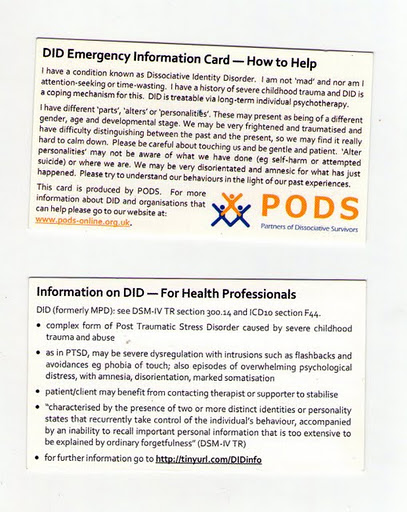
DID Card

Recently someone gave me a few of these very interesting little cards. They are the size of business card, and use that minimum of space to share vital information about the nature of DID. In the event of a crisis I imagine they could be very helpful!

They also provide a link to a website in the UK – you can find it here. It’s quite comprehensive with a lot of information and resources. I would love to set up something like that here in Australia! I’m going to chat to the members of Bridges and the Dissociative Initiative about perhaps making up our own cards of information like these. One of the things I’d like to see is a second complementary card that discusses dissociation. Something that frustrates me a great deal is that in all the hype over multiplicity, those dealing with dissociation that presents in other ways – such as amnesia, depersonalisation, loss of senses etc. can be overlooked. Multiplicity is one manifestation of dissociation, but severe and chronic dissociation in any other areas can be equally distressing and disabling. I’ve been searching for books on dissociation but not multiplicity for Bridges (as the group offers support to people with either experience) and I’ve been quite frustrated at the appalling lack of information out there! The majority of the books in this field concentrate on either general trauma phenomenology, or multiplicity.

It’s been suggested to me that perhaps considering this gap in the literature, I should write such a book, and I admit I’m giving it serious thought. When to find the time is probably the biggest consideration. What to write, how to structure it, how much research I’d need to do to back up my opinions, and whether to wait until I have professional qualifications in the field for greater credibility are all on my mind. There’s a WEA class on writing non-fiction coming up that I think could help me think about structure, layout and organisation. Part of my concern is also how to make it affordable so those who most need it can access it – perhaps through a grant of some kind? Also, making it shorter, a booklet, may keep costs and therefore prices down. The beauty of this blog is it is free for me to host articles and suggestions, but the net is not accessible to everyone and there is something to be said for being able to underline, asterisks or cross out things in a book if you are so inclined. In rare quieter moments I’m finding myself starting to work out the introductory chapter and the structure… I’m also doing training shortly about how to write grant applications, so I’ll keep this project in mind then. Perhaps I could secure some funding to keep the book inexpensive or even free? Who knows, you have to ask. 🙂

There are some possibilities coming up that perhaps more training and resources will become available here in SA soon. I’m very mindful that at present, while we have the group Bridges, we lack supports for carers/family, and also training opportunities for support workers and professionals. Talks are happening about what we can do in these areas, which is very exciting to me! A year and a half down the road from my first terrified talk about DID, I can now see what I’d like to change about the talk I wrote and better ways to present the information to make it easier to understand. Building a library of books and accessing journal articles in these fields has been absolutely invaluable to developing my framework and understanding of dissociation, multiplicity, trauma, and recovery, as has so many people generously and courageously sharing their personal experiences. There is so much to learn yet, but even the little we know now could make such a huge difference to so many people out there.

It breaks my heart that so many people are suffering so needlessly and so alone with these experiences. I am furious that some staff are still telling people that dissociation doesn’t exist or all symptoms are invented for attention. I am so distressed by the chronic pain, high levels of suicidiality and self harm within a population that has one of the best responses to appropriate support of all the mental illnesses! There is hope and there is help, but so many people don’t know that yet. There’s a lot of work to be done here. I did a course in Mental Health First Aid a little while ago, and it really frustrated me that a dissociative crisis wasn’t mentioned. Most people don’t know what one is, how to recognise or support someone in that situation. We talked about suicide, drug overdoses and panic attacks, which was great. Dissociation is also extremely common, often overlooked, and can be deeply distressing. Knowing how to recognise it and reassure someone in crisis that they are not going crazy, that these experiences are common and can be managed can sometimes make the difference between life and death. This is not rocket science! We can do this. We can make things a whole lot better for a lot of confused, scared, lonely, creative, resilient, amazing people out there who deserve a better deal.

What is Peer Work?

Peer Work is drawing from your own experiences to support someone else. It’s an idea that’s been around for many years in health, for example cancer survivors running groups to support people newly diagnosed. It’s fairly recently a role that’s becoming respected in Mental Health. At the moment many people are employed to support carers, perhaps called Carer Consultants, who have or are themselves carers and can support, educate and relate to other carers in a personal way. This is one kind of peer work. Consumer Consultants are people who draw upon their personal experience of living with or having had a mental illness themselves to support, encourage and educate other people. When the term Peer Work is used in mental health, this is usually the kind they are referring to. There are many names for this ‘peer work’ role such as Consumer Educators, Community Workers, Mental Health Educators, Peer Facilitators etc., and it’s becoming more common for mental health teams in hospitals and community centres to have Peer Workers on staff. Peer Workers are also often in voluntary roles such as visiting people in psychiatric hospitals.

What do you need to do to be a Peer Worker? You do need to be reasonably well yourself, whether living well with your condition, or recovered from an episode. Anytime you draw upon your experiences to help another person, you are doing peer work. Many peer workers find that this isn’t so much a job description as a part of how they live their lives. Even if you are very unwell and in hospital, if you can listen, encourage, give useful information to, or in some way make things easier for another patient, you are doing peer work, in my opinion.

If you’d like to become a peer worker, there is some training you can do, through the Peer Work Project here in SA. It will also help if you spent time with other people with mental illnesses through a community centre or online perhaps. Often we know a great deal about our own condition, but very little about other mental illnesses. Broadening your knowledge can help you relate to and support more people. I’d suggest you attend or volunteer at a local club, centre, or hospital that supports people with mental illness.

What does a Peer Worker do exactly? Well, that depends, the roles can vary tremendously. Some people work one on one and support people living with mental illness. Some people give talks, sharing their story with different audiences – perhaps people who have little experience of mental illness and who may benefit from putting a human face on labels and conditions. Other people run groups, perhaps around a skill, activity, or particular experience (eg. anxiety). Some people do admin and get peer related resources up and running such as online websites.

Being a good peer worker involves a passion for this work, a willingness to be open about your experiences, excellent listening skills, lots of patience, and good support. Good boundaries, a degree of stability, and the ability to handle having a foot in both worlds (part ‘consumer’, part ‘staff’) will help a lot. Peer Workers, like everyone else in this field, are vulnerable to burn out so you really do need to take good care of yourself, have good support and pay attention to your early warning signs. Having said that, for many of us the opportunity to convert painful experiences into something that helps people and to feel useful is a crucial part of our recovery. If it suits you, you can find a good balance, and you have good support, then Peer Work can be one of the things that supports your mental health.

New training opportunities

Hot off the press – What’s On has details for some great training coming up with very limited places. If you’re interested in peer work or art, or looking for free or low cost courses, hop over there and check them out! I’ve booked in to a few of them myself.

Back to cleaning and sorting…

Nesting

Nesting is an idea that may be useful for you to explore if feeling chronically unsafe is part of your life. This may be as part of an anxiety disorder, a dissociative condition, for someone with self harm issues or who is highly reactive to triggers, and so on. The idea of a nest is to create for yourself a bolt hole to retreat to when you are feeling very unsafe and overwhelmed. Kids often instinctively do this, they may hide under the bed or in a cupboard or up a tree when they are scared. If you did this as a kid it may be you can replicate a similar sense of safety for yourself now by tapping into that good memory. I used the term nesting to describe this behaviour because it is so strongly linked in to your environment rather than other techniques that may be about self talk or moving your body in calming ways for example. That’s not to suggest this is in some way a better approach – there’s a lot of options out there and by no means do they all work for everyone. Nesting is also often the term used when a parent prepares a room or nursery for a child, and that has a similar concept behind it – to make a safe, comfortable pleasant place.

For many people, their home is their nest and they feel safe there and don’t need to think any further about it. To them, the idea of creating a nest for yourself may seem a bit ridiculous or childish. But many of us who feel chronically unsafe don’t find our home serves this purpose, and sometimes harking back to childhood and finding a way to calm our ‘inner child’ is more effective than efforts to maintain a mask of being ‘grown up and coping’.

If you can make your home feel safe that would be fantastic. If you live alone, it may be that you need good bolts on your windows, a lovely big dog, your own posters on the walls or music playing to help you feel like you belong and this is your space. If you’ve been burgled or assaulted in your home, this might be a real challenge. It can feel like the walls were torn apart and your sense of security turned out to be an illusion. The memories of people who came into your space may linger and torment you. You can over time reclaim your own space and drive these memories out. But if you’re having trouble with this, you might find it easier to start with something smaller.

It can be ideal if your bedroom is a safe place for you, especially as we spend so many hours sleeping and vulnerable there. For some of us though, the bedroom is the most tainted and difficult room in the house. If this is causing you major problems, don’t be afraid to rearrange. It doesn’t matter if you sleep on the couch or drag your mattress into the kitchen. Whatever you need to do to start to feel a little safe is worth trying. Once you can find a toehold on safety, it may be then that you can start to reclaim more and more territory. Sometimes it’s just finding that first toehold that gets everything started.

Follow your instincts in creating your own nest. If the wardrobe was a safe spot as a child, it may be that you can put a pillow, some stuffed animals, a flashlight and a book in there and hide out whenever the dissociation/flashbacks/panic attacks/urge to self harm etc gets bad. When I was a little kid, I read a book about meteors. It told the unfortunate true story of a woman who went to sleep one night in her rocking chair and was struck by a meteorite and killed. Being a highly stressed child with a vivid imagination, I linked her death to the act of sleeping and developed a terror of sleeping in my bed. For many months I went to bed obediently, then dragged my blankets off to the bottom of my wardrobe where I figured the meteorites wouldn’t be expecting me!

This little story is a great illustration of the kind of logic we have as children, and this kind of logic can sometimes be in play for those of us under high stress. Sometimes if we can put aside our need to look ‘normal’ we can speak our own emotional language and meet those needs. Whenever we do things that communicate to our self that we are looking after ourselves and working to make things safe we’re sending good messages. Sometimes that alone is enough.

One of my ‘nests’ is my bath. It eases joint pain, it wasn’t a tainted location for me, and I find it comforting and safe. My preference is to set up candles and oils and music and nest in properly. I keep topping up warm water and stay there as long as I need to. I find putting my ears underwater where I can’t hear anything but my heartbeat is very soothing. I’ve had some struggles with self harm when I’ve felt very unsafe, and there have been days where I’ve crawled out of bed and into the bath – with clothes or PJ’s still on, and just stayed there until I was safe to walk past the knife block in the kitchen. I think 9 hours was my longest stay. I might feel stupid or really annoyed with myself but I get out of those situations safely and that’s often more than the ER can offer me.

I’ve also used my computer space as a nest sometimes. Surfing the net can be quite trance inducing, hours pass without you really noticing. I’ve used this to reduce building panic or wait out dangerous situations too. When my bedroom has been simply impossible to cope with, I’ve dragged the mattress out into any other room and slept there that night. My bedroom has posters of my favourite artworks, an oil burner, music player, my journals, everything in it that I can use to make myself feel safe and at home. I put the kind of thought into it that expecting parents put into a nursery, and I keep playing around with the contents and arrangement until I find a set up that mostly works. It has to be familiar and to speak to me specifically. I often put up quotes and poems that I find inspiring or reassuring, and I keep my favourite books by my bed where I can reread them whenever I need to. Bolting back to a familiar environment is one of the keys of a good nest. For some people it might be their craft space, their kitchen, their shed, their garden… the possibilities are endless. All it needs to be is close by and some place that feels safe.

Fear and stress often have a regressive effect on us, and this can be really challenging to deal with. We are often deeply committed to our idea of ourselves as rational adults, and when we suddenly present with the emotional logic of a traumatised child it can take a lot of courage to face and meet those needs. But the pay-off can be huge. There’s a lot of ways to work on increasing a sense of safety, nesting is just one suggestion. If it doesn’t appeal to or work for you, try not to be too disheartened. You will find what you need. If you hadn’t thought of it but if it strikes a chord, you might want to go look at your environment with new eyes and see where your nest – or burrow, or eyrie, might be.

Newsletter 3

Here’s the latest Dissociation Link newsletter. You can access it in pdf form here to download, print, or share easily. Please feel free to pass it along. 🙂

(function() { var scribd = document.createElement(“script”); scribd.type = “text/javascript”; scribd.async = true; scribd.src = “http://www.scribd.com/javascripts/embed_code/inject.js”; var s = document.getElementsByTagName(“script”)[0]; s.parentNode.insertBefore(scribd, s); })();

Labels – helpful or harmful?

It’s so interesting to listen to people talk about their experiences with mental illness. I’ve heard such a range of stories, from those who became unwell, received an accurate diagnosis and useful treatment, and drastically improved, to those who first suffered the terror of developing mental illness and then the terror of inaccurate, incomprehensible, and traumatic diagnosis and intervention. One of the areas I’ve noticed people have a range of reactions to is this issue of diagnosis, and whether labelling people’s behaviour and experiences is helpful.

The central idea behind the labels used in mental illness was to be able to group people’s experiences into similar categories and give them a name so that it was easier for one doctor to communicate to another what kind of struggles a person was having, and so that things that were found to benefit the majority of people in a group could be made available for them. Born out of the medical model, mental illnesses are listed as diseases, with the presumption that the processes can be measured, will be found to have a clear cause, and always only involve deficits. The reality is more complex, mental illnesses seem to function more as syndromes – clusters of ‘symptoms’, causes likely to be a combination of factors, and numerous subgroups who experience different sets of symptoms and respond best to different treatments. That’s still a medical model framework, and doesn’t account for people’s experiences that are positive, while still being different from the norm, or for the idea that some psychological processes seen as illnesses may be healthy responses to overwhelming circumstances.

When labels are experienced as helpful one of the things I hear most often is a relief that confusing and frightening experiences have a name. With a name, they can be talked about. There is a language to describe them, to take the intangible and the terrifyingly personal and communicate about it to another person. For myself, I have experienced dissociation for as long as I can remember. I didn’t encounter the word to describe it until I was in my 20’s. Prior to that I had no words to explain what I was experiencing, and no way to understand why I felt different, the nature of the gulf between me and my peers. That difference was formed by many things, such as The Gap, but I wasn’t able to express or understand the tremendous difference in the way I functioned. With no words for it, I was absolutely alone in it, unable even to ask for help. We need names for things to be able to talk about them. Many people are deeply relieved to discover their difficulty has a name, be it depression or mania or dissociation.

I’ve also experienced the enormous relief of discovering that reactions I didn’t like or understand in myself were part of a condition, PTSD, instead of just my own personality. Being able to locate my troubles as separate from me helped me to feel less shame and humiliation about them.

Labels also give us a community. With a label we have a chance of linking up with other people who’ve struggled with the same things and feeling less alone. There is a pool of resources (hopefully) we can seek out, books, community groups, organisations who exist to share information and strategies to manage your particular condition.

This experience of community can also be one of the things people find terrifying about labels. Labels are black and white. Many people have had the distressing experience of being hospitalised and aghast about their new ‘peers’, the other patients. There’s little room for degree, and people remember the extremes and the most unwell. A person diagnosed with MS immediately pictures wheelchairs and severe disability, a person told they have schizophrenia dreads a future of long term hospitalisation and unrelenting psychosis. For those of us who’ve come from a world divided into them and us, the sick and the well, the disabled and the rest of us, it’s a huge shock to the system to suddenly find ourselves in the other camp. We may reject our label, deny, downplay our symptoms, protest about all the things we can still do…. and at some point perhaps, realise that the entire rest of the disability community are saying exactly the same thing, and readjust our view of the world a little.

Where labels hurt is where they define us to the exclusion of all else – a person with Borderline Personality Disorder becomes “the Borderline”, instead of somebody recovering from a mental illness. Labels are also things we live to, children treated as if they are smart, hard working and will do well in school tend to live up to those expectations. The reverse also applies. Told we will be profoundly disabled, we will have our condition our whole life, we will never be able to work again or live without meds or have ‘normal’ relationships or live independently – many of us will live to fulfil those predictions. (a few of us with a tendency towards rebellion will use them as impetus to accomplish exactly whatever we were told we couldn’t) Labels can box us in, hold us back, define our world in a way that is deadening and takes away hope.

Labels can also cut us off from each other and from resources that are labelled in a way we’re not familiar with. I’m constantly coming across information in different areas that have developed independently. Because of our tendency as people to specialise, often useful ideas and resources are locked away in different areas. It needs people with broad interests, or experience in several different areas to link things back together. For example, people struggling with self harm have been developing comprehensive lists of grounding techniques – but few people struggling with dissociation have come across them even though my experience has been they are very helpful for dissociative symptoms. People who have a severe anxiety disorder don’t have access to great work being done about reducing ‘exposure anxiety’ for people with autism. People with MS talk to each other about ways to cope with symptoms such as numbness, muscle weakness, and chronic pain, but no one with Fibromyalgia is likely to pick up a book labelled MS and read about these, even though they have those same symptoms. People with a physical illness or disability are often deeply reluctant to seek help or information for emotional distress such as anxiety or depression because they need to view their symptoms as physical and collecting another label would only depress them further. Labels can set up a false separation between us, and cut us off from communities and information that would be helpful. For people with very rare conditions, labels leave them feeling deeply alone and envying people with more common conditions, and money and organisations to support and advocate for them.

I don’t care if you feel lonely because you have social anxiety, experience the classic negative symptoms of schizophrenia such as withdrawal, or are too exhausted and overwhelmed by your severe arthritis to get out of the house. That experience of loneliness is something each of these people have in common, and each could be a great support to the other. In our Voice Hearer’s Group some people have a psychotic condition, some a dissociative disorder. Some people hear voices as if someone is standing next to them speaking, others hear them within their mind. Some people have no diagnosis, or do not hear voices but hear or see other things. There is tremendous diversity in our labels, but we are united by a difficult experience, a need to speak about it and connect with other people. Labels that encompass whole complex conditions such as Bipolar can be less useful at times than a language to describe things such as anxiety, slow wound healing, or hallucinations. There’s a lot more common ground out there than we may think, and a lot to be learned from other people, however different their labels.

Upcoming events

There’s quite a lot going on at the moment, I’ve been updating my What’s On page to keep you updated on various opportunities about the place, mostly free or low cost. Check out opportunities with Lifeline, Relationships Australia, CAN SA, and don’t forget that the Broken Hill Poets Pilgrimage is happening this week! It’s not too late to hop on the Tuesday train over there! I can’t wait. 🙂

I’m also very excited that the Medieval Fair folks have announced the dates for this year’s festivities! I have been going to this event for many years, it’s a fantastic weekend away from it all, in beautiful Gumeracha. One of the major highlights of my year. 🙂 Here’s some pics for you to whet your appetite. (all details in What’s On)

The procession that launches the weekend
There are many examples of traditional crafts and skills
Gorgeous bellydancers

The traders often set up rustic homes and stay overnight

Many opportunities to watch craftsmen at work

There are many wonderful costumes and displays

Lovely chain mail jewellery (yes, I have some!)

My favourite dressmakers in the whole world – medieval gowns

Lots of gifts and trinkets

Traditional music

My favourite herby lady

Morris dancing

Sword dancing

Medieval middle eastern coffees and delicacy’s 

If you appear in any of these pictures and would prefer not to, please contact me and I’ll remove you! 🙂

Artificial skin

No, I’m not talking about the burns unit, rather skin in a psychological sense. You may have noticed the idea of needing protection from the world turns up in my work on this blog, I thought I’d take some time to elaborate. I’ve often felt like I was thin-skinned – or even missing skin entirely. I’ve since discovered this can be quite a common experience for many people – especially in the trauma recovery or mental illness communities. I am sensitive to my environment, strongly affected by things and people around me. I feel emotions intensely and seem to lack a lot of the psychological buffers that help people shake things off. A lot of my life I’ve felt tossed about by emotional storms I can’t prevent but have to ride out. I’ve been missing some emotional skin – some of the personal boundaries that help to separate us from our environment and the people around us. I’m highly adaptive to different environments, and sometimes even to the people I spend time with, identity becomes blurred as I unconsciously take on their perspectives, mannerisms, language. I lacked defences to unfair criticism, being assailed with severe self doubt – what psychologists call ‘poor ego strength’. There is an inclination to obedience and submission that meant hours, days, or weeks could go by before triggered emotions turned up – ‘actually I feel really angry about that situation last week’, well past the point where those feelings could protect me or I could act on them.

This sense of lacking skin is linked for me to feeling raw, and chronically unsafe. Heightened sensitivity, perception, adaptation, and damaged boundaries all combine to create a painful state where I feel like all my nerves are exposed and I’m permanently vulnerable. One result of this state for me was to feel intense ambivalence about other people – both craving and deeply fearing contact. Another was difficulty with intense emotions, feeling ‘flooded’ and profoundly different from other people most of whom seemed unconcerned by events and experiences that I felt deeply.

I don’t feel so raw over the last few years, developing skin has been something I’ve been working on. I don’t mean I wish to be less sensitive or passionate, but in less pain, less overwhelmed by the world. There are tremendous positives to characteristics like sensitivity and adaptation. But without protection, without some buffering, it seems to me that they leave you vulnerable to exhaustion and despair.

I’ve found that I need artificial skin to survive. One of the first ways I started to create this was through my journals. I started writing when I was introduced to the idea of poetry as a kid. At about 15 I was carrying a big blue binder around with me everywhere and stuffing it with poems, notes and drawings. My level of trust was very low so it didn’t leave my side. Since then I’ve always kept a journal, usually of poems. This private space was my voice, a receptacle for all my intense feelings and a place I could be honest. There’s a fairy tale about a woman tricked into a horrific situation and forced to be silent. In it she digs a hole and screams all her agony into the earth. My journals are that earthen hole for me. Over time as I reread I learn about myself, I start to see patterns and needs. What was only a scream once has become a dialogue with myself.

Years later when I moved into a caravan, that also became part of my artificial skin. I’ve found I must have time alone to process or I do not function well. I also need my own space, a room or home that is mine alone, with no intrusion, no compromise, no sharing. This became the place I returned to from the world, to check in with myself. When I was caught up, over adapting, losing myself and my own perspective, the caravan was like a hermit crab returning to their shell. In it I felt safe enough to work out what I thought, I felt, a distance from the world that was essential to have the strength to disagree, to know myself and have my own voice. I was curious to later read Julie Gregory describing a similar process in Sickened where she lives alone in a house full of mirrors, learning who she is and what she needs.

Self talk has also become part of my artificial skin. Without the automatic buffering afforded by a ‘strong ego’, I have to talk myself through rocky situations. I coax, coach, and reassure myself deliberately when I encounter a situation that needs skin. I don’t just mean bad situations either, for example, I gave a talk in Melbourne last year that was very well received. I got a lot of hugs afterwards, which was enough to blow all my fuses and induce massive dissociation. I ended up hiding in the toilets talking reassuringly to myself, waiting for everyone to move on to the next talk and to be able to stop shaking and start to feel my feet on the floor again. Talking myself through that, and also finding someone else who knew me to take me for a coffee and just chat about ordinary things, served as my skin and helped to buffer me.

This brings up an important part of skin – other people. There are many ways people create skin, some of them have terrible costs. Some people emotionally numb, dissociate, or desensitize to distress around them, becoming cold or indifferent. There are a lot of forms of artificial skin that deaden you or are like armour covered in spikes that hurt people who move close. True artificial skin should ideally replicate as close as possible the natural kind – a permeable barrier that separates you from the world but does not leave you invulnerable to it, or inflict harm. Other people and how we are treated are an important part of our psychological skin. For me, becoming involved with the groups Sound Minds and Bridges exposed me to a whole room of people who treated me in a respectful, caring manner. Experiences of kindness and love build our self worth, and when we feel we are worth something it’s easier to protect and care for ourselves.

I’ve also done a lot to try and make peace with my nature. I’m always going to be someone who feels things intensely, who is affected by things around me. I have learned I need to hang on to the upsides of these qualities, to seek out role models who are also intense emotional people, and get less angry at myself for my weaknesses and limitations. Instead of blazing at myself with frustration and burning with fury that I’m weak, emotional, pathetic, always the drama queen – my journals have a lot of this kind of self hate in them – I try to be unsurprised and accepting of the downsides, and to enjoy and embrace the upsides. So I cried at work again – oh well. I write poetry that I like, I care deeply about other people (although being sensitive is no guarantee of always getting it right sadly, I still regularly miss the mark and feel upset about that), I live an intense passionate life full of art and depth and mood. These are things I value. If they mean I’m sensitive to criticism, vulnerable to being overwhelmed, and need to maintain an artificial skin to buffer the world, I can be okay with that.

If you feel that you’re missing some psychological skin too, perhaps some of these ideas might be useful to you, or get you thinking about the kinds of artificial skin you need. We don’t have to accept things the way they are. People with sensitive natures and boundary issues can still be resilient and learn how to protect themselves. The things that make you vulnerable are often also the very qualities that give life such depth and help you endure the hard times. Take care.

What do I have against positive thinking?

Let me caveat this by saying some of my friends love positive thinking. It clearly helps them to stay optimistic, look on the bright side, count their blessings, and make the most of things. I wouldn’t dream of trying to take it away from them or argue with them about it. People come from different places, react against different things and find different ideas helpful. But for me – I hate it. Positive thinking and I have a painful history.

When I was young several of my role models were great believers in positive thinking. I admired their attitude and absorbed all of their ideas about how to best live life. I took copious notes during talks, about overcoming adversity, always finding the silver lining, looking for the best in people, never giving up, and always remaining positive no matter what.

I fervently believed these ideas and lived by them. This had a number of unforeseen outcomes. I was incapable of believing ill of anyone, and therefore incapable of protecting myself from the school bullies. I behaved in a painfully naive manner, always looking for the best in people and frequently being taken advantage of. Never giving up meant I was unable to walk away from anything, any project, any relationship. If I failed at something it simply showed I had not tried hard enough. If a relationship died it evidenced my lack of extraordinary effort.

Having to be positive all the time left me incapable of expressing anything ‘negative’ without guilt. To cry, feel overwhelmed or afraid was to be weak. I never considered that my ‘dark moods’ may have a kernel of insight to them, whereas my ‘sunny days’ may be more about self-delusion than reality. I ignored every uncomfortable feeling, all those instincts that say ‘this worries me’, ‘they seem scary’, ‘I don’t like this’. I hoped for the best, forgave, turned the other cheek. I didn’t know that sometimes you need to be shrewd, cautious, un-trusting, and self-protective.

I’ve come through things that made me reject the ideas of positive thinking. I’ve been in situations where my best efforts were not enough. I’ve loved and risked and dreamed and been broken when I lost everything. I’ve learned there are many things I cannot control, and that running from pain strips me of all feeling. I’ve learned that we call it a risk because you may lose. I’ve learned that that point in the movie, where you appeal to their better nature and they melt, they just cannot treat you that badly after all – that there are people who reach that point and merely laugh at your naiveté. The world can be a very unkind place to people with Pollyanna ideals. And people with Pollyanna ideals may ignore all evidence of pain or abuse for someone else because they are too busy looking on the bright side and believing the best of people. It’s been hard for me to come to terms with that. It’s hard when nice people don’t want to know what’s really happening.

In my teen years I gravitated towards the goth subculture, because there I found people who ignored the conventions and expressed pain. When they felt bound and trapped they wore chains. I could not escape but I could at least protest. I could reject the conventions that silenced me, and find other ways to have a voice, and to speak my own truths instead of the scripts given to me.

My personal philosophy is oriented more to the idea of trying to be authentic than to be positive. I gravitate more to the idea of telling myself the truth than trying to believe affirmations that deep down, I simply reject. I don’t like fighting myself like that, and I don’t like feeling that I’m building castles in the air, that while I’m hopeful I can believe all these wonderful things but there may or may not be any reality to them. So when I’m exhausted, frightened or depressed, all my foundations disappear. I like to hold onto things I can still half believe when I’m in a black place. I also crave the freedom to be honest about how I’m feeling.

I think most people who are unwell feel the pressure to be positive. Children dying of cancer who are still cheerful are held up to us as examples. This burns in me. It feels like being silenced. One more time when I have to pretend the bad things aren’t happening, that I’m not in pain, not afraid, not dying inside. I’m scared by how many times I hear after someone has killed themselves – we didn’t know anything was wrong. I’m scared and angry that people in pain feel they have to keep it secret. I’m tired of making a secret of suffering.   I’m tired of being cheered up when what I want is connection, when I want are relationships that make it easy for me to be honest and hard for me to tell even sweet lies – instead of the opposite.

So for me, I’m always trying to hold onto my voice, to accept what I really feel, what I really think, or fear, or hope. I crave authenticity. I crave the strength to be honest. I want to speak the truth, even when the truth is horrific. I am a very positive person, I have a deep love of life and a dogged pursuit of hope. But I reach this almost by going in the opposite direction, by going down into black places, into bleakness, rage, despair, loss. I embrace these things rather than run from them. I want to be able to be real to the people around me. I want not to have to lie, not to wear a smiling mask over pain or emptiness. I want for people to be able to trust my smile and my tears. I want to be known. Somehow my journey brings me towards hope, joy, self compassion, and so many of the things I know those who love to think positive are also seeking. I just need to take a different road.

Great news and events!

Today I found out I was accepted into the inaugural Cert IV Peer Work course! I’m very excited about that. 🙂 I’m still waiting to hear if I’ve been accepted into a Visual Arts course too, hopefully by mid-month I’ll know. Obviously that one will be done part time! A Cert IV will be a boost to my resume and I know a few of the other people who’ll be studying with me so I’m sure we’ll have a good time talking about Peer Work together. I also know a couple of people who didn’t get in, which is upsetting. Hopefully the course will be run many more times for all the other hopefuls!

There’s also some information days coming up about Lifeline Telephone Counsellor Training, which was my backup plan if I didn’t make it into the Peer Work cert. Maybe next year 🙂 If you’re interested in learning more, check What’s On for the details.

For those of you who were interested in the Voices Conference in Melbourne in February, but perhaps couldn’t get the funds together or time off work, I’ve just heard they are going to host a “Mad Pride” event on the Thursday evening that’s free and open to everyone! So if you’re in the area, consider coming along. If I’m still standing I plan to be there. 🙂 See What’s On for details.

Tomorrow I sign for my new place and collect the keys, all going to plan! I still have the rest of my studio to pack and clothes/shoes etc. I’m very excited!!

The packing is at that funny stage where half the house is trashed and the other half is cleaner than it’s been in ages. Obviously, this is the trashed half:

And the kitchen is neater than since I’ve lived here!

I need to spend some time with my diary and work out which training fits where and how many of my other planned activities I can fit in… I’ve been hoping to start some training with Radio Adelaide… and the SmART course when that comes round again in early Feb… oh dear, I think I’m over booked! What a delightful problem to have after those years of trying to find things to fill my time. 

Survival lessons

Some time ago I became curious about what qualities and skills people use to survive extremely harsh environments, such as polar expeditions. I wondered if there was any overlap with the kind of skills needed to survive harsh environments closer to home, such as an abusive family or chronic serious illness.

I’ve read a couple of books about factors that influence survival and come across some interesting ideas, such as the notion that survivors of extreme circumstances seem to share an unrelenting will to live. It seems that perhaps some people reach a point where the cost to keep living is too high. The pain is too great, or the despair, the things they would have to do are too awful or exhausting. Others drive to live is so strong they will severe trapped limbs, drink their own urine, stagger for hundreds of miles. That’s not to suggest that the will to survive is the only factor – luck, skill, experience also play roles. Sometimes it doesn’t matter how hard you try, you simply can’t find your way back to safety. I’m also not suggesting that those who curl up and surrender to overwhelming circumstances are weaker or inferior. Both defiance and acceptance have their place in how we respond to the world. Sometimes those who defy, triumph, other times they do terrible things in their determination to live. Sometimes we mourn those who gave up before help arrive, other times we venerate those who refused to be dehumanised, who gave up their food or wrapped the last blanket around someone else. Sometimes we just mourn the loss of someone who faced hopeless and overwhelming circumstances.

It seems to me that there’s a lot of parallels between situations involving starvation, hypothermia, drowning, being lost or cut off from safety in an inhospitable environment, and those many of us face in our personal lives, children who are being abused, people living in violent homes, a family member struggling with a life threatening illness, those of us who instead face loneliness, humiliation, shame, grief, misery, hopelessness, or fear. The nature of the threat may be very different but the need to find a way through it, ways and reasons to endure or escape, and a way to balance survival and morality, these seem very similar to me.

I once watched a documentary, the name of which escapes me, about how men in the polar regions coped with such a difficult environment. It put forward an interesting idea that stuck with me, that the key to navigating a stressful environment with chronic unpredictable crises, is to be able to respond very quickly to the development of a crisis, and then to wind down afterwards equally quickly. They had as an example a fire in the campsite. A fire in the poles is incredibly dangerous, most of the water is frozen ice or snow so it can be difficult to put out, and all supplies are terribly precious and difficult to replace, possibly the difference between life and death. Men who had been dozing, reading or relaxing playing cards were shown rushing to action. In a heartbeat they ran out to the fire and efficiently had it under control. Having responded to the emergency, they came back to their quarters and returned to dozing, reading and playing cards. They said these were key survival skills, to respond very quickly, and to get out of crisis mode very quickly. Sustained crisis mode is very dangerous, burning energy very fast like running on turbo. You can’t afford to be depleted in a survival situation.

When I thought about how I manage crises like this I decided I do pretty well at responding quickly. I tend to be the first person to spring into action in a first aid situation, I’ve helped out at fires, talked to suicidal people, nursed dying pets to the vet, and so on. I’m good at recognising and quickly responding. I’m not so good at the wind down afterwards. Having gone into high alert crisis mode, I tend to stay there for hours or days. I find it really difficult to wind back down to regular functioning. I think cats are amazing at this, they go from sleeping to manic to sleeping again with barely a pause between. One of the things I’ve noticed for me is that staying in crisis mode exhausts me. It also ‘stacks’ the crises, instead of separating them into distinct experiences. What I mean is that without getting any downtime between events, each crisis feels worse than the one before. Each exhausts me further, leaves me more depleted and discouraged, life starts to feel like I’m under siege, an army camped at my gates, staring at a larder of dwindling supplies.

Working on coming down between crises can be hard. Once you’re all wound up and on high alert and running on adrenaline, there can be a warped logic that says ‘Oh we’re here now, might as well stay here, the next crisis wont be far off anyway’. Without downtime though, you never get to restock your larder. You are like an engine in neutral with the pedal to the floor, accomplishing nothing but burning fuel. We can’t function well when we don’t get the chance to take breaks, wind down to normal functioning, and take something in. Whatever nourishes you – reading, touching base with a friend, gardening, playing music, having a bath, going for a run, having a good laugh, playing with kids, sports… whatever it is you need it. You have to take time out of crisis mode and take in some sustenance. It doesn’t matter what the nature of your difficult environment is, whether it’s something you’re working to change or something you can’t, whether the stress is physical illness, abuse, mental illness, family breakdown, financial crisis, housing stress… one of the things that may help you get through is to resolve that every minute that something terrible is not happening right now you will wind down and replenish. It doesn’t matter if you’re having Monty Python film nights between visits to the hospital, or snatching 20 minutes to tend a garden, anything that breaks up the unrelenting stress and nourishes you will help you survive, endure or escape.

Anything in your life that you can enjoy or appreciate will nourish your spirit. In times when I’ve been struggling with suicidal feelings I’ve reminded myself of prisoners of war starving, of their joy when released at such ordinary luxuries as salt on their food or soap when bathing. Not to belittle my own struggles or make me feel guilty, but to remind me to tune in to these things. To feel the softness of soap bubbles on my hands, the cool clean water running through my fingers. How good it feels to drink when you’re thirsty, to wash your face when you’re hot and tired, to stand barefoot in the warm dust, in the cold mud, on the cool earth.

They don’t make up for the pain of whatever you’re going through, maybe nothing can do that. But they break the pain down into parts, the crises into mouthfuls instead of unrelenting distress that goes on for weeks, months, years, and strips every resource, every last bit of energy, hope, optimism and tenderness from us. Just a moment can give us a little sustenance, and can break up the bad times. You don’t want to have bad years. You can break it down to bad hours, bad days, bad times, with good times between, with peaceful times, with a little pleasure or silliness or rest. Last year for me was a very bad year. It was also a very good year, because I’ve been fortunate enough to have opportunities arise, people who care about me, and because I work on snatching back any moment I can to get out of crisis mode. I’ve written more about this idea in Self Care and a Myth of Crisis Mode.

If we can teach soldiers and explorers skills to cope with harsh environments, I can’t see why the rest of us can’t borrow some of the ideas and apply them to our own lives.

Do you have to remember/talk about trauma?

A query that sometimes comes up is whether healing from trauma means having to dig up all your most painful memories. This is a bit of a trauma myth too, in that plenty of people, sometimes including those who work in mental health, are under the impression that is what healing from trauma is all about. I would certainly dispute that, as would many of those who work and write in the trauma field. In my experience, memory work is often handled poorly. There are therapists who start therapy with asking a client to talk about their most painful memories. They tend to skip the most important first stages of building rapport, developing trust, establishing the primary symptoms and/or diagnosis, establishing safety, and developing considerable self care skills. Without this foundation, digging into painful memories may demolish someone’s ability to function and stay safe.

I’ve had many first appointments with mental health professionals over the years, so I’ve had some time to learn the standard assessments that psychiatrists and other professionals are taught to give. It’s always very interesting to me how each person interprets this, and I’m always curious to see which symptoms are inquired about and which are ignored. For example, I’ve never been asked any questions related to dissociative symptoms, and the entire psychotic spectrum are sometimes forgotten as well. There are occasionally enquiries about  trauma and these tend to be the most insensitive and unhelpful possible. I was once asked by a psychiatrist to rank each of my traumatic experiences in order of most to least traumatic. I explained that this was not possible, that I had more than one incident that was for me a 10/10. This particular doctor seemed quite irritated by this and explained to me that as my “life has been a train wreck” he had no interest in working with me. The feeling at that point was rather mutual. These kind of first appointments invariably left me quite shattered, the effort of talking about traumatic events with no care or concern on the part of the doctor, trying to recall precise factual details and dates and not cry or express unwanted emotion was extremely unhelpful. I had to space out these kind of appointments with weeks or months between as they left me extremely raw and shaken.

Likewise, there has to be a purpose and a gentleness to going over trauma memories. Talking about them does not in and of itself, magically heal anything! Talking about them when you don’t really want to, when the timing and choice are not yours, and in an environment or to a person who does not feel safe and caring may actually only traumatise you further. This is important to keep in mind, as quite a lot of the harm that many traumatised people experience isn’t just due to the actual events, but also to how they are treated after the incident/s or when they seek support.

Talking about what happened can help, but the reason this helps is because of things like – having a chance to express how you felt about things, feeling heard by another person, having someone else help you to reframe the experience (‘you did nothing wrong and have nothing to feel ashamed about’ for example), getting the opportunity to think through and make sense of things that at the time were chaotic and surreal, starting to be able to orient the memories in the past so they feel like they happened rather than are happening to you… Some people with amnesia for traumatic events find that remembering can be a relief in a way, to know what happened and not be wondering. On the other hand, others find that their focus is in the here and now, building a good life, and that process shouldn’t be disrupted to go hash over the very life they’ve just escaped from. Trauma work of any kind is supposed to support and complement the work you are doing in your life and your focus of energy, not interrupt and divert it. Everything has its own time and that time is different for everyone. Talking about memories because you feel you have to, because you’re afraid you won’t get better otherwise, with someone you don’t connect with, in a way that makes you feel more shameful, more hurt, and more alone isn’t going to make anything any better!

One of the most common feelings that many traumatised people have is ambivalence. That doesn’t mean not being sure what you feel, it means feeling more than one contradictory feeling. You may want to talk and not talk, or to remember and not remember, both very strongly. It can be really difficult at times to work out which feeling to follow, which instinct is taking you in the right direction, and which will lead you to an unsafe place. I sympathise! I’ve found that over time with some thinking about it, I can start to unpick what drives each feeling, the wanting to talk may be motivated by fear that I wont make progress, even though I feel really unsafe with the person I’m going to talk to. In that case I’d not share. Or it might be that the wanting not to talk is being driven by old childhood fears that telling secrets will get me into trouble. I can’t give you a way to easily work out which impulse to follow, only to say that if you’re unsure, wait a while, and if need be mentally try on each idea for a little while and see how it feels. If you find your stress going through the roof and all your symptoms increasing – maybe that’s not the way to go. If on the other hand some internal distress settles and you feel less overwhelmed – that sounds like the right path for you at the moment.

If you can’t work it out, perhaps don’t act on either and see if time changes things or things become clearer. If you just feel stuck, perhaps try to act out each impulse in a very small way – if it becomes clear that one road is not helpful you haven’t done anything too wildly disruptive and should be able to ride out the distress, gather yourself, and give the other road a try. This isn’t an all or nothing deal either, it might be that you feel okay talking about x and y but z is completely off limits at the moment. That’s okay – you’re the one responsible for taking care of you. It’s also pretty common for us traumatised folks to do things at the extreme and think of things in polarised way – either I tell all or nothing, either that person is 100% safe or completely unsafe. Most of life and a lot of trauma work is about being able to reclaim a bit of grey and try out small steps instead of swinging wildly from one extreme to another. It’s okay to take these things slowly, and if you try something that doesn’t work, oh well. We’ve all been there. Hang tight and settle and give something else a go.

If you’re in a spot in your life where it feels like digging into memories wouldn’t be helpful, I’d like to recommend considering taking a look at 8 Keys to Safe Trauma Recovery by Babette Rothschild. She has a whole chapter about how it’s entirely up to you whether you feel remembering and talking about the trauma would help, and some ideas on how to talk to a therapist about your feelings and choices, and other things you can do to support yourself instead. If you are in a place where you feel a need to talk about what happened, to feel heard and be able to express how it felt and you’d like to learn more about how this process might happen and how it could help, you might find Facing the Wolf by Theresa S Alexander a useful resource. It details eight sessions of working through painful memories from the perspective of both the therapist and client. (of course, please be aware that this does involve memories of child physical/emotional abuse and neglect) I’d also like to mention that if you do not have a therapist, or do not have a good relationship with one, don’t forget that a friend, helpline, or your own journal can all be places where memory work happens. While therapy can be a wonderful support, a great deal of our healing and hope is also developed in the rest of our lives. Good luck with whatever you decide to do. 🙂

Trauma Myths – there’s not many of us

There’s a few common myths about trauma that I come across pretty regularly, and this is one of them. In mental health, the role of trauma is one that is debated all over the place. For example, there’s people who argue that Borderline Personality Disorder is caused by childhood trauma, and those who argue that it is likely a genetic predisposition to an emotionally reactive way of relating to people (among other issues). Personally, I think that it’s entirely possible that there is more than one way to end up developing a mental illness – for example some people with a psychotic disorder have their first episode in the wake of a major life stress, others were just minding their own business and the world turned upside down. What we do know is that some things can be inherited, and the combination of an inherited vulnerability with a high risk environment is exactly the kind of circumstances where people are most at risk of manifesting a mental illness. Nature and nurture both play a role, and traumatic events are one of the things that can make someone more vulnerable to mental illness. While trauma is always at play in a condition like PTSD, it may or may not have a role in causing some other mental illnesses.

Some mental health staff have taken this to mean that learning about trauma and how to work with traumatised people is a specialised field that is useful for only a very few participants. That’s not my perspective. For a start, when we look at the statistics of people who are the most severely impacted by their mental illness, such as inpatient populations, the numbers of those who’ve experienced major trauma are very much higher than the general population. These traumas may not have had a role in causing their mental illness, but they can certainly make it much more difficult to manage one! So trauma sensitivity has a real relevance in mental health.

Another thing is that having a mental illness can be very traumatic in and of itself. One of our great fears is that we are going insane. Madness holds a terror for most of us, and developing a mental illness can feel like we’re going mad. We may have terrible fears about our state of mind, our experiences, trying to keep our job, worrying about how we’ll raise our children. Experiences such as being chronically suicidal can leave us afraid of ourselves, mistrusting our own mind. It’s not like this for everyone, some people become very unwell without realising it, others may be caught up in their experiences (such as delusions or mania) and even enjoy them. But for many of us mental illness involves severe emotional pain and fear.

Various interventions can also be traumatic. Being confined to a hospital, room, or bed, being medicated without any choice, not being allowed to smoke, to drink, to wear your own clothes, be with your family or pets, have internet access or your phone is effectively being kidnapped. I’m not suggesting that the intention is to traumatize people through ‘assertive engagement’. And I’m not saying that some people who are desperately unwell and a danger to themselves don’t appreciate being kept safe for a time. But the loss of control experienced in severe mental illness, and the loss of control that comes with experiences like being shackled to a bed, even when it’s done by kind and caring people, can be traumatizing, and can also replay earlier traumas.

Not everyone’s experiences getting help in the mental health system are good either. Imagine waking up in hospital from a suicide attempt to be told by the nurse that it would have been better if you’d died because they need the bed for people with real illnesses. Imagine being told by your doctor that your condition is incurable and degenerative and you will likely become less and less lucid and be unable to live independently. Imagine being told that you are faking your condition to get attention, that unless you follow through and kill yourself nobody will believe that you are genuine, and even then you would just be proving that you were a hopeless case. The oath to first do no harm is not always upheld, and some people are caused terrible suffering by the people who are supposed to help them.

When you include experiences of stigma or discrimination, attempts at disclosure that go badly, the grief and loss of having relationships break down under the strain, giving up study or losing employment because of the mental illness, the idea that there’s quite a few people with trauma issues of one kind or another really makes a lot of sense to me.

The other aspect to this is that behaving in a way that is appropriate for a traumatized person isn’t inappropriate for an un-traumatized person. Being sensitive to issues of control, proximity, touch, pacing of treatment, confinement, respect, and the need to listen doesn’t go astray for anyone. Being sensitive to the possibility of trauma is being sensitive and engaged, taking your cue from the other person and adapting to what is helping and working for them. There’s nothing inappropriate about that! Even when the condition isn’t a trauma origin one, and you haven’t been told the person has a trauma history I’d be careful in assuming that trauma isn’t relevant. There’s a lot of people for whom it is, and thoughtful sensitive support can make a big difference!