Elixir and Taboo

Today I presented the results of a term’s work in my concept development class at Tafe. The topic was Food and our works had to incorporate food in some way if possible. I wound up making two small sculptures from my research. The first was playing with ideas of elixirs, infusions and preservation. I was very taken by the idea of preserving things other than food – memories, relationships, knowledge… I researched honey which is a fascinating substance and used in both preserving and embalming processes. So for this first work I used honey to preserve the memory of my close relationship with my grandmother, represented by a strand of blue pearl beads.
Sarah K Reece - Elixir
The contents then become an elixir to be taken during difficult times. The label reads:
Memories of Grandma
Dose: one thimblefull
To be taken: when lonely, afraid, or feeling unworthy

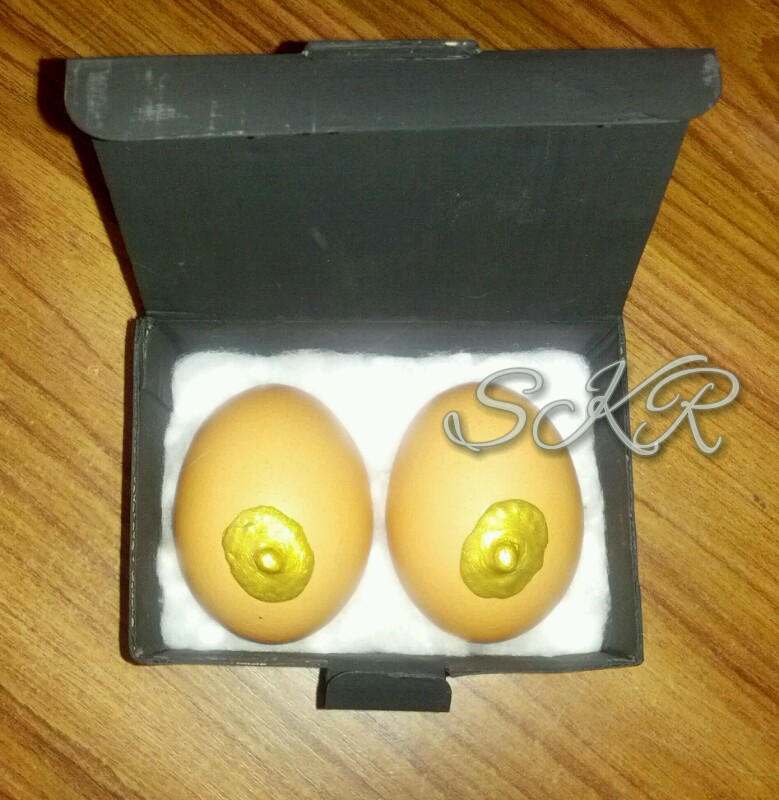
The second sculpture was playing with ideas around the sacred and taboo, particularly around our cultural reaction to the only food we make ourselves: breast milk. I used eggshells to represent new life, and turned them into breasts with the addition of sculpted polymer clay nipples. Blowing the eggs empty was fiddly and time consuming, I spent a lot of the last weekend with egg in my fringe. 🙂 I played with realistic colouring but decided to reference the use of gold leaf in art to signify the divine or sacred instead. The result has an unexpected element of humour to it, which I love. There’s also something a bit cheeky about the work, a slightly flippant take on a serious topic, a wink to fake breasts a la Monty Python, a nod to my own sexuality. Something that makes me smile: breasts in a box.
Sarah K Reece - Taboo
Plus I’m pleased with those nipples! My presentation went well, and I’m very happy to be on holidays from Tafe now. 🙂

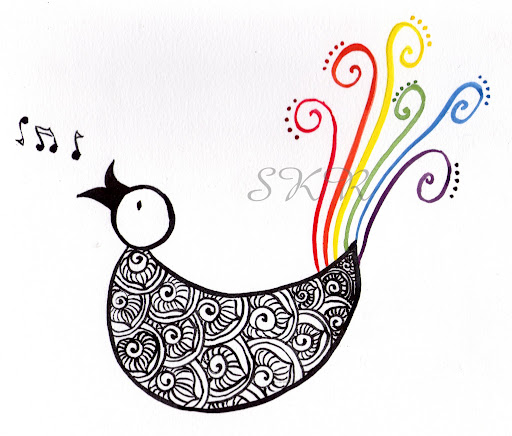
Logo for group The Gap

Today I finally bunkered down in my studio for some non-art degree related art making. 🙂 One of my projects was this; to make the logo for one of the groups I co-facilitate. The group is called The Gap, and is for same-sex attracted women aged between 18 – 40. Hence the ‘gay rainbow’ represented in the tail feathers (traditionally using only 6 colours) for this bird of happiness. This work has been made with ink on archival paper, the bright colours are Chinese style ink paints which are beautiful and vibrant. The bird’s body is inspired by traditional henna designs.

Draft one of our postcard advertising the group can be viewed here.

Queer – loves books, rats

It’s been a hell of a journey I’ve been on, clichĂ©d as that word has become. Claiming my sexuality has been stressful, frightening, and wonderful. I was in the library the other day, looking up resources for the dreaded Concept Development project on food. Thinking laterally, I flick through books about sex looking for information about supposed aphrodisiacs or games involving food. I find a book called the Lesbian Karma Sutra and add it to my growing collection to borrow. One of my local libraries has recently extended their maximum book allowance to 40, as a result I had to buy extra green carry bags from them this day. I’m aware of a tension between the old rules – that a book like this was forbidden – and the new world – where I can publicly acknowledge my interest in the topic. There’s a sense of reclaiming territory that should have been mine all along, that should never have been fenced off.

Of course, the one book that refuses to scan at the self-service checkout is the Lesbian Karma Sutra. I put on my brave face and go up to the librarian and look her in the eye and ask her to scan it through for me. I refuse to be intimidated! I do however, walk to the desk with the older female librarian rather than the older male. Not that liberated yet!

I’m loving spending time with other queer people, especially women. I have gay male friends but very few female. It’s been wonderful to meet other people and flesh out what have been mostly media-informed stereotypes in my mind. My initial sense of being totally out of my depth and uncertain is making way for a new sense of confidence and enjoyment. I love the company of these women, and I treasure feeling accepted by them. I’m also becoming ever more passionate about making safe spaces for queer people.

That’s not to say there haven’t been some interesting experiences. One day recently, I had a huge stressful day at work, dashed home to change and dress up – trying to find that line between just enough to look good and fit in and not so much that it looks like I think I’m on a date or trying too hard… gawd it’s like being a teenager again, worried you’ve got lipstick on your teeth and playing nervously with your hair. I drive off to a group I’m meeting up with. I’m nervous and excited and hypersensitive and jumpy. Watching them watching me watching them… wondering if any of these new friends have read any of my blog and if so what they thought about the crazy new group member or if that’s a conversation yet to happen, wrestling with a bra, my nicest one, whose straps climb off my shoulders every few minutes, and slightly freezing as we’re meeting in a big, cold hall.

A new member turns up with a pet rat tucked in her jacket and I can’t resist – I love rats. I wait patiently for a cuddle of him, he’s big and placid and sweet. He also quietly pees all down my jacket front. So, having gone through the anxious process of trying to dress up but not dress up too much – to work out which part wants to attend (the same one as last time or take turns? – this affects which outfit gets chosen) and the ramifications of that choice, trying to be friendly without over-sharing and fit in without pretending to be anyone I’m (we’re) not… I’m now sitting on the floor with all the carefully made choices about how I present myself to a new group of queer/lesbian friends rather foiled by the fact that I am wearing rat piss perfume.

After some thought, I give back the rat reluctantly, strip off my jumper as if I’m not cold, surreptitiously pat my tee-shirt to check if it’s wet, decide I’ve got away with it and finish out the evening. And laugh half the way home. Life is surreal! 🙂

Healing

Things have been going so well lately. Not perfect, (not manic), not without some confusion and struggle, but still; flying. Being ‘out’, especially as bi, is finally not just traumatic. It is liberating. I’m having positive dreams! Beautiful dreams, sad dreams, dreams of how things might have been for me growing up, if it had been safe to fall in love with women. Dreams that make my heart ache, make me cry when I wake up, curl back the curtain and cry in the golden light that spills onto my bed. Dreams of spring, blossoms on tree branches, light falling through orchards and curtains rippling in the cool air. Dreams that heal.

I’ve written before here about having ‘ugly days’, where my self perception is so destroyed I hate and loathe myself with an unbearable intensity.

I’ve been having ‘beautiful days’. Days I love what I see in the mirror, days where I dance, where my heart soars.

I feel like a little battery hen that has come at last to a world of green grass and blue sky and endless horizons.

It’s been a week since the psychosis workshop with Rufus May and my voice has been so quiet, but I can feel her, there’s no sense of absence or loss, I can feel her like a warmth in my chest, like a cat curled up tight around my heart. I am ecstatic.

I’m under no illusions, the work with this voice may not be done, there will be backsteps and bad days and times again of confusion and distress.

But, to make such a giant leap forward, after so many years of struggle… empowered really isn’t a strong enough word for how I feel. Perhaps hope is.

There’s been a lot of work happening over the past few weeks, so much thinking and remembering and making connections. Unpicking locks and following string into labyrinths. Coming to understand the things that trap me, the monsters that savage me, the ties that bind. Moving further into freedom and health. Feeling the sun on my face and the rain on my skin and being able to smell the cut grass in my yard. Washing off layers of secrets and shame like oil slicks. Feeling my system come alive, like a carousel turning with music and lights, that deep dreaming start up again, the wells flow with poems.

Another coming out

For a blog that covers some madly personal stuff about my life, there’s a surprising amount of things going on that don’t end up on here. I live a very complicated life, and I’m always mindful of both my own sense of exposure anxiety, and that it is at times difficult to tell your own story without telling parts of other peoples. Who didn’t start a blog or ask to be included in one. So I’m trying to be open but discrete and honest but useful.

When I gave a workshop earlier this year about starting a blog, I found myself explaining to various people, usually of an older generation, what a blog is. A number of them referred to it as an online journal. For some blogs that is true, and some of those blogs are simply amazing. For me, it is not. I keep journals, and I write in them regularly too. For me a blog is an entirely different thing. Everything that is posted here is run through a specific set of filters, and the most important one is “Will this be helpful to other people?” So while I’m doing my best to be honest and honour the dark, painful, and anguished aspects of my journey, I’m careful about how I do that. I don’t write posts about, say, suicide, when I’m feeling deeply suicidal. I write them when I’m stable, have some perspective, and can hopefully write something that is both authentic and uplifting. Raw distress and confusion can go into my journal but usually not my blog. There are certainly glimpses of it at times but I’m very aware that some of the readers are in bad places and I don’t want to drown anyone. Plus I’ve found that sharing about things I’m currently struggling with instead of those I used to struggle with often makes people uncomfortable, and some reduce that discomfort by imposing advice. Which I hate. So I’m cautious about how I engage that whole area.

This year has been a very big year for me. I moved into my own secure, stable unit. My dog and cat died. I got a puppy. I’ve been giving talks locally and interstate. And on my birthday, I came out as bisexual to my family. That is my group identity. As I’m multiple, the reality for me is straight and gay parts.

It feels like such a cliché to be struggling with sexuality. Many years ago I was in a community health centre and saw a poster that initially made my breath catch in my throat. It read “Is being different getting you down?” I went closer to see what they were offering. The small print read “Some girls like other girls. Some guys like other guys. Some like both.” I was so disappointed. It’s been such a long road to work out why I felt so different, what that meant and where I could find peers. Multiplicity and dissociation have dominated that process. Sexuality hasn’t had much of a look in.

I grew up in a highly homophobic, at times violently so, environment. As a young person I deeply buried these feelings that would have marked me for rage and abuse. As a young adult I suffered from chronic nightmares that were creative and horrifying. I described them at the time to a psychologist I was seeing as torture. Every night I went to sleep and was tortured in my dreams. Eventually we realised there was a lesbian part who had been totally cut off, buried, and denied expression. When we reached out to her with acceptance, those particular nightmares immediately stopped and have never returned. They were part of me screaming in the dark totally alone and rejected, who no longer screams.

Accepting the group identity of bisexual has been both challenging and liberating. I deeply fear homophobic reactions from others, and while I kept my own sexuality secret, I could also maintain a distance from the homophobic abuse of others. Now, it is personal. To read about a gay teen being bashed I no longer feel angry and horrified like I used to, I now feel afraid and loathed. That has been a difficult transition. I don’t cope well with feeling loathed. With a history that includes being stalked, I also don’t cope well with predatory advances. Revealing a queer identity as a women can bring out  distressing responses from some straight men. As someone who loves children I’m painfully aware of those who see all differences from the norm as ‘deviance’ and who confuse minority sexual orientations with paedophilia. To be thought of as a monster is horrifying.

Encountering the stigma specifically surrounding bisexuality has also been very difficult. I am afraid of rejection from both the straight and queer community, there is at times a sense of not belonging properly to either. When I go to queer events I am always assumed to be lesbian and find myself constantly correcting people and wondering why I bother. I have been stressed by the discomfort of some of the straight community and find myself constantly assessing my behaviour to make sure I’m not being misinterpreted. Giving flowers or a hug to another women is not simple anymore. It has been a huge process to reconcile the fundamental difference of some parts being attracted to men and others to women, and to work out how we could possibly date and love someone without hurting them or being hurt by them.

The conclusion we have come to for us is that being in a straight relationship is deeply distressing to gay parts at the moment, while being in a gay relationship does not distress the straight parts. Getting into chat rooms online to find lesbians talking viciously about bisexual women has been confronting and painful. To be stating our group identity as bisexual when we are not looking to date men is frustrating and sets me up for stress. But identifying as lesbian when that is not how all of us feel is merely swapping one closet for another, and I am so tired of closets.

I feel deeply resentful that I have both the multiplicity and the sexuality to come out about, that feels too much a burden of mis-perceptions and stigma to handle. I want to be out, that is the kind of life I want and the values I have. But I am also rocky and scared and have needed to break the whole process up into small steps to keep it manageable. I am also deeply frustrated that these characteristics become all consuming, totally defining who I am for some people.

So this year, when I turned 29, I woke up that day and decided I was not going to reach 30 and still be hiding this. I’m tired of secrets and the shame that glues to them. I’ve been reaching out to the queer community and making new friends, which has been wonderful and difficult and left me feeling like the world has turned upside down. I still can’t quite believe that I’m allowed to be attracted to women and no one is going to hurt me for it. I went to a “Rainbow service” at a church over easter and sat towards the back, sobbing my heart out and trying not to show it. It’s been an incredibly difficult process even though it’s what I want, even though I believe no one should be ashamed of their sexuality, and I’ve done it at my own pace. I still find myself lost for words, overwhelmed, remembering the speaker at my Grandmothers funeral using his time at the podium to sneer that in her time “we didn’t have homosexuality”. The ridiculousness of that statement is blatant. So is the contempt, and it makes my heart curl up and wither.

Bizarrely, despite how incredibly difficult this journey has been, accepting my attraction to women feels like somehow taking the easy way out, after having spent so long suppressing it and keeping it secret. It’s such a relief, such a sense of coming home. To have escaped the world I grew up in and navigated my own fear and confusion and the mess of labels and stigma, to be finding a place where I can just exist as I am, it’s like flying.

So here I am. Many of my favourite artists and musicians are bisexual. I’m part of a diverse community. Bisexual is not shorthand for faithless, promiscuous, damaged, or untrustworthy, although bisexual people may certainly be any or all of those – like anyone. As an artist I find bodies beautiful, vulnerable, and deserving of being seen through romantic eyes, not shaming or judging ones. I’m angry that so many people are struggling with things that leave them excluded, secretive, ashamed, and lonely. I do not believe that is right. I now co-facilitate a fortnightly group The Gap, for same-sex attracted women aged 25 – 40, not because I have extensive networks and experience in queer culture but because the group was short a facilitator and closing down. I believe that we all have the right to choose our own words and labels that feel most comfortable and not to be defined by other people, and that we have the right to live whole lives, free from shame, fear, stigma, abuse, and isolation. I want to be free, authentic, to feel like I can breathe, that I am whole, I want to love and live in the sunshine and drink the night and be fully alive. And I want to help other people find those things too.

Multiplicity and relationships

This is an area I’m often asked about; how do people with ‘multiple personalities‘ have relationships? (if you need a refresher on common terms, that link will take you to a relevant brochure) Well, there’s not one answer! Different people adopt different approaches to relationships that suit them. Non-romantic relationships, friendships, family, co-workers, may be a bond between one part or many or all parts in a system. Friends may be aware of the multiplicity or may think they are always interacting with one person. If they only ever meet one part, this would be quite an accurate perception, although they might be surprised by some of the ‘out of character’ seeming hobbies or activities their mate gets up to at other times, or a bit confused by mutual friends who seem to be describing someone quite different. On the other hand, friends may already be meeting and spending time with many different parts, but unaware of this. A pretty common conversation when a multiple discloses their multiplicity is for the friend to to expect to see them switch to someone totally different, and be pretty surprised to hear that they’ve already been meeting 5 different parts without knowing it.

Roles that require specific skill sets are often taken on by parts most suited to them, so for some people only one part ever goes to work, for example. In other cases, parts share roles for example 10 parts may all be involved in different aspects of parenting; organising, nurturing, downtime, play, deep-and-meaningful conversations etc. There’s tremendous variation from person to person about how this works out.

Romance is the area that people can be confused about. I’ve observed a few different basic models about ‘multiple romance’. A common one is that only part has romantic feelings and inclinations, they are the part that forms the romantic relationship, or the only part allowed to form a romantic relationship. So for example, lets say Roxy who has a team of 4 other parts is in love with Justin. One of the other parts sees Justin as a friend, one of the other parts is very young and sees him as more of a father-figure, one of the parts doesn’t particularly like him and prefers not to spend time with him, and one of the parts is rather maternal and protective towards him. Roxy is the only part who spends time with Justin in a romantic way. This is in many ways not that different to relationships between non-multiples – some of the time is spent romantically, some of it as companions, some of it apart etc.

Another model I’ve seen is more than one part having a romantic attachment to the same person. In this example, let’s say Cassandra, Tayla, and Michelle are all parts of one system who are romantically involved with Olivia, but the other 10 parts in their system are not. Olivia has a romantic, girlfriend relationship with all 3 of those parts that is different and distinct to each of them; their tastes, personal interests, and personalities.

Another model involves more than one part with romantic feelings, but creates certain boundaries to maintain a monogamous relationship. For example, Samuel is married to Beth, but other parts Sam, John, and Sally are not in a romantic relationship with Beth. Samuel, Beth, and the rest of the parts have decided that Sam and Sally can express romantic feelings for other people, provided the other people know Samuel and Beth are married and that no physical contact takes place. John is not interested in romantic relationships.

I’ve also seen a model closer to poly-amorous relationships (having a romantic relationship with more than one person at the same time), where more than one part has romantic feelings for different people, and separate romantic relationships are pursued. For example, Stacey, Kelly and Cindy are all parts in the same system. Stacey and Kelly are both in long term relationships, Stacey with Paul and Kelly with Shane, and Cindy enjoys a night out with a new casual partner now and then.

Some multiples have no parts with romantic interests and are contentedly asexual, others choose a celibate lifestyle for many reasons such as reducing internal conflict or healing from past abuse. The complexity of multiple relationships can make it challenging to develop good communication and team functioning whilst trying to maintain everyone’s connection with outside people. Sometimes not engaging romantic relationships is a good option, certainly it’s one I’ve found very necessary for resting and recharging.

Some multiples choose not to develop long term relationships but have casual partners instead. Some multiples have truly poly-amorous parts that have relationships with more than one other person at the same time.

There are also multiples who get into relationships with other multiples. In this case, there can be a very complex web of relationships as every part can have their own unique relationship to every other part. If neither person is aware of the multiplicity that can add an extra layer of confusion to communication. This type of relationship is not as uncommon as you might think, most multiples have felt very ‘different’ without being able to describe exactly how or why, meeting another multiple can be the first time they have functioned similarly to someone else and felt like another person. This sense of kinship can be a strong bond. I have noticed that often the both multiple systems will create pairs or teams that often spend time together and get along – eg a parental adult part of one person’s system may often come out around the child parts of the other’s system, and vice versa. These teams can be asexual, as in the parent-child dynamic, or romantic relationships, and they may be based on similarity; eg both the party girls going out together; or on complimentary pairs, eg a skilled teacher and a keen student. This may not work harmoniously, for example a parental part and a teenage part may fight constantly, or two highly traumatised distressed parts may set each off badly. Not all the parts may ever meet all the other parts, and if some parts go away for a long time, or one or both systems are polyfragmented – that is, having groups of parts that operate completely separately from other groups of parts, then chaos and distress can be caused when relationships are suddenly disrupted or severed. If some parts hate parts of the other multiple the relationship can be fractious or abusive, even if other parts are loving and invested. I have noticed that often one person’s system will ‘lead’ by doing the switching, and the other person’s system will generally ‘follow’ by adapting to those switches, this can be an organic dance between them or can create a power imbalance between them.

Having parts with different senses of their own gender or sexuality is not universal to all multiples, but it is also not uncommon. Sometimes the minority gender or sexuality in a system can feel very isolated and get ‘outvoted’ on being allowed to openly identify or act on any of their feelings. Because multiplicity is often overlooked as a possibility, many people have spent a long time suppressing parts that are very different to them, or being confused by co-conscious switching where sometimes they ‘feel female’ and other times they ‘feel male’. It can be a great help to not have to ‘choose’ one identity but to respect the diversity internally and find ways to reduce shame, stigma, loneliness and misery for all parts. It is particularly helpful, given this, if queer and transsexual support services are sensitive to the needs of multiples and able to provide friendly support.

Sometimes too, parts have formed with a strong sense of identity that has developed in reaction to trauma or distress, for example a frightened abused girl may split and form a part who is a big strong adult man. Later in life that man may conclude that his sense of masculinity was a reaction to a terrible situation rather than an integral part of who they all are. Sometimes parts change their sense of identity and their roles over time. In other cases they don’t. Sometimes parts become more alike, systems with straight and gay parts become bisexual, or an all male system with one female part integrates and considers that part to be his ‘feminine side’. There is more than one way that multiplicity can form, and there is more than one way that people heal, grow, and have relationships. What’s more, people change over time, and models that worked really well at one stage of life can feel restrictive or exhausting or depressing later on.

However unusual or complex these models of relationships may seem, the goal is still the same as any other human being – to love and be loved. To find a place and a way of being in the world that is not lonely, painful, or causing any harm to anyone else. It might be a bit more complicated at times, or involve conversations, decisions, and compromises with other parts to get there, but it’s a good worthwhile goal. It might also help to remember that everyone brings all their parts into their relationships too, their competent adult parts or cheeky teen parts or hurting, selfish child parts. All relationships have to navigate the whole complexity of who a person is, has been, could be, to love them as they are and find ways to create space for growth. All love is complex, mysterious, amazing, and takes lots of work. It is certainly possible to love and be loved by a multiple.

For more information see articles listed on Multiplicity Links, scroll through posts in the category of Multiplicity, or explore my Network The Dissociative Initiative.