Learning the cycle

So I’m noticing a cycle. I soar into something wonderful – a new capacity or skill or realisation. Life is wonderful, almost ecstatic. Then I find myself grounding and trying to integrate the new experience with my life and ideas and past. It’s messy and complex. Then something glitches badly and I find myself way down in the swamp.

Messy turns to painful. I hurt and cry and become anxious and overwhelmed. No matter how many times I’ve gone into and come out of the swamp, a key feature is that at some stage I will lose hope, lose all sense of competence, lose any guiding light. In that place, where my vulnerability is total and the darkness around me absolute, I will discover the block. Forced into confronting it, I will find a name for it and begin to explore it, deeply afraid and very resentful.  Once I’ve found this block, I will be released from the swamp. In understanding the block I am freed from it and come soaring back into flight again.

It’s a cycle of learning: not an illness but an emotional circle, of learning and doubt and reflection that repeats and at each stage offers me an opportunity to confront something key and learn. With support and with time for honest reflection I am learning how to tune in and listen more quickly to myself, and my writing and journals and poems help me tremendously, become paper mirrors that help me see me. Focusing skills help too.

If I don’t listen or tune in and I don’t find the block, at a certain point I’m come out of the swamp anyway, but I’ll go back in shortly, over and over again in the most exhausting and demoralising spiral. If I find the block and come out of the swamp but then stop tuning in to myself, I’ll try and push myself through the block instead of negotiating it and I’ll make a mess of myself, driving myself to exhaustion. If I keep listening I’ll find out how to unpick the mess and go forward in a way that suits us and gives us freedom.

Adult learning. It’s a fascinating field! Emotionally, it’s painful and messy. But when I see it coming and get out of the way and understand that by tuning in it will move along faster, I can see how it works and why its needed, and how people can get stuck. Yesterday we figured out a block and settled. Today, I feel fantastic again. I’m glowing with health and enthusiasm and enjoying my work again. So maybe I need a note on the bedroom wall that says – “when you go down, listen well, and you will come up again. It will be okay, you have been here before and you will be back again.”

People don’t like cycles much, we tend to pathologise them. But cycles are intrinsic to nature, seasons, day and night, even our own cycles of sleep and wakefulness. Rhythms and tides are how living things work. And all cycles have their winter or their dark night in them. It doesn’t have to mean anything is wrong. Some knowledge we need in life is bright, beautiful, glowing and sitting on our lips like honey. Some is dark, painful, angry, wounded, and spilling from our mouth like blood. Some things we learn in ecstacy and some in anguish. Some things we dress in our finest clothes for and some things we must be naked to embrace. All of it can be life giving, can be part of a whole, deeply felt life.

I don’t know better than you

I don’t know better than you how to live your life.

I don’t know better than people I sometimes care for when they’re unwell.

I don’t know better than the rest of my own system. I couldn’t be any of my other parts better than they are.

In fact, my conscious or rational mind doesn’t know better than the rest of my mind.

If I tried to take over your life, on the basis that I know better than you how to run it and that I’d do a better job, there are two predictable outcomes – you would fight me every step of the way, overtly or covertly, desperately trying to preserve your own freedom and dignity. You would fight me even if what I trying to make you do WAS good for you, or felt helpful or needed, or would actually make your life better. Because those needs are less important than the need to be in control of your own life. It is a fundamental human need to be autonomous. The freedom to choose, even if our choices are terribly flawed. This is part of the foundation of our sense of dignity. We will be incredibly, instinctively ‘self destructive’ in situations where people are trying to take over our lives, simply to try to restore a sense of control. Rebellion is a common human response to control.

The second predictable outcome to my control would be your submission. Obedience is another common human response to authority. The more authority I have, the more likely you are to obey me. The more other people obey me, the more likely you are to obey me. The more I get you to believe that you are very, very bad at running your own life, and I could do a much better job, the more likely you are to obey me.

People express these conflicting responses – rebellion and submission, in a variety of ways. Some people, usually a minority, will rebell whatever the cost to themselves. I will see this as proof that you are out of control and need my intervention.

Some people will flick between times of rebellion and times of submission, expressing deep ambivalence and conflict about their relationship to this person in authority. I will ethos as proof of your unstable nature and inability to be consistent, proving that you need my direction.

Some people will become highly manipulative and passive aggressive, submitting openly but covertly fighting. I will construe this as you having poor boundaries, behavioural issues, and an inability to engage in normal, warm human relationships, proving the need for my management.

Others will become highly compliant and withdrawn, obeying all control and hoping that submission will stop anything worse happening to them. I will construe this as your passive nature, that you are clearly unable to direct your own life and see it as proof you need ongoing parent type support.

The nature of how we think and process our own experiences makes it challenging for us to hold this conflict in our minds. If I have taken power away from you, but also met your needs at times, you may find it impossible to openly criticise me. If I have a very hostile response to criticism, very defensive, and a lot of power to punish you, you may learn to never criticise me.

I will criticise you however, particularly if you disobey me or manage to try something for yourself which goes badly. Many things you try for yourself will go badly because mistakes is how we learn and the longer I’ve been able to keep you from making mistakes the less chance you’ve had to learn. I may also shame you for criticising, requiring you to constantly express gratitude to me for the very hard work I’ve done in helping you. You’ve been a heavy burden and very hard work at times, trying my patience, terribly ungrateful, rude, passive, and hostile. You will be constantly how inadequate you are and how much you owe me. The biggest things you owe me are gratitude and silence about anything I don’t like to hear.

You may internalise my ideas about my competence to run your life and police and suppress even your own thoughts and feelings – fighting your natural instinct to rebell and hating yourself for feeling that way. Now you have turned against yourself. You distrust your own impulses. You fight to stay in control of your feelings and urges, feeling shame about them. They are the enemy, proof that you are weak, sick, and incompetent. Further proof that I am right to direct your life.

You are also exhibiting signs of chronic disempowerment or institutionalisation. You have trouble making decisions on your own. You feel very anxious when you can’t get clear feedback that I our other authority figures are happy with you. You are incredibly vulnerable to the slightest shift in mood or sign that you are out of favour. You lack motivation and energy. You lack creativity and spark. You feel out of control, depressed, and miserable.

If you have turned against yourself strongly and effectively, you are so dissociated from your own feelings and impulses you would swear you are not unhappy. Your life and health shows the signs of profound unhappiness but you yourself insist that you are fine and that I love you and have your best interests at heart. If you were an animal, we might describe you using words such as tame, docile, or domesticated. Something essential about you has been crushed. You are incredibly uncomfortable around people who are not crushed. You tend to have an authoritative, brutal, detached relationship with anyone you are in power over.

I am exhausted and frustrated by your constant neediness. I am angry about your occasional criticism or rebellion, and your passive aggressiveness infuriates me. I may be desperately looking forward to the day when you start to run your own life and not need me anymore, or I may be dependant upon your gratitude to cope with my sense of emptiness, my chronic emotional starvation from never being real and open and vulnerable and having my own needs met.

I may not have started this process. You may have become afraid or overwhelmed and collapsed in my arms, looking for someone to follow and investing me with both the power and responsibility to direct your life. I may look like the bad guy but actually be suffering terribly, exhausted and totally confused about how to hand control back to you without you just being dead by the end of the week. I may live in terror of your irrationality, your self destructiveness, your bizarre, violent impulsiveness, your lack of self compassion or patience. When I try to leave you may harm yourself, attempt suicide, stalk me, stop eating, or destroy my reputation. Roles act as hooks. If I take over, you are likely to collapse. Equally, if you collapse, I am likely to take over.

I may be your parent, your doctor, your best friend, your partner, your shrink, your kid, your minister, your small group leader, your boss, your carer.

I may be the dominant part in your system, doing my misguided best to help us all function. I may try to take over (or be dumped with) every other role, not sharing any power or responsibly with the rest of you. I am good at some things but very bad at others. I am deeply frustrated that other parts fight me, disobey me, even hate me. I think my good intentions are enough and I don’t understand that being so intrusive is always harmful even when I’m doing it from love. The more desperate and afraid I am, the more control I take away. The more control I take away, the more my system shows the signs of disempowerment and alienation.

I may be you rational mind. Treated by your culture, your family, your shrink as the only bit of your mind that is really ‘you’, the only bit that should be in charge at all times, the only bit that can do what you need to survive and live, put in charge of every other system and function, and called to account for unconscious dreams, fears, desires, for threat systems and triggers from old wounds and pleasures, for fragmented memory structures and hallucinatory sensory input.

I confabulate stories to fill the gaps from when I was not running the show. I deny all other aspects. I claim to be the only self, the only voice, the only reality. I delete other perspectives, fight with them, silence them, and try to take over their roles. I remove instances of loss of my control from our master narrative of self. I pretend I am always aware, always online, always in control and ignore all the times we cycle into other states of awareness.

Sanity, I am assured, rests in my total dominance. Health is me being in control. No more daydreaming. No more idiosyncrasies. No more irrational fears. So I take over instead of being part, and we become less. Silenced voices fight back in rage or wither in isolation. We become less than whole. Instinctive systems are dysregulated because of my intrusive micromanagement; slow to kick in when needed, randomly intruding when not needed. Emotions are frequently ignored as ‘irrational’, cutting me off from the vast knowledge in omy unconscious mind. I have almost no intuitive capacity to understand myself or other people. I am terrified of diversity, difference, altered states, lots of control, dreams, spirituality, mystery, and human vulnerability.

Or I can recognise that I am part of a whole and step back. I can be the reflective process that helps us to learn. I can regulate the empathy that leaves us vulnerable to exploitation. I can gently challenge the irrational and bizarre thoughts and impulses that would lead us down terrifying paths, while recognising they are the flip side of our sensitivity and capacity to look for patterns. I can channel input from the unconscious and give it equal, but not more, weight with what I already think I know.

I can acknowledge the wholeness of self that is more than just me, my illusion of singleness, my illusion of conscious control. I can learn to tune in, learn to listen well.

And we can breathe, can speak in many voices, can recognise each others expertise, can work together. The brain is an argument, says one of my favourite neuroscience books (Into the Silent Land). The brain can also be a conversation, can also be a song.

So can our systems. So can our relationships, our families, our culture.

Learning through love and pain

I got some sleep! Thank the gods of small items that get caught in drawers.

And everyone who was kind to me yesterday. I am so grateful, and learning so much – or rather, relearning things we knew but have almost forgotten. How kindness can clothe us when we are naked.

The place I was in yesterday – triggered to the edge of hysteria, raw in the presence of people who were not raw. I used to live there! I remember.

Coming out of it for me yesterday was the intellectual grounding of my people, saying to me in many subtle and overt ways, that it’s okay that I’m different, okay that I’m human, okay that I’m raw, okay that I’m triggered. Over and over again. The balm of acceptance, like oil poured into the painfully self aware distress of my public hysteria. I am learning so much, less from the conference then from all of you.

What happened when I was raw to that place of screaming? I couldn’t see them as people anymore. They couldn’t see me. I would smile at strangers and their eyes would bounce right past me. Embedded in a culture dominated by the ideas of the somebodies and nobodies, I was a nobody far too heartsick to fight to be a somebody, too sickened by the fight and the process, by the shouting at each other from podiums.

I don’t even feel alive when I sleep indoors every night in my own tiny, beautiful, personal home. Out in my van under the stars I’m far from the gradual dissociating provess of a life seeking comfort. Here in this hotel, temperature controlled to a warmth that makes me eyes feel hot and my lips in the mirror this morning seems dry and slightly swollen, a soft bee stung swelling and a shade of pale skin as if I’ve been sucking out poison from a wound and a little is left in my face. Here I’m far from home.

In an online forum I’m part of, a different group of people are talking about the ways peer work is most effective – and it’s excellent and well thought through and observational and drawn on years of experience. One of their points is that it needs to be processed rather than raw. I speak to that – that my experiences have often been raw rather than processed and that’s the tip of a complex conversation I don’t have time for in this rush rush rushing, that my stuff is often much more processed then others simply because our group mind works that way, and yes, that too raw can be too vulnerable, too full of rage or too under the thumb – telling the stories of the dominant culture back to the dominant culture in a self gratifying process (that those of us outside it often call with pity or frustration or a sense of shame that these are the people representing us -) “tame peer workers”…

I know, I see the problems with that. But I also see the value in this raw process. Something can be lost in the processing. If we don’t start with raw, dense, rich with complex detail, unprocessed as much as possible, honest stories, we lose so much. Maybe that’s why I’m an artist. Truth telling us important to me and my work, and in mental health it’s something I have to fight for because they prefer “tame artists” too.

I get the need for a relationship and not a screaming argument. I get the need for processing to make our stories bearable to hear and to tell. I understand that we need to speak in the language of the people we are trying to speak to, if we want to be heard. But… But…

I’m not talking to astrophysicists. How can you be telling me that mental health workers cannot hear me when I am speaking in the language of raw, unprocessed pain and truth? How can you be telling me that they cannot bear the intensity of honest and deeply wounded humans? I hear you and I believe you and you are only putting in words what I have already seen and felt but…

This is the problem!

It’s not just something to notice and work around, it’s the heart of everything that is wrong. If I can’t speak in the language of unprocessed pain and have a mental health worker hear me and understand me and be able to bear that language and rawness, what the hell are they doing in the field of mental health?

So my tribe, you are keeping me sane. You are holding me while I scream and dig the traps and lethal ideas out of my head, and then hold me while I bleed and sob and reassure me that, this too, is human and okay. It’s how people look when we are far from home. There’s nothing wrong with me. I am an ex-cult member back in the cult, trying to hold a space for my new tribe. Trying very badly, messily, crumbling. Not well able to use the ways this culture gives respect or signals importance or the things they require for a basic sense of dignity and inclusion. I’m not very good at it.

I’m sitting here, in the front row of a session at the moment, wearing a silver velvet dress and my strong boots. Trying to find a way to not be like them but be accepted by then, to tolerate the pain in me of being among them but not become so overwhelmed with pain that I can’t see them as human anymore either – that I give up on them and all their world, leave it to the pain soaked stereotypes of emptiness, not hear anymore each individual voice with all its richness and brilliance and loss but hear only the roar of the whole culture, see only the ways that they harm and none of the ways they heal, find no value in them but run home and say with agony and bewilderment and rage “they are not human, like us”. I think of the indigenous people seeing the first white people, seeing ghosts in the mists. It’s just as difficult for me to see them as human as it is for them to see me as human.

So, I sit at a mental health conference and think of all we have learned. The knowledge I am so passionate about, the neuro psychs, the brain biologists, the people learning how to help stroke victims heal, the social scientists unpicking power and the subtleties of abuse in our most intimate and most impersonal relationships. It’s all so important and so valuable. Every thing we know about the world and ourselves is so valuable, there’s not a single tiny piece of information we don’t need. Every bit of it is essential and relates to a complex whole.

But right back down at the coal face of one human to another, of how do we connect with people in pain, how do we hear when people speak with the language of agony and broken hearted rage, how do we be human with one another, see and be seen… All the wisdom of our brilliant, disconnected, scientific culture is totally useless if we don’t know how to love each other.

So, thanks for standing with me. I’m learning a great deal. You make this possible, you learn with me, I learn with you and from you. Language connects us, culture connects us. You help me bridge the gaps, help me stay human. I hope I do the same for you.

Nameste, gratitude, blessings, prayers, and love.

Crisis Mode & Being under Pressure

I had a lovely lunch with a wonderful friend today and we were musing about my recent post Self Care and a Myth of Crisis Mode. She made an excellent point I wanted to share, which was that for her, crisis mode was being triggered, not by trauma but by being the ‘bottom line’ in a number of areas of her life at the moment. This really resonated with me and fit the pattern of a number of people I know who struggle with constantly being in crisis mode and all the distress around that experience.

Being the ‘bottom line’ is being in a place where you must function because there is no one else to pass important tasks off to or take on the role you are doing. It can be a part of trauma and crisis, for example a soldier on active duty must function and do his job well. But it can also be a part of everyday life in ways that aren’t so much about trauma as they are about being under pressure. So, having tight schedules and a demanding job where you can’t easily be replaced can put you under a lot of strain. Being a parent with children who are sick or have high needs in some way is exhausting because you are always the bottom line, and even if they are being cared for by someone else for a night, you know that if the wheels really fall off the train, you are going to get a call at 3am and you had better be able to turn up and fix it all again. There’s a kind of chilling reality of adult life going on here, that is possibly more about our fractured social networks and isolation than it is about being adult. It’s the culture we live in where each family is responsible for it’s own and asking for help outside of that family can be extremely challenging – or getting it, for that matter. I remember a few years back when I was single, I was very sick and desperately needed some support – having a friend who would offer to come over and fill a script for me, or another who kindly drove me to the doctor, or another who came down at short notice late at night to sit with me so I didn’t have to let a stranger into my house by myself when the locum called… such kindnesses were the difference between a challenging situation and a desperate one. We all need the networks and capacity to drop our bundle from time to time. In fact, know that we can drop it and things will still be okay is a big part of what helps us be more resilient! It’s a kind of foundation upon which we can stand and face the world and fulfill our responsibilities.

So, being the bottom line is about pressure. Some pressure is fine, it’s manageable, even helpful. Too much is destructive. Where that line is, is different for each of us. And some of us put ourselves under a lot more pressure than the situation warrants. I’ve talked with lovely, hyper-responsible people who are acutely suicidal and at extremely high risk who simply will not cancel something they are booked in to, because they must keep their word, must do what they’ve said they will do, and because they think they are basically a lazy or overly dramatic child who needs to be pushed into doing the right thing and not allowed time off whenever they feel like it.

Oh boy, is this me. Rose and I have had some memorable show downs where I’ve been acutely unwell – physically, or at extremely high risk emotionally and I’m still trying to get off to college or keep a work commitment of some kind – even when I’m so stressed about it I’m shaking and hysterical! In fact, the more stressed out I am, the more likely I am to not think clearly and default to my preferred stance of “it’s not that bad, I’m just a sook, and I must do whatever I was scheduled to do”. Rose, who is at that point thinking considerably clearer than I am, is the one who both demands that I take better care of myself, and gives me permission to.

I’ve been a little like an exhausted horse who’s rider is flogging it with a whip to keep it moving, except I’m both the horse and the rider in one. The more the horse collapses and staggers and foams at the mouth, the more the rider beats it and drives it on. Over time the rider becomes absolutely convinced that the only way the horse will ever be kept moving is with this driven brutality, because whenever they try stopping the horse collapses and doesn’t move at all. It takes some serious convincing to get the rider to understand that the horse wants to run, and that if they tried caring for it instead, letting it rest and feed and move at a pace it can handle, it will carry them joyously and loyally. This is the driveness I’ve described so often on this blog, and it costs me a great deal, not to mention sucks a lot of the joy out of life.

We don’t generally come up with these ideas by ourselves. Most of us put ourselves under pressure, are brutal about withholding things we need, and suspicious that we are actually just weak or lazy because at some time, in some way, someone has treated us this way, or treated themselves this way and modeled this for us. We internalise this kind of approach whether it was parenting, or teaching, or an impossible standard to live up to, or high expectations of our capacity, or low empathy for vulnerability, or the idea that austerity and self denial makes us strong. These are the voices we hear in our head, they are the inner voice we talk to ourselves with. If they were harsh, we are harsh. If they had no grace, we give ourselves none.

Sometimes it was overt trauma, situations in which we simply had to push past our limits to survive, had to endure the unendurable, face the horrific, know things we absolutely could not bear knowing. And somewhere in that we lost trust in ourselves and started to use pressure and contempt to motivate ourselves and now we are too afraid to let go of that tool even when it’s destroying us. I’ve written more about self hate as a form of motivation in

When I put myself – or others put me, under the intense pressure that says I must function no matter what it costs me, this sets me into crisis mode and makes self care impossible. If I try to do self care from within crisis mode, I do it as a task that I must perform – something to keep my shrink happy or prove to my doctor that I am a responsible patient. I am unable to actually benefit from it. I schedule in fun and try to have it and feel totally detached and find myself looking sideways at myself to see if I’m having fun yet. I sit in a hot bath and it’s not a luxurious break from my day, it’s just a tub of warm water. My body is still rigid with anxiety and becomes more so as I start to wonder why I’m not relaxing properly and why I’m even failing at this simple task. Self care become exhausting and depressing, one more thing I should be doing to keep people off my back and prove I’m being a responsible person. I’ve written more about this in

Self care that breaks me out of crisis mode feels completely different. It is felt. The body calms and unknots, not because I make it but because it is genuinely relaxing. My mind calms, the anxious tension eases, the self hate settles. I don’t have to do anything, accomplish anything, prove anything. I’m not under attack, I don’t need to prepare a defense, and I’m not under pressure to perform. I can just be, and follow my own impulses. In this place, it’s easy to do self care. It’s easy to tell what would be nice, there’s a strong pull towards a bath or the beach or a Blackadder and popcorn night, and none of it feels like work or something I can fail at.

I’ve noticed certain trends such as – everytime I’ve fallen into a sick exhausted heap and had to step back from all my passions and projects and just BE for a little while, I’ve suddenly radically improved. Everytime I’ve been given permission to be human and vulnerable and have limits and needs, I’ve suddenly found things easier. The more I’ve been coaxed and cajoled (and modelled) to take care of myself instead of pushing myself way past my limits all the time, the better I’ve functioned. Walking out of things that stress me like a really triggering talk or film took immense courage the first few times and now I can do it easily. Having to cancel on someone still eats me up inside but with coaxing from Rose I can do it when I have to. Just being given permission to stay home when I’m having a meltdown oddly enough means that I often suddenly feel up to managing the trip. Feeling past my limits and trapped in a situation where I must function is the exact set up that means I’m least able to. Chronic pressure and long term crisis mode are killers.

A shift has taken place inside me. The better I look after myself, the more I stay out of crisis mode, and the less pressure I put myself under, the more I can actually do. I was a high achieving, intelligent child of whom great things were expected. I was often able to accomplish them but at huge personal cost. Learning that I get to stop when it’s too much has taken me a lifetime because that’s not how things worked when I was a kid. I was often past my limits, exhausted and suicidal and yet things like school remained a brutal, inescapable reality I simply had to endure. Permission to be human and take care of myself have been difficult to learn. I’ve had to start by finding other people who do this themselves, and who could help me do it without putting me under the intense and impossible stress of forcing me to do it before I was ready. It’s taken courage to explore self care when I was convinced that I did not deserve it and that it would make me weak. But the place it’s taking me to is that my inner horse runs free; it runs, not because it must, but because it loves to, from a place of heart singing joy.

Self Care & a myth of Crisis Mode

There’s general agreement about self care, it’s good stuff, we should do it and so on. There’s a lot of talk about meditation and exercise and bubble baths in ways that bewilder the more adventurous of us, nauseate the more masculine, and create yearning for those who actually like these things!

If only it was that simple. For some people it is – figure out what you need and do it. For others, it goes more like figure out what you need, try to do it. Run into walls and blocks and internal obstacles. Fight them like crazy and manage to it only sometimes. Kind of hate yourself a lot and feel ashamed and confused. Get stuck. And hate everyone who tells you to ‘take care’.

Yeah, been there. Lots! Sometimes we have to spend a bit of time unpicking the things that make self care impossible. There’s many, many reasons. One of them is when we are crisis mode, self care feels wrong, even dangerous. Crisis mode is a state of high alertness and changed priorities that we use to manage extremely volatile challenging and threatening situations. It’s important and essential. We all do it and we all need to do it. It’s triggered by a sense of threat. That’s important to understand becuase often that threat is in response to an external situation of violence, homelessness, or some less tangible risk of loss such as widespread retrenchment in your workplace. Other times it’s triggered by an internal threat, or a memory of threat, or by unworkable core beliefs such as “I must be better than everyone at everything or I’m not worth anything” that make threat an inevitable, permanent part of social interactions.

Crisis mode is the thing that shifts our brain from higher functions and long term planning to immediate threat response. It’s primal. It’s the thing that makes us run toward a screaming child, react to a dog attack, drop our toothbrush and put out the fire in the kitchen. It’s flight or flight stuff and it uses our brains in a very different way. It’s triggered by the strong emotional sense of threat and fear. When people suffer some kinds of brain damage or are heavily dosed on tranquillisers or mood dampening drugs, they can be missing this response completely and struggle to react appropriately to threat. There is a sad case study of a man who continued to brush his teeth while his kitchen burned down, because this kind of brain damage was present. He heard the smoke alarms screaming and intended to respond, but without the emotional reaction kicking him into crisis mode, he stayed with his current plans for the evening which involved brushing his teeth and so on, and merely tacked ‘do something about the kitchen fire’ to the end of his mental to do list. Crisis mode dumps our previous to do list and rapidly reorganises with with a focus on threat and survival. It’s brilliant and essential.

However, like any system, things can go wrong or get stuck. Some people don’t have crisis mode activate at all when they need it. Some find it kicks in too often or for the wrong kinds of crises such as interpersonal conflicts or existential threats where a loading of adrenaline and a hyper focus on the threat is exactly the opposite of what would be helpful. There can also be issues with staying in crisis mode too long. There’s complex biology behind this about the sympathetic and parasympathetic nervous system and long term cortisol levels and adrenal fatigue and so on. But the bit I want to focus on is the clash between crisis mode and self care.

When things are very hard in a longer term way than short urgent crises such as a car accident – whether you’re homeless, suicidal, or facing horrific debts, you can get stuck in crisis mode long term. The self care side of things is actually about getting yourself out of crisis mode. It’s about relaxing, taking intense focus off the threat, calming down brain and body, and getting out of that flight/fight/freeze mode. The aim is to reduce the intense emotions that are triggering the crisis, make space for the ones that need to happen post the crises – so where terror triggers crisis, a wash out of grief, sadness, and fear following a crisis can be an essential part of moving out of crisis mode where such feelings are numbed in order to function. However, in longer term crises we can hang on to our crisis mode because we feel we need it. We can’t rest yet, stop yet, relax yet, feel things yet because it’s still happening!

Worse, when we try to, we feel weak and vulnerable and emotional. We may even radically decrease our functioning and go from being able to keep up the ‘front’ and hold up work and study and getting dressed in the morning – to falling in a heap and not being able to get out of bed or stop crying. This is a natural result of making a safe space in our lives, all the feelings we’ve pushed aside turn up. If we’ve pushed very BIG feelings aside, or been pushing them aside for a long time, we will probably feel very big feelings at this point. So we, and the people around us, get scared. We think we’re getting sick, losing control, going crazy, or falling apart. And we can’t afford to fall apart!! The crisis is still happening! So our sense of terror and threat kicks back in and we go back into crisis mode, that urgent, hypervigilent, holding-on-with-white-knuckles approach to life. And we feel incredibly strained, but at least we’re ‘strong’ again. If we can just fix the problem, then we’ll go and self care!

There’s the myth – it’s better, safer, more efficient to stay in crisis mode than to go into and out of it all the time. Self care can wait until the crises are all over.

  • Emotional Flooding – learn more about ‘feeling’ weak and how suppression of strong feelings and containment of them are different
  • Carpe Diem – exploring the way I look strong in crisis and look weak when it passes but they’re the same process at different parts of the response to life events

Welcome to major issues. This is a poor strategy for managing crises. It feels right and makes sense intuitively, but it destroys us. Our bodies and brains are not designed to be in crisis mode long term. (Not that brain and body are truly separate, but this still how people think of them) When we put them in this mode for a long time, they change. This is adaptive. Basically our body and brain go – well, I guess this person is unlucky. They are living in a really dangerous time and place. We will adapt and help them to have the kind of brain and body that can survive in a really high risk environment. We will make them hypersensitive to any hint of threat. We will give them a hair trigger to kick into adrenaline. We will change their cortisol levels to crisis mode ones all the time. We will wake them up if the tiniest noise happens. We will help them problem solve the bad things by making them dream about them over and over until they figure out how to manage them. We will keep them obsessively focused on the problem so they can fix it. We will help them be the highly sensitive, alert, focused, reactive person they clearly need to be in order to keep them alive.

Our body changes too. Our muscles stay chronically tense in what is known as ‘guarding’ where they literally try to armour us against physical harm. Chronic muscle tension has implications for blood flow, immune function, and lymphatic drainage. It is linked to chronic pain caused by chronic tension and issues with poor lactic acid drainage following exertion. We feel both wired and exhausted and in pain and numb. Our senses may become heightened as they can when a sense is lost. Like a blind person noticing tiny noises, we are deeply attuned to anything that suggests danger, noticing smells and sounds we’ve never been able to pick up before. This may destroy our usual levels of helpful dissociation, so we can no longer tune things out. People crunching foods now drives us up the wall. We can’t listen to a conversation with the radio in the background. We can’t sleep if the neighbours check their mail.

We have to let go of the idea that long term crisis mode is helpful. This is the ‘being too strong all the time’ that sets us up for chronic health and emotional problems and sometimes a huge breakdown when it suddenly fails. No one can be strong all the time without rewiring their body and brain to believe that their life is under constant threat. Those re-wirings are what we call Posttraumatic Stress Disorder or various other dissociative, psychotic, and anxiety disorders. (psychosis and crisis a topic for a different post) For people in constant danger, they are useful. For people who are under threat but not the kind that can be solved by this approach, or who are actually in intermittent crises but try to stay in crisis mode and be strong all the time just in case, these changes are extremely destructive and distressing. Even noticing that these changes are happening can make some people kick into crisis mode as they fight them and try harder to be ‘strong’. This sets off a spiral that can result in tragedy and severe impairment. Accepting that our brains and bodies are wired to survive and that we are carried along by that process, able to influence and direct it but not solely in control of it – and for very good reasons, is critical. We can’t control it because the whole point of crisis mode is to hijack our brain and body without us having to think about it and straight away convert us into crisis mode so we have the best chance of surviving. It is extremely rapid and we don’t have to try and think it into happening, or we’d all be tiger food.

Nobody wrist poem

So, if survival and functioning isn’t about being strong all the time, what is it about? There are lessons to be learned here from those who work and manage extreme environments such as the Arctic. The best model of survival is not a constant state, but a cycle. When a crisis is right now happening, respond to it. Drop everything and do what must be done! When a crisis is not happening right now, right this very moment, this second, that we can do something urgent about, then use self care and grounding to get yourself out of crisis mode as quickly as possible. It is the turbo boost on your car, you should not use it constantly. It is the cheetah’s top speed, you can only hit it once a day before you wear out or change how you function. If you don’t want the changes (PTSD) then get OUT of crisis mode at every opportunity you can. Notice how quickly you kick back into it and rely on that – if it is needed you will be able to activate again, so quickly you won’t even think about it. But get out of it. I’ve discussed ways to do this and more behind the idea in other posts:

  • Handling Hot Material – a simple approach ‘Pick it up and put it down again’
  • Survival Lessons – how do ‘professional survivors’ of extreme environments do it?
  • 5 Hours After an Assault – my partner Rose and I personally navigating a crisis, with explanations of the basic threat responses fight/flight/freeze/fold/tend-and-befriend
  • Awesome Quote – Self Care – how do other people who have come through a lot of hard stuff still manage to function?

It’s not just okay to be ‘weak’, it’s essential to your survival. It helps you recharge and build strength for those times you urgently do need to respond to life. It also kicks you out of crisis mode in your body and brain, and back into your higher functions. For simple urgent issues like ‘I’ve just fallen in the lion enclosure’, or ‘he won’t get his hand off me’, crisis mode is perfect. (By simply, I do not mean ‘easy’, nor do I mean ‘not awful’. Some of the simplest crises you could ever face are some of the most traumatic and horrific!) You will react to the threat instantly, before you can even think about it. Non essential brain and body functions are powered down. That means memory, logic, digestion, and peripheral circulation, among other things. You become designed entirely to survive – to fight, run, or freeze. To survive blood loss, lift fallen trees, scream for help, run for miles, cope with intense heat or cold or severe injury, numb and dissociate through the unendurable and un-survivable.

When your crisis is complex – as ours often are in a first world country – and longer term – problems like chronic unpredictable relationship violence, gambling addiction, a stressful workplace, or a sick child needing round the clock care – crisis mode is mostly unhelpful. Yes, the adrenaline will help you sit up all night with the sick kid, but it will also give you the jitters, stop you sleeping the rest of the week, trigger heightened alertness to sounds, cause gut problems as you try to eat normal foods with a digestive system that’s basically in ‘standby’ mode, and make it very difficult to think clearly. You need your higher brain functions to manage these issues, and they are offline in crisis mode.

So, whether you’re facing something tough now, or dealing with the fallout of it, you are best served by making crisis mode as brief a part of your response as possible. Get out of it whenever you can – even if that’s only a 10 minute break sitting in the backyard while your Mum cuddles the screaming baby, get your system out of that mode and back into your higher functions so you can think and problem solve and navigate our complex world. Crisis mode will be there again when you need it, and hopefully your time spent out of crisis mode helps you set your life up so you need it as little as possible.

Best wishes all. There’s nothing wrong with you if you’re struggling with these things. Your brain and body are supposed to work like this. It’s called adapting to your environment. You just have to understand that they read all crises the same and try to manage them with a crisis mode that’s sometimes exactly what you need, and sometimes really unhelpful. You can work with your brain and body to get the best out of them, learn to ‘speak their language’ and accept how they work – just had a bad meeting with your boss? Well that anxious I’m going to throw up feeling is crisis mode – your body is full of adrenaline, your digestions has shut down, and your muscles are ready to run or hit someone but of course you’re not allowed to do that so you’re clamping down on your crisis mode like you’re holding someone down who’s struggling with everything they’ve got. Now you’re staring at your lunch feeling wound up and spaced out and thinking about having a panic attack or punching a wall or eating all the chocolate in the vending machine because all of those options would actually help your brain and body resolve the crisis mode and settle. Or you can take a brisk walk around the block to work off the adrenaline and vent on the phone to your best friend while you do it, and that will also get you out of crisis mode, back to higher functions, able to eat your lunch, sit still, focus on something other than your boss, and use the more complicated parts of your brain to figure out what you want to do about the situation. It’s not rocket science, but knowledge is power. You have a body and brain that want you to survive. Work with them! 🙂

Follow up post:

Unplugging a little and connecting a little

We’re off again, borrowed a van and we’re camping all weekend under the stars and going to enjoy the Medieval Fair. These little get aways are doing great things for my head.

I’m watching to see what exactly seems to make the difference. One of them is being less plugged in to my online world. So when I’m home I’ve started sleeping with my phone in another room at night.

This morning I woke up and wanted to check it. There’s a kind of nervous compulsion to check up on everyone, see how the world is travelling before I start my day.

As a child, when life was bad, I used to wake in the night and sneak into the bedrooms of my family, checking to see they were still breathing. On the very bad nights I’d find a heavy stick or some kind of weapon and wait up alone in case I needed to protect them against violent home intruders.

There’s odd parallels, the wanting to check in, setting the tone for my day. Mornings without the phone there I check in with myself first. I set the tone for my day myself. Then I have a peek at my friends worlds.

This morning I woke up and wanted to check my phone. When I remembered it was in the lounge, I was annoyed for a moment. Then I remembered that the idea was to check with with myself. As I lay there I realised my neck was crinked at an uncomfortable angle causing a fair bit of pain. (mornings are always bad for fibro pain) I relaxed and settled into my pillow. The neck pain eased. I feel my energy settle back into my body. I felt relaxed and comfortable and safe. There was a moment of just me, in my own mind and body, before I got up and began the day. It was good. So that’s something I can do.

I’ve just remembered the first night I spent in a shelter for homeless women running from domestic violence. I lay under a thin blanket, on a plastic wrapped mattress, alone in a room with locks on the doors and window, my ptsd jangling me out of my mind. I could only sleep with my phone clutched in my hand – my lifeline to the outside world, my one hope in a place where I was trapped and powerless.

And that makes me think of the nights in the caravan I lived in for a year, where sleep only came at dawn, and so many nights only happened at all if I slept with my hand on the big carving knife, tucked safe under my pillow, in case he came hunting me. There’s no other way out of a caravan once someone has broken into your door.

Safety and connection has meant many things to me over the years, I guess.

Carpe Diem

Sometimes life kicks you in the face and you fall over and have to curl up and lick your wounds. Sometimes it just keeps kicking you and at some point you get up and kick back. That’s where I’m at now.

Two days ago, we sent Tamlorn for cremation. We took all your beautiful sendings with us in a box.

2015-04-27 11.05.14-1

This is how mothers say goodbye – on their knees.

20150427_130817_wm

Yesterday we learned that our donor’s circumstances have changed and he’s no longer going to be part of our process.

Today I picked up Tamlorn’s ashes from the funeral company.

Tomorrow I’m going back in to the local welfare centre again to beg for help with these ongoing debt issues that no one ever returns calls about.

And I’m fighting back.

I’m sleeping. I’m cooking meals. I’m energised and throwing myself into life. I’ve started the new term of art college. I used the holiday to catch up on all the homework so I’m ready and focused. Things are different now I’m in second year subjects. This week I’ve actually felt like this isn’t a crazy waste of time. I’m getting some support for the kind of art that is meaningful to me, learning useful things about the history of art where I can place my own stress and ambivalence into context. I have a new sense of hope that there is a place for me and what I do in the art world, somewhere.

I am currently doing prep work for a gathering tomorrow of the potential board for the HVNSA and DI networks I’ve been care taking through my business. And I am excited! I’ve been reading a couple of books; Start Something that Matters by Blake Mycoskie, and Be a Changemaker by Laurie Ann Thompson. Social entrepreneur… it’s not a word I’m familiar with. I have painstakingly gathered business skills in my face painting business over the last couple of years. I am not good at marketing myself. I am good at giving things away for free to vulnerable people. But now at least, I can manage invoicing, tax, record keeping, and the basic admin of a business. And I am finding words for my passion for people, and models for what I’ve been trying to do. I feel less alone and bewildered and overwhelmed. The other board members are good people, conversations with them imbue me with hope about what we can do together. I am realising that what I most need at the moment is not to be doing this alone.

So, I’m burning with passion and my mind is clear and alert. I’m confident and imaginative and enthusiastic. I know this energy can’t last. No matter the cause, at some point the body needs to rest, the mind to recharge. That’s okay, I can do that. I’m astonished by my current state, grateful and relieved. I did not expect this. This has been an incredibly hard year. I’m determined to live fully, to embrace what I have and do what I can. I’m reaching out to country and interstate people about going and giving my talks – I’ve decided to offer some for free and ask for help to cover travel costs. I want to be out there, I want to be doing what I love, helping people. I don’t have a little baby in my arms, I may not even be able to try and get pregnant again this year while we look for and build a relationship with another donor. So I have a lot of love in my heart and there’s a lot of people out there who need a bit of love.

And when the night falls on my heart again and that flame of hope goes out… I want you to remember that one is not good and the other bad, one is not real and the other a lie. Pain, sorrow, anguish. They are as real and necessary and sane a response to my life as my current zeal. I am reminded of something I wrote a long time ago in Traumatic replay:

When awful things are happening I feel awful. I feel numb. I feel furious. I fight like hell. I feel strong. I feel helpless. I feel vindicated. And other people say things to me like “How are you still going?”, with respect.

When nothing awful is happening I still feel awful, numb, furious, but I have nothing to fight. I feel weak, helpless, stupid, pathetic, and full of self loathing. And other people say things to me like “What is wrong with you?”, with contempt.

Remember this day, tomorrow when I am broken again. They go together, the flying and the falling. This is the fire – I am forged strong, but I am also consumed and devoured by it. This is my life, ending one minute at a time. Carpe diem.

Understanding Emotional Flooding

Oh, the joys. I’ve been wanting to write this for ages, but it’s large and complex. I haven’t entirely done it justice here and I’ve touched on some areas that I’ve covered in other posts in more detail so I’ve linked instead of repeating myself. A lot of us with troubles with flooding get diagnosed with things like Borderline Personality Disorder, and although having a word for it can help, it can also leave us feeling very powerless and different from other people, which in some ways can hurt a lot worse. I don’t think we are either powerless or even particularly different. I think we are experiencing powerful things that our culture isn’t good at handling, and often convinces us to respond to in the worst possible ways.

What do I mean by emotional flooding? That place in which you are drowning. Emotions are so intense, so deeply felt, and so long lasting that you feel like your very identity is dissolving in them. You can’t clearly remembering not feeling this way and you start to lose hope you will ever feel differently again. We have a term for this when the feelings are really good ones – mania. But for the black depths of emotional pain or the anguished hypersensitivity of the chronically triggered, we don’t have a lot of words. Which doesn’t help! Decompensation is one way of putting it, but it’s not pretty and describes the effect of it, not how it feels on the inside.

I call it flooding. It’s the opposite to numb. It’s breaching containment. It’s not just taking the lids off boxes full of strong feelings and painful things you don’t like to think about, it’s falling in and having them snap shut on you so you can’t get out again.

Flooded can be an enduring state or a temporary crisis. I’m really familiar with it because I’ve spent a lot of my life flooded. It’s the state of being without ‘skin’ described by people trying to recover from trauma. It’s the ‘highly sensitive person’ label used by those who flood easily but don’t usually identify trauma. It can be hell. Exhausting, overwhelming all your resources to cope, and rapidly getting you to the point where you hate yourself and your life. It often leads to a state of frantic agitation which can be dangerous. People feeling frantic distress may resort to self help measures that seem crazy to those around them, and often to themselves once the crisis has passed.

I can only really describe flooding from my own perspective and much of this may be fairly unique to me, but I’m hoping there’ll be points of recognition and useful ideas for others too.

I flood quickly under certain circumstances. The first is when I’m chronically triggered. That might be a particularly bad week where a lot of big triggers happened to line up, or it might be that I’m particularly vulnerable at the moment and triggers I could otherwise handle are setting me off. One big trigger can cue a level of sensitivity and vulnerability that make me exquisitely attuned to all other triggers around me – I lack psychological ‘skin’ and can’t buffer the world anymore. Everything gets ‘under my skin’, everything feels personal, I can’t shrug anything off, and the littlest things feel like the straw that broke the camel’s back. I’ve touched on these issues before, you can read a little more about them and my coping strategies:

The opposite process can also flood me, not triggers from outside but the result of internal processes. When you’ve come through anything that causes big feelings and intense thoughts and questions, most of us learn that to get out of bed in the morning we have to contain them. We put them in a mental box (or the cellar, or walk away from the big pit, or however our mental landscape works) and go focus on the rest of our day. This is a really useful skill. However it has a couple of risks. One is that triggers can set off a really huge reaction if they breach this containment. That’s why I can go from completely fine to a panic attack or overwhelmed with tears about baby stuff at the moment. My miscarriage is fresh and I have a lot of big stuff in boxes that can flood out and overwhelm me. The second risk is that, once we’ve boxed up the big stuff, we can find that walking back towards it voluntarily takes a bit more courage than we can coax up. Worse, our culture of ‘move on and get over it’ and our warped ‘recovery oriented’ mental health supports – when they think recovery means not feeling big stuff, can punish us for opening those boxes and warp our mindset to a point where we think that being in pain is sickness, failure, or us doing something wrong.

At that point we can shift our focus from containment – a highly necessary skill! to suppression. Where containment boxes stuff up so we can focus and be safe and do day to day things until we have a safe and appropriate time to feel and think and open the box back up, suppression coats the box in concrete and drops it in a lake. We box things up with no intention of ever going back for them. When they rattle and howl and start keeping us awake at night, we concrete the lake too. The trouble with this is that this stuff has buoyancy. The deeper we push it down, the harder it pushes back up.It also contains key aspects of our self. Little bits of us gets boxed up too. The reason the stuff wants to come back up is because we need it. Like iron filings trying to reach a magnet, it tries to come home. But we have split off from it and don’t recognise it as ourselves anymore. It’s like your lost cat turning up on the doorstep in a storm, wet, covered in mud, howling like mad. We freak out and slam the door and shut the windows while it cries, growls, and starts to attack the door.

Suppressed material isn’t trying to torture you, it’s trying to finish a key part of a process that you started – reconciliation. When we never make space for it, it randomly ruptures through a thousand feet of concrete and bursts all over our life with the intensity – and sometimes the unseeing rage – of an abandoned child. When we finally get it back ‘under control’ we feel vindicated that of course this is the right way to deal with it, because it is completely irrational, intense, dangerous, and unmanageable. It is flooded. But the truth is, this is the outworking of our process.

In suppression, we often turn against ourselves with shame, rage, fear of this feeling of being out of control, and often harsh self punishment. This is what does the harm, not the flooding, but our misunderstanding of it and response to it. Intense feelings and confusing questions are a normal part of life. They are frequently but not always triggered by experiences of change, loss, or trauma – not always our own. They are not mental illness or weakness or brokenness. They are our responsibility to figure out how and when to deal with them. Being flooded is not an excuse for flooding or abusing those around us. But it’s not a bad thing, not something to be ashamed of. It’s just human. We need food and air. And sometimes we need to feel very big feelings and ask very hard questions. There’s nothing wrong with us.

Shifting from suppression and self loathing (I hate myself) back to containment is possible. When suppression has been used a lot, initially the mind fights all forms of containment. Even putting aside little feelings can become impossible because you have broken trust – your mind no longer has faith that you will come back for anything you manage to compartmentalise. In an effort of elf preservation, it tries to stop you adding anything at all to the massive, growing collection of suppressed material you already have trying to break back through into awareness. Basically it doesn’t want you to feed the volcano any more. As you start learning how to safely let out small amounts of contained stuff, without blowing up the whole volcano every time (it’s not always possible), your mind shifts gears. It gets that you’re back on board and starts working with you to contain things. You have to coax and prove that you’re trustworthy, but it can turn around surprisingly quickly. This can simply start by inviting your mind to help you put aside your reactions to a trigger until you can get home, and then promising you will make a cuppa and sit in the back yard and let the feelings and thoughts come up – or however it is you prefer to feel big things.

For those of us with multiplicity, parts can be flooded, that can be their role. We often hate the part instead of hating and dismantling the role. In fact, whole groups of parts can be flooded. While they can feel like the worst thing imaginable, and impossible to let out or connect with, they are probably what stands between you and a lot of big stuff. They flood so you can feel sane and think straight. For me, I have taken on the idea that my job isn’t to reject them but to start to figure out how to look after them. If my most likely to self harm part comes near the surface I push her away until we’re home safe, and the she can sit in the bath or write in the journal or paints inks on our skin as she needs. (Wrist poems)

Another common trigger for being flooded is approaches that treat the flooding itself is useful. Ideas around catharsis, ‘letting it all out’, the need for big ’emotional releases’, and some approaches to anxiety use flooding  because on the other side of flooding is some outcome they want. A common example is people who have a perfectionist approach to therapy or self improvement and try to ‘process’ all their feelings or triggers all the time. I explore this more in

Flooding can activate attachment and makes us bond to others nearby. This can be a very valuable experience of being safely supported and connected with when we are overwhelmed. It can also be a form of dangerous trauma bonding in which attachment figures are sometimes experienced as safe and sometimes so frightening or intrusive that we flood – and in response to that flood they shift back to being caring so we bond. Some parenting approaches teach parents to deliberately induce flooding in children using methods such as restraints, because the resulting bonding is thought to be helpful – however, most therapists argue that bonds created under such duress are problematic and that the experience of being so intruded upon and overwhelmed that you are pushed into flooding does long term harm to a child’s perceptions of safety and autonomy that the trauma bonding merely conceals for a time. When this occurs without good intentions on the part of the adult the same process may be described as ‘child grooming’.

Some approaches to phobias also deliberately flood people ‘Flooding’ is in fact another name for ‘exposure therapy‘ where someone is deliberately overwhelmed with triggers to try to break the link between the trigger and the flooded state. Forced to confront what they would far rather avoid, for some it may reprogram that link so that trigger no longer evokes panic. It can be a powerful way to reality check a broken internal alarm system – see, you were so scared, but nothing bad actually happened. For others they may simply snap from being flooded into being dissociatively numb. The way exposure therapy is timed – some therapists take patients beyond the point of hysteria, while others move extremely slowly and practice relaxation and calming skills through the process, and the way it is handled – if the patients wants it or is being forced into it, possibly impact which outcome occurs – a genuine changing of the trigger or simply a dissociative break.

We ourselves can trigger these same dynamics with rapid changes of approach to our own triggers and vulnerabilities – going from extreme avoidance to extreme confrontation of triggers is common for those recovering from trauma. It often sets off cycles of being flooded and numb. We also feel deeply frustrated that ‘no matter what we do’ we still feel out of control and overwhelmed.

We can cycle between numb, ‘normal’ and flooded. This makes us feel chaotic and crazy! We can also get stuck in a flooded or numb space. For those with multiplicity, this kind of cascade switching can be a system desperately attempting to self regulate by giving each kind of part some time out. (Multiplicity – rapid switching) The problem is that you don’t get to choose when it happens and feel horribly out of control. You also probably use all the times that you’re numb or feeling okay as ‘proof’ that you’re not ‘really’ needing extra care or having big feelings, you’re just kind of faking or being weak and need to try harder – ie need to suppress more. Self care becomes suspicious self indulgence in your mind, especially if it acts as a trigger and the mind assumes that self care means its an appropriate time to let out some big feelings. It doesn’t work, we think to ourselves. It just makes me weaker and sicker! Being mean to myself is much better, it makes me stronger.

Other people being kind to us or praising us can have the same effect – sudden flooding can be cued simply by feeling slightly emotionally safe. This can make you try to self regulate by maintaining a chronic feeling of being unsafe. Over time you exhaust as well as emotionally starve and your containment starts to fail. Flooding becomes a regular part of your life and you are at constant war with your mind to keep it at bay, using what has always worked in the past – punishment, self hate, chronic anxiety, and staying away from people who treat you well. Traumatic replay of horrible events can easily be part of this dynamic too. These approaches make complete sense but they take you nowhere good in the longer run! Bits of them here and there aren’t the end of the world on bad days, but if this is how you always approach flooding you are in for a rough time.

For me, being pushed for intimacy instead of invited into intimacy can also trigger flooding. Some situations (eg therapy with someone I don’t trust yet, or a relationship where connection is being demanded) will inevitably flood me. If we are being asked for things that are currently in our mental boxes, being contained – whether that is ‘be more vulnerable with me’ or ‘I need you to show me how you feel’, my mind will open all the boxes  if that is the only way to be obedient or to have a connection. That isn’t the end of the world unless I or the other person don’t cope with the flooding or I get stuck in it. I’ve had this happen a couple of times and ruin friendships. These days I’m a lot more careful of this dynamic. People who have empathy for your vulnerability will usually cue it just by being attentive. Those who demand it are often those who are least equipped to cope with it.

Good trauma therapists are familiar with these dynamics and don’t panic if someone floods, but they also don’t try to open all the boxes at once. I recall a great example given by Barbara Rothschild where she uses the metaphor of carefully opening a shaken bottle of fizzy drink bit at a time, so you don’t get yourself covered in drink. Here’s a talk by her about this idea with a couple of easy to understand examples like that one:

It takes some practice to learn containment again and work with your mind when you’ve been using suppression and feeling intense fear or shame about your flooding. It’s especially challenging when your social network doesn’t get these ideas and supports the suppression-and-shame approach without realising what that’s costing you. A lot of the ideas around phase-oriented trauma therapy is giving people time and support to really learn, experience, and trust this different approach before opening the really frightening boxes. Of course, you don’t need a therapist to change how you think about and respond to flooding, and many therapists will actually make this process worse. I know of one locally who would insist that any client who wept must leave the room and stand outdoor the closed door. They were not permitted back until they ‘had themselves under control’. Bad therapy frequently confuses obedience and suppression with ‘recovery’ and would make this process of turning towards yourself, tuning in to yourself, and working with instead of against how your mind is trying to work, much more difficult.

It can be done. You can normalise flooding and have compassion for yourself in this state without just being overwhelmed by it or fighting it. You can learn how to open and close boxes again – not perfectly, not always exactly the way you would like, but enough to be both human and able to function. You can find value in the intense states and learn with experience that you do pass through them. It’s not fair that some of us have a much rougher road and a lot less skin and we build up huge amounts of intense stuff to deal with. But it’s also part of a more profound experience of life. Intensity isn’t just about mania or despair or depersonalisation. For myself at least, there are also experiences of deep connection, spirituality, the profound, the sublime. I envy the undisturbed a lot less when I realise how deeply connected to my own heart I am, the passion with which I have lived my life. It is precious to me that I can feel, even that I can be stripped of name and self, that I can find myself at 3am naked on the cliffs before the void in my own soul, in a kind of utter freedom. That I can sink so deeply into love, contentment, peace. I have lived deeply, and I would not have it any other way. I have suffered, but my heart has also been made larger. The size of the cup that brings pain and bitterness to my lips is the size of the cup that brings joy. Even in pain there is something of value, something human. To be deeply moved, to know passion, to know life. To know and recognise and be able to sit with flooding in others without being swept away. It takes courage to live in hard times, to live with an open heart. It can be a thing of great beauty.

Getting by with a little help

image

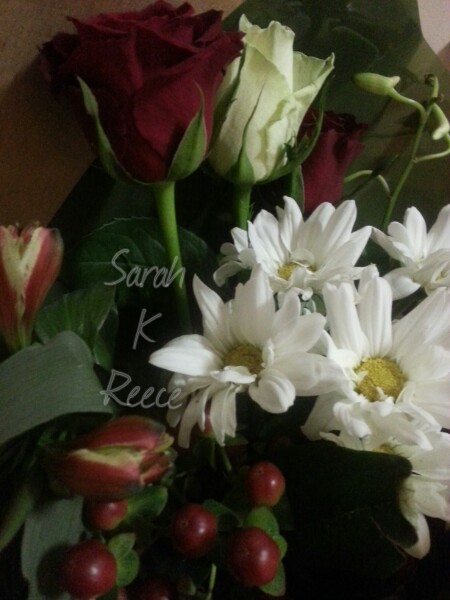
Grateful for friends on the other side of the world who send flowers.

Things are hard. We’re in crisis mode. Not much sleep is happening. I’m doing a lot of paperwork tracking down these debts. So far I’ve discovered we were billed for a bit over $400 we don’t owe, which is good news now that that’s been fixed, but there’s a kind of recurring error in which we’ve been over paid (not our fault) then had our rent increased and pay cut on the basis of this, then been asked to repay the over payment while the rent stays up and the pay stays cut. I’ve gone as far as I can with fixing this on phones and have to go and try to track down help in person next week.

Crisis mode means we had ice cream for dinner last night. It means we’re glad when we have good hours and we’re not surprised when they turn bad without warning. We make plans only a few hours ahead with any sense of certainty. We touch base every couple of hours, touch each other when in the same space frequently, fingers to fingers, hand to cheek. A hundred little ways of saying to each other – I’m still here, I love you, we’ll be okay.

We’re talking this weekend off and heading away from the city to hide out with a friend and our dog. I hope it helps, we sure could use a break. Friends being lovely are helping to keep us going.

Distraught

I am shattered. 2 days of intense Posttraumatic Stress Disorder (PTSD) type distress. I remember this, it’s like being 14 again (when I was first diagnosed). I jump at every little sound or movement. I’m still bleeding, so much blood. It flashes in front my eyes, I see it pouring from my opened wrists for just a moment, a flicker of it pumping from the drip site in my hand. This isn’t just grief, it is trauma. I feel like I’ve staggered into another world, I’m walking wounded with the returned soldiers from a war we’re not supposed to talk about that everyone pretends isn’t happening. I feel like a ghost. I feel like I’m dead. I’m slipping sideways into that detached place where I’m not sure what the hell is wrong with me or why I can’t just cope better, where nothing matters and nothing counts.

I’m reading about women miscarrying at work and not being allowed to go home early, about partners putting on pressure to get over it, about women who were treated with sympathy after the first loss but the fourth is old news now and there’s just frustration that she needs time off again, about women being treated brutally by medical staff, denied pain relief, denied the treatment of their choice, suffering through multiple internal exams, strangers trying to pull the last debris from their womb by hand. I’m reading about women who 3 years on still have flashbacks, can’t bear to be too close to another pregnant woman, can’t see her children without pain. And no one talks about PTSD or trauma, because no one has talked to them about it. Because ‘nothing really happened, miscarriages happen all the time and most women just get on with things and don’t make such a fuss and an early loss isn’t really a baby and it’s best not to talk about, not to think about it, not to make a big deal out of it…’ So we don’t call it trauma and we don’t call it dissociation or flashbacks or triggers we just call it some hypersensitive women not coping…

I’m at the limit of coping. Small things push me into hysterical distress. I can’t go more than a few hours without feeling absolute desolation and sobbing. My voice cracks, my heart feels shattered, there’s this keening howl in my throat when I breathe in. I feel like I can’t breathe. I feel like I’m drowning. I hate reading other people’s experiences but I can’t bear to be alone in this either. Their pain, their crazy-making pain, their trauma and woundedness and hopefulness and grief and sense of being alone give mine context. This is just what it is, this is what it feels like. I get it now, and when I feel compassion for them or rage on their behalf, a little spills over for me too.

I crave sleep and rest, time in the garden, in the sunlight. Other people’s children hurt to see, their babies are a physical pain in my chest, an ache in my arms. But I love them also, I want to be near them, to follow them, if they look at me or smile I feel like my heart breaks but it is bitter-sweet, a flood of love and hope, looking over at world where the sun is shining. I don’t want to avoid them yet. Maybe after the next loss I will be in that place.

Every time I have to talk about the pregnancy in the past tense I feel a fresh wound.

I find I crave touch. I want to curl into a hug for 6 hours and not get up again until the world hurts less. I want to hide in a pillow fort, under blankets until the monsters go away.

I want to run down the streets, naked and screaming, blood streaked, and set fire to the houses of the complacent people who don’t think this is a big deal.

This morning I slept in a little then got up to go to college. I dressed and got ready then opened emails from welfare. They have made major mistakes with calculations and we owe them a lot of money. The same thing has happened with housing and we now owe a lot of backpay rent too. I called a friend in hysterics. They came round and cleaned the kitchen while I called debt departments and wrote up excel charts to try and figure out how this happened and how we are going to manage it. I spent all day in admin between bouts of hysteria. I’m exhausted to the point of trembling.

People are sending in messages of grief and support from our Invitation. I read them out loud in bed to Rose at night. We kiss goodnight through tears. I’m so glad we did this, so glad we chose to handle it this way. It’s deeply meaningful to feel we are honouring other dead babies, other families love and grief too. I have to go back to college soon, to work on artworks and all I want to do is memorialise grief. All I want to do is make trees that weep for dead babies, monuments that speak for silenced grief.

I’m trying to keep my life running. I’m scared of dropping out of college, of losing my business, my networks, my friends. I’m scared that when I climb out of this black hole and there won’t be anything left. The world is already moving on, sweeping me along, demanding attention. And I’m still here, bleeding. I’m still here.

It’s not pretty

image

Feeling sick.
Feeling angry.
Inks and poetry are my punching a wall. And music
Music lets me breathe
Especially Trent.

She shines in a world full of ugliness
She matters when everything is meaningless.
(this is the first day of my last days)

It’s not pretty, it’s life.

Still no news if the baby will live or die.

Trauma is not everything

Bear with me, all those of you who are still fighting like crazy to have trauma recognised as important, relevant, meaningful to people’s experiences and struggles. I know that for you the idea that trauma can be overstated or misapplied may seem ridiculous because in so many areas it’s still fundamentally so ignored! But the fields are not flat – in some areas trauma is the focus in a huge way, and sometimes this is unbalanced and makes life harder for people.

I was discussing this issue once with a sexual therapist who was being driven to distraction by the assumption that trauma underlies all challenges people have. People were being presumed to have been sexually abused merely on the basis of having some issue they would like to seek support from a professional like her. The gender and sexuality diverse community has laboured under this myth for many years! I still hear from friends that some doctors and psychiatrists believe that being queer in any way is a sign of sexual abuse in childhood, or means they have unresolved issues with a parent. (Who the hell doesn’t have an unresolved issue of some kind with a parent??)

Trauma being a central focus can also cause problems because of people’s natural desire to arrange things in some kind of order. People often create a hierarchy to trauma experiences and feel humiliated and mystified when their trauma history isn’t ‘bad enough’ to justify their current struggles. Context – so dull and yet so key to the story of post trauma stress – is so often forgotten. Friends, connections, and meaning play such a huge role in our response to trauma. It’s not all what happened to you, it’s also how people treated you afterwards. Some of the most undramatic stories in our lives, loneliness and loss, leave the deepest wounds. Resources that focus on trauma either exclude those needing the same support but due to anxiety or other kinds of distress, or they broaden the definition to the point where all people are traumatised and the answer to every question and result of every equation is trauma.

It’s easy to look at a misfit like me and see trauma, and trauma is a big part of my story! But it is not the only part. I was a creative oddball long before school bullies and self harm. Claiming and understanding my trauma history and how it has shaped me has been essential to understanding myself, but I also find that at times I have to reclaim myself from the overwhelming trauma narratives. My life includes these things but does not revolve around them. I am more than what has happened to me. I am more than a sad story of harm or a triumphant story of recovery. I am also a life, a human life, with all the sorrow and pain, and the confusion, and the sublime. My story is not more or less meaningful, my pain not more or less real, my joy nor more or less extraordinary. I am human, and trauma narratives can take that away from me and put me in some other box of people who are different, lesser, or special. I am not other. I am human.

I remember going to Melbourne to see the Tim Burton exhibition and reading about his childhood and early life as an artist, expecting to see a trauma story given his proclivity for the gothic misfit. There wasn’t one. He was a creative oddball who didn’t fit well – his portrayal of the blandness of suburban life are now legendary! (think Edward Scissorhands for example) Trauma is part of the story of many artists lives, but for many it’s not, and we misunderstand something about the nature of creativity and restlessness when we forget this. When we don’t recall that many artists don’t ‘fit’ at first, we turn that ‘not fitting feeling’ into something about trauma. Being an outsider is always a strange, challenging, and blessed experience whether you’re super smart, disabled, or vaguely mad. Trauma may be a result if you’re isolated or bullied, but it’s not always a cause. 

I find myself wanting to talk about how harm can happen when all our dominant narratives become about trauma. When friends struggle through extremely poorly delivered child abuse awareness training where they are told definitively that people who are sexually abused as children are damaged for the rest of their lives and never recover normal relationships or sexual intimacy, I’m so angry. And when those friends try to speak up and say – hey, that was me, and yes, it’s the most horrible thing – but don’t write off our lives! We DO have lives! And are instead told their personal experience is clouding their judgement so they are failing to appreciate the catastrophic impact, I think something is wrong.

I’ve read ‘trauma informed care’ documents that make victims of trauma sound like helpless children, or that insist that healing only happens in therapy and close connections to a traumatised person should never be attempted by someone not ‘suitably trained’. You can almost hear the void around the hurting person as everyone steps back and waits for an expert to come along. In other contexts, we call this ‘the bystander effect’. It’s not a good thing. Friendships and relationships have a language of their own that should be respected! Communities have been finding ways through trauma – well and badly, for thousands of years before we invented therapy. Therapy is one of many tools, and it does not ever replace community and a sense of belonging. (many trauma therapists know this, of course!)

I’ve sat in talks about multiplicity that were so concerned to let us know we may be triggered, we were welcome to leave partway, caring staff were on hand if we needed to talk to someone etc etc that I seriously wondered if they’d considered that I manage pap smears, nightmares, losing people I care about to death and suicide – on top of the various traumas in my more distant past. The focus on my vulnerability left me extremely angry and unseen –  my strength, my coping, my competency were all invisible in a space that marked me as a trauma survivor and permitted me to leave the room where the important educated people were discussing the difficult topics of the life and recovery of people like me.

There’s a fantastic looking conference happening later this year I would love to attend and speak at. It’s being held by the International Society for the Study of Trauma and Dissociation. Unfortunately it’s happening the month after I’m due to deliver our baby, so I’m not going to put an abstract in. But reading the front page of info really made me want to, because its called Broken Structures, Broken Selves, and describes “The very structures given the responsibility to protect these children, broke down their basic trust in the world, and therefore their very essence – Self – so necessary for their future development.” And I so want to go there and talk about the harm we do when we constantly refer to people as broken! The number of times terms like fractured, broken, fragmented, and developmental failure turn up in books and articles about multiplicity is absurd. People are harmed when we constantly describe them this way! People are harmed when there is no concept of healthy multiplicity, non-trauma-origin multiplicity, or healthy dissociation. I KNOW there is a profound need for awareness and sensitivity to the impact of trauma, to normalise and support people especially when their only other framework is “I’m crazy!” People are harmed by trauma, yes! But when inbuilt defense mechanisms like dissociation act exactly as they are supposed to, I would argue they are a very long way from broken. It is those who harm people who are broken. That is the inhuman behaviour.

I can’t go along this time and say any of that, I’m hoping that someone will anyway, there’s a diverse group of people interested in this field and I don’t but heads with all of them! Some of us have fought so long and hard to have trauma recognised as important, we need to be careful of what happens when it does gain that recognition and becomes the dominant framework. It can be inconceivable that something so fundamentally respectful of people, something so essential and good could be misused or harm people. But such is the risk when any perspective becomes dominant. There’s more to us, to our stories, our lives, and our selves than trauma. Part of what it is to be human is to feel broken, to be aware of our own incapabilities and limits, to mourn what we could be. That story isn’t just about trauma, it doesn’t cut us off from those who lived blessed lives. We don’t have to sit on our side of the fence hating them, watching them live in the sunshine while we drag our mangled hearts through the darkness. There’s pain in all of us, loneliness, brokenness, and hope. This is the human story. It seems so deeply important to me to place trauma in that context, to – if you will – integrate it with our stories of what it is to live and love and be a breathing living collection of fears and dreams all wrapped in skin.

When sanity is lethal and madness has value

I’ve been thinking a lot lately about our cultural ideas of sanity. Being sane is seen to be about living in reality, or what we call ‘the real world’. Children naturally only partly live in the real world. They experience, interpret, and believe many things that would be considered psychotic in an adult, flights of fancy such as imaginary friends. Artists are generally not considered to live in the real world much either, but for most adults it’s mandatory and something we spend a lot of time teaching our kids to do. This is linked to some pretty harmful ideas about growing up.  It’s also generally the goal for people with ‘mental illnesses’.

I don’t think we do live in the real world. We talk about it, we make assumptions about it, we share in a mass set of beliefs we call ‘reality’, and we’ve built a mental health system on the idea that not only is there a shared reality, it’s also easy to define, simple to determine who isn’t connected to it any more, and that sanity and mental health is about people believing in it again. I disagree!

I don’t believe ‘the real world’ is reality. (Of course, that’s hardly definitive. According to most of the doctors I’ve seen, I have some collection of mental illnesses. The actual collection differs from doctor to doctor, and the implied level of insanity with it, but the general consensus has certainly been that I’m no poster child for the well adjusted and sane.)

Of all my family, I have the most significant list of mental illnesses, and on paper am apparently far less in contact with reality than the rest. But it’s not difficult for me to gather evidence that suggests something else entirely! At times, I’ve been the one left standing and keeping people safe through chaos, or the one who was able to see danger coming and put things in place to deal with it, or the one who went and found what we needed to make decisions and stay alive. Crises have both harmed me and taken me out of the role of the ‘sick one’ and thinking that multiplicity was the worst thing in the world.

We don’t overtly use words like madness a lot in mental health these days, but scratch the surface and you can quickly find that the premises underlie a great many of our ideas and assumptions. We now have the rather inadequate terms ‘mental illness’ and ‘mental health’ as part of the medical model re-visioning of psychological states. They are direct stand-ins for the concepts of madness and sanity, especially in the field of psychosis, with a veneer of ideas around non-culpability and potential cure. Let’s think about them for a minute. What are they? If sane is about being in contact with reality, living in the real world, madness is seen as the opposite. Loss of contact with reality. Distress, confusion, delusions, hallucinations, bizarre beliefs and behaviour. Not living in the real world any more.

Madness and sanity are presumed to be opposite states, on a spectrum of intensity. Doctors treat the severely or moderately mentally ill in the hopes of restoring them to at least mild levels of mental health. Psychiatrists and treating registrars make calls of madness and sanity in brief interviews with often heavily medicated and highly distressed people. The results can be almost comic in their fallibility. Eleanor Longden tells the story of a time she was sectioned as psychotic when a doctor thought her mention of her upcoming work on a local radio station was a grandiose delusion. Her understandable distress at being so profoundly misjudged was taken as further evidence of her mental illness. It’s a closed loop; the normal emotional responses to being assessed as crazy are used as proof you are, in fact, crazy.

And yet, most of us share a terror of madness. It’s one of the primary reasons people seek help, and are relieved by a diagnosis – “there’s a name for it! I though I was just going mad!” We are driven mad when people think we are mad. It terrifies and distresses us and we will go to great lengths to convince people we are not. This behaviour is the same for people are psychotic or simply misunderstood, and yet in the former it is assessed as anosognosia (lack of insight) when in fact it is an intact, normal response to being seen as mad that most people will have in those circumstances. Those who embrace that they have become mad are usually, at least for a time, crushed by it. It is a state that is utterly without value, completely terrifying, and puts people into a whole new class of humans who can swiftly lose many basic rights about their lives and medical care. Having been assessed as mad, even calm, normal human behaviour is distorted through a lens that amplifies diversity, individuality, and departure from the obedient patient roles and interprets it all as further madness. (See the Rosenhan experiments) The cost to a person’s credibility is high, and can be extremely difficult to restore.

Think about what this actually means. We have a massive collection of people employed in our police department specifically to try and figure out what reality is when there’s a possibility someone has been injured or laws have been broken. We have entire complex branches of science dedicated to determining different tiny detailed aspects of the nature of the world we live in. They regularly disagree with one another and update new theories as old ones are disproved. We have an entire judiciary system structured on the understanding that knowing the truth of a situation can be extraordinarily difficult and complex. The whole history of philosophical thought examines the nature of reality and finds that even defining the concept is astonishingly challenging. It’s difficult to find any three people on the planet with completely identical beliefs about the world and their place in it.

And yet, we sit a doctor and a patient down in a room, and assume the doctor can determine reality and can pronounce madness and sanity with excellent accuracy. Wow. Who are these marvels of discernment? They are us. Doctors, psychologists and psychiatrists have similar if not higher rates of ‘mental illness’, trauma histories, job burnout, and suicide, than the rest of the human population. They contain the same qualities we find in every other person doing a job – some highly skilled and insightful, some mediocre and clock-watching, some true scum bags. And yet we, as a whole culture, invest in the illusion that not only is reality easy to define, but that these people are experts in doing so. In fact, their testimony is frequently relied upon in situations such as custody battles. The presumption that they are sane, and highly skilled at determining not only what reality is, but also sanity: who is ‘in touch’ with reality, is infrequently challenged. In many situations, merely challenging these assumptions is itself seen as evidence of madness. A considerable number of patients stress tremendously about their ‘trust issues’ when they struggle to connect with their shrinks, when in no other context would we expect people to share with a complete stranger who is not likewise vulnerable and has established no trustworthiness beyond attaining a degree. My assessment is that there’s little sanity in any of these processes.

I believe that I am, like most people, both mad and sane. I don’t find the terms mutually exclusive. As for ‘the real world’? I would go a step further and argue that this idea is partly what drives my pain and dysfunction, and that my sanity often resides in refusing to believe in it. Lets look at trauma for a moment. We as a community believe a collection of things that are not true, but that are convenient to believe. For example, here in a first world country, we often believe that if we are decent people, we will be mostly safe from harm. Many of our child raising techniques are overtly designed to create and preserve this belief in children. Our sense of security rests on an illusionary contract with the world at large. This is what a horrific trauma incident can shatter. Having upheld our end of the bargain, our sense of safety is utterly destroyed when a violent, terrifying incident reveals that the world isn’t playing by our rules. We are devastated by our loss, overwhelmed by intense grief for a world we no longer feel a part of, and given the arduous task of rebuilding a sense of security in our new reality where we can’t always stop truly horrible things from happening. It’s a deeply personal experience of the scientific process of testing a hypothesis, finding it is terribly flawed, and having to devise a new one, preferably one we can live with, and even better, in some way explain to others.

The tension for people in this situation is that it’s not uncommon for the people around them to still believe in the very illusion they’ve just had shattered. Their idea of the ‘real world’ has not been destroyed by a personal confrontation with mortality, horror, and vulnerability. Their idea of sanity is to maintain a belief system that the traumatised person can simply no longer subscribe to. The traumatised person is newly exposed to the experience of helplessness and profound injustice. Their perceptions of risk are disproportionately high as they lack the buffering of any sense of emotional security. Aware that they are partly irrational, it is easy for them to subscribe to the idea that sanity is about restoring their old beliefs, so that they can once more grasp the emotional security their friends still enjoy. The bone-deep emotional reality of their experience will fight every attempt to re-instate the old beliefs through depression, distress, and other involuntary trauma reactions. Hence the war inside someone who has been traumatised, has been sold the idea that ‘going back to the way they used to be’ is how they will become healthier, and who is now fighting their own experiences and emotions in the hopes of restoring themselves to sanity.

What we call ‘the real world’ is not only more challenging to define than we have treated it, but it’s sometime actually the problem. I had a lovely friend called Amanda who killed herself. At her funeral, a theme that came up over and over again was one of failure. Diagnosed with bipolar, Amanda crashed and burned at just the time her peers were finding their wings. Struggling with university, struggling to work, to live independently, to attain any of the goals that had been set for her, Amanda drowned in a sense of failure. As someone who’s highest educational achievement to date has been a cert 4, who lives on welfare, in public housing, a mere disability statistic, I can empathise. Of course, this view of her and I isn’t reality. The reality is, we are each important members of complex social networks, highly skilled, compassionate, and primarily ‘disabled’ not through our challenges but because we live in a post-industrial society where we must be able to work reliably at certain days and hours each week, and where our public identity and sense of personal success relies on being able to secure and maintain such work. The ‘failure’ is not ours, yet we and people like us bear a terribly burden, often mistakenly equating our skills and intelligence with our mental health and doubting that we are genuinely disabled. We are haunted by fear that really, we are just weak, lazy, or useless. ‘The real world’ is that Amanda had failed and was continuing to fail. The reality is that she was amazing and deeply important and her life was beautiful and meaningful and lived with kindness, humour, and depth, and that she is profoundly missed.

I’m not naive. I’m very familiar with the world of psychosis. I’ve tried to calm people who are distraught because of hallucinations that are terrifying them. I’m well aware that many of us have a basic, blunt instrument kind of discernment of when someone is wildly delusional or hallucinating. The poor young man terrified that his neighbours are trying to poison him, the woman convinced she can fly from the top of the 9 story car park, the new Mum terrified of her growing conviction that her infant is evil. Buddhist philosophers may debate the nature of reality but they still look both ways before crossing the road. At times this may be very simple – I know the woman cannot fly and will be hurt or killed if she tries. At other times it only seems simple – the quiet young man, well dressed, with a job, and a calm gaze, is sane. The young woman huddled under the rug, weeping and tearing out her hair is mad. What the police and the paramedics cannot know, and the woman cannot articulate, is that the young man has been emotionally torturing her for months, and that night raped her when she refused to have sex, then used her distress and prior diagnoses to have her committed and discredit any possible allegations she might bring against him later on. This sort of thing happens. It happens more than we think. And when it happens often enough, the traumatised person loses the ability to tell their story, the credibility to be believed, and sometimes even the memory of what lies beneath their ‘madness’ and pain.

There is really no greater power in the world than to be the person who determines what is real and who is sane. And yet we wield this power so thoughtlessly, so convinced that good intentions will protect the vulnerable from exploitation and the powerful from corruption. This is naivete.

Sanity is relative.

It depends on who has who locked in what cage.

-CS Lewis

Reality is determined by the powerful. The powerful are not necessarily sane, they are merely powerful. Their ideas have popular traction and become what we think of as ‘normal’ or as ‘the real world’. The ‘real world’ once told me that I was poor, white trash living in a caravan park, fallen so far from my sterling academic success and the expectations of my school and family. To dig my way out of the pit, out of the catastrophic effect this had on my identity, self esteem, and hope, I had to reject this version of reality and construct my own. I had to connect with a different idea of success and find a new way to evaluate my life. Stumbling onto this power – to define my own life, my own reality, and make my own choices, saved me. It is still saving me. While sometimes our beliefs can threaten or destroy our lives – I know people who have tried to kill themselves, kill someone else, who became homeless, refused food, and many seriously destructive behaviours because of their beliefs – our basic need to be the architect of those beliefs remains. We are harmed when we are instructed or forced to substitute someone else’s ideas about reality for our own. When we’ve had our trust in our own beliefs taken from us, we lose something critical. The loss of it can drive us further into madness, or it can flatland our life as we remain fearful of our thoughts and mind and totally dependant on outside sources of information. Collaboration with outside sources is often useful, it’s the substitution of another’s ideas for any of our own that so disempowers.

Here’s the thing; I also know of people who are considered to be entirely sane who have tried to kill themselves, or others, who work jobs they hate, see family who make them miserable, enact policies that destroy people’s lives. Many of them are people who consider themselves to live ‘in the real world’ and think that because they do not hallucinate and at times I do, that they are saner than I am.

We are all philosophers and scientists, making sense of our own lives, coming up with theories, trading them in, building new ideas. When we build the myth that reality is fixed and easy to define, and that sanity is about consensus and submission to a group belief, we take away from people their most fundamental power to make sense of their own world. It is a violence, even when done with kindness. Collaboration and relationship are where we best seem to make sense of the world. It doesn’t take much imagination to realise that every person on earth believes some ideas that someone else considers to be madness. Simply imagine your most difficult family member being invested with the power to decide what is reality and who is sane, put them in the judge box, and justify your life choices and beliefs to them. There’s no way you’re going to come through stamped ‘sane’. The same is probably true of every family member or friend you have, to some degree. This is diversity.

I’m often asked to define reality. Even in my low position as a peer worker in mental health, people invest me with the power to tell them what is real. They come to me after talks and ask me if their behaviour is ‘normal’, which considering I’ve often just been describing my own so-called wildly abnormal behaviour (living as a multiple), is a curious expression of trust in my capacity to delineate between reality and madness, and an even curiouser idea that I am here to police their reality. I’ve spoken with people who have a spiritual understanding of the origin of their multiplicity (such as having a part that is the spirit of a dead family member) who’ve asked me if it’s real or not. I’ve been reported as abusive by a woman suffering with paranoia who was convinced I was hacking into her personal life to stalk her. I’ve instigated the forced hospitalisation of a person who had recently become homeless due to their unusual beliefs, and who I assessed to be at very high risk of assault or exploitation. I still consider that act of reporting to be an assault, and the person in question has never forgiven me. It was an incredibly difficult decision. I’m still uncertain about it, distressed and regretful and also far more aware of the horrific decisions like this so many people have to make on a regular basis.

It’s incredibly important to define what is real in some contexts, and almost impossible to in others. People are all both sane and mad. We all share some aspects of reality and have other experiences, quirks, passions and desires that are entirely our own unique way of being in the world. Something terrifying happens when we make social constructs ‘the real world’ and think they are reality. Reality is did you hit him or not? It is physical and measurable. It is not about the constructs that make up our ideas about ‘the real world’. It is not a flatland of emotional deprivation. It can exist alongside psychosis and dreams and surreal experiences. It is not freedom from pain. If you are human and alive, then you will sometimes suffer. You will have your heart broken, you will lose people you love, you will have dreams crushed. You will need to weep and scream and hurt. That’s a side of sanity we don’t talk much about.

So here’s a side of madness we don’t hear much about either: madness; our unique perspective and experience of life, is like fire, a great gift with destructive potential. Madness is part of reality, part of our sanity. It can protect us. Madness is disagreeing with ‘the real world’ and the way things are always done. Madness can be breaking out of roles and expectations and doing what’s actually meaningful to you. Madness can be joyful exuberance and childlike magic. Madness can be dancing in the rain, or communing with God, or sitting on the roof and watching the stars fall. It’s the sublime. It’s the things we don’t have words for. In some situations, sanity is a threat to our hope, our emotional stability, and our lives. Sometimes it’s sane to give up, to hate, to shut down, to want to die. Sometimes madness saves us.

little spark of madness

Multiplicity and Love

How do you get engaged when there’s more than one of you?

There’s a million different ways. I’ve written before about multiplicity and relationships, and also about how switching affects relationships. Some people don’t know they have multiplicity when they enter into long term relationships. Some have a single part bond – one part is engaged, the others may have reactions ranging from excitement to indifference to horror, or be entirely unaware this is happening until they come back out maybe months or years later. Some may have group bonds where many parts have relationships of various kinds with the other person.

I’ve done romantic relationships before I knew about parts. They were tremendously challenging. Things would be going brilliantly and suddenly completely derail without warning – what I now know was being caused by different parts switching and needing completely different things. Child parts would be distraught at being kissed on the mouth, wild parts would need to run in the night, the poets needed ink and solitude and contemplation and freedom to be melancholy, the researcher craves new information and sharp minds to discuss with. The experience for the partner is one of ‘consistent inconsistency’. Some days I drink my tea this way and some that. Some days I love licorice and some days hate it. Some days I sink into a hug and some days flinch. Part based roles make it challenging to engage relationship boundaries – this part remembers all the good things, that part the bad. When the former part is out they are happy, easy to get along with, generous, and malleable. When the latter is out, they are frustrated, suspicious, and desperate to repair whatever trust has been broken or boundaries violated. Hence the bounce between ‘everything is awesome’ and ‘everything is broken’.

The real challenge was in discovering that they are both right but also both a little unbalanced because of the skewed information they have to work with. For years we thought my part who recalls the painful and frightening things was simply us being ‘depressed’, and that we should ignore everything we think and feel during those times as merely being the product of mental illness and low mood. Turns out she actually had some really important points, and that without her perspective we’re really vulnerable to exploitation and abuse. On the other hand, most of her proposed solutions were drastic and destructive. We had to take her input and work on something more useful to do with it.

I’ve also tried my hand at romance once I knew about my multiplicity but wasn’t ready to share it. That was challenging in a whole different way. Concealing switching was easy because that’s how my system usually works anyway, but trying to get a partner not to take it personally or think they’d done something wrong when I needed things to be platonic for child parts, for example, was really hard for me. I found that I started to feel like a sleeper agent with a cover story. There were real feelings and people and lives around me, but a central secret about who I was disconnected me, and the constant need to conceal and the terror of being outed caused me tremendous distress.

I’ve been in romances with multiples as well as singles, guys as well as girls. They are wildly different in some ways, but I wouldn’t describe any of them as fundamentally ‘easier’, just different. I’ve found that we gravitate towards people who have access to a wide range of ‘sides of themselves’ if they’re not actually multiple. That is, what we usually mean when we talk about parts of ourselves; ‘part of me wants to study tonight, part of me wants to go hang out with my friends’. People who have found one way of being in the world and stick with it through all circumstances tend to confuse and sadden me. I can often ‘feel’ their buried parts or cut off emotions, and struggle not to interact with those sides of them. I can find myself impatiently waiting for them to reveal more of themselves – particularly when their approach to life is clearly not working for them – why don’t you switch already? Sometimes I feel like the lucky one and people with so little access to other perspectives and ways of being in the world feel like the ones who need help.

That’s not to say that these other ways can’t work! At one point I was in a relationship, as an undiagnosed multiple, with another undiagnosed multiple. When it worked it was beautiful, a synchronicity, us against the world, at last someone who functioned the way I did, needed the things I needed, saw the world the way I saw it. When it didn’t work it was agony. People find themselves in very different situations and navigate their relationships in different ways. There’s no right or wrong answer here, just different ones, and the challenge to love without harming or being harmed.

Rose is the first person I’ve been involved with as an ‘out’ multiple. I vastly prefer it! It means that the night one of my deep, very wounded parts came out and had a panic attack when Rose touched her made sense. I could explain what happened. Rose could adapt. Rose now recognises almost all of my system by sight – how we talk, walk, hold our body, the colour of our eyes. She knows our individual personal names. Even when she can’t tell who it is, she can tell the basics that she needs to know – adult/teen/child, male/female/other, romantic/platonic, reassured by touch/traumatised by touch. With that information we can both navigate the switching and build and maintain relationships between everyone. She’s met most of us who switch out, and with most has formed a strong relationship of some kind. In our case, there’s several who are romantically involved with her, then there are friends, ones who relate more as sisters, ones who only get involved occasionally, and so on. We’ve proposed as a group, and so we didn’t ask her to marry us, but to be our family, because what we’re asking for and offering is different for each of us.

There’s challenges! Everyone doesn’t always get along. Parts have different needs. It can be easy to fall into a carer/caree dynamic as that is how we are seen in the mental health world. There’s the added pressure of being treated as ‘trailblazers’ who are proving that relationships with multiple are (or are not) possible. Rather similar to the way that our relationship is seen as representative of all lesbian relationships in friendship or family circles who haven’t been directly exposed to any others. There’s the challenge of embracing Rose without writing her into my system – letting my child parts love her but not treat her as a parent (that’s our role), not catching her up in the inevitable rescue fantasies that most of us who have at some point been deeply hurt find written into our approach to the world, not seeing her as others who have hurt us when things aren’t going well.

There’s also upsides. Like the time she asks for the part who handles physical aggression when we’re walking at night and group of guys is watching us in a scary manner… and I can say to her – already here love, don’t worry, I’ve got your back. It’s late night video games with my kids, it’s climbing trees with the wild ones, it’s sharing stories of homelessness with the survivors, and having huge conversations about peer work and youth work and social work and community and mental health and power and families. It’s Rose having someone who gets her experiences with flashbacks, nightmares, body shame, and self loathing… and can make her laugh about them. It’s about us having the stamina to switch out the tired ones and make it through a week of Rose in hospital, also keeping the pets alive, easing her trauma reactions so she doesn’t wind up sectioned as well, being there through severe pain, and putting all our needs on hold until it’s over. It’s about the contradictions that make up all people, writ large; the edible glitter on cupcakes and the goth nightclubs, the gardener and the naked body painter in a psychotic whirl, the person who takes lizards off the road and nurses orphaned kittens and the one who burns with rage when Rose is being hurt.

As I keep saying, multiplicity is normal human function, writ large. It’s a dance, between adult and child, light and dark, male and female, the apparently functional and the apparently wounded, the ones who fit in and the ones who don’t fit anywhere. We dance together, sometimes she needs me to make her laugh and my cheeky imp turns up and turns the house upside down. Sometimes I need her to hold me and tell me “don’t worry love, everyone gets to see your charismatic ones. I’m privileged to know the ones who don’t stand up in front of crowds”.

There’s days she cares for me but she’s not my carer. There’s times she feels deep empathy for me, but she’s not with me because she feels sorry for me. There’s needs she has that I’m good at meeting, but we’re not together to exploit my capacity. There’s ways in which we’re similar and also big differences. Navigating multiplicity is a key aspect of every day and every part of our relationship, and in another sense, it’s irrelevant. Once you get used to kids turning up in the lolly aisle at the supermarket and know not to be scared and wander around hand in hand talking about the virtues of kinder surprises vs gummi bears, knowing that I’ll switch back to an adult in time to drive home, it’s just not that big a deal. Once you’ve learned what helps in a bad night, then swinging into action to rub my back and listen empathetically as some wounded soul howls or flashbacks or recounts a nightmare is just part of our life. Trauma is part of our world, some times a big part to manage, sometimes so small it’s barely there, but it’s just something to live with. It’s not a source of shame or fighting or horror, we make plans around it just like we would if I was still in a wheelchair. We don’t compete about who is in the most pain, we don’t treat my experiences or my multiplicity as worse or more important or more amazing than Rose’s experiences of trauma and loss and triumph. She is neither healthier, nor sicker, nor luckier, nor less creative, than we are.

We’re both just people, frail humans, with capacity for light and dark, with frustrating and enduring weaknesses, with amazing strengths. We work to keep our power in balance, to love each other, to own our own stuff, and to make a great life together. Just like anyone else. Love is love.

Phobias ain’t phobias hey

Post op pain is a bitch. The ENT was kind enough to warn me that the procedures I’ve had done tend do two pain spikes, around days 3 and 7. Forwarned is forearmed, it helps a lot if you know to expect it and aren’t panicking that something has gone wrong. Mornings and late night are my worst times, which is usually the case for any of my conditions. Peak functioning and lowest pain is afternoons, best time for visitors, appointments, eating, and uncomfortable procedures. I’m have to drown myself on a regular basis with salt gargles, sinus rinses, and sinus sprays. This is the ickiest post op I’ve ever done, I spit blood and drip pus and generally ooze. It’s truly delightful.

I’m concentrating on staying out of trauma memories as much as I can. The difference when they’re triggered is huge, my whole perspective shifts and I feel physical pain more keenly through the lens of helpless misery. I also struggle with body memories such as feeling drips and needle pain that isn’t current, I radiate distress so people are stressed and alarmed around me, and I can’t access most of my skills to manage the situation because I’m so overwhelmed by emotional pain. Humour is currently my ally! Nothing breaks the state more effectively at the moment. As I deliberately look for something absurd to focus on, I can feel myself back swimming away from a dark vortex, and color returns to the world. I don’t understand it all yet but I’m trying to pay attention and not the details so I can unpick it later because there’s something very powerful in this.

My capacity to manage the needle phobia has run out for now, sadly. This op was my first time using fentonil for pain relief, and I should be getting as blood test done to see how my liver coped with it. Unfortunately the hospital needed my bed and moved me on without follow up, so yesterday Rose took me to my GP clinic. I can be really difficult to draw blood from, phobia aside my veins are good at hiding. After several harrowing minutes on each arm the GP gave up and I’ll have to drink lots and try again on Monday. Unfortunately this means we don’t know how my liver is going so taking any codine is an unknown risk. Hence high pain levels. The techniques I used to manage the drips in hospital just didn’t have traction, like they hadn’t recharged. My hands dripped with sweat and I shook. But it was brief (ish) and I recovered pretty quickly.

When I’m back on my feet I’m going to a hypnotherapist to try and make some sense of this. There’s a lot of needles in my future! On the plus side, the progress I have made will give up somewhere to start I think. I had a really, really bad reaction to a blood test as month ago and clicked that I don’t think I do have a true phobia, rather blood tests and needles seem to trigger a massive trauma reaction complete with flashbacks. That might explain why the phobia approaches haven’t been working for me. In hospital I used visualisations based on attachment needs to great effect, and found that whenever pain spiked I could concentrate and determine what were current sensations and what were memories to be brushed away.

Anyway. So yeah, stuff. I’m taking notes and I’ll follow up later. For now I’m distracting myself with a Buffy marathon and stopping my jaw seizing by chewing licorice bullets. Tonks is being a crazy moth hunter and stalking the unit with gusto. Zoe is a total couch potato who will snuggle with any discarded clothes, socks, or, if she can find him first, my stuffed lion toy. Good company!

image

Pain, & truth, & holding onto the stories that heal

I don’t much appreciate the hedgehog that’s living in my throat, and whoever sneaks in while I’m sleeping to stuff skewers in my ears and glue in my sinuses is not on my Christmas card list. Ah, post op, that unique combination of pain, boredom, and day TV. I’ve still got laryngitis which fortunately Rose thinks sounds sexy. I’m sure that helps with the regular top up of slushes!

Have an out of sequence blog post I wrote before going in to hospital. I’m not coherent enough to edit so I take little responsibility for the content.

I’ve had some lovely responses to my recent post Fear, grief, & chronic illness, telling me that other people too, don’t always find a positive approach helpful, that letting their pain speak limits its destructiveness, or that hearing my own vulnerability is in some helpful. I so needed to hear that.

I try to keep this blog as real as possible and sometimes that feels like an endless task of painting pictures of myself and the way I see the world, then pulling them down again to paint another one that’s more complex or shows something different… and I feel this suffocating pressure to only show the successes and the positive, or only share the pain after it’s been digested and finished with and turned into something palatable… it feels both incredibly vulnerable and somehow deeply urgent to defy these pressures, like fighting upwards through water to get to air where I can breathe again. But the water constantly rises and the struggle is often present for me. I don’t know if that’s a function of my culture, of the way social media works, or of the mental health culture… perhaps it’s a little of all three?

Certainly we fear pain because we’ve turned intense pain, even grief, into mental illness, which means you are not well and should do things to become more well. Intense pain is at times necessary, needed, appropriate. A rational and human response to life. Add to this the pressure of peer work where you are supposed to show that you are now ‘well’ and provide hope for others by successfully remaining well. Social media can be a fantastic vessel for connection, but it also comes with pressures and vulnerabilities. People sculpt their online image with the attention of a company to their brand. They live in fear of the enthusiastic judgements and criticisms of public life, and they try to show their best side and most successful parts of life. The reality of their self and life becomes increasingly divorced from their public image. Often they police other’s sharing also, shaming those who express hurt, confusion, loss, or other ‘private’ emotions and experiences. This is not to suggest that people who prefer not to share deeply personal things or distress on social media are wrong or deceptive, merely that people draw the lines between public identity and private self in different places, and that a competitive culture of presenting a successful public self can be difficult to navigate. The lines between authenticity, duplicity, intimacy, and privacy can be a challenge to determine. Ultimately, most of us want a sense of connection but fear of judgement and hope for respect and admiration can be big obstacles.

Back to navigating pain. It’s not a complicated concept – go down into the pain and hear what you need and do it, and it will ease. And yet I find myself over and over again losing this approach, forgetting that it works for me, and I never hear it from anyone else. When I’m struggling responses range from the positive thinking to the hang in there, and there’s nothing wrong with that – people share what works for them, or what they think may help. But I never hear – go deeper into the pain, stop avoiding it, downplaying it, ignoring it. It’s real, it counts, it needs attending to. Surrender to it, and it will pass through you and ease. Over and over again I stumble onto the discovery that by letting go from the cliff I’m hanging from, I don’t die, and the world doesn’t end. I fall into it and it hurts and I come through it. I still haven’t found any way of fixing this knowledge into my mind or life.

I think this one of the biggest challenges of having a belief that doesn’t have a lot of cultural support. Sometimes the process of undoing one belief and building a new one feels like I’m deprogramming from a cult while I’m living in the next town over. It’s really hard, and there’s plenty of triggers around that reset my old beliefs so I have to wrestle out of them all over again. I think anyone that’s come through any kind of abuse, particularly entrenched in the local culture (school, family, church, club) and minimized, struggles with this vulnerability. You are given stories to understand yourself and your world that do you harm, but that on a deep level you continue to believe and fear may be true, even when you’ve decided that other stories are more accurate. Contact with these old stories (being molested isn’t ‘really’ sexual abuse, kids only cut themselves for attention, you’re a drama queen, you’ll never amount to anything, all mothers adore and do right by their children) can either trigger a major response – kind of like an immune response, or sneak in under your guard without you noticing. In the major response, you encounter a foreign story and you are half infected by it and half fighting it off. The more vulnerable you are to infection, the more dramatically you fight, and the more internal struggle you experience! The other option is much more subtle, a slow insidious poisoning where the story seeps in and takes hold and becomes your own without you noticing or putting up any kind of fight. Weeks or months later you find you’ve taken on their perspectives “I’m useless and lazy and never try hard enough” or internalised their ideas “I’m only bulimic, if I was really dealing with an eating disorder I would be anorexic” and are starting to live from them as if you believe them.

It’s so hard! It’s made even harder if you have little support for your new stories, if you are in regular contact with people who believe and push the old stories onto you, and if they have any kind of power or authority over you. Other things that can make it harder to keep your own beliefs is if you don’t really believe your new ones (eg. trying to use over the top positive affirmations “Every day, in every way I am getting better and better” can be a much more vulnerable position because the new stories are so unrealistic and unsophisticated with no room for back steps or grace for human flaws or bad days, that every day life can constantly provide you with enough evidence that your stories are not true that you are forced either into constant internal conflict or severe denial to maintain them). Self loathing and self doubt, which obviously spring from particular stories about yourself can also make this process more difficult as they naturally undermine all your other beliefs and endeavours and make you prone to hearing bad things about yourself as true and good things about yourself as untrue. A lack of emotional skin, which can be about trauma but is also often related to social power – the less we have, the more important others opinions become for our survival, also increases our vulnerabilities to living according to other people’s stories, and often these stories suit the other people and not ourselves.

This is where I come back to authenticity, and to the idea of truth. Truth is often complex, and we like to boil it down. We try to sum up our childhood, our relationships, people we’ve known, as if we could weigh the good and bad on scales and come to a definitive number. The reality is that this process obliterates and obscures truth. Finding truth is not about boiling down but about opening up. It doesn’t sum up all the complexity in a neat conclusion, it lays each piece next to each other, side by side, not over lapping. A simple example: my childhood was terribly painful. I was devastatingly lonely, witnessed violence and abuse, was traumatised by death and loss, suffered chronic suicidal impulses from the age of 10, and struggled with nightmares, self hate, guilt, grief, sexuality, gender identity issues, bullying, undiagnosed multiplicity, severe dissociation, and major trauma. That’s one story. It’s all true, all verifiable. My childhood was also wonderful. I was given free reign to be incredibly creative and adventurous, taught skills and resilience, offered freedom to explore rivers, climb trees, sleep out on the roof, light and cook my own meals on fires, wear wild clothes, explore artistic pursuits. I saw deserts and mountains, swam in icy snowmelt rivers, watched a meteorite shower, built a hay bale cubbyhouse to sleep in, stayed up late to watch lightning, nursed an injured baby goose for months in the pocket of an apron, ride motorbikes and go karts and beach buggies, go rock climbing and abseiling outback, bucketed hot water into a bathtub once used for stock feed in a paddock, and had a hot bath outdoors in the rain with my sister. This is also all true. People often try to ‘sum it out’ as if the good might outweigh the bad or vice versa. I’ve found that when one story obscures the other, I lose some important truth. It’s not or, it’s and. My childhood was wonderful and painful. It’s headbending, but its a key skill to be able to tolerate the tension of more complex stories like this, because single-note stories, black and white stories, often distort and conceal some truth that we need. There’s freedom in the contradictions.

Hanging onto them, even when they’re as accurate as we can craft them, as undelusional, as informed, as balanced as we can manage, can still be tough. This is where good therapy can build you up and be another voice of support (“I know your father says that you’re weak for being raped, but I also know that’s not what you believe and not how you feel about other people who’ve been raped”), or conversely where bad therapy can take your head apart (“You are manipulative and faking your issues for attention”). I also use a number of other sources of inspiration. My favourite artists adorn my walls, I reread my favourite books every year and own the movies that inspire me and inform the stories I choose to tell about myself and my life. For me, it’s about poetry, about heroes like Cyrano de Bergerac, Bradbury, Amanda Palmer, about the love of children, about all the things we use to anchor us in our beliefs and weather the tides that pull us off course and plant traps in our minds.

Absurdity is a gift

It’s been an exhausting week. Far too much bad news, challenging situations, and friends and loved ones under massive stress. Today, Rose and I were both fragile and depressed, with little left for each other. I collected her from work after a day of discouraging medical appointments and dull errands, and we drove home both in tears, at the end of our tether. We had friends visiting for dinner, so before they arrived we took a moment to touch base. Either we were going to reconnect and pull off a wonderful evening, or snap at each other and deepen the strain. We were able to sit with the triggers and hear each other and found as the tension lifted that our natural crazy sense of humour returned. We spent a wonderful evening playing board games, making jokes, and pulling silly faces at each other. In bed that evening we mused- we’d somewhat lost our humour lately. We had times of deep & meaningful conversation, or companionable connection, or heavy duty trauma territory, but it felt like it had been ages since we’d made each other laugh. What a gift it is, this simple thing. What a miracle that the world that weighs so heavy can be lifted by a laugh. Suddenly the road doesn’t seem so long or the night so dark. It’s the most simple and joyful form of mindfulness I know. It’s not about the destination, it’s all about the journey. There’s no better answer I’ve found to the scream trapped in the throat and the waiting for better years.

When have you last laughed? When have you last felt yourself step sideways out of crushing anguish and found the pain can make the humour sharp and black and driven and surreal but no less funny and no less freeing? I hope you disturb sleeping people and burst stitches and cry from the corners of your eyes and get a stitch in your side and blow chocolate milk out of your nose and gasp for air. I hope the absurdity of life helps you put down big rocks of pain and grief and play for a little while and pretend to be someone who isn’t dying inside, isn’t frozen by terror or crushed by pain or tortured by memory. And if you don’t have someone to play with, don’t forget that phones can record your silly faces and funny voices and baffling walks. Sometimes laughing is the bravest thing we do.

Families, abuse, & hope

Political systems have always been a facsimile of the predominant family dynamics

Parenting for a Peaceful World, Robin Grille

I’m about halfway through this incredibly challenging book. The most difficult and interesting part has been reading through a brief history of different approaches to children and child raising. The brutality and disconnection is truly horrifying. At one point Grille notes that the hysterical dissociation cases so common in the Victorian era are far less frequent now, probably due to very different child raising practices. Yet, I work with many people who’s childhood experiences were neglectful and abusive in probably very similar ways. Each family is like a tiny culture of its own, a mini country with its own customs and political structure. It’s interesting to also consider the reverse – looking at complex politics through the lens of a family. The same questions that can be useful to consider on the small scale are also relevant on the large – who exercises what kinds of power, and how? What is the cost of being the least powerful, or out of favour? How safe are the most vulnerable members?

Rose and I are talking a lot about families at the moment, as we plan our own. I find it interesting that our broader culture structure is capitalist, while our private family structure is closer to socialist, with much unpaid labour and sharing of resources. There’s a tension as we move between these frameworks in public and private spheres of our lives. So we have significant labour such as child raising, or caring for family who are sick, disabled, or frail aged, going largely unrecognised as they have neither job title nor a decent wage attached to them. Family power structures can be fascinatingly complex and subtle. Those who are obviously in power are sometimes only figureheads. Oppressed and brutalised family members are often the most brutal themselves in their enforcement of family traditions and rules. Families create their own mindsets, a framework through which members learn to view themselves and the world around them. When this framework is destructive, “You’re an idiot and you’ll never amount to anything”, “The world is dangerous and will eat you alive”, it takes massive effort to mentally and emotionally challenge these beliefs, break free of their hold, and construct new frameworks. Children basically grow up inside the ways their parents view the world. Many adult children of destructive families find that while they are trying to find their power to built and maintain their own beliefs, they are highly vulnerable to having their frameworks ‘switch’ to those of the family culture whenever they are anxious or in contact with them. Some families navigate such challenges with growth and new connection, others have harsh, rejecting, or even violent responses to what is essentially a war of ideologies. It can be a big challenge to maintain an individual perspective that does not mesh with the family perspective.

A task I once found incredibly helpful was to sit down and nut out the ‘rules’ of my family of origin – not the spoken ones, but the actual way we functioned. Sometimes these align, sometimes they don’t. This isn’t always a bad thing – in the case of a family with avowed ideals of patriarchy or harsh punishments, the reality may be modified and softened by genuine affection and care. No family gets it all right, and many have a combination of generous and altruistic practices mixed in with selfish and cruel ones. Those who have been raised with harsh practices may enjoy ‘their turn’ at exercising power rather than dismantling the abusive structure. But the process of deliberately choosing to observe the dynamics, to note the rules and the roles was extremely helpful for me. For example, many families have a role – the ‘lightning rod’. Whoever is in this role is available to be put down, made the butt of jokes, talked over, doesn’t get to make choices, gets less access to family resources, has to do the worst jobs or so on. This person is targeted as the source of family stress and they are available for the most powerful (not necessarily physically, but politically) family member to work out their frustration on. In some families the lightening rod is always the same person, in others it’s a shifting role as people go in and out of favour. In some families, being able to discharge tension in this way is the sole prerogative of the most powerful member, in others everyone must show their loyalty by treating the out of favour person badly. Sometimes there are factions and more than one lightening rod, with vulnerable members trying to maintain neutrality across all the teams and not find themselves in the least favoured role.

It can be useful to ask questions such as “Who gets their needs met?”, “Who has the most powerful vote?”, “Who’s plans get disrupted when something goes wrong?”, “Who does the most jobs they don’t like?”, “How safe is the least favoured family member?”. And then comes the most interesting part – how would you like your family to function? What rules did you wish your family really worked by? Many of us with challenging upbringings want to do better and can eloquently name the things we hated that hurt us badly – shaming, beatings, emotional detachment, poverty, and so on. Figuring out what we don’t want to repeat can often be much easier than figuring out what we’re going to do instead. For me, one of the things I really wanted my family to be was a nurturing place, somewhere it was safe to come home to when you were sick, hurting, anxious, or had failed at something. I want it to be normal for family members to be kind to each other, to help each other out, and to listen to each other. I sat down and nutted out a bunch of other values and ideas that are also really important to me. I found that they were pretty similar between family and friends too.

The next thing I found helpful was to start acting as if these values and ideas were normal in my family. Instead of instinctively obeying unwritten rules, I chose over and over again to operate from my own values. In my case, I had to do this with my eyes wide open because sometimes the results of breaking these rules were violent. People are often very invested in ‘the way things are’, even if they are suffering under it. Sometimes there’s a lack of hope, sometimes people are trapped by beliefs such as ‘If I was just a better person, everything would work out’. It can take time and coaxing for people to see that there is freedom and kindness possible in change. For those the current dynamics suit – those who are getting most of their needs met, or are comfortably placed within the power structure, or are so entangled with their own demons that they need a painful and chaotic environment around them – the protests can be intense. In some cases, change can expose people to life threatening consequences. This is one, of many complex reasons, that abused partners stay in relationships where they are suffering terribly.

Obeying abusive family dynamics will almost always require a person to violate their own morals and beliefs in some way. It might force someone to be a bystander when they find that intervening makes the situation worse. It might be that blaming and hurting the most vulnerable family member was the only way to be safe. There are often complex trade-offs where children may submit to abuse in the hopes of protecting their siblings, wives to rape in the hopes of protecting children, men to beatings in the hopes of protecting the women and so on. A complex network of attempts at self protection and protection of other family members often results in deep shame and a sense of failure. People in this position are embedded in the family dynamics and take on a sense of responsibility for them. With shame and guilt eroding their confidence in themselves, deep beliefs in their own worthlessness and incompetence, and a powerful and justified fear of the consequences of breaking the rules, it takes extraordinary means for people to start building new frameworks and escaping old dynamics. In some cases people will be harassed or rejected, in others they will be beaten, raped, or killed. In many situations I’ve observed, those who protest these changes do not even understand their rage, there is simply for them a sense that they are less safe, and they use whatever power they have to make themselves feel safer.

None of us is immune to this dynamic, and any of us who exercise any kind of power must consider this if we wish to handle it ethically. Even good intentions can take us down bad roads when we run solely on instinct and the desire to be safe.

The good news is that even the tiniest of gestures to break away from abusive dynamics start to generate a sense of identity and personal power. Within even profoundly abused people, a will to survive and to maintain identity is extremely strong. The entire ‘child abuse survivor’ movement is testament to that – as are the statistics on people – including children – who flee abusive families. While most will return more than once, within the deep conflicts of fear, hope, despair, and bonding, a desire for freedom remains intact. It may not be the most powerful voice, but it is still present. In violent families this change might be done entirely in secret – public obedience, but private kindness. It might be sneaking food to the child denied yet another meal, it might be covering for someone so they don’t get punished. Even secret collusions erode abusive power. They create a sense of personal agency that obedience to the rules takes away, and with that agency comes an awareness that you can and do disagree with what is happening. Environments that strip us of power and choice also reduce our possible responses to two options – we can comply, or we can rebel. In situations where the cost of rebellion is unmanageably high, most people will comply. In situations where the price of compliance is almost or is as severe as the price of rebelling – most people will rebel. Many of us actually alternate between the states, often instinctively trying to find a mid-line where we get the benefits of compliance such as approval, access to resources, protection from violence, some affection, and the benefits of rebelling such as freedom, the opportunity to connect with people outside this dynamic, and a sense of personal power and identity. Like abusers who do not understand their rage when change threatens, most of us engage both submission and rebellion instinctively and are confused and frustrated by our own drives for both.

Being able to truly disconnect from abusive dynamics is about being able to make room for a response outside of the submit/rebel dynamic. Some families (and other institutions for that matter – psychiatric hospitals spring to mind) make this extraordinarily difficult because every action of the members is conceived in a black and white framework of loyalty/disloyalty. They are for us or against us, they are one of us or not one of us, they are a good kid or a bad kid. For me, it helped to be aware of this framing of my choices, and not to mind them. While I engaged conversation about them, I did not initiate them, and I did not expect to persuade anyone. I simply identified what I wanted and acted from that. I wanted a family that was fair, so I resolved to treat members fairly, irrespective of whatever else was going on. This meant my actions were constantly misconstrued, because of course everything I did was interpreted through the framework the family was using. If I gave a gift to a powerful family member it would be assumed I was being compliant and currying favour, if I gave the same value gift to a disgraced member that was likewise a political act. This constant misunderstanding is often exhausting and debilitating to those who are trying to change the way they engage, and if their goal is to persuade people to a new framework, they can become deeply discouraged and give up, or increasingly defensive and get into massive rows. In situations where the stakes are high it’s important to be aware of the politics without subscribing to them. If an act could put you at risk of violence, homelessness, loss of job, custody, or other catastrophes, acting without thought for consequence is foolish. This process of being aware of possible or probable consequences can be immediate in some cases – “Father has always said if any of us drop out of school we’ll be kicked out of home” – in others it’s a slow process of observing the ways the stated rules “In this family we all love each other” and the actual rules “We don’t talk about your brother since he outed himself”, differ. Processing the reality when we’ve been fed a lot of lies and spin can be extremely challenging and confronting, and people are good at obeying unwritten rules while paying strong lip service to the written ones.

However, the freedom to choose your own response is powerful. Instead of merely reacting to what is present, you actually bring into being a new framework of your own, and live from that as best you can. This might cause minor friction or it might involve running to shelters and setting up new homes in new cities. Some of us pay much higher prices than others. Even with the best of intentions, you will at times fail to live up to your own values and standards. But the more you have set them for yourself instead of having them imposed upon you, the more congruent your beliefs and actions become, and the less internal struggling and weakening of identity occurs. It’s a powerful, gradual process, where the first tiny act can be nightmarishly difficult, but each subsequent one a little easier. Instead of being a pawn for the use of the more powerful, you become a player in your own right, exercising freedom of choice over your own actions and accepting the prices if you think they are worth paying. This may be profoundly unfair, involve intense grief and loss, and it can be extraordinarily difficult to maintain a minority perspective in the face of massive opposition or total indifference, but it can be done, and the gains are massive. Being able to have complex, deep, authentic relationships instead of living under the yoke of roles is an amazing experience. Claiming freedom to create a life that is personally meaningful is profound.

Learning to see the giants of our childhood as people who themselves live with the ghosts and shadows of childhood, is a perspective we can only reach when we have somewhere safe in our heads to stand. It can help move us away from attraction/repulsion, submission/rebellion, and into a place where we can see the people behind the roles. This is a much safer place from which we can feel the compassion for vulnerability and loss that may previously have trapped us or exposed us to harm, or likewise the judgement of narcissism or brutality. We can be freed from the black and white thinking where we can perceive only with compassion or only with judgement, which means our actions are more informed by the whole complexity that makes up a family, and less the instincts of ourselves as a stressed child. It can be the start of breaking away and getting out, or the start of reconnecting and making something real – or sometimes both at the same time.

Links between childhood trauma & adult chaos and hoarding

I know these two things don’t seem to be related, but my experience has been that for some people, there’s several links that can be very difficult to manage. Not everyone who was traumatised or abused as a child struggles with mess & chaos as an adult – and vice versa! Plenty of people who’s personal style is more ‘trench warfare’ than ‘glossy magazine’ haven’t been abused. And there’s a natural diversity here that I don’t wish to pathologise! But for those who have experienced childhood trauma this can be a difficult aspect of their lives, one that causes conflict and shame, and can be depressingly resistant to efforts towards change.

I once had a friend, I’m going to call them Nicole, who really struggled in this area. Their living space, and most especially their bedroom, was in a constant state of chaos and uncleanliness. Things were not just messy but in major disarray. Lack of clean clothes, bedsheets unchanged, food leftovers not picked up, mess from pets not cleaned away. Her spaces ranged from untidy to actual health hazards with moulds on walls or tiles surfaces and in food areas, and food scraps attracting rodents and bugs. I remember being initially confused and then repulsed by the state of her home. I couldn’t understand how anyone could live this way. I would help out from time to time when Nicole became really overwhelmed by it all, and between the two of us we would clean everything back to sparkling and she’d vow to do better. It never lasted. The more I helped out, the more I realised that there was more than messiness going on here. I’ve lived with messy people, they’re a pain to pick up after, but if you’re fairly diligent and there’s not too many of them, you can keep up with things. With Nicole it was different, it was more like she was at times actively trashing her space. And yet, she hated it. She wouldn’t invite friends over because she felt so ashamed of her home. When she house-shared, it was a constant source of massive conflict with her house mates who became fed up with promises to change that never came through. She struggled to maintain work when she couldn’t find any of her resources, important documents, or food for breakfast or lunch. When things got very bad her personal hygiene also suffered, without clean clothes it seemed pointless to shower, the bathroom was unpleasant to spend time in so she would also stop brushing her teeth and hair. Profound humiliation set in as she would take long stretches off work on the basis of anxiety, and self harm and suicidiality would be the result of this awful spiral.

It was so distressing to watch. We talked about it and over the years we started to tease together some idea of what was driving it. Nicole isn’t in my life anymore, but I’ll never forget the conversations we had, and my slowly dawning awareness of the links between her mess and her history of child sexual abuse. We coined a phrase – graphic, but appropriate, for the need that the mess sated – it was her moat of corpses. For a child who hadn’t been safe in her own bed at night, surrounding herself with filth and mess made her feel safer. She slept better at night with the comforting notion that anyone sneaking into her room would fall over the trash so she would hear them coming, would be put off by the mouldy food, might decide it was all just too much trouble. Once articulated however, this idea simply made her feel more humiliated and helpless, like confessing as an adult to a fear of the dark or still wetting your pants. (Neither of which are uncommon for people sexually abused as children when they are triggered and stressed) On some deep level, her inner child was still terrified of sleeping in bed, and found the mess a comforting barrier, and the idea of being unclean and unattractive far safer. These needs, difficult to explore or understand as they were, were far stronger than Nicole’s other needs for order and cleanliness and comfort in her own space. The essence of the struggle was a profound sense of not being safe, and a struggle for control between her deeply ashamed adult self, and her terrified and abused child self. (using this language in the sense in which we all have parts, rather than that of multiplicity)

I’ve since come across this dynamic many more times, with friends or loved ones, or people I’ve reached out to in my mental health work. At times issues like this are driving the cluster of behaviours we call ‘hoarding’, although there are many other things that can instead be at play. I’ve noticed a few more links between childhood trauma and chaos, one is that of the child who is raised in chaos and has no models of how to use adult routines and systems. If you’ve ever helped a child to clean up their room when it’s been completely trashed, you’ll know that children struggle to work out how to break such a big task down to small steps. Helpful adults show a child how to tackle tasks like these ones, perhaps like this; start by putting all the laundry and bedding on the bed, then let’s put all the shoes in the shoe box, now the toys back on the toy shelf, now the lego back in the lego box, now we’ll sort the clean washing from the dirty… and helpful adult have set up basically useful systems in their houses – like having a toy shelf and a place for shoes to go, and a routine at evening where everyone brushes their teeth before bed. Chaotic houses are not like this. The adults in these houses are often either distracted (such as with a very sick child in hospital), overwhelmed (with mental illness, grief, or addiction), lacking in these skills themselves, or abusive or neglectful and do not invest energy in the child’s environment and well being. It’s important to note that chaotic households are not always abusive, particularly in the instance of very bonded parents there may be a great deal of love and fun in all the chaos! But without someone to model how to use systems and routines, kids struggle to develop these skills. In houses that at times also felt unsafe and highly stressful, this effect is compounded in that it can be harder to simply tack on a few extra skills once adulthood is reached.

In other situations I’ve seen children who come from highly organised households still have huge struggles in these areas. Sometimes an abusive parent is not chaotic, but rather wears a mask of caring investment in their child. Children of these parents often reject their hypocritical role model – and so also reject the valuable skills around maintaining a home. It takes a lot of processing, maturity, and self esteem to be comfortable in any way resembling someone who has badly hurt us, or whom we despise. Sometimes it is not the parent who is abusive, but in strict households where order and neatness of appearance are prioritised over connection and expression of emotion, children who are traumatised or being abused in another setting can find themselves under tremendous stress at home when their ‘normal’ reactions to those experiences are interpreted as disrespectful and disruptive. Huge power struggles over issues of neatness and hygiene can result, with the underlying issues of poor self-worth, emotional exhaustion, alienation, and intense emotional pain going completely unnoticed. Rebellion against house rules that are perceived to be overly strict, or designed with the intention of ‘looking good for other people no matter what’s really going on’ can become an entrenched behaviour into adulthood. For many people in this situation, arguments about cleanliness with family members continue well into adult life and remain a constant point of conflict. Awareness that developing these skills and resolving the issues around chaos would meet with family approval can completely block any progress in this area when this approval would be distressing. At times the need to be in opposition to people is far stronger than our need to feel successful in our own lives.

There’s a lot of overlaps between the kinds of dynamics I’m describing and those I see in families where someone is struggling with dangerously disordered eating. There’s both the issue at hand, and the challenge of the massive stress it causes in key relationships. Caring about someone who is a trauma survivor can be challenging. Sharing a space with someone who keeps trashing it can be a source of intense distress! The conflict of needs is not just within the person, but within groups of families, friends, housemates, and neighbours. In severe forms, this can be a health hazard. People can get sick from improperly stored food, or where fridge or freezer doors are left open, moulds can trigger allergies and respiratory issues, and the psychological impact of living in a permanent tip can be huge. It may not be possible to have friends to visit. It can be a huge struggle to maintain your own life and routines when there are not only no clean dishes, but even the dirty ones haven’t been put back in the kitchen and you have to go looking for them every morning if you want breakfast. Mail gets lost. Important things are left in the rain. Broken glasses are trodden on at night in bare feet because no one cleaned them up. The back yard is a mass of dog shit, broken toys, and flies. Undesexed pets spawn litters that are sickly and difficult to home. For some people, the shame is catching, and living with a parent, sibling, or housemate who generates this kind of chaos can make people feel very ashamed. A sense of misery and hopelessness descends. It’s a difficult environment to take good care of yourself in, to feel a sense of dignity and self respect in, even to think clearly in. With all of this comes a sense of being held hostage to someone else’s demons. Efforts to fix everything don’t last or are rejected. Cycles of feeling sorry for them, of ignoring it all, of being really angry with them, cleaning it all up, and numb depression never seem to resolve, except with explosive ruptures where households disband. The underlying shame is re-enforced and there’s no way out.

If you are someone who struggles with chaos, take heart! You don’t have to be caught forever in a spiral of shame and rejection. You may be able to find ways to resolve the needs and learn the skills needed to keep a home ticking over, or you may remain messy and chaotic, but either way you can manage this. The very first thing people often need is a way to be able to think about this without hating themselves. You’re not just a horrible person. It’s not that you don’t try hard enough. I know that you have huge blocks in your head that make this incredibly difficult to even think about, much less act on. It’s not your fault.

If you are living with someone like this, also take heart. You can break out of the cycle and find ways not to be drowned by it all. You don’t have to be caught between feeling sympathy for them (and putting up with it), or hating or leaving them. You are allowed to love someone who is flawed and has been wounded, and struggles with chaos as an adult. You’re also allowed to insist on your right to feel safe and not at risk of harm in your home.

Being able to accept that this is an issue can be a radically different approach when everything you’ve always tried has been either fix it/live with it. This approach is about reducing shame and trying to untangle all the different valid needs that people have. Shame often intensifies the stress that drives this behaviour, creating a loop that drives everyone insane.

Containment is a key need. The spiral I described that Nicole would get into started with messy bedroom > chaotic home > work stress > lower personal hygiene > self harm > feeling or acting on suicidal feelings. If she was flat sharing, the messy bedroom wasn’t the end of the world, but the chaotic home stressed her flatmates, and self harm or suicidal impulses made them scared, angry, and tended to blow up simmering stress into major rejection and restructures. If the spiral can be interrupted, and the chaos can be contained to some level, the catastrophic results don’t come into play. There’s many different ways this can happen. Perhaps 1/2 day a week, everyone cleans up the house together. The rest of the time it might be trashed, but this is a regular enough team effort that it is never too unmanageable to live with. Perhaps rules around safety are agreed upon and the home is allowed to be incredibly messy provided there’s no fire or health hazard. Perhaps the person with the chaos lives alone, or in a separate space, which can be trashed without distressing their partner or family. Perhaps some more money is needed to help set up systems – shelves for boxes, wardrobes for clothes, a fridge with a door handle. Poverty and chaos are often tangled together and they can re-enforce each other. Considering that each often generates disgust and contempt from other people, those struggling with both these issues are in for a very challenging time.

Perhaps different home set ups are explored – often when these dynamics are in play it’s like there’s only two options – trashed, or magazine perfect. Homes come in so many different flavours! Sometimes the magazine look is a huge trigger, but a hippy home full of lamps and rugs, or a thousand knick knacks on shelves, or a collection of indoor plants becomes a space that feels safe and able to be tended and looked after. Sometimes rooms need to be set up differently! If bed feels unsafe, maybe you need to sell the bed, sleep on the couch with the dog for a year, set up that sewing room you’ve always wanted. Maybe you need to move away from our modern trend towards open plan living, and set your bedroom up as a labyrinth, with shelves in front of the door, a box to step over, a lego bucket as the world’s most lethal moat, a lock on the windows. When you’re not feeling overwhelmed by shame, and that not having this problem any more is the only way you’ll be acceptable to friends and family, suddenly you can tap into your creativity and find other ways to manage it.

It’s important to protect other people from our demons, and in some cases where chaos is a trigger for your friend or partner, it can be very difficult! Sometimes our particular demons do not play well together. It’s not the end of everything, you can create enough safe space for your relationships to be happy despite these challenges. They don’t have to dominate your life, threaten your relationships and self respect, and bring social workers into your home. There’s some great resources online such as Unfuck Your Habitat. Part of this is about skills, but a lot of it is about the blocks that can make those skills so hard to learn as an adult. There’s room in life for blocks, we all have them! You can find ways to manage the stress and limit the damage. Good luck!

My experience of sexual health counselling

A few years ago, I took myself off to see a counsellor at my local sexual health clinic. I was anxious as all hell, looking for some support while I grappled with my sexual orientation and dysfunction after previous distressing sexual experiences. What I thought was going to be a brief fix to my anxiety, sending me on my way with some reassurance, has turned out to be some of the most useful and powerful therapy I’ve done. This is completely at odds with everything that says that people with DID need intensive therapy by experts in dissociation and multiplicity. To be honest I manage a lot of that side of my life pretty independently. But help in some areas, such as sexual health, has been invaluable for me.

I didn’t see the counsellor very frequently, often we had a month or two between appointments, but the conversations have changed my life. I developed a routine for sessions, I’d follow them with a trip to the Shine SA resource library and borrow books about bisexuality, sexual dysfunction, sexual development, sexual health in seniors, feminism, gender, and culture, essays about being the children of gay parents, and so on, then I’d head over to a café to sit and ponder the session, write in my journal and sometimes cry into a my chai latte.

What I’ve learned is that sex isn’t a side issue the way we think it is. It’s treated as a specialist topic, quite separate from other issues such as trauma recovery or mental health. But for me, it’s not an issue off to the side of my life, it’s part of my foundations. My experiences and beliefs about sex impact my sense of self, my approach to life, my ideas about relationships. Conversations about identity, power, communication, relationship, love, consent, and desire have had a profound impact upon most aspects of my life and health.

I started with thorny confusion about things like: I think I’m into women, but what if I’m wrong? What if I start dating, some lovely woman falls in love with me, and I break her heart? What if my attraction to women is caused by abuse? What if I’m just trying to piss off my father? …Or conversely, what if I only think I’m attracted to some guys because I’ve been culturally conditioned to think that’s normal? Or because of abuse? (if abuse can make a straight person think they’re gay, can’t it also make a gay person think they’re straight?) Does God hate me? Is this about lust or love? Can it be both? Does what happened to me ‘count’ as abuse? Does my history mean I might abuse other people? How do we define abuse? How do we engage as sexual adults when we’ve been traumatised as children? Does abuse really destroy you forever? Is it possible to have a great sex life after trauma and abuse? How do I navigate coming out late in life?

I have never been able to discuss most of these things with other therapists. Even those who specifically work in the area of trauma and child sexual abuse have not been comfortable discussing sexual matters explicitly and matter of factly. We would talk in generalities, but never openly. Usually the therapist would look deeply uncomfortable and change the topic.

In this therapy, all things were discussed, without shame. There was space for frank discussion, it was respectful, appropriate, and very real. I remember one session starting with the therapist looking me in the eye and saying “so let’s talk about masturbation”, as I blushed with embarrassment and laughed with relief that here, the taboos could be spoken of. (obviously we had a rapport at this point) What use is therapy, if not for the discussion of things you can’t speak about?

These conversations have touched on crucial issues that have helped me to understand so many other areas of my life, such as key experiences that drive my intense self hate, my distress and confusion about the exercise of power, and my tangled and painful sexual development and struggle to reconcile myself to my sexual orientation. More importantly, they’ve helped to free me from them.

A while ago, I said thank you and goodbye. I was sad and grateful and looking to the future. I have navigated coming out as bisexual, and found myself a comfortable place under the umbrella term queer. I have started dating and fallen in love with a beautiful and complex woman, Rose. I have gently ended seven years of celibacy and discovered it is possible to have a wonderful sex life despite having an abuse history and issues with trauma. I have learned a vocabulary I am comfortable with to think, read, and talk about sexual matters. I have overcome sexual dysfunction. I used to suffer from vaginismus, an involuntary flinch reaction due, in my case, to traumatic experiences. While I still don’t like them, I can usually handle medical interventions such as gynaecological exams. I no longer sob with some undefinable, overwhelmingly intense grief every time I masturbate. I’m learning to embrace the diverse gender identity within our system. I have a context for pain and confusion in my childhood. I have begun to understand the cost of family secrets and cultural norms that I inherited, to find ways to face and understand legacies of shame and fear. I no longer think that I was a monster as a child. I am beginning to understand just how little we do understand about sex and sexual development. I am facing my demons and finding some frameworks that make sense. I am looking to the future and thinking about how I engage the world as a parent.

I’m not finished. I’m still living with trauma. I’m still living with the devastation of a family divided by abuse, shame, secrets, and fear. I’m still living in a culture that treats sex as a commodity, that confuses love with narcissism, that struggles to understand consent, that traps victims of abuse in a place of disconnection, silencing, and the expectation of permanent dysfunction, and groups all offenders, those fearful they could be offenders, sadists, the abused, children, criminals, people in breakdowns, pimps, into one box marked ‘inhuman, evil, kill on sight’. I still have questions, losses to grieve, things to understand. But I don’t look at the world, or myself through the old frameworks any more. On the one hand I have a powerful legacy of trauma, distress, self hate, and confusion. On the other hand, there’s absolutely nothing wrong with me and never was. I don’t need to hate myself or to fear sex.

Our ideas about child abuse are often inadequate and ill informed. In the same way that I hear so often often from people struggling with multiplicity who “are not a real DID” (their words, not mine), we don’t have a good understanding of the diversity of people’s experiences that cause pain and suffering. Each creates its own ‘Gap’. There are those who experienced the horrible, sordid stories we are familiar with, who understand how effortlessly lives are split into day and night, the things we speak of and the secrets we keep. There are those who’s stories sit further down spectrums of torture, victims of organised crime or isolated with inventive sadists and debased in ways that defy our sense of hope in humanity. There are also those who experienced harm in contexts that left them wondering if they had any right to claim refuge under the term ‘abuse’, cousins on the farm making grotesque comments about animals mating, a teacher who stood too close and arranged too many private conversations and spoke about his sex life but never touched, an aunt who left porn lying around the house. There are also people who’s harm was not exposure to sexual contact but to silence and fear and shame about anything sexual; menstruation, nocturnal emission, infatuation. People who have never been sexually abused but who have been told they are ugly and repulsive for years, who find this makes sex an experience of painful exposure and deep shame. People who were told they were lucky because they were only ‘almost raped’, or because they were beaten instead of molested. People who struggle to make sense of their experiences and untangle their unique combination of terror, numbness, excitement, shame, curiosity, self loathing, comfort, and loneliness. Some stories have a familiar anguished simplicity to them, the brutality of a more powerful person taking from a more vulnerable. Others are paralysingly complex, people who found some comfort in the sexual experiences when the other parent was so terrifyingly violent, or children who re-enacted sexual abuse in games with each other without realising their gravity. We tend to want to rank traumas but my experience has been that anything that makes you feel disconnected from yourself and the world around you, any story you can’t share and own, anything that makes you hate yourself, has the power to kill you.

There are not many in my past who did wrong with the intention to harm me. Some of my bad experiences for example, were by a peer, then also a child, who had themselves been terribly abused. Sadism is present in my story, but it doesn’t dominate it. Most of my ‘monsters’ were themselves profoundly damaged and abused, which is in some ways easier to process and understand, and in other ways harder. Part of my pain was stories told and secrets that were shared that needed keeping still, and part of it was also being forced to observe sexually abusive behaviour between other people in my personal life. Self hate and a profound conviction that I was evil, and myself a monster, stemmed not only from abusive experiences, but from confusion about my own culpability as a young child, from appalling frameworks that made it impossible to develop any interest in sex without being framed as a monster, creep, unfeminine, dirty, or unholy. Frameworks where being queer, multiple, having a complex relationship to gender, and being attracted to other women were all seen as sickness, sin, and depravity. Frameworks where I was not allowed to control my own body, not allowed to say no to touch that made me uncomfortable, where I must play a role and obey social convention. Frameworks where my body belonged to someone else for their pleasure, where the stakes were astonishingly high and the risks of failure to be perfect and behave as I was required to could not just impact my life but damn my eternal soul. (this is not to suggest that all religions have harmful attitudes towards sex, or that all non-religious cultures are sex-positive)

Like my experiences with bullying, the incidences of contact we think of when we talk about child abuse are not really where the most damage was done to me. There was a much more mundane, insidious harm. The cultures of ignorance, secrecy, shame, confusion, and victim blaming is where I suffered. These cultures can harm people without any direct abuse ever taking place. When we make all the conversations about trauma, and a narrow definition of trauma at that, so many people with struggles miss out on support and resources. I remember once asking a psychologist I was seeing if I could attend the ‘sexual abuse support group for women’ he was facilitating. He told me that my none of my experiences of trauma really qualified as abuse, and that would make the other women feel uncomfortable. It’s been cold comfort to later piece together the complex jigsaw of my life and determine that some of my experiences certainly did fall within that definition.

Like many of us with bad experiences, I’m still grappling with how to translate my knowledge into something that is an asset rather than a poison for my own children, into wisdom and courage instead of paranoia and shame. How can we bear it, those of us who know exactly how vulnerable children can be, and how dark the world but can get? I cannot go forward with the belief that I can control everything and prevent terrible things from ever happening. I can hope that my familiarity with this particular underworld may have sharpened my senses. I put my faith in all the learning that tells us it is not so much the act of being touched that does such harm, it is the lack of support and love, it is the world shattered by secrets, it is the stories we tell to and about children who’ve been hurt, and the stories the abusers tell them, and the stories children tell to themselves. Terrible things sometimes happen to children. This knowledge makes me want to scream at a pitch that will shatter the world. But people also heal, and they heal very well when they know that the world can be terrible, when they can speak about their pain, and when they have love and support and skills to navigate trauma. Many, many cultures in this world who have been destroyed by war, famine, poverty, crime, earthquakes, and the horrific sex crimes that often accompany crisis and social breakdown would attest to this. Resilient cultures mourn and rebuild. I will try and figure out how to be part of a resilient culture, and how to support my children to be resilient. I will try to make sure the frameworks are good, healthy, sex-positive ones. Between the rage and the terror, I will try to accept my limitations in making the world a safe place for my children. I will fight and be aware and do everything in my power, and then I will try to have faith in our capacity to grieve and heal.

I am less afraid. I can speak now. I can read books, search the net, look for information when I’m lost and confused. I’ve found that I’m not alone. Conversations about sex happen everywhere in my life now, and there’s so many people struggling. People with abuse histories, with disabilities, mental illness, with orientations, identities, or desires that mean they don’t fit in the majority, people with anxiety and confusion about sexual health, desire, love, consent. The need is so much greater than me, which is why I started writing my series about emotionally safer sex. I’ve not been struggling and confused because there was something wrong with me. I was struggling and confused because the whole world is conflicted. Mixed messages, terrible advice, wild assumptions, misinformation, disconnection, disappointment, grief, and confusion are everywhere. We confuse privacy with shame, bragging with honesty, coercion with romance, obsession with love.

In sexual health counselling, I found what I needed to be able to engage with this part of the world, and this part of adult life. I don’t have all the answers, but I have a place to stand. The most useful part of this counselling for me, when I drown in shame, confusion, and silence, is the very clear memory of someone speaking with me with compassion, without disgust, without fear. Conversations that untangled sex from shame, and desire from destruction. My hope is that, in some small way, sharing such a personal experience with you will help you also to find this place within yourself, or to be a gentler and more loving support to someone else who hasn’t found it yet.

PTSD friendly bedroom

Rose and I rearranged the house over the weekend. PTSD trauma stuff often has the same settle and flare pattern as chronic illness, and there’s a flare lately which is killing sleep. So, it’s a good time to work on the sleeping space.

I had my art studio set up in the master bedroom of my unit, and a queen size bed stuffed into the small room. Unfortunately this meant the bed was pushed against a wall, so whoever slept that side had to clamber over the other one to get in and out. We swapped sleeping sides depending on who was feeling the most fragile about feeling trapped. Now we’ve got the reverse, the bed in the master room with space on three sides for leaping in and out, and my studio table in the small room. It’s a brilliant change and is making tough nights just a little easier.

We also get to open the widow in this room as it faces the front of the house – the other room faces the back and Zoe destroys those screens when there’s thunder and she panics in the yard. A cool breeze during trauma stuff is super welcome, as is being able to lie in bed and look out at the garden instead of into a shed.

There’s not enough room in the smaller room for all my art supplies, so our bedroom has shelves of brushes and turps, which is also helping. Sometimes if trauma has a link to a particular room it helps a lot to do things that make the space feel really different. So it’s not a straight bedroom, it’s a bedroom-art-studio with paints in the drawers and ink paintings on the walls.

There’s still nightmares and distress and broken sleep. But these gestures help a little, in between them there’s content mornings reading in bed with the cats. And the fresh realisation that the patterns and arrangement of your life exists for you, if it’s hurting instead of helping you don’t just have to grit your teeth and struggle. However unconventional it may be, you find something that works for you. There’s things you can’t change, and things you can.

Your problems are your fault

It’s hard to be present in the face of pain. Sometimes it’s really hard. If we’re already feeling fragile or scared, someone who is hurting can feel like a whirlpool that sucks us down. If someone’s pain is really big and deep and strong, being with them on any level can feel like we’re caught in a storm. The sense of helplessness can be overwhelming. We want so badly to make it better. We want to stop them hurting, to ease and heal that tangle of futile rage and helpless hurt. I’ve been here. I know what it’s like to have no words for someone, to fumble badly and find myself turning to silence or clichés because I don’t know what else to say. I remember the terror I felt the first time I went to visit a friend in hospital after they survived a suicide attempt. Walking in was so damn hard, I was so frightened that I would do or say the wrong thing and make it all worse. I remember sitting with someone I loved who was in emotional agony, night after night, and literally singing to myself in my head to dissociate from their distraught, racked, sobbing because it felt like it was going to kill me. I have spent a lot of my life in pain, and I have spent a lot of my life reaching out to other people in pain. I still get scared, and I still stuff it up.

We are to some extent, wired to ‘catch’ emotions from each other. We’re social, we live and work and play in groups and families. Emotions are powerful ways we connect to each other and communicate with each other. We mirror emotions in each other. This can be a wonderful thing, it can help us to realise something is badly wrong and we need to be scared before someone even opens their mouth. Our ability to treat each other as human is partly founded on our ability to empathise with each other. But it can make it hard when people are hurting, because we feel a little of their pain. And we hurt too because we have to witness it and face our own inability to fix it, and that helplessness is a really hard place to be in. We also hurt and get scared because it’s frightening seeing other people hurt and realising this could be us.

If we are brave and skilled, we can be with people who are in pain. If we lack courage, we’re too vulnerable ourselves, or we don’t have the skills to stay afloat, we are left with really only response – distance. We might simply go silent. We might stop calling or visiting the friend with cancer, we might block the family member who is drowning in depression. We just retreat, make our excuses, and quietly move the threat out of our lives. Another form of distancing is to blame the person who is in pain. If their pain is in some way their fault, it gives us a lot of breathing room. We can disconnect empathically, because the solution is right in front of them and they are foolishly not doing it. We can feel less afraid of going through what they are suffering, because we know better. Some people blame to justify leaving. Others stay connected but use the blame to distance themselves and protect themselves from feeling the hurt too.

Anyone who has suffered has had some experiences with people distancing themselves like this, and it’s extraordinarily painful. Take whatever it is you’re already experiencing, and magnify it significantly for every time someone plays the role of Job’s comforter in your life. It’s a cruel twist that other’s people inability to handle your pain will add to it. People distancing themselves hurts. People telling you that there is something you are doing wrong, or something you are failing to do, that would make everything better is a kind of torture. I’m not talking about people sharing resources – that is a wonderful thing, and many of us spend a lot of time passing along and gratefully receiving suggestions for therapies, physio’s, and good books. This is done in an attitude of shared humility – hey, this thing was helpful for me – it might work for you! It’s timed for when we’re looking for information, and we feel like equals. Blaming you for your problems may be done under the guise of ‘trying to help you’ but it is actually about managing discomfort around pain. It’s done when you are most hurting, without connection but in place of it, and the more distressed you become, the more adamant they are that all this upset is simply needless if you would just see their doctor/meditate more/ask for forgiveness from God/fix your karma/take this supplement. It’s not about your pain, it’s about theirs. For you, being told that you have control over something you simply don’t is an impossibly painful place to be in. The only thing more distressing than being bashed against some terrible obstacle – be it sickness, grief, mental illness – is being told that it’s not actually there in the first place.

There’s whole branches of self-help and spiritual ideas that are specifically about this kind of distancing. Books and gurus that are geared around making us feel better about awful things that happen to people by reassuring ourselves that we can avoid it. It’s a form of victim blaming. The most obvious forms we tend to see in situations of violence – the ‘s/he was asking for it’ line after a sexual assault. Facing that the world is not under our control is a hard thing. There ARE things we control, and they are very important! When we try to control things we can’t – or when we’re expected by people around us to be in control of things we are not – it’s like a moth trying to reach the ligth inside the globe, or a fly to get through a windowpane. It’s a futile nightmare, and it takes energy away from the things we CAN actually do in our difficult situations. When it comes to sickness, grief, and other kinds of suffering, there’s so many ways to make it someone’s fault. In spiritual practices this is as simple as a ruthless assessment that the suffering person in some way deserves their lot. God, the gods, spirits, or karma are doing their thing. It is fair and just and the person should either endure it and be ennobled by the experience, or figure out what they’ve done wrong and make amends. Sometimes it’s conceived of as a ‘test’ of some kind. The single standard feature is the horrible lack of empathy hurting people are treated with. The self help alternative health sector can also be ruthless. Entire disciplines of thought have developed around the idea that people are in control of every aspect of their health and able to control their experiences. Much of this is a warped take on some very real, very important discoveries about how people function. Books such as Louise Hay’s You Can Heal Your Life put forward the idea that all physical illnesses are caused by emotional struggles. This is a gross misunderstanding of the reality that our physical and emotional health are interrelated. Blaming the person is not a new thing, and it especially occurs around conditions and diseases we don’t really understand yet. The victim blaming ‘it’s your personality’ theories that used to be levelled at people with tuberculosis are now dumped on the door step of people with fibromyalgia, for example. These ideas put sick people under impossible strain and tend to polarise the conversation – everything is emotional and under your control – everything is physical and how you feel is irrelevant. This clouds the information we actually need to be able to manage it.

Let’s look at what we do know. Physical illnesses are physical processes. Aids, cancer, strokes, cholera, chromosomal abnormalities, and so on, are not caused by grief, issues with your mother, or a lack of self love. There is a physical mechanism in action. Sometimes there’s things we can do about this – good diet, care about sanitation, keeping an eye on genetic conditions. Sometimes there isn’t, bad luck deals us a crappy hand and we do the best with it we can.

Our emotional life is different from, but connected with, the rest of our health. Sometimes it’s the filter through which we experience things – for example, our perceptions of pain are far more intense when we feel scared. Sometimes the interaction is more direct – how we feel can impact how our immune system functions, and how quickly we heal. Sometimes it’s more subtle but even more powerful – how we feel influences our life choices, how much energy we have to look after ourselves and how much we care for our bodies. Sometimes we can trace the mechanisms by which emotions and health interact, and sometimes we can’t. But there’s no denying that they are, indeed, very important! Dr Dean Ornish has written a beautiful booked Love and Survival, which details the costs of experiencing things like loneliness, and the health benefits of intimacy and love. Research projects of many different kinds with many different conditions demonstrated that feeling loved and supported was a key – something the biggest single factor in recovery or preventing relapse – bigger even than diet or exercise or smoking or other things we know are huge risk factors. Sick people who felt lonely, unloved, or lacked support were twice or three times more likely to die. Emotions do matter, a great deal! But they do not give you control. You cannot stop planes falling from the sky, or cancer, with your feelings. For every story of someone who miraculously survived an illness, apparently due to positive thinking, there are ten amazing people who loved deeply and looked after their bodies, and were very optimistic, and had children to live for who died anyway.

So, where does this leave us? How do we untangle this information? What do we do with it? Well, let’s look at the context. Emotions don’t happen in isolation. The primary arena for this – whether it’s healing or harming us – is our relationships. That means those of us who are unfortunate enough to be lonely and isolated, or abused and put down, are a lot more vulnerable than those of us who feel loved, connected, supported, and nurtured. When something bad happens and we’re in a lot of pain, we’re often very scared of being rejected. We know that people may feel overwhelmed and distance themselves, and we try to manage this in different ways. When we’re also under pressure to be positive and make ourselves magically well, we often try to shut down our emotions. Some of us are very good at this and will wear a cheerful face through the most harrowing of circumstances. Some of us are terrible at it and anguish leaks through all our attempts at suppression. Either way, we often start this process of trying to distance people from our pain. This disconnection can leave us very lonely in a crowd, without anyone we can be real about our feelings with. When some of our people also struggle and distance – for some unlucky people everyone in their networks will distance – we find ourselves in exactly that vulnerable place of isolation that makes our situation so much harder.

The research out there about how emotions impact health suggest that, rather than blaming and distancing, entirely the opposite response is needed – empathy, connection, shared experiences. The distance/blame response actually sets up exactly the most vulnerable emotional circumstances for hurting sick people. So the guys doing the loudest, most unbalanced shouting about how important your emotions are to your health are setting the stage for causing harm to people already sick and in pain. Most of the times this is not at all the intention! But to claim it’s all altruistic is also a bit disingenuous. Even if you think you have the cure for a dying person who, through stubbornness, won’t take it, you approach them with love. And with a little integrity you quickly find that for every miracle, there are so many of us who don’t get them. We’re not bad people, or unloving, or denying the possibility of hope, or out of touch with spirituality – or at least, not more than all you healthy people out there. If you can’t see that you’re not much of a friend.

If you are struggling with people stuffing it up when you’re hurting – welcome to the club. And sadly, experiences of pain don’t really equip us with the skills to be automatically awesome when other people are hurting too. I wish it did! But it can motivate us. We don’t have to get it right all the time. Muddling through is good enough. The quote I’ve used to guide me – both to forgive well meaning friends and to comfort myself, is ‘the friend who comes, and holds your hand, and says the wrong thing, is dearer than the one who stays away’. Try to find some grace in your heart for those who love but stuff it up. When you are less overwhelmed, maybe you can share what you do need or need to hear and what isn’t helpful. Or maybe you can lose it and be honest about your feelings and then make up. For those who stay close but don’t listen, don’t empathise, don’t connect, and keep distancing – be careful. This can be abusive and destructive. They may totally disagree with your ideas and approach, but a basis of a relationship has to be that respect for you and some sensitivity to the distress their approach is causing. Some people get off on causing other people pain, and some people work through their own issues around suffering, vulnerability, and mortality on handy nearby hurting people. Don’t let anyone drip feed you poison. Losing ‘friends’ like this might be painful and lonely and bad for your health, but my experience has been that networks full of people like this do far more harm than loneliness does. 

In an odd sense, I feel I was lucky. When I was a kid, as the eldest girl and the one with a knack for first aid, I was taught how to comfort a distressed child when my parents were stretched. I recall hours sitting by the side of a sibling who was suffering from migraines. My mother taught me how a regular gentle stroking action on the skin can help distract from pain, how to match breathing with someone who is panting in distress and gently slow my own down so they calm with me and slip into sleep. I learned how to box up my own feelings during first aid crises such as dislocations, car accidents, or bad lacerations so that I could be present and useful and then feel all my shock and distress later on. I learned how to talk myself through scary things, to remind myself of my values, to accept that some things are very hard to do, to reward myself afterwards with time to wind down. They get easier. They are absolutely easier to do than to lose someone and have to live with the knowledge that you bailed. We distance to try to protect ourselves, but unless we do a massive amount of running away and lying to ourselves, we hurt anyway. It hurts to be near someone in pain, and it hurts to let them down, and it hurts to lose them. If taking on a bit of pain and figuring out how to live with the knowledge that bad things happen to people who don’t deserve it helps to reduce their pain a little, how can you not? One day it will be you, realising the limits of your own power and control, and desperately needing other people to understand that your problems are not your fault. Or one day it will be someone you care about enough to want to stay with them, and it will sure help to have learned a few skills before then.

How to rebuild

I learn so much from books I love. I gave a talk again about Mental health and recovery to some students at Tafe the other day. Each time I do this I love it more. It’s such a treat to have the floor for a little while, to talk about freedom and loneliness and love – all the things we so rarely talk about in mental health, all those things so critical to our lives. I draw upon such a wide collection of information, psych textbooks, biographies, my own experiences and those of other people I’ve met or supported, and so often, fiction. Good writers understand life deeply and they write about it in ways that are just as useful in helping to answer questions about life and people.

I’ve just finished re-reading The Forgotten Beasts of Eld, by Patricia A. McKillip, one of my favourite authors. There’s a beautiful passage in it that resonated with me. I’ve heard a few people lately struggling with how to rebuild lives that have been taken apart by grief or illness. This is a gentle place to start:

I do not know anymore… I cannot care. It seems I have heard a dream, except that – no dream could hurt so deeply or be so endless. Maelga, I am like weary earth after the killing, hardening winter… I do not know if anything green and living will grow from me again.
Be gentle with yourself…Come with me tomorrow through the forest; we will gather black mushrooms and herbs that, crushed against the fingers, give a magic smell. You will feel the sun on your hair and the rich earth beneath your feet, and the fresh winds scented with the spice of snow…Be patient, as you must always be patient with new pale seeds buried in the dark ground. When you are stronger, you can begin to think again. But now is the time to feel.


Living with Rage

If you love someone who has been hurt, you have to learn how to live with rage.

I’m used to living with my own pain and anger these days. I know where it hurts, I know what to do on those days when it’s going to drown me, when I need to burn it all down.

Rose has been badly hurt at times. When I hold her, when I hear her stories, I swallow back my own feelings. I’m just present. She hurts, or is afraid, or hates herself. I hold on, I hold onto her, onto hope, onto grief, onto love.

Underneath this is rage. Touch her again and I will kill you. Make her cry and I’ll scream your world apart. Tell her again how worthless she is and you’ll inherit a firestorm. She’s not alone anymore. She’s no longer the only one, a place you can leave your frustration with the world, your own inadequacy and impotence, without consequence.

It builds, over time, I find.

I’ve been in relationships where friend or partner insisted that I do not get involved when they are harmed. Once someone had my boyfriend against a wall by their throat and he still would not allow me to intervene. I locked myself in the toilet and cried. I was 16.

I once inherited everyone in the world of my partner. They had access to me. People I would never have shared time with, never have let close, never have trusted, had access to me.

I once turned into a single entity with my partner. We had to operate as a unit in all things. What they submitted to I must submit to. What they hated and walked away from, I had to leave behind.

Then, I stood alone in a caravan, after all the years of trying so hard to be loveable and to make people feel safe around me, and I realised that I was in less pain now. It hurt less to be alone than to be the least important and valued member of a group that kicks downwards. I paid high prices for the illusion of belonging. I promised myself that I’d never let people treat me like that again. I’d rather be alone. I’d rather self destruct than let someone else do it to me.

Here I am, and this time I don’t inherit anyone. Respect is met with respect. Only those who love me get close to me. I don’t become a unit. I make my own choices about what I will suffer and why. I stand my own ground. And sometimes, I have to find ways to express rage, because I love her, because she deserves so much better.

And she deserves better than me too.

But how can you hate yourself when that’s hating someone she loves?

Sometimes I get angry with Rose. I thought I was hiding it well, discharging little bits in dark comments, sniping with tone or look. She called me out on it and the relief was huge. I’m not the only one watching to make sure things are fair and okay. It’s so much easier when we both watch. I’ve less power, less responsibility. I’m an equal. I saw a vision of myself as an abusive spouse, of where this could take us, and I cried bitterly. There was only one way out – painful honesty. Being real about the times we drive each other crazy. Being real about our limits. This was many months ago now, and I haven’t slipped since. Love and humility are a good match.

But I am finding that I’m losing my capacity to swallow my rage when she cries into my arms about something someone else has done. I know what it’s like to take it because you love someone. I know what it’s like to be forced to stand by. I don’t want to get into places I don’t belong. I don’t want to overshadow her choices. I don’t want to be someone else to manage. But I want everyone to know that she’s not alone. Those vile ones who took so much because once she was small and alone, watch where you leer. I loathe you more than you can understand. I restrain my violent impulses. I wake from nightmares and think of your faces, distorted with narcissistic self pity. Rage burns like fire in my bones.

Now, the wounds inflicted by those who lash out unthinkingly, who act out their petty frustrations and choose someone close to hand, someone they’re pretty sure will take it and won’t leave, how then do I hate those she loves? Where she forgives, I want to down the façade of unity. This time she has somewhere safe to run. This time there’s someone there to say ‘don’t hate yourself, you’re beautiful’. A place where your lies get washed away. I may not be there, I may not have my hand on your throat, but I’m watching. When she sobs into my lap about the names you call her, I’m listening. When you roll your eyes, raise your voice, curl your lip with that sneer, I’m clocking your contempt. When she swallows down an insult or doesn’t hear another assumption about how she’s just not trying hard enough and has it pretty easy I’m sharpening my teeth in the shadows. Don’t think things aren’t changing. Try that on me? Try that with her when I’m there? She has my heart, she carries it in her chest. I pay no allegiances beyond love, and I protect my heart.

It’s the simplest of things, to love those who love her, those who see what I see in her. To hate those who hurt her, her make her feel that she is somehow less, who use her as a place to ease the ache of their bones. And the rest – those of us who love but let her down? I’m watching you, just like I watch me. Make all the excuses in the world, but you had better mean it when you bow your head.

And me? I find it helps to have someone who doesn’t mind if you spit fire. The kinds of friends who just say ‘that’s messed up’ and don’t try to calm you down. A car is almost sound proof if you need somewhere to scream, or better yet, to scream along to music up loud. Break a few rules that won’t kill you. Direct the rage into making you look clearly at things you’d rather avoid. Clean up your act, clear out your own stressors. It’s okay to love, it’s okay to want to protect those you love. You can’t stop the fire but you can direct where it goes. Handle it with respect, with integrity. I read dark books and breathe turpentine. It passes, it eases. The scream fades in the air and a silence comes over, a space made for a different song.

She’s free, and I’m free, and we share pain and fury and grief and longing and fear back and forth between us like a complex knitting. She shares pain and I give her back rage. We are free and we are not free. We share terrible truths in the night. We see ourselves in each other’s hearts like dark mirrors. Love transforms these offerings, they are transmuted, purified by the process. An alchemy of broken hearts. At the end we are wounded, we are divine, we are human. We try to bring light. We try to bring peace. We lay down sword and tear and wing. We are restored to love.

Nightmares & changes

It’s been nightmare central around here lately. There’s changes and upheaval everywhere! The first step of the big move is happening, Rose is packing to move in with my sister, my close friend, and his daughter (my goddaughter Sophie)! This is heart stoppingly exciting, and very stressful for her. Like me, she’s been homeless more than once and is really afraid of making stupid decisions that might make that happen again. She’s also job hunting now that her ankle has mostly healed as she’s not being given shifts at her current casual job. So there’s plenty of fodder for rough nights there. As usual, some friends get it, some don’t. We’re both stressed and I’m doing my best to be supportive.

I did something a bit risky the other night when I came home shattered from a day at college and just zoned out on the net all evening… I read my way through a blog post about movies the writer had found really hard to watch or finish watching. I was gratified to see them list se7en, which I watched at 16 when my then partner stupidly or sadistically persuaded me it didn’t live up to the R18 rating and I’d enjoy it. I remember crawling into an empty room afterwards, huddling into a corner, pressing my face against the wall, and sobbing my heart out. I was a bit cautious about the article as movies easily set off nightmares for me, but as many of them were ones I’d heard of and which lose most of their disturbing impact in the description, such as Clockwork Orange, I read it anyway. Whoops.

The last several nights have been horrific. I’ve latched onto the idea of sadism and torture and murder and had a really rough time as my imagination has played out what I’ve read and added from my own bank of bad memories. It’s been really, really stressful. Hopefully I’ll let it go soon. What it has brought to my mind though, is that this used to be every day life for me. It’s astonishing that this has become something I deal with sometimes, not every night. Bit by bit, things change, wounds heal over. The hard work pays off. You can recover from PTSD.

Things are difficult at the moment. But it’s not death pangs, it’s the birthing of a new life. It’s a price I can pay. There’s moments I’m one breath away from a panic attack. There’s moments I’m so content, in such peace.