Is DID Iatrogenic?

Working (hah, and living) in the field of dissociation, I often come across the popular idea that multiplicity is iatrogenic, that is, caused by well meaning therapists implanting the idea in the minds of vulnerable clients. It’s almost impossible in the clinical sector to have a conversation about DID without someone raising this concern.

What really interests me is the clinical sector only seem to worry about this possibility with DID. I’ve never heard of anyone worrying about iatrogenic Depression or Schizophrenia. Surely people vulnerable enough to be convinced through suggestion that they are multiples could also become convinced of other symptoms? Iatrogenic mental  illness should be a huge concern for the psychiatric profession if this is the case: the whole process of assessment and diagnosis should be done in a way that reduces the likelihood of iatrogenic effects, with deep sensitivity to power imbalances, vulnerability, adaptation, and living to labels. So, is this what we’re doing? No, we have collared the word ‘insight’ and changed its meaning to ‘agrees with the doctor’. People are put in situations where to prove sufficient ‘insight’ to be allowed out of hospital they must agree that they have – whatever,  lets say Schizophrenia. Two months later a new treating doctor does more tests and changes the diagnosis to PTSD. Where does that leave the ‘insight’? Where does that leave ‘vulnerable people’ and iatrogenesis?

Secondly, when the iatrogenic argument is used as an attempt to explain that DID or multiplicity do not exist, we find ourselves in an unusual situation where apparently a doctor has the power to create a powerful belief and accompanying symptoms in a patient, but it is impossible for highly traumatised people under stress to create this same set of circumstances in themselves. Is the doctor magic? If doctors can do it, why not the rest of us? Of course, this leaves us with old definitions of multiplicity – that the person doesn’t really have parts, merely the delusion of parts – an approach which categorised multiplicity as a form of schizophrenia and led to therapeutic approaches that centred on denying the existence of parts and was generally pretty ineffective. But that’s down to arguments of cause and cure – the iatrogenic argument is still assuming that a ‘multiple state’ can  be created in someone vulnerable, but gifting this act of creation as the exclusive domain of therapists and presuming that no one else in any other context might be able to create this state also. Bizarre.

Do I think that everybody diagnosed as multiple must really be a multiple? Of course not. Mis-diagnosis is so rampart within the mental health system that it is actually the norm. It’s laughable to listen to the spin of the mental health sector about science and support and watch someone be given a diagnosis within a 15 minute assessment during high distress on admission to a psych ward, medicated and treated as if that diagnosis has merit over the next few weeks, and then watch it change as the psych on duty changes, and then again when the roster changes in two months, and then again… I’m  not making that up, I’ve supported people through that process. The whole idea that someone can sit in a room with you for a few minutes when you’re at your most incoherent (or drugged) and know better than you do what is going on inside you is laughable to me. I have huge issues with the DSM, with our diagnostic entities such as schizophrenia, and with the power imbalance of our process of diagnosis, where an ‘expert’ tells a vulnerable person what is ‘wrong’ with them.

Does my stance on DID (that multiplicity is certainly real and possible) mean I don’t worry about iatrogenic effects? Not at all. I’m very concerned because research consistently shows that people live to their labels – children treated as smart do great in tests, those treated as truants act out, those treated as caring are kind. We know this and have demonstrated the powerful effects of labels, obedience, authority, and adaptation in research over and over again and yet we pay very little attention to the massive risks of diagnosis, particularly being diagnosed with syndromes.

Let’s compare for a minute the diagnostic entity of Dysthymia with that of Schizophrenia. Dysthymia is chronic, low grade depression. Schizophrenia is a syndrome, a cluster of symptoms such as hallucinations, delusions, lack of motivation, lack of emotional expressiveness, and so on.

What are the risks of living to these labels? With both, there is an assumption of duration, that you will be ‘sick’ for a very long time, with schizophrenia most people are told they will be sick for the duration of their lives. How concerned are we that people who might not have struggled with these experiences for their lives will now live to that prophecy and fulfil those expectations? We should be very concerned about this!

In the instance of schizophrenia however, the labelling risk goes further. You can be diagnosed on the basis of a single experience such as hearing voices. On the basis of that ONE experience, people are told they have a condition that includes many other debilitating symptoms. We have just increased the likelihood that the person will experience all the rest of the cluster, and that when they do they will attribute them to the illness. It’s no surprise to me that many people with schizophrenia lack motivation, between the stigma, disruption, loneliness, and low expectations isn’t it the slightest bit reasonable that lack of motivation might occur? Is that really an ‘illness symptom’ or a reaction to circumstances?

Diagnoses often cluster many different symptoms and also make predictions about duration of experiences. My experience has been that while certain clusters are more common than others, we each of us have our own personal unique cluster. We should never ever be set up to expect that we will develop a whole range of other crippling symptoms if we don’t already have them! And I believe it is appallingly irresponsible to make miserable predictions about duration or quality of life when we have such an excellent evidence base that tells us people are vulnerable to making prophecies come true, however ill-founded they are.

So yes, I consider that DID is both over and under diagnosed. That in no way means that I assess people to try and determine if they are a ‘real’ multiple – it means I take your word for what is going on with you. I believe you are the expert in your own experience. I don’t care what your diagnoses are,  if you tell me you’re not a multiple, that’s cool. Right up to the point where you switch and introduce yourself as George anyway. 🙂 I think it is unhelpful when people are not dealing with multiplicity to have therapists trying to frame everything in that way – but not more so than therapists framing experiences as psychotic when they’re not or borderline when they’re not. All frameworks have limitations and that of multiplicity is no exception. It’s only valid if it’s helpful! I find it useful, and I find the notion of ‘healthy multiplicity’ useful and the idea that all of us have ‘parts’, that multiplicity is normal and healthy, merely the dissociative barriers are unusual. I’ve known people who needed to be more multiple, who had lost so many of their parts that they had become less then who they really were, shut down and limited and struggling. I’ve talked with people like this about Jungian archetypes, about the tremendous wealth of information and resources within us, about the need to react to life with a full deck of cards to play, not the same two cards over and over. But part of what makes these frameworks useful is that I have explored and adapted them to myself, not had them imposed on me from outside. (That’s not to say I haven’t been diagnosed, I was, but for me I went through a lengthy diagnosis process for myself to be satisfied that the language was accurate, useful, and not iatrogenic – see How do I know I’m multiple?)

For myself, like many other people, the simplest rebuttal to the iatrogenic argument is that my life, experiences, and journals all evidence significant signs of major dissociation and multiplicity long before I ever sat in a therapists office or came across the concept of DID. Not every multiple has this – and lack of it is not proof of iatrogenesis! Many people do have this; journals with different handwriting, different names used in different social networks, chronic amnesia, voices, and internal wars that predate contact with the mental health system. In some cases, a person’s medical notes carry all the evidence of distinct multiplicity documented many years prior to anyone considering a dissociative diagnosis, even noting the different names, ages, and functioning of parts but failing to consider multiplicity and conceptualising the observed behaviour as psychotic, borderline, or bipolar instead. Iatrogenesis is not a reasonable alternative to the possibility that multiplicity really exists. It is often framed in different ways, outside the west cultures may talk about people being possessed by demons or in touch with spirit guides, or speaking to to their ancestors, but the basic underlying experience of separate parts are what we have termed multiplicity and they certainly exist all over the world.

Excerpts from some very early journals of mine, many years before shrinks and therapy:

Oh how I envy you, 
who have nothing to suppress
but who are whole;
in this world.


What is this, that cries so plaintively, arcing wings within me?
Whose voice do I hear when the darkness descends?
If you put your head beneath the water, you can hear the screaming.


In dark mirrors my reflection is a strangers face
I cannot remember the sky or the feel of the rain.


For more information see articles listed on Multiplicity Links, scroll through posts in the category of Multiplicity, or explore my Network The Dissociative Initiative.

DI Constitution draft

Constitutions are kind of tricky things to write when you haven’t done it before! I have been really, really pleased with how the Dissociative Initiative (DI) groups and resources have been going running them from values rather than rules or ‘norms’ and so I really wanted to make sure the DI constitution actually laid out the fundamental values and principles of the organisation. I’m a writer and words and language are my thing, but the language style of constitutions is highly formal and for a poet that is kind of a stretch. 🙂 It’s funny how hard it can be to try and pin down things that are as invisible as values, things I feel in my gut such as the instinct to be caring or respectful, to try and tease out what has (and hasn’t) been working from a group or program and write it into the structure for the next one. I’ve been floundering a bit, trying to find my feet in this area that I’m new in. One of the things I did a little while ago was write off to various organisations to see examples of their constitutions so I could get a better idea of how these things are put together. My favourite inspiration is still definitely the work over at Intervoice which has such wonderful community values. Anyway! Here’s some extracts of our working draft so far, please feel welcome to get in touch if you have any feedback you’d like to give. 🙂 If you want to read the full version I’ve hosted it online here.

Purpose

To promote better life experiences for people whose lives are touched by dissociation and/or multiplicity (and other similar experiences) whether directly (through lived experience) or indirectly (through a social/family/support role); respecting the diversity of ways in which dissociation and/or multiplicity can be experienced and the role that trauma can play in these experiences.

Values & Principles
Members of the Association acknowledge and value:

The principles of Trauma Informed Care

  • avoiding re-tramatising practices
  • respecting autonomy
  • supporting personal control
  • recognising strengths
  • healing occurs in a social and relational context

The Principles of the Recovery Model

  • person-oriented
  • personal involvement
  • self determination
  • hope

Equally the knowledge gained through lived experience and knowledge gained through training
Social Inclusion

  • Reducing disadvantage
  • Increasing social, civic and economic participation
  • People participating in decisions which affect their community

Building community by bridging divides and removing barriers to relationships
Collaboration with others to achieve common objectives
Diversity of the experience and meaning people ascribe to events and opportunities
Peer Work

Vision

We have a vision for a more inclusive community which understands and respects the experiences of our members

Objects (objectives)

  • Educate and raise awareness about dissociation and multiplicity
  • Reduce stigma and discrimination about dissociation and multiplicity
  • Support people who experience dissociation and their supporters
  • Create resources and facilitate access to resources about dissociation or that are ‘dissociation friendly’
  • Promote peer work and recovery
  • To directly address the disadvantage and distress experienced by those who live with dissociation and or multiplicity, and their effects on health and social inclusion.
  • To advocate for informed and ethical research that supports the further development of knowledge about dissociation and multiplicity and which informs recovery and or peer oriented practices.
  • To collaborate with other like-minded associations and organisations in the best interest of the Dissociative Initiative Inc.
  • To engage in any other activities which directly support these objects.

We’ve also had to try and define some difficult concepts. All the important terms in a constitution need to be clearly defined so that any reader can work out what you mean you use the word. I am keen to use definitions that are clear but also broader than medical/clinical terms because I know that different people have different understandings of their experiences of dissociation or multiplicity and I feel strongly that it is important to make everyone feel welcome and at home whatever frameworks they are using. I’m a little envious of the Voice Hearer’s movement in this respect because voice hearer is a neutral term, non-clinical and it presupposes no cause, diagnosis, or outcomes. Dissociation is tricky, poorly defined even in the clinical literature and clearly a clinical term. Multiplicity is non-clinical which is good but on the other hand reflects a whole spectrum of possible experiences which are also difficult to pin down briefly in a formal document. It’s really important to make these resources inclusive that they be defined around people’s experiences rather than diagnoses, but trying to capture that is not simple! Here’s draft one of attempts to do this!

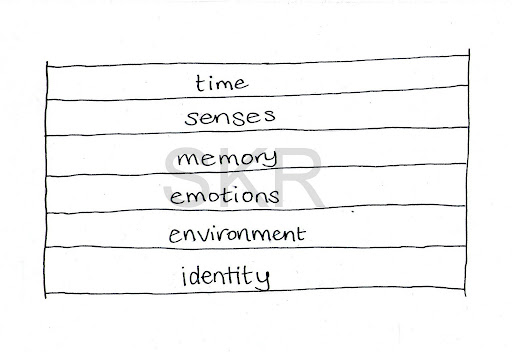
  • “Dissociation” means a disconnection in areas which would normally be connected such as memory, time, senses which may or may not be distressing or disabling, but which impact on a person’s experience of the world.
  • “Multiplicity” means experiencing dissociative barriers between parts of self, occurring on a spectrum of degree, which may be experienced for example as voices, alters, lost time, a sense of being fractured or divided.
  • “Parts” may also be known as “alters”, have a separate sense of self and function independently within the one body, switching with or without amnesia.
  • “Voices” can be understood within the context of multiplicity as parts who speak to each other. Not all voices fit within the framework of multiplicity, and some voices can be parts who also switch.


New library resources

I woke up the other day to find a parcel tucked into my door from the postie. I love waking up to nice mail, it really makes my day. This morning it was a collection I’ve had on my wishlist for the library for awhile, a collection of talks from the 2008 Recovery from Psychosis conference in Perth. The set was selling for about $30 plus postage, then dropped to $17 with postage so I couldn’t resist any longer. Here’s what was in it:

  1. “Hearing Voices and the Complexity of Mental Health Issues from an Aboriginal Perspective” 
  2. Dr. Helen Milroy (Australia)

  3. “The Personal is Political” Jaqui Dillion (England)
  4. “Hearing Voices with Children” Dr. Sandra Escher (Holland)
  5. “Voice Dialogue” Dr. Dirk Corstens (The Netherlands)
  6. “Understanding Psychosis” John Watkins (Australia)
  7. “Making Recovery Happen: From Rhetoric to Reality” Ron Coleman & Karen Taylor (Scotland)
  8. “Recovery with Voices: A Report on a Study with 50 Recovered Voice Hearers” Prof. Dr. Marius Romme (Holland)
  9. “Recovery from Psychosis: What Helps and What Hinders?” Lyn Mahboub & Mariene Janssen (Australia)
  10. “Working with Voice Hearers in Social Psychiatry”  Trevor Eyles (Denmark)

If you’d like to buy your own, you can get it here.

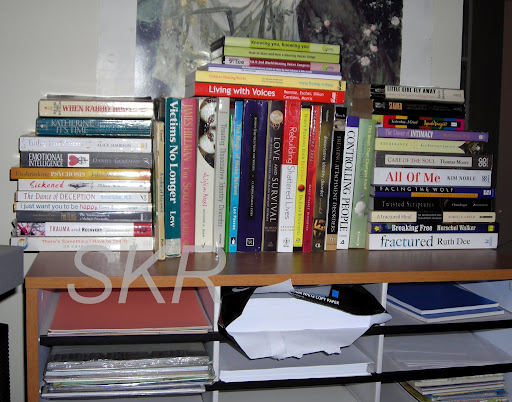
My library has grown substantially over the past month or so, there are actually some books in there at the moment I haven’t read yet – most unusually for me! I mentioned the new additions in the latest Dissociation Link newsletter, but if you didn’t get it, here they are:

I’ll be posting reviews and recommendations when I have time. All of these are available to borrow for a refundable deposit, if you have any to donate or to recommend as an addition, that is always appreciated too. 🙂

Recovery is not a one-way street

One of the things I’ve noticed in mental health (and to some extent the disability sector) is that we often clean up our autobiographies when it comes to the idea of recovery. I’m not talking about the Recovery Model here, which is simply gorgeous, I’m talking about the idea of recovering from something. Recovery is really messy. Really, really messy, in my experience. Recovery means having the ‘lightbulb moments’ (how I hate that phrase!) we all love to put in our memoirs, and it also means that three nights later we’re howling on the floor of the bathroom, wracked with fear and despair and convinced this will never get any better. Recovery is three steps forward, four steps back, two steps to the left and six to the right. Sometimes recovery means you are only losing ground slowly, under terrible circumstances, fighting like hell and only going downhill a bit at a time. That’s recovery. Sometimes recovery means you’re self-harming because it’s the only thing you can find that makes the suicidal urges go away. Sometimes recovery isn’t the smiles and sweetness we see in the brochures, it’s about trading an appallingly dangerous strategy for one that will kill us slower, because that’s all we can manage. And sometimes recovery is the way it looks in the movies, it is about light and hope and moving in the right direction and letting go of things that are tearing us apart. It is about healing and peace and green grass and kindness.

I give talks about my personal ‘Recovery Journey’ (ye gods) here and there. It’s a strange thing to do, and something I put a lot of thought into. I don’t want people to come away from them feeling overwhelmed or hopeless. Nor do I want to be part of the ‘spin’ in mental health, the messages I feel I’m supposed to be giving out that I do not believe and that my experience does not validate, such as “Just ask for help and it will all get better”. I know there are people for whom that has been their experience, and the last thing I want to do is deny their story. Their experiences are just as legitimate as mine. However, I also know far too many people for whom that has not been their experience, for whom the ‘help’ did harm. Life is complex.

Recovery is also complex. What we are recovering from is very different for many of us. What exactly is threatening to destroy us, to limit us, to cut us off from life varies tremendously. The strengths we use to recover are also highly individual. Recovery becomes pointless and limited when it is narrowed down to the same things for everyone, a one size fits all, eat your greens and get lots of exercise parental exhortation to conform. We can’t all recover in the same way, because we are threatened by different things and bring different strengths! Recovery works best when you tackle it with your unique strengths, whatever they are. For example, I write extensive journals which are mostly poetry. This has been absolutely essential to my recovery process. It is a safe place where I can be totally honest because I protect the integrity of my journals fiercely and anyone caught tampering with that process would be executed in a world of trouble. Ahem. In my journals I find the truth of how I was feeling, what was going on in my internal world at any time since I started when I was 14. I know that when I stop writing I have become silenced by something I am afraid to say. I feel very strongly about the value of a space to speak the truth, of creativity, of having a voice. I also know however, that not all of us are poets or writers. I am careful to encourage those who have these strengths to use them in their recovery, and not to impose the framework on people whose interests and talents lie elsewhere. If riding motorbikes is the thing that makes you feel alive, it can become part of your recovery instead. (Or as well as. You can be a poet-bikie if you want) One the most important principles of recovery I follow is to play to your strengths. Whatever it is you are good at, do well, whatever your unique personality strengths are – making friends, creating order, planning ahead, rolling with the punches, researching, expressing yourself, finding the funny side… they’re what you bring to the battle.

However, even doing this, recovery is not neat, not always uphill, not a one way street of ever increasing health. I think we do people a terrible disservice when we allow them to think this. Personally, as a peer worker, I am constantly caught in a difficult position between various of my values. On the one hand it is important to me to allow people to see the ‘rough edges’ of my process, the very real wounds I carry and difficulties I struggle with. Hence, this blog. I get stressed when I feel I’m starting to ‘spin’ mental health or the recovery process. Keeping things real and being truthful about the process is really important to me, and I get angry when people are set up to fail by being given the impression that if they just try hard/get help/take this pill, everything will be fine from then on. On the other hand, letting people see the very real pain and difficulty under this process can stress them out, make them feel anxious for me, and as a peer worker, can make them worry that I won’t be able to sustain what I’m doing and will leave them in the lurch. So I can get good feedback from both revealing and concealing distress – thankyou for being honest, it really helps, or thankyou for being professional and holding onto your own stuff to give me space to deal with mine. And I can get negative feedback from both revealing and concealing my distress – I’m stressed and worried for you, or you seem to have it all together while I’m a total wreck! I bounce about between values, and have learned that the line between is not only unclear – but what is helpful for one person is something the next complains about. The best path so far has been to listen to the feedback I get and adjust as I go, while keeping in mind that as a peer worker the attributes, such as respect and acceptance, that I am hoping to bring to my relationship to other people with mental illnesses, are also the attributes I have a right to expect that people will treat me with. Like recovery, relationship is a two-way street.

So, when I hear about services exiting clients who “aren’t recovering fast enough” I’m very angry, and I feel they’ve missed the point. When I have to fill in forms about my health and feelings to prove that I am recovering and the service I’ve been receiving is useful, I’m angry that a 5 point likert scale has more weight than my own thoughts and ideas about what is working for me and what I want. Even more, I’m angry that recovery is scored, at the idea that it shows a clear upward trend with no back steps. There have been times when a service has not been getting nice, joyous, increasing health scales from me, because I’ve been in severe crisis, where as far as I was concerned, still being alive at the end of the week WAS recovering! Recovery is more like a rollercoaster or a game of snakes and ladder than a “Go directly to GO” card in monopoly. Services that are genuinely client-centred and recovery model oriented will reflect that.


The Disability Tango

There are two sides to Sarah. No, this is not a declaration of multiplicity, rather a tension that I live with as person with a disability. One side of me is my potential. The talent and skills I have, my character strengths, experience, learning, everything I bring to my life that is an asset. Another side of me is my limitations. These are my illnesses, harm left by a history of chronic trauma, character weaknesses, things I struggle with. Something I’ve noticed that constantly frustrates me is that often people can see and relate to only one of these sides at a time. This results in a really unbalanced perception of who I am and often, a really unhelpful approach in relating to me.

Those who perceive only my potential often relate to me with frustration. A lot of pressure characterises these interactions. These people can see where I could go, and think that I am holding myself back or just need some encouragement to get there. They simply cannot conceive of my limitations, how real and binding they are. They push me to get into higher education, to write books, travel, give more talks, do more. They can’t see that I am already at my limit, doing as much as I can, as fast as I can. The effort it is taking to manage the cultural divides, to walk the world of community services when I am, at heart, a strange poet creature, the freak factor. The effort it is taking to disguise and contain the harm left by chronic trauma and abuse. I have had a personal goal not to cry at work, I don’t think I’ve ever made it more than three weeks without falling apart. So many triggers, coping with the bad days, trying to fit in, protect my credibility, look normal, contain my distress, not show the scars, do enough things that feed and nourish me so that I can handle the things that exhaust and deplete me. I am always at maximum output, because I have very big dreams and I have started a long way behind. It is very difficult for someone to come from where I have been and get to where I want to go.

So I work incredibly hard, and I live my life on the edge of a catastrophe curve, way out of my comfort zone, because that is where the change and growth happens. The level of pressure I put myself under is ridiculous and destructive, and the drivenness I live with is dangerously destabilising. Every strength run to excess becomes a weakness. My drivenness has got me through and kept me going when the world burnt down to the ground, but it is also volatile and costly and needs careful handling. But, and this is the important bit – it is still an asset, and it is a part of who I am now – I can no more get rid of it than you would pluck out your eye. I live with it and I try to live with it well. I will get better at it.

On the other hand, those who perceive only my limitations react to me with anxiety. Our conversations are frustrating because their reaction to every speed wobble is to tell me to slow down. Take on less, do less, cancel projects, rest more. What they don’t perceive is that when I was doing less, when I had almost nothing to occupy my time and no projects to pour my heart out into, I was not content. I was profoundly miserable. I need a sense of meaning in my life. I need projects to mull over, I need intellectual stimulation, I need things to do. I describe this to my friends using a dog analogy – my brain is like a dog, one of those really big, clumsy, active dogs. If it gets bored, it starts chewing on the furniture, digging up the garden, and inventing amusing games where it tears all the orange coloured clothes off the washing line because the neighbour rode his bike this morning and left the car behind. I need to keep it busy or it keeps me busy with amusingly intricate symptoms of mental illness, where I find myself re-categorising my freezer contents or developing new and interesting tics. Down that road, peace and harmony do not lie. Doing less is rarely the answer for me, and I feel incredibly frustrated by how often people want to slow me down – with the best of intentions! Want to send me back to bed, have me content living on my pension, resting comfortably within my limitations, pushing nothing, risking nothing, trying nothing, and never finding out just what I really can achieve. It’s stifling, patronising, and phenomenally dangerous.

Sometimes I fall apart because of things that would make anyone fall apart – I get sick, life crashes, pets die. It wouldn’t matter if I had spent the previous month working on my tan instead, these things would still bowl me over. They are nothing to do with my hard work or lifestyle. Sometimes, it’s true, I crash and burn because I’ve pushed things too hard. You know what? It’s MY life! I’m allowed to! If I accept that the occasional crash is the price I pay for pushing myself hard into recovery and growth and learning, then I’m allowed to pay it. My choice. I’m the one who lands in bed with headaches and joint pain and hallucinations, and I know this isn’t neat and tidy, but growth isn’t. It’s messy and strange and you learn on the fly. The thing is too, this isn’t my first rodeo. I’ve been really damn sick. I’ve been so severely dissociative that I’m blind and cannot feel touch. I’ve been so disabled by pain and fatigue that I’ve been in a wheelchair. I have learned the roller-coaster of chronic relapse because I pack a months worth of longing and dreams into the one good day I get and wind up in bed for weeks afterwards. I’ve been here, I’ve been on this carousel a lot. I’ve learned a lot. I’m a lot more tuned in, a lot more caring of myself, and a lot better than I was then. A day of pain and headaches as pay off for a week of accomplishments? You’ve got to be kidding, I used to pay a fortnight of agony for one trip to the doctor where I couldn’t get a close enough park. I am used to paying very high prices for the opportunity to live, walk places, be able to think clearly enough to read. This is nothing. And I have lost years of my life, I cannot wait any longer. Carpe diem quam minimum credula postero. Memento mori.

Health for me has been a complex balancing act, I’ve had to learn not to push the good days too far, setting myself back. I’ve had to learn that emotional stress costs me in illness, and that self care is not self indulgence. I’ve had to learn that intellectually understanding my trauma history in no way reduces it’s impact. I’ve had to learn that taking on board the cultural reactions to me; as a crazy person, white trash homeless, a battered wife, or a disabled person – will kill my spirit. I’ve also had to learn that if I become afraid of pain I will never push my limits and never get any better. I live with a degree of incapacity, pain, and distress, in order to live. Trading off painlessness and stillness for not accomplishing any of my dreams is a fraud.

The people who relate to me best are those who see both sides of me, my potential and my limitations. They don’t try to stop me working the way I work, they try to support me. Even if at times I drive them nuts, worry them silly, or get really snappy when they try to advise me. I’ve been alone an awful lot, I’m not used to community yet. I’m used to only relying on myself, and some days politely telling a well intentioned person to hang on to their advice because I don’t want it is stretching my patience.

What’s helpful is when people show me more efficient ways to do what I’m trying to do, and get it when sometimes options that seem easy and obvious to them are not workable for me. Some days I take the stairs despite the joint pain, because the PTSD is too bad to handle the lift. Almost all of my limitations are invisible, but I can tell you from inside here that there is always a reason I am doing things ‘the long way round’. And some of us have to learn things the hard way, we are stubborn and independent and scared of burdening other people. Don’t forget that’s part of why you love us in the first place! And think for a second what we would be like with the limitations and disadvantages we face if we weren’t so pig-headed. Believe me, this is the better of the options. If all else fails, remember you’re not perfect either and people still love you. 🙂

See more like this:

Multiplicity and relationships

This is an area I’m often asked about; how do people with ‘multiple personalities‘ have relationships? (if you need a refresher on common terms, that link will take you to a relevant brochure) Well, there’s not one answer! Different people adopt different approaches to relationships that suit them. Non-romantic relationships, friendships, family, co-workers, may be a bond between one part or many or all parts in a system. Friends may be aware of the multiplicity or may think they are always interacting with one person. If they only ever meet one part, this would be quite an accurate perception, although they might be surprised by some of the ‘out of character’ seeming hobbies or activities their mate gets up to at other times, or a bit confused by mutual friends who seem to be describing someone quite different. On the other hand, friends may already be meeting and spending time with many different parts, but unaware of this. A pretty common conversation when a multiple discloses their multiplicity is for the friend to to expect to see them switch to someone totally different, and be pretty surprised to hear that they’ve already been meeting 5 different parts without knowing it.

Roles that require specific skill sets are often taken on by parts most suited to them, so for some people only one part ever goes to work, for example. In other cases, parts share roles for example 10 parts may all be involved in different aspects of parenting; organising, nurturing, downtime, play, deep-and-meaningful conversations etc. There’s tremendous variation from person to person about how this works out.

Romance is the area that people can be confused about. I’ve observed a few different basic models about ‘multiple romance’. A common one is that only part has romantic feelings and inclinations, they are the part that forms the romantic relationship, or the only part allowed to form a romantic relationship. So for example, lets say Roxy who has a team of 4 other parts is in love with Justin. One of the other parts sees Justin as a friend, one of the other parts is very young and sees him as more of a father-figure, one of the parts doesn’t particularly like him and prefers not to spend time with him, and one of the parts is rather maternal and protective towards him. Roxy is the only part who spends time with Justin in a romantic way. This is in many ways not that different to relationships between non-multiples – some of the time is spent romantically, some of it as companions, some of it apart etc.

Another model I’ve seen is more than one part having a romantic attachment to the same person. In this example, let’s say Cassandra, Tayla, and Michelle are all parts of one system who are romantically involved with Olivia, but the other 10 parts in their system are not. Olivia has a romantic, girlfriend relationship with all 3 of those parts that is different and distinct to each of them; their tastes, personal interests, and personalities.

Another model involves more than one part with romantic feelings, but creates certain boundaries to maintain a monogamous relationship. For example, Samuel is married to Beth, but other parts Sam, John, and Sally are not in a romantic relationship with Beth. Samuel, Beth, and the rest of the parts have decided that Sam and Sally can express romantic feelings for other people, provided the other people know Samuel and Beth are married and that no physical contact takes place. John is not interested in romantic relationships.

I’ve also seen a model closer to poly-amorous relationships (having a romantic relationship with more than one person at the same time), where more than one part has romantic feelings for different people, and separate romantic relationships are pursued. For example, Stacey, Kelly and Cindy are all parts in the same system. Stacey and Kelly are both in long term relationships, Stacey with Paul and Kelly with Shane, and Cindy enjoys a night out with a new casual partner now and then.

Some multiples have no parts with romantic interests and are contentedly asexual, others choose a celibate lifestyle for many reasons such as reducing internal conflict or healing from past abuse. The complexity of multiple relationships can make it challenging to develop good communication and team functioning whilst trying to maintain everyone’s connection with outside people. Sometimes not engaging romantic relationships is a good option, certainly it’s one I’ve found very necessary for resting and recharging.

Some multiples choose not to develop long term relationships but have casual partners instead. Some multiples have truly poly-amorous parts that have relationships with more than one other person at the same time.

There are also multiples who get into relationships with other multiples. In this case, there can be a very complex web of relationships as every part can have their own unique relationship to every other part. If neither person is aware of the multiplicity that can add an extra layer of confusion to communication. This type of relationship is not as uncommon as you might think, most multiples have felt very ‘different’ without being able to describe exactly how or why, meeting another multiple can be the first time they have functioned similarly to someone else and felt like another person. This sense of kinship can be a strong bond. I have noticed that often the both multiple systems will create pairs or teams that often spend time together and get along – eg a parental adult part of one person’s system may often come out around the child parts of the other’s system, and vice versa. These teams can be asexual, as in the parent-child dynamic, or romantic relationships, and they may be based on similarity; eg both the party girls going out together; or on complimentary pairs, eg a skilled teacher and a keen student. This may not work harmoniously, for example a parental part and a teenage part may fight constantly, or two highly traumatised distressed parts may set each off badly. Not all the parts may ever meet all the other parts, and if some parts go away for a long time, or one or both systems are polyfragmented – that is, having groups of parts that operate completely separately from other groups of parts, then chaos and distress can be caused when relationships are suddenly disrupted or severed. If some parts hate parts of the other multiple the relationship can be fractious or abusive, even if other parts are loving and invested. I have noticed that often one person’s system will ‘lead’ by doing the switching, and the other person’s system will generally ‘follow’ by adapting to those switches, this can be an organic dance between them or can create a power imbalance between them.

Having parts with different senses of their own gender or sexuality is not universal to all multiples, but it is also not uncommon. Sometimes the minority gender or sexuality in a system can feel very isolated and get ‘outvoted’ on being allowed to openly identify or act on any of their feelings. Because multiplicity is often overlooked as a possibility, many people have spent a long time suppressing parts that are very different to them, or being confused by co-conscious switching where sometimes they ‘feel female’ and other times they ‘feel male’. It can be a great help to not have to ‘choose’ one identity but to respect the diversity internally and find ways to reduce shame, stigma, loneliness and misery for all parts. It is particularly helpful, given this, if queer and transsexual support services are sensitive to the needs of multiples and able to provide friendly support.

Sometimes too, parts have formed with a strong sense of identity that has developed in reaction to trauma or distress, for example a frightened abused girl may split and form a part who is a big strong adult man. Later in life that man may conclude that his sense of masculinity was a reaction to a terrible situation rather than an integral part of who they all are. Sometimes parts change their sense of identity and their roles over time. In other cases they don’t. Sometimes parts become more alike, systems with straight and gay parts become bisexual, or an all male system with one female part integrates and considers that part to be his ‘feminine side’. There is more than one way that multiplicity can form, and there is more than one way that people heal, grow, and have relationships. What’s more, people change over time, and models that worked really well at one stage of life can feel restrictive or exhausting or depressing later on.

However unusual or complex these models of relationships may seem, the goal is still the same as any other human being – to love and be loved. To find a place and a way of being in the world that is not lonely, painful, or causing any harm to anyone else. It might be a bit more complicated at times, or involve conversations, decisions, and compromises with other parts to get there, but it’s a good worthwhile goal. It might also help to remember that everyone brings all their parts into their relationships too, their competent adult parts or cheeky teen parts or hurting, selfish child parts. All relationships have to navigate the whole complexity of who a person is, has been, could be, to love them as they are and find ways to create space for growth. All love is complex, mysterious, amazing, and takes lots of work. It is certainly possible to love and be loved by a multiple.

For more information see articles listed on Multiplicity Links, scroll through posts in the category of Multiplicity, or explore my Network The Dissociative Initiative.
RIP Charlie

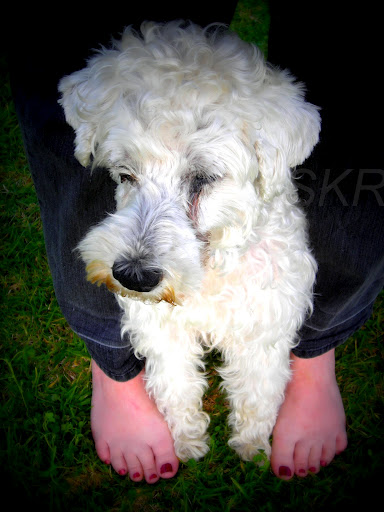
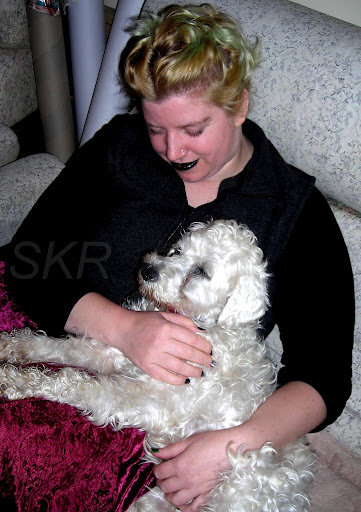
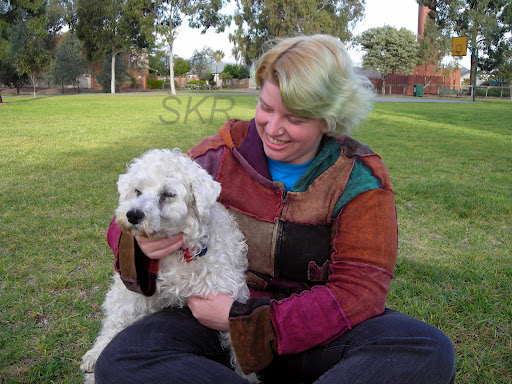
Charlie died at 4.15 on Tuesday. The decision to put him down was incredibly difficult to make. It was very quick and very peaceful, I stayed with him the whole time. He wasn’t stressed or upset and was happy gobbling treats from my hand. An overdose of anaesthetic stopped his heart. I miss him terribly.

The last week we spent together was very precious to me. We spent a lot of time in the sunshine down at the local parks, going for walks, or snuggled on the couch watching movies. I knew at the outset that once I’d decided I could no longer leave him at home alone and needed to put him down that I wanted to spend a last week with him. I often waver on those kind of gut instincts, I feel pretty strongly about following through on things I’ve said I’ll do. I’m so glad I didn’t this time.

I wanted to get him groomed and cleaned before the end, it took quite a bit to find someone who could fit him in and checks back and forth with the vet about his health and making sure it wouldn’t stress him. In the end the lovely people at Doghouse Daycare bent over backwards to look after him and treat him gently. I stayed with him as he was washed and trimmed. This made it easier for me to keep him clean and dry over the last few days.

He was such a funny little chap. I got him when he was 3 years old, as his owners were moving overseas and couldn’t take him. I took him off to the vet worried about his eyesight because he was running into things – trees, walls, posts. They had a look into his eyes and did some tests and said they were working just fine. As they were telling me this, he tried to walk straight off the examination table! The conclusion was that he was just a bit daft.

He had a tendency to explore life with his face, stuffing his nose into everything. Because he’s a schnauzer cross, he has lovely long whiskers and eyebrows, which he would constantly fill up with prickles and burrs.

After a bath when his coat was long, he looked a bit like a sheep with a static charge. The first time I got him clipped they did a very short cut all over and I didn’t even recognise him afterwards! He has a very fine pointed terrier nose under all that fuzz!

It’s been a very disrupted relationship, with the chronic homelessness I’ve experienced I’ve had and lost him many times. I gave up on ever seeing him again last year and was surprised to suddenly have the opportunity to get him back last December, and then horrified at the terrible condition he (and Loki) were in. It’s been really strange and stressful. I love him to bits but the bond between us got jammed. Mostly I felt overwhelmed by guilt and stress and wished I’d been able to give him a better life. I’ve known for the last several months that I’m kind of numb about him but I didn’t know how to fix it. This last week was very precious because it finally clicked. I haven’t been handling him very much, between pain, arthritis, incontinence and infection I’ve been fairly hands off. I mean, I’d scratch his ears and give him baths, but he wasn’t allowed on the couch because I’d have to keep washing the cushions, as it was I’ve been doing a couple of loads of laundry a week, most of them old soiled towels. He didn’t get a lot of cuddles and I don’t spend much time on the floor because my joints hurt. This week I threw all that out of the window. He got wrapped in towels and cuddled on the couch for hours. He went everywhere I went in the car. I sat on the grass in the park and played with him. I discovered he could still ‘dance’ when you played with him, pushing him over to rub his tummy. The extra affection really made him happy. He’d lie on the lawn in the backyard in the sun, chewing a bone and radiating contentment. When he was anxious he wouldn’t just come and find me, he’d learn against my leg and beg to sit on my lap. When I gave him a cuddle he’d snuggle his face against mine. It was like the difference between a baby who snuggles into your arms and one with autism who lies stiff against your hold. He felt loved and he snuggled, and when he snuggled all my numbness disappeared and I finally felt bonded. Too brief! But I’m so glad it happened.

Somewhere in the mess and pain of the last few years I seemed to have turned off the attachment part of me to stop being overwhelmed. But that’s not how I want to live, it’s eerie and painful to feel like there’s a layer of thick glass between you and those you love. I’m glad I accidentally stumbled onto what I needed to connect, even though I now feel heartbroken at losing him, at having so little time with him. I’m also so grateful. I’m going to dig back through the books and information I have on attachment. I need this back.

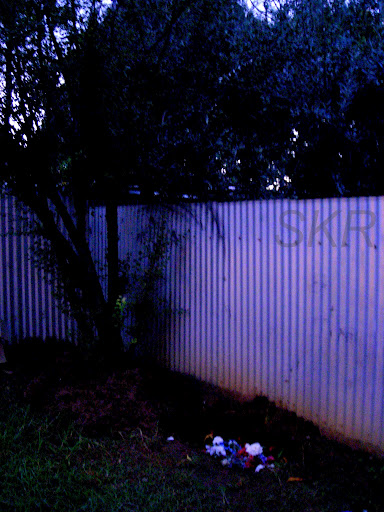
I dug (with help) a grave for him in my backyard. We filled it with autumn leaves and then covered him with flowers and buried him. I’m going to plant my bay tree there.

I wish we’d had longer, more years in the sun. Less pain and confusion. His life was harder than it should have been, but it still had value. He was loved, he is missed. RIP xxx

Hearing Voices Resources!

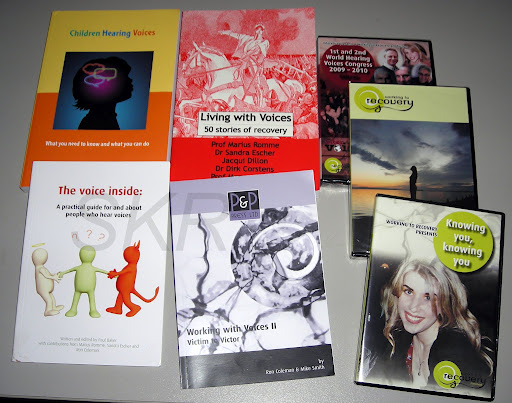
On Friday a huge package arrived for me. It contained a whole set of books and DVD’s about Hearing Voices! Some time ago I joined the facebook page Intervoice, and through there found out about a fund set up to provide resources free to individuals or groups about Voice Hearing. I sent in an application and am thrilled with the wonderful package! Oh, if we could only do something like this for people through the DI

I will read and watch the collection so I know what to recommend to people, and I plan to hold an information session about voice hearing sometime soon using some of the DVD’s. I was so excited by the Voices Vic Conference I attended earlier this year, and so wished I could have brought our whole group along to experience it. These DVD’s will go a way to helping them feel connected to the whole world-wide movement that we are a small part of! These will all be added to my personal library which I make available to anyone to borrow for a small refundable deposit. I am ecstatic to finally have some voice-specific resources for Sound Minds, the VH group I co-facilitate! I am also planning to set up a Sound Minds welcome pack similar to the dissociation welcome pack I created for Bridges.

I have just added all of the titles to my personal library page, please feel welcome to contact me about borrowing any of them. I started collecting dissociation related books about 6 or so years ago, the library is very small and a lot of the books are second hand. Lately I’ve been buying more new when my budget permits and have been able to get some more up to date books which has been great. A couple have even been donated, which is fantastic, and sometimes people tell me to keep their deposit, which I always put into the library fund for more books. Down the track I’m starting to think about fundraising ideas to generate a bit more money to build the collection up. My wishlist is pretty long! 🙂

I so needed information when I was struggling with diagnosis, and each of these books were hard to find, expensive, and some were quite traumatic to read or really unhelpful. I really needed not just a library like this, but a librarian to point me in the right direction! For some people, this resource has been really useful and I’m so pleased about that. Can’t get over the excitement of having it grow by another 7 in one hit! A huge thankyou to the kind people at the Hearing Voices Network Cymru, I hope they will be pleased with how we use their resources.

Behind the Logo

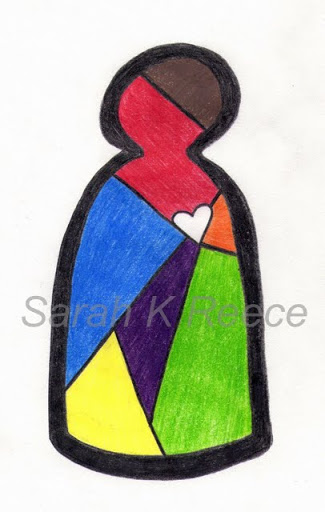
I developed the Dissociative Initiative Logo when several of us were working on starting up the support group Bridges. I created a fern image in consultation with the Voice Hearing group Sound Minds for their flyers, and I wanted to make something for the Bridges flyers.

I trialled several different designs. I wanted something striking but simple, that would work big on a flyer or really small on a business card. Dissociation is difficult to communicate visually, so I was looking at visual representations of multiplicity because these can be someone’s personal experience of parts, but are also a lovely metaphor for the coming together of diverse people in the Dissociative Initiative. Many people like the image of a jigsaw puzzle for multiplicity, which I understand, but as it is also used to represent autism I thought I would keep looking. I love rainbows as a representation of diversity and acceptance, of not having to change who you are to be accepted, but rather the differences between us creating a beautiful harmony when we pull together, but as rainbows are used to represent GLBTIQ communities I wanted to do something a little different there too. It was very important for me that the image also be gender-neutral and race-neutral.
I trialled patchwork designs, and various natural images of parts that also form a whole – such as the petals of a flower, or leaves on a tree, but none of them were quite right.

In the end I created this logo, called “The Undivided Heart”. It is modelled on a stained glass window design and uses rainbow colours to represent different parts of a community, who all come together with one heart, a shared purpose – in this case to raise awareness and support people who experience dissociation. As different as we may be in so many ways, we are united by a passion for mental health and a belief that people deserve resources and community.

Peer Work course

The Peer Work Cert IV I’m studying at the moment has been a very mixed bag. We’ve had a number of different teachers/facilitators come through the course, and their skill and passion for adult education has varied significantly. Many of us students have already been working as Peer Workers, or in the Community sector for many years, so the bent of the teaching is pitched far too low for us. We spend a lot of time being told things we already know. This shouldn’t be a big deal as most of us are also really friendly and patient people. Without exception all of the speakers that have been invited in have been great to listen to. When it’s worked really well there’s been some great conversations between the students, and we’ve all been treated as resources for each other and encouraged to learn from each other. I’ve loved spending time with other people who are really passionate about mental health and peer work, and there are some amazing experiences and skills in our class. When it’s worked badly we’ve been taught inaccurate information, patronised, and treated as though our experiences and skills are a threat to the class instead of an asset.

Pilot programs always have teething troubles so I hope that the quality of the course delivery will improve if it is offered again. There’s been some tough days for me where some areas I’m feeling pretty raw in have not been handled well and I’ve found it quite distressing.

This Thursday was just back to the tedium of repetition and inane craft activities. We spent several hours having the concept of Peer Work once again explained to us in depth, what it is and how it can be useful for people. This makes for a very long day! The afternoon was spent with the facilitator reading a powerpoint to us that explained how to make presentations interesting and engaging – oh the irony!

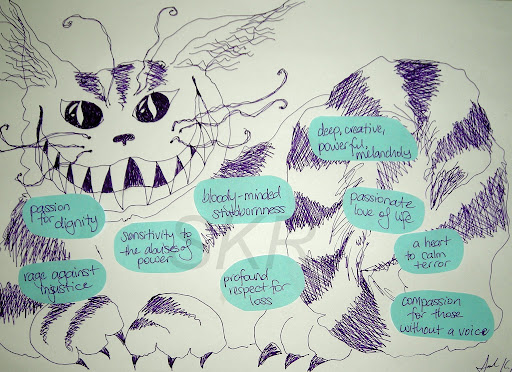
We were required to do a craft activity which was recommended as a tool to use when engaging participants who were so unwell that conversation was difficult. We had to draw a cat on a piece of paper, the cat was called the Fantasticat. Then, we had to write things we had gained from our lived experience on other bits of paper and glue them onto the cat’s tummy. The things we have learned are, you see, things we are Fantastic-at. The class is not exactly enthusiastic about these activities (we have done a lot of craft in this course, and most of it is depressingly similar to the craft we did the week before), which unfortunately instead of resulting in the activity being modified to make it more interesting or suitable, got us a lecture about being open minded and aware that many people we would be working with were going to be extremely ill and need this kind of directed activity. If anyone ever catches me bullying a participant into this kind of thing, put me out to pasture immediately.

Anyway, here is my lovely cat:

It turns out I make good art under duress. 😉 I’m rather proud of him.

I hate myself

Self loathing is vicious, seductive, persistent, and something I fight. When I’m struggling, “I hate myself” is what I hear in my head. This voice may speak once or twice. It may loop over and over again for days. The intensity of the rage and loathing I feel for myself is difficult to communicate or comprehend. It permeates me and threatens to tear me apart.

About four years ago I made the call that the single biggest internal factor that was holding me back and crippling my life was self-loathing. So I set out to understand it better, to fight it, and to starve it. These days it’s not with me all the time. I have whole weeks where I can just live and enjoy my life and it doesn’t bite at all. But I still have the bad days here and there where it wells up strong and I have to work really hard just to stay still. These are days I fight self harming compulsions. They are days I can’t look in the mirror, can’t eat, can’t bear to be touched. Human contact is intolerable, indifference leaves me drowning, criticism cuts into me, and praise only makes it more intense. I have learned when to fight it and when to endure it.

Self loathing is difficult to wrap your brain around if you don’t experience it to this extent. It runs so counter to our self-protective instincts and the usual human preference to think of ourselves as decent people. I can’t speak for anyone else, but I have been able to untangle some of the things that drive self loathing in me. One of them, and it’s a big one, is siding with someone else’s perspective about you. If you’ve been degraded by someone who treated you as pathetic, inhuman, revolting, contemptible, useless, or unlovable, then in the dark times when your reserves are low, you may wonder if they were right. I was bullied a lot at school, so in my case self-loathing was just taking the side of the majority opinion that I’m a freak and deserve everything that happened to me. We don’t like to back the losing horse, and when abusive people are in the majority or more powerful than us, it’s not uncommon to lose our own perspective and take on theirs instead.

Another thing that feeds self-loathing is the deep desire to not be vulnerable to harm again. In the aftermath of trauma or abuse, we may assess ourselves as inadequate and use self-loathing as a tool for self-improvement, thinking that we will make ourselves stronger, more resilient, and more impervious to harm in the future. It’s a seductive idea, but the reality is that we carry on the work of abusers long after they have gone, and cut ourselves away from the very things we need to be able to grow strong – compassion, truth, love. We become brittle and damaged by a campaign of relentless self modification that leaves us disconnected from our sense of self or self-worth.

This inclination towards self modification can also come from a sense of worthlessness. Self-loathing can be the rage that results when we perceive ourselves as fundamentally inadequate in some way. We often judge ourselves harshly when the outcomes of our efforts have been poor. Despite everything we tried, we could not stop them, or we could not keep them, or we could not make them love us, or make it better, or make the dreams come true. Facing our powerlessness is so devastating we turn on ourselves instead, with all the viciousness of someone with a deeply broken heart. And we resolve that next time, we will make ourselves into someone who would be loved, who would get the happy ending and would deserve it.

Self loathing can be used a powerful motivational tool. We gear towards punishment and talk harshly to ourselves to drive us through all the things we don’t want to do, to overcome the depressive reluctance to engage with our lives. We make ourselves keep getting up in the morning, keep working, studying, breathing, fighting for a better life. We do what works, and self loathing does work, for a while. When the alternative is curling up to sleep in a house on fire, we generate change and cling to life with whatever we have. But at some point we have to stop using such a savage implement on ourselves because it will warp and destroy us.

Self loathing often has a very close relationship to shame. Many of us carry secrets about which we are deeply ashamed, an internal list of how hideous and unlovable we are. These may be things we regret, our failings as parents, partners, children, or friends, things done to us about which we take on shame, and about which our culture shames us. We hold these things very tightly to us, and in the dark they fester, they grow in magnitude. We may be unable to forgive ourselves for our own powerlessness, for times we’ve been selfish, cruel, indifferent, lazy. We may be trapped by a need to hold an abuser to account, and find that our thinking twists so that we cannot accept our own fallibility without somehow saying their actions were not that important. We may fear exposure of things that other people would shame us about, sexuality, abuse, gender issues, mental illness… We cannot be reconciled to who we are in some way, and so we suffer, and we hate ourselves for our suffering.

Sometimes we hate ourselves because we’re the safest person to hand. We don’t feel safe to be angry with people or about situations in our life so we direct it all inwards. The rage victims feel towards abusers can be frighteningly intense, and many people conclude that the safest, moral choice is to take that rage out on themselves instead of risking acting out revenge fantasies on another person. The cycle of trauma continues and the person is left weakened and desolate by these attacks on themselves, as well as furiously angry about the self loathing on top of the original harm. People will also turn rage inwards when they don’t feel they’re allowed to be angry, for example a woman who gives birth to a child with severe illness may come to the conclusion that she has ‘failed’ to bear a healthy child. In a position where she feels that she cannot express her anger and disappointment without being seen as a bad mother, she may soothe those feelings by savaging herself instead, in ways that seem deeply irrational to those around her.

Self loathing, oddly enough, can feel safe. Where the alternatives, like being angry at someone powerful and well protected, or deciding to accept our own weaknesses, can feel terrifyingly risky. They may even be incredibly risky. Retreating into a dark hole to gnaw on our own flesh and bones seems to us like a victimless crime, the lesser of many possible evils. As a child, one of the things I feared most was not being destroyed by the bullies, but becoming one of them. I craved the power to protect myself but deeply feared that this meant I would hurt someone else instead. When forced to confront this ambivalence, my reaction was suicidal. Self loathing gave me a way to try and improve my life while feeling safer that I was not blithely exchanging roles. Criticism – legitimate or otherwise, feeds it, and praise also leaves me afraid that I have tricked people into thinking I’m an okay person when deep down I’m convinced I’m not. There’s something alarmingly soothing about retreating from the world back to my dark cave of self loathing.

The cost is very, very high. Intense self loathing leaves me with a profound sense of not being safe anywhere, ever, because one of the people I’m most afraid of is myself. Without safety, recovery is nearly impossible. I become the monster that hides under the bed and stalks me from room to room. There is no escape. I undermine my own efforts, sabotage safety, blossoming friendships, destroy good things in my life I’m convinced I don’t deserve or will ‘weaken’ me. It quickly becomes a spiral, as I act out my feelings I have ever more fuel for my rage at myself and ever more evidence of my own intolerable flaws. The difficulty is that refusing to act upon such strong feelings leaves me with an incredible tension – where the difference between how I’m feeling and the outward appearance of my life is so vast it is actually painful. There’s such an intense need to show some of my feelings, and to discharge some of the intensity. I use journals, inks, symbols that I have imbued with personal meaning to stop me resorting to more drastic measures. I fight the impulse to unmake them all, the despise all my protections, to wake the next day and feel humiliated. I nail my colours to the mast and when needing an answer to the question “What does it mean?” in the aftermath of torment, insist on only one answer “That I am human” and turn all the rest aside.

So I starve my self loathing. It can’t grow strong if I don’t feed it on twisted thinking and fears. If I am loving to myself and let others be kind to me, I grow stronger and my thinking grows clearer. I insist on treating myself the way I treat others, and being kind to my vulnerabilities instead of harsh. I am cultivating healthy entitlement, and taking the risk that through care and kindness I will grow, rather than through drivenness and self hate. Initially these choices were very difficult, and felt terribly risky. They get easier. I am committed to good principles of hope, healing, joy, respect, fairness, even if I can’t live them every day.

When the bad days happen I argue with the voice in my head and I say to it “I don’t hate myself, I’m just stressed.” I cancel classes and stay home. I stay away from the mirror. I let myself go without food for a day if I have to. I try not to claw at my skin. I put the knives out of sight. I write. I paint. I try to hang onto memories of being loved. I let the images of mutilation and destruction flow through my brain and turn my face from their allure. I find somewhere to cry I hope the neighbours wont hear. I let the pain and the rage be there and I hold my fingers tight and refuse to act on it. I follow the pain down and face the horror that has incapacitated me. Slowly, the desire to tear all the skin off my body will ease. Slowly, the images of breaking all my own fingers will settle like leaves on water. The urgent need to act will pass and the sense of rawness will curl back under my skin. The fire in my brain will go back to coals, the stars come out, the planet turns, that which consumed me passes on, and I’m free of the demon again. Just a little more breathing room, just a little stronger.

More info about self loathing here.

See more like this:

Stress Vulnerability Coping Model

The Peer Work Cert IV has resumed after a break for the holidays, and sadly I am not enjoying it at all. I am so upset about some things that happened that I’m mulling over whether to make a complaint. I shan’t go into them here as I suspect that would be seen as a breach of confidentiality. We ended the day by being asked to create an artwork or collage to represent the Stress Vulnerability Model of mental health. The gist of the model is that mental illness is the result when a collision of inherited vulnerabilities and environmental risks occur in someone’s life (similar to the diathesis-stress model). From the point of view of preventing a relapse in those conditions that are episodic, such as psychosis, the model suggests that risks that compromise mental health need managing, and protective factors that enhance it need to be maintained/introduced. This is what I created:

Risk vulnerability model
Some risk factors
A protective factor

It’s not perfect. The ‘passions’ protective factor illustration for example, could be seen as a gardening hobby, or could suggest that this person stalks the streets and digs up random trees. Ah well. 😉

Finding your sense of fun

In Bridges this week one of the topics discussed was how to let go and have fun again. Many of us find ourselves spending so much of our time being grown up, responsible, organising our lives, managing our illness, eating well, getting enough sleep, and generally being adult that fun becomes an alien concept.

Some of us (ahem, ahem) can get so stuck in adult mode that even when we make time for fun things, we ruin the fun aspect of them. I can go on a holiday with a to do list that reads “relax, eat healthy food, read 16 books, swim every day” and all through my day off be thinking things like “Am I relaxing?”, “Am I relaxing enough“, “Oooh that’s handy, this playing chasey is really good exercise”. Most of us are familiar with the idea of having an inner critic (see Reclaiming Creativity). This is a bit different. This impulse I call my inner social worker.

Inner social workers are a good thing. They’re the voice that says “go and eat something!”, “clean that bathroom”, “you haven’t walked your dog in a week”, they are sensible, practical, and very focused on self care and accomplishment. The problem is that these attitudes are complete anathemas to having fun. When you’re stuck in adult mode with your inner social worker along for the ride, the most outrageous fun somehow gets turned into work. I remember being at a talk once where the speaker said “Look, I know many of you find art helpful, but for god’s sake don’t tell them that! They’ll turn it into art therapy.” Now, I quite like art therapy, but I got where he was coming from. Something emotional and spontaneous being turned into something functional by the imposition of social worker goals and language. The minute someone uses words like “a recovery focused program of increased self -awareness through artistic expression in a goal-oriented 6-week structured course designed to enhance independence”, all the magic drains out of the art room. Or maybe that’s just me?

Anyway. Having fun, I mean really shucking the adult role for a while and being able to enjoy yourself for the sheer fun of it, involves banishing your inner social worker. Some people describe letting go of their adult or parent side for a bit, personally I prefer to box them for the duration, rather the way you banish a big dog to the backyard while you have a tea party with the fine china. Except in this case, it’s kind of the reverse! Fun is about reconnecting to your inner child. Kids know how to have fun instinctively. They live wholly in the present moment, are ecstatic about small joys like icecream, a trip to the park, or being able to stay up late, and never spoil it all by trying to turn it into something productive.

So, you’ve boxed your inner social worker and determined that the next several hours will in no way be productive, what then? Spontaneity is one of the big aspects of fun. It doesn’t have to be, kids have a ball when a trip to the pool has been planned for a week, but if you’re struggling I’d suggest getting as far away from adult as you can. Wake up on a wet day and decide to go to the beach, romp about on the grass with your dog at the park, invite a friend around and make chocolate fudge cake. Deliberately try things that feel childish, give finger painting a go, eat a cheesecake without forks, go build a sand castle, dance around your living room to loud music, cook popcorn and leave the lid off the pot. If you get really dried out and can’t think of anything creative and interesting to do, try keeping lists of ideas you might like to try the next time you have an afternoon free. Get ideas from books or sites suggesting activities to keep kids occupied during the holidays. Build a fort out of your sofa cushions, dye easter eggs, go join a costume society or build a model train set. Hanging out with kids can be an amazing way to find your sense of fun again.

Breaking the rules is part of why things can be fun, suspending the normal world for a moment and entering a place where anything might happen. For this to work you need some safe rules to break. We’re not talking rules like “don’t play on the road”, but rules like “we eat at the table”, “you can’t get wet in your clothes”, “bedtime by 11pm”, “dinner before dessert”, or “no flooding the bathroom”. If you don’t have some safe rules to break, make some, stick to them most of the month, then have a night off where you break all of them. Midnight feasts are fun because they’re against the rules, but not actually dangerous in any way. Suspending the normal structure or your life to go and ride motorbikes, learn surfing, or lie on your lawn eating mangoes under a sprinkler can be the release from the adult world that you need to feel rejuvenated.

Friends are another big part of having fun. A strong sense of fun involves a sense of humour and a strong vitality. A love of life, an attraction to the ridiculous, indifference about looking like an idiot, and an aversion to monotony. Some people have these characteristics in spades, and if they were marooned on an island, would still set up a practical joke shop and make a brisk trade selling brilliant ideas to themselves. The rest of us often find that we need other people to bounce off, that our sense of fun is at times very strong, and at others, totally battered by all kinds of things going on in our lives. There are times when we are the spark that lights the fire for our weary friends and starts an evening of rolling around on the floor laughing through a game of pictionary. There are times it’s our friends that invite us to go on a zombie walk through the city covered in green facepaint and fake blood. This mutuality prevents one person doing all the inspiring and the other/s enjoying being inspired but never working out how to start that fire themselves. You don’t want to find yourself in a situation where you are the only one with a fire and everyone else is happy to warm their hands at it, but in your dark nights they have nothing to offer or are just irritated with you that you aren’t still providing the lovely fire for them. Friends who get it and bring their own love for life to the party are a joy, and you often develop an ‘in-crowd’ language about these kinds of times spent together, where one of you can ring the other up and say “lavender socks” and have them burst into laughter and clear their evenings plans.

Fun is magically restorative, it eases all those knotted muscles, relaxes our facades of respectability, lets us open up to life and feel and breathe and live. It’s not all there is, pleasure, quieter joys, melancholy, curiosity, contentment, so many things are important to a full, rich life. Fun gives us our childhood back, grass stains on the knees, chocolate frosting on one ear and sprinkles on the other. Somewhere along the line a lot of us lose our sense of fun and adult fun becomes about breaking taboos of sex or drugs, or getting drunk enough to lower inhibitions. It doesn’t have to be this way, your brain can create that heightened, giggly, tipsy state all by itself without spending lots of money or getting plastered. Some of us have just forgotten how for a while. But it’s like riding a bike, we never truly forget.

About Multiplicity

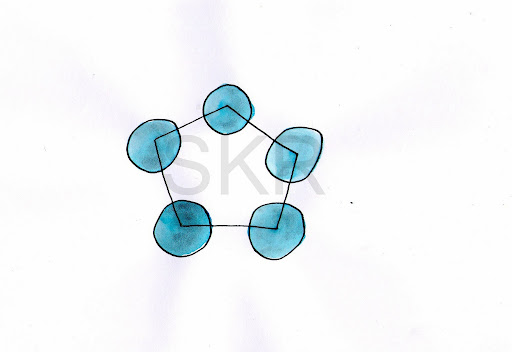
Multiplicity describes a form of dissociation that happens in the area of identity. Dissociation can happen in many different areas, of which identity is one.

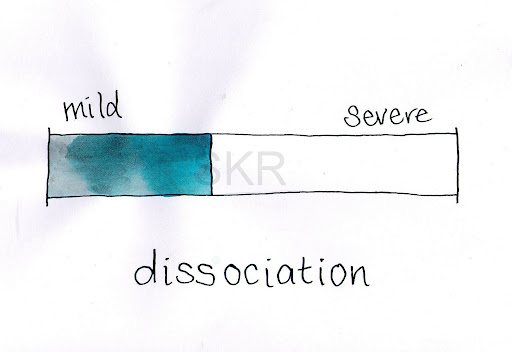
To start with a broader understanding of dissociation read About Dissociation. Dissociation describes a disconnection of some kind. Disconnection in the area of identity can occur in a very mild and commonly experienced way, or be quite extensive and severe. We tend to think of multiplicity as being a distinct category of its own, something you either have, or don’t have. Dissociation occurs in degrees of severity in any area, including identity.

People also often use the diagnosis of Dissociative Identity Disorder (DID) as a shorthand term for the concept of multiplicity. DID describes very high levels of dissociation in the areas of both identity and memory. It is possible to experience multiplicity without memory loss (in fact, this is sometimes part of the goal of therapy for people who have DID) and people with that experience may instead be given the diagnosis of Dissociative Disorder not otherwise specified (DDnos). People with multiplicity issues may also be diagnosed as schizophrenic, psychotic, or other conditions, or not given any diagnosis or framework to make sense of their experiences.

Right down the ‘normal’ end of this spectrum, we all have ‘parts’ if you want to look at things that way.

We all play different roles in different areas of our lives. We show different sides of ourselves in different relationships – with our co-workers, our friends, and our children. Some theories of personality and identity development now conceive of the idea that everybody is an integrated network of sub-personalities, united by a single sense of consciousness. So, to a certain extent, we can all relate to the concept of multiplicity. We know what it feels like to be in two minds about something, to have conflict between aspects of ourselves “Part of me wants to go out tonight, and part of me wants to stay home.” We may also have experienced spending time with a new friend, who bring out a side of ourselves we hadn’t known was there. We may feel like we leave parts of ourselves behind – perhaps the part that loves to study and research is left behind as we throw ourselves into parenthood, or our fun and silly part is forgotten about as we try to manage a large company. We may also recover and reconnect with these parts later in life. All of these parts are ‘us’; they are all facets of a single, whole personality, and there is a high degree of connection and cohesion between these parts.

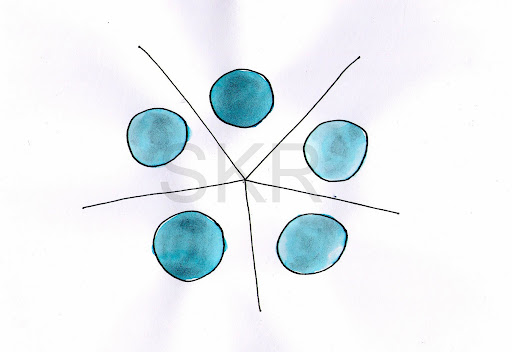
In multiplicity, there are dissociative barriers between these parts, like walls that disconnect them from each and keep them separate. The degree of multiplicity is determined by the extent of this disconnection. So, what are some ways multiplicity might present?

The Doubled Self

This is a really common form of mild multiplicity, particularly for people who have come through some kind of trauma. People talk about ‘the me that’s talking to you now’ and ‘the me that went through that’. They are both the same person, there is a single sense of consciousness and a unified self. There can be a sense of living in two worlds, and that even when the trauma is over, part of them is still stuck in the trauma world. For example, some people describe themselves as having been ‘the day child and the night child’. This is not DID and does not necessarily mean you have a mental illness or need to feel worried. It’s a common form of disconnection.

Rational-Emotional Split

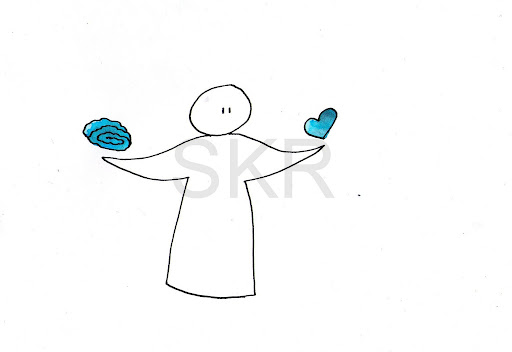
Another really common mild form of dissociation in identity, people can experience a disconnection between their ‘mind’ and ‘heart’. For example, they can remember the facts, dates, information about a traumatic event, or they can feel the emotions associated with it, but not both at the same time. Depending on how this presents, it may be dissociation in the area of emotion, but where it is associated with feeling like there are two distinct parts of you then it may be more useful to consider it a form of mild dissociation in the area of identity.

Like all forms of dissociation, these are not necessarily pathological. In fact some therapeutic interventions, such as the mindfulness approach of developing the ‘observing self’ may be conceived of as a form of mild functional multiplicity that supports and enhances people’s ability to gain useful perspective on themselves and their situation.

My Voices

Some people who hear voices understand their voices as being parts. This is particularly so when the voices have stable personalities of their own and have been heard by the person for a while. The framework of multiplicity is not appropriate or useful for all voice hearers however! There are many other ways of making sense of voices. (see Hearing Voices Links and Information for some resources) But for some people, it helps to think of their voices as parts of them-self, or parts their mind has created. For these people, their relationship with their voices is often the key to whether their voices are comforting assets or disabling and destructive. There is a common idea that how people experience voices is diagnostic; that people who hear voices in their mind have a dissociative condition, while people who hear them through their ears (as if someone else is standing behind them talking) have a psychotic condition. This would be a convenient distinction but research doesn’t support it.

Parts that Affect My Mind

These parts have the ability to affect how someone thinks and feels. They may be able to block memories, take away words, flash images into the person’s mind, block or trigger emotions. These kinds of experiences are often considered to be part of the Schneiderian First Rank Symptoms (FRS), and to mean that the person has schizophrenia. However people who do not have schizophrenia may also experience FRS, and some research suggestions that FRS are actually more common for people who have DID than people who have schizophrenia. The person in this illustration does not have DID, as they do not switch and they do not experience amnesia (dissociation in memory). However, their experiences can be understood as being a form of multiplicity rather than psychosis. Their parts may talk to them (as voices) or be completely outside of their awareness.

Parts that Affect My Body

These parts have the capacity to affect the person’s body (another FRS). People who experience this may describe watching their own hand write in a different handwriting, or having a voice that can move their body and make them safe when they freeze in dangerous situations. This can also be really frightening and people may feel possessed and like they are fighting for control of their own body. They may or may not hear these parts as voices, and may or may not be aware of them or know what they are fighting for control with. If people interpret this experience through a spiritual framework, such as demons possessing them, they may become extremely distressed.

Co-conscious Switching

This person has a high level of multiplicity with at least one self contained, separate part that at times ‘switches’ and operates the body with complete control. Even when the other part is out, this person is still aware of what is happening, or they are filled in on what has been going on. This kind of awareness is called co-consciousness, it means there isn’t amnesia (dissociation in memory) happening for them.

Amnesiac Switching

Dissociative Identity Disorder is the diagnosis for people who experience amnesiac switching. This means that when they switch and another part is out, controlling the body and going about their day, then they are not aware of what is happening. They don’t experience themselves as switching, their perception is that they ‘lose time’ or have blackouts. Minutes, hours, days, weeks, or even years may go by without them knowing what is going on. When they come back out they may discover they’re wearing clothes they would never choose, or that major life changes – house, job, partner, have happened while they were gone.
Where there is more than one other part in a system, there may be different levels of awareness and multiplicity between the parts. For example, imagine a multiple with four parts, Greg, Graham, Greg 2, and Pearl. Greg is amnesiac when Greg 2 or Pearl are out, Pearl is amnesiac for everyone else and doesn’t know she has parts, but Greg 2 is aware of everyone and what is happening all the time. Graham never comes out, he is a part that speaks to Greg or Greg 2, but he doesn’t know about Pearl and Pearl can’t hear him. These things may not be fixed either, perhaps if Pearl was in a situation of terrible danger she might suddenly be able to hear Graham telling her to run to safety. Over time things can change.
Some multiples are in fact highly fluid, with such constant changes that system mapping is impossible and pointless until some degree of stability has been created. On the other hand, some multiples are so fixed that they find their parts are all playing roles and trying to manage people and circumstances that have long since changed. The best functioning – as with all people – seems to be a balance between flexibility (adaptation, growth) and stability.
As with all other psychological symptoms, different things can cause them, including physical illnesses and problems. If you suddenly develop parts or any other form of dissociation it is important not to presume that a psychological process is always at work. Symptoms may in fact be due to an infection or kidney problems for example.
Multiplicity can be both under, over, and misdiagnosed, as with all psychological conditions. There are other psychological processes that can seem similar to multiplicity – such as rapid cycling Bipolar, (where mood changes may be mistaken for different parts) or chronic identity instability as part of Borderline Personality Disorder (where the issue is more a disconnection from a sense of coherent self rather than the division of the self into parts). People who have a high level of adaptation to different environments may seem to ‘change personalities’ in different situations but this relates more to issues around ego boundaries rather than a divided self. Other forms of dissociation can be mistaken for multiplicity, such as when people experience severe levels of amnesia and it is assumed that this must mean that another part has been out, whereas they may not have any multiplicity at all, only memory issues. Ego states are a way of describing ‘normal parts’ and sometimes these will be mistaken for DID when inexperienced people think that feeling like a child again when you’re around your parents, for example, means that you are a multiple. Multiplicity is only one framework among many, if it doesn’t fit or isn’t helping, keep looking. There are many other ways of understanding your experiences, spiritual, social, mood related, biological, and so on. It is also possible that more than one thing is going on, for example you may have multiplicity and bipolar. In that case bipolar symptoms may occur across all your parts, or perhaps only 2 parts have bipolar and the rest do not.
It is really common for people struggling with multiplicity issues to be given many different diagnoses and spend many years in the mental health system before somebody considers dissociation as a possibility. A lack of training and awareness about these issues, as well as sensationalism and controversy have unnecessarily clouded this field and made life a lot more difficult for many people. People with parts are not more special than anyone else, and although multiplicity can seem startling at first, it is really no stranger than the experiences of people who have psychotic episodes, mania, or compulsions. There is a high level of stigma and freak factor around multiplicity that can cause a lot of problems for people who experience this and can make it very difficult to think clearly about. If you’re trying to work this out it can be tough, hang in there and be nice to yourself. You may it helpful to read How do I know I’m multiple?
Whatever is going on for you, there is hope for recovery. What that looks like is different for different people, rather the way it is for voice hearers – when ‘well’ some don’t hear voices any more, other still hear voices but they are positive, others still hear difficult voices but have learned to manage them. Some multiples work on improving communication between parts to be more of a team, or rebuilding connections to function in a less divided way. Some people integrate, where the dissociative barriers come down so that every part is ‘out’ all the time. There’s tremendous variety, and it’s important to note that the degree of multiplicity is not necessarily indicative of loss of functioning. A person with very high levels of multiplicity may function better than someone with none at all. A disability model may fit better than the medical ‘mental illness’ framework, where multiples may live differently to other people but are part of the diversity of human experience rather than ‘sick’ or ‘impaired’. Having said that, for many people dissociation of any form can be extremely challenging, distressing, and disabling. There is tremendous need for more information and support to help people with these experiences to manage them the best they can.

You can find some more information I’ve written here at Multiplicity Links, or over at the website of the Dissociative Initiative. Good luck and take care.

What’s it like to have hallucinations?

I experience hallucinations when I’m stressed, which is pretty common for folks like me who have Posttraumatic Stress Disorder (PTSD). Actually hallucinations are pretty common all round. Technically a symptoms of psychosis, many people experience mild hallucinations during their lifetime. Voice hearing for example is extremely common, the stats vary between one study and the next, but a ballpark figure is one in twelve kids hear voices at some point. Like dissociation, one of the simplest ways to induce hallucinations in almost anyone is to deprive them of sleep. Hallucinations can range from very mild, minor experiences – glimpsing something in your peripheral vision that turns out not to be there, thinking the radio is playing quietly but discovering you already turned it off, reaching for your phone to discover it wasn’t ringing, through to more dramatic experiences where a person might seem so real that you converse with them without realising they’re a hallucination.

Mine tend to sit in the mild to moderate range, for which I feel pretty grateful. I don’t experience delusions or disordered thoughts, so although the hallucinations can really bother me, they don’t confuse my sense of reality. I’m well aware they’re internally generated and not externally real.

So what’s it like? Well, frustrating a lot of the time. You can hallucinate in any sense you have – and contrary to popular belief we have more than five senses. We can not only hear or see, but also have the ability to sense things like air or water pressure, gravity, the location of our own body parts (this is why you can close your eyes and still touch your fingertips together), and sensations such as hunger and pain. Dissociation and hallucinations can interfere with any of our senses. A common one I get is taste hallucinations. This can make life quite difficult, particularly as I live alone. I have to be careful when I am experiencing these because it makes it hard for me to work out if food is safe to eat. Sometimes I will experience persistent tastes even though I haven’t eaten that food lately. Sometimes tastes will be oddly swapped about. I once ate marshmallows that tasted of petrol, another time hot chips tasted only of honey. Not like honey flavoured chips, but like I was eating teaspoonfuls of honey. A common one I get is food tasting intensely bitter, when it tastes perfectly fine to everyone else. When eating alone this bitter hallucination can mask real warning tastes and make it hard for me to work out when food is spoiled. I tend to err on the side of caution. When these are happening a lot I also tend to eat less, which can quickly spiral into real problems for me.

Smell is another really common one for me. At the moment when I’m stressed I smell burning. I lived in a caravan for a year and had three fires in it during that time due to electrical problems (one of them was the electrical safety switch I’d had installed catching on fire!) so there is a strong stress memory of burning. It’s impossible for me to tell when I am hallucinating the smell of burning and when it’s happening for real so I always have to check that I’ve not left a pot on the oven or anything like that. I use my other senses to help cue me in, for example if the air is not hazy and my lungs don’t feel tight, there probably isn’t any smoke in the air.

I also get a fair amount of tactile hallucinations. In my case I get body memories, that is, the remembered sensation of something that has happened in the past. One of my common ones is linked to my history of having a needle phobia. Again, when I’m stressed, this one turns up, and I can feel needles in the backs of my hands or in my elbows where I have had drips in the past. I find this sensation really unpleasant and when it gets bad I will often try to override it with other sensations, such as by slapping at the inside of my elbows or laying a warm heat pack over the back of my hands. I’m sensitive about having the backs of my hands touched because sometimes this can set these off. Tactile hallucinations also play into some minor tics I get when I’m tired, my brain gets confused and tells me that when my hands are resting palm down on my lap, that really the backs of hands are touching my lap. Because I can feel that the insides of my wrists are resting on my lap, this creates the weird sensation that my wrists are broken and my hands have been turned upside down. Flicking my hands over and back gets rid of the sensation. If I try suppressing the flicking, the sensation builds to something quite unbearable, almost like a deep itch you can’t scratch. This only turns up for me when I’m tired, I use it as an indicator to head off to bed. Or, I ignore it and tic my way through the rest of the movie. 🙂

One of the most common types of hallucinations people report is hearing things. The things I hear are all tied in to the PTSD hypervigilence issues. So for example, I can be lying in bed trying to sleep and hearing the doorbell ring. I don’t mean faintly, I can hear it very clearly ringing. It isn’t ringing, but the hallucination that it is can be so loud and persistent that I can’t get off to sleep. Alternatively the phone will ring constantly. When I’m really struggling, I can hear people in my house. I will sometimes hear an entire event – a strange car driving up the street, turning into my drive, parking. People getting out, doors slamming shut, voices talking to each other. Footsteps, crunching on gravel. Keys jangling, the door unlocking, opening, a conversation between several people. Footsteps through the house, opening cupboard doors, the fridge, moving things around, turning on a tap, coming to my door. I check these things once, then having decided they are hallucinations I do my best to ignore them. There’s no point interacting with the content for me, it means I’m really stressed and feeling really vulnerable. So I write in my journal or read or cry or call lifeline and ignore the sound of these people trekking through my house. It’s not very nice, but it’s not the end of the world either.

The most severe hallucinations I’ve ever experienced have been when I’ve been put onto medications I’m allergic to. I have a lot of allergies due to liver problems, and we’ve had to work out the hard way what I’m allergic to and what I can tolerate. I’m not on any psychiatric meds because we haven’t found anything I can tolerate that helps. Allergic reactions are absolutely horrible and make me incredibly ill with liver issues and my skin blistering and peeling off or ulcerating, and in these instances I’ve had full-blown hallucinations that were really intense and frightening. Some of my friends struggle with intense hallucinations all of the time and I have so much respect for how hard they work to function despite people around them looking like skeletons or hearing stobie poles talking to them. Life’s complicated enough as it is!

If you’re looking for more information or some great suggestions about managing experiences like these, or supporting someone else who’s struggling with this kind of thing – there’s an awesome little booklet by the Voices Collective you can print out here, and a lot more resources on their website here.

See more like this:


Should we be afraid of psychotic people?

There is still a widespread myth that people with mental illnesses are dangerous, and psychosis especially so. The chap talking to himself at the bus stop freaks people out. What we fear is the different, the unknown, the irrationality that makes people confusing and difficult to predict. Having a mental illness myself does not make me immune to this. The first time that someone came to the voice hearer group I attend, Sound Minds, who was actively psychotic and clearly perceiving things we were not, (apart from the voices, obviously) I was spooked. I felt stressed and anxious and really unsure of how to interact with them. Fortunately, there were other people present much more experienced than I was, and I was able to learn from their excellent responses. I’ve since read a lot more and met a lot more people who experience all kinds of mental illnesses. Many of my good friends are dealing with psychosis and the whole area is a lot more familiar to me now.

The most useful thing I ever read about psychosis was about a shrink who had a miraculously calming effect on psychotic inpatients. He so was renowned for this in the hospital that the staff used to call him in for the most florid, hysterical, extreme examples of psychotic distress, only to marvel as the patients inevitably settled down and within a few minutes were conversing lucidly. His secret? He spoke to them kindly, respectfully, and as if they made sense. That was it.

It can be challenging to put ourselves in the shoes of someone who is psychotic, that is, experiencing hallucinations and/or delusions. One of the things it is difficult to appreciate is what it feels like to be perceiving things other people are not, and to be gripped by certainty about ideas and beliefs other people do not share. Attempting to communicate with other people is a terrifying, frustrating, shocking confrontation with their refusal to accept your reality. You are desperate to convince people of what they refuse to believe, and profoundly afraid that you are insane. Caught between terror and denial, you are incoherent, and people respond to you with fear, are dismissive of your perceptions, and treat you as if you are not worth engaging with. You spiral into a dark place where you are alone with your nightmares.

Having someone respond to you as if you are normal and still perfectly comprehensible reaches through that darkness. You may be caught up in an inner reality that no one else can see, but you are still human. The fear settles, and the imperative to convince other people of your beliefs is reduced when they don’t argue with you. This doesn’t stop you being psychotic, but it does mean that you can connect and engage and become more settled and lucid.

So, when I come across someone experiencing psychosis, I am not afraid of them. When they talk to people I can’t see, I ask them about them without fear or judgement. I try to have interest and compassion guide my responses. If they share about delusions that are frightening them, I am sympathetic to how distressing the situation is. I never lie about my own perceptions, if they trust me to help to reality check I certainly explain that I do not see or hear or believe what they do, but I do it pretty gently because working out that you are alone in your perceptions is pretty confronting. I simply treat them as if they are a normal person who happens to be experiencing things I am not. Most of the time this leads to increasingly coherent conversations.

The statistics clearly indicate that people with mental illnesses are no more likely to be violent than the general population. In fact, people with mental illnesses are more likely to be the victims of violence. Having a mental illness can make you more vulnerable to harm. The only indicator that has ever been shown to be reliable in predicting the likelihood of violence is previous violent behaviour. One of the most effective treatments for psychosis is the development of a close, supportive relationship with someone (therapist, partner, friend) whom the person trusts and regains the skills to reality check psychotic experiences with. That is, the two together work out what is dream and what is reality. One of the best descriptions of psychosis I have come across was by actor Alan Alda about his mother who had schizophrenia, that she was “dreaming while awake”. I’m not saying that is the science behind the experiences, but as a metaphor it works beautifully. The experiences of psychosis are often a tangle of deeply personally meaningful fears and desires mixed with the kind of random bizzareness that we are familiar with in our dreams and nightmares. There is both meaning and irrationality. Treating all the experiences as meaningful can be exhausting, confusing, and lead to delusions. Treating none of it as meaningful – which is generally the approach of mental health services that favour biological explanations, strips people of the ability to interact with the content in a useful way. Because they are dreams, they are written in the language of symbol and metaphor. People craving significance may have delusions that they are angels, come to save humanity in the end of times. A good therapist or friend will support the person to work their way through the ideas, cope with the painful crash back to earth, and find ways to meet that need for significance.

So what about the stories we hear on the news, where someone with psychosis has murdered or harmed another person? This does happen – at the same rates as all the people without mental illness murder and harm, but it certainly does happen and the incidents stick in our minds. What happened? Many things may have happened. There are some truly horrible people out there who also happen to have psychosis. Having a disability or mental illness doesn’t only happen to good people. The psychosis may have been completely irrelevant. They may not have even been psychotic at the time. In other cases, people can do terrible things when they become deeply lost in delusions. A parent who becomes deluded that their child is trying to harm them may become intensely preoccupied and distressed, and if no one intervenes, the outcome could be tragic. These cases are so deeply distressing because there is such terrible pain in having a good and caring person become so confused that they have harmed people they love.

This is very rare! Most people who experience psychosis are in no way dangerous or a risk to anyone. They are not struggling with the kind of delusions that are likely to lead to such tragic outcomes. There is also a range of degree in psychosis – in milder forms people may be having hallucinations but are able to reality check – they are completely aware that what they are seeing/hearing/feeling/smelling etc is not ‘real’. Even in more severe psychosis, most delusions are benign in that they are not of a kind to induce a violent response. Most psychotic people are either really scared and believe they are going to be hurt – they want to run, escape, or hide; or they are caught up in a complex grandiosity where they are Buddha, or Jesus, or a secret government agent, or an angel with a message of wonder for all people. These kinds of beliefs may certainly be strange to the rest of us, and interfere with daily life quite severely because when you believe you are the savour of the universe you are much too busy to worry about eating, sleeping, showering, or getting the kids to school, but they are not in any way likely to inspire violence. In fact, we have at times had a really good giggle in Sound Minds about how silly these kinds of beliefs seem when you’re no longer gripped by them.

One of my best friends experiences at times severe psychosis, and he is, even when psychotic, one of the kindest, most generous, peaceful, gentle people I have ever met. The fear and stigma that he faces breaks my heart. What has helped him work through his experiences (among many things) is having friends who accept him for who he is, who understand that at times he is caught up in his internal world, his internal reality, and who support him to work out where the internal and the external realities meet. Social support is one of the most crucial factors in the recovery and management of experiences like psychosis. When we are afraid and shun people with these experiences, we are the ones who set the stage for the possibility that some of them will become completely lost, walking labyrinths in their mind with no string to guide them home. The best way to reduce the risk of violence has always been to love. If you know someone who struggles with psychosis, don’t be afraid. Be loving, trustworthy, compassionate, and wise. You are at no greater risk of being harmed by a strange neighbour who rants at people you can’t see and wanders about barefoot in the small hours of the night than you are from your perfectly normal seeming neighbour on the other side. If you remember that and you behave that way, you are part of the work to reduce the stigma and help people with these experiences to still feel part of the human race. That can only ever be a good thing. If you’re serious about reducing the risk of violence, you will work to strengthen community and include people who experience psychosis.

A final point. Psychotic and psychopathic are frustratingly similar sounding words, and many members of the public use them interchangeably. They are descriptions of utterly different traits. Someone who is psychotic may be hallucinating, struggling with disordered thoughts (that is, all jumbled up and confused), or delusions (being convinced of things that are not logical to the rest of us). Psychopathy is not a mental illness. It is a description of a set of traits and behaviours. Psychopaths lack fear, empathy, and guilt, and therefore behave in ways that are manipulative, abusive and exploitative. To be perfectly fair, most psychopaths are not violent either, because most are capable of blending in and achieving their goals without the risk of the repercussions of violence. Despite the similar sounding names, the two conditions have absolutely nothing to do with each other.

Supporting someone after trauma

I get asked this question from time to time, often by distressed family members after something terrible has happened to someone they care about, occasionally by concerned mental health staff wanting to better support some of the people they see in their work. It’s quite heartbreaking to witness someone’s anguish in the aftermath of trauma and one of the most common responses we have is to feel terribly helpless.

That feeling is based on the reality that we cannot change that something awful has happened. We cannot reduce the losses, take away the pain, or suffer it on their behalf. We are limited in what we can do. But we are not actually helpless. Research and experience shows over and over again that many traumatised people are equally, or even more, traumatised and distressed by the way other people react to them than they are by the original trauma. One of the most powerful examples of this I’ve come across is in Victor Frankl’s Man’s Search for Meaning. People who had survived the Nazi camps and were at last free were devastated to have so many people in their community react indifferently to their suffering. Many people’s attitude was one of denial, along the lines of ‘so what, we’ve been in a war too you know’. People who had been holding on, craving freedom and ecstatic to get out of their horrific circumstances were crushed by these attitudes.

How we respond to and support someone after trauma can have a profound impact on their lives. When I have been in serious trouble, reaching someone on Lifeline who speaks kindly to me, or having someone in my life who makes time to listen compassionately to me has helped keep my heart safe. So one of the most important things you can do when supporting someone, is to make room for that feeling of helplessness. Accept it, ignore it, and don’t let it drive you into discouragement or into trying to ‘fix’ them.

Control
What a traumatised person has lost is their control. Whatever it is that happened, they were not able to prevent it. They might have been able to escape, to fight, to react well, to protect themselves, but they couldn’t stop the situation happening in the first place -whether it was a flood, assault, or car accident. The more they were able to maintain some control in the situation, often the less challenging their recovery will be. To be made to feel utterly helpless and completely vulnerable has a profound impact on people’s sense of being in control of their own lives. Most traumatised people are very sensitive to issues around control, whether they are hypersensitive to losing it even in the smallest of ways, or whether they have collapsed into defeat and cannot summon the hope to direct any aspect of their lives.

Sensitivity to this area is really important, especially because in our zeal to help and protect someone, it is really easy to accidentally disempower them even further. We may be furious at someone who has hurt them, and insist that they take the matter to court – taking away their choice. We may start to determine what they can and can’t do, what might be too risky. It is very common for victims of sexual assault to be put under tremendous pressure to see a counsellor, by worried friends and family who do not understand that this pressure is part of the problem. Supporting the person to regain a sense of being in some control in their own lives is really important. It will help if you ask them what they want and explore options with them. It will help if you share your opinion and perspective but do not try to impose it. It will help if you continue to treat them as if they are capable of running their own life – even if you are worried about them. You cannot know the best recovery path for them. Wherever possible control should be restored to the person.

Safety
Safety is another critical area that traumatised people often struggle with. This issue is twofold – actually doing whatever needs to happen to make sure the person is safe, and also trying to support the process of regaining a sense of safety emotionally. Badly traumatised people can carry this feeling of not being safe into all areas of their lives. This can be really frustrating for you to watch, it’s easy to see how irrational some of these fears are – but the problem is that the traumatised person usually already knows this and feels stressed and humiliated by it. A good rule of thumb is that whatever can be adapted to easily, just do it. As quickly as you can support them to regain some sense of safety somewhere in their lives will help to settle the intense anxiety and the irrational fears.

It’s very important to try and be a safe person for them to be around. This doesn’t mean always getting it right – that is completely impossible. What it does mean is accepting that sometimes you will get it completely wrong – and being okay with acknowledging that. So if they say ‘It’s really not helpful when you do x’, you can go ‘sure, I’ll stop’ instead of launching into 300 brilliant reasons why you thought x was a good thing to do and why any sane person would have appreciated it. It’s also helpful to keep in mind that sometimes there is no right answer. The person is just stressed out and overwhelmed and not coping, and anything you do will be wrong. Don’t sign up for abuse about this, but don’t rake yourself over the coals for it either. As the stress and intensity settle down this should be less of an issue.

Another big part of being a safe person is not putting pressure on them to recover. Victims of assault for example, may find their partners deeply frustrated with their changed needs, feelings and behaviour, and constantly asking when they are going to be ‘back to normal’. Other people desperately need to move on and feel normal again and are under pressure from well meaning friends to open up and talk about it all. This brings me to the next critical area:

Balance
People who have been traumatised often express intense ambivalence. There are many double binds where they feel conflicting needs very strongly such as I want to talk about/I never want to talk about it. It can be very difficult to find a balance between the need to honour the events of the past, to speak about it, feel heard and validated, and have it recognised; and the need to escape it, to move on from it, to connect to the present moment and plan for the future. Different people have different needs and gravitate towards or away from their trauma at different times. Often from outside, we can perceive the lack of balance in their response. We are concerned by obsessive reliving of the event, or anxious about their intense avoidance of it. We can try to intervene and restore balance by pulling the person back in the other direction, but often this is merely perceived as an attempt to control. I would recommend instead trying to support the person and trust their own instincts about what they need and when they need it. When they have met one need, they will naturally swing towards the other. No one goes through this on some kind of ‘perfect’ arc, struggling to process trauma in an unbalanced way is the norm. Over time and with work and love, these things settle down. Be guided by their instincts, and never, ever forget, just how powerful it is to feel heard. When all else fails, or if you’re not sure what to do, your default stance is to listen compassionately. Sometimes the less you say or try to do, the less you fix, rescue, hover and fret, and the more you just hear the person, the better.

Another really important area around balance is to be aware of the changes that trauma makes to your relationship. It can temporarily shift you both into a carer/caree dynamic. This kind of dynamic is very powerful, to set aside your needs and make sacrifices to support and nurture another person is an incredible demonstration of love. But the unbalanced nature of this relationship, where you give care and they need care, can also cause problems. Healthy relationships are very fluid, there is a constant exchange of roles between who listens and talks, who sacrifices, who nurtures, who protects, who advises. This mutuality is a key to trust, respect, and mutual contentment. The carer dynamic can undermine that. I advise you to wear the roles lightly. Look for opportunities to share your vulnerabilities too, to allow them to support you as they are able to. If you can remember that the person is far more than their trauma, you will help them to remember that also. The natural response of relationships to trauma and intensity is to polarise into opposite, rigid roles. This is stifling and destructive, so be aware of it and encourage natural growth back towards mutuality.

Looking after yourself
Lastly, it is really important to recognise that when someone you care about is hurt, you are hurt too. You also need care and support and to take care of yourself. You may find yourself feeding off their anxiety and dissociation, feeling chronically irritable, frustrated, or depressed. Debriefing can be very helpful – if the person you care about is sharing deeply personal information with you, you can become very stressed by the need to keep secret things that are really upsetting you. In this instance confidential counselling of some kind can be really helpful. A sense of humor can also help to reduce the impact of trauma, breaking tension and relieving stress. Sometimes there is nothing better in the world someone can offer me than to come round and watch some Monty Python. 🙂

I hope there’s a few suggestions in there that are useful to you. In a nutshell I would suggest that you listen a lot, be guided by what they ask for and want, and hang in there. Research consistently shows that social support is one of the biggest factors in how resilient people are to the effects of trauma. Your care and sensitivity can make a tremendous difference.

To see these ideas in action in a personal case study, please read 5 hours after an an assault.

Quick tips for bloggers

Sharing your story online
 
  • Consider whether to make your blog public or personal, open or anonymous.
  • Consider blogging anonymously if that is safer – but be aware that a falling out with a friend could result in you being outed, so be careful.
  • If you are sharing your personal story, then you are effectively a peer worker – representing other people who have similar experiences to you. It may help to think about what makes a good peer worker when writing your blog.
  • Decide on boundaries of what you won’t share before you start writing. Don’t share information that could be used to track you down, eg. photos of your front yard.
  • Work out what your point is and stick to it in each post. If you are writing several thousand words, try breaking the post up into parts. People read these on the bus in to work; they want to be able to digest a post in one sitting.
  • Don’t traumatise your reader with unnecessary details about intense situations. Certainly share things but be aware that graphic descriptions of abuse for example, may cause distress.
  • Learn from other people. Follow blogs that are about similar topics to those you want to write about and see how they manage things. Model your way of blogging from those more experienced. (Never copy someone else’s work though!)
  • Invite feedback from your readers, they will often have invaluable insights.
  • It often helps to picture a specific person that you are writing to, perhaps a close friend. If your blog is public, edit your work with a more challenging audience in mind – your most difficult relative, your future employer, your kid.
  • If in doubt – less words, more pictures.
  • If in doubt – sleep on a post. If you’re still uncertain the next day, don’t put it up. Write something else instead and come back to it later. Yes, you can edit or delete your work later, but with the internet – once it’s out there, you can’t take it back.
  • If you are impulsive, structure your blog to allow you ‘cooling off time’. Schedule all posts for a week or two ahead to give you time to reconsider.
  • Post reliably. Set a pace and stick to it. Let your readers know what it is. If they have come to expect that you post every Sunday, they will come looking for new material on Sundays. If you deliver, they will return. But don’t worry about this if it’s too hard. Decent content is better than being reliable.
  • Promote your blog using whatever social media you’re comfortable with. Commenting on similar blogs will also lead people to find yours.
  • If your blog becomes popular, expect troubles. That’s just the way of the internet, nasty comments or emails will happen at some point. Delete, moderate, block, and take care of yourself.
  • Never “delete” your blog, this just blocks your access but leaves it on the net. Delete the content of each post and save it empty, and then delete the blog.
  • Think about what you are trying to do – share your art? Raise awareness? Showcase your pets? Tell funny stories? Share recipes? Blogs with focus are good to read.

More suggestions for starting your own blog.


Reclaiming Creativity

As I am such a madly creative person, it’s easy to assume that art comes easily to me. In fact, I went through about an eight year drought in which I was unable to make any art. This was during the time when I was the most ill, both physically and psychologically. Various things crashed my ability to make art. Upheaval in moving houses, studio space being promised but never quite eventuating, or my art table being sabotaged by housemates who knocked drinks onto my work, borrowed and didn’t return tools, etc. Increasing illness and trying to manage work meant I culled art time as my energy gave out. As I experienced setbacks and losses in other areas of my life that shattered my self confidence, my confidence in my art also suffered. As my physical health disintegrated to the point where I was housebound, using a wheelchair, and needed assistance with meals, dressing, and bathing, art became a distant dream. I remember craving the day when I would be well enough just to work on a cross stitch for a few minutes a day.

As my health started to improve, I began to make things again, but no longer art. I couldn’t handle the severe internal criticism whenever I tried to make something of my own design, so I kept my hands busy with crafts. I also employed my creativity in an attempt to strengthen my social network. So, I didn’t paint or sculpt any more, I spent hours making birthday cards for friends. I made cross stitch where I worked with someone else’s design, and got into stamping and embossing. I learned ribbon, wool, and bead embroidery and made gifts.

A few years ago I decided to concentrate on the blocks that were stopping me from making art. I didn’t want to give away my creativity and use it to try and stay connected to friends any more, I wanted to use it to say the things that I had in my heart, and to work on becoming a professional artist. I felt like I’d allowed my voice to be taken away from me and I wanted to take it back.

Don’t get me wrong here, there’s a popular culture hierarchy that goes something like this: crafts on the bottom, then ‘low arts’, then ‘high arts’. So an oil paint is deemed to be more high art than a street performance or a loom worked tapestry, which is deemed to be better than a cross stitch project or a leather worked belt. That’s all rubbish as far as I’m concerned, the skills needed to make a knife, handle inks, sew a dress, or sculpt a face are all significant! I love and spent time on various pursuits considered crafts, and on others generally badged as arts simply because I enjoy being creative and making things with my hands. I found crafts easier to get back into than arts simply because crafts are often about skill with your hands and the material, but not so much the deeply personal aspect of designing artwork. Simply put, there was less of my own heart and soul in the crafts.

I moved back into art in small steps. Having made many crafts, I started to design my own craftwork, such as beaded earrings. This was actually really hard to do, my perfectionism was out of control and my inner critic absolutely savage. I would bead some gorgeous earrings at night and feel really excited about them, but when I looked at them the next morning I would be disgusted and filled with self contempt for my efforts. It took tremendous self control not to destroy my own work or throw away my supplies. On bad days I would have to hide it all out of sight to reduce the temptation.

A lack of self worth also crippled me, I felt like nothing I could make would possibly be good enough or of any interest to anyone else. It felt like arrogance and pretentiousness to presume to make anything.

Another huge stumbling block was attitudes about art I had taken in from some other people, that only photo-realism counted as real art, that art was pointless and meaningless and a waste of time, that if I had the energy to make art I should be out in the real world doing something useful. All art is self-indulgent navel gazing. Tied into all of that was the idea that if I’m going to be on disability support and be a drain to society, the least I can do is be deeply unhappy and unfulfilled.

This all took a bit of working through! I moved as fast as I could without causing major problems – this was actually pretty slow. Lots of small steps. When I started painting again, I got into ink paintings. I had a lovely fountain pen I used to write in my journal with, so the jump between writing poems with it and drawing shapes with it wasn’t too much. I fought perfectionism and watched docos about other artists, noticing how near-universal many of my issues were. Most artists think their own work isn’t so good, struggle with self esteem, feel intimidated by other artists etc. I started to fight back hard with my inner critic, tearing their assessments and philosophy to pieces. I also started to mimic them in silly voices to undermine their place of authority in my life. I decided that the role of an inner critic is to protect us from putting ourselves out there in a way that makes us vulnerable to external criticism, and to inspire us to produce work to the best quality. I tore my inner critic to pieces and reassembled it in a more constructive way. This was really hard work. There were a lot of days when I sat at a blank canvas for hours and dragged myself away in tears.

I also bolstered myself by keeping art around me. I bought a table easel and kept it on display all the time. It made me feel happy just to look at it, inspired joy in me instead of cringing. I started to feel like an artist again, the way I did back in my school days. I also kept a visual art diary by my bed with my journal. I noticed that when an idea came to me, my visual art side had started to wake up. Sometimes the idea would clearly be a story or a poem, sometimes now it was an image to be painted or sewn or sculptured. Sometimes it would flicker back and forth between words and image, finding a home somewhere. Sometimes I will make the same form in many different ways before I find the medium it is really supposed to be. With practice, this all became easier, like muscles getting stronger.

I started to display my creations more, wear my jewellery, hang my pictures, enter exhibitions. I bought art supplies even when I was too knotted up to use them, because the fact of having spent money on them would help me win the psychological battle to actually make some art. I worked out who the voices of my inner critic were in my life and to tackle them directly in my mind. I would sit at my art desk and visualise evicting that person from my house, locking the door on them, and denying them the right to decide how I spent my time or what sort of art I made.

I deliberately forced myself to confront stupid values that had become lodged in me. I would make myself finger paint when I got stuck with ideas about realism. I surrounded myself with imperfect objects and images that reminded me to experiment and be creative. I got away from the idea that everything I make must be to the very highest world-class standard and got drawn back into the fun of the process, of experimenting and having most of it come out weird or completely different from my expectations. I started to make peace with the aspects of my own art that I hated most – in my case one of these was my very childish representations of people and the world. I turned these into aspects of my own signature and deliberately painted in this strange childlike perspective and found that there was something in it I really liked. I let go of the idea that a work had to look like what I saw in my mind and grabbed hold of the idea that what I most wanted was for it to feel the way I felt about what I saw in my mind. I decided that the rule I’d learned “You have to learn what the rules are before you can break them” was stupid. Suddenly my manifold limitations weren’t stopping me anymore, it was pretty irrelevant how well I could mix colour or handle paint or how cheap my brushes and paper were. I could bypass all of that and make something that made me feel something.

An audience remains an aside to my own art practice. It’s lovely when someone else is moved by my work, but I don’t make them for other people. Like my poems, some will probably never be shared. Through art I share a little of my inner landscape, how I see and experience the world. I once spoke with someone who felt that art was not really art until there was an audience. I disagreed. Art that remains shut in my books and tucked away safely is still art. It does what I needed it to do, whether anyone else ever sees it, or not. And it turns out some people like my art, like to buy these little windows into my head and look at the world through my eyes for a moment. Which is wonderful, because other people seeing me as an artist has also helped me to claim that identity for myself and to find pride and joy in it. Making art is one of the things that keeps me well, that gives me a voice and connects me to my own heart. It is a way of being alive that nourishes me and gives me strength.

Reviews, notices, upcoming events

The Fringe event I was recently a part of has been very favourably reviewed here! Whee!

Bridges is not on this Friday as Mifsa will be closed due to the public holiday. More information here.

This Tuesday there is a free workshop I’ll be attending about Vicarious Traumatisation (this is the stress and distress that being exposed to other people’s stories and bad experiences can cause you).

Coming up later this month Cary and I will be giving a free talk about Managing Dissociation at Mifsa.

I’ve just discovered that the Voice Hearer’s Network is offering free support packs to individual voice hearers or larger packs for groups of voice hearers. I will be asking for a pack for Sound Minds, the group I help facilitate. If you hear voices and don’t have a group nearby, you can ask them for a resource pack here.

I have finally downloaded and installed the Adobe Creative Suite with In Design! Now that the Tafe holidays are here I am very excited about learning to use this software and starting to lay out my very first booklet for publication!! At last!

I am also entering the ninth month of this blog, and I am very pleased with well it has progressed. I have passed the 11,000 pageviews mark and have really enjoyed the discipline of writing a post every day. I have also written more than 60,000 words in mental health articles alone, which makes me feel a lot more confident about tackling postgraduate work, or writing a book. Don’t forget about the Blogging Workshop coming up, I’ll show you how to start your own blog and share some tips.

A couple of folks and myself are going to be interviewed by Peter Goers about this Blogging Workshop on ABC Radio Monday evening the 9th of April. I’m a little nervous because he seems a bit intimidating but I figure he’ll have to be nice to me or I’ll cry on his show. 🙂

Details for all these events are at What’s On!

Trauma Informed Care

Today wrapped up the Tafe directed component of the Cert IV in Mental Health Peer Work! It was a fantastic session, we’ve been talking about trauma lately which obviously is a topic very close to my heart considering that I have PTSD. One of the areas we talked about today is a concept called Trauma Informed Care TIC). I’ve heard this term bandied about a bit but I’ve never read anything that really broke down what exactly this model proposes and recommends. I was particularly taken by these key principles:

    • That recovery is possible, and that healing occurs in healthy and supportive relationships
    • Supporting control, choice and autonomy
    • Focusing on strengths

These principles are demonstrated through practices such as

    • Respect for individual choice
    • Recognition that treatment and service delivery may be traumatising
    • Avoiding shaming and humiliation at all times

I am delighted by this model! I have had some very unsuccessful arguments with various services over the years about these concepts but lacked a model to refer to specifically. I often encounter myths such as “very few people with mental illnesses have experienced trauma” (by far the opposite is true, the majority of people in the mental health system have experienced trauma or abuse).

I am particularly taken with how well this TIC model dovetails with the values and principles of the Recovery model. One of the things I have also been trying to communicate is that TIC is not inappropriate for the untraumatised! It is helpful for everyone to be treated with respect, given choice, and supported to exercise control over their own life. People who have experienced trauma tend to have extra sensitivities in areas such as control, proximity and touch, confinement, new people and environments, and trust. 

Certainly in the areas I’m involved in as a Peer Worker it is crucial that services are trauma-informed. I am really pleased that Bridges has been operating from TIC principles and I’m keen to do more reading in this area and make sure that all Dissociative Initiative resources and services operate in this way.

For more information about TIC, here is a lovely talk by Dr Warrick Middleton, an Australian psychiatrist and the Director of the Trauma and Dissociation Unit at Belmont Hospital in Queensland. I love his approach to trauma, dissociation, and borderline personality disorder, incredibly respectful! The talk is in three parts:

Adult Survivors of Child Abuse (ASCA) have a wonderful page full of resources about TIC here.

There is a government training powerpoint about TIC that is nice and easy to read here.

This document is much more dense, but I particularly like the distinction between Trauma Informed Care and Trauma Specific Services on page 15.

There is a brief clear overview of the need for TIC in this newsletter.

Here is a brief video about TIC particularly with children.

I’m very excited by this area. Today’s Tafe lecture was wrapped up by sharing about Recovery and asking everyone in the class to create something that represented recovery for them. Here is my rainbow bird, made out of sheets of felt:

The rainbow bird for me represents wholeness, diversity, community, creativity and joy. All the colours are distinct but together form a whole, complementing each other. This resembles my dear friendships with such diverse people who nevertheless all contribute so much to my life and together create a community. The tail feathers resemble tears because for me, grief and pain are intrinsically linked to my experiences of joy and wholeness. They are not forgotten and not hidden, but instead are part of the beauty and authenticity of the whole person. The brightness of the colours and the rainbow represents creativity, expressiveness, imagination, dreaming, and joy; each of which have been essential components of my own recovery.