I’m Presenting in Prague

I’ve just arrived in beautiful Prague today.  I’ll be presenting an online keynote and workshop at the International Hearing Voices Congress 2025 for Intervoice Day on the 9th Oct. You are welcome to attend that day online for free by contacting Kellie Stastny (Chair of Intervoice) at her email: kelnco87@gmail.com.

I haven’t been to a Hearing Voices Congress since 2013 when it was held in Melbourne. Back then I presented Introducing Multiplicity explaining the different ways people experience voice hearing, dissociation, and multiplicity/plurality, and a second talk about using the Hearing Voices peer based group model to support people with other experiences with my co-presenter Jenny who passed away recently. We used to facilitate the local hearing voices group Sound Minds together.

This time the conference is themed around the topic of supporting young people. I’ll be delivering a keynote called Gary: supporting young people with complicated minds, and then in the afternoon holding space in a workshop about finding hope when supporting people with ’embodied voices’ – all kinds of multiplicity and plurality. 

I used to exclusively support adults in the community services sector, but NDIS has brought me into contact with many families, children, and young adults over the past 5 years, and as a parent of 5 kids, and someone who was themselves a ‘Complex’, ‘at risk’ kid, I’ve learned a lot. There’s always so much more to learn, but I also recognise that a child who hears voices or switches between different personalities is for most people so far outside of their comfort zone they don’t know where to start. I certainly don’t have all the answers but I do know where to start.

I was once that strange child who felt possessed. I’m still ‘possessed’ in that we’re still multiple/plural, we’ve grown up but we’re still a group. We are married and own a house and raise our children and run a business and employ a team of people. I have supported other people and families and witnessed from afar even more people finding good lives. It isn’t hopeless and it doesn’t have to stay scary.

So, I’ve created a collection of new ink paintings in purple and black ink and put them into a powerpoint, printed out a stack of Welcome Packs about multiplicity and dissociation, brought warmer trousers and packed melatonin and sensory items.

ID ink painting in dark purple of a downcast young adult with an arrow in their chest, pinning a card to them with the word Complex on it. Their dark hair tapers into fern like curls, which are also the pattern on their pants.

I’m so looking forward to meeting familiar faces again and getting to know some new people. This movement is precious and they sheltered me when everyone else rejected me. They saw capacity when everyone else was consumed by my limitations. They welcomed me to grow in the local group and then use it as the fertile soil in which to plant my own strange ideas and grow resources for others out there on the margins who were also excluded and alone. They’re messy and imperfect and certainly not a Utopia in any way, but their values are excellent and the observations and knowledge and hope they hold for people written off as crazy and doomed is unparalleled.

It’s a big deal to come here, it’s expensive and time consuming and it means a week without my family, with my beautiful wife holding the fort with the kids and the business. We talked about it for months, going back and forth about the value of it and the cost and the potential risks. During that time, we also had 4 funerals over 5 weeks, one of them Jenny’s. She was an unfailingly kind soul, who welcomed everyone and spent years spreading her story of acceptance and hope. I carry that story with me, alongside so many others.

Nightingale and I found ourselves asking what we will have wished we had done with them if we knew we only had a year or two left ourselves? Our children are our world and everything is wrapped around our family, as it should be in our circumstances. But my world pre and post covid looks vastly different and I am aware of the losses, the things I used to do and the voice I used to use. Movements struggle when people can’t show up for them. Nightingale and I keep coming back to this – finding safe and accessible ways to share this kind of information. Making the terrifying understandable, the unspeakable bearable. Facilitating conversations. Holding hope. Diversity like this has a suffocating weight and people – and children – around the world are drowning under it. They don’t need to be alone.

Empowering therapists and parents and partners and doctors to become comfortable with people like me, hearing stories of hope and meaningful lives, having a language for experiences so you can share them, and meeting others like yourself are powerful antidotes to isolation, darkness, and terror. So I’ve flown half way around the world to reconnect with a movement I believe in and add my small candle to all the lights people are holding out there in that darkness.

What’s really hurting disability support workers?

I am frequently infuriated by the incredibly poor understanding of risk in this sector. The standard hr templates are inadequate to a level bordering on neglect. They are aimed at protecting the organisation rather than creating mutual safety for organisation, staff, and clients. The resources around risk and safety are so fragmented and limited, so inapplicable to our actual work and our actual workforce, and so distracted by the risks we can easily find words for and pretend to ourselves we have adequately controlled. The real risks are frequently completely missed, unspoken and unspeakable. And many of the strategies used to manage the risks we can talk about are profoundly destructive.

Humans are, by and large, rubbish at accurately assessing many kinds of risks. We are also not particularly wonderful at coming up with fantastic solutions for managing them. In fact, sometimes our solutions are so bad they make us feel better but make the actual risks worse. In public health we call this the unintended consequences of our interventions. A basic tenant of all work in public health is that all actions will have unintended consequences. If you think you’ve done something and got away without having any unintended consequences, it means that either you’re not looking hard enough, or you’re not asking the right questions.

This process of examining the impacts of our actions is called evaluation, or critical appraisal. In public health it’s the macro version of what we do in intimate psychological services where we engage in supervision and reflective practices on a micro level. It’s an essential step that is utterly missing from most risk management approaches. It’s a catastrophic omission.

Without this step we often have no idea if our management approach is working, or not working, or actually making things worse.

Worse, our assumptions are embedded in the framework in ways that forces our thinking down very particular pathways: all risks should always be eliminated where possible. Compliance is always the goal.

Starting with these two premises unquestioningly immediately reduces the whole conversation around health and harm and quality support work to something so narrowly defined it makes my teeth ache. How we define if something is ‘working’ can be so limited it’s dehumanising.

Take a step back even further and we often miss the real risks completely. Entire policy suites are written from what is effectively a set of unquestioned assumptions that doesn’t reflect the real work or risk accurately, and worse, is usually profoundly embedded in all kinds of discriminatory, abelist crap that sets the tone and culture of the work and the workplace in subtle but powerful and destructive ways.

So there’ll be pages of crap and all kinds of training about managing difficult behaviour from clients, but nothing about handling difficult behaviour from co-workers or your managers. Why? Because we have othered the clients as uniquely dangerous and subhuman, and because the exhausting and terrifying mental health risks of dealing with highly stressed and stressful colleagues and bosses is still an unspeakable nightmare. It happens, we just don’t admit it and we sure don’t provide nuanced and compassionate training about it.

There’ll be policies full of waffle about how to do risk assessments to allow our clients to even leave the house, mainly driven by pressure from greedy, unethical, vile insurance companies who don’t care a fig about staff safety or client wellbeing, but are looking for excuses not to cough up when something goes wrong. These requirements are swallowed whole as reasonable and ethical and in the best interests of the staff and clients instead of being red flagged as the undignified, butt covering, traumatic and bureaucratic bullshit they really are.

There’s a hyper focus on physical risk and injury because it’s easier to define, and creating long lists of forbidden activities is much simpler than co-designing individualised protocols tailored to each staff members capacity and each client’s needs.

The assumptions are that risks are intuitive. That it’s easy for us to guess at them, rank their severity and likelihood, design and implement management approaches, and move on. The actual research is sobering. Frequently the risks are wildly different from what you’d guess. The pain points are not intuitive. Severity and likelihood is extremely hard to estimate accurately, even for people fully trained in this field for whom this is their bread and butter. Designing and evaluating effective interventions takes serious skill, and more than that, it takes a framework that draws on essential values and principles such as co-design, lived experience, continuous improvement, open dialogue, client centred care, the dignity of risk, the social determinants of health, trauma informed care, relationship based services, and critical appraisal. Risk management that’s high quality is inherently relational.

Did you know that one of the highest risk services a support worker can provide for a client is to trim their toe nails?

One of the leading causes of death for people with disabilities in Australia is dysphagia (swallowing difficulties).

The working from home guidelines about ergonomic office setups presume all employees are able-bodied and neurotypical. There’s no scope for people who need to move, fidget, or curl up in a bean bag. It’s so hard to get our exploitative workplaces to fund chairs that won’t hurt us or screen armature that’s set at the correct height to prevent eye and neck problems. We haven’t even managed safety 101 for the average worker, no one has got up to including divergent people and the best practices for us yet! We are still largely invisible.

Myths about Duty of Care continue to harm participants too, as this DSC article explores, exposing them to overprotective misguided restrictions that limits autonomy, freedom, and opportunities to connect and engage with the world in meaningful ways. Risk is frequently framed for them through a narrow lens of physical harm or making bad choices and rarely explored as a potential consequence of engaging with services who are risk adverse.

The biggest risks most support workers face are psychological – burnout and vicarious trauma. Undertrained or put through rubbish training, under resourced, frequently without any access to quality supervision or debriefing, we often witness discrimination, ableism, and injustice in contexts where we have very little power. Many of us have lived experience of disability and marginalisation we draw upon for this work, which is a powerful resource but also a source of vulnerability in how we are treated by our workplaces and other organisations. Magdel Hammond has beautifully articulated the risks of moral injury which are frequently suffered by lived experience workers in this linked in post. Moral injury – the profound distress we experience when we witness or ourselves engage in behaviour that violates our values and beliefs – presents profound risks in the workplace. But you’re very unlikely to see it mentioned in your policy suite. Trauma informed care demands we acknowledge the risks of structures and organisations to individuals, to be attentive to signs of distress and harm, and responsive to those indications. We aren’t even having the conversation. When faced with work requirements that are at odds with our personal values, we most often privately and silently choose between compromise, or judicial non-compliance. Both can take an extremely high toll on our mental health.

We keep blaming the individuals when things go wrong. Individuals do the best they can where they find themselves, and that’s a horrifying reality when you really think about what it means that some of the horror stories out there were someone’s best. Our tools let us down. Our language, our training, our incident report forms, our risk policies, our management approaches, our gig economy, they are all fundamentally inadequate for this work, in extremely dangerous ways. We have the frameworks we need. We know about trauma informed care, about the value of cultural awareness, the empowering dynamics of the recovery model. We know that values based work is essential when supporting people. What we don’t have is those models translated into our structures and tools. Our working practices, policies, and documents. We talk about dignity of risk then have lengthy processes that gatekeep leaving the house. We acknowledge the value of individualised care then write policies without any flexibility that must be applied to all clients. We understand the risks of bearing witness to suffering, then create training that’s little more than an instruction to try not to be affected, building shame and secrecy around people’s struggles. We are not effectively translating our values into our work, and it’s putting us at risk. We are most often silenced about those risks, and silenced about the impact on us. We are trying to provide safety for clients in contexts where we don’t get to experience it.

It’s not just us, all workplaces remain bastions of trauma, abuse, and suffering, particularly for those already marginalised. The power of the bosses and the risks of the work are only vaguely contained by laws protecting those dependent on their paycheck. The rules are written by the powerful who have agendas of their own. Most harm happens exactly where harm is always found – in the unspeakable. What we feel we can’t discuss, or write into policy, or create training for. There’s no accountability for the lovely mission statement. There’s no way to ask how it translates into this policy or that practice. So the beautiful values and the elegant frameworks remain as unrealised dreams, guiding lights or stars to navigate by if we’re lucky to be in a good workplace, but far, far from hand. We work down in the mud and the mess with tools that harm as much as they help, and cultures much more likely to blame us for breaking, than to admit it was always a possibility, and one we were not protected from.

The Gift of Neurodivergent Diagnosis

Like many late diagnosed neurodivergent people, I’ve had a hellish run with episodes of severe exhaustion and burnout. Not understanding how I function, what supports me and where my limits are, seeing and being seen only for my capacity with my difficulties all unnamed and invisible created a horrifying cycle of productivity and crash. Diagnosed as gifted in my teens but not with ASD and ADHD until my 30’s created a horrible environment of insanely high expectations and invisible vulnerabilities. Every few years I’ve been diagnosed with exhaustion as my mind and body run out. I’ve endured brutal unexplainable immune system crashes where I’ve simultaneously contracted infections in multiple areas. My other conditions such as fibromyalgia and PMDD flare to unmanageable levels. I fall off the edge of my world and I never see it coming. Trying to stay alive takes all my energy and every resource I have. I lose everything I’ve built and have to start from scratch, and I never have a good reason why.

This is the not the future people envision for their children when they say they don’t want to burden them with a label. Diagnosis has been complicated for me, painful, isolating, relieving, hopeful. Since I’ve been diagnosed with Autism and ADHD 5 years ago, I’ve never experienced that level of exhaustion again.

I’ve learned that I’m risk blind and need to pay attention to the anxiety of those around me when I’m flying too close to the sun. I have explanations for what used to be confusing and humiliating limitations like not being able to listen to voice mail or reply to emails. I hate myself less. I pace myself better. I let go of a lot of things. I’m beginning to understand what I need to be able to show up and do the things that are important to me.

The labels come with a price of course. The diagnoses subject me to misunderstandings and low expectations. But the alternative was devastating. I’ve pursued diagnoses for my loved ones, hoping to spare them what I’ve suffered, and aware that I have no idea what it’s like to have been diagnosed young, and that they may have both benefits and costs I can’t relate to.

Here is a journal extract I wrote in an episode of exhaustion a number of years ago:

“Finding words for experiences that have no language for them, finding ways to string life back into stories, into a narrative that starts and proceeds and finishes, when my world has unstrung like a broken necklace. Discovering that in this place where things do not make sense that there is no inclination to share, no longer a drive to connect that makes me tolerate the whispered accusation of narcissism when I bare myself in public. I can be silent. I don’t need you, I don’t need this space, I don’t need to be heard.

I wait. I wait for the world to have meaning again. The days pass. Some days I find contentment. Some days I live with a stoic acceptance. Some days I cry until I vomit.

People miss me. While I’m in deep space, protecting the world from an atomic anguish. I tow my boat way out to the deeps where the blast won’t burn anyone else’s house down. I swim far from the old comfort of my online world. In sudden panics I run to familiar harbours. I bite my teeth over the blackness and crouch at the edge of other people’s lives and bask a little in their normality. Some days I fail my own principles and howl while a loved one talks soothingly, holds my hand, listens sympathetically, tells me I mean something to them. Sometimes I make them cry. I watch tears in their eyes, desperate to feel anything but the void.

Someone sends me an email like a crow sent winging from a black well to say thank you for writing from your own hell, it helps. I want to save us all. I’m saturated by death. Sometimes I become terrified I’m going to kill myself, and I calculate the loss, the holes punched through everyone I know and have loved and my reach, my influence, my connections so hard won now seem like the worst possible thing I could have done. Alone my death is just a sad story. Have I built a tribe so you can watch me self destruct? Will pain be my legacy here? Why write when I have no answers, only fears?

After a night of terrors I calm over and over, that reignite the moment I fall asleep and wake me in panic, I crawl to my psychologist’s office and wrestle with hysteria in front of her. She books me an emergency appointment with my GP for anti-anxiety meds and diagnoses me with severe exhaustion. None of the fast acting meds are pregnancy safe so I come home holding a script and a sense of being broken that I’m going to have to live with. How sweet it was to feel above this, once.

I start culling the big dreams, the vast sense of responsibility, the career plans. Tangled with my grief is peace. I have tried very hard and maybe now I can stop pushing this boulder up the hill. Enough…. I look into short courses and small jobs – orderly, care worker, and when I’m not being garrotted by my own high expectations and elitism I’m relieved at the prospect of just living a small life, earning a little money, letting my business be a hobby. Painting when it moves me, writing because I love to. Selling a few prints. Letting it be what it is. Not having to turn those skills into a factory, or myself into all those things – entrepreneur, leader, business person, change agent. I’ve watched the successful ones and tried to do what they’ve done, follow their paths. My own parents ran a very successful business for many years. I’ve risked many things and nailed my colours to the mast. Some of them have worked out and as my world burns around me I want to let go and go back to loving the things I have, the risks that paid off, the life that’s waiting here for me.

Exhaustion is storms and sunbursts that run according to their own tides. I have no more control over my feelings than I do over the weather. Night falls at 2 in the afternoon and I creep to bed to hold my wrists and tell myself I’m okay over and over. The moon sings to me and I find I’m still alive – not numb, not ruined after all. I haunt my house naked with starlight on my skin and breathe galaxies with a rueful smile and the night smells of roses. The strain of feeling deeply alive and very dead each day leaves me trembling with shock, a violin with strings wound too tight. But I can feel it seeping back into my cracked heart.

More human than I want to be.”

I tripped over my invisible disabilities and fell hard, and fell often. I am better off where I am now, knowing what I know now. Life still hurts badly at times. It’s more complicated and tangled with more people whose stories I’m careful not to share. I miss writing this blog and having my online community, and being able to use my words to provide context to so much about me that is different and doesn’t make sense. This blog was the way I leapfrogged over so many barriers between me and other people. I felt like I had a whole world of people once, who knew me and cared about me and felt cared about by me. I lived in public in a way that was a mutual gift. I am more private now, I have children, clients, employees who all need discretion and all fear exposure. I find myself more decontextualised than I was to my people. I make less sense, become more isolated. There must be a pathway between disconnection and exposure, but I’m not yet able to see it well. If I can’t be sure, I hold my tongue.

But I spend less time in meltdown, sobbing on the floor. I keep house. I am raising four children at home. My capacity has increased, my understanding of self care and my knowledge about my limits has been a gift. The first time someone gave me noise cancelling headphones to try, I was walking with them through a busy airport. I put them on and pushed the button and the peace came over me like a flood of warm water. It was so intense I couldn’t walk. I sank to the ground where I was and just wept. I had never experienced such peace outside of water. I used to calm myself by lying in a warm bath with my ears underwater. The same muffled quiet wrapped me up and it was so beautiful and so painful to realise I had lived my entire life in a harsh bright world that always hurt and never made sense.

It’s a strange story to tell, given my deep ambivalence about diagnosis in mental health. Diagnosis of poorly constructed syndromes, laden with assumptions and stigma, can function as social curses, doing catastrophic harm. The world of neurodivergence with it’s profound observations and confused wrangling of slippery categories and terms is not so different. The low expectations that come with a diagnosis like autism, and the stigma and misunderstandings that shadow the poorly named ADHD have costs. But on the other hand, I spent literally years trying to understand and find words for concepts as basic as body doubling. I have been on the intersection of so many invisible diversities, contorting myself to try and fit paradigms I was never built for. I am now finally beginning to understand my long history of failures and losses, and start to claim my skills and build my capacity. It’s sad, and hard, and beautiful, and deeply liberating.

Introducing Calliope

This little snuggle bug is now 3 months old. After her rocky start she has settled into our family and is back to being a regular newborn. The temperature wobbles have disappeared and that frightening skin mottle is just a bad memory. She’s beautiful and healthy, eats well, gaining weight, and alert.

ID gorgeous smiling baby girl with light brown skin, bright brown eyes, and a little dark brown hair. She’s lying in a bassinet, wearing a Winnie the Pooh onesie.

Her siblings are besotted with her. Bear is 2 and loves her with a degree of unrestrained enthusiasm that requires attentive supervision! Poppy at 8 is old enough to carry her and even sometimes walk her to sleep. Nemo didn’t think they could fall as hard for any baby as they did for Bear and has discovered that joy of your heart expanding.

Calliope has discovered she can interrupt any activity and melt any heart simply by smiling. She has the most adorable dimple on one side. She loves to talk back and forth with her little burble and coo. When she’s interested in chatting she’ll lift her eyebrows in an expression of intense surprise. She is happy for a time in her bassinet but loves to be carried in a wrap, snuggled close to your chest. Sometimes if she’s sad and crying she’ll stop and listen if you sing to her. If she’s very upset, her favourite song to calm down is Aretha Franklin’s (You Make Me Feel Like A) Natural Woman.

I cannot believe how incredibly fortunate I’ve been. Back when I was 14 I realised that I deeply wanted children. So many obstacles came between me and that dream, the collapse of my marriage, my struggles with endometriosis and adenomyosis, coming out from a hostile religious background, chronic illnesses, poverty, unemployment. To be unpacking the carefully saved clothes for the fifth and last child, and this time putting them aside to pass onto someone else is simply astonishing. It’s a very busy, very tiring life but I’m absolutely in love with it. It’s a privilege beyond words to raise these children and I’m very aware how many people don’t get the chance.

We recently put a little money together to hire what Nightingale calls a Baby Whisperer. A lovely NICU nurse with a lot of additional training including in Newborn Behavioural Observation came and spent some time with Calliope. Nightingale and I have noticed that we don’t seem to be able to read her cues as well as we could with Bear – at this age we could pick a number of different pitch cries that indicated hunger or tiredness or discomfort with him, but with her we’re often unsure. The Baby Whisperer came and assessed her to see how she was after the illnesses and hospitalizations. We discussed how she had been showing signs of feeding and touch aversions from the trauma of her treatments. We’ve been gently rubbing cream into her hands during restful moments like when she’s feeding to help her recover from the stress of multiple painful gelcos being placed.

The outcome was really thrilling. She’s recovered incredibly well. She has strong cues, she’s robust, able to soothe herself when a little agitated, not showing any residual touch aversions and only a little feeding aversion. The glitch is more that we’ve been basically trained to be hyper sensitive to her health cues – we’re not very tuned into her different cries but we pick up on skin colour changes with incredible speed and sensitivity. So we’re missing some of her social and emotional cues as a result. In a nutshell, she’s not traumatised but we are a bit! So we’re working on that. Having her so sick, and the hospital response so fragmented and contradictory cemented that we need to be intensely vigilant monitoring her health and advocating for her. It takes a minute to stand that down and switch over to focusing on connection.

So here we are, 4 fabulous kids in the house growing up at a phenomenal rate. Chronically broken sleep. Date nights few and far between. The other day the older 2 kids happened to be out of the house for the night and we got very excited that we only had the younger two to care for and said brilliant! Date night! Cooked steak, lit a candle, and laughed at ourselves because we don’t know anyone who would consider caring for a toddler and a 2 month old a night off. It is gruelling hard work, and there’s times of overwhelm and misery. There’s also a beautiful bittersweet awareness that every milestone she reaches is the last time we’ll have that experience. Daft people who haven’t quite followed the complicated nature of conception in our queer family tell us we can’t be sure we’re done and we never know what might happen. (So much planning and baby math goes into conception for us) We are savouring everything, and so tired we’re forgetting half of it, falling over it in the dark, tag teaming, staggering along in the perpetual dampness of infant care. It’s absolutely beautiful and utterly consuming and I’m incredibly proud of how we’re living it and looking after each other.

She’s beautiful, she’s healthy, and she’s so well loved.

Making a Home

Home from the surreal terror of NICU and into the surreal mix of bliss and boredom that is life with a newborn. We’re exhausted and recovering as best we can. Baby is doing so well, getting stronger and feeding well. Little bear is bewildered by the new addition but very much enjoying exploring the new yard. The house still has many boxes stuffed into corners yet to be unpacked, the carport is a mess of dismantled shelves and tools and craft supplies. The front lawn has largely died while we were preoccupied with the baby, and is covered in pieces of jungle gym and swings yet to be reassembled, and things too heavy for me to move alone like a table with a circular saw.

I didn’t love this house at first. This was not our first choice, we were trying to renovate the damaged house Nightingale bought years ago. When that fell through we had a tiny window in which we could buy a place before baby came along. We applied for a house every week and there were others, prettier ones with creative layouts and ivy growing up the walls that I was in love with. This one was merely available, in the right area and with 4 bedrooms. When we were successful in buying it I was ecstatic and then I cried in disappointment.

I have waited a long time to own a home and I thought we would have time to explore many options and fall in love and it would be romantic. It was instead absolutely exhausting and under tremendous pressure. Sometimes one of us would run into the open inspection while the other lapped the block in the car trying to keep Bear sleeping through his nap, then tag out and swap. Some were insanely expensive, much more so than we’d expect. Some were frighteningly dilapidated. Many lacked basic things we need like a fence. It was an intense time with Nightingale extremely pregnant and unwell.

But we’re here now, in this funny white box of a house, set into a hill, and I’m falling in love with it. It’s peaceful. There’s birds and trees. I drag the sprinklers from tree to tree and patch of lawn to patch, starting to nurse it back to green. There’s a clothes line by the back door and I find peace in the simple domestic tasks after days of wearing the same soiled clothes in hospital. Bear moves dirt from one spot to another. I open a few more boxes every day, start to make patches of functioning space in the chaos.

It feels different to own it. I’m settling into the carport as a workshop space, and I’m not afraid of splashing paint or creating sawdust. There’s so much hard work that came before this and is yet to come but right now I’m in a tiny quiet eddy of time without a school run and work stripped back to the basics, not ready yet to face the world. Just cocooned here, getting to know the baby, the house, letting everyone get used to all  the big changes. Eyeing up the empty spot in the freezer where I keep the spare meals, planning the fortnight shop, changing nappies, tidying away crafts, folding washing.

ID Sarah sits in front of a garden, with very short silvery hair, white skin, and blue eyes, smiling at the camera. I’m wearing a dark blue t-shirt. Cradled to my chest is a tiny baby with dark hair, sleeping in a froggy position and wearing a strawberry outfit.

Soon enough I’ll be the working parent again and my job will be to leave and focus elsewhere. Right now I resent that so much it’s hard to breathe, so I’m focused here. I’m cleaning Bear’s bottles and figuring out where to store the spices and learning where the new chemist keeps the latex free bandaids. I’m incredibly tried and I wouldn’t want to be anywhere else, doing anything else.

Dreaming of the Last Child

Sitting at the ASO Hans Zimmer concert with a friend, quietly crying to the theme song from Inception. It’s so beautiful. I remember the first time I watched that movie, thinking of my friend Leanne who had died, and feeling that she was so close by, just in the next room. That god was only a dream away, was just waking up. I wept then too.

Nightingale and I are expecting another baby. Our last little one, the fifth child in our little patchwork family. We’re halfway through the pregnancy, and while Nightingale has been brutally unwell, the baby is healthy. Much loved, much anticipated. My world, which was once so lonely, is now woven tightly with my family, my children, and my work. Solitude is rare, I am the gardener tending all the growing things, aching in the moonlight and resting when I can in the summer heat.

ID: black and white ultrasound image, profile of a baby’s face at 20 weeks old.

We’re back in the world of hospitals and white water rafting through medical trauma. I remember you being born, Bear; I remember cutting his cord. I remember how hungry I was to hold him, how my skin ached when he cried. The memories are like dreams, hazy and unclear. Underwater in a sea of trauma. I remember stuffing the scream back down inside me, my fingers twisting my fingers into knots, crying in therapy until I couldn’t breathe. Those memories are sharp and clear as glass. 

I remember you too, Poppy, birthed into water in the dim light. I remember you falling asleep on my chest, night after night, pacing the driveway with you in a carrier, held close to my heart. I remember the frozen wordless terror left in my flesh.

It’s exhausting to have children at 40. And yet, my capacity is greater than it has been at any time since I was 18. This is my window, our last window, to bring these beloved children into the world. And while this baby is our last baby, it will not be the last. There will always be other children needing love, food, or a spare bed. There will be strays and grandchildren and friends of friends we take in and take on and love. We are lucky that way.

Holding the dream of the last child with so much love and anticipation. With worry about our housing, about more months of sleeplessness, about money and energy and weaving a new relationship into the family with each of the other kids. We are preparing more this time, building a team, asking the hard questions now, and making time to unpack the wounds. It’s a different kind of nesting to the first child. There are so many beautiful memories and so many dark ones. Tam and Luna float about us, light as moths, brief as butterflies.

We’ll do our best by you, littlest love. You have such a beautiful, imperfect, loving family waiting to welcome you. We have been so lucky in these dreams, and the moments blur together and become mundane and ordinary.

Then some artist fills the world with such beauty and sorrow and grandeur. And I remember the first time Bear gazed into my eyes when I was rocking him to sleep and how deeply moved I was. I remember Star resting her head on my shoulder in the hospital after her knee was torn. I remember getting ice cream with Nemo and debriefing a difficult appointment. I remember bathing Poppy in the backyard under the beautiful old tree. All these moments become framed in something that elevates them from the everyday. I sit in the dark theatre, weeping and grateful I have a heart that can still be moved. Grateful for these precious dreams and memories among the dark seas and storms. One day soon we’ll meet you too, little one. Hold on and keep holding on. We love you.

Disability Support Workers, Autism and Self Care

Speaking as an autistic person, the parent of autistic children, and the organiser of supports for autistic folks, it is desperately important not to assume anything when it comes to self-care. Some autistic people have no issues in this area, but many of us have struggles! Self-care gets used to mean a few different things such as activities of daily life which are the things we need to do regularly to look after our bodies like hygiene and grooming, and mental/emotional self-care which are things we need to do to look after our mental and emotional wellbeing such as things we enjoy and find meaningful. Autistic folks can have struggles with both, in this instance I’m going to discuss physical self-care.

Culturally we are accustomed to children needing monitoring and support for self-care, but autistic children will often need more of both, and tailored to their particular challenges. We are less familiar with able-bodied adults of normal or high IQ needing assistance with self-care. This means we may fail to ask simple questions, we may miss signs of problems, and we may accidentally add to shame and secrecy.

Examples of Self Care Challenges

I have spent a lot of time in emergency departments with an autistic person in crisis, with doctors doing all kinds of tests before someone realises the primary issue is one of self-care, or that a lack of self-care is exacerbating and complicating the issues. We can have a lot of difficulty with activities of daily life such as

  • Drinking too much or too little water
  • Restricted eating, compulsive eating
  • Forgetting to or struggling to shower or bathe
  • Difficulty brushing teeth
  • Difficulty managing head, body, or facial hair
  • Difficulty trimming nails
  • Difficulty managing splinters, wound care
  • Difficulty managing periods
  • Not taking medications correctly
  • Not enough/too much/other sleep disorders
  • Dressing appropriately for the weather, managing dirty clothes
  • Managing continence
  • Managing pets and animals in our homes
  • Managing domestic tasks

Why are there difficulties?

These challenges can arise for many reasons. Autism can come with intense sensory attractions and avoidance. Some autistic people have a hypersensitive awareness of some body functions, and little or no awareness of others. Many can have difficulty with executive functioning which can make remembering and doing self-care tasks difficult. Sometimes people have never been taught self-care skills. Sometimes people have grown up in disrupted environments such as poverty, foster care, or homelessness where self-care was not modelled and they’ve normalised the lack. Often these issues become more pronounced when self-care isn’t adequate – the executive functioning is worse when people forget to eat, the mouth sensory aversions are even more intense when someone hasn’t brushed their teeth or seen a dentist in 10 years.

What can the outcomes be?

All of these can cause trouble – for example, one person may forget to drink because they never ‘feel’ thirsty. Another may drink far too much because the sensation of thirst is intensely unpleasant to them. Self-care challenges can have serious consequences for people, and in some cases can be life-threatening. It is absolutely possible even for educated, well-off, well-presented adults to have severe self-care challenges that they do not disclose. This is an interesting case study of a late-diagnosed 18 year old where self-care difficulties caused serious medical complications.

The consequences can also be more subtle and hard to see – for example someone who stops leaving the house because they are worried they may smell. People lose out on social and work opportunities and can become painfully restricted in their lives due to these challenges.

The role of shame and confusion

Many people carry intense shame and confusion about why they are struggling with these things. This is often even more severe for those who are diagnosed late and don’t have a framework to understand that their challenges are part of a disability, not a personality flaw. For example, someone may have perfectly physically functional capacity for continence, but have frequent toilet accidents because when they notice they need to use the bathroom they are unable to interrupt what they are doing and give that task a higher priority. They will continue to do the task in front of them – perhaps with overwhelming panic and dread, knowing they are not going to be finished in time to get to the bathroom but stuck and unable to switch tasks. If this person has never had this explained to them, the shame can be intense.

It’s also common to have many factors in play – for this example maybe we add in an experience of sexual trauma that adds shame fear and confusion to all things related to gentials, and a sensory aversion to the smell of urine making bathrooms difficult to spend time in, and a sensory aversion to wet hands making the task of toileting hard to manage.

Secrecy and putting it out of mind is a common way of coping with these issues. Unless directly questioned, many autistic folks with self-care challenges simply don’t volunteer the information, and in some cases are not aware that other struggles are linked to them and may simply endure or spend many hours and a lot of money trying to find causes for illnesses that are actually things like dehydration.

What does good support look like?

Sometimes disability support workers are the ones who notice a problem. We might be the first people who are spending enough time with a person to realise that they never drink, and that they often overdress in hot weather and have frequent headaches, nosebleeds, and fainting episodes. We might be the first people let in on the scary secret. We are sometimes the ones who help make sure the right people are linked into the information – I’ve sat in on more than one Functional Capacity Assessment and had someone breeze right past all their self-care struggles and forget to pass on information like their clinical malnutrition. I’ve also sat through assessments by people with no training in neurodivergence who spent the entire time focusing on the clients physical capacity and completely ignoring these hidden challenges. This is unfortunately common in the medical profession and adds a lot to shame and misery.

We can help by reducing shame and being safe to hold such personal information about someone. When we are supportive, we go at the person’s pace. If they are not ready to tell people like their GP, we build that trust. We accept that this is hard, and that being open about it is in some ways even harder. Sometimes people are very accurate in their fears about how the information would be received, and we can help them find safer people to ask for help.

We can normalise the challenges and keep them linked to the disability, not the person’s character. Disabilities can be tough to manage. Peers and peer experiences can somtimes help a lot. Anything we can do to help someone feel less alone and less freakish can be useful.

We can help externalise the challenges. Drawing a distinction between the person as a problem, and the person dealing with a problem. When we team up to deal with a problem, it’s less personal. We can recruit other safe people for the team too – Occupational Therapists or Speech Therapists with experience in Autism can be very helpful in understanding why some of these are so hard and helping figure out work-arounds.

  • We can help with prompting when the issues are around remembering and initiating tasks.
  • We can body double when the issues are feeling overwhelmed and not being able to focus
  • We can take notes in useful appointments and help people remember the strategies suggested
  • We can help make aversive tasks less difficult or stressful by telling jokes, playing music, planning nice things afterwards, breaking them down into little steps
  • We can remind people to tackle hard things slowly, to take breaks, to be kind to themselves
  • We can be companionable such as sharing lunch time together for someone who struggles to eat
  • We can check in to see how things are going in an unintrusive way
  • We can shut up and back off when the person is feeling swamped
  • We can plan ahead for the next time things are hard – for example if someone has struggles with self harm and wound care, we can help them find a good caring local nurse, make sure their first aid kit is well equipped, and normalise asking casually and privately about self harm during shifts to help reduce severe infections and scarring.
  • We can educate and remind people eg. I wonder if you feel awful because you’ve forgotten your meds?
  • We can accept rigid thinking, validate feelings, and help people care for themselves without directly arguing with them eg. I know it’s very annoying the doctor insists you eat something with this medication, do you feel more like cheese and crackers or yogurt?

Really good support in these areas is built on a solid relationship. The person with the challenges needs to feel somewhat safe and respected. Sometimes they will not see their challenge as a problem which can mean that for them they have to put up with people around them ‘making a fuss about nothing’. This can be managed where there’s some trust. I support someone who has no sense of food safety at all, but accepts that I ‘fuss’ about things like chicken that’s been left on the bench overnight. To them it’s a needless annoying trait of mine, but they value the support I provide enough to put up with my ‘foilbles’ about food safety. I accept that this is their perspective even as I ask them to ‘bear with me’ while I replace bacteria laden chicken with a fresh meal.

People are more likely to hide, lie, or shut down and forget these issues when they don’t see a way of handling things that preserves their sense of dignity. For them, the trade-off simply isn’t worth it. They’ve already tried and failed to do any better at managing it than they are, the last thing they want is for it to have a massive social cost too. It’s often up to support people to make sure it doesn’t. A lot of health and healing comes from finding ways to bring the unspeakable out into the open in safe places, whether that is ‘psychotic voices’, disordered eating, or incontinence. When we work so closely with people in their homes, we can be a huge part of helping make at least that space one in which it is safe for them to have the disability and the challenges that they have, and to still be seen and celebrated as whole people.

Unpacking success in business: vulnerability, mistakes, and inclusion

Hello, lovely ones.

I have some wonderful news to share and I’ve been trying to share it for a while now. My business is finally a success.

Isn’t it funny how sharing our successes can make us feel so vulnerable? I’m very used to sharing things most of us prefer to hide. I’ve found value in it and learned how to deal with the downsides. I’m intimately
acquainted with failure and loss.

I’m less familiar and in a lot of ways less comfortable with sharing my wins. This is a big one, and right now I can finally feel it, and it’s not too terrifying to share.

20 years ago I wrote myself a goal list for my life. I wanted a lot of things, but my main ones were a job that paid well enough for me not to need Centrelink (welfare), a safe place to live, and a partner and children. They are not exceptional asks. But for someone like me they have been the work of a lifetime.

For 20 years, my work has tangled with my identity in deeply painful ways and brought a constant taste of failure to my life. I exposed myself as different before I found a safe place to stand with income, and that was risky, and it burned me. I have spent a lot of my life alone and naked in front of the crowd. And that created a community for me, it built connections I could not otherwise have created, and it humanised me in a world that saw me as other and less. It also closed so many doors, outed me early, and left me on the sidelines in a race that saw me as a dangerous liability instead of a resource to invest in. Self-employment was my remaining viable option, and it has been a brutally challenging path.

I have finally climbed my personal Everest. Work and money. I am officially broken up with that abusive relationship Centrelink. I’m financially independent.

It’s been scary to tell you. I didn’t feel successful, or safe, or like I’d made a real achievement, it just felt like a break in the storm, with more rains coming. What if shouting about it brought down an avalanche? What if I stumble and it all falls apart, and I have to crawl out of the rubble and tell you I’m back where I started? What if I fail again?

I will fail again.

I have been quiet, busy, kept my head down wrestling with it all. I have learned so much. I am now celebrating 4 years in NDIS space.

I also want to sing my achievements from the rooftops, because it looked so impossible for so long. So many people have helped me or struggled with me on this road, and I know there are so many other people like me out there wondering if it can be done.

When I started employing people I had three goals:

  • To do really good support work for our clients, something approaching the level of attuned and responsive care provided by good unpaid carers
  • To take really good care of our staff which is very rare in this industry
  • To run the business well so we all had security

I have to some extent achieved all of these, using a combination of approaches such as kaizen and co-design, values such as inclusion, and skills such as my capacity to engage in a vulnerable and authentic way with people I don’t know. Unlearning what doesn’t work and ignoring what everyone else is doing that creates the outcomes I don’t want has played just as important a role as finding the tools and approaches I need, and encouraging the values and methods to emerge from the process.

Sometimes I can feel a sense of accomplishment, but a lot of the time I’m just struggling with the things that aren’t working well yet. My fourth goal was added a couple of years in:

  • for my role to be a good fit for me

All are still in progress, and by the nature of this work always will be, but this one has come a long way. A couple of years ago I was lying face down in my driveway in meltdown over a distressing experience in this work. Most mornings I woke up hating my job. Most days I now wake up feeling reasonably good about it. There’s further to go but the profoundly unmanageable demands on me have been drastically adjusted and the fit is so much better.

Recently I have done a thing that clicked with me, that made me feel successful in a way nothing else has. I sent an email authorising paying my staff a Christmas bonus. There’s enough money in the business to pay me, and to give something to them too. I was walking on clouds for a week.

I’m autistic. I have ADHD. I have an unpleasant collection of chronic illnesses and a pain condition. I have mental health problems. I have a trauma history. I have struggled with poverty for much of my life. I have been homeless. We are plural/multiple. We are looking after a family with young children. And we are running our own business successfully enough that we no longer qualify for welfare.

None of those things went away. We are still plural. We still have ADHD. The pain and chronic illnesses have backed off and we’ve learned how to manage them well enough to have time to work – but even then I’m not working full-time. No one on my team is. Some weeks I manage about 10 hours and just keep the fires burning. I did not have to be cured of any of my disabilities to achieve this. I had to get the right support, the right advice, and to survive the shitty learning curve and all the mistakes I’ve made and the people I depend on have made.

One of my favourite quotes:

An expert is a person who has made all the mistakes that can be made in a very narrow field.

Niels Bohr

I am becoming an expert by the simple maths of running out of mistakes I can
make. And bringing with me a stack of advantages, and resources I’ve found, and playing to my considerable
strengths.

So what exactly have I achieved? I usually employ around 10 staff, most of whom are Disability Support Workers. We do something very unusual in NDIS space, which is to use a relationship-based, team approach. Most of our clients are neurodivergent and/or dealing with mental health challenges.

I now draw a regular income alongside my staff. I have taken out my first-ever loan and bought a car.

I used some of the profits to buy a caravan because we had 3 clients and 2 staff dealing with homelessness just in our second year of running. The homelessness resources here in South Australia are hideously underfunded and under-resourced. I have had staff sleeping on my couch and once had to drop a client off in the parklands with a warm jacket and a cheap phone. So I bought a caravan for emergencies and temporarily housed 4 people last year.

I have kept two highly vulnerable clients alive during the pandemic, fighting people up to the Health Minister of NSW and burning nearly every personal and professional bridge I had to do so. It worked. It was messy and exhausting but they were both at extreme risk including covid exposure and for one illness requiring ICU stays, and they both survived.

I’ve employed 39 staff total in this time, with a range of backgrounds and circumstances and many with their own disabilities. Some have been ridiculously overqualified but blocked from accessing employment due to issues like racism. I have been a step towards a bigger goal for people who just needed someone to give them a chance.

I don’t recommend starting a new business a few months before a pandemic kicks off, it’s stressful. We’ve survived a lot. Coping with $33,000 of unpaid invoices that took 9 months to resolve. Managing the theft of $23,000, changes to the award rates that looked like they would kill the business, and so many HR and SCHADS issues I’ve lost count. I have floundered as an inexperienced boss with disabilities myself and no road map on how to do that well. And yet, we’re here.

All our clients survived, some have moved on, some have stayed, many have begun to thrive, and some have had proper support during extremely difficult times in their lives. People who were trapped in isolation now have safe networks. People are getting fed good hot meals they enjoy. They are getting dental care, replying to their emails, getting their homework done, having birthday parties, passing rent inspections, getting first aid for self-harm from someone kind, decluttering their home without shame or pressure, getting the kids out to the park to play, having someone they can talk to about the voices, being able to use a clean bathroom or help to find a GP they can trust. It’s the most mundane and domestic things, and the most sublime and profound. We clean toilets. We change lives.

I’ve made plenty of mistakes, sometimes horribly publicly, and certainly sadly burned some bridges in desperation, but I’ve hung on, dusted myself off, got up and tried again.

As this team has come together the business has finally clicked over from being a hobby that pays for itself but not much more, to being a legitimate income for me. The nature of this work is that it’s in a constant state of flux. New staff, new clients, new NDIS rules and SCHADS conditions. Transitions in and out like the tide. I’m still refining the model, and there are still things I hate about it – like being constantly on call and struggling for work/life balance, but it’s easy for me to drown in everything that still needs attention. I wanted to stop for a moment and call attention to this impossible thing. I pay myself every fortnight. I pay taxes. I pay staff. We help people. We make a difference.  Some folks couldn’t find what they needed in support workers from other businesses. They are teaching us how to be better support workers and using us to bridge the gaps in their lives between their capacity and their dreams. We learn and refine each time, and something important emerges.

One of the key things I’ve learnt is that I can hire inexperienced disability support workers and train them myself, because I have those skills. But I cannot hire inexperienced administrators because I lack many of those skills and I can’t do the training. That was hard, and I struggled a great deal to depart from my preferred approach of hiring for values and then training people into the role. My disabilities drastically impact some of my administrative capacity. I can’t train people to do things I can’t do. So experienced administrative roles such as my business manager and my PA who can problem solve and experiment and function independently have been tremendous assets.

This job is all about people which means good HR is not optional, it’s the foundation. I’m on my fourth company so far. My darling wife Nightingale has provided stability and helped with tasks I’m truly bad at such as running the roster. I am time blind and have dyscalcula, which impacts my ability to get dates and times correct. No one in their right mind wants me doing scheduling. I once famously took my entire extended family to the Willunga Almond Blossom Festival 2 weeks early. I’ve needed people on my team who are better than me at essential tasks, and that’s taken a lot of time and a decent amount of luck.

My employees have added their knowledge and skills. Some have had terrible previous experiences and come in with considerable work-related trauma we’ve tried to use as antigoals to create safer policies and culture. Some have had experience in advocacy, community services, and management and they’ve been generous with that experience. I’ve gradually begun to find ways to manage some of my disabilities in this context as we’ve created a more inclusive workplace for each other.

I’m passionate about good service design. My years of experience in community services, peer work, alternative mental health, government, consulting, my training in public health, and my lived experience in disability and as a carer make me the right person to set up a business like this. I have found a place where my strengths are relevant and can make income. I have found a model where I get to provide services for some of the most marginalised people and still get paid.

I have had to sacrifice too. In the middle of a family lunch, there will be an emergency with a client rushed to hospital and I’ll be on the phone sorting it all out. I had to shut down every other wing of my business for 3 and a half years to focus on getting this running right and dealing with the pandemic. My ADHD brain found that nightmarishly hard at times. I have made almost no art and had almost no side projects. I have lived and breathed my family and this work. 6 months ago things stabilised enough to allow me the time to be able to re-open some select consulting work and that has been a joy. As much as it’s satisfying to figure something out myself and create it, it’s doubly so to have the kind of reach that means other people, organisations, or businesses can make something good too. I have honed a lot of expertise and it’s exciting to use it to support other people’s projects and watch them succeed.

Not everyone can do this. If I was still super sick this would be impossible. But many of the things that make this impossible have nothing to do with me, my disabilities, or my limitations. They are needless thoughtless exclusions that cut people like me out of the narrative of work and money and cast us away. It should never have taken me 20 years to get here, and it should not have been so hard. So much of the advice and training was worse than useless, and the intensity of trying to prove myself and prove my value as a person in this world has scarred and savaged me. This is not inspiration porn. It is not a stick to beat yourself with. This post might hurt to read, and if it does, I am so very sorry. I have cried a thousand tears. I cry with you. It isn’t fair and it shouldn’t be like this.

This may be a relief to read, for all those who have fretted quietly in the background about me. I remember being told once, there’s so much goodwill out there for you, but no one knows how to help you. I did not fit.

This may be hopeful to read. You too may not fit. Or you may be wondering if your autistic child has hope for escaping poverty if the people who apply for jobs at your business are worth taking a risk on if the dreams you have are in any way possible. If multiple/plurals can function in the world in some way or are doomed to be trapped in poverty.

Yes, we can, sometimes. This isn’t just about me, it’s about the context in which I’m doing what I do. I have had a raft of support, opportunities and strengths, alongside the pantheon of losses, impairments, and challenges. I’m still learning what’s made this finally work for me. I’m still finding words for the costs. I’m still figuring out how to stay afloat as things change. I’ll keep sharing honestly. Because all of us deserve financial security, we deserve jobs and public identities, and we deserve to be seen as part of the solution not just a social problem to be solved.

This is my story and it’s beautiful and painful. I’m sharing it because it takes courage to change the world and we are all changing the world. I have made a thing and it’s beautiful. I climbed a mountain. My feet are bloody and I have lost some toes. Failure is terrifying and necessary. Success holds its terror, it obscures and dehumanises and makes us want to keep our vulnerabilities more secret, it carries us to new heights to fall from, it is embedded with prices we didn’t realise we were paying. And it’s beautiful and powerful, the view across the horizon. Paying for Poppy’s dental surgery last year without needing to ask anyone to help. The illusion of independence and self-sufficiency, the protection from the consequences of our flaws and our soft underbelly, the place where we connect in humility that’s now covered by scales and cloth and so hidden we can’t even name the loneliness. I can afford my medications. I pay rent. I feel ashamed and survivor’s guilt for having enough in a capitalist culture that keeps the vulnerable below the poverty line to incentivise work. I wrestle with my place in a broken system when I am no longer at the bottom of it. I try to buffer the people in my care from the worst excesses of it.

Come raise a glass with me. I made a good thing. I dreamed something out of reach and have wrestled it down from the gods, eaten lightning. Come share my fire.

I’m Hiring

I am looking to add to my team of Disability Support Workers. I can offer about 20 hours a week, happy to share the hours between more than one person. Our work is relationship based so onboarding is a gradual process, not a sudden diary full of clients.

I’m also looking for someone for Personal Assistant work. Usually this person does some PA work and some work as a Disability Support Worker, but I’m flexible about the arrangement. I have about 8 hours of PA work a week needed. Some PA work is online from home, some is at my office in Aberfoyle Park. Experience in admin and supporting people with ADHD will be well regarded.

People with lived experience of disability, mental health challenges, neurodivergence, and caring for others are particularly encouraged to apply.

More info here on How my Support Teams work and the Requirements of the Role.

These are casual roles under the SCHADS award.

Please get in touch if you feel you’d be a good fit, or to ask any questions. Please be human and give me some real info I can engage with not just a resume or list of qualifications.

Mental Health Master Class

Hey lovely folks! I’m thrilled to be getting back into my workshops. I shut down all my public speaking, workshops, and consulting when the pandemic took hold and it’s absolutely wonderful to be dusting it all off and getting back into it. Keeping my clients alive and figuring out how to hire folks to be their teams was absolutely consuming and I simply couldn’t juggle anything else for the last couple of years. Yet I have missed it so much, there’s a special kind of magic in these spaces you don’t get in one to one work. Groups have so much power to validate and support each other. Nightingale is kindly sorting out the important things like room bookings and dates so things actually happen and I will be turning up to the correct location and on the right day!

This time I’m running a session on mental health on Friday 3rd of March, so if you’re interested share this post. This is a fabulous introductory price so grab your tickets asap. 

You will get to spend a day redefining mental health from my unique perspective. Mental health training is all too often divorced from the real world. Services are imperfect, frameworks have limitations, and sometimes our madness is what saves us. Embrace the contradictions and find hope rather than confusion in the complexity. Support others to find their own meaning and discover the most useful resources they navigate a mad world.

When: Friday 3rd March, 10am – 4pm 
Where: 19 On Green*
How Much: $300** (GST included)
If you don’t have NDIS funds and are experiencing financial hardship, please contact us. Some reduced price tickets available. 
admin@sarahkreece.com
Where to Book: https://www.eventbrite.com.au/e/545817403547

*Fully mobility accessible venue with breakout room.
**NDIS payment accepted for self and plan managed participants, please contact us if you need an invoice sent to your plan manager. 

I would love to see you there. This is suitable for people with no experience at all, or those who work in mental health but would value a fresh perspective. Carers and people with lived experience are very welcome.

Baby has arrived

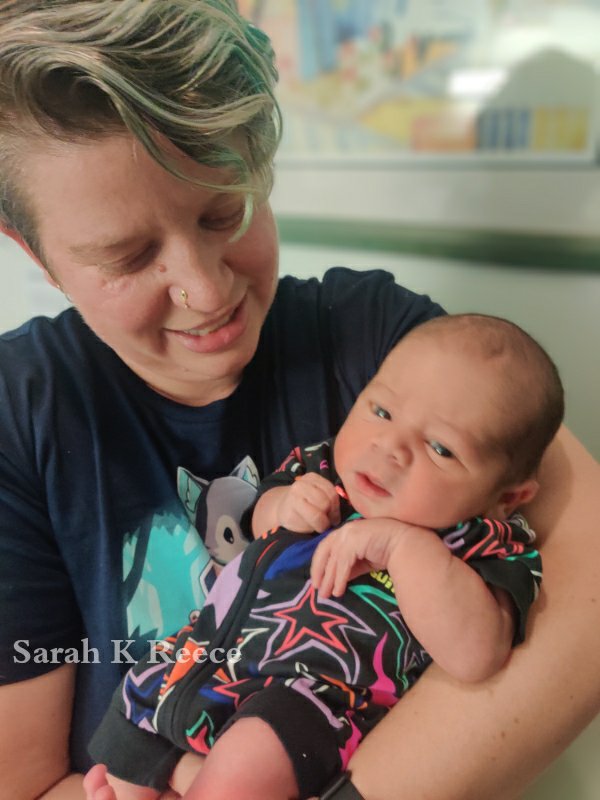
We have a beautiful healthy little boy, born on Friday by c-section. It’s been a very long, disruptive process of inductions and hospital visits and stays. He’s not yet been named. He’s very beautiful with a full head of dark hair. He makes all the lovely newborn snuffles and snorking sounds. He feels like velvet. Nightingale was able to do skin to skin immediately after birth in the theatre and through recovery. He’s in newborn sleep mode which means loads of naps during the day and cluster feeding and squeaking all night.

ID light brown newborn wearing a blue singlet, snuggled up on a cream blanket. He has short dark brown hair and looks content.
ID black and white portrait of a baby wrapped in the striped hospital blanket and lying on his tummy. He’s looking very serious with big dark eyes.

Nightingale sailed through day 1 post surgery then started collecting a horrible bunch of post op complications. We’ve been stuck in hospital much longer than hoped because of them. She’s been through hell the past few weeks with so many painful procedures and things not working. I’ve held her hand through most of them and we’ve worked hard to protect ourselves from the stupidity and vagaries of the health system. We’ve succeeded far better than I expected in many ways, but far less than I’d hoped. There’s a lot of bad stories and a lot of pain and trauma. Most of the staff have been fabulous, and a few really saved the day by talking us properly through options, or listening to concerns which they thought were unlikely but turned out to be accurate, or protecting our wishes when someone else tried to take over. A few have been so bad we banned them from contact again. It’s so different to Poppy’s birth and yet so familiar. Miraculous and beautiful and awful and dark. We are grateful and relieved and overjoyed and exhausted and hurting and can’t put many of the experiences into words.

Pain is an ongoing challenge, Nightingale has been suffering from pain crises where she is in 10/10 pain, sometimes for many hours and the pain relief doesn’t work. A few nights back she was unable to move or speak for 6 hours while the staff maxed out all the pain relief options without effect. She should still be in hospital but we negotiated fiercely for home. I can nurse her with all the same resources they have the (except of course, someone to take over at shift change), and the stresses of the long stay in hospital have been building each day. The awful food, the hundreds of people who come into the room day and night, the Covid limitations on visitors so we can’t have both our kids visit, the lack of proper titration of pain medication, the way the plans change at every doctor shift change, notes going missing, stretched staff taking 45 minutes to respond to a call bell, the new person not reading the notes and harassing Nightingale for needing pain relief or blaming her for not getting out of bed every day because someone forgot to chart that she has, the ones who don’t understand consent or are confused by anything that’s not 101 typical presentation and keep giving bad advice, the ones who block agency and access to even the basic resources like an ice pack, the constantly having to explain, provide context, build rapport, and ally with every new staff member, the gratitude for things that should be a given, the sheer helplessness of being stuck inside a system with so little power. The costs accrue alongside all the good care and helpful folks. So we’ve finally come home late last night with a long list of medications and things to deal with and some home visits and outpatient appointments.

Everyone has been homesick and missing each other. Our community of family and friends have been looking after Poppy and Nemo. We’ve managed two hospital visit with them both, Nemo is anxious about accidentally dropping the baby, while Poppy is nearly exploding with excitement. We feel stretched at the seams. We’re trying hard to look after all of us.

ID Sarah holding baby. Fair skinned adult with green hair cradling a baby who is wearing a black onesie covered in bright coloured stars.

He’s beautiful. It’s incredibly strange to have a baby I didn’t birth. It feels a little like cheating at times, there’s so little effort on my part to bring him here, while Nightingale’s body has been a war zone. I feel oddly guilty.

I also feel slightly out of the loop. The hospital don’t see partners. They see a mother baby dyad. I’ve been absolutely invisible for most of the process. The same rules apply to me as any other visitor. All the paperwork says Baby of Nightingale. I have to find and store my own meals. I’m often not allowed to use the bathroom in our room but required to go elsewhere. There was a moment in theatre when they needed to take him off Nightingale’s chest and weren’t sure if they should put him in the warmer. I offered to hold him skin to skin myself and they were so startled and flustered and turned me down. The doctor asked Nightingale about her mental health as part of discharge, I’d spent most of the day crying but didn’t flag. We’ve done a fabulous job of protecting the connection between Nightingale and bubs, I’m not quite there yet.

I feel fiercely protective of both of them, and deeply relieved he’s okay, but also jolted by a hundred small experiences that tell me he’s not my son, like micro aggressions that have stacked on top of each other over weeks. I can feel the difference and I can feel the trauma jangling in my bones, the way I’m frustrated with him when the staff are doing something horribly painful to Nightingale and I’m trying to hold her hand and hold him too and he’s screaming and I can’t comfort him so I can’t comfort her. I hoped it might be better than this, we got our golden hour and protected our family as best we could. But here it is. We got the perfect outcome with him. We got a difficult outcome for Nightingale and I. We’ll keep repairing the damage. We’ve got time to grow all the good things. There’s a lot of love here.

Waiting for Baby

Everything in our lives for the past year has been moving towards this point, like a staircase spiralling up a tower. We are in the last days now, waiting. Our kids are enjoying visits to friends and family, while we swing between home and hospital for daily checks. We’ve had a bumpy ride with hospital, some wonderful staff and some hostile and probably traumatised ones. We’ve worked hard to build relationships, normalise seeking consent, and collaborate on the approach.

Nightingale has had a bit of a rough pregnancy, very high hormone levels causing severe morning sickness and some difficulties with low blood pressure and gestational diabetes. As a result we’ve been put on the high supervision pathway, with frequent growth scans, twice weekly diabetes check-ins, and so many hospital appts that some weeks it’s felt like we live there. Every time we attend there’s a different doctor or midwife, and often different contradictory information and advice. It can be very stressful.

Now we’re approaching the due date with pre labour contractions making every day a possible birth day. It’s exciting and tiring. There’s a steady stream of enquiries from folks wondering if bubs has arrived and we somehow forgot to let people know. It’s impossible to make plans, and anytime we can we’re just catching up on sleep.

We went into hospital recently for a catheter induction which was very painful and unfortunately not effective. Nightingale has previously had a c-section so some options they might usually consider at this point are too risky. There’s no signs of distress for bubs or Nightingale so we’re just waiting at this stage. After meeting with the delightful head of the department we have collaborated on a plan to try again next week, and in the meantime go into hospital for a checkup every day. Being able to go home to proper food and good beds has been deeply appreciated and helps a lot with the fatigue. Now there’s a clear plan it’s been a much smoother process instead of each shift change exposing us to a new person’s ideas and values. We’ve denied contact from a couple of staff who’ve been aggressive and controlling, protecting our space and the precious sense of safety and trust needed to labour and bring a child home.

It’s incredibly hard making decisions and trying to weigh up different risks and approaches, often with very little quality evidence to go on. I don’t envy the doctors who have to try and do this for many people every day. Tailoring individual care on the basis of conflicting research, poor quality information, or massive cohort studies full of unmanageable variables is very challenging. Each protocol and policy has unintended consequences and theories and ideas that seem so intuitive, so obviously helpful turn out to be full of incorrect assumptions and focusing on the wrong indicators. There’s so much we don’t know and so much knowledge we lose.

We ride a roller coaster together, and our community along with us. There’s times of deep peace and connection, such hope and joy. We’re ready for them, everything is ready. There’s times of fear and sadness, afraid of loss and regret. We tumble up and down together, riding the waves and watching the stars. Come home littlest love. We’re waiting for you.

Marrying Nightingale

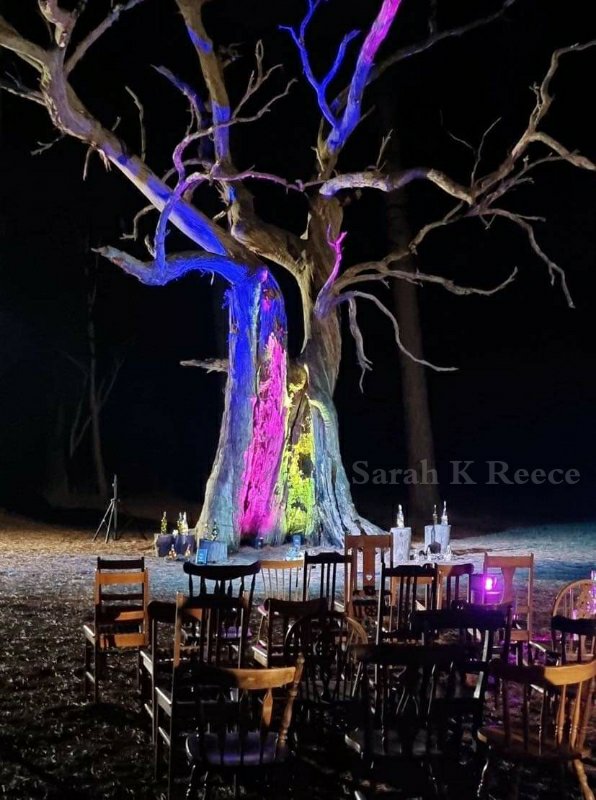
Nightingale and I married in July, on a winter night in a forest beneath a beautiful old tree. It was magic. It was messy. It was beautiful, and imperfect in many ways both trivial and significant. It was us.

ID: A forest at night. In the foreground is a cluster of wooden chairs of various designs, arranged in rows facing a huge white dead tree. Pink, blue and yellow lights are cast upon the trunk, making it glow. Bottles of fairy lights are on tree stumps on either side.

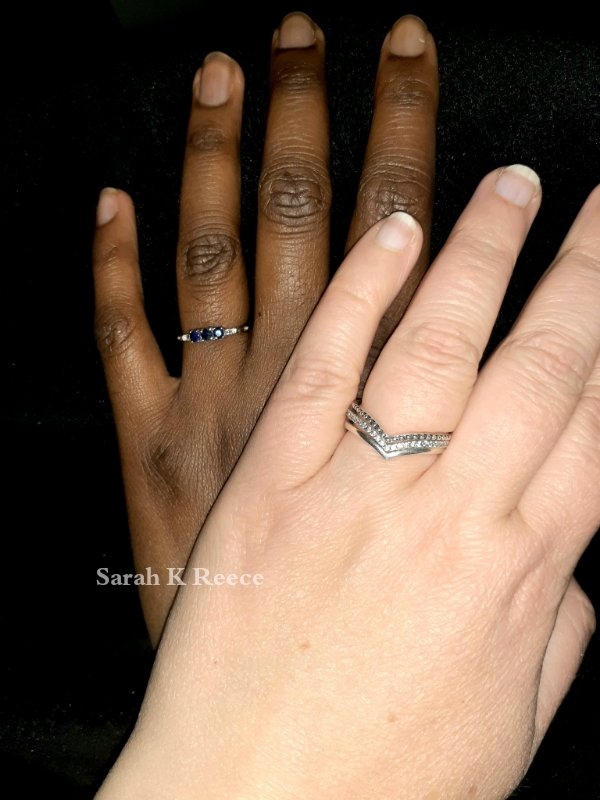
We started many months before, with rings. It was a delicious way to spend precious date time together. Nightingale wears a simple sweet sapphire ring I brought myself years ago, and she took Poppy shopping to help pick out a lovely trio of rings for us to choose between or wear together. We tried on rings together, talked with jewellers, and fell in love with parti sapphires. It took us months to pick out the stones, taking them back and forth between sunlight and lamps to see them change hue. Design and manufacture was beset with troubles and they’re still not finished, so we married with our stand in rings. We planned a lovely hand fasting and brought beautiful silk ribbons for it, which we forgot to bring into the forest with us. There was a delightful frazzled moment mid ceremony where we each started to stumble across these facts and Nightingale smuggled our rings off and gave them to our wonderful minister just in time for us to give them back to each other.

Nightingale has a wonderful friend who is a minister living overseas. We wanted them for our celebrant but they can’t legally marry someone in this country. So we found someone local who was happy to team up with them. Then Covid and vaccination rules meant some very important people couldn’t attend the wedding with our celebrant. So we split the day into a tiny legal ceremony with the local celebrant and a big ‘renewal of vows’ in the evening with our friends and family and minister friend. This meant two ceremonies to plan, and a lovely restaurant lunch between intended to thank our hard working friends and family, that instead ran terribly overtime and took up most of the prep time for the evening.

A couple of weeks before the wedding we had to change venues for the reception due to issues hiring generators and accessible toilets for use in the forest. So our simple outdoor ceremony then ran across two ceremonies and three venues!

Vases accidentally got taken to the forest instead of the hall, leaving hundreds of flowers in buckets in a back room. People who planned to help set up with us were sick on the day and I woke up to a huge asthma attack after packing all the things the day before in the cold air. The flowers for the cake were wrong and had to be completely redone by the cake decorator that morning. It was complicated to say the least and various dear friends sprang into service and filled in some huge gaps to ensure things were set up and people were comfortable, fed, and enjoyed themselves.

In the end Covid or similar illnesses knocked a number of key people out on the day, guests, members of the wedding crew, our videographer, and most crucially darling Poppy who is still sad they missed out. Once our rings are finally done we plan to do a little ceremony again together to include them.

ID Large red cap mushroom with white dots nested in pine needles on a forest floor. Trees are visible in the background.

Our lovely people carried us through. The lights on the trees in the forest were incredibly beautiful and finally all our confused guests understood what we meant by the theme of WOMADELAIDE. Stunning red and white spotted mushrooms sprang up all through the forest that day. The day was perfect weather, cool but clear, and the hall we found was so well appointed, warm and comfortable with the most lovely person staffing it. Our dessert table was a rainbow of lollies as a nod to our lovely queer crew of teen guests who worked as kitchen hands for the night and gave us some of the most beautiful wedding cards.

ID: A trestle table set with bowls and jars or lollies and treats arranged on approximately a rainbow from red to purple. Two large rainbow umbrellas are open over the table. Visible are red jaffas, pink musk sticks, yellow bananas, yellow fantails, green spearmint leaves, and purple pastilles.

Clothes were lovely and difficult and complicated. As a non binary person there’s not a lot of weddings I see myself in. Nightingale thought she wanted a black dress but hated them when she tried them on. Thought she wanted pants but found herself twirling in the beautiful white dresses feeling oddly at home. We tried on so many clothes. I held space for her to experiment and find what she really wanted. She held space for us to be confused and excited and anxious and try on femme and masc clothes and try to figure out who of us was going to be present and how to present us. In the end we both wore beautiful jackets, white shirts and black jeans to the first ceremony, she wore a red sari to lunch, and we both wore amazing dresses to the evening. She spent several months having to convince her nearest and dearest that this was her choice and not being fostered on to her by someone obnoxious or tradition. Hers was a stunning white halterneck with clean flowing lines that fit over her baby bump, and had pockets! Mine nearly didn’t arrive in time, a guest kindly brought it in their luggage from the overseas seamstress. It was a lovely ivory and honey tulle skirt with a corset top. Nightingale wore fairy lights in her amazing braided hair, and they were sewn all through the lining of my skirt.

Everytime we talked to the celebrant or minister, I cried. It hurt. There are important people in my life who wouldn’t be there. I have been married before and I promised then to hold on until death parted us and I took that promise so seriously it nearly destroyed me. I’ve failed before, profoundly, when it meant everything to me and I still don’t in my heart understand why I couldn’t keep what I loved alive. How do I offer such imperfect love to someone I love so deeply? How do I believe in promises again? I couldn’t find the right words and they had to be right. There was so much sickness and loss and grief to row our little boat through and I felt so excited and so guilty and sad. And there were people there to hold us and guide us. We stumbled through the fears and grief to find what we do believe in, and what dream is so important to us we’re willing to put life as we know it at risk for. Knowing love hurts and breaks as well as heals and grows. Being hurt and broken and holding on to each other and the shared life we’re growing.

Friends helped me gather the flowers myself when we suddenly had an indoor venue that we wanted to decorate to feel special. I got the fabulous experience of being able to pick them out and plan the table flowers, cake flowers, and bouquets. I chose a range of flowers from the most important bouquets Nightingale and I have brought for each other since we first became friends. There were black lilies and white and green and blue chrysanthemums and white and blue delphiniums and tiny cream roses and andromeda and asiatic lillies and jonquils. Her bouquet was accented with green and mine with blue. It was spectacular and lovely and delightful. The tables were also decorated with willow branches and tiny red mushrooms, potted plants, blue books, and fairy lights in gin bottles.

ID: Table decorations. A potted black violet in bloom worth a decorative red and white spotted mushroom. To the left is a gin bottle with blue fairy lights inside. To the right are booked wrapped in brown paper. In front is a chocolate cupcake in silver foil, with a swirl of teal icing and two silver chocolate bird skulls on top.

The cake was a splendid teal buttercream chocolate cake with fresh black and blue and white flowers and silver bird skull memento mori. The guests had cupcakes in silver foil. For gifts we wrapped ‘blind date’ books by some of our favourite authors, the potted plants, lolly bags for the kids, and boxed macarons. So many of the people we love either garden, read, or enjoy a sweet treat.

ID: A three tier wedding cake surrounded by cupcakes. The cakes have teal icing, silver bird skulls, and edible flowers and butterflies. The main cake has a spray of black lilies and other flowers flowing down the right hand side. Black chocolate drips from each layer.

Our backup videographer was lovely. Friends stayed late and helped us clean up. They wrapped our last gifts and decorated tables and unpacked chairs and kept an eye on my asthma and kept an eye out for the few guests who knew almost no one else. Our makeup artist soothed many difficulties and helped us dress. Two dear friends missed the ceremonies because they set up the hall and spent the evening cooking for us! An interstate friend wound up mostly driving hired furniture and lights around instead of us. We woke the next morning incredibly ill with what turned out to be influenza. It was a brutal one and none of us left bed for a week. We didn’t get a honeymoon or to spend any time with our lovely long distance visitors. We still haven’t picked up all the wedding bits from the kindly folks who took home bits and bobs with them so we didn’t have to.

ID: Hand holding a cupcake with two bird skulls.

And it was perfect. No one fought, no one cried, we created name and pronoun badges for all the guests to make life more comfortable for all the gender queer folks to wear whatever we wanted to. The venues were beautiful, our guests delightful. People restrained themselves from giving us physical gifts as we currently have no home to put them in. We announced our pregnancy to much celebration. There was hot homemade soup and a stocked bar and a tremendous amount of kindness. We wrote emails about accessibility and tried to consider sensory needs, small children, chronic illness, mobility, safety, and comfort. We tried to ensure every guest knew at least one other guest. We brought beautiful shoes we didn’t wear and ordered lovely food we didn’t eat and stayed in a home nearby with an extra bed for tired guests we didn’t use and none of that mattered.

Nightingale was so beautiful and full of life. So lovely and nervous and kind. Putting the wedding together had been lovely and stressful and incredibly time pressured with so much else going on in our lives. I was afraid that on the day there would be tensions, sadness, fights, strain. But all the fears and tears and pinch and ache of the planning and stress just eased that day. We rolled with every change and gratefully accepted so much help and enjoyed all our guests and just let go of everything we couldn’t control.

Our vows were lovely. Our choices for everything were so considered and so specific to us. Our people carried us through bad luck, poor planning, and difficult timing with such generosity and grace. We made promises and vows we believed in. We exchanged rings. We held each other at the end of the longest day and felt exhausted and grateful. She said yes. She is my wife. I am her spouse. May we always be as lucky and as loved as we were that day. It was splendid, and she was spectacular.

Baby on the way

Nightingale is 22 weeks pregnant! We were fortunate to get pregnant again after losing Luna and so far all signs are of a healthy growing baby. Nightingale herself has been having a rough time feeling unwell and there’s a lot of medical appointments and a pretty intense attraction to naps but it’s all in the category of unpleasant and stressful rather than scary and dangerous.

ID Black and white ultrasound of our 20 week old baby in utero. It’s lying on its back facing up with a little snub nose. Part of the chest is visible on the left side, with a little hand over it.

There’s a lot of preparation happening, it’s a big transition for everyone! Poppy is excited and anxious and slightly confused. Every week all her classmates and teachers get dragged over to see Nightingale’s growing belly and told about the baby. She’s also worried that maybe she’s being replaced because she wasn’t cute enough in some way, so there’s lots of conversations about why people have babies, and why she was born and why we want this baby to join our family too. Her name suggestions we are accepting politely, so far they include gems like “flower” and “bus stop”.

I remember back when I was about three months pregnant with Poppy and Star first turned up, she was initially jealous and rejecting of the coming baby. We did a lot of work to hold a space for those feelings and help her find a valued role and relationship towards the baby. Once Poppy arrived she was warm and an incredible support when she had capacity. Poppy is much younger and I’m expecting some regression and anxiety, but hoping that a similar approach and good groundwork will ease the transition.

I am the non-gestational mother this time and I am feeling that deeply. I have so wanted another baby after Poppy, but I find myself disconnected and distanced. Nightingale lives and breathes the experience every moment of the day, while I orbit from a distance, preoccupied with tasks and appointments. I remember back when planning Poppy I was initially going to be the non-gestational parent and I was preparing by reading about other people’s experiences. They spoke about the sense of disconnection and social invalidation. Not seen as the ‘real mother’, not the father, often mistaken for a friend or sister, it’s an odd role. It’s easy to write myself out of the scenario by default, to talk about Nightingale’s baby the way others do, to sideline myself. Then I find myself feeling numb and that triggers shame and therefore secrecy. It’s hard to find words for, or to accept this very different experience. Everything is the same, and everything is different. The bond is there, the sense of responsibility and the fear. But that warmth, the sense of connection and joy is growing more slowly and sporadically. There’s a sense of unreality and a dreamlike quality to all the future hopes. The more afraid I am of things going wrong, the more my heart ices over. I play my role but fear the empty space inside me.

We go away together, just the two of us, to sit by a fire next to the ocean and out come all the unspoken and unspeakable things. It’s painful and tender and we both want to run away, stop listening, turn our faces from each other. We stay, and listen, and talk, and stop talking. The sharp things come out of our mouths without blood, and we don’t wound each other. The clouds pull apart and there are stars after all, bright behind them. Waves ripple down the beach in a slow dull roar that runs from far left of us to the far right, past the hills. We stop for food, for sleep, for medications, for a million bits of work and child arrangements that need attending to with patchy reception and phone batteries dying. Every time we think we’ve found the end of it and hold each other with relief, or make a joke, the next moment opens us up again and it’s a dark river rushing through us, nightmares of a bad future and lost hope. This is not what we planned, and we’re sad and confused. There’s so many ghosts and fears and painful things. The night is crowded.

And then it’s not. The waters finally run clear. The skies are bright. We hold each other and there’s patience and peace. And under my hands, a tiny creature rolls and kicks in the darkness, like a salmon leaping in water. “They wake up and kick when you talk” Nightingale tells me, and in my own darkness my heart leaps in answer. Oh little one. We’re waiting for you. Grow well.

Why do I write this blog?

I lose the thread every so often and have to ask myself all over again. Why? And who for? What is this thing I’ve made?

I find different answers, sometimes the same answers that needed to be brushed off and given some love. Sometimes new ones that sit alongside the old ones, different, disharmonious, complex. Sometimes other people show me their answers, their perspective, and that can take time for me to process.

In my business development course, much of what I do was looked at through a different perspective. A new work of art to sell prints of is a new product. This blog, or an exhibition, is marketing.

I’ve had to learn to stop panicking that if I put down my Romantic lens of the world, I’ll lose it and never pick it up again. So I look at the blog for a little while through that lens. It’s true, in one sense. Almost all the work I’ve gained – except for some of the face painting, has been through this blog. In that sense, it is a marketing tool.

Which feels instinctively repulsive until I think more about what marketing is.

Which, when stripped back to the bones, is simply communication. Who am I? What do I think? What do I do? What could we do together? The fact that it’s so often done badly, deceptively, in ways that feel repulsive, dishonest, slick, intrusive, or faux friendly doesn’t mean it has to be any of those things. It’s simply talking to people I don’t know, in public. More than one at a time.

So, what happens when I think of this blog as marketing, alongside the other ways I see it (public art, volunteer peer work, self publishing, and so on)…

The first wrestle with a new perspective is often the freeze response for me. I seize up and stop writing. Without a clear sense of why I’m doing it or who I’m writing to or for, everything on my mind goes hazy and derails. It’s a hard one to be patient through.

I has taken me a long time to find a way to merge my ideas about work and the vulnerable, personal sharing I do here. For the longest time they were incompatible, unbearable, even. Work is the place we must be most professional, clothed, armoured, protected, shiny. It is, in my mind, the opposite of what I’ve been creating here: a shared look into my life, my reflections, experiences, growth. Unravelling what’s worked for me, sharing the keys, leaving the doors unlocked behind me so any others can also navigate them.

Professionalism and work have had to be reclaimed from the corporate world of depersonalised success.

I write to humanise myself to people who see me as other. To contextualise my strangeness. To have conversations that are not possible when I’m just getting to know people, but that without the context, I rarely get close enough to have. I get to address the confusion and anxiety of the ways I’m different and build connections with people who would otherwise never get to know me.

I write to claim my own story and my own unique perspective. To frame experience into narrative. When I can’t write or create art I’ve lost my key way of processing life.. I’m silent and the experiences are stripped of story and remain fragmented, immediate, and uncertain.

I write to ease the unbearable life threatening loneliness of people who are in some ways like me. Diversity and pain can both leave us feeling profoundly alone.

I write to share hope, to give an authentic account of the darkness and an honest witnessing of the joy and pain of human existence.

I write to leave a legacy for those who love me and those I love. If I died tomorrow, Poppy could find me in these words, find my deep love, my absolute thrill at bringing her into the world, my confusion and my contentment.

I write to help make a tiny corner of the world a little warmer, safer, brighter. To do what I can to bloom where I’m planted and share what I have.

I write because you write back to me. You share your stories with me, send me letters and gifts, you listen and speak and tell me I’ve done something that matters.

Hoping for a Baby

Nightingale and I are looking for a donor to help us have a baby together. She has one 15 year old, and my little one Poppy is now 5, and Star has long since flown the nest at 21.  

We have each been hoping to have another child for a long time before we got together. At times it looked likely and at others we’ve both tried to forget about it or push it off, hoping for better circumstances. When Rose and I separated as partners and began the process of figuring out how to be co-parents, I mourned the change in our family and began to close the door on any chance of another baby for me. I know how sick I was when I was pregnant, so it’s likely I’d need more support than is easy to arrange as a single parent, and raising Poppy in a pandemic has kept my hands full. I’d never want to do anything that took away from what Poppy needs to thrive. It just wasn’t feasible on my own.

As Nightingale’s friend at the time, I had wondered if maybe we could create a platonic arrangement to help us both bring a new baby into our lives. Single parents sometimes share houses or live close by to assist each other and I knew it was an important and painfully unrealised dream for her too. But my fertility issues persist, I’ve needed time to adjust to my new life circumstances, and age is not my friend in this matter. So I told myself to focus on all the things that were good about my life now, to remember what I was risking if I chased that dream, and I did my best to let it go.

Then Nightingale and I fell in love, and suddenly we have a tiny, precious, last-minute window, not for a baby each into two single parent families, but for one baby born into our family. There are still vulnerabilities, anxieties, and uncertainty. It might not happen for us. But there’s also all the shared resources, two kids at home who are doing well, and a long-held dream. So, with great care and hope, we’re reaching for it.

We’re letting our people know that we’re looking, because a known, rather than anonymous donor, is the only one we’re willing to consider. It has been so good for Poppy. Being able to update about health and medical information or diagnoses as they arise has been invaluable. Having a name and a photo to share with her from birth has meant there’s no gaping hole in her history. I’m grateful to her donor from the bottom of my heart. She’s a beautiful child who is fully aware of how she was brought into the world and knows down to her toenails who her people are and her sense of belonging. I have no regrets at all about how we brought her into the world, and no doubts about how deeply she is loved.

Here in SA, clinic donors can legally assist 10 families in our state to create children, and more interstate or overseas. These unknown half siblings can have very difficult relationships with each other if they meet, and some find it challenging to have so many other donor siblings out there. A known donor who has never donated before or assisted only one or two families who are known to each other is a very different scenario. There’s still a lot to learn about the unique needs of donor conceived children, but the research and learning from the now adults is all pointing towards openness, honestly, and shared knowledge, and away from anonymity, secrecy, and large numbers of children being conceived from small pools of donors.

We know there’s often people in personal networks who are good folks, who already donate blood or have a family member who needed IVF with donor eggs, and if they knew their friend, or friend of a friend was looking for assistance they’d be happy to explore it. And if we’re not the right fit or this isn’t the right time, there’s many other wonderful people out there who need assistance too and we can point you towards those networks. So, if you’re in South Australia, between 25 and 40, happy for us to get to know you and discuss how the AI donor process works (there’s no sex) and what it means to be a known donor (not a co-parent), please feel welcome to reach out.

Poem – my business is not who I am in the world

I read this fabulous article tonight about objectification at work, How to build a life: A profession is not a personality.

It was posted on the ever brilliant and relevant Freelance Jungle, the best mental health resource for Australian freelancers I’ve come across. It reminded me of a poem I wrote in my journal a few years ago when I was wrestling with my obsession with work. When I was sick and unemployed I struggled deeply without a public identity because that is usually our work. Struggling to figure out work left me tangled and defining my self and life in ways that disempowered and wounded me. I recall listening once to a fabulous presentation at a world hearing voices conference when one of the speakers told us he felt as defined and limited by his public identity as a psychiatrist as he used to by his public identity as a schizophrenic. He introduced himself as a person who worked as a psychiatrist. It was strange and thought provoking. We are all more than the roles we play, and it seems to be just as important for us to remember that as it is for other people to perceive it about us.

My business is not
Who I am in the world.
It is not
My identity, my value, my self respect
Not the sum of me
My place
My impact
My legacy. 

My business is a project
One project among many
A way to earn money
Make a difference
A way to be in the world.
It is not the only way
The one, true, right, way
The sum of every effort until now
Validation for all that came before
The reward for every tribulation.
It is just my business, one dream
Among many.

My business is not 
Proof that I've 'made it', or
Evidence I've settled, given up, sold out, lost faith.
It doesn't mean I've gone over to the other side
Become a success or failed a character test
It's something to be proud of but not the only thing
It's a part of me but I am not
A peice of it.
If it died
I would still be here.
My business is not
Who I am in the world.

Support Worker needed for Northern Adelaide

I am hiring to build up the team of a lady in the Northern suburbs. I can offer between 8 and 20 hours a week, happy to onboard 2 people for around 10 or with an eye to increasing up and adding other clients once they’ve settled in. Our work is relationship based so onboarding is a gradual process not a sudden diary full of clients.

Male staff are particularly suited to this client, if they are keen on gym, sports, and working out that’s ideal. There’s 2 other staff on her team already who will provide support. Due to mental health issues this client is always supported with 2 staff rostered together. Staff assist with domestic tasks such as cleaning, small scale gardening, and cooking, with transport to appointments, managing admin such as mail and appts, and providing companionship and help to access community. You’ll need to be comfortable with people with mental health challenges and have a friendly and patient disposition.

More info here on How my Teams Work and the Requirements of the Role.

I’m hiring again, so please get in touch if you feel you’d be a good fit, or to ask questions. Please contact me via email or chat using FB or discord, not phone. Please be human and give me some real info I can engage with not just a resume or list of qualifications. I’m far more interested in your values than your training.

Nightingale Proposes

Quietly and secretly, Nightingale and her son crafted a beautiful proposal. In a dim room in the city, above the scrape and bell of the tram line and the river rush of traffic I found her waiting for me one evening with a table laden with gifts. She had been collecting mementos of us; sheet music from our songs, text from the books I’ve been reading her to sleep with, lyrics and poems and quotes we’ve shared. She printed them onto my favourite colours, finding the codes for teal and not aqua with the same fumbling determined uncertainty I have in her world of music and song where I think I can almost hear the distinctions she points out. These papers were folded into 5 petal origami flowers, one for each day we’ve been dating.

ID a coffee table with a white table cloth, covered in multicoloured paper flowers and candles, in front of a huge window through which there’s a view of the city lights and a gibbous moon rising.

She disguised it as a work project, folding in lunch breaks, hidden in her lap on the bathroom floor while I had a hot bath to ease pain, in the hours I was asleep or working. They are double sided with paired matched mementos, the music and art of our love.

ID close up of origami flowers, candles and gin.

Nested into this paper bouquet were fairy lights, candles, rose petals, our favourite chocolates and gin, and the set of rings she brought us. Three stacking rings as placeholders for the engagement ring yet to be designed. Three slightly different rings so we can each choose which to wear and change them as we wish. To have our plurality and non binary identity given such care and room to breathe is such a joy and relief.

In the centre of the table was a love letter tied with black ribbon. I sat and read the flowers, opened the chocolates, smelled the candles, breathing it all in while the moon slowly rose outside the window. There’s tears and joy and peace. In the letter she talked of our love and what I mean to her, and she asked me to marry her. Words can be hard, voice is harder still.

I say yes and kiss her face and hands and then write yes on paper and nest it into the flowers beside her letter. At 3am when the magic will seem strangely distant and maybe a dream, it remains there – her question and my answer. A beautiful anchor in such strange seas.

ID a person kneeling before a table of rainbow paper flowers, reading everything with great care.

I’ve spent years learning how to let go of what I cannot have, how to release my desire for control over what cannot be controlled, and how to let go of dreams that have broken my heart. Suddenly she is there, so incredibly real and beautiful, moving towards me, kisses on my mouth and a thousand arrows in my heart and my life is no longer about letting go or accepting the fates but grasping hold with fierce anguished joy. It rains in my nights again, and when there’s no rain there’s tears like rain, talking through the nights, hearts on fire. The children sleeping and stirring and singing and hurting and needing and loving and somehow embracing us both despite all the stories and norms of fractious step families. The things we expect to be hard are easy, and where there’s sorrow and loss we can name it and give it a place to be. The stakes are impossibly high and at the same time they’ve never been more within reach. We hold each other and weave together this dream of our future, unpicking and reweaving and getting tangled and easing them out again with patience and courage. She’s magnificent. Love is always a wild thing, untameable, a leap, a gamble. And yet, I feel so grounded, roots deep down and my voice unbound. She’s beautiful and wounded and fierce and devoted and I adore her. The family we make together is utterly worth the risk.

ID two hands over lapping, each with place holder rings. Mine is the white skin and all three rings stacked. Nightingale has 3 small sapphires on her placeholder ring, her hand is slender with brown skin.

When we first started dating we feared losing our friendship. Now I think of my life without her and that’s a cold wind, an empty chill. Life is painfully short, impossibly long. We wrap ourselves around each other and hold on. Some nights it rains. Some nights she sings. I’m writing again. Life is hard and bountiful. The garden is well tended and yields fruit. In the winter, we plan to get married.

Being Disabled at Work

Well, 10 years in to having my own ABN, I’m now running a small team of 9 employees and have a few fabulous subcontractors and other businesses providing support too. I’ve been thinking a lot lately about disability at work because as a person with multiple disabilities work has been a huge challenge for me, and most of my employees have some form of lived experience of disability either themselves or as a carer in their personal lives. Figuring out access needs for all of us is a constant theme in my life at the moment! I’m presently overhauling all my HR documents to make them more inclusive and accessible, it’s so time consuming but also so essential.

I’ve also done a lot of training and mentoring over the years trying to figure this process out. Sadly, most of it has been worse than useless, it’s been so uninformed that it’s done harm. I’ve had to un-learn a lot of what I was taught because it became part of what was holding me back and adding to my struggles. The micro-business for people with a disability cert 3 I did 8 years ago was destructive. Experiences with some (not all) Disability Employment Service Providers was likewise, as were various trainings offered by mentors, business support services, NEIS, and so many other systems intended to make life easier for someone like myself. They almost all floundered on two very simple diversities: poverty and disability. Without a good grasp of those two realities, so much of the material was a poor fit and in some cases seriously so.

I’ve got more confident about walking away these days and in some cases providing feedback. Here’s a de-identified email I sent to a mentoring program I was in a year or two ago:

Just putting down in email some of the things we’ve been talking about. I think XXXXX has a lot to offer me and other medium to long term unemployed folks with disabilities, but some aspects of it are also concerning, stressful, and potentially harmful. My brief rundown is:

Positives:

  • Strong focus on increasing individual capacity
  • Wide range of useful methods with a good research base
  • Positive approach to challenges’
  • Useful overview of the business development processes
  • Excellent use of human centered design tools for product and service development

Difficulties

Most of the information is generic and not disability specific, particularly for people who are neurodivergent. (people’s who’s brains/minds work differently from the norm, such as autistic people, those with ADHD, giftedness, brain injuries, mental illness, and so on)

Much of the information is presented in a decontextualised way which is highly risky for people who experience systemic discrimination and trauma (both almost ubiquitous to the disability population) By which I mean things like

  • Telling people that empathising with other people groups is easy has the potential to be not only vastly inaccurate but shaming. Many people with autism experience over or under developed empathy in very challenging ways, most people who have been long term poor find it very difficult to empathise with people with money such as potential employers, and generally they lack the intimate access necessary to such people to form it.
  • Another example: “You’re not limited in any way if you have internal motivation” which is a cruel set up for shame and humiliation when people discover that in fact systemic oppression still exists and issues of stigma still impact their lives in harmful ways.
  • We were told often that habit formation is very easy “anyone can do it, it’s just like breathing!”, whereas difficulty forming habits is a common aspect of ADHD. (for more about this see here) And breathing is an autonomic reflex, not a habit.
  • Told that “If we were more outside our comfort zone, we would have more growth and success”. This is risky advice to give to vulnerable people, and there’s a substantial body of research that shows the benefits of safety rather than risk in promoting growth.
  • Told that we all lack motivation and struggle to make ourselves do hard things.
  1. there’s little evidence for any widespread personality deficits in either the poor or disabled communities.
  2. a quick discussion with the online group revealed the usual more complex relationships with motivation with 2 group members who hyper focus, 2 who find positive feedback distressing, 2 who use negative feedback as perverse reinforcement (common for marginalised communities) and only 1 who found motivation a concern in general. This took about 3 minutes to ascertain.

Quality of the facilitation. AAA is using a ‘mug and jug’ style of education where he the expert passes on information to we the students who are in need of his expertise. BBB is using a more appropriate adult facilitation style that includes more opportunities for reflection and tailoring of the information to the students. For example, CCC in the online group was clearly reluctant to engage and feeling alienated by the focus on positivity. A short conversation with the online group revealed a distressingly high level of job rejection with attendant loss of confidence, social alienation, and personal vulnerability. Without care for this context the information is useless at best and actively harmful at worst, playing into victim blaming dynamics already culturally prevalent for the poor, disabled, and unemployed.

A great deal of the information is inherently contradictory and rather than exploring that it’s being glossed over. For example, we are being told that happiness is the key to success but that motivation is not a feeling and we shouldn’t use feelings as motivation. This is fertile ground for discussion but that’s not being given time. Efforts to discuss are being dismissed as intrusive and needless, making the space less safe for anyone to volunteer information or contradict provided wisdom.

Conclusions

Many of the underlying assumptions about the causes and cures of long term unemployment need closer examination, as does the risk of the intervention itself. The intake materials for the course were based on the readiness to change materials used in drug and alcohol rehabilitation services. They had no data points reserved to indicate that any life domain was currently progressing well. The underlying message was that all aspects of our lives were in need of major changes, and that we were indicating our ‘readiness to give up unemployment’. However the central tenants of the readiness to change model – meeting people where they are at – is not being used. So people like CCC are being put under pressure to grasp the power of positive mindset rather than being offered the validation and grief tools needed to process their history and recover from it.

So far the course has given me much useful food for thought, but I’ve also been told that I am where I am in life because I lack enough empathy, willingness to take risks, self motivation, willingness to make myself do unpleasant things and to choose growth. This is grossly inappropriate.

Recommendations

If you would like to consider your program in a more holistic manner, I suggest the use of Critical Appraisal tools by Rychetnik (see more here) who was one of the pioneers of evaluating unintended consequences of interventions such as yours. I also recommend using frameworks such as Trauma Informed Care (more info here), and social determinants of health to contextualise your information in more appropriate and less risky ways.

I’m not sharing this to shame the program in question – there’s so many out there like this and most are put together by good folks with great intentions. I’m certainly not getting it all right myself either, this is a difficult space and I’m constantly messing up and learning with myself and my staff. I’m sharing to help you think more critically about what we think we know about disabilities in the workplace, and why it’s so crucial to take the onus of access and modifications off the people with disabilities and start placing them back on the employers and services. The burden of having to navigate these things is massive and largely invisible.

Understanding diversity is incredibly important when you want to turn good intentions into actually useful outcomes. If you’re going to be working with people with disabilities, poverty, and long term unemployment then you’d better talk to a few them and do a modicum of research before you start, otherwise you run the risk of simply creating one more shiny, painful obstacle in our lives. It’s absolutely possible to support people with disabilities in the workplace and we are competent, brilliant, reliable, and highly skilled. We can do better about how we do this.

Introducing Nightingale

I have a lovely partner, who on this site shall be called Nightingale.

She has been singing in my nights for so long. I used to read about friends, watch movies about what friends could be for one another, trying to learn. Undone by hopeless yearning. Over the past few years, as my family fell beneath the onslaught of illness and anguish, I turned to my friends. Nightingale was one of those who responded.

First lockdown last year, I ran to the edge of my strength for Jay. I found myself voiceless and naked in my bath, trying to call hospitals for them, losing hope. One of my friends (not Nightingale) came and sat next to me on the wet floor, interpreting texts and whispered stutters to make the calls that were now beyond my capacity. It was a horrifying and precious moment, blazed in my mind forever. My own vulnerability and nakedness irrelevant beside the strength of our friendship and our shared fears and hopes for Jay. This friend moves in and out of my life on tides as friends do, sometimes a weekly visitor and companion, sometimes focused elsewhere or drowning in terrible depression. She’s very precious to me.

Poppy regressed terribly as Rose disappeared into a hospital that covid restrictions closed to children. Until then I had taken Poppy into every hell Rose was lost in, every single day I made sure that Poppy saw Rose no matter what. Suddenly not all my determination could scale the walls between them and Poppy falls apart into a frightening, angry mess. I visit another friend, not Nightingale, who holds me, feeds and bathes the child, waits on the phone with me as Poppy rages in the car in the night, savage with grief and unwilling to go home to the too empty house.

The person beneath the landslide cannot coordinate the rescue efforts. Rose slides towards death in the ICU, two friends sit with me and listen to my incoherent pain. They construct lists of needs and allies, menus of options I can choose from. They do the asking on my behalf, the reassuring my fried networks of people that what they are doing is enough, that I am not hurt if they cannot help, they comfort and soothe when I’m lost for words. On days I can’t stop crying to speak they run their lists of things that might help and I only signal yes or no. They are within reach always, on my phone, a message away however far apart we are. I am crushed by the weight of fear and grief. Someone turns up every day to my home and I scrape myself off the floor, out of bed, off the couch. I gasp for breath and do chores, make meals, push Poppy on the swings. In the background these friends orchestrate.

Sick and bedridden with pain and vomiting, friends and family arrive to take me to hospital and Poppy to bed. Friends stay with me by text on my phone as I wait an hour to be triaged and advocate on behalf of a bleeding hemophiliac gentleman and a distressed psychotic man afraid he’s been infected with AIDS. My friends are my lifeline in the bizarre world of the ED, they hold my heart and my sanity. They are Faber in Montag’s ear, the soothing drone, the context, the cautious advice.

Through these nightmares I have been profoundly blessed with a community of friends and family who have brought meals, head rubs, movie nights, mopped floors, listened to me, pushed Poppy on swings, held me as I held up a sky that daily seemed to somehow weigh more.

I tell you this so you can understand that I’m no longer starved for friends, and that among such incredible gems, these faithful and loving people, Nightingale. In such incredible company, her compassion still shone. Enduring her own painful circumstances and challenges, she showed up for me, and let me show up for her. Our lives weaving closer with each kind gesture, each shared painful secret and moment of joy. We grew closer through terrible storms, finding in each other a companion with dark humour, bitter wisdom, and stubborn determination to endure. When little was constant except the frailty of our dreams, we were constant to each other.

Poppy is so deeply loved, but she hasn’t had the carefree childhood I’d hoped for her. Given the losses and confusion for her I had resigned myself to being without a partner for a long time. She adores Rose and I and has had so much to make sense of already, I felt that there was no way I could bring someone new into her world for the next 10 or 15 years. Letting go of Rose as a partner has been a terribly long process, our brief wedding plans last year, their new partner, the last hopes of our romance early this year. There’s bitter pain as we try to birth a new type of relationship to each other, navigate so much with so little. I joined friendship apps. I grieved. I cleared out my house and organised my drawers. I accepted the need for stability and security and I poured myself into my friends, into Poppy, and my work. Old dreams came creeping back like lost cats.

Nightingale was there all along. One night when she hugged me the world shifted beneath me. A different future entirely stood before me like a door I’d never seen before. I stood for a week on a precipice between the familiar road and the new door. Continue as only friends or confess that I could fall in love with her? One path I could see and understand, the other felt like stepping off a cliff into the unknown. Why risk it all? And how could I possibly still believe in love? And yet. What else is friendship but love? I am so loved, and I love already. There’s little room for jaded cynicism in my world, I know how lucky I am despite all the broken dreams. Maybe I would share and she would not feel the same. We’d laugh and shake it off and life would continue as before, infinitely precious.

That’s not how she felt. I’d been firmly shelved as unavailable in her mind back when we first met. Now everything changed. Could fall for each other became are falling for each other. We barely slept the first week, unpacking every fear, every reason to keep the door closed, the losses and fears falling on us like sledgehammers. Just because we feel something doesn’t mean it’s a good idea. There’s so many tangles and complications. Love isn’t the same as it was at 16 or even 29. We’re both single parents with responsibility for more hearts than just our own. We both know what it is to hope and lose. And yet, some of the impossibly difficult things have somehow been so easy. Nightingale was already one of Poppy’s safe people. We already know each other well, in some strange ways nothing changes. In others, everything changes, and some of that has been terribly sad and painful, others of it tender and wonderful. We work so hard, but it seems to bear fruit. There’s sweetness in it, not just toil and tears.

Friendship to romance is new to me, I’ve never experienced the sense of security that comes with already knowing the other person, already caring for them – and being cared for by them, so deeply. We find each other’s hands and go through the door, flying and falling. It’s giddy and beautiful and scary and lovely. There’s someone to come home to at the end of the day. I read her to sleep, I sleep in her arms, she shows me sides of herself hidden from the world and lets me hear her sing. We hide from the world on a couch and listen for the rain.

Everything changes and I don’t know what the future looks like anymore. So many dreams suddenly within reach like far off stars that turned out to be fireflies. She’s breathtakingly beautiful, incredibly strong, wounded, tired, and like a tree with deep roots she holds fast in all kinds of weather. Like a nightingale she sings in the dark. Whatever happens next, I’ve been phenomenally lucky to have each of my friends, and for her to invite me into her life the way she has – that will always be a privilege and the most lovely of memories. Unlooked for, fraught, passionate, precious, dazzling. My heart is full of hope and she is my home.

Mental health in lockdown

Every lockdown I hear about folks with psycho social disabilities being abandoned by their support providers. Welcome to an NDIS that is largely informed by people with a disability background, with mental health as a last minute tack on. Yes, maintaining supports for people with high physical needs is obviously essential – people who need support to transition out of bed into their wheelchair, or assisted showering or feeding must be able to access their services. It may be less obvious, but it is just as essential to maintain support for people with high mental health needs! Lockdowns are a highly stressful event with well documented mental health impacts. Our most vulnerable people are of course going to feel this impact even more. I am deeply frustrated by the lack of recognition of how real these needs are and how serious the outcomes can be for people.

As a small provider of support teams I recognise there’s a huge logistical challenge in lockdowns. It’s tempting to ignore all but the most obvious care needs. It’s critically important to make sure mental health is part of this. Here’s a quick run of the process I’ve developed for my team:

Risk Assessments

Each client is assigned to a low, medium, or high risk category for that lockdown. These are specific to the needs of the client for each lockdown, and not a static unchanging category. Low risk clients are those who are well prepared and resourced and highly independent or with excellent in home supports. Children with parents at home who have organised all the needed resources, adults who have excellent independent living skills and only need support with transport or gardening or other non essential tasks are examples of low risk. This assessment is based on contacting each client and their primary support worker, if both agree all is well then halting all in person services for that client is likely the safest response. Continuing in person service provision for these folks will put them at far more risk than halting services. Some low or moderate risk clients will still need supports that can be provided online or over the phone, for example assistance to purchase online supplies, or help to access covid testing if needed.

High risk clients have vulnerable health or mental health needs and/or living circumstances that mean they will need in person supports during the lockdown. Examples of high needs from a mental health perspective include clients who will not eat without support, those who struggle with paranoia or persecution type delusions, and those with high sensitivity to loneliness or perceived abandonment. Just because someone has the physical capacity to feed themselves does not mean they will be able to do this under stress. For these clients a personal safety plan is created and shared with their team. A template of my plans is available here, you are welcome to use this for your own circumstances, it suggests opportunities to engage some of the key mental health impacts of lockdowns according to the current research.

Reduce risk of client to client transmission

Support workers who will be needed for in person support are assigned to one client each. Where possible it’s best practice to try and prevent one worker travelling between multiple clients. Bear in mind that some support workers will also be carers and travelling to support family or others with high care needs in their personal time. Clients with high needs will need a small dedicated team to limit risk of losing staff due to illness or hotspot exposure. Other support workers can remain in reserve to replace any face to face staff who have to isolate themselves. Support workers should attempt to minimise needless transport and perform necessary travel on behalf of vulnerable participants. It’s also very important to ensure participants are receiving updated health advice in a format they can understand – this may be a plain English print out for their fridge, or a morning phone call to check in.

If you have mental health challenges or a trauma history or are supporting someone who does here are a few key support needs and considerations I have found helpful:

Food challenges

Most people with issues around food struggle more during lockdown. There’s many ways to assist depending on what the challenges are and how well you know the person’s specific needs. If they have helpful support from a dietitian or GP they may be able to inform this process A few options might be: shop for supplies of that person’s safe foods, the things they find easiest to eat even when they are stressed. This might not be varied or nutritious but all food getting in and staying down is a positive thing when restriction is an issue. Meal replacement shakes/drinks/supplements may be an important resource. Shared meals can be helpful for those who find social support useful. Distractions in the form of movies, puzzles, conversations, and board games can assist. Company for an hour following meals can assist with preventing purging. Meal planning can support those with lower capacity to plan and manage tasks. Eating to a schedule of 3 meals 3 snacks can assist those who struggle with bingeing or restricting (it sounds counter-intuitive but regular food is a very strong preventative for bingeing). Having meals provided or portioned can assist those who struggle with that aspect. Obviously some of these approaches will be unsuitable or even harmful for some people – tailored support is essential for good outcomes.

Anxiety/Paranoia/Psychosis

Folks who struggle with these issues are likely to have increased difficulty during lockdowns. Anxiety generalises easily so people may express fears about the virus and their loved ones through other seemingly irrational fears or get locked on to concerns that compromise their safety or provision. For example some people who need personal support in showers may suddenly refuse this, or be unable to cope with showering altogether. Issues with neighbours may flare up into huge problems, minor conflicts with family or housemates may become unmanageable. Phobias can become so intense people can’t function, and if paranoia increases too much people may come to fear and reject their team, refusing medical care or food or support.

It’s important not to get too caught up in the expression of fear, but to recognise this is not intentional, and to engage the underlying needs as best as possible. Yes the person may be talking crazy sounding things about being poisoned by the neighbours, but arguing about this is likely to leave them feeling more alone and unsupported, and even afraid that you might be part of that plot. Someone who has become so phobic of birds the house has to stay completely closed up in case they see one through a window may well know on some level that this is irrational, but the brain link to their fight/flight response isn’t something they can think their way out of, and adding shame and embarrassment to the situation rarely helps. The real needs are often about control, territory, and connection. When people feel unsafe they experience and express this in a variety of ways. Any small things that can restore or preserve control, territory and connection can reduce the distress. The sad thing about experiences like psychosis is that they often impact the very things people need to be able to manage them safely, so it falls to us to be aware of this and try to work around it.

Meeting needs for control can be as simple as asking the person to help draft their own safety plan, to decide if they want to cancel the GP or change the appt to telehealth, to invite them to choose a meal plan you can help them shop for. For people with traumatic histories around psychiatric inpatient experiences or residential care, anything that helps their home still feel like a home and not like a formal care environment can help reduce triggers. Be mindful that sometimes simple things like our communication books or weekly roster shouldn’t be on display but digital because of that history. For other people having access to the communication book will help them feel more in control. It’s individual.

This links into territory too, who’s home is this and how safe does this person feel in it? Do they have retreat spots where no one is allowed to disturb them? Are there issues with housemates? Can they change things around to help them feel more in control of the environment? This might as simple as asking them where PPE like masks and sanitiser are kept, or helping them to create a quiet nook in their bedroom where they can hide out and use headphones when things are a bit overwhelming. Some more thoughts about territory here.

Connection is vital, we don’t endorse phobias or delusions as real to us but we do endorse them as very, very real experiences for our clients. We may not see what they are seeing or sensing but they absolutely do, and they have to navigate all the feelings that come with that experience. Validation is incredibly important, as is understanding that people trying to reassure someone their phobia isn’t really harmful, or delusion isn’t real, is actually in it’s own way very confronting and isolating. Read more about my experiences with psychosis here. Maintaining the same team wherever possible, ensuring the team is large enough to cope with a number of people being removed and required to isolate, and wherever possible using a co-design approach to all changes, introductions of new people, new routines, and so on can all contribute to emotional stability and reduced distress.

Self harm

Are there appropriate medical supplies in the home for the clients preferred methods of self harm (burn cream/antiseptic for burns, butterfly stitches for cuts, etc)? Is there access to a local nurse or GP who can assist with any more serious injuries? Mental health informed and non-judgmental vastly preferred! Will this person be safer if access to risky supplies is prevented, or safer if they are not searching for new unfamiliar materials to self harm with? Eg if there are parents providing supervision then reducing access can be very helpful – parents may for example lock away knives. If there is no supervision then reducing access can be risky – people searching for new tools can use items that are far more dangerous. Does this person have alternative options for managing self harm impulses? For example, a grounding kit, ink not blood, Dialectical Behavioral Therapy skills, safe people to contact? Are their support workers and housemates compassionate and informed about self harm, or stressed, confused, scared, or angry? Do they need more information and training? A place to start might be My experience of self harm. We need compassionate and regulated people in support roles, not overwhelmed, horrified, and confused folks. This also goes for our approach to ourselves when we are struggling with these issues.

Confusion

For folks with severe dissociation, dementia, psychosis, and various other challenges the higher stress and disruption of the usual routines can lead to high levels of confusion. This might mean forgetting crucial information, mixing up important lockdown guidelines, missing essential appointments, taking medications inappropriately my mistake, and other errors that can have huge implications. People who are usually able to drive might not be safe to, or those who independently manage their medications might need more scaffolding for the lockdown. Draw on resources from supporting clients with dementia such as whiteboards, alarms, reminders, checklists, and countdown clocks.

Make sure you are checking for higher needs that might be unintentionally concealed, or intentionally hidden by embarrassed clients or those afraid that higher supports might never be reduced down the track. Short periods of more intensive support can be the difference between riding out a tough time and full breakdowns with serious consequences and sometimes much more long term loss of capacity. Again, good relationships, a high sense of safety, and clear communication assist this process.

Insomnia/hypersomnia

Sleep disturbances are really common during times of stress. The latter is disruptive but the former, like food stress, needs to be regarded as a warning sign. For many people it will be unpleasant but reasonably benign, and resolve itself. For some it will become a major problem that can endure over many years – particularly for those with trauma issues that cause hypervigilence. A period of severe sleep deprivation can have a catastrophic impact on people’s cognition, behaviour, and health. People may be unsafe to drive, make judgement errors, experience various forms of dissociation, have disrupted emotional regulation, and have loss of physical coordination similar to being drunk. This can result in a higher rate of home accidents and injuries, poor caregiving and child supervision, self harm and abusive behaviour. Sleep deprivation is a common precursor to episodes of mania, depression, and psychosis for those vulnerable.

When sleep issues are being triggered by a lack of sense of safety, I’ve found it more successful to address that as a priority over ‘sleep hygiene’ responses. This might mean supporting someone to change their bedroom around, increase mess in their home!, or sleep on the couch, to read books over the phone to help someone’s hypervigilent nervous system to calm down, or to help them build a nest in the cupboard to cocoon in.

Depression

For those with severe depression, functioning can be profoundly impacted. Scaffolding can make a major impact for someone in a bad episode who can’t get themselves out of bed, into the shower, or attending to admin and self care needs. Phone calls, prompts, help with routines, alarm reminders, friendly check ins, and visits to help coax folks back into routines and help reduce the spiral of shame, isolation, and overwhelm is really helpful. Normalising the response and reducing the impacts of the initial loss of function can prevent the development of a viscious cycle of neglected tasks causing further stress that increases the depression. There’s many approaches and treatments for depression which is far beyond the scope of this article, but a couple of things to keep in mind are: depression is a normal response to highly stressful life circumstances, depression becomes self reinforcing when it destroys our sense of self worth and connection to our community, and depression can respond well to opportunities to explore and grieve losses, choosing to focus on our values and what gives our lives meaning, and support that helps us still see ourselves as useful, valued, and capable.

Addictions

Folks with addictions are at high risk during lockdowns. It can be counter-intuitive but there’s very real research behind odd sounding decisions such as keeping bottle shops open during lockdowns. Withdrawal without support can be dangerous or for some folks even fatal. Withdrawal can also increase other risks such as domestic violence. So as strange as it may sound, this is actually about risk management and harm minimisation. Do not use a lockdown as an excuse to try to make a person give up or cut down on their addictions.

Safety at Home

Not everyone is safe in their home. Both the environment and the people can present huge risks and lockdown can be a pressure cooker that exacerbates those. It’s crucial not to make assumptions about the home. It’s been a long standing issue that there are limited or sometimes no homelessness support services for people with disabilities, based on a naive assumption that people with disabilities are always well cared for. The reality is that people with some forms of disabilities are simply more likely to be abused in situations and homes they can’t leave. For other forms such as mental illness we’re more likely than non disabled folks to wind up homeless or in prison. In all instances we’re at higher risk of being harmed. We are also sometimes the folks who harm others.

One of the biggest privileges of being a carer or disability support worker (carers are unpaid people in our personal lives, support workers are staff paid to be there) is our high level of access to people’s lives. Where a psychologist has to make sense of a person’s circumstances in an hour a fortnight, filtered through that person’s perspectives, or a GP has to understand at times very complex interplays in health outcomes for patients in 10 minutes a month, we have vastly more access. When I am working with someone in their home 10 hours a week for 6 months, I have a depth of knowledge about them and their circumstances. All that knowledge can be utilised to create highly individualised responses to challenges such as lockdowns. This is where the NDIS approach excels. Where it tends to fall down is the lack of utilising that knowledge beyond one carer or worker. Without a team who make time to pair up the front line worker knowledge with management bigger picture systems/public health/service design knowledge we get a disconnect. Management make calls that make sense in a big picture but can so utterly fail to fit an individual client it can do harm. And excellent front line staff can get caught between their personal knowledge and the guidelines of their work, or left to fend for themselves without the team support needed to get good sustainable outcomes in complex and intense situations.

One of the principles behind all these approaches is called trauma informed care and they apply both to those of us with trauma histories and those without. They are also universal in that they are just as important to keep in mind for staff, families, carers, and the clients. Sleep deprived staff can’t be their best, and some staff are in highly vulnerable and challenging circumstances with uncertain work hours, high responsibilities at home, and loss of income during lockdowns. Excellent care of people with disabilities doesn’t happen in contexts of burnt out carers and exploited staff. Understanding the risks of this kind of work, which are largely relational/emotional and rarely well addressed by OHS&W myopic focus on physical health risks, can help us to identify and address the things that cause common issues for excellent staff such as struggling to switch off after work when they are worried about a client, feeling unheard and unsupported when they have concerns, working outside of paid hours and outside of policy guidelines alone to meet the genuine needs of clients they are worried about, and being abused by clients who have control over their work hours or firing them. Promoting resilience is about understanding these contexts and being able to tailor services to support appropriate self care for clients and staff. A few thoughts about that in Self care and a myth of crisis mode, and crisis mode and being under pressure.

Hope there’s some helpful food for thought here for you or the folks you care for. Lockdowns don’t impact us all equally, they have a far greater impact on some of our most vulnerable people, and those of us with mental health issues are commonly being overlooked in rushed and inadequate risk assessments. This is a horrible reflection of poor planning and lack of familiarity with mental health and it causes needless distress and risks to many people. If you are in that situation I hope you feel able to advocate for yourself or your client or loved one, and please do reach out beyond your service providers if they have shut down services and you are in need. There are online groups on social media such as facebook where people find independent support workers, and a host of online platforms such as Mable. If you are in any kind of online support group associated with your disability many of those people will have a lot of experience and service provider recommendations. Sometimes you just need a small rejig of your current services to include a good lockdown plan and a team leader who can coordinate staff for you, or a little bit of training around trauma informed care or whatever your specific needs are. Mental illness shouldn’t be the tack on to the end of the disability approach, the impacts are just as real and the needs are just as valid.

Be safe and best wishes.

Losing Rose

Rose is in a terrible place, rarely far from death. They’ve been hospitalised many times since their near death experience in December. There was such a sense of celebration when they came out of hospital and it was so misplaced. Physical and mental health have cycled through chronic crises. It’s brutal.

Rose and I are no longer a couple.

They didn’t come home to me. Nearly dying blew wide every crack in our relationship. Every effort we both made to find a bridge between us was swamped. They proposed and ran from me. All the demons woke up. The only glimpses of peace to be found were when I took myself out of the picture and left Rose and Poppy together on a beautiful autumn day. I hoped patience would heal us but the longer I held on, the further down Rose fell.

So I let go and life took us to some un dreamed of place where the foundations broke beyond repair and for months I woke to the nightmare that they’re gone. The new normal.

Rose found love with someone else, found peace and a sense of safety that couldn’t be found with me anymore. I am so happy for them. I so want them to be okay, to feel safe, to feel loved. I am so confused and heartbroken. They are so confused and heartbroken. Nothing makes sense. We try to make time to talk but every day is torn apart by medical appointments, new infections, new allergies, medication changes, intense rehab, the fallout of trauma. No conversation is finished, few are even started. I think of the weeks spent rubbing their hands and feet and wonder if in some strange way I smell like the hospital, like death and terror and paralysis, drowning slowly in the shrill beeping hell of ICU. There’s no words for this. Their mind is fractured and ravaged. I’m replaced. I hate them. I love them. I accept what I cannot change.

I cry every day for months. Everyone wants someone to blame. I find myself defending everyone. Poppy gets a cold that lasts weeks and Rose is forbidden by doctors to be near her because they are so vulnerable now to respiratory illness. The distance drives them insane, tears their heart apart. After 4 weeks of staying apart, Rose is hospitalised with pneumonia anyway, then has anaphylaxis to one of the antibiotics. No one’s body, it turns out, can be on these massive doses for this long without becoming sensitized. Rose’s heart and mind are stripped so raw the lightest touch burns, triggers pile up and overlap, flashbacks descend like lightning storms and the nightmares rise like black floodwaters full of dead things. They are tormented by the fear it would have been better if they’d died, and it’s a mind virus resistant to nebulous hopes of a different from planned but still bright future.

My friends and family hold onto me and I hold onto Poppy. I flip my life around as a single parent. Gradually my capacity returns; I can wash dishes, cook meals, be present, plan adventures and crafts, go hours without falling apart. Plug the holes in the boat, make new plans, test new adventures.

Hate the circumstances and don’t hang blame where there isn’t culpability.

Fury at the situation eases my self hate. I can breathe again. It’s not fair and it’s not my fault. Sometimes life is just hard.

Let go of everything I can’t have. My lover, my beloved growing old alongside me. The family, waking in bed together in the mornings, holding each other tight after each fright and each good news. Let it go. Face what’s in front of me. Rose fighting for their life and not knowing what it will even look like anymore. Poppy needing a childhood that’s safe and adventurous and connected. Hold onto all our values and ideals. I can’t be half Poppy’s world anymore. I can’t work in the background knowing Rose is there with her, filling up that wonderful tank that needs connection and attention and delight and fun. I can’t be half a parent. Step up. Show up, count my blessings, hold tight onto everything good and beautiful and precious. Fight like hell for it. I nearly missed out on this. Let go and hold on.

Rose swims and drowns. I am no longer the carer in the middle of their story. I watch from the sidelines, try to throw life savers. Grieve. Train my mind to stop going over every conversation, looking for the place it went wrong or what I could have done differently. Stay focused. If I drown too, so does Poppy. You can have an existential crisis or you can have a life. Choose wisely. Hold tight.

I don’t know what happens next. I’ve found I don’t really get used to the scares. I want to be home and nearby when things are bad even when I’m not welcome to visit. Old habits. When things get very black for Rose I struggle to sleep, to think clearly, to be grounded. A fog descends that makes daily life so hard to manage. The terror fades into the background but it never goes away. In some ways I’m still waiting for them to come back from a war. I have to keep finding my way into the new world, creating it every day. Building on new habits, creating the security, the consistency, the patterns and connections and community that buffer us from these storms.

We are all losing who Rose was, and they don’t have words for this. No one can come through these experiences unchanged, and right now change is their only constant. They are in flux. They are in torment. They are in love, in pain, in the middle of it all, bound up with death and life and hope and dreams and grief and loss. They are profoundly lost and struggling towards a new future they can’t envision. We may yet bury Rose this year, or Rose may emerge in some new form, to a new life. None of us yet know the ending of this story. Whatever the ending, I must live with it, and Poppy must live with it.

There’s grief and shock and sorrow. Rage, despair, pain.

And there’s acceptance. Grace. Love. We accept the things we cannot change. We let go of what we cannot have. We hold onto what’s precious and in front of us. Over, and over again. We face life with as much love, courage, compassion, and humour as possible. Let go. Hold on.

Letting people help

Recovery is vastly different for me to the way it is for Rose. I remember things they don’t, there’s experiences I know only the story of that they carry the memory of in their body, where they are struggling for a sense of agency I’ve been drowning under the responsibilities of home, work, parenting, and caring. At the point where it looked like Rose was going to die, I stepped back from work and our community rallied around me. Offers of support came in and I withdrew into tongue tied silence. As the communication gulf widened, I started writing here again.

I don’t understand autism or adhd. I’m still undoing all the cultural litter of misconceptions and outdated ideas about it, trying to get a clearer handle on what they are, and what they are for me. Somewhere this year they went from an exciting revelation to a horrifying reassessment of my identity, capacity, and place in the world. They call into question so many things I thought I knew about myself. And they provide another explanation for the confusing mix of things I find easy and things I find impossible.

People send me messages asking simple questions and offering supports. I sit looking at them with a head full of white noise and a stone when my tongue used to be. I recall parts of my diagnostic report that discuss communication challenges, difficulties with scheduling and making decisions. I keep trying to move my life away from these skills I lack being so fundamental and essential to my day to day existence. Crisis brings them all back to the center.

The blog is reassessed through this new lens, as a workaround for my strange communication style. Eloquence and honesty here substiting my incapacity to find the right amount and timing for honest sharing in person. People keep asking me how I am, I flounder and test out different levels of openness or bypassing the question altogether, come and answer it here instead. I’m good at communicating. I’m terrible at communicating. [“Everything anyone has ever thought is true.” Do Androids Dream of Electric Sheep, Philip K Dick]

People offer help, ask what we need. I can’t answer. I am numb. I don’t know. When I do know, the effort to message person after person looking for someone who can help, and being reassuring to all the people who can’t and feel bad is exhausting. My own feelings are exhausting. A friend tells me all their free and busy times for the next week, but I don’t know what day it is now, and I can’t track any of it. People try to plan days ahead but the situation is so unstable nothing lasts and I’m constantly weaving and unweaving plans. Another tells me the reasons they are booked up and can’t help and to me in that moment, fearing that day Rose is dying, they seem trivial and I’m incandescent with rage, holding my mouth shut against exploding my safe places and destroying my precious relationships. Unspoken, the anger numbs me further, creates distance, but right now I lack the capacity to own my feelings without venting them. Poppy needs me to not be scary, not scary sad, not scary angry, not a seething mass of skinless triggered distress, so I freeze. I sit very still. I talk in a soft and slow voice. I layer thick frost over self. Then I try to thaw slowly in safe places.

I ask a friend for help coordinating. She steps in and plays the role I’m so familiar with: the building of safety and persistent enquiry until she understands the shape of my needs. I’m clearer about what I don’t want, what’s helpful is the negative space left when we eliminate all the things that evoke visceral distress. The offers of help are rerouted out of my inbox into hers, she corrals, explains, thanks, apologises, tends the relationships with the sensitivity my terror requires and my exhaustion precludes. We add another friend to reduce the workload. They message in regularly with ridiculous caveats: would this be helpful? Don’t answer if it’s stressful right now. When you feel up to it would you mind letting me know if this plan sounds good? I hate needing this level of kid glove handling, but it works. Slowly we build the plans and reply.

People offering food I can’t eat are redirected towards buying things I can. Poppy and I are doing samefood and struggling to keep regular meals. I can’t eat, or I eat and feel sick, or I throw up. Unfamiliar food is overwhelming. The guilt of not being able to eat gifts is overwhelming. Familiar things are safer. I’m embarrassed, but at least I know now what this is. I have words for it, even if they’re terms like samefood no one outside the autism community understands.

Offers of caring for Poppy are rebuffed gently, because we now know she will regress if left with people she doesn’t know very well. 2020 has been a training ground for what helps Poppy cope when Rose is unavailable. After the hell of my earlier mistakes, I’m glad to have a clear understanding of what she needs and to be able to stick to what I know works. Friends visit to take her out then change plans and sit at the table for 3 hours playing play dough because being away from me is too much for her some days.

I accept the help and tolerate the fear of judgement, the sense of unworthiness, the survivor guilt, things being done differently to how I do them. Someone comes to help with housework, so the day before I clean the toilet, bathroom sink, and fold 7 loads of washing instead of napping like I actually needed. It’s stunningly difficult and deeply exasperating. Despite my chronic agitation, it works. My depression lessens. There’s things to eat. Poppy is still thriving. Community folds around us, and we find workarounds for the warm boundaries and communication needed to translate the good intentions into helpful action, far beyond my capacity to do so. It takes work to transmute goodwill and effort into such elegant outcomes.

I’m reminded how essential feeling safe is to accepting help, something I know intimately in caring and in my disability support work, but struggle to find for myself. Many hands hold the pain and it becomes bearable. Many hands hold the tasks and my own inadequacy eases, the connections are strong while my capacity is broken and starting to heal. This is the heart of the work I’ve been doing, and having such an intense experience of needing support myself is both humbling and helpful. When I’m trying to create resources for someone who is freezing, unable to articulate their needs, afraid, guilty, lost: we start with safety and connection. We build everything from relationship. I couldn’t do it if I hadn’t experienced it.

Thankyou.

I’m hiring

Applications now closed for this round, thankyou.

Central to Northern Adelaide Disability Support Worker wanted

I’m looking for a new person to add to my team. This is a small family business: we’re tight knit, deliberately informal, non clinical, anti-corporate, and work in pairs or teams. This is a nightmare for some people and a breath of fresh air for others, so think about it.

I have some staff taking time off over Christmas and need one or two people to fill in a total of around 18 hours a week for a month or so, and hopefully continue if it’s working out well.

You need to be diversity friendly: that means comfortable with folks who are queer, neurodiverse, have brain injuries, have unusual beliefs or experiences such as hearing voices or mental illness, and trauma histories. I’m looking for folks with great skills at building rapport, who are ethical and passionate and care about the people we work with. Great communication skills are key. A sense of humor is a big plus. 🙂

Personal experience is highly valued. If you have cared for someone or have your own experiences of diversity or disability this will be highly regarded. Happy to work with your disability employment provider or make appropriate provisions if needed. Supervision and training are ongoing parts of this role. Our philosophy is that we support you so you can give your best support to those we work with.

The role is broad, usually in people’s homes or out in the community. We love ‘jack of all trade’ types. It involves domestic duties such as housework, admin, cooking meals. We support people to attend appointments, get back into hobbies, connect to new communities, navigate their relationships, find or stay in jobs and so on. Everyone on the team has their own particular strengths and skills and we are looking forward to learning about yours.

The real role is about HOW we do these things. Some people we work with have spent years hiding their mental health issues and need people who can help them out in ways that protect their dignity and respect that sometimes maybe they most need a cuppa and chat, even if we were booked in to clean that day. Others have severe paranoia and we might need to build trust over months before they feel okay to let us in their home to help. Flexibility is crucial.

You’ll need:
*a full license and access to a car
*a DECD working with people with a disability clearance
*Covid training (free, online)
*first aid training
(We can help you sort out the training if need be.)

You’re welcome to ask questions and show your great communication and rapport building skills 😉 please apply here or contact me on sarah@di.org.au 0401099174.

For those who have their resume online or via linked in or similar platform, feel welcome to throw me a link.