The funeral is over

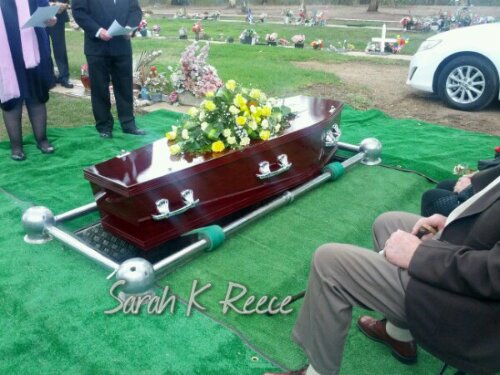
I’m sitting in the graveyard as they remove the trappings from the grave and prepare to bury my friend. It rained through the service but now the sky is clearing. It was a long drive here. We just finished the house move the day before. My Mum and I drove over together, and got stuck with no motor oil left, in a small town late at night. A pub owner was astonishingly generous and loaned us his very nice late model car to go find a 24hr service station and buy some. He thought a nearby town would have one but they were closed and unfriendly. We argued through the glass but a clerk refused to let us buy oil. So we wound up driving all the way to our destination then back to the van, left fuel money in the borrowed car and tossed the keys over the pub fence as instructed. We finally arrived at our caravan park at around 3am and went straight to bed. Mum slept, I only caught a few hours. We were lucky, it was quite a pilgrimage to get here.
image

The service this morning was beautiful. I knew very few people there except a few by name, people aged spoken of to me, sung their praises, told me how much she loved them. It was moving to be among so many people grieving, so many other people who loved her. I passed my contact details to a couple of them. They talked about grief and celebration. They talked about shock and loss and love. They talked about what an amazing, complex, vibrant, vulnerable, strong, generous woman she was.

Many people had the same story I had, that there had been distance and then a recent reconnection. Maybe, if she had known she going to die soon, maybe she wouldn’t have done it so differently. I could feel her so strongly, sitting next to me, embracing me, forgiving me, asking for forgiveness, making me laugh, telling me she loved me. She’s utterly irreplaceable. I loved her.

I wore the pendant I’d made in her memory, and a silver velvet dress she would have loved. I cried. There’s a big hole in my heart, in my future. She was so young. She will always be part of my family. I will remember us laughing together, raucous, raw with sadness and sharp with black wit. I’m not leaving her behind, here in this earth. I’m taking her with me.

And now, home.

Mourning in clay

image

I sculpted this pendant today, in memory of my friend. She told me once that she’d had a vision of me holding a baby of my own. I tried to sculpt that vision, the gift of hope and dreams of a good tomorrow.

It’s still raw, I’m going to paint it yet. It’s made with polymer clay, a freshwater pearl, a piece of polished shell, and three swarovski crystals in the colour of black diamonds.

I’m heartbroken, and still too angry to hear people talking about peace. I took today off and stayed home. It’s a luxury to have time to grieve, I so rarely have had the chance in my life. I feel angry and empty and hurting and deeply depressed. I’ve watched episodes of Scrubs and the first Garden of Sinners episode which was strange and sad and fitting.

I’ve found out that her funeral is next week, interstate. I’m so relieved to not have missed it. That’s happened before and it left this terrible feeling. I’m making plans to drive over. Poor Rose is packing her house alone for the move. I’ve eaten and cried and showered and written and made art. It’s all I have at the moment. She’ll never read this. She’ll never read another word of this. Everything is wrong.

In movies, death is an ending of a story arc, a finale. Here, things are unfinished, there was no warning. We don’t even know how she died yet. It’s the most terrifying feeling, this awareness that we make sense of deaths like this only in the aftermath. That we edit and write into someone’s life some kind of ending. We view all the last years differently now we know they are the last. But you can’t see it coming. It could be me, or you, or anyone we love. And as much as I want to hope she made the choices she would have made of she had known, I don’t know. None of us can truly live as if we’re going to die tomorrow, we have to have one eye on the years, to be aware we might have to live with consequences for a whole lifetime. Trapped in that place, it seems to me, we’re so vulnerable to living out lives chosen for us by other people, lives that do not fit, that we do not want, that do not make us feel alive.

My friend struggled so much to find a life of passion and meaning. I think of us out to dinner, laughing so loud the whole restaurant would turn to look, our black humour perfectly matched. We should have had more time to laugh like that again. There’s so much I still wanted to say.

Death of a friend

I’ve just heard that a friend of mine has died. I have no details, only that she passed away in her sleep. She was one of my oldest friendships, but she herself was not old. I thought we had more time. She was in my plans. Her death is like another door closing, slamming shut, becoming part of a past that is full of closed doors. For someone like me, someone who had to run a long way to find some kind of peace, there’s already so many shut doors. She was not going to be part of my past, she was going to be part of my future!

I wanted her to meet Rose, to meet my children, the babies we used to write about in letters to each other, as she chose – ambivalently – to not have children, and as I  grieved my own dreams of children due to sickness and ended relationships. She told me once she’d had a vision of me with a baby of my own in my arms. I wanted her to be here to see it happen! She was there through so much of the shit, our relationship suffered, we fought, there was distance and pain. We’d just started to reconnect, to let go, we’d just decided to make a new friendship.

I want to scream! There’s a howling rage in me. We suffered so much when the old world burned. I wanted her to know me now, in a place where my skin doesn’t burn anymore, where I’m not all teeth and shadows. I wanted to hug her again and tell her I loved her and never forgot her.

She’s not supposed to be dead.

I don’t want to be okay, I don’t want to move on, I don’t want to grieve, I want to burn the world down. This is not fair. This is wrong. We deserved better, we’d earned it. I’m screaming. I’ll scream as long as I need to.

About Growing Up

I’ve been thinking a lot about this lately. Some people with multiplicity point to key experiences such as wishing whatever was happening, was happening to someone else. I’ve never been able to relate to that. But the idea of not wanting to grow up? Oh yes. And what better way to achieve that then splitting off child parts and forming more parts when circumstances required new skills?

There was not a single adult in my world I envied. No one whose life I wanted to have. What I saw around me was a lot of pain and loneliness. Often they didn’t even seen to be aware how unhappy they were, but for me it was painfully visible. I could smell it on the air, feel it in my chest. An empathic child, I felt the cast off emotions and denied anguish of everyone around me. I felt stuck, in a body growing older, when there was nowhere I wanted to grow to. Perceptiveness can be lethal. I saw, and understood, far more than I could emotionally process. I was constantly caught between the dark and the light, between the way everything seemed to be on the surface, and the underworld. A good loving family, and the constant threat of violence. An upright private school, and the casualty list of victims too underprivileged to be worth protecting from the bullies.

Adults close to me had their own issues with the adult world. One told me that the process of growing up kills your spirit. Adults don’t play anymore, don’t climb trees on the way to work. They’re numb. I promised myself I wouldn’t turn into an adult. Another told me how children are innocent but adults lose this. In Sunday School we were told stories about children who could ask the challenging questions of hurt and angry adults, and be heard, where another adult would have been shut out. Many used me as a secret keeper. I heard horror stories that many had shared with no other person. I became tasked with this impossible goal, of not growing up, by adults who were mourning their own lost inner children. I tried very hard to comply. I kept the secrets of my peers also, even those who bullied me. I was steeped in the knowledge of unspoken pain.

“Adults are the corpses of children.”

Oddly enough, I was expected to function at an adult level at a very young age. For an oldest child in a family under massive stress, this isn’t an unusual story. Not all of that was a bad thing. But some of it hurt. Some of it was lying in the dark at night, afraid of the shadows, because I was now too big a kid to have a light on. Some of it was lonely and overwhelming, heavy burdens of expectations and responsibly.

I grew up surrounded by the myth of the Golden Age of Childhood. Constantly being told these were the best years of your life. I swore to myself never to rewrite my history and pretend this had been the case for me. I lived in this surreal world where everyone was locked away with their private pain, where everyone pretended there was no war and no dead bodies. It was like being able to see blood all over the walls and no one else acknowledging it was there.

A boy stalked me when I was 14. He was profoundly distressed, suicidal, and self harming. When I sought help for him from the head of our school department, I encountered endemic denial. The boy had started coming to school with extensive fresh injuries on his arms from cutting. I begged the head teacher to intervene. He asked the boy how he received the injuries. He reported back to me that they were ‘from falling into a rose bush’. I cried and said you know that’s not true! The teacher said well there’s nothing else we can do, with the relief of an adult out of their depth who has been allowed to keep running with the easier cover story. You could scream for help very, very loudly in my world without anyone hearing.

My peers were not the same. They yearned for adulthood. They craved power, freedom, and sex. Impatient with childhood, they raced towards an adult world that contained everything they desired and were denied. This difference became a rapidly widening gulf between us, bigger every year.

My sexual development was screwed up by weird attitudes, secrets, teachings, and abuse. I feared my own desires. I feared power and corruption. I had no illusions about the freedoms of adulthood. The only freedom I craved and lived for was to leave school. Responsibility and failure weighed heavily upon me.

I’m 30 now, undeniably an adult, at least physically. I have child parts, and sometimes I think they are the best of us. We have on some levels, admirably succeeded in our attempts to not grow up. It has been a painful mess. Sometimes I think that child in an adult body is one of the loneliest creatures in existence. My little 5 year old would sometimes just switch out and sit alone on the couch, waiting. She was hungry and wanted ice cream, but kids aren’t allowed to open the freezer so she would just wait for a grown up to come and help her. I live alone, no one was coming. I feel them yearning in me when we pass children at the park. When I read about a multiple giving a box of crayons as a gift to another newly diagnosed, a great desire leaped in my heart. It was another year before I was brave enough to buy crayons for us.

So here I am, painfully suspended between the worlds of child and adult. There’s so many ideas to untangle. That adults live in the ‘real world’. I’ve spent a lot of time trying to fit myself to that real world – the world of admin and responsibility and success and bills that need paying. I also keep rebelling against my own goals, switching in the rain, running away from my own life. I’m starting to develop new ideas. I’m starting to think that perhaps the task of all adults – multiples and otherwise – is to love and look after their own inner children. I’m starting to think that there is no ‘real world’, that the real world is just as much a dream as any other. When I live in a caravan, what am I ‘really’? White trash or a gypsy dreamer? Adults get together and dream up their version of what reality is, of what love is, and what success is. I think my idea of the real world is a nightmare. A bad dream, dreamed by a lot of hurting adults with very lost and lonely inner children. It’s not even about success, when I look at some of the ‘successful’ people I admire – like Amanda Palmer – she doesn’t live in the real world! Oh, she does admin and pays her bills, but only as a means to ends, not as a goal in themselves. They are the poles that keep up the tent in which the magic happens. The magic is the real world, the creating and adventuring and connecting and being uniquely oneself.

I’m starting to dream new dreams of adulthood that don’t scare me so much. Some days I have the most glorious glimpse of life as a mother who is very imperfect, who is sick and strange and full of dark art. And I see her painting the kids to be dinosaurs and chasing them round the yard. There’s joy and freedom and silliness. There’s a different world, that has nothing to do with the real, nothing to do with adults who are dead on the inside.

Rose and I have both been so sick this week, and yet, when I let go of the idea of what we should be doing and how I expect this to play out, something magic happens. The day becomes infinity. I’m captured by the fall of the light through the curtains, by the colour of the skirts of leaves, by the warmth of her skin, the feel of ice water in my mouth, watching the kitten chew the dog’s foot and laying back to laugh. What was a wasted day, a sick day, a day in which nothing good would happen, a day to be endured as I wait to get back to the real world, becomes the most beautiful day of my week. I read lovely books and slip in and out pain and sleep and let go of the driving and the haunting sense of failure and I am given back the most beautiful day.


Maybe crisis was the best thing that could have happened

Sometimes when I’m working with other multiples who are in crisis and feeling overwhelmed by their internal chaos and frightened and frustrated by their parts, I think to myself that discovering I have parts and then going through a few years of crisis might have been the best thing that could have happened to me. It’s a weird thought, because if I could take back years of homelessness, isolation, confusion, and pain, I would in a heartbeat. And yet, it provided an odd protection for me. I rallied, or rather, we rallied. To survive. And the thing we protected ourselves from, most of all, was a story about what it means to be multiple that would have crippled us.

I recall, back when I was working with a MH PHaMs worker, her sending around emails trying to find me a psychiatrist to work with. At my request she was asking for someone willing with to work with a person with DID without trying to integrate them at this stage. At the time I was homeless, caring for someone who was suicidal and often in hospital, highly vulnerable and under horrific stress. I was well aware that having parts was greatly helping me. While some parts were burning out, others would step up and take on our very complicated and painful life. We were running a complex relay where infighting and conflicts gradually made way for a deep mutual respect.

Like a platoon of soldiers in an appalling conflict, we started to bond. We started to realise how deeply we relied on each other, that we were all in this together, even the ‘crazy’ ones you would never have befriended back home, even the ‘useless’ ones you would never have chosen to have by your side in a war. You fought for them, you protected them, you demanded their respect, simply because they were your platoon. We might hate each other, we might not understand each other at all, we might be very, very different from each other, but we’re fighting the same war. We’re mates. So you don’t steal each other’s rations. You don’t play mind games with each other. You might yell sometimes. You might hold your hand over the mouth of the one who won’t stop crying, just until the enemy pass by. You might hit them when they bite you. But then you say sorry and you tussle their hair and when you find a box of pencils you save them for them.

Maybe over time you find they’re not as crazy as you thought. Maybe you find that when you’re kind to them they don’t cry so much and don’t screw things up so much. Maybe you get to the point where you can let them sleep next to you and when they can’t sleep for the nightmares, you sing a little to them. Maybe someday an old story comes out about them, about how they were in the war long before you, back in the early days. About how brave they were and how broken they were, and you realise that really, they were protecting you, all along. They look like crazy kids because they were young and they got hurt early and being brave wasn’t enough, and their army wasn’t big enough to win. So you hate them a little less and you make sure they get a bowl of soup when there’s soup to be had. It’s hard to be disgusted by someone, however weird, when you find out they’ve saved your life. Things change, they have to.

I was lucky because the war was still going on, so I didn’t see my parts as the enemy. They weren’t destroying my life, outside forces were still doing that. They were still trying to keep us alive. So the story never really fit me – this ‘once having parts was helping you but now it’s messing everything up’ story. I know it fits other people, but it didn’t fit us. We couldn’t afford to have our most useful way of managing crises removed from us while we were still in crisis. And we really couldn’t afford to abdicate responsibility to a shrink. So the ‘you must have weekly therapy for years to manage DID’ story didn’t fit well either. Most people couldn’t manage what I was managing, and most shrinks were rapidly out of their depth too. Some just denied the DID or laid the chaos at my feet – your life is a mess, you must be borderline. Which is a lovely cop out for the brutal reality that life can be extremely bloody hard at times, and sometimes that’s just bad luck. Some laid the mess at the feet of the DID – you will always be lonely and chaotic while you have it, you need to integrate as rapidly as possible. But I was watching friends and family burn out and fall away, where I could keep going. I was doing the impossible, every day. I could switch instead of freeze and face down the most violent and frightening person in my life – someone I had never seen anyone stand up to, someone who scared even the therapist. And I could do this because we were parts, separate, because we could switch to whoever had the most useful approach. I simply couldn’t deny the reality that having parts was currently keeping me alive.

So I had to build different stories. And the more I looked, the more I realised how narrow the old stories are. There are so many people they don’t fit. There are so many people who get lost in this idea that someone else – a shrink – is the best person to lead their lives, because they are broken and damaged. There are so many people trying to figure out their parts and fit them into frameworks of ANP’s or ISP’s or Protectors, and in such fear and pain when they don’t fit. When the stories fit they can be so liberating – someone else knows what I’m going through! But even then, they obscure. There is such uniqueness to each person. I have heard hundreds of stories of multiplicity and YES of course I tell people ‘such and such is common!’ when they feel crazy and scared, but I also constantly want to honour the diversity. Each story is so unique. And I’m so sad at the long, painful, tortured road so many people seem to have to take through years of treatment to get to a place that crises got me to so quickly – I’m blessed.

Even my most dysfunctional parts are trying to help us survive. That love is the best way to engage a system. That I’m not crazy or broken, or at least, no more so than anyone else. I can’t helping thinking how much quicker and less painful this road is if you don’t start with stories about sickness, brokenness, needing other people to help you survive. Maybe this is what happens, all over the world, in places where they’ve never heard of psychiatry. Maybe this is what happens to thousands of people who don’t quite meet the criteria for DID and never get that diagnosis, as they come out the other side of crisis and take stock. There are so many stories about multiplicity we never hear.

I’m not anti-integration! One of my favourite lines is from The Flock, saying that perhaps it will happen when and if it is supposed to. I have personally approached it, initially with great enthusiasm, and now with caution. I don’t see it as my goal. If it happens as a by-product of my living and healing, how wonderful! If it does not, how wonderful! Life is a strange and amazing thing. There is no one road, we all walk our own. But certainly, sometimes, when I’m listening to people taking on the standard stories about multiplicity, framing it as an illness, seeing their parts as the problem instead of their inexperience, self hate, or trauma as the problem, I’m so sad! It seems I was lucky that life gave me another kick in the teeth just after I was working this out, because it sure has helped us work together. It’s an odd thing to wish for someone else, especially someone already struggling, and it’s not really true. I don’t wish crises or suffering on others, but I do wish they have the chance to write new stories.

Most of all, I want people to be free from other people telling their stories for them! I want people to be free not to fit themselves into other people’s frameworks, but to find their own. I want them to have the chance to greet the possibility they have parts with courage and love and joy, instead of stories of terror, loss, and suffering. It all rather reminds me of a strange old prayer:

A Franciscan Benediction

May God bless you with discomfort,
At easy answers, half truths, and superficial relationships,
So that you may live deep within your heart.

May God bless you with anger,
At injustice, oppression, and exploitation of people,
So that you may work for justice, freedom, and peace.

May God bless you with tears,
To shed for those who suffer from pain, rejection,
Starvation and war.
So that you may reach out your hand to comfort them
And turn their pain to joy. 

And may God bless you with enough foolishness,
To believe that you may make a difference in this world,
So that you can do what others claim cannot be done.
Amen

Living with Rage

If you love someone who has been hurt, you have to learn how to live with rage.

I’m used to living with my own pain and anger these days. I know where it hurts, I know what to do on those days when it’s going to drown me, when I need to burn it all down.

Rose has been badly hurt at times. When I hold her, when I hear her stories, I swallow back my own feelings. I’m just present. She hurts, or is afraid, or hates herself. I hold on, I hold onto her, onto hope, onto grief, onto love.

Underneath this is rage. Touch her again and I will kill you. Make her cry and I’ll scream your world apart. Tell her again how worthless she is and you’ll inherit a firestorm. She’s not alone anymore. She’s no longer the only one, a place you can leave your frustration with the world, your own inadequacy and impotence, without consequence.

It builds, over time, I find.

I’ve been in relationships where friend or partner insisted that I do not get involved when they are harmed. Once someone had my boyfriend against a wall by their throat and he still would not allow me to intervene. I locked myself in the toilet and cried. I was 16.

I once inherited everyone in the world of my partner. They had access to me. People I would never have shared time with, never have let close, never have trusted, had access to me.

I once turned into a single entity with my partner. We had to operate as a unit in all things. What they submitted to I must submit to. What they hated and walked away from, I had to leave behind.

Then, I stood alone in a caravan, after all the years of trying so hard to be loveable and to make people feel safe around me, and I realised that I was in less pain now. It hurt less to be alone than to be the least important and valued member of a group that kicks downwards. I paid high prices for the illusion of belonging. I promised myself that I’d never let people treat me like that again. I’d rather be alone. I’d rather self destruct than let someone else do it to me.

Here I am, and this time I don’t inherit anyone. Respect is met with respect. Only those who love me get close to me. I don’t become a unit. I make my own choices about what I will suffer and why. I stand my own ground. And sometimes, I have to find ways to express rage, because I love her, because she deserves so much better.

And she deserves better than me too.

But how can you hate yourself when that’s hating someone she loves?

Sometimes I get angry with Rose. I thought I was hiding it well, discharging little bits in dark comments, sniping with tone or look. She called me out on it and the relief was huge. I’m not the only one watching to make sure things are fair and okay. It’s so much easier when we both watch. I’ve less power, less responsibility. I’m an equal. I saw a vision of myself as an abusive spouse, of where this could take us, and I cried bitterly. There was only one way out – painful honesty. Being real about the times we drive each other crazy. Being real about our limits. This was many months ago now, and I haven’t slipped since. Love and humility are a good match.

But I am finding that I’m losing my capacity to swallow my rage when she cries into my arms about something someone else has done. I know what it’s like to take it because you love someone. I know what it’s like to be forced to stand by. I don’t want to get into places I don’t belong. I don’t want to overshadow her choices. I don’t want to be someone else to manage. But I want everyone to know that she’s not alone. Those vile ones who took so much because once she was small and alone, watch where you leer. I loathe you more than you can understand. I restrain my violent impulses. I wake from nightmares and think of your faces, distorted with narcissistic self pity. Rage burns like fire in my bones.

Now, the wounds inflicted by those who lash out unthinkingly, who act out their petty frustrations and choose someone close to hand, someone they’re pretty sure will take it and won’t leave, how then do I hate those she loves? Where she forgives, I want to down the façade of unity. This time she has somewhere safe to run. This time there’s someone there to say ‘don’t hate yourself, you’re beautiful’. A place where your lies get washed away. I may not be there, I may not have my hand on your throat, but I’m watching. When she sobs into my lap about the names you call her, I’m listening. When you roll your eyes, raise your voice, curl your lip with that sneer, I’m clocking your contempt. When she swallows down an insult or doesn’t hear another assumption about how she’s just not trying hard enough and has it pretty easy I’m sharpening my teeth in the shadows. Don’t think things aren’t changing. Try that on me? Try that with her when I’m there? She has my heart, she carries it in her chest. I pay no allegiances beyond love, and I protect my heart.

It’s the simplest of things, to love those who love her, those who see what I see in her. To hate those who hurt her, her make her feel that she is somehow less, who use her as a place to ease the ache of their bones. And the rest – those of us who love but let her down? I’m watching you, just like I watch me. Make all the excuses in the world, but you had better mean it when you bow your head.

And me? I find it helps to have someone who doesn’t mind if you spit fire. The kinds of friends who just say ‘that’s messed up’ and don’t try to calm you down. A car is almost sound proof if you need somewhere to scream, or better yet, to scream along to music up loud. Break a few rules that won’t kill you. Direct the rage into making you look clearly at things you’d rather avoid. Clean up your act, clear out your own stressors. It’s okay to love, it’s okay to want to protect those you love. You can’t stop the fire but you can direct where it goes. Handle it with respect, with integrity. I read dark books and breathe turpentine. It passes, it eases. The scream fades in the air and a silence comes over, a space made for a different song.

She’s free, and I’m free, and we share pain and fury and grief and longing and fear back and forth between us like a complex knitting. She shares pain and I give her back rage. We are free and we are not free. We share terrible truths in the night. We see ourselves in each other’s hearts like dark mirrors. Love transforms these offerings, they are transmuted, purified by the process. An alchemy of broken hearts. At the end we are wounded, we are divine, we are human. We try to bring light. We try to bring peace. We lay down sword and tear and wing. We are restored to love.

Ink Painting – From the stars

I sat up late last night in my studio, painting with inks again.

I’m sad and tired and can’t seem to shake it. World weary and weighed down. I thought painting might help. All my images were of grief. It did and it didn’t. It didn’t and it did. I re-read Greylands by Isobel Carmody. I’ve looked for furniture for my studio at local second hand stores. I’ve discovered that the name we were going to use for it is already being used. I’ve looked up new names, none of which quite fit.

My basil plant is huge and fragrant and full of bees. My sage is dying, despite all love. Life is strange and sad and my heart is full of broken glass.

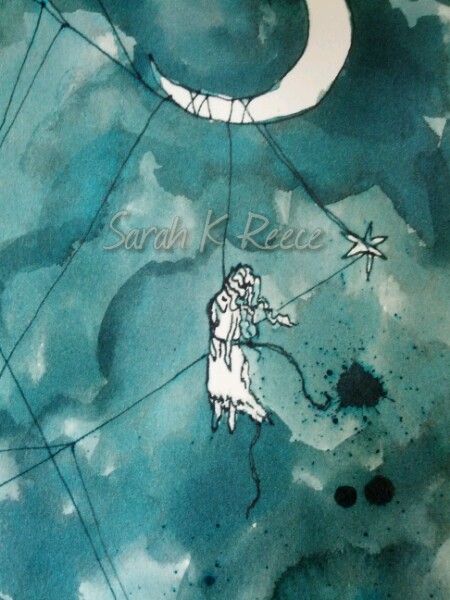
I’ve painted this dead woman and her howling dog, she’s hanging from the moon and stars, tangled in the dreams she was weaving.

image

image

image

Nightmares & changes

It’s been nightmare central around here lately. There’s changes and upheaval everywhere! The first step of the big move is happening, Rose is packing to move in with my sister, my close friend, and his daughter (my goddaughter Sophie)! This is heart stoppingly exciting, and very stressful for her. Like me, she’s been homeless more than once and is really afraid of making stupid decisions that might make that happen again. She’s also job hunting now that her ankle has mostly healed as she’s not being given shifts at her current casual job. So there’s plenty of fodder for rough nights there. As usual, some friends get it, some don’t. We’re both stressed and I’m doing my best to be supportive.

I did something a bit risky the other night when I came home shattered from a day at college and just zoned out on the net all evening… I read my way through a blog post about movies the writer had found really hard to watch or finish watching. I was gratified to see them list se7en, which I watched at 16 when my then partner stupidly or sadistically persuaded me it didn’t live up to the R18 rating and I’d enjoy it. I remember crawling into an empty room afterwards, huddling into a corner, pressing my face against the wall, and sobbing my heart out. I was a bit cautious about the article as movies easily set off nightmares for me, but as many of them were ones I’d heard of and which lose most of their disturbing impact in the description, such as Clockwork Orange, I read it anyway. Whoops.

The last several nights have been horrific. I’ve latched onto the idea of sadism and torture and murder and had a really rough time as my imagination has played out what I’ve read and added from my own bank of bad memories. It’s been really, really stressful. Hopefully I’ll let it go soon. What it has brought to my mind though, is that this used to be every day life for me. It’s astonishing that this has become something I deal with sometimes, not every night. Bit by bit, things change, wounds heal over. The hard work pays off. You can recover from PTSD.

Things are difficult at the moment. But it’s not death pangs, it’s the birthing of a new life. It’s a price I can pay. There’s moments I’m one breath away from a panic attack. There’s moments I’m so content, in such peace.

Dissociation is a super power

“Please tell me there is an bright side to dissociation“. Someone found my blog the other day by searching for this phrase. It makes me ache with frustration and sadness!

Of course there is a bright side! There are so, so many bright sides. They get lost when we talk about illness, disability, deficits. When we share the ‘once it was helpful but now it’s a problem’ story. When we collapse a whole life into a single, painful narrative of difference and limitations. Dissociation can be horrific and devastating and I don’t make light of it or of the suffering people experience. But this isn’t the whole story! Let’s start talking about bright sides, shall we?

Not all dissociation is pathological

Dissociation has been broadly defined. This means a LOT of highly valuable, important skills are being included in the category. Some level of capacity to dissociate, when it is broadly defined like this, is actually essential in our ability to function. Disconnecting from things is helpful in our ability to focus. People who struggle to damp down any of their sensory input are overwhelmed and highly distracted by it. Being able to put aside most of the input (the sound of a fly buzzing, the prickly feeling of rough socks, the worry about your friend who isn’t talking to you, the slightly sick feeling after drinking too much water) to focus on something important, like an exam, is very helpful!

People who are struggling with severe and chronic dissociation, the kind that leaves you numb, confused, lost, unable to feel, taste, touch, smell, or remember the faces of the people you love, often think of these kinds of dissociation as existing on the other side of a continuum of health. That once they’ve got the ‘bad’ dissociation under control, and they’re back to ‘normal’, maybe then they will get to experience some of the good kinds.

I disagree. Those of us who are drowning in the kinds of dissociation that takes away instead of enhances our lives are closer to the useful kinds of dissociation than many regular people. We are well versed in it, we are used to it, we have a huge aptitude for it, and often we are only drowning in it now because we once stumbled across it as something incredibly helpful. Do we need skills other than dissociation to navigate life? Certainly! Does depending on dissociation exclusively leave us uneven and struggling? Of course. But, sometimes when I’m talking to people who are absolutely overwhelmed by intense dissociation, I talk about dissociation as a super power. Sometimes working on reducing it through grounding techniques and trigger management just isn’t working. Sometimes the first step is to learn how to live with it better, how to use it to your advantage, how to stop hating it and feeling destroyed by it. Sometimes we need to become better at being dissociative, rather than less dissociative.

We are so used to this idea that dissociation is bad. We are so used to this idea that our minds are damaged and broken, and that we need expert intervention to help us be more normal and functioning. Dissociation can be a terrible thing. But it can also be a gift.

  • Dissociation can be learning self hypnosis to turn off your experience of pain during a dental visit.
  • Dissociation can be letting go of the bad memories for awhile so you can have new experiences.
  • Dissociation can be the ability to attend uni and study despite homelessness and self harm and carer responsibilities and your dog dying.
  • Dissociation can be discovering that you have a part who has not experienced any of the loss or heartache, a part who loves like their heart has never been broken, who hopes and dreams and cares and helps to lead your whole system to better places.
  • Dissociation can be sobbing into the night, overwhelmed with grief at the loss of your child, and still being able to get up the next day to hug and cook breakfast for your other child.
  • Dissociation can be disconnecting from the panic and terror and the overwhelming smell of blood to be able to help out at the car accident.
  • Dissociation can be laying in her arms and touching her face and feeling the minutes stretch out to whole days, to years that you’ve lain here like this, alone together with no world intruding.
  • Dissociation can be not noticing you haven’t eaten all day because the book you’re reading is absolutely brilliant and captivating and you can see all the characters in your mind and hear them talking to each other and at night you dream about them.
  • Dissociation can be walking away from every cruel and unkind thing ever said about you and finding new ways to think about yourself.
  • Dissociation can be having other parts to ask for help, not being alone anymore through any of the hard things.
  • Dissociation can be a four year old inside singing you to sleep when you’re lying awake worrying about the world.
  • Dissociation can be going numb when you’re feeling suicidal.
  • Dissociation can be reliving the most wonderful, exciting, hopeful, inspiring moments of your life as if they happened this morning.
  • Dissociation can be smelling a perfume and vividly remembering your Grandma’s garden and the feel of her hugs.
  • Dissociation can be having a conversation on the phone with a sick friend, getting the lunch boxes packed, finding your shoes, filling up the cat food bowl, helping knot a tie, and getting out of the house on time to catch the bus.
  • Dissociation can be the way, for just a moment, while you’re swimming, or drawing, or listening to your favourite music, or watching him play, everything in the whole world is okay.
  • The ability to compartmentalise is what helps us to do our best in a situation. For a doctor to concentrate on a patients needs even though their marriage is rocky and they’re stressed and anxious about it.
  • Dissociation can be part of the experience of artists who lose time when they paint, and athletes who forget they are tired when they’re running, and happy nerds who don’t notice someone calling their name when they’re lost in a good book.
  • Dissociation can be about mindfulness. The ability to be captured by the movement of the breeze in the lavender bush, to taste every drop of beer and be immersed in the smell and laughter of other humans.

You can learn how to use your dissociation. If you can turn it on, you can turn it off again. You can learn how to trigger it, how to use anchors, how to dial it up and down, how to go with the flow. When to trust it, when to shape it, when to learn other skills. We have so much to learn! Something that can help you put aside overwhelming feelings, or not feel physical pain is simply amazing! We have this idea that you have to lose all of those things in order to be well, in order to not be overwhelmed by dissociation in a way that steals life. Maybe this is true for some of us. But I’d caution making that assumption for everyone. And if you’re stuck (at least for now) with some of the downsides of being highly dissociative, why not at least explore the upsides? Maybe we don’t overcome everything by fighting it.

There’s balances. My experience has been that using dissociation as a blunt instrument for every purpose has great costs. Choosing not to feel all the painful feelings often costs you all the wonderful ones as well. Containment often works better than suppression. Being guided by your own needs rather than imposing a schedule or ideas from outside. But if I told you that some people can choose not to feel pain when they’re injured, not to remember awful memories when they are busy getting out of that life, that some people still watch movies like little kids do, where the characters are real and make them cry, that some people find that doing their favourite thing in the world makes time stretch into something approaching infinity… you wouldn’t tell me these people are sick, you’d say they have super powers.

Psychosis & Secrets

I’m sitting on the pavement outside my car, waiting for the RAA to come and deal with the keys locked inside. I’ve just been to Sound Minds, our local South Australian Hearing Voices Group. I love getting along to this one.

We had a pretty full room. At one stage someone was chatting away and one of the members got the giggles. Everyone was trying to listen and keep a straight face. One by one more and more of us succumbed until we had to stop the conversation to laugh. A good belly laugh, about nothing at all. These beautiful people ground me.

I told them my good news, that my GP is on board with my unconventional approach to psychosis. A couple of us chatted about how destructive the idea of schizophrenia can be, life long illness, life long medications, being forced to confront your new reality in the interests of ‘having insight’, employers unwilling to take a risk on you, friends scared of you, family confused by you. I talked about how shame and secrecy can feed psychosis because people let them run unchecked, and try to maintain their usual activity level instead of resting, driving themselves deeper and deeper into it. How destructive the idea of a life long disability with no upsides is! How secrecy can often be woven into the fabric of psychosis, preventing the possibility of sharing the details and getting helpful reality checks. People are driven to this when saying ‘I think I might be hallucinating’ or ‘I’m feeling a bit paranoid’ would scare away friends or see them fired from jobs. One group member reminds me of the saying ‘You’re only as sick as your secrets’. Good point.

I’m not saying people who have to conceal mental illness, or those of us who prefer not to live our lives publicly on social media and blogs are sicker than the rest! I’m saying that cultural shame and fear trap people into keeping the kind of secrets that can make them very sick and very lonely.

Scars & stigma

We’re in the process of job hunting in my world again, or at least, Rose is. Some industries tend towards the kind of contract or short term grant based work that make this a regular occurrence. I remember the days of job hunting before I came down with Chronic Fatigue and Fibromyalgia, and it was a pretty simple business. Write a nice resume, arrange some referees, and send them out.

Now, the resume is only the start. Rose spends entire days writing long, detailed letters that must address each point of a job description. It’s basically like a math equation given in word form: If John had seven oranges… You have to repeat all the information that’s already in your resume, in interesting sounding ways, and big note yourself for pages whilst also sounding humble and grounded. Then you might get to an interview. This often requires bringing in a truly astonishing collection of forms already filled out. Some interviews also contain written test components and require you to wait while they are scored and then be called back. One really frightening one went for most of a day and involved a bunch of psychological assessments and group work with all the other hopeful applicants. I find myself increasingly jaded by the whole idea that this is a good way to select an appropriate employee. It seems like a good way of recruiting very slick, charming, narcissistic people, and probably a good few psychopaths. I know a lot of brilliant, caring, highly committed people who would never shine in this kind of setting. Fortunately, Rose does.

We were chatting with friends today about issues of disclosure around mental health when job seeking. For those of us with visible scars from self harm, it can be very challenging to confront questions in interviews. It always plays against you, no matter that is often part of a past that involves a lot of wisdom and strength and self awareness to have survived. There was talk about checking over the organisational policies to try and get a feel for their stance on mental illness in their employees. The consensus was to wear long sleeves and keep it hidden. One friend did that for the entire duration of her job because the organisation treated employees with mental health problems as liabilities. This was a mental health organisation, offering support to people in the community. The wrongness of this makes me sick.

All these places talking about stigma as if they have the answers, as if they, the enlightened few are here to tell everyone else, the ignorant masses, how to be better people. And these places are so often hotbeds of systemic stigma and discrimination. I remember when I spoke at Parliament House about mental illness, disability, and barriers to employment. I was asked what the government could do to encourage employers to retain people with disabilities. I said – lead by example and show it can be done. Demonstrate how to overcome every concern and issue the wider community expresses, with transparency and dialogue. Then people will be less afraid and more willing to engage. It might have been my imagination but this didn’t seem to go over brilliantly. The problem is never with us, and the solution is never ours to implement. It’s always someone else’s fault and someone else’s responsibility. We stand around telling each other to be brave and honest and  our every other sentence is a lie.

I’m very angry about this tonight. My faith and my hope keep being rewarded with hypocrisy and harm. Oddly enough, I’m starting to be glad that the Dissociative Initiative has been so hard to get off the ground, that most of those who shared my dream have been occupied by other dreams, or become too overwhelmed by the needs of their condition, to continue with me. It’s breaking my heart, but it’s also saving me from a form of failure that comes wrapped in a package that looks frighteningly like success. I’m starting to think that organisations or any kind of corporate structures should not have anything to do with the support of people in pain. But oh, how I do miss my little team. How my heart hurts every time someone emails me saying, please when is that Bridges group starting again? And how angry I feel every time I confront the sick reality of the profoundly flawed frameworks we have constructed with which to engage the most wounded, vulnerable, lost, and suffering members of our community.

Why do I need a job and an income? Can’t I just open a shelter for everyone who needs it? How do I engage without burning out? How do I not scream with frustration at the burden of all the terrible things I hear, when I walk in a world that is mostly unaware of this suffering? Trapped in secrecy and lies and the requirement that we pretend not to be what we really are, as if self harm scars are slave brands or the tattoos of a criminal, shameful pasts that you cannot escape but must forever conceal. As if being human and having suffered is something to be ashamed of, a weakness, a liability. This is wrong! I hate it! I hate it and I refuse to have any part in it. I will not lie, I will not conceal, I will stand and be counted, I will use my voice to speak for all those who cannot, because the risk to job, or to family is too great. This is wrong. Structures without courage or integrity cannot ever really serve people. They may abuse openly or poison slowly, but they always do harm. There is always a cost for engaging with them. It’s always too high.

Poem – Curled into her arms

From my Oct 2013 journal

Curled into her arms I laugh with joy
and the sound of it delights me, like a bell, like bird song
clear and pure and unrehearsed,
without audience or self consciousness,
she holds me and my skin
trembles in the candlelight, there’s a space
here within our arms, when we are breast to breast, where
darkness does not fall, for a night
or an afternoon
or a golden morning, I am without a past
no touch but hers, no memories of pain or blood or loss
we are shameless.

We are kites,
flying over all those burdens,
beyond the dark obsession,
the memory intruding,
the nightmares from which we wake
screaming, the cult of survivors,
the platitudes of therapists, the way
the social workers think they are being enlightened when they tell
us in the mandatory child safe courses that children who are abused
will never recover, the screams that
sound in our deeps,
that wait beneath our words, that we can hear
when we place ear to breast:
None of it is real.

 None of it is a truth we have to live forever,
some days the knots slip
and the strings fly free, we dance
on the other side of darkness, we are
reborn, into innocence, love
begets freedom, phoenix from ashes
there is laughter in our bed
joy in our love.

When Multiplicity doesn’t protect us

For most of us who come to multiplicity by way of trauma such as abuse, neglect, bullying, or chronic pain, we’re familiar with the idea of multiplicity as a creative defence mechanism, something that helped us to survive. This can be a powerful re-framing of the idea of multiplicity as an illness, and very helpful! For some people it’s not all of the story. In some ways, multiplicity can make you more vulnerable to harm.

Many of us with multiplicity start out with no idea that we have parts, either we lose time due to amnesia, or experience the world through the hazy confusion of co consciousness. For many of us, the dissociation is highly functional, breaking up information and containing it in ways that help us to manage life, and allowing us to adapt simultaneously to a variety of different environments with very different social requirements. We have found a way of growing and navigating life that works for us, even if we are completely oblivious to it.

I’ve been talking lately about how powerful triggers and anchors can be for people with parts, but it needs to be said that they can also be abused. Even when the multiplicity is hidden or unknown, sometimes abusive people figure out by accident or instinct that certain things will keep a compliant part out, or trigger a part who discredits themselves to other people. They may not interprete these things using a ‘multiple’ framework and language, but they stumble across triggers and anchors and use them to their own ends. It’s worth mentioning that these factors are at play for people who don’t have parts too, in that all people are vulnerable to things like finding they are more submissive in certain settings, or more likely to act out when treated certain ways. But it can be devastating when dissociative barriers prevent a person from being able to access memories or skill sets to help them protect themselves. This can be the catastrophic downside to multiplicity as a protective mechanism.

Sometimes harm is done with no intent to harm. Triggers may be avoided or used unintentionally by family or friends who tell a person with parts that  ‘You’re not yourself today’ when they switch to a part their family doesn’t get along with. Sometimes others may learn to fear certain triggers such as what happens when the person gets drunk, or listens to certain music, and switches to a part who’s disoriented or aggressive. People with parts can find themselves under a constant subtle pressure to keep out the parts other people like, get along with, or find easy to manage. Other parts can spend many years trapped inside and be frozen at certain stages of development, never getting the chance to hone crucial social skills, tell their stories, use their talents, or connect empathically with other people. This can leave systems extremely uneven in their ability to function and their experience and expectations of the world. Systems can easily become polarised into the compliant parts and rebellious parts. Sometimes therapy can also play into this dynamic where the parts that the therapist relates to or finds easiest to get along with get to have key roles, while other parts are excluded, supressed, ‘fused’, ‘integrated’, put into lockdown, or convinced they are no longer needed and have no further role to play in life. (that’s not to suggest that these approaches are never useful or necessary)

Self awareness can make a huge difference for people with parts. Understanding that you have parts can be tremendously helpful in buffering the issues that multiples in a non-multiple world can have. Whether it’s someone saying that they like this artwork/outfit/meal better than that one – and inadvertently hurting the feelings of the part who worked on the less well received item, the frustration of losing skills and abilities as parts surface and go away again, or simply the phenomenal daily challenges posed by differences between parts as large as gender or sexual orientation, or as seemingly small as the part who does the grocery shopping love oranges and yoghurt and never buys any bread even though the rest of the parts love toast for breakfast and never eat oranges. Knowing why you have conversations in your head, 4 different opinions about almost everything, why you can be feeling happy, sad, bored, and curious all at the same time, or for that matter, hot, cold, scared, and sleepy… can help make a lot of sense of what has just been one more bizarre and confusing experience.

However, awareness alone is not sufficient for protection. Awareness of multiplicity can make you vulnerable through exposure to the massive stigma about these experiences. People’s relationships and jobs can be at risk if they are outed. There’s also a vulnerability in inheriting a whole stack of rigid ideas about what it means to multiple, for example when people are told that their systems must have a certain number or type of parts, or that they will inevitably remember horrific abuse, or that therapy is essential, long term, and extraordinarily painful. People can be vulnerable due to the language of symptoms where the number of parts, degree of dissociation, or level of incapacity is used as a measure for the severity of pain and worthiness of support of the person. People can also be vulnerable when multiple communities behave in alienating ways, such as being overly concerned with ‘faked DID’. Sometimes people find that their systems are overly fluid, or overly rigid and fixed in ways that make growth and adapting to new circumstances extremely difficult. The dissociation can limit the healing effect of positive life circumstances and loving relationships.

There can also be vulnerabilities in other people being aware of a person’s multiplicity. Sometimes abusive people use multiplicity against a person. This can happen with children who are being poorly treated, but adults can also be vulnerable. For example, people with parts who are in abusive relationships can have horrific experiences such as having a young part who has previously been abused being triggered during sex for the titillation of their partner. Multiplicity can be magnificent and protective, but it can also be devastatingly vulnerable. People with parts who find that their multiplicity is not effective to protect them from abuse or trauma may become extremely fluid, chaotic, poly-fragmented, or build massive numbers of parts. (this is not the only reason systems can function in these ways!) Systems that have experienced this kind of harm can be like labyrinths designed to confuse and hide essential information from an abuser or series of abusers who have discovered how to use the dissociation to their own advantage. Often this design also confuses therapists and the person with parts, and can frighten and overwhelm those who are seeking to understand, map, and make sense of themselves. Realising that confusion is the intention and that it serves a very important purpose can be a valuable first step in learning to love an inner labyrinth. Understanding triggers and anchors and knowing how to use them can be a powerful way of ensuring that abusive people cannot use them against you.

Known multiplicity can also be interpreted in ways that are harmful. For example, some people are put through traumatic exorcisms to get rid of parts who have been understood as spirits or demons. People with parts who have different gender identities have accessed trans support services that haven’t considered multiplicity as a possibility and have unintentionally suppressed and rejected all the parts of one gender. Multiplicity can be misdiagnosed and mistreated, for example if it’s seen as schizophrenia treatment may concentrate on keeping the person lucid and stopping the voices via medication – which can translate to tranquilising the person until they can’t hear their parts, and trying to prevent switching. Some people have accessed therapy that has interpreted and navigated their multiplicity in ways that they later come to believe was deeply harmful.

Multiplicity can also make you more vulnerable alienation, loneliness, and self hate. These are simply things that everyone without a peer group is vulnerable to. For people who don’t have parts, there’s often something strange and fascinating about the idea. What it can be difficult to understand is just how strange people without parts can seem to those of us who have them. This is our ‘normal’, and we can feel very alien and alone in the world. This can be compounded by the issue of masks. Many people wear social masks, the face they present to the world. People with parts are often thought to be wearing masks and then revealing their ‘true’ self when they switch. Pre diagnosis, everyone in my life had a different idea of who Sarah really was, and we ourselves couldn’t figure out who we ‘really’ were. Different people formed bonds with different parts, and most of my relationships were one-part bonds only. Switching caused chaos. I would invite friends over to visit, then switch later on and be confused and frustrated that people who didn’t seem to particularly like me were on my doorstep. They, on the other hand, experienced me as moody, unpredictable, and very strange. A freak. I also had big issues with connecting with other people’s buried parts – not the dissociative kind, but the kind we all have. For example, someone who presents themselves to the world as together and successful may have a hidden part that is lost, afraid, and steeped in grief. For some of us with parts, we are used to hearing and feeling things beneath the surface and we accidentally interact with and draw out the hidden parts of other people in ways they can find both deeply moving and intensely uncomfortable. Certainly not necessarily conducive to stable relationships!

It’s hard to be the only one of your kind. This is why bridging the Gap and finding points of connection and similarity common to all people can be so desperately important! It’s also why connections with peers and peer workers are crucial. Everyone needs a space in which the way they function in the world is ‘normal’ and for a few hours they don’t have to explain everything in full, because people get it. Being the only deaf person, the only kid with two Dads, the only scholarship student can be hard. Diverse communities help, and contact with other people who share your experiences also help. However multiple/multiple relationships can also be fraught, while there’s a common language and understanding, there’s also the complexity of two systems and a different type of relationship between each possible pair of parts who are out, as well as the loss and grief of forming connections with parts who go away or are supressed or overruled by other system members. Friendships between multiples can be wonderful but also fragile.

Multiplicity can be life saving. It can help people to contain, protect, and adapt. It can also be a difference that leaves people at greater risk of abuse, exploitation, and isolation. Here lies a tension that many of us peer workers with parts are struggling to engage. We need to hear that multiplicity can be healthy and useful, that there’s hope and that the illness model isn’t the only story that can be told. But it’s the vulnerability of multiplicity that drives us, the knowledge that people are struggling and suffering and being harmed that makes us want to speak out and create resources and healthy communities. The less stigma people encounter, the easier the path to healthy multiplicity is. (this path doesn’t exclude the possibility of integration or fusion) We’re often sold an idea of multiplicity that is about being broken, profoundly alienated from self, where the multiplicity is conflated with the trauma history in a way that makes it difficult to think creatively and respond with enthusiasm to the task of understanding, accepting, and making a wonderful life with yourselves. We don’t have to pretend that multiplicity is any easier than it is, nor do we have to choose only one way to understand it. Like anything in life, and like any kind of difference, there’s deep complexity and ambiguity in our experiences. We need the freedom to be able to engage those honestly, and we need opportunities to be able to combine our collective wisdom and help to reduce some of these vulnerabilities for people.

For more information see articles listed on Multiplicity Links, scroll through posts in the category of Multiplicity, or explore my Network The Dissociative Initiative.
My approach to first episode psychosis

After my first experience of psychosis, I did a lot of thinking and wondering about where it came from. I visited my psychologist and we talked about all these different ideas, and put together a strategy in the aftermath. We agreed that the idea in John Watkins book Unshrinking Psychosis that there can be many different reasons for psychosis, including positive ones such as personality reorganisation, or a spiritual awakening, was a good foundation. We drew no conclusions about why I’d had the episode, and made no assumptions about what it meant. Going forwards we decided the best approach was

  • For me to work on accepting the idea that I am a person who sometimes experiences psychosis as quickly, gently, and positively as possible. It can be a huge shift in self-perception and identity, and if too large, or threatening to hope and self esteem, people stay mired in denial.
  • To reduce my fear of the experiences and anticipation of possible new experiences. To be careful not to develop frightening personal narratives about the experience, or of being sold into anyone else’s ideas.
  • To that end, to do my best to avoid mainstream mental health services.
  • To develop my social support to meet this new challenge. At that time, my networks are very supportive when I’m physically unwell, or struggling emotionally, but many of my friends have no experience of psychosis except for a lot of fear based cultural ideas about schizophrenia. People don’t know what to do or say or how to be helpful. I can work on this by using times when I’m not psychotic to gently educate my networks about what it is and how it works. To also connect with other peers who experience psychosis (through the Hearing Voices Network)
  • Welcome psychotic experiences into my life. To make room for the possibility that I will have more episodes, without being paranoid or fatalistic. So, make life, relationship, and career choices that will accommodate the occasional episode with a minimum of stress, and without having to be overly secretive or afraid of being outed.
  • Approach the psychosis from a place of gentle curiosity rather than fear.
  • Reduce shame, secrecy, and isolation. Stay connected to people. If I ever start to struggle with my reality testing, research suggests that close, trusted relationships with people who are not afraid of me or the psychosis will be the most helpful in supporting me to make sense of what is real and what is delusional.
  • Learn. And accept not knowing things. Tolerate ambiguity, uncertainty, complexity.
  • Grow. Use times that I’m not psychotic to explore ideas and needs that may underlie the psychosis, things that I’m drawn to or that feel significant during the episode. I may not be able to prevent another episode, but may instead be able to reduce how distressing the experience is for me. If I’m going fall into an inner world, maybe by taking good care of myself I can help the world to be one of dreams rather than nightmares.

I’ve since had a second episode and I’m working on making sense of that. But I’m still really happy with this approach. It makes a lot of sense to me, and it’s helped me navigate a second experience without shame or terror. It’s such a different way of looking at psychosis to that found in mainstream mental health services. I can’t help feeling deeply fortunate, and so sad and angry that my story and experience of psychosis is so unusual. I knew what was happening as soon as it started. I had experienced people to talk to about it who offered wisdom and support. No one panicked. No one made me feel I couldn’t handle what was going on, or that the safest approach would be to lock me up and tranquillise me. So, I didn’t have a load of shock, trauma, and fear to deal with on top of the psychosis. I was instead able to put together a plan with the support of people around me, which included options for outside support if managing at home became overwhelming. I don’t know what my future holds. Neither does anyone else. I’m free of dangerous, life limiting assumptions, free of a model of psychosis that speaks only of loss and limits, free of an enshrined cultural terror of madness. Don’t misunderstand me, this is not a polyanna, naïve approach, ‘mental illness’ of any kind can be terrifying and destructive. But as an approach, this has worked well for me. I hope it might be helpful for others too.

A second experience of Psychosis

Well, I’ve come through a second brush with psychosis surprisingly well. The process this time was very different to my first episode. This time, I locked myself in my house alone, and made art. Dark art, yes, strange art, certainly. Intense art. I painted myself and took selfies on my phone. The results resonated with me. They’ve stayed, the way a cut on the wrist stays, so that the morning after the black night, you cannot simply walk away and pretend it didn’t happen.

As soon as we shut ourselves away and negotiated the freedom to create whatever art we wished (provided we didn’t publish anything online), the psychosis eased, and an intense state replaced it. The hallucinations, the fraying, the collapse of my sense of reality all lifted like so much smoke. I fell into darkness that did not hurt, like falling into a river in my soul. For a time I was free of everything that is used to define me, free of roles, relationships, expectations, free of need, or name. In this space, art was easy. No limitations blocked me. I could see through the things that stop me from creating. My hands were alive and my mind was burning clear. Art came as easily as speaking. I did not speak. I spoke in art, in paint, in my eyes in photos, my hands.

This time there was no terror, hiding from the sky in my bed for days. No fear of the dark. No nightmares. This time once the psychosis lifted it stayed away instead of drifting through my life gently for days or weeks.

I won’t pretend it isn’t crushing to have a second experience. There’s always that hope that the first will be the only one, and for many people that is true. Yet, I am also not giving up. Maybe this is now something I will have to manage regularly. Maybe I will have only two. No one can possibly know. I’m not panicking. I’m learning. I’m listening, unpicking the knotted threads. There’s a relationship here between art and madness that I don’t understand, nuances I can’t yet hear or speak. There’s also beauty, something that deeply moves me. This is not just loss, or brokenness, not just a mind overwhelmed by stress. Maybe there is danger here, and loss, and woundedness. Such is life. There’s also fierceness, joy, freedom. There in the shadow, I breathe the night. And then I let it go.

Using Anchors to manage Triggers – Multiplicity

I’ve been writing about triggers lately. This post is specifically about how triggers can affect parts for people with multiplicity, it builds on the information I’ve already shared in

  1. Managing Triggers – an overview of how triggers work and many different approaches to managing them
  2. Mental Health needs better PR – the risks and benefits of the different ways we think about triggers and why we want to manage them
  3. Using Anchors to Manage Triggers – exploring how anchors work and can be used to help with triggers around trauma, anxiety, and other distress

Sometimes parts get stuck, inside or outside, and this can cause problems. Sometimes a part may stop coming out when their trigger to do so disappears, and this can be a terrible loss. Perhaps a child part only came out around a favourite aunt who has passed away. Perhaps a quiet, studious part only came out at uni, and now that you’ve finished the course that part has gone missing. I have one who only comes out at night, down the beach. Wounded and different they have retreated from all the rest of our lives and it is moonlight and solitude that calls their name. When I was originally diagnosed and my shrink was hoping to make contact with some of these parts, we told them with despair that a counselling office was not their world and I had no idea how to get them here, or even if that was a good idea. The shrink was likewise baffled about how to engage with parts who only came out at school, or during storms, or in candlelight.

Two things lay beneath this dilemma – a fundamental question of the purpose and direction of therapy – was it about us making ourselves function and presentable in the shrink’s world, or about the shrink being able to follow us into our own… or some kind of collaboration and bridging of this Gap? Was it about illness or a Grand Adventure? The other was simply the lack of awareness on both our and the shrink’s part that triggers can be changed and wielded deliberately.

Sometimes it helps to change the triggers that call parts out. I have one in particular who responds to threat and manages violence. Parts with roles like this can become restless and destructive when things start to improve in your life, because they are inadvertently being written out of the life. As this role is needed less and less, they come out infrequently, sometimes inappropriately, and the rest of the system responds with frustration instead of gratitude. Heroes of the old regime, these parts find there’s no room for them in the new world order. Changing the trigger that calls them out can be a powerful place to start changing or expanding their role to have more life in it.

This can be a simple matter of forming a new association with being out. Every time they are out, to have a new chosen trigger present – someone calling their name, a piece of music, a bracelet, bare feet on grass, pink nail polish. It needs to be something they want and have chosen, something that resonates with them. A trigger that doesn’t evoke a response of some kind, an emotion, a feeling in the body, a memory, a sense of connection – is no trigger at all. In order to work as a trigger, it must evoke something, it must connect with something that is unique to this part and in some way represents them. Over time this trigger becomes more connected to the experience of being out. Once this link has been made, it can start to become strong enough to be used as an anchor, something that can be used to call them out and invite them to be present.

For my system there’s a sense of distance inside, sometimes some parts are close to the surface and easy to call out, while others are far out in the deeps and beyond any call. Some parts always respond to their triggers, others are unpredictable. Each system is unique, and the process is often more organic than mechanical.

Sometimes parts have a difficult time staying present when they want and need to. It might be that other parts are being triggered out, or that they habitually go away inside under certain types of stress. Sometimes some parts just seem to have a tenuous grasp on the moment, in the body, in the world. They are more like smoke on the wind than a plant in the earth. Anchors can help parts to stay present in times when switching would be dangerous, traumatic, or inappropriate such as driving, sex, or delivering a presentation at work. Clothes are an anchor my system often uses to help to keep a part present. If this part has her boots on, or that part her pearls, it’s much easier for them to stay present. Music is another powerful one, and it can have a lingering effect. An hour of listening to P!nk at high volume before leaving the house can be the anchor a part needs to stay present through the morning. Or the right music on the radio in the car can stop a child part switching out when we’re driving.

We were in some training a while ago and struggling badly. The facilitation was extremely poor, and most days at least one student became distressed by bullying behaviour. I spent a lot of time following people into toilets to offer comfort, and biting my lip during lectures. The group dynamics were being encouraged in such a poor direction that distressed students were maligned as ‘low functioning’ and probably unsuitable for study, rather than offered support. Each day that went by I became more enraged. The part who handles threats was constantly triggered, but their expertise is physical threat – violence, sexual assault and the like. This was an incredibly inappropriate environment for them because none of their skills were useful here. They could not physically respond, even by screaming, to the increasing sense of being trapped and forced to watch as people were hurt. In fact all their responses; their obvious pain, their supressed anger, their capacity for action, played against us in this setting. We lacked credibility when we responded this way, tongue tied, vehement, and desperate to escape.

It took a lot of thought but we finally were able to come up with a better approach. A different part who could handle this kind of ‘threat’ that was psychological and subtle rather than physical and overt. Someone who wasn’t afraid and therefore wasn’t sitting at a desk with their adrenaline thrumming. Someone who could speak up without anger in their voice, and who therefore couldn’t be told off for being rude. Someone who could laugh and break tension while speaking our truths. Once we figured this out, we changed which clothes and makeup we wore to the classes, changed where we sat and how we engaged. It was still a deeply unpleasant experience, like being a participant in a social experiment about power. We still had some troubles with the furious part being triggered out. But we had a better approach and were able to finish the course without being reprimanded for any behaviour, without self harming to cope, and without becoming compliant and submissive to the bully. Anchors can be powerful.

Sometimes they can be also be used against us in ways that hurt us. Multiplicity sometimes makes us more vulnerable.

Using Anchors to manage Triggers

Anchor is a term I use to describe deliberately using a trigger to help me function. Triggers get talked about lot in various communities – those of us struggling with various forms of mental illness such as eating disorders, those of us working on recovering from trauma, and those of us with multiplicity. For an overview of triggers and a range of different suggestions about managing them, please start by reading Managing Triggers. This post has stories about using anchors to help manage anxiety, trauma issues, and other ‘mental health’ problems. Information about using anchors to manage things that trigger parts for people with multiplicity is coming in a couple of days.

Some of us just drown in triggers. Our world feels like a giant pinball machine where we are constantly ricocheting back and forth, never able to be still or to direct our own course. Some of us are not this chaotic, but we find our efforts to reach goals and build a good life get randomly capsized by triggers we can’t seem to get a grip on. Sometimes this sensitivity is something we can harness instead of trying to overcome. Sometimes the best way to mental health is to find and use the strength that’s hidden in the ‘weakness’ or vulnerability that’s overwhelming you. If being less reactive to triggers isn’t helping, maybe you can use your reactivity in a useful way. Sometimes the goal isn’t to stop feeling things, it’s to feel things that are helping you build your life.

That’s where anchors come into things. An anchor is a trigger you deliberately use or cultivate to help buffer you from the effects from other triggers. It’s strong enough to overwhelm the impact other triggers have on you.

Here is one of my old anchors:

2014-01-09 16.12.01-1

Yep, it’s a bag of stones. But not just any stones, MAGIC stones! No, actually, just stones. Ahem. This started when a stressed younger part in my system stole a stone from a potted plant at our shrink’s office. It was something she could look at later, to remind herself of good conversations and a sense of acceptance that we experienced in that place when they seemed unreal and distant. It was a way of finding some Object Constancy. A few other stones were added later, such as one from the garden of the shelter we stayed at the first time we were homeless, as a reminder that we’d survived. They could be carried everywhere, tucked easily in a pocket or the bottom of a bag. They were tactile and comfortable to hold or rub with fingers. And they triggered something, they evoked a strong sense of connection to people, places, and times in my life. When I felt empty and hopeless, that sense of freefalling and disconnection, these anchors reminded me that all those things had really happened. They helped to connect me to my own life story.

I often use perfume as an anchor to literately and deliberately overwhelm my own hypersensitivity to the smell of strangers, which is a strong anxiety trigger for me. I’ve written about this before as part of ways to help manage Using Public Transport. Heightened senses can play a huge role in our sensitivity to triggers, and it’s common for people who have been traumatised or who have PTSD to find that certain senses seem to always be straining, very alert and very receptive. Instead of getting caught in the chronic hyperarousal, with all the frustration and irritability that a sense on high alert all the time can bring, why not see it as a superpower and use it to your advantage? For years the smell and proximity of strangers made public transport, crowds, shopping centres, and concerts almost impossible for me. I spent a long time trying to dull this useless, hypersensitive awareness, trying to make it normal again. I ricocheted between dissociative numbness and agonising sensitivity, flooded with sensation.

I finally started to realise that problem might also be the solution. Scents evoke memory in a powerful way. I once smelled a perfume that took me right back to my childhood, playing in the garden, so powerfully it took my breath away. I think my beloved elderly neighbour must have worn it. I have a bottle of it now myself. It’s very precious to me. When I smell it, I feel loved, and beautiful, and carefree. I started to explore scents. I bought an oil burner, essential oils, and books on how to create blends. I joined forums about fragrances, and discovered a whole world of people for whom scent is a complex ecstasy, people who visited perfume houses, who reminisced about perfumes now unavailable, who . I bought samples of strange perfumes from eBay and discovered that a heightened sense can be a source of delight. I grew fragrant plants in my garden and loved the way I could still smell them hours after brushing past them. I learned how to wear perfume as an anchor, to lift my wrist to my face when the smell of someone very afraid, when the odour of hospital cleaner, when the tang of blood overwhelmed me. Any Sensory Supports can function as anchors if you respond to them.

As a young person struggling in school, I used to carry my journal everywhere. It was one of my first, most successful Grounding Techniques, a place I could honestly express all the intensity that burned in me. I wrote myself into being, wrote myself through pain, back from the edge of self destruction, asked myselves questions and pondered the answers. Tried to make sense of my world. The actual journal itself became an anchor, a physical representation of all that writing meant to me. I could walk back into school with the weight of it in my bag. I held it to my chest like a shield. I used it as Artificial Skin when the world was unbearable.

When struggling with the overwhelming urge to self harm, one of my approaches is the Ink not Blood idea. In very bad times I have painted ink wounds on my arm and bandaged them, and that bandage has become an anchor, something to touch and hold, for fingers to worry at, a physical reminder of pain and of loving choices made when in pain. It is comforting in the way that a healing and tended wound can be comforting for some of us who struggle with self harm.

When I’ve written about managing chronic suicidal feelings, I’ve talked about things I use as talismans against death, things that keep me holding on.

They are my talismans against the dark, and they fail when the darkness is great. I hold one until its light goes out, then I put it back and take out another. The power of feeling suicidal is that it strips meaning from that which means most to us.

Some of these talismans are ideas or experiences or quotes or relationships. All of them trigger something in me, some courage, or hope, or acceptance. Some of them are physical things that could be understood as anchors. They are things that weight my soul in life, that help keep my boat here when the tide is pulling me over the edge of the world. The stub from a concert ticket. The peace lily my friend bequeathed me after she died. A poem on my wrist, or a Ray Bradbury book. A bag of stones. They are things that keep a good, healing story about my life alive for me.

Anchors are about taking your sensitivity to triggers and learning to use it, to hone it like an instrument and play beautiful music with it. They are not always the answer, they are not the only way to manage triggers, and they don’t always work. But they can be beautiful, turning what has been a curse into a blessing. Sometimes we live best when we embrace what it is to be human, to be vulnerable and moved, full of memory and feeling. If the only song triggers ever play in your life is the one of suffering, perhaps it’s time for some new music.

For more information about using triggers to support your mental health if you are multiple, go to Using Anchors to Manage Triggers – Multiplicity.

Awesome quote – Grand adventure (or, my philosophy of multiplicity in a nutshell)

I’ve told this story before, but it’s worth giving it’s own post to. A few years ago, I was seeing a therapist I was not getting along with at all. My life was chaotic, lonely, and very painful. I was scared and confused about my diagnosis of DID. I felt trapped between a therapeutic approach that felt deeply wrong for me (such as getting rid of parts deemed by the therapist to be either too damaged, or too hostile to be integrated) and all the books I’d read that said without therapy I would never recover. Caught in this dilemma, I called Lifeline.

By sheer luck, I spoke with a guy who clearly knew a lot about DID. He listened very attentively as I explained my situation and how distressing I was finding it. He drew out of me my inarticulate intuition that this therapy was not the right place for me. Then he framed what I was feeling in a neat summary that has stayed with me ever since.

Just because you’re split, doesn’t mean everyone else is whole. You can choose to engage this as an illness, or you can go on a grand adventure of self discovery.

That’s it – my philosophy of multiplicity in a nutshell. I don’t mean that people who find a medical model approach to their multiplicity can’t also be on grand adventures of self discovery! But that for me, at that time, these were different options. I couldn’t have both, not with this therapist. So I took a risk that all the books were wrong. I started to wonder how, if we only ever studied those who were formally diagnosed with DID and stayed in therapy, we could possibly know that people never recovered from, or lived with DID successfully without therapy? I set up this idea of The Grand Adventure as my guiding star, my compass that let me know when I was on the right path or not. When a choice would take me further away from it, I didn’t take it. I kept to the paths that moved me closer to treating my life, and my multiplicity, as a grand adventure. Adventure can be painful, even agonising, but it is also awe inspiring, beautiful, profound, and challenging. It takes you places you couldn’t have dreamed of. It’s a very long way from my original plans to be the perfect patient in therapy and ‘heal’ as quickly as possible to get on with my life. And it’s served me well. I’m not waiting for therapy to finish, or integration, or fusion, or to feel like I’ve got over my childhood, to begin living. My life is a grand adventure. Some of it hurts terribly. Some of it is breathtaking. All of it is worthwhile.

For more information see articles listed on Multiplicity Links, scroll through posts in the category of Multiplicity, or explore my Network The Dissociative Initiative.
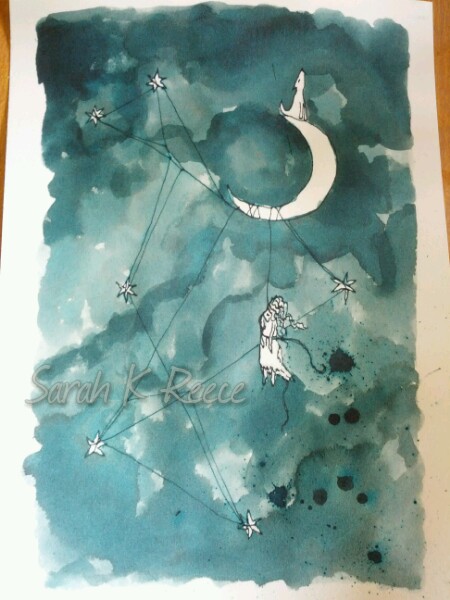
Dark bodypainting self portraits

26-2014-01-09 17.50.10

It’s been a rough few days. Yesterday, I barely spoke all day. I remember when I was living in a caravan park, this used to happen. Days in a row would go by in which I was silent, except for my journal, except for the weeping. There’s a relief in it, sometimes. I hide from the world, lock the doors, keep the curtains drawn. My paints sang to me and the day turned into a collage of sleeping, body painting, and photographing myself. When all else makes no sense, make art. I have my souvenirs from the underworld. Yes, it’s strange, but it’s cheaper than hospital. I’m still cleaning paint off the bathroom floor. It’s better than cleaning up blood. These are a small sample of the photos I took.

09-2014-01-09 17.36.50-2

04-2014-01-09 22.00.29

03-2014-01-09 22.16.35

12-2014-01-09 18.26.54

07-2014-01-09 20.38.11

So many questions. Why the psychosis? How is it linked to art? Why does creativity, not just any art, but the dark kind, help? How much of this do I need? Can I pre-empt the fraying? How do I fit this into my life plans – a job, sharing a house, becoming a mother, when it’s strange, anti-social, dark? I want to get my camera fixed, the good one, and buy a tripod. I’m supposed to be going back to college soon. I can’t fit it all in. My inks are singing to me. Is this how I heal? Ink not blood, and Wrist poems, and Making art. I don’t know. This is not about pain. There’s something else down the bottom of this well, this rabbit hole. Something I don’t understand. The voice of the night wind perhaps. Something – some one – needing a voice and a place at the table, even if the cup is chipped and the soup is watered down. A sense of freedom from the world, a place where my identity is solely that of ‘artist’.

Wrist Poems

Wrist Poems are an art form I have been exploring since my youth. During school years I would write poems or draw images onto the skin of my wrists, arms, and breasts as a way of communicating, connecting with myself, owning my own skin, and protesting a highly censored and restricted environment. I have since come to love body painting, tattoos, henna, and other forms of skin based artwork. Wrist poems continue to be part of my art practice and my own self care.

I have struggles with self hate and self harm. I use wrist poems as an alternative to bloodletting. There are no images of real self harm or blood anywhere on this blog. These are part of my Ink not blood response to the impulse for pain and self destruction. The titles of each are links to more images or information about that Wrist Poem.

Blue Rose:

wpid-20150129_234742_wm.jpg

This is not my Hand:

wpid-20150630_073311-1_wm.jpg

Alone at 4am:

Alone at 4am

Looking for self compassion:

7e1cc-img_20130415_192700_wm

Body Painting Glove Project:

Body Painting

Wrist Poem – Nobody:

Nobody wrist poem

Wrist poem – Broken:

Wrist Poem - Broken 1

Sickness and Health:

Health & sickness 1

Ink not Blood city:

wpid-IMG_20131208_235709_wm.jpg

Still here

Still here. Black and bleak and locked in my house but here. Not fraying anymore. So tired my eyes feel like hot black coals. I’ve slept all night and half the day. Dreamtossed. I start dreaming the moment I close my eyes. I’m sailing out on the tides, and it’s stopped hurting for now. No screaming fire pain, no anxiety making my heart run like a rabbit. Just my breath, moving in my mouth. Numb air cool against my tongue. There’s the sweetness of poetry, running like juice down my chin. I could not come to the night, so the night came to me. My hair smells of frankincense and my skin of memories.

My wrists have stopped singing to me. It’s my inks and paints I can hear. I want a souvenir. (something I can hold in the palm of my hand) When the dawn strips me of everything. I want to remember.

On thin ice

Yesterday was an okay kind of day, some good stuff, some difficult. I’m home now at the end of it and I’m fragile. I’ve been doing a lot of things lately that asked a lot of bravery of me and perhaps I’ve misjudged somewhere. My head is full of parts who are screaming and I’m massively dissociative and in the early stages of a possible psychosis. I’m deliberately cultivating the dissociation in the hopes that will be protective against the psychosis. It’s a really weird feeling to go from being fine, to that sudden sense of being on very thin ice, where a wrong move will tumble me down a rabbit hole that’s cold, dark, lonely, and populated with nightmares.

I can feel my hands fraying into the night. There’s screaming under the water, and a shrill kind of silence that’s like pressure in my ears. And then, in the next moment, we switch, and there’s breath in my throat again and nothing seems more ridiculous than the suggestion that we’re in any kind of trouble. Breathing in and out and watching the night go from peaceful to terrifying. Not looking at the starless sky. I take three steps back inside my own skin. I pull the ash of the zombie years over my skin, use it to weigh me down so the wind cannot blow me away. I withdraw my consciousness from my hands. These are not my hands, not my fingers, these hives on my wrist are not mine. I am a candle deep inside a lantern of skin.

No crying now, just the little eye roll of the unperturbed. Someone who has to stay up all night with a sick child or creature. Someone stolid, who settles in with a book and a cup of coco, who has brought a blanket to wrap in against the cold, to do what must be done without trauma or exasperation. Tomorrow is another day, it’s another day.

About Transgender

For those of us who are a bit new to the idea and language around what it is to be trans, it can be a bit confusing or intimidating. Some of us are just baffled, some of us are trying to engage but worried about getting it wrong and being offensive. Some of us are loud and offensive about being baffled.

Some cultures cope just fine with the idea that some people have a strong sense of gender that is different to their body. On the whole, Western culture has not. We divide our world by gender starting at or before birth, and people who find their bodies place them on the wrong side of that divide are highly vulnerable to ridicule, disgust, and violence. This divide also causes strife for gay people, partly because the idea behind it is that all boys and all girls have more in common with their own gender than with each other, and that safety and discretion are obtained by separating them for private acts such as toileting, changing clothes, sports, and medical care. When we think that our young girls are made safe from feeling exposed by segregation from boys, having a gay girl (or a girl who is thought to be gay) in the class can trigger a powerful sense of threat, and with that fear often comes rejection or even violence. The same goes for when a young trans girl (ie a girl with a male body) uses the girl’s facilities – or the boy’s facilities. These minority gender and sexual identities are often highly vulnerable and don’t have a safe place in a world divided by gender and assuming that everyone is straight.

So what is trans? A quick guide to the language – someone who is trans has a sense of gender identity that is different to their body. Those of us who have a gender identity that is the same as our body are not called ‘normal’, but rather cis-gendered. This is because it is normal for some people in every community to be trans. Some people with a female body have a strong sense of being male. This is different to feeling like you are female but masculine (or male but feminine) – I have tomboy girls in my system and their sense of themselves is completely different to the guy parts. Being trans doesn’t mean you’re gay. There’s a difference between gender identity and gender expression, and also with our connection to the traits we’ve bound up in our ideas about what is feminine and masculine. They are all connected, certainly, but also distinct. Some trans people are gay, or bi, some are straight. (I touch on this is my post What bisexuality is and 9 things it isn’t) Some trans people take hormones or have surgeries to help themselves look and feel more like their real gender. Some trans people don’t have the money or social support to come out. The rates of suicide and violence against trans people are far higher than average.

In some ways and areas the trans community has been able to get legal supports more quickly than the gay community, in areas of recognition such as legal documents and relationships. In other areas the trans community is still far more vulnerable and at risk, particularly when it comes to social acceptance. Part of the struggle for this is that many gay people are willing to openly identify as gay, and want their lives and love and families to be visible. Many trans people do not identify as trans, they identify as male or female, and what they desire is to be accepted and to ‘pass’ for being their real gender. For many people, being trans is a source of shame, and being identified as trans is humiliating. This means that there are not many trans people willing to become activists to help to raise awareness and further the cause of social justice. So the community is very vulnerable. This is changing more and more, as is the traditional either/or binary of identifying as male/female. Some people identify as both, or as neither, or feel different on different days. There’s nothing wrong with any of this!

Trans issues and needs are highly relevant in my own work with people who have parts, because it’s quite common for different parts to have a different gender identity. This can be tough for people, sometimes trans supports aren’t multiple friendly and want people to choose to be either male or female all the time. Sometimes multiple supports aren’t trans friendly and treat being multiple as if that means it’s never healthy to access trans supports or to want to identify as trans. The reality of course, is more complex. Sometimes multiple systems want to transition because their primary part or parts who run the day to day life are trans. Sometimes one part is trans and wants to know about temporary devices and supports (such as prosthetics, makeup, or breast binding) to be able to be out as their gender and go to a movie or out to dinner. Many multiples who are gender diverse have great difficulty with things like using public, gender specific toilets, or engaging with gendered communities and activities such as sports. Sometimes supporting a trans part can be as simple as buying a pair of guys or girls shoes for them to wear, or having a partner willing to use the correct gender pronoun when they’re out. Sometimes trans parts in a girl body will find it easier that they can wear male clothing in the western culture and this is pretty normal for girls today, sometimes being seen as a tomboy rather than a guy just makes them feel painfully invisible. Sometimes trans parts in a guy body find that the rest of their system feels so threatened by being seen as female that it’s very hard to get any gestures of being female accepted.

I have male parts in my own system and we’re still struggling to figure out how to engage this positively. One of mine is a black humoured cross dresser who wears more makeup than most of the girls in my system and finds it deeply amusing that he can go to work in drag without anyone being the wiser. Another is a gentle and shy gay guy who is so lonely and quiet that I know almost nothing about him. I come from a background where women were run down and the feminine was treated with disgust and disdain. Being female was equated with being weak. The only women who were treated with respect were highly masculine. I remember the courage it took to tell people that I wanted children, that I felt highly maternal. It took a lot of processing to embrace being female, to find strength and beauty in it. It took possibly even more to reconcile myself to some aspects of the feminine, and to my attraction to women. So it’s been highly threatening to process that some parts of us feel male. And even more confusing to us, that they are not necessarily particularly masculine guys at that. We’re working on it, gently. In our culture, gender can bring out a deep sense of threat and fear even in those of us who consider ourselves to be very accepting.

So, let’s work to make more room in our lives for diversity in gender. Let’s embrace the trans people in our communities, in our own systems, in our schools and workplaces. Let’s stop trying to force people to ‘choose a side’ when their real, authentic state at the moment is confused, ambivalent, both, or neither. Some trans people find that after years of only identifying as their real gender, through all the hell of outing themselves and transitioning, they are finally safe to acknowledge that they like some activities, or qualities, or have some skills or interests that are traditionally seen as being of the other gender, and that’s okay. So do most cis-gendered people. 🙂 Let’s be honest about fear and threat and work to make everyone feel safer, and be safer. Let’s make it possible for trans people who want more than anything to pass, to not have their trans identity subsume all the rest of who they are, and to not have to live in fear of being outed. Let’s support the trans activists and people who live openly and answer questions and humanise, and remind us of the painful, awful statistics that show we have such a long way to go for social acceptance of trans people.

If you’d like to read some more about trans issues or find some support, here are a few links I’ve come across recently that I liked. If you’d like to add any other links or thoughts, particularly if you’re trans and feel I’ve misrepresented you in some way, please comment or email me. 🙂 As I’ve said, this isn’t my ‘home turf’, I’m somewhat new to the topic and might step on toes or repeat myths without being aware of it. Wherever you stand, I hope this article has given you some food for thought.

Readers’ Top 10 Transgender Stories of 2013 | Courtney O’Donnell.

All About Trans | Encouraging better understanding of trans people in the UK.

From bullied child to transgender woman: my coming of age | Paris Lees | Society | The Guardian.

35 Trans Women I Had #Herocrushes On In 2013 | Autostraddle.

Awesome Quote – Self Care

Sometimes someone else says something to me that just clicks. Like a bell ringing deep in my chest, there’s a sense of connection to something I needed to hear. It will often stay with me for days, sometimes even years, and get woven into my complex personal philosophy of life, or trauma recovery, or community building, or whatever other framework I’m currently working on.

This one was by a friend and fellow peer worker with DID, who like me works a lot with other multiples. She was sharing how sometimes people get frustrated that she is able to function in the world – she has a home and a long term relationship and a job and all those things that both give and require stability. For some of us with DID, these can seem like impossible dreams. She said to me one of the things she tells them, if it’s appropriate is:

I can do what I do, because I spend a minimum of 3 hours a day on self care. When you do 3 hours of self care a day, you too will be able to do these things.

This resonated.

On one level, both she and I know it’s not this simple. Bad luck, abusive relationships, sickness, homelessness, and so on can all strip any person of the capacity to work full time or do many other things that need a lot of sustained energy and emotional stability. There’s more to recovery than self care, there’s also things like community, opportunities, and a decent dose of luck. Self care, like self love, often needs to be done in a context – we are better at loving ourselves when we are loved by others, and when we see others loving themselves too. Sometimes the first goal of self care is to find or create some spaces where we can care for ourselves without being attacked or belittled.

But on another level, this idea about self care boils down a whole stack of complex concepts to something incredibly simple. Are you getting what you need to function? Are you sabotaging yourself? Are you neglecting yourself? Are you trying to run on empty? Do you even know what you need? Are you waiting for someone else to do it? Do you wait until you crash and burn before being caring? Do you look after yourself, with your specific and unique needs, a lot, every single day? How do you expect to function if you don’t?

It was a powerful reminder. I have big dreams. I have big expectations of myself. I need to match them with a powerful commitment to looking after myself. That can’t be self care that would work for someone else. It can’t be punitive, traumatising, or harsh. It needs to genuinely be the unique things that support me. The kind of care and devotion I have learned to give to my pets and garden, applied to me. It may not be easy, but on one level it’s stunningly simple.