About Dissociation page

I’m continuing to work on the new website when I have a moment here and there. It’s been a lot slower to get up than I’d hoped, mostly because I was completely over-estimating how much time I’d have to do it in. Typical! I’m happy with the layout and design, just working on filling in and updating all the pages now so that it is easy to navigate and has lots of useful links and up to date information.

Tonight I’ve been working on the ‘About Dissociation’ page that will be an introduction for anyone coming to the site. I’ve decided to use some of the images and structure from my latest talk for the Voices Vic conference. That’s another booklet in the logjam of booklets I’m working on publishing! I’m also planning to update and create links to PDF’s of the factsheets I wrote and then drew upon to write the  information about dissociation and DID for this blog for people to print or download.

So, for all of you who couldn’t get to the talk and haven’t had a chance to see the artwork yet, pop over to the new site The Dissociative Initiative and have a look. 🙂

The Freak Factor

The Freak Factor is the name I’ve given to the stress that feeling profoundly different from other people causes me. I really feel it a lot talking as openly as I do about experiences such as dissociation. It’s a difficult issue for me to manage. It has roots in childhood bullying for me, where other kids found me different and weird, and I was often ostracised. Freak was a favourite insult and something I heard a lot of. In some situations like this people will shut down and become very compliant and try to fit in. In my case I couldn’t fit enough, nothing was going to get me accepted and there was no reward for shutting myself down like that. So I went in the other direction, and celebrated my independence. When the other kids are ‘normal’ and they are the ones who make you hate yourself, then you don’t much want to be normal.

I’ve found it really sad how many anti-bullying campaigns focus on trying to stop the current victims being targeted. Without a shift in the culture of the class, often all this does is changes which kids are the bottom of the heap. The fastest way out for me would always have been to join forces against someone else, or at the very least turn a blind eye.

So, I have an ambivalent relationship to the concept of being a freak. There’s a point at which I’ve taken on that identity, even found safety in it. When normality is presented as cruelty, indifference, conformity, loss, I’m proud to be a freak. I wore bizarre David Bowie type clothes to casual days, glued gems to my throat, wrote poems down my arms, loved my black lipstick, craved freedom and celebrated diversity. With an affinity for the theatre, the gothic, the circus, as someone who wrote poems, struggled with suicide, burned with loneliness and longed for a life with depth, meaning, and passion, freak was a word I reclaimed and wore with pride, the way some people have done with queer and mad.

But freak also touches some deep wounds in me. Finishing the last years at school I had several recurring dreams that haunted me. One of them was of me, standing alone at night in the school ground. The moon was bright and full and the white bricks of the buildings were the colour of fresh stripped bone. I had paint on my hands, crimson paint. On the long wall in front of me, is the word ALIENATED in red letters as tall as I am. I am stretch tall, starvation thin, legs and arms just skin over bone. In my chest is such hopelessness and rage. There’s paint on my hands that changes to blood and back to paint and back to blood again.

The humiliation and rejection were powerful. The need for acceptance, for somewhere I felt I belonged, something greater than myself I could be part of and give myself to, tore me apart.

Getting a diagnosis felt like ‘freak’ by another name. To stand up in front of rooms of people and talk about dissociation when it is so often feared, misunderstood, and sensationalised is to be hit with the freak factor in a huge way. It can feel like the things about me that are different obscure everything else, dominate my identity, overwhelm even the most basic level of shared humanity. The Gap opens under me and I fall into it. Alienation cuts deeps, and my response is suicidal distress. There’s a point at which I cannot bear any longer that the only acceptance I get is when people don’t know – or pretend not to notice – how different I am. There’s a point at which this ‘kindness’ is unbearably painful and I feel like I’ve got my wings pinned, my shape crunched into something unnatural for me. I crave flight, my own shape, my own name, the freedom to be who and how I am, and the need to be known and to be loved. Whereas talking openly often feels like a bug on the dissection table, pinned back as people investigate a curiosity that ceased to be a person the moment I held my hand up and took on the freak label willingly. People often don’t seem to realise that as strange as they might find how I function, for someone like me for whom this has been how I have always worked, I live in a world where everyone else at times is strange and confusing to me.

At the moment the freak factor is causing me a lot of trouble. I find it really destabilising. There’s a huge conflict in me between my desire to raise awareness, educate, and support people around these issues, and the inclination to never tell another soul, to stay home and lock the doors and paint. I’ve been trying to work out ways to reduce it. Bridges is part of this, having the opportunity to sit in a room of people and feel ‘normal’, in the norm, just one of them is so powerful and such a relief. It’s become part of my safe space, something I come back to when I’m exhausted and overloaded dealing with the freak factor and need to recharge. Mates who accept me, places where I feel I can be myself and accepted, instead of those two needs always being in conflict, acceptance always being the reward for keeping secrets and trying to blend in.

I’ve been thinking of doing talks and things like that as a trip into a desert. For a critter like a frog, that’s a lousy environment. I can handle it for a bit, but too long and I’m going to shrivel up. I need to head back to my pond and soak up some water, get my skin wet. I take that sense of being normal back out with me, of being okay, and try to share it for a bit, to help people see another way of looking at this, especially those who have these issues themselves and feel alone and afraid. Maybe I’ll get better at carrying it around with me. Maybe my pond will get bigger over time. Maybe it will always be this difficult. I’m not really sure. Some days I hide out in my pond and get away from the freak feeling and others I neutralise it by turning into something I value. In any case, considering that a lot of what makes me ‘different’ is about self expression and individuality, I’m certainly not looking to deal with the freak factor by turning myself into a ‘normal’ person. Normal has never been my goal. Healthy, functioning, authentic, passionate, genuinely alive, loving, these are the things I want, the growth I seek. I’m aiming a lot higher than normal.

The task is not to become normal. The task is to take up your journey of recovery and to become who you are called to be.

Patricia E. Deegan


Poem – A long day

Long day, I feel weary now
dark
sad
badly in need
of my own company

here in the shadows
where I hear the wind stir
in the peppercorn tree

here in the silence
a voice almost speaks
on the edge of awareness
I feel something stirring inside
my dusty wings
longing for flight
listening to the night wind
sing a dark song of midnight rain
moonlight on water
owl flight, dog howl, the secret
passageways of mice
the trees that go roaming, roaming
walking the hills under shadows
and the streetlamps, winging
about the cities, 
hearing our violence and our dreams.

Such songs, to stir my heart
to wake restless longings in me
the need for poems then…
the need for ink
a great sorrow lies beneath my days
a dark wonder
the lonely passage of the trains
and the wind, the wind
singing in the trees.

Ceramics

I have been really enjoying my ceramics class. There is something very magic about the process, starting with a bag of clay and ending up with an amazing object of some kind. I love the feel of fresh clean clay, The feel of glazed fired earthenware in my hands. I find them very precious these little things, even simple little dishes made by people I’ve never met, there’s a kind of touch left in the clay that I feel, something human in how lovely and hard wearing and practical and fragile they are.

Last week I had my access plan to take in. This is the Tafe disability support process, how it works is you go in to see a counsellor or support services person, and talk to them about what you have and what support you need. You get paperwork filled out by your GP verifying everything, and you and the counsellor work up an access plan together. The plan doesn’t say what your condition is, it only says what supports or accommodations you may need. For instance in my case it mentions that my hands and wrists fatigue and I will need to rest them during long studio sessions. (among other things)

I wanted to hand the form over to my ceramics tutor today so that he would be aware that sometimes I may need breaks etc. As I walked down the stairs to the ceramics class, I passed a couple of Tafe staff talking to each other. I was trying not to listen in but they weren’t being particularly quiet. They were talking about someone else at Tafe, one of them said to the other “He’s gone nuts!” and the other replied “Yes, didn’t he say last year he has a mental illness?” I kept walking, head down.

It was really hard to pull out my access form and hand it over.

On the train home from the Voices Vic conference in Melbourne, I went up to the little cafe to buy a drink and the staff member there commented about how tired I looked. I mentioned I’d been at a conference and not had much sleep that week. When he asked what the conference was about I said Mental Health, and then added voice hearing. He went a little pale and pulled back, and I remembered that back in the rest of the world, this is scary and dangerous and not something people talk about. He was very courteous and we talked a little longer. I explained that many people hear voices that aren’t distressing or dangerous, and that one of the aims of the conference was to try and learn from them what can be done to support those who hear voices that are awful. Working in mental health is like constantly crossing cultural borders sometimes, between very different worlds where what is normal in one is taboo in another.

This week I am hoping to fire my little creations and then I will take photos to show you. We have been learning some basic clay work techniques called hand building, that is just working with our hands, not using a wheel. We had to make some small objects of our own choosing, I have made two pitted stone fruit halves and a fat luscious pomegranate. I bring along a hand cream because the clay draws all the moisture from your skin and I get eczema quickly under those circumstances, so ceramics class is becoming forever linked to the smell of rose hand cream for me. Sitting down there in the basement watching the rain on the pavement up in the high windows is very special. The studios are so beautiful and so well laid out, I always feel at peace in them. It’s so important for me to spend time being an artist and not let the peer work take over everything.  My own studio is not set up properly yet, just a start. The whole unit is in limbo a bit, I’m having a lot of trouble convincing myself that I’ll be able to stay living here. Things have been transient for a long time. It’s hard to move in properly when you think you’ll be leaving again shortly anyway. It’s taking time, taking time.

I’ve been sick, quite suddenly. After a couple of days resting I don’t think it’s physical exhaustion, the timing is wrong. My head is busy and my heart is busy with a lot of processing. Sometimes it’s hard with me to work out if the problem is more physical or psychological, and often a bit of both are going on. I feel full, I haven’t been able to digest the conference or the funding training and opportunities or the situation with Charlie and my neighbours or getting a home of my own. I keep going out the back door and being surprised to find a yard there, it’s bigger than I remembered and there’s a tree and a lawn. It’s all a bit surreal.

I was ill all morning, the TMJ flared and my pain level was high but I was out of painkillers and money. The joint pain was bad, I get a lot of inflammation in the tendons in my feet and my heels become really painful to walk on. My stomach has been upset for a couple of days now. I had to drag myself off to Radio Adelaide to do some homework due Monday night, it took a couple of hours which was a lot longer than I’d expected. Mostly it was because I was using Adobe Audition (on their computers) for the first time and the manual didn’t have any instructions. I kept having to look up help online to work out how to perform basic functions. I got there in the end, I have my first interview recorded and edited. I pulled it from 7 minutes down to 5 and removed a lot of ‘ummm’s from my interviewee. I’m proud of that effort and I managed not to throw up on the computer either. 🙂 Monday is a long day but I have all Tuesday off, just some homework to do and friends to catch up with, which I’m looking forward to. One foot in front of the other.

See my first ceramics creations here.

Articles!

I’ve spent a little bit of time recently catching up with old articles I’ve written and uploading them in PDF format on my Articles page. Some folks like to print them out to share, and in any case having all of the articles together makes it easier for people who find searching the archives time consuming and frustrating. I’m usually a few articles behind at any one time because writing, editing and posting to the blog is time consuming enough every day without adding in the extra steps for the PDF. Usually every couple of weeks I set aside some time to go back and catch up.

I was pretty amazed to see that since I started this blog in August I have written 46 articles so far, at a total of over 60,000 words! That’s not including the rest of this blog, just the articles. Wow!

A few people have encouraged me to write a book about dissociation and I’d been thinking that if I took some of the articles as the starting point for various chapters and elaborated a bit more I’d probably be able to put together a book about managing dissociation pretty quickly. Now I’m starting to think that if I keep this up I’ll have to prune and edit instead!

As I’m currently swamped with study this isn’t a project I can put a lot of energy into right now. Second semester or next year, possibly. But I am mulling it all over and thinking about structure and format and pictures and how clinical or personal it should be and who the primary audience is.

What I am going to be working on soon however, is getting some booklets published. I’ve delivered a number of talks with complimentary artworks over the past couple of years and I frequently get requests for the talks in a booklet format that can easily be shared. I’ve been so keen to do this and feeling very frustrated that it’s taken a lot longer than I’d hoped to get it happening, mostly because of my mad schedule, partly because I’m broke. The first one is going to be the most difficult because I’ve never used the software you lay it out on before and I expect it to have a steep learning curve. Hopefully after that it will be easier to put together, and if I create them as a series then a lot of the formatting can be used from one to the next which will help to cut down on my workload and speed things up a little.

In the meantime, I’m concentrating on actually making time to recharge. I’m finding this a huge challenge which means things have become quite unbalanced. It’s hard to slow down! But I need to or I’ll fall apart. Even if it means some thing take longer or don’t get done. I’ve made up a big pot of chicken noodle soup for the week, washed a load of laundry, given Charlie a bath, had a bath myself, caught up with a couple of friends, done a rehearsal for the upcoming Fringe event, played some computer games, and listened to new music on youtube. Plans for some camping in a couple of months, starting to think about going away for my birthday somewhere. Rereading a favourite Alistair MacLean book, trying to work out how I’m going to actually start feeling like I live here and this is my home, house smells of garlic and thyme, bathroom’s been cleaned, rain keeps falling. Pretty awesome weekend.

Is Mental Illness a Disability?

Okay, big topic, plenty of toes to step on. Let’s see how I go!

I personally do group Mental Illness in with other Disabilities. Speaking as someone who has a number of disabilities in various areas – psychiatric, chronic illness, learning, and at times mobility related (eg. I’ve spent a couple of years in a wheelchair) I’m in a good place to compare and contrast.

There are some really good arguments against treating Mental Illnesses as Disabilities. One of them is that disabilities tend to come with the perception of lasting a long time. Doing anything more that makes people feel they will not or can not recover from or live well despite Mental Illness is not a good thing. Another one I’ve heard is that people feel that the word disability is so negative, it immediately obscures everything they feel they’ve gained through their experience of Mental Illness.  People point to their creativity, self awareness, drive, passion, empathy, sensitivity, resilience and say ‘Is this a deficit? I think not!’ Those who reject the medical model aren’t happy about the label ‘mental illness’ being applied to their experiences, which is pretty understandable. They tend to be even less thrilled about being grouped in the disability box too!

My experience has been that most folks who find themselves in this ‘disability box’ feel much the same way. The first experiences of someone sectioned in a psychiatric hospital are often absolute horror at being trapped in with the crazy people. Suddenly faced with a ward full of people who are weeping or medicated to sleep or talking to themselves or wildly unpredictable, most people are mortified at the implication that these are their people. That as far as society is concerned, you are one of them. Folks disabled suddenly often struggle with the same massive identity shift, confident footballers left paraplegic following accidents are stunned to find themselves now thought of and spoken of as a disabled person. As with mental illness, often some of the greatest harm is done not by the actual condition or limitation or experience, but by the terrible stigma that accompanies it.

Those of us who have prided ourselves on our independence, strength, productivity, cheerfulness, generosity are bowled over by the shock and stress of having to see ourselves completely differently and struggling to maintain our sense of self and self-esteem when everything we used to rest it on gets taken away. Sometimes we are forced to confront ourselves as dependent, vulnerable, exhausted, irritable, and the recipient of care rather than the giver.

People with disabilities often express deep frustration that their limitations are constantly given more focus and attention with their capabilities. The entire disability sector is attempting to reduce stigma, redefine horrible labels, and draw attention to the incredible array of skills, gifts, interests and talents that people with disabilities have. Some of these – as in the case of superb hearing, are a direct result of the disability such as vision impairment. Many people with disabilities talk about what they are able to do, and how so much of what holds them back and restricts them has nothing to do with their condition and everything to do with stigma, discrimination, and lack of awareness.

Disability tends to evoke the idea of a life-long condition. For some people this is the case. For others, a disability of some form is temporary. They may heal, be cured, grow out of it, adapt to it, recover. This misconception about life long doesn’t fit a lot of people.

My experience has been that everything we hate about the disability label, is everything everyone else in the disability label hates.

For those who do not consider their experiences to be ‘Mental Illness’ and do not see them as a limitation of any kind, it’s entirely understandable that being asked to view them as a disability would be deeply unpalatable.

There are many definitions of disability, including social constructs that view the limitations as being socially created (through lack of access etc) rather than oriented within an individual. To bypass some very complex conversations for a moment and use a very primitive definition of disability – a limitation of some kind for which you need support, assistance or a different approach to be able to do something someone else your age could do – then it’s true that there are experiences currently called Mental Illness that do not fit this definition. Voice Hearers who live well with voices that cause them no harm or detriment are right to be uncomfortable with being classed as having a disability. We are not the only ones who feel this way, there are other people who have been traditionally grouped in the Disability sector who have fought to not be considered part of it anymore. Two big areas are those of the Deaf Community and some folks on the Autism Spectrum. I think we can learn a lot about our relationship to the Disability label by observing the dynamics of other groups and their stance.

A big portion of the Deaf Community have argued that Deafness is a cultural state and in no way a disability or limitation of any kind. With a history of appalling treatment by well-meaning hearing people who banned sign language in a fairly futile and certainly traumatic attempt to make deaf children communicate ‘normally’, there are now many deaf people who have so divorced themselves from the disability sector that when a woman recently spoke about curing the world of the scourge of deafness, this community was furious at what they perceived to be an attempt to annihilate their kind. They point out that within their own communities with things set up for them they are in no way limited or disabled. The separatism in some areas is so extreme that some hearing parents are afraid of the Deaf Community ‘getting hold of’ their children and entangling them in a social hierarchy that confers status on the basis of degree of deafness and deafness in your lineage. The Deaf Community is desperately underfunded, there is a chronic shortage of money to pay for translators to enable Deaf people to further their education, interact with their own doctors, and function in a hearing world that largely ignores them. The arguments about cultural pride can be so loud that a newly deaf person who is shocked and mourning a loss of a sense they valued has no voice.

Some in the Austism Community, Auties (those with some form of Autism), and Aspies (those with Asperger’s, ‘high functioning’ Autism), have also rejected the disability label and embraced Spectrum Pride with enthusiasm. Those who are ‘high functioning’ point out that they do not perceive any limitation or disability arising from their condition. They talk about how we have pathologised a normal variant of the human condition, and that efforts to help them are little more than attempts to coerce them to conform to social norms and values they have no interest in. There are a lot of parallels here. In some groups, separatism is becoming extreme, Auties and Aspies spending time and forming relationships exclusively with each other, talking in stereotyped and derogatory ways about ‘Neurotypicals’ (the rest of us) who lack creativity, innovation, strength and are examples of lesser kinds of humans. Autism is generally considered to be responsive to significant, quality early intervention, which is highly expensive. Autism support is also desperately underfunded.

There is a conflict here. People are trying to find frameworks that are respectful and dignified and acknowledge that for many people given a label, there are no limitations beyond that of stigma and small mindedness. That the world and people are incredibly diverse and there is richness in acknowledging that and joy in being proud of it instead of characterising it as a defect. This is so important!!

Those in the disability sector who have an illness of some kind rather that a condition that is stable and non-life threatening don’t tend to lean towards the ‘Pride’ movement in the same way. Rather than being offended by the prospect of cultural annihilation, they are tired of pain, weary of medical interventions, afraid of early death, struggling to survive. There is great pride in what people are able to do despite their illness, but the illness itself is often perceived as an enemy that takes much away. These people usually want to be cured, their conditions rob time, dignity, comfort, fertility, and life.

And then there is the need, the reality that at the other end of the spectrum, where the voices are abusive, where the autism is severe and terrifying, where the deafness leaves someone isolated, distressed, unable to complete schooling, there is great need. When we allow our most functioning representatives to shout about Pride, the cruel reality seems to be that our most vulnerable people go without funds and services. Funds and services are provided for people who need them. If there is nothing wrong with us, if we are just diverse, if we have no limitations and are not disabled, there is no need for funding or services.

I am very wary of freedoms that are purchased at the cost of someone else. It is not only the wider community that can be discriminating, negatively stereotype, dis-empower and harm. Sometimes those of us who have received the most appalling treatment are at the highest risk of reacting against it by building our own worlds on the same principles. 

I am wary of those of us who know the pain of stigma making decisions about how we see ourselves and our group on the basis of stigmatising misconceptions about other groups.

I think we make things better from within, together, rather than splitting off and saying ‘we are not like those other people’. I think we fight to reduce stigma, to create pride and joy and celebration of all diversity, not just our own. I think we who are least limited and have the most voice owe those who are most suffering. We overcome stigma and discrimination when we stop dividing people up into camps and defining ourselves as different from – better than, those people. We build a better world when we stand together and say – see these people with intellectual disabilities? These are my people. See these ‘mad’ people in the psychiatric ward? These are my people. People with autism, with MS, with delayed speech, with social phobia, with downs syndrome, with acquired brain injury, people who are isolated, friendless, suffering, people who are incredible, resilient, creative, these are my people. 

These are our people. 

We all deserve self-respect, and we all deserve support when we need it.
Beyond Cultural Sensitivity

There’s an interesting idea becoming more prominent in the mental health and community services area. Here in multicultural Australia we’re starting to talk about making sure services are culturally appropriate. Some examples I’ve come across are allowing traditional healing ceremonies for a person from an Aboriginal or Torrens Strait Islander heritage who is suffering from severe mental illness. Another is being willing to use the terms and frameworks about mental illness that people from a different culture are more comfortable with.

There’s an interesting tension between the goals of wanting to educate, raise awareness , and reduce stigma about mental illness, and wanting to be sensitive to the beliefs and understandings of different cultures.

From my perspective one of the things that interests me is how narrowly we are currently defining this idea of culture. If a white European turns up in the psych ward convinced he is hearing the voice of God it is explained to him he is psychotic. But according to the expectations of cultural sensitivity, it’s not appropriate to say that to someone from a CALD (culturally and linguistically diverse) background.

From the perspective of someone who’s spent a lot of time rejecting the mainstream culture I was raised in and embracing the values and ethos of various subcultures instead (such as goth), I find it frustrating and offensive that being Caucasian means it is assumed I am of the same culture as the social workers who put together community programs.

Most of our mental health services operate from a set of values that in my opinion are very middle class. I see that as both as strength and a weakness. There are a number of middle class values that are pretty awesome, and there are a lot of people who find these values and this culture the most comfortable and reassuring. But on the other hand, there is a high need for appropriate support for people from marginalised subcultures, as that experience of being marginalised is one of the risk factors for developing a mental illness.

When everyone is dressed in suits and speaking clinical psych lingo, our hippies, punks, goths, stoners, metal heads, bikies, artists, sex workers, emos, nerds, surfies, queers, new agers, and skinheads may not feel comfortable looking for support, and may not be able to find the kind of support they actually want.

I think defining cultural sensitivity more broadly means encouraging diversity of many kinds in our mental health services. I like to see people from CALD backgrounds in services. I also like to see men and women, mainstream and alternative, younger and older. When our services get uptight about appearing ‘professional’, often under the mistaken idea that all people see this as a sign of respect, I am depressed. When we translate fact sheets and information into Italian but not into Plain English for laypeople I feel like we’ve missed the point. And when we go to a lot of effort to create environments in which our funders would feel comfortable but not our highest need people with mental illnesses I’m deeply frustrated.

The training around social and community work has a language that mostly leaves me cold. I drive through small towns with little community centres bravely trying to offer social cohesion and connection in a format that is perceived to be so profoundly uncool that only the most desperate or dis-empowered will seek help there. On the most basic level, having almost no services available after hours when we know that after hours are the peak need times, that many people with mental illnesses are most stressed and vulnerable at night when they can’t sleep and can’t talk to friends or family is such an obvious clash between the need and the structure of the services.

Another example is of a young person seeking to rebuild their life following an episode of mental illness, and encountering a major culture clash between their needs and the values of the support staff. They loved to DJ which involved late nights, but the staff were trying to help them get up early and have ‘normal’ sleep patterns. Whose recovery is this, anyway?

Mental illness and different from the norm are often confused with each other. It can be difficult at times to get people to see them as separate concepts. One of the things that concerned me back when I started this blog is that I am a fairly alternative person – my way of coping with a stressful talk at an interstate conference is to dye my hair green. I worried that my artistic nature would make me a poor spokesperson for all those people with mental illnesses who are trying to explain – ‘look we’re normal’! Then I thought about all the oddballs like me who also need spokespeople, particularly those who can say ‘I am not normal and I don’t want to be normal, but I do need support to function!’ ‘Normal’ and ‘healthy’ are different concepts. ‘Different’ and ‘mentally ill’ are also different concepts. Some of us crave a link back to wider society and need our ‘normalness’ recognised. Some of us want our uniqueness to be seen as separate from our challenges, because we want help with one but have no intention of being ‘cured’ of the other!

The most frightening experience for me as an alternative person with a mental illness, has been struggling with homelessness and poverty and feeling very keenly that it’s critical I find a way to be perceived as valuable in the eyes of the people who control the resources. I wore no strange clothes to Centrelink appointments, no unusual hair or makeup to see people about housing support. Alternative people do not often run funding bodies, they are corporations with business and professional people in them who are comfortable in a corporate world. These are the people who set the tone for the services, and they feed and house their own.

What bypasses this? Community based support. Things were incredibly rough last year for me, and where I was staying I had a lovely neighbour who regularly gave me food over the back fence. That did a hell of a lot more for me than a visit from a community nurse. Taking in mates between houses, helping people move, gardening bees, hosting catch-up’s, pet sitting, volunteering to help at an art class, these things change people’s lives. Kindness is the greatest gift to anyone in difficulty, and is most spectacularly demonstrated between people who are both struggling. Often the most generous behaviour is between those at the bottom who know hardship and the difference that a gesture of care can make. What you do in your life matters, you don’t need to be well, or working, or saving whales to make a difference. How you choose to treat people, the other stressed out people admitted in hospital with you, your difficult neighbour, the girl at the community centre who completely rubs you up the wrong way – these things count. They make a difference, and you know they do, because each of us has experiences where care mattered, or where kindness was absent and its absence was painful.

So, I like the idea of culturally sensitive services. I especially like it when it dovetails with the idea of client-centred services, where there is recognition that on some level, each family, each friendship group, each religion, each town also has its own culture. Services also have a culture of their own, language, values and traditions. Sometimes there is a good match between these cultures and sometimes there is a painful clash. Good services adapt to the people they are there to support, and they model diversity of cultures within themselves. The best outreach to any group is often from a member of that group, and that means we need to create a culture in our services that welcomes and embraces people from diverse backgrounds in a way that encompasses and goes beyond CALD.

See more like this:

News and events

Righto, there are things coming up you should know about! Firstly, I’m going to be performing as part of the Fringe this year, in the Cracking Up Comedy team. I can’t tell you what I’ll be doing exactly because I haven’t written it yet! It will almost certainly involve poetry. It will be good, because I don’t go through the stress of getting on stage to perform something I don’t think is good. Come along! Details on What’s On. You can see a pic of me on the flyer on the main page of the Mental Health Coalition of SA. (just scroll down)

Also, I have heard recently about a retreat for people who have experienced childhood trauma or abuse. It will be in April at Swan Hill in Victoria. There is a cost involved but it’s pretty minimal for the time you’re there being fed and housed. I can’t personally vouch for this, I have never been on it, and I don’t personally know the people running it. I have heard some positive things second hand, and also been assured that at least one of the support people there is familiar with dissociation and DID, so please do some research if you think this might be useful for you. All the details on What’s On.

I have a poem in an exhibition in Broken Hill called Plastic Lives, written for an artwork that will be displayed in the gallery there. The opening is Friday 9th March with a poetry reading on Sat 10th I’d like to be able to get to. If you’d like any details, email me.

In other news, my TMJ pain has settled considerably since I got my night guard from the dentist. This week I’m trialling going off the new meds to see if I can do without them now. As they dry my mouth out (sounds innocuous, but it’s not – causes me severe dental decay) I’d prefer to do without them.

Charlie is…. still in a difficult spot. His ears are dreadful and the new meds haven’t yet done any magic. They are also very expensive, the new regime costs me $80 per 12 days and I’ve been told I may need to keep this up for 3 months. I’m not yet thinking about how I’m going to be able to keep that up. He has stopped howling at night which is a huge blessing, but I can hear him start up as I drive off, so I’m still very concerned about that. I have some sedating pain relief for him which I’m hoping will help. His new meds don’t taste very good as I found out the hard way the other night. Usually I can crush pills, mix them with yoghurt and he’ll gobble them. Not this time!! I had to spoon every last drop into him as he fussed and bubbled and sprayed me and the kitchen with gritty yoghurt. I had to change and mop afterwards!

We’ll get there somehow. Vet checkup next week to see how his ears and eyes are doing. I’m thinking of writing an open letter to my neighbours to let them know what’s going on.

Making your own stamp

I have a whole morning off today! I am enjoying it immensely. I’m still in my dressing gown past noon, sitting by an open window listening to the rain. I can feel my insides all unknotting. I’m also making plans to go camping with a friend and immediately I’m starting to feel more relaxed. I so need something good to look forward to, but it’s easy to forget that. Plenty of good things do happen, but having something to anticipate really helps me.

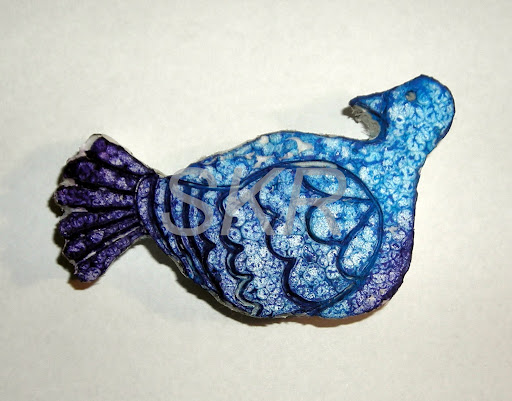
I am brewing some more mental health articles, don’t worry, but today I feel like posting about art instead. I was chatting recently with a friend about making your own stamps out of styrofoam so I thought I’d share that. Styrofoam is very cheap and easy to mark to make stamps with. Here’s the process I’ve used before.

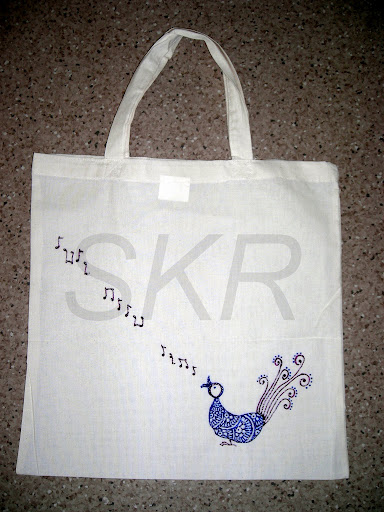
Hand made blue bird of happiness styrofoam stamp

1. Get a piece of styrofoam and cut it down to size. A utility or Stanley knife will do the trick.

2. Work out your design on paper, then transfer it using a pen onto the styrofoam. If you have trouble with it, your design may be too complex. These are best for simple stamps. You can also try cutting around the paper design and outlining it, then you can fill the details in by eye.

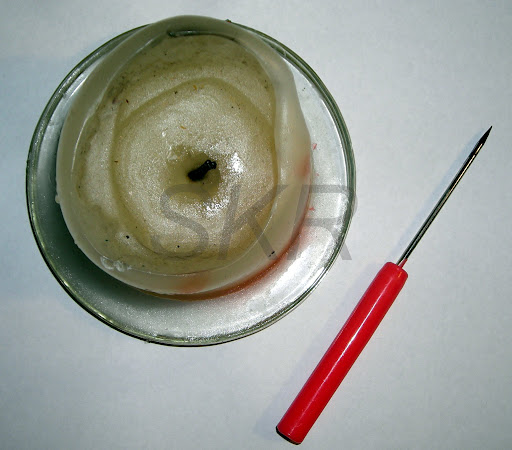
3. Take an awl, a nail, or some other thin piece of metal. I’ve used an awl here. (an awl is a sharp pointy stick used to pierce fabric) Light a candle and heat the tip of your metal in the flame. If the base is getting warm, make sure you use gloves, hold it with pliers, or wrap it in something heat proof.

4. Use the hot metal to melt your design into the styrofoam. This must be done in a well ventilated area, or for preference outside, the fumes are nasty smelling and bad for your health. The metal will cool quickly so keep the candle to hand and keep reheating it.

Awl and candle

5. Prepare your paint. Use any acrylic paint, add a drop of drying retarder if the weather is warm to give you lots of time to work before the paint dries.

6. Load the stamp. This means get paint onto it. You can do this by dabbing the stamp in a tray of paint, or by painting the stamp directly with a brush or sponge.

7. Test the stamp to make sure you are getting the right amount of paint on it. If your test is patchy, you have too little paint. If your test is blobby and the lines have blended, you have too much paint. It can take a few goes to get this right. These stamps will always leave a mottled paint because of the little balls that make up the styrofoam block. I really like the affect.

8. Use the stamp!

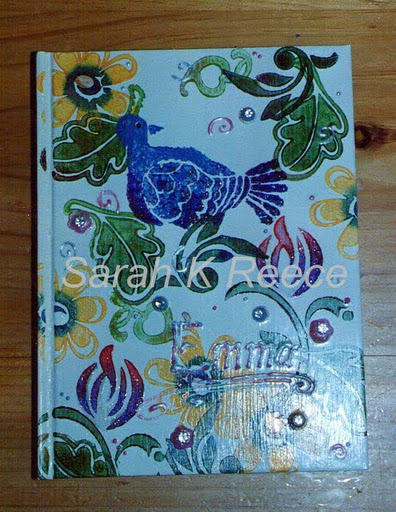
Personalised Journal, painted white and decorated with stamps and dimensional paint

9. Very gently wash the stamp under running water. Don’t scrub it or it will fall apart. Leave to drip dry. These kind of stamps don’t last forever, but they are cheap and quick to make. You can try making stamps from many other materials too, cut potatoes, kitchen sponges, foam, felt, bits of lace, even leaves will make interesting marks when loaded with paint. Enjoy!

The Voices Vic Conference 3

The Voices Vic Conference sweeps us from on speaker to the next, feeds us in crowded spaces, moves us quickly through different messages, personalities, styles of delivery, personal perspectives. I’m swept along with it, soaking up amazing different ideas, putting it all on mental record and knowing I’ll need a week to sift through it all and digest it. Home life with all its complexity doesn’t stop while I’m away and it’s often a challenge to stay focused. I end up missing a couple of talks I was hoping to attend while I pull myself together.

I get a call from my co-facilitator of Bridges, who’s been unwell and off work all week. Our third facilitator Cary is injured and unable to attend it. What can we do? I do not have contact details for everyone, and those I do have are in a secure location I cannot access at the conference. There is also the chance that a new person will turn up any time. I name a few people who are familiar with dissociation who may be able to sit in and hold the space, to apologise to those who turn up and offer a social catch up rather than have reception turn people away. I call back at the end of the day to see how things went but can’t get hold of anyone. I feel guilty and anxious. I go back to the conference.

I get a call from the vet to say that at his checkup my little sick dog Charlieis not improved. His ear infection has not been at all reduced by the medication and they are concerned it is very serious. They want to run expensive tests to culture the bacteria and work out what is going on. I accept. Then she tells me that his eyes, while improved and no longer ulcerated, are permanently dry. In fact, apparently this is a common genetic trait in a dog of his breed. It is the cause of his blindness. My poor little dog has scratched his dry itchy eyes to the point where he is totally blind due to the scarring on his eyes. A $12 bottle of eye drops could have saved his sight. None of the previous vets I’ve taken him to have caught this or mentioned anything like this. I am furious. I cry. I feel terribly guilty. My hands shake. I go back to the conference.

I get a call from family to say my neighbours have called them because Charlie is in my backyard howling and howling and upsetting everyone. He is getting two visits a day for meals and meds and a walk but as soon as he is left alone and he howls and they cannot quiet him. Day and night he howls. I am horrified. He is incredibly difficult to care for and the howling which was only an occasional problem is becoming steadily worse. I arrange for him to be collected and stay with someone else while I’m away. They inform me he howls at their place too, wakes at 4am and howls to himself. I have already sent my cat Loki away to try and keep him and my neighbours happy. I’m afraid of losing my dog. I go back to the conference.

I get a call from the vet with the culture results. The bacteria found are the worst possible result. It is a highly antibiotic resistant strain, and is completely unaffected by any of the many antibiotics Charlie has been on over the years. It is also known to cause ulceration in the ear and to damage the inner workings of the year when untreated, perforating the ear drum and destroying the delicate inner mechanisms. If this has happened he will also likely become deaf and have balance problems. I am to start him on an expensive course of antibiotics immediately; they may take up to three months to have an effect. He will also need eye drops three times a day and ear baths twice a day, along with the baths three times weekly to keep his coat clean and ensure the incontinence issues don’t cause flystrike problems. He needs another vet check-up in a fortnight. I mention the howling. I am told by the vet there are three likely causes: he is deaf and can’t hear himself. In this case I am in serious trouble and it is unlikely we will be able to stop him. Possibly he is going senile and getting confused and separation anxiety. There is a medication that boosts blood to the brain that may help. Taking him off the restricted food diet he’s been on to reduce the strain of extra weight on his heart and arthritis is risky but it’s possible leaving low fat high quality dog food out for him all the time would be comforting and reduce his distress. The other possibility she thought might be making him howl is he’s in pain. He’s certainly in some level of pain with all the conditions although the vets have felt it’s not severe. It’s possible a painkiller twice a day with a mildly sedating effect will reduce the howling.

It may be that’s he’s lonely. He had a permanent dog friend until she passed away last year. The vet was concerned that efforts to get him another friend may not work considering his sensory losses and total disinterest in all other animals including other dogs when we’re out walking. My council also only allows for one dog in a backyard of my size – irrespective of the size of the dog.

I feel totally overwhelmed at the effort of caring of Charlie and trying to keep my relationship with my neighbours good. I cry for a bit and go back to the conference.

I get a call from Housing SA to tell me one of my neighbours has complained about Charlie. I explain that I’d heard yesterday and removed him from my place straight away, and won’t be leaving him there again when I’m away. The Housing SA officer sounds satisfied and happy with my actions. I wonder if my neighbours will be. My hands are shaking. I remind myself that I am an expert at compartmentalising things. I remind myself that I do not have to prove anything and there is nothing further I can do about any of these things at the moment. I mentally put them all in a box and put it in a dark room and go back to the conference.

Life is complicated.

The Voices Vic Conference 2

I gave two talks of my own at the conference. They are both on Thursday which makes life easier for me. I’m frustrated that they are scheduled at the same time as some really interesting talks I’d been hoping to attend.

I have to take the train in to the city where the conference is being held early on Thursday and Friday mornings. I am very short of sleep, and I start the day with breakfast and a coffee. The sleep deprivation, not being able to get a seat that faces forwards, and feeling the coffee slosh about inside me for the 45 min train trip leaves me feeling pretty travel sick on the journey in. I am so relieved when our conference bags have mints in them and suck on them until my tummy settles. I know only three people in the entire conference. Some of the spaces are small for the crowd and I am surrounded by a lot of strangers. I am starting to float over myself.

My first one is ‘Voices and Dissociation’, talking about voice hearing from the perspective of multiplicity and dissociation rather than psychosis. I’m standing in a room 5 minutes before I’m due to start. There are about 4 people the room and I’m mentally immediately adapting the talk to become more conversation rather than a lecture. The nervous energy is now high, I feel like I could climb mountains. I’m anxious and also so excited to be here doing this! I check the laptop there to make sure my power point presentation is on it. It isn’t. I get out my backup copy on USB and transfer it over, relieved by my policy of assuming everything will go wrong. I get a glass of water and pull a chair up rather than stand over the small group. Someone comes in and says ‘Why are you in this room’? It turns out my room has been changed. I gather up my gear and rush across the corridor to another, smaller room. This one has most seats full and a generally expectant air. I check the laptop here. Still no sign of my power point. I get out my USB again and transfer it over. I’ve been rehearsing the talk and simply cannot bring it below 24 minutes without losing important steps in the train of thought. I’ve checked this earlier in the day with Indigo, one of the organisers of the Conference. She’s fine with it, as long as I exit the room on time for the next speaker. It just reduces the question time a little. I mentally shift gears again back to a lecture to suit the larger audience.

I try to start a couple of minutes early to compensate for the time issues, but as soon as I’m introduced more people arrive. Then more people. We fill up all the seats. People stand up the back and sit on the floor at the front. I’m aware that as I’m starting from a foundation and building my way up, anyone who misses the first few slides will be at a huge disadvantage so I delay and try to make sure everyone is comfortable and has somewhere where they can see. We start a couple of minutes late, I launch into the talk.

When talking to my supervisor the previous week I expressed my frustration at the level of exposure anxiety these talks cause for me. He’d suggested briefly mentioning in my introduction that I need a bit of sensitivity around these topics, just because I come and talk about them in this format doesn’t necessarily mean I want to discuss them if we bump into each other on the bus. There’s a quiet chuckle from the audience when I say this and I’m pleased that it goes down well. It does take the edge off a little. I break all the rules about pacing and power my way through the talk, aiming for coherency and humanising and hoping people can keep up. I rely heavily on the artwork I’ve painted to help me express complex concepts in a simple way. The room has that intense quiet of a whole bunch of people listening intently. At the end there are more questions than I have time for. I put the address of this blog up as the last slide so people can contact me to ask questions later or look up more in depth information here. I also have business cards there and some paperwork; fact sheets, Bridges flyers and so on. There’s a rush to the front of the room as people want to look at them, and people gathered around me wanting to share their experiences, their concerns about dissociative clients, to express what they thought about the talk.

I am trying to keep eye contact and give all my attention and also drag the group out of the room so the next scheduled speaker can begin. In the corridor people need to talk. The breathless rush of words that sometimes fill Bridges opens up, there is so rarely any opportunity to talk about these things and the talk has pulled the cork from the bottle. I am trying really hard to focus on every person, to give them full attention, to commit names and faces to memories, to write notes on business cards given to me as memory aids later. I know the need, I know the fear, the discrimination, the need for information, for sensitivity, to feel heard and understood and normal and relevant and I’m trying to make sure everyone, everyone, and especially those who hang back, who find it hard to make eye contact, who tell me in quiet tones about their struggles, feels those things even if it’s only for a moment.

Then it’s done, the weeks of work towards this point are done. I am shaking with adrenaline and anxiety, I feel breathless, my vision is blurring. I feel like I’ve just done an intense sprint. My voice is becoming slightly hoarse. I find somewhere quiet and get a very sugary cup of tea and sit on the floor against a wall. I am so excited, it feels like finishing a work of theatre after months of preparation, or handing in the final exam and it has all gone well and I know I’ve done well and people are telling me thankyou and that it was useful or helped in some way.

In a couple of hours I give my second talk with co-presenter Jenny. It’s less personal, less exposing, easier to do. It’s about the development of our groups Bridges and Sound Minds and I’m passionate about the topic, and Jenny is passionate. In our short time we seem to transmit that and the audience is focused, interested, asking questions, following us into the corridor to follow up. People are inspired by our groups, our work, want to learn more or form their own or adapt their own.

I’ve pulled it all off. It doesn’t matter what happens now. I’ve done my bit. All these amazing people have had a chance to hear about dissociation and multiplicity in a way that isn’t sensational, is easy to grasp, has a framework that makes sense and validates and calms fear. People that were alone with these things have words and a language to describe them, have discovered that there is a community out there to connect with, learn from, share with. People tell me they already have people in their voice hearer groups struggling with these issues and now they have some ideas how to support them and where to go for more information. It’s the perfect place and exactly the right people to launch my first talk about the nature of multiplicity.

Sleepless and wired that night the come down is hard. There’s a bizarre culture clash in giving talks for me, an abrupt shift from anonymous and unknown to someone people approach and talk to, a move from work and life that is often solitary and where I have to remind myself that who I am and what I’m trying to do counts, to a sudden flood of appreciation. I love it and I love being able to approach strangers, to suddenly being able to talk to anyone at the conference, not struggling to feel like I fit in drinking tea and listening in on other people’s conversations. And I hate it, can’t believe it or really take it in. And I do take it in, try to lock away in my head to think about later the things people are saying, the flood of positive feedback, hope they will help me keep going. I’m proud of myself, to have created a voice, to have been offered these chances to share my knowledge, my journey, my hopes, to be able to connect with all these strangers, to have their faces become familiar in just a few hours and be able to smile and make eye contact and share lunch together. The whole experience is like breaking a fast with chocolate mudcake, magnificent, unsettling, overwhelming. In my journal that night I write:

Dark and hollow
Deep in the pit
Where I am alone
Empty and solitary
Only the sounds
of water dripping
moonlight
that lays on the wall
like a slash of ice


it’s empty and hollow and
I’m empty and hollow and
I feel all dead now
Numbed and untrusting
Alone and alone and alone and alone
such sadness and such emptiness
no fertile soil here
here, nothing grows
only nightmares
only fever-dreams
all gone, all gone.


Doubt drags me under, fear sucks me empty. I write and I listen and it eases a little, eases enough to sleep, the nightmares just the usual background noise, not too bad tonight, not too bad.

Part 3 here.

The Voices Vic Conference 1

How to communicate the experience of the Voice Hearer (VH) conference? I’m very aware of how privileged I am to have been there – abstracts accepted and fees waived by the conference organisers, transport costs to be refunded and support from my Supervisor at Mifsa, free meals and accommodation offered by a friend in Melbourne… without that wonderful constellation of generosity I could not have attended. I still owe money for the vet and the dentist and will need further services of both over the next month.

I so wish I could have taken with me all the people in our VH hearer group Sound Minds – to say to them, we are not a minority, we are not just a wonderful little group, we are part of a whole movement! All around the world people like us meet up and build groups and write training and talk about the future and how to make it better. One of the speakers said that now we have realised that many people hear voices, who do not have a mental illness and are not distressed by them – we need to try and learn from them to help the people who experience abusive voices and are suffering because of them.

I’ve been through so many emotions in the last few days. It’s been incredible, overwhelming, distressing, exhilarating, peaceful, beautiful, painful, moving.

This was the first conference I have spoken at that was a consumer-run event and the atmosphere was distinctly different to the more corporate forums run by and primarily for mental health professionals. In some ways it was easier to speak and share my own personal story in this context. That sense of being a bug under a microscope with the dissecting tools hovering closer was less pronounced.

Eleanor Longden gave a long, powerful talk about her experiences as trauma developed into psychosis which was stripped of all context, meaning and therefore any hope for recovery by the ‘support’ she was given in the Mental Health services.

People talk in terms of how many years lost, how many years locked away, numbed, medicated, and mindblasted. The sense of grief and fury is palpable.

Eleanor is an incredibly powerful and moving speaker, she has learned the clinical terminology (is in fact completing a Masters degree in Psychology) in order to speak on equal terms in the same language as the clinicians who so disempowered her. She uses their tools of reason and science to debunk their methodologies and cry foul when cruelty and sterility are passed off as evidence based practices. She shows slides of widespread brain changes evident for someone experiencing psychosis, and those experienced by people who have been chronically traumatized. They are the same.

She shows a scale of characteristics at percentages in the general population. The percentage of people who hear voices is higher than those who are dyslexic, vegetarian, left handed, have red hair, heart disease, stammer, have a PhD, or are bisexual. This is a massive percentage of our population who are at risk of receiving a psychiatric diagnosis of psychosis if they let a clinician know of their experience. But only distressed voice hearers come to the attention of the psychiatric services as a general rule, leading to a massive exposure bias for clinicians.

She is hard hitting about her own experiences, I feel like she is trying to move audiences accustomed to disconnecting from pain and distancing from human connection – the experiences of a distressed person with a mental illness whose condition is treated as an entirely inexplicable and biological phenomenon. She speaks quickly and lays emphasis on her words, they strip me of my own defences against pain and I struggle to bear her talk without sobbing. She talks about the anguish and loss for people “who have been made to believe that silence will save them”. At the end she is given tremendous applause and disappears looking pale and shaken. I want to reach out and make contact but in this situation I am only audience, a stranger who wants to tell her that what she has done is worthwhile and what she has given us is generous and superb, but who does not know her and cannot comfort her.

I think of getting a standing ovation and a million hugs following my talk in Melbourne at the Peer Work conference in 2011, how so much enthusiasm and physical contact blew all my fuses and immediately sent me into massive dissociation. How much I appreciated such incredible support but how overwhelming it all was. Hiding in the toilets until the crowd moved on to the next talk. I don’t follow Eleanor.

Dr Lewis Mehl-Madrona talks about Narrative Therapy with voices, shares slides of his people’s, his mothers and father’s Native American peoples, their traditions and healing practices. He is so warm, so mild mannered and delightfully eccentric it is difficult to believe that such a unique and individual personality survived the training to become a psychiatrist. His workshop on the second day is full of powerful psychodrama where strangers act out the voices of a brave voice hearer. The feel in the room is electric. I imagine what this would be like for me, to see my own internal world on a stage, acted by strangers. I feel naked, liberated, terrified, breathless, hopeful. A worker asks a question: how do you keep participants safe? What if they are triggered by the exercise? He seems bemused by the assumption of danger, the concern about risk, about actually doing anything that may have power and impact. (So much better to offer budgeting and simple home cooking skills) He says, we used to be afraid of talking about suicide, we thought it would hurt people. Now we talk about suicide and the suicide rates have gone down. It is the same with voices. I wish I could hear more, could sit for days and soak up this approach. I take down the details of a group in Victoria who offer training in Narrative Therapy.

Ron Coleman talks about the future, about making things better, spending less time blaming and more doing. He gives a stirring speech about citizenship and personal power. He talks about taking power, that power cannot be given, that it is impossible to empower another person. At times I feel like this is a call to war. I’m uncomfortable with this. He talks about his relief to see younger people taking up the challenge of caring for and about the Voice Hearer movement. He says “it makes no sense to talk about evidence based practice in a discipline where we do not have evidence based diseases”. He tells us that 25 years ago having a conference of this size and a movement of this strength was inconceivable. He weeps when he tells us that. I cry too. I think of Voice Hearers like him losing years and decades in psychiatric hospitals and I cry. I think of my own Dissociative Initiative and how we have so little voice, so few rights or recognition and such a fledgling community and I cry. He leaves the stage and goes away to collect himself. I run after him but he’s gone. Later he comes back and we all celebrate what has been done so far, the difference that is being made, voices that are being heard.

On the bags we are given for the conference are the words:

Not being heard is no reason for silence. -Victor Hugo

I am so glad I came.

I gave a couple of talks on the second day, read about those here.

Novel

While lying in bed the other night thinking about the universe, I finally thought of an ending for a novel I’ve been wanting to write for many years. I started a new draft seriously last year and put together the first 8,000 words in a few weeks, but illness and caring demands put a stop to the project.

I came up with the novel idea back when I was 15 and I’ve never really been able to end it, but now it’s all fallen into place. It’s so obvious I don’t know why it took me so long to think of it.

I’m going to get to this again. I’m not sure when, at some point it will click internally and be the right time and flow easily. I’ve learned not to force things, I stay with the projects that feel right now and let the others brew. It’s time will come. Here’s an extract for you, it’s about a girl called Leonie, who’s uncle Eric has just died.

She gets home wet and cold and sits in a hot bath for awhile pretending she doesn’t have any homework, doesn’t have to eat tea, and doesn’t have a funeral tomorrow. She spends most of the evening on a geography assignment that makes her brain feel like mud. Her mother bounces around the house, talking loudly and then playing music. When Alistair gets home from cricket, he’s loud too. Neither of them can sit still for long or speak quietly. Leonie and her father are the quiet ones. She closes her door and puts music on her mp3 player to drown it all out. Her music seems inadequate today, she thinks to herself for the first time that she doesn’t own anything sad enough, or angry enough. Nothing to play for those feelings. It never occurred to her before. She gets half of the assignment done, although it took her twice as long as it usually would and left her feeling drained. She turns off her music and can hear the television running, and her mother talking on the phone. It sounds like she’s talking to her sister, Auntie Elsie. She talks about her job and the trouble she’s having with one of the other real estate agents at her office. When she laughs it is loud and sharp. Leonie feels worse now, restless and agitated. It’s dark outside and the rain has stopped. She closes her curtains upon the black mirror of her window. She wants to go somewhere but there’s nowhere to go at this hour. She curls up on her floor and hugs her knees to her chest. In the mirror in her wardrobe door she looks small, like a sad child. She reaches out with one hand and pushes it closed. She’s angry with herself for feeling like this, for being disrupted when no one else is.

The light through her curtains is pale. Inside her room shadows lie half hidden beneath the furniture, black and soft under the bed, behind her dresser. Under her closed door falls a sharp slice of white light. Leonie sits under the window, she presses her face against the cold wall. Her mind is empty and dark. Everything hurts but she doesn’t feel any pain. She closes her eyes and rests her forehead against her dresser where it meets the wall. She inhales shadows. In her mind, Eric is playing his violin. She is looking up at him, light behind him, the frangipani tree visible through his window. His arm swings as he plays. He’s not looking at her. She can’t hear the music, just the memory of the light being shattered through his arms. She wants to disappear. The thought of facing another day is a great weight upon her. Something has to change, it can’t all just be the same.

She pushes the dresser away from the wall and watches the shadow shrink away from her. The wall is bare and white. She wishes for a stupid moment that she could hide behind it. She takes a pencil from her desk and writes on the wall, in tiny letters down by the skirting board.

Eric was here

She takes a breath. The weight on her eases a little. The darkness in her chest goes back to sleep. She looks at the words for a long time. Then she pushes the dresser back against the wall and gets ready for bed. Shower, brushing teeth, saying goodnight, getting a glass of milk from the fridge. She notices all her uneaten dinners stacking up at the back of the shelves. She puts it out of her mind and goes to bed.

Recovery approach to Risk Workshop

Tuesday, I was fortunate enough to be given a free spot (as a broke, voluntary peer worker) in Mary O’Hagan‘s workshop at the MHCSA. Ah! So wonderful! Inspiring me that I’m on an important path with my passion for Peer Work, and challenging me to take my thinking even further. She conceptualized a much broader perspective of risk than we usually see in Mental Health Services – not just that people are at risk perhaps of self harm or suicide, but also at risk of hopelessness, disempowerment, loneliness… subtle but powerful risks we all face. She also encouraged us to examine the risks of a risk adverse approach to life, what that costs us and the constricted lives we lead when we become afraid of risks and thus unable to grow.

I was so excited I felt like Hermione wanting to leap out of her seat with her hand in the air at every question! Some of the practical tools about how to engage risk and engage at risk people without just giving up on them or taking control away from them were really fantastic. I wish we had had another couple of days to explore these concepts in more depth because the paradigm shift is quite profound. At one point my table was given an exercise, described a woman in a really difficult catch 22 situation and asked how we would intervene. The scenario is that the woman was hoarding ‘junk’ which was a serious immediate fire risk (eg papers stashed over the pilot light on the gas stove), a health hazard with degrading and composting items, causing serious trouble with her neighbours due to the smell, and going to get her evicted very shortly. She was completely against having anything removed or even moved around to safer places within the apartment and continuing to add to the hoard on a regular basis.

At first I just felt hopeless, I know that the situation is desperately urgent and the woman is at risk of losing her hoard and becoming homeless which may very well set off a profound mental health crisis. The need for urgent change combined with what sounded to me like an extremely high need for control over her environment are such an impossible conflict. My first thoughts were of removing her from the house to hospital or another place and fixing and cleaning it for her. The pointless and desperate power play we would be caught in at that point would almost certainly end with the woman self destructing in some way.

Then we started to think more creatively about it and break it down into different areas. Some issues – like the fire hazard, were urgent and non negotiable. Clear, immediate change was needed. But even there we didn’t have to do the obvious and force her to clear the stove. Someone in the group suggested turning off the pilot light or temporarily disconnecting the gas to her apartment. That’s one urgent problem solved without dominating her. The next step I felt was to get her some support for whatever was driving the behaviour – anxiety, grief, trauma issues, OCD… if we made the issue the behaviour we were pretty doomed, if we could get help for what was driving the behaviour maybe we could settle it down. The high need for control always sparks concerns for me about possible trauma history – and at that point I’m looking for ways to help meet that need, exaggerated though it may be, rather than trample it.

I felt that a peer relationship would be crucial, I suggested calling around the peer networks to see if we could find someone who had themselves had trouble with hoarding and was doing better to call in and befriend this woman. Many people who struggle with behaviours like this are deeply ashamed, isolated, and confused by their own behaviour. Having the experience normalised, having someone else around who ‘gets it’ and can also incidentally, probably offer some great suggestions to us as the workers, can make all the difference in the world.

We also suggested that framing any change or intervention should be done not through the lens of our perception of the needs and risks (her relationship with her neighbours is going to collapse, she is going to become homeless, she is at risk of a breakdown of some kind), but within the framework of her goals and what is important to her – so instead of talking about keeping her house we would be talking about helping her keep her belongings (which of course she would lose with her house). That is currently her goal and focus – it may change over time, but at the moment that is what is important to her.

Suddenly we had an approach that was not controlling or coercive, that took the situation seriously and managed the high immediate risks, and that had a change of success. I was really excited about this! We were also asked what the risk to her might be resulting from our intervention. I felt that the biggest risk of this approach might be that working around her high need for control may inadvertently re-enforce the need and make the behaviour worse. I don’t think there would be a very high chance of that, generally I’ve found that people with exaggerated needs of some kind get a great deal of relief when they are accommodated and learn how to meet those needs while living in a less than ideal world – there’s a lot of negotiation and creative problem solving involved in that! There can be such a huge relief in being allowed to have a struggle or challenge of some kind instead of just being under constant pressure to get over it and have it sorted out. But people do react differently to things and I felt if what she needed was reassurance, was someone to come in and help her contain her behaviour, then treating her as if her anxiety were legitimate or her compulsion reasonable may possible amplify it.

I am so excited by these ideas around the opportunities that risks present us, around the understanding that freedom, dignity, and reciprocal relationships are foundations of mental health and if we want to support people’s recovery we have to find better ways of building these into our services! My experience as a ‘consumer’ has frequently been that dignity is the price at the door for any support or assistance you get. Freedom and equal, mutual relationships are also pretty rare finds and very precious when you do find them in mental health services. I am more committed to Peer Work than ever.

I had a very busy, exciting and inspiring day! I had some wonderful conversations with people, there’s the possibility of a few opportunities opening up – like perhaps a chance to give a talk with Tafe. I also rabbited about the Dissociative Initiative and talked to Mary about our groups Bridges and Sound Minds – she’s interested in the framework we’re using as she’s involved in trying to set up some peer groups back in New Zealand. Goodness gracious, how strange the world is when the movers and shakers of the mental health world want my opinion about something!!

I also have very exciting art news – I’m going to be in the Fringe!! The Cracking Up comedy show needed another person and I’ve been invited on board. I’m so excited! I get a badge! I get passes to events! I get something great on my art resume! I get some training! I get to perform with some really awesome people!

I’ve flown to Melbourne safely and landed, all is well except for the slight hiccup that I’ve had a very busy week, I’m quite sleep deprived, fairly dissociative and somewhere between exuberant and hypomanic which is far too wired and excited to sleep. I wish all the good news and exciting possibilities didn’t happen at once like this, it completely fries my brain and I can hardly take any of it in. One really exciting event per week please, certainly not 6 in a day! Still, as far as life goes, it’s a pretty damn awesome problem to have.

My talk on Thursday is progressing well, the powerpoint is set and done, I reordered a bit to make sure it would all make sense to people totally new to dissociation. I still can’t seem to get it down below the 25 minute mark (I only have 20 mins) which is deeply frustrating. I’ve already badly condensed talking about my personal experiences and cut out the poems. It’s being forced to be more a clinical talk than I want – the personal side of it is so important. But, without the clinical framework, the personal information can just become sensational and not educational which is absolutely not what I want. Essentially I’m trying to cram four talks into one here – Introducing Dissociation, Introducing DID (or Multiplicity), Managing Dissociation, and My Personal Story. Each of those could comfortably be a an hour talk or a days! One day when I offer to give a talk they’ll give me a whole day to do a workshop instead of accepting the abstract and knocking down my allocated time! 🙂 Not that I’m whining, I’m so terribly excited to be here, to have the abstracts accepted and the conference fees waived and Mifsa have agreed to reimburse my travel costs and I’m being kindly hosted by a friend for the duration – otherwise it simply wouldn’t be possible with bills to pay off. All day I’ve been thoroughly enjoying saying “I’m flying to Melbourne tonight to give a talk”. 🙂

Mad Monday

Busy today! The Mental Health Peer Work Cert IV started today and occupied 9.30am – 4pm. There was a lot of talking about cultural sensitivity and an hour DVD about racism that I found deeply disturbing in that I’m not convinced that reversing power roles and swapping who gets betlittled and humiliated is the best way to create harmony between people of different races.

Dashed home to work more on the talk for Melbourne this week – re ordered the content to help it make more sense to someone who doesn’t know anything about dissociation or multiplicity, cut out the poems, and managed in the end to only reduce it by 1 minute running time… I still have to cut another 5 minutes from somewhere. Deeply frustrated!

Then ran off again to Radio Adelaide for more training. Did my first interview with a hand held recorder standing on North Terrace and trying to block out the traffic noise. Fun! Really enjoying this course.

Home again to work more on the talk, print up travel passes, pack, fire off last minute emails, and get ready to go.

Tuesday is a full day of training with Mary O’Hagan at a ‘Recovery approach to Risk’ workshop I have been fortunate enough to get into. I’m very excited about it! That’s a full day, I’ll munch down some dinner, grab my gear and head off to the airport to go to Melbourne after.

Charlie is looking a lot better and booked in to the vet for a checkup on Wednesday… another fortnight’s pay demolished!

And today a big chunk of a molar that’s been slowly dying fell off, leaving a sharp jagged edge that’s cutting into my tongue. The quickest appt I could get with my (superb) dentist is mid March… I hope I don’t get a big ulcer just before having to do these talks!

When I get back I’m going to polish up the Dissociation Link website and launch that with a new newsletter for this month, print new business cards with those details on it, do my Radio Adelaide homework, and book in some nights off to relax. So far I’m keeping all the balls in the air and still eating two meals a day at least and wearing clean socks. I suspect by the end of this week I’m going to be ready to wipe out… although the nervous energy following the talks might keep me wired until a crash on Sunday.

Hope you’re having a good week too. 🙂

Working on my talk for Melbourne

I’ve been working hard this week on putting together my talk for Melbourne. Today I’ve polished the last of the plan, selected some short poems, and painted nearly 30 ink paintings to illustrate various concepts I’ll be talking about. For example:

Illustrating a common split in traumatized people, between heart and mind, or to put it another way, between their emotions and their intellect.

I like using pictures particularly in a situation like this, where the content could happily fill a week of day long workshops but I’ve only been allocated 20 minutes.

One day, I’m going to be better known as a speaker and when I ask for an hour to do a talk I’ll get it!! Considering that nearly every talk I do has to have the basic ‘What is dissociation’ intro to it – and that to properly answer that question would take at least 20 minutes, my job is a hard one!

This is the first time I’ll be doing a talk with such personal content without sharing the spotlight with Cary… I don’t like it! It’s nice to have another person with a dissociative disorder to shoulder the load and ease the freak factor a bit. So, I’ve re-dyed my hair instead which oddly enough is making me feel better about it.

Back to it, still have four more images to paint and then need to rehearse it all and check my time.

Art Commission

I was approached recently about drawing up a design someone had in mind and decided to give it a go. It’s very tricky working with other people’s ideas, particularly non visual art people (which is usually the case as the visual arts people are usually happy to make things themselves) because of the challenge of working out what they have in mind so you can try to bring it to life. Not to mention that many non arts people kind of assume an artist can do anything. Whereas most artists have styles and mediums they are most comfortable with. So if someone came to me and wanted to commission me to paint a car in photorealism style (that’s where it looks like a photograph) my first question would be “why me??”. I’ve never done any work in that style, so it would cost a fortune because it would take me forever. Not that it isn’t fun to get a challenge and stretch yourself, but usually not on someone else’s dollar. That’s what art school is for!

Anyway! The brief in this case was a pencil drawing. The requirements were very specific (which is great, very specific or very flexible is easy to work with – vague is always the tricky one) and even came with an existing sketch. The previous artist commissioned had produced the drawing and now my customer wanted it reproduced exactly the same but with a few design changes and different wording.

He wants to scan the image and put it onto T-Shirts and other merchandise. I really wasn’t a fan of the pencil. I decided I’d take a risk and paint it up in inks and see if he liked it. No money had changed hands so no harm done (except for my time) if he didn’t. Here’s my version with his changes:

Here’s the version he brought to me:

I de-cartoon-ified the tiger and cub too. I’m pretty happy with how it’s turned out. He came round to have a look when I was part way through, before any of the colour had been added and was pretty happy with it.

Here’s some close ups:

I really like the tone through the tiger’s coat. It was very handy that I’d brought such a range of ink samples in so many different colours recently! Now I really very badly want to buy the full size bottles!

I also like that the trucks are a bit similar in colour to the tigers, that now they live there instead.

I’m going to have to write up a new form of receipt, because this is an unusual situation. I’ve previously sold either the physical artwork, in which case the other person owns it but does not have the right to take a photo of it and put it up on their website or put it on mugs and sell them because it’s my artwork. I’ve also sold the digital image of artworks, where they have bought the right to use the work on a website (such as here) or print on a brochure (such as here on page 9). In this case I’m selling both, the physical work and the digital image, and the copyright to reproduce it. A bit of money coming in will help with my vet and dentist bills! 🙂

The Afternoon Tea was great

*my pdf hosting site scribd is down for maintenance so most of these links won’t work at the moment. It’ll be up in a day so I’ll be back to fix them!

I was really pleased with it. It was really nice to take a moment to celebrate what we’ve been able to accomplish! About two years ago Ben, Cary, and myself starting meeting up to talk about the lack of resources for people who experience dissociation.Cary and I were (to my knowledge) the only two people in Mifsa with a dissociative disorder, both of us had started as participants and had to explain our condition to every support work or staff member involved with us. Initially we talked about how frustrating we found this. Then we started to investigate how we could start to change things.

We ended up holding some ‘community consultations’ where we asked other people who experience dissociation what their experiences in mental health services have been like (mixed – a lot of bad stories, the occasional really great therapist or worker) and what resources they really need. We then had a look at what, practically we could actually get set up.

The greatest ask was for a support type group. Most people with a dissociative disorder have never even had the chance to meet someone else with the same experience. The isolation was extreme, and the level of stigma and discrimination also. Many people talked about being thrown out of hospital while in crisis, told their condition doesn’t exist or they are faking it for attention. The level of anxiety in this population is the highest of any group I’ve ever worked with. The need for sensitivity and confidentiality is also very high. Some people have been told by their support workers that they will lose their support if they ever ‘research’ their condition, as that will be seen as proof they are making it up. The result of this is often deeply internalised self-stigma, and an inability to access information, community, and resources – which are the very things anyone with a mental illness needs. Even the process of community consultation was both confronting and a huge relief for many of the people who came. There have been tears as for the first time people hear someone else talk about something they’ve experienced and kept secret for so long. It’s very powerful and deeply moving to be part of.

So we decided to set up Bridges and put a lot of time and research into deciding on a good format and making sure we could sustain it over time. We launched a new flyer for the group, which has the answers to the most common questions we’re asked about it printed on the flyer here.

The other resources people asked for that we felt we could get up and running without too much trouble was fact sheets that broke down dissociation and multiplicity into simple everyday language so people could take them home to family or friends or in to doctors. The burden of constantly having to try and explain confusing experiences we may not understand ourselves is a huge one and some paper resources can help. At the Afternoon Tea we launched two fact sheets that will be made available at the front desk (on display behind the receptionists). You can download your own in pdf form, one is Introducing DID, the second is Managing Dissociation.

Access to books to read about dissociation was another request we’ve been able to start on. I’ve made my personal library available to anyone at Bridges, and now opened it up broader to anyone who needs some more information be they family, friend, or staff working people who experience dissociation. I do need a deposit to help me replace books that don’t get returned, but it is refunded on return of the book. You can find a list of my personal library here.

We’ve recently been very fortunate to have several books about dissociation from my wishlist donated to the Mifsa library! The admin team are now creating a brand new area the library, Dissociation, and putting the new books into it! I’m so excited about this, when I first came along to Mifsa I looked for information about dissociation in the fact sheets and the library and was deeply disappointed that there weren’t any. Now there are both! The Mifsa library books are free to borrow for Mifsa members (which only costs $10 a year conc), just take the book to the reception and they’ll sort you out. 🙂

Most of the people attending the Afternoon Tea were from organisations outside of Mifsa, which was really good to see. A couple of people came along to ask about Bridges and seek support which I’m always really glad about. I bought along a little gift for myself, Ben and Cary to thank each of us for the work we’ve put into this. I think it’s really important to make time to celebrate and appreciate people, and when there are a lot of voluntary hours involved that is doubly true!

So there we go, done and dusted and now I can work on finishing the powerpoint for my talk in Melbourne this week – it’s almost upon me! I leave Tuesday evening to give me Wednesday to chill out a bit and then both talks I’m doing are on Thursday. Lots of busy-ness will be happening in the next couple of days!

More ink experiments

I found a bit of time recently to explore some more of the ink samples I’ve purchased and see how they handle with different pens and papers and mixed down with water too. 

 I’m really happy with the results so far. Some colours are clearly standing out as superior in tonal quality and degree of waterproofness etc. which are important qualities when ink painting.

I have a particular predilection for those inks that are almost black in concentrated form then flower into a variety of shades when diluted with water. 

Eventually I would like to own at least the primary and secondary colours for ink paintings. I attended the grant information workshop on this week that I’d had up on my What’s On page, it was a bit discouraging as apparently they do not provide any funding for people to self publish. Apparently their thinking is that if the work was of publishable quality, someone in the publishing industry would do it. This doesn’t really apply to niche markets such as poetry – even very well known and respected poets often self publish their work as most publishing companies are not interested in small print runs. In my situation, retaining the copyright over my artwork images and also being able to control editions and small prints runs is really important to me. Once locked in with a publisher you sometimes have trouble where the work has all sold and you have requests for more, but the publisher won’t do another print run or allow you the copyright back to print the book elsewhere.

So, I may have to look elsewhere in that area, but another possibility is seeking some support for more traditional and well understood resources, such as funding to buy more inks and papers, or mentoring by a more experienced artist or writer. One way or another the various projects I’m nursing along will have their day!

Poem – Germination

Birds move high on the cool air
the sun threads light through the clouds
like a living thing
sweeping broad golden leaves 
across the sky.

It catches the white wings
of the birds
that weave their flight 
around each other.

They are diamonds 
studded on clear cool silk
that kite the air above me.

They are the autumn’s evening flag
sailing over the green blush
of recent rains
calling me to run
arms open with the thrill of living
calling all new green and growing things
to move with the winds.

Helping out at Mindshare

I’ve taken on a voluntary role with Mindshare, helping to upload and manage the Writing area of the site. 🙂 I’ve been involved as a contributor since the site was launched, you can see some of my work here. I really like the ethos of the site, the idea of giving people a voice and developing an online community. They also have facebook page here.

“mindshare is a unique space that allows mental health consumers and their supporters a place to creatively tell their stories. It is a community dedicated to de stigmatising mental illness through shared experiences” 

– Louise Pascale, Digital Media Officer.

Those of us involved had a meet up on Monday to talk about the site and possible improvements. One of the downsides of the lovely uncluttered front page they have is that while new blog posts are always posted on the front page, the other new creative content such as photos, writing or music don’t always show on the front page, so please have to go looking to see if there’s new content. Unfortunately there’s no way with the website structure to automate a front page update, but one of the volunteers is going to try and manually rotate all the new content through the front page when they can to help people find it. Another new development was opening up comments on all of the content – previously comments were restricted only to blogs. It can be a little disheartening to send work out and not get any response, so I hope this step will help to strengthen the sense of community on the site.

So, for all those of you with something to say – a story to share, a poem, an experience to write about, a complaint, an idea, a suggestion, type it up and send it in. (to the Mindshare email please, not directly to me!) We need posts for the blog, we need music, art, photos, poems, whatever you have that’s in digital format. We love to be posting several new things every day so we need people to send us new material. All the details are on their Get involved page. You can be anonymous if you wish, just chose a pen name and send in your work with that name on it. If you’d like to add a short biography of who you are, we’d love to attach it. If you have a website or blog of your own, we’re happy to put a link to it, just let us know.

For those of you thinking about Peer Work, this is another great opportunity to tell your story and reach a large audience. I promise that writing an article is a lot less stressful than giving a talk! For those of you thinking about starting your own blog, this is a great chance to hone your skills and become familiar with the format before you jump into managing your own.

On that note, we are planning to offer a workshop soon on how to write for a blog, and I plan to offer a quick walk through of starting a new blog of your own with the Blogger platform. There’s also talk about new training to learn how to use different technology and be able to make your own movies, vlogs, and podcasts, which I am very excited about! Stay tuned for further details!

And a last quick reminder about the SmART training this week – get in quick if you were thinking about it! See all the details at What’s On.

Training at Radio Adelaide

Yesterday I started my Radio Adelaide training and I loved it! I am doing the ROCC, (Radio and Online Contributors Course), which is part of a Cert III in Media if I wish to take it further. I’m thinking yes! Today we learned a bit about the instrument panel in the studios, and I recorded my first interview! It was fun! The sound of your own voice in your headphones is slightly weird, but I really enjoyed myself. I’ve been feeling a bit down and tired since the move – possibly still recovering from that, maybe the new meds, who knows. I’ve been concentrating on better separating my work and play times and making sure I actually go and do something I enjoy for my relax times instead of just zoning out and letting the hours go by. This afternoon in between two different training sessions I took time off and played computer games, and I felt a lot better afterwards, more energized. But getting into the Radio Adelaide training was even better yet, I love learning new skills, I love a challenge, I felt my brain wake up and focus and take everything in – this doesn’t always happen, but it’s magic when it does.

I remembered that so far my new study has been admin and paperwork, which grinds me down, but that soon it will be new skills and being stretched and exposed to new ideas and I will feel excited and enthused about it. That was very encouraging. I remember why I had been so excited about all my new study!I’m going to learn how to use WordPress – Radio Adelaide are setting up a blog for interesting stories and interviews to be hosted on and as part of this training we have to learn how to use it and upload content to it. I’ll also be learning how to podcast – hurrah! We’re working with Adobe Audition which so far has been delightfully easy to use. I love it when programs use similar commands and hot keys. We did basic editing of a sound file using the Ctrl+C, Ctrl+V cut and paste commands! Couldn’t be simpler. Wheee!

What awesome skills to develop as a Peer Worker! I don’t know exactly how or where I’ll use them, but I am very excited by all the possibilities. I did an impromptu interview with fellow trainee Gary, he elected to be asked about his carbon footprint and chatted about bike riding and recycling, and I elected to to talk about some of my earliest memories (these were the only options we had) and chatted about how excited I was as a little girl about wearing my new red sandals for the first time, and the experience of being accidentally smacked in the noggin with a gold club – which I think for the duration of the interview I called a ‘golf stick’ whoops. But there you have it, two vivid early memories of mine. I like the sound of the voices in the microphones, you have to get very close to them and the voice kind of burrs, become softer and base-y, it’s oddly intimate sitting in a studio with a stranger asking questions about their life. I imagine it would be easy to become comfortable with the other person and forget this was going to be aired to the rest of Adelaide!

Sound editing! Recording processes! Absolutely fascinating. Apparently next week we will be learning how to use a portable recorder for interviews outside the studio, and possibly how to edit multi-track files – where you have more than one layer – say the voices for your interview is one, then maybe some music fading in is a second layer, or some sound affects a third. Just think of the possibilities! Some poets record their poems and post the sound file alongside the written form – very useful for those with a print handicap of some kind, and sometimes reading a poem can bring it to life. I certainly enjoy reading mine, such as at the Broken Hill event recently, and listening to a well read poem is a joy. New horizons beckoning.