My critters

On a lighter note… these are the lovely critters owned by myself and/or other family members. About time I introduced them. 🙂

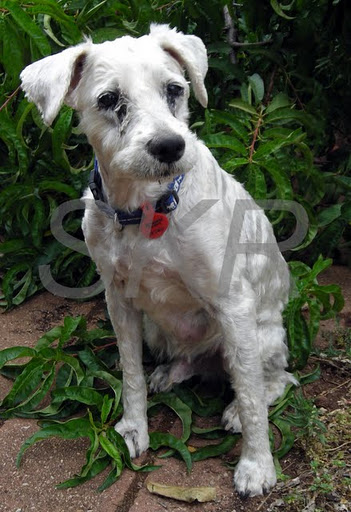
This is my little dog Charlie:

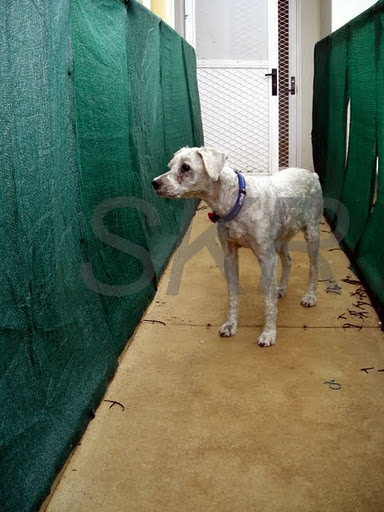
He’s looking pretty spiffy at the moment because I just had him washed and clipped recently. He’s about 10 years old, a mini schnauzer cross maltese. He usually has big whiskers and eyebrows like a scottie dog, but they’ve been clipped so he doesn’t fill them up with prickles. His health isn’t good, he’s completely blind, has chronic ear infections and a grade 5 heart murmur which is pretty bad. He loves short walks and hasn’t really worked out he’s blind now, so he walks into things or falls off edges like the gutter a lot if he’s not well supervised. My little backyard will be perfect for him, and no steps to get back into the house. 🙂 Where I am now the backyard is accessed by a ramp, so we’ve had to border it with shadecloth otherwise he falls off:

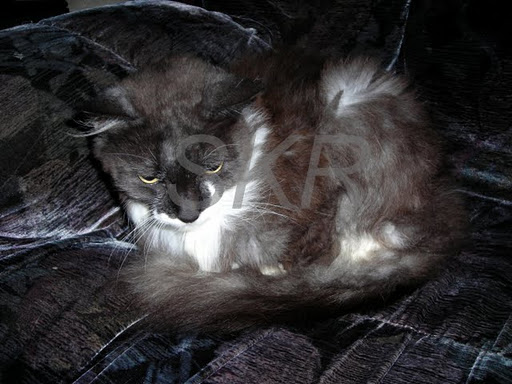
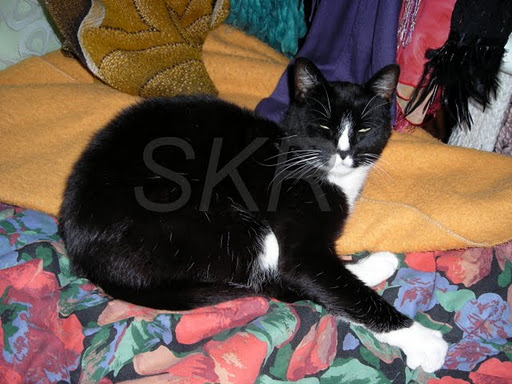
Meet Loki:

He’s coming with me too. He was a kitten from a litter of cats born to a sweet natured stray we took in many years ago. He’s also been very sick, the vet thinks he has a virus of some kind, although he tested neg to FIV which is a relief. He’s very very thin and lethargic and being nursed along with lots of small meals and meds at the moment. When he’s sick and grumpy he kind of looks like a owl with his big fluffy ears and yellow eyes.

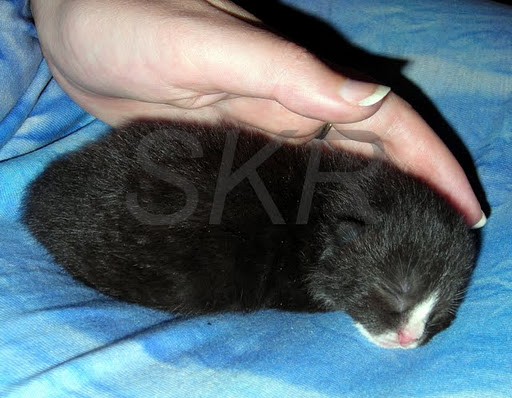
Meet Sarsaparilla:

He’s a lovely friendly big cat, very healthy and smoochy with a funny little yowl if he’s confused. He’s quite timid around people he doesn’t know, but gets along well with other cats and Charlie. He was also born in a litter from a stray cat we took in, I fell in love with him and adopted him. Here he is with me as a baby:

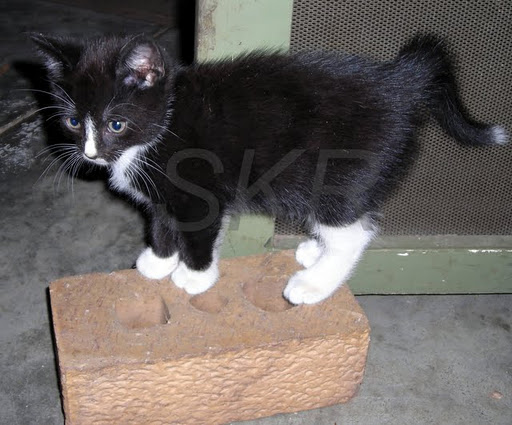
And as a little kitten:

I’m overjoyed to have him back with me again, he’s been sleeping on my bed at nights (he gets the feet, Cleo the pillow). I love his little black nose, the white whiskers and the white tip on his tail. He’ll be coming with me too.

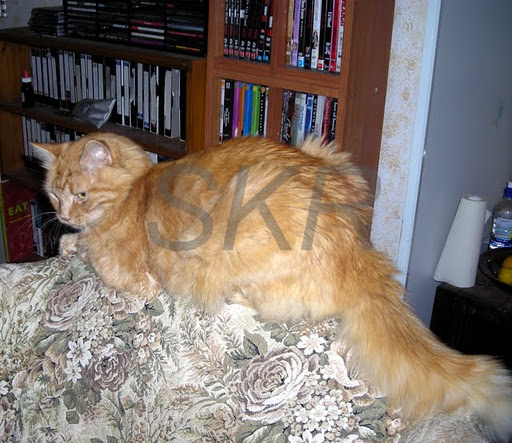
Meet Horatio:

Horatio was another rescued stray cat, we took him in as young cat with his family. He had a brother he adored called Orpheus, who died after being bitten by a snake. He’s very fluffy as you can see, and looking pretty nice at the  moment as I comb all the moulting fur out every evening and trim any mats out his tail that he can’t fix. His health is good and his personality is the most affectionate and sweet. He’ll be living with other family.

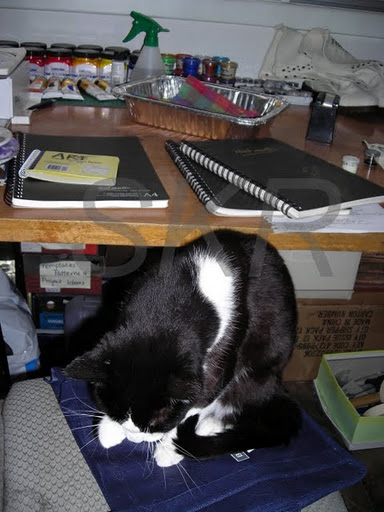
Here’s Cleo minding my art supplies:

She’s doing well too, she’s adapted to having other cats around but really hates Charlie, so she’ll be staying with other family until she is adopted to her forever home. Charlie accidentally walks into the cats as he can’t see them and Cleo gets very offended and attacks him, which is a bit hard because he can’t work out how to get away! He’s a bit daft the funny little fella. Cleo’s been keeping an eye on my packing and checking out my new empty bookshelves and the clean bathroom. She gets lots of love and cuddles and I’m sure she’ll be relieved to be living in a dog free house again. 🙂

Last but not least is my fish – the aquarium is difficult to transport so I haven’t decided yet if she’s coming with me or staying put. No photos at the moment as I can’t get her to stay still long enough! 🙂

Trauma Myths – there’s not many of us

There’s a few common myths about trauma that I come across pretty regularly, and this is one of them. In mental health, the role of trauma is one that is debated all over the place. For example, there’s people who argue that Borderline Personality Disorder is caused by childhood trauma, and those who argue that it is likely a genetic predisposition to an emotionally reactive way of relating to people (among other issues). Personally, I think that it’s entirely possible that there is more than one way to end up developing a mental illness – for example some people with a psychotic disorder have their first episode in the wake of a major life stress, others were just minding their own business and the world turned upside down. What we do know is that some things can be inherited, and the combination of an inherited vulnerability with a high risk environment is exactly the kind of circumstances where people are most at risk of manifesting a mental illness. Nature and nurture both play a role, and traumatic events are one of the things that can make someone more vulnerable to mental illness. While trauma is always at play in a condition like PTSD, it may or may not have a role in causing some other mental illnesses.

Some mental health staff have taken this to mean that learning about trauma and how to work with traumatised people is a specialised field that is useful for only a very few participants. That’s not my perspective. For a start, when we look at the statistics of people who are the most severely impacted by their mental illness, such as inpatient populations, the numbers of those who’ve experienced major trauma are very much higher than the general population. These traumas may not have had a role in causing their mental illness, but they can certainly make it much more difficult to manage one! So trauma sensitivity has a real relevance in mental health.

Another thing is that having a mental illness can be very traumatic in and of itself. One of our great fears is that we are going insane. Madness holds a terror for most of us, and developing a mental illness can feel like we’re going mad. We may have terrible fears about our state of mind, our experiences, trying to keep our job, worrying about how we’ll raise our children. Experiences such as being chronically suicidal can leave us afraid of ourselves, mistrusting our own mind. It’s not like this for everyone, some people become very unwell without realising it, others may be caught up in their experiences (such as delusions or mania) and even enjoy them. But for many of us mental illness involves severe emotional pain and fear.

Various interventions can also be traumatic. Being confined to a hospital, room, or bed, being medicated without any choice, not being allowed to smoke, to drink, to wear your own clothes, be with your family or pets, have internet access or your phone is effectively being kidnapped. I’m not suggesting that the intention is to traumatize people through ‘assertive engagement’. And I’m not saying that some people who are desperately unwell and a danger to themselves don’t appreciate being kept safe for a time. But the loss of control experienced in severe mental illness, and the loss of control that comes with experiences like being shackled to a bed, even when it’s done by kind and caring people, can be traumatizing, and can also replay earlier traumas.

Not everyone’s experiences getting help in the mental health system are good either. Imagine waking up in hospital from a suicide attempt to be told by the nurse that it would have been better if you’d died because they need the bed for people with real illnesses. Imagine being told by your doctor that your condition is incurable and degenerative and you will likely become less and less lucid and be unable to live independently. Imagine being told that you are faking your condition to get attention, that unless you follow through and kill yourself nobody will believe that you are genuine, and even then you would just be proving that you were a hopeless case. The oath to first do no harm is not always upheld, and some people are caused terrible suffering by the people who are supposed to help them.

When you include experiences of stigma or discrimination, attempts at disclosure that go badly, the grief and loss of having relationships break down under the strain, giving up study or losing employment because of the mental illness, the idea that there’s quite a few people with trauma issues of one kind or another really makes a lot of sense to me.

The other aspect to this is that behaving in a way that is appropriate for a traumatized person isn’t inappropriate for an un-traumatized person. Being sensitive to issues of control, proximity, touch, pacing of treatment, confinement, respect, and the need to listen doesn’t go astray for anyone. Being sensitive to the possibility of trauma is being sensitive and engaged, taking your cue from the other person and adapting to what is helping and working for them. There’s nothing inappropriate about that! Even when the condition isn’t a trauma origin one, and you haven’t been told the person has a trauma history I’d be careful in assuming that trauma isn’t relevant. There’s a lot of people for whom it is, and thoughtful sensitive support can make a big difference!


Dissociation and food

I’ve not come across a great deal of information about the relationship between food issues and dissociation. My colleague Cary is working on a thesis on the topic, and it came up the other day in our group Bridges. Many of us who struggle with chronic dissociation also have some difficulties with food. This is by no means all people, dissociative experiences can vary significantly from person to person. What do I mean by food issues? I’m talking about struggles that range from entrenched eating disorders to milder difficulties. Some people have a tendency to starve themselves, others find themselves overeating. Personally I struggle with a binge-starve cycle that slows my metabolism, wrecks my energy levels, and causes my weight to fluctuate. Dissociation and food issues can go hand in hand. People who struggle with over eating sometimes describe ‘unconscious eating’ where they consume food without being aware of it. Most of us know the annoying experience of reaching for a cup of tea and discovering we’ve already drunk it without registering. For some people this goes a step further and they find themselves looking at a clean plate and wondering what they had for dinner, suddenly realising the biscuit packet is empty, or finding themselves roaming through the cupboards looking for snacks whenever their concentration wanders.

Not eating due to dissociation can also be a difficulty. Personally this is something I’ve realised I have quite a problem with. When I’m very dissociative, I tend to lose my sensations, so I can’t feel things very well. That includes the sensation of hunger. Without that cue, I would at times go for several days without realising I hadn’t eaten. This starvation would do nasty things to my blood sugar levels and usually increase my dissociation. It wasn’t until I started fainting that I realised this was quite serious. A combination of sleep deprivation, starvation, and extreme stress has produced the most severe and terrifying dissociative experiences I’ve ever had, something like a drug overdose high. I now have to use the time of day as my cue to eat, and as I do eat more regularly it’s been exciting (but also freaky) that my sense of hunger has been returning.

The binge part of this cycle for me is that erratically I would eat large meals of high sugar foods. With my metabolism slowed down, I don’t tend to feel hungry and I’ve lived for many years on one meal a day. The binging has been a problem since childhood, when I would hoard, an on occasion even steal, sweets. At the time I was confused and deeply ashamed of this compulsion. At times my behaviour seemed to resemble an alcoholic, with sugary foods hidden in stashes that I consumed secretly, at high speed, at times of stress, and felt deep guilt and shame about. I teetered for many years on the edge of adding a purge component to this cycle, and deliberately cultivated a phobia of vomiting to help keep me away from this.

I’ve come to understand my food struggles as being created by a number of different issues. One of them is attachment problems. This is about our experiences as children, and how we now tend to view and react in relationships. For some people with attachment problems, ‘comfort food’ goes a step further and children may hoard food in fear that their needs will not be met and as an attempt to be self reliant. Another component is self image and self loathing issues, born out bullying and humiliation during childhood and teenage years. A deep ambivalence about food and myself makes it difficult to have a healthy relationship with food. Another component for me is intense stress. Sugar cravings are common for people who experience intense stress, because adrenaline and sugar have a relationship in the body. I’ve found I tend to crave sugar when I’m stressed. Another factor for me has been that at times I’ve been threatened or physically assaulted, which is just the kind of situation that makes you wish you were bigger and more imposing. This can lead to weight gain.

Food issues can also be a kind of self harm. There are many ways to play out self loathing, to try to override emotions or memories, and to express pain, and needs around control. People used to living in a disconnected dissociative state may use over eating or starvation to trigger dissociation when they feel overwhelmed. Others may use the discomfort of overeating or the pain of hunger pangs to reconnect them to their body and help to manage dissociation.

So, what can be done about this? Firstly it helps to know that food issues and dissociation often re-enforce each other. They easily form cycles where the dissociation aids the food problems and having problems with food makes you more vulnerable to dissociation. This cycle will need to be broken. For me, I’ve had to move quite slowly on reducing my issues. Several years ago after my most severe dissociative episodes involving low blood sugar and sleep deprivation, I made a rule that I had to eat one meal a day. At the time that was quite a challenge. I also started to examine what was behind my difficult relationship with food, and started to tease out the emotional components and work on them. One of the biggest I started with was the issue of self loathing. Initially I couldn’t imagine a life without it, but I could see how badly it was crippling me and kept working away at it. On bad days I can’t eat, and if I force myself to I will only be terribly ill and likely vomit. I don’t force myself. When stress levels are high, energy is diverted away from the digestive system. There’s only so much I can do and I let myself off the hook on the bad days. The goal is sustainable change, not re-enacting abusive scenarios where I feel terrible and out of control.

A couple of years ago I moved up to two meals a day. I was able to sustain that except for periods of homelessness when I tended to drop back to one or less. Now, on good days I have three meals. Possibly half my week is like this at the moment. I also tried to link food to good experiences – so I often eat a snack or even lunch in my groups because they are such a safe and positive environment for me. And I wanted to remove shame and humiliation from eating. I dismantled my stashes and decided that if I was going to eat something like chocolate, I would do it openly, I would enjoy it, and I would feel no shame, even if I gained weight or people made rude comments. These movements, little by little, have moved me towards a better diet, better energy, and better health. My cholesterol level which had been rising is now low and stable. My weight has stabilised, and my health is better than it has been in many years. I no longer diet, I refuse to engage in fads or restrictions, ‘bad foods’, or an obsession with ‘healthy’ food. My goal has been to tune back in to my body, to eat and enjoy eating, to have fuel, and to get back to the good side of being fussy about food – the pleasure of good food and my love of cooking, the kindness and care of preparing good tasty food for people you care about, and to resolve issues of shame, control, stress, and comfort in my journal rather than my diet.

If you’re struggling with dissociation and food, take heart, you’re not alone! It may be that a two pronged approach – working on reducing the dissociation, and working on understanding and resolving the drive behind the food issues will give you the best chance of making good changes. Food issues can be tenacious, deeply rooted, and re-enforced by the unkindness of our culture. You’re not going to make progress every day, and you may find that things change slowly with back steps and challenges along the way. I’d suggest watching those who have a good relationship with food and their bodies and modelling whatever you can.

If you’re a multiple, you may have food issues broken up among different parts. Sometimes everyone in the system is fine but one part has a major eating disorder. Sometimes the roles around food are broken up, perhaps one part cooks, another eats, and another cleans up the kitchen. Maybe you function just fine around food until the one who eats goes away for a while, or until someone who doesn’t eat ends up being out for a long time. I know that this kind of dissociation can add a whole extra layer of complexity to the situation, it may take a while to even work out what is going on and who is doing what. Be patient and gentle, you will make sense of it at some point and work out what you all need to do to make sure your body stays nourished and taken care of. Getting a hold on food issues may help you drastically reduce your dissociation and be an important part of your recovery. Best of luck to you!


See more like this:

Feeling chronically suicidal

Wow, another big topic! I simply cannot do justice to these in a blog post, so please don’t be under the impression that my notes are in any way definitive. I just hope to share a few thoughts and ideas and maybe they’ll be useful to someone else. If not, there are a lot of books out there, and good support too (although you may have to look hard for it) so please don’t be discouraged, keep hunting for what you need.

Feeling suicidal has been something I’ve lived with for most of my life. I was first seriously making attempts on my life when I was 10 years old, feeling totally alone and overwhelmed and desperate not to suffer anymore. Since then it’s been a companion I’ve had to learn to live with, a shadow I can’t shake. It sits on my shoulder and whispers into my ear, weakens my courage and resolve, tells me that things will not get better. So how am I still here?

There’s a few nasty traps with feeling suicidal that I’ve been able to see and to some extent avoid. The first one is the idea that if you are sick enough, or in enough pain, that someone else will come and help you. This is a powerful rescue fantasy that the mental health system often inadvertently plays into, which is heartbreaking because no one can sweep in on a white horse and take your pain away. I once spoke with a young woman who tried to admit herself to hospital as she was feeling suicidal. They told her unless she hurt herself they couldn’t help her. So she did. Mental health staff will often draw distinctions between degrees of suicidiality – the occasional thought, feeling it strongly, making plans. Between so called ‘passive’ and ‘active’ attempts (those you have a good chance of recovering from and those you don’t). In my experience this is often done quite without any awareness that in an attempt to be taken seriously and gain the help they think is on offer, people often steadily graduate up the ranks to higher and higher degrees of suicidiality. What agitates me so much about this, is that a cross-wiring of kinds is happening here – good healthy impulses to get help and get better are being cross-wired into self-destructive acts. Now both the healthy and the unhealthy impulses are driving the person down into suicide – what hope do they have then?

Sadly, the line between the people not sick enough to need help, and those so sick they are considered beyond help is very fine in some circumstances. People find themselves unable to access services as their situation is not serious enough, and then unable to access them as they are too high a risk. A long time ago I discovered that my learned pessimism about other people’s power or willingness to help me actually stopped me getting worse in a misguided attempt to get support. It’s not an easy one to stay out of for me, a bit like a whirlpool that pulls at me. I have to mentally remind myself a lot that my energy must go into getting better and taking care of myself, that getting sicker to get help is like going deeper into the desert following a mirage of water. No hope lies that way.

Another trap I’ve noticed is using symptoms to express pain. The mental health system is at times very poorly set up to support people who’ve experienced trauma. Sometimes the number and severity of your symptoms are used to ‘grade’ how severe the experience you’ve come through is. This penalises you for being resilient, and leaves you caught between getting validation and acknowledgement for your trauma, or functioning to the best of your capacity. People with trauma can start to speak ‘the language of symptoms’, in inpatient settings they may compare severity of illness to rank their trauma along side each other and compete for the highest severity, comparing scars, numbers of diagnoses, amount of time in hospital, number of suicide attempts. Especially when your trauma is being denied or downplayed by those closest to you, the need to have it acknowledged can be so profound that people self destruct seeking that validation. This can be hard to understand if you’ve not experienced it. The language of symptoms is subtle and insidious and once you start speaking it it’s very hard to break. In this language suicide is seen as the ultimate way to express pain, to reject terrible circumstances, to show that you were a victim, and that your situation was so severe it was not possible to survive it. The way out of this is to refuse to rank trauma, to validate all harm and all pain, to take away the burden of ‘proving pain’ from people who are hurting.

The lure of safety is a trap that can make death seem enticing. People who’ve been badly wounded and broken can be willing to hide out in any port to escape the storm. It’s hard to keep hoping that tomorrow will be better when all your hopes are dashed. It’s hard to find strength when the bad days are horrific and completely outnumber the good. We can get to a point where we just want it to stop and will do anything to make it go away.

I turn these thoughts on their head whenever I can. Instead of seeing death as a peace that I am denied, I find anger in my heart at the thought that my story would end in such a miserable place. I use everything I have already survived as impetus to keep me going on – if I was going to give up, I should have done it 10 crises ago. I’ve already come this far now, nothing will take me down now. I find that it is crucial to reframe the seductive nature of the traps and find a way to think of things where continuing to live is being brave, is bearing witness, is triumphing over abusers, is having a voice, is all the things I long for. If you allow suicide to be framed in a way that it seems to contain the things your heart deeply longs for, then you are incredibly vulnerable to it because it will take all your strength to deny yourself what you so deeply desire and have within your power, and none of us can be strong all the time. For me it’s key to see these things as tricks and deceits, like sweet voiced sirens that will sing me onto the rocks if I listen to them.

I also hold onto many things that help to keep me in life and wanting to live. I do not have one precious thing, for that would make me terribly vulnerable to losing it. I have lost so many things dear to me in my life. I have many things, big reasons and little reasons that hold me here and keep me fighting for life. Some are huge ones – I want to write books, who would care for my pets, my family needs and loves me. Some are little ones – I’d planned to feed the ducks this evening, I haven’t finished making that birthday gift, the moon is so beautiful tonight, perhaps I’ll watch it set. They are my talismans against the dark, and they fail when the darkness is great. I hold one until its light goes out, then I put it back and take out another. The power of feeling suicidal is that it strips meaning from that which means most to us. In a black, fey mood, the thought that our children would miss us is suddenly hollow and devoid of power. I have learned to expect this and not be dismayed by it or blame myself for it. I rotate my reasons to keep going, and never hold onto one past its usefulness. In time it will regenerate and I’ll be able to use it again.

I also now know that there are times when all my reasons fail. When I am joyless and without love of life, when I have no hope for a future and can find no meaning in my pain. When to ask me to live is to ask to me to submit to torture and anguish. In these times I pour the pain out of me, into journals, I weep for hours, days, months, I scream myself to sleep. I accept that I am without hope, without reasons, and I put myself at the mercy of the world. If I am to die, then kill me, but it will not be by my hand. And if there will one day be a reason for me to have endured this, then spare me. I will wait for it. One day there will be reasons and meaning and hope and I will be glad to have endured.

I have also learned that not all change and help comes from within me. When I am deeply broken, I bind myself to stillness to keep me safe from my reckless longings, and I wait. I have learned that if I wait patiently, with my eyes open and my ears pricked and my heart ready, then something will change around me. I will read a book that speaks to me, or someone will say something that unlocks a peace in me, or some circumstance will change and give me hope. Sometimes my desire to be the agent of change, to fix the pain and put the world to rights is the very part of me that is most dangerous in despair. I hold myself still and wait for hope.

I also find hope in my ignorance. I remind myself how many books I have not read, the degrees I do not have, all the millions of people in the world with thoughts and ideas and theories and experiences I’ve never heard of. When I can find no way to patch together any hope with what I know, I go hunting for information and I tell myself that I will find it again. My knowledge is such a speck in the universe, and how much my world has changed with powerful books, good friends, sound advice, how much my inner life has grown and my strength increased as I’ve learned and understood more. And yet still I know so little. I cannot pronounce the certainty of despair when I have only the tiniest fraction of all the knowledge in the world. Other people have found hope, I will sit at their feet, I will watch their lives, I will find foundations for my own.

I abandon reason when reason drives me to despair. There have been times in my life when the anguish was so unbearable that I have broken inside and decided that it was no longer fair to ask me to endure it. That if love of my family kept me here, than that love was cruel. I have taken my hits and bled my last drop and no more can asked of me. I had no reason to expect that my life would become any different to how it has always been. In this place I cast about desperately for a reasonable response and could not find one. In the end I sidestepped the question entirely and concluded that if hope was foolishness and staying alive was madness than I would be a fool. A little madness can be a refuge from the relentless logic of such thoughts.

At times it is helpful to remind myself that there are those, only a very very few, who have hurt me for the sake of the pleasure of hurting me. That they would gain delight in knowing that I continued to inflict pain on myself long after they had gone. That dying by my own hand would be murder from an untraceable distance. I am a profoundly stubborn person. I decided if they wanted me dead, they were going to have to do it themselves. If there are black days where I live only to spite those who’ve hurt me, then so be it.

Feeling chronically suicidal can become a mental habit whenever things go wrong. Your brain tosses it up as an option like a big dumb dog dragging something horrible on to your bed. If you’re used of thinking of suicide when you’re stuck, it may help to talk back to your brain (politely) and tell it you don’t want this option at the moment. You want other suggestions and ideas about how to improve things. You may even write a list of all the various options open to you, and number them ahead of suicide in your list of ways to respond to your life. So perhaps suicide ends up being at option number 467, after

  • 452. Move to Japan and take up kite making
  • 231. Eat everything you can find in the fridge
  • 93. Call a helpline

I run my proverbial list in order from most to least likely to help, easiest to most drastic, and least to most harmful. Even self harm, total isolation, or an eating disorder are before suicide on my list. They I can heal from later, suicide I can’t. Some things – like harming someone else – are after it. It doesn’t have to be a good reason (although a good reason is better) it just has to be enough to get you through. Almost anything you do with your life should be above suicide on your list of options.

So the rope I have cast over this pit is woven from many different things, stubbornness, folly, faith, patience, experience and a deep love for life. No one thing alone could keep me safe, but between all of these things a kind of armour is made that helps to protect me from despair, a kind of path that walks me through the darkness.

I imagine that the things we each make this path from may be different for us all. It doesn’t matter if it makes sense to no one else, if it’s patchworked together, a jumble of contradictions, badly worn thin and with holes you have to leap over. It doesn’t have to be perfect, it only has to be enough to get you through this night. Tomorrow can take care of itself.

I hope you may find something here useful or thought-provoking. If you are feeling suicidal yourself, please take good care of yourself. Call someone if that may be helpful, do those things that keep you safe and give you hope, reframe it, wait it out, find someone to hold you, find reasons to endure, and walk gently. There is hope for us.

Australian 24 hr phone services:
Lifeline: 13 11 14
ACIS: 13 14 65
Suicide call back service: 1300 659 467

Big news!

Well, just when I was getting back into the swing of things, I’ve had some great news that has bowled me over and thrown all my new plans and routines out the window – I’ve been offered a unit through Housing SA!

It’s absolutely gorgeous, close to the city, ground floor (no steps or stairs – important when you have a fluctuating joint pain issue) with a little backyard that’s fully fenced, so my dog can come. There’s a small garden patch out the front that I’m thinking may become a veggie patch. It has two bedrooms, a master that will make a great art studio, and a small secondary that will be used as a bedroom. There is a bath, which makes me very happy, a large loungeroom, a dining area and a kitchen, a small laundry, and a garden shed out the back. The stove and water system are on gas, and it has a double sink in the kitchen. There’s a huge peppercorn tree in the backyard for shade. The area is very mixed with some new homes, some very old ones, and a bit of industrial as well, but it has a great arty feel to it. My moving date is next friday – the 13th – most auspicious 🙂

I am so very excited and fortunate. This has been a very long road. I left home at 18 to live independently, but had to return at 19 when I became very ill and unable to care for myself. A few years later I had to run from an abusive relationship and found myself homeless. Unfortunately, at that time I was advised not to bother getting my name on the Housing SA list as the waiting times were so long it was pointless. How I regretted that! I didn’t realise that once you’ve become homeless once, you are very vulnerable. A lot has to go wrong in your life for you to be homeless, a lot of security, stability, finances and social connections fall apart. Places that help homeless people often make a distinction between those who are homeless, and those who are roofless. The roofless are those we tend to think of, they are sleeping rough on the streets, in squats, abandoned buildings, skips, anywhere they can find. The homeless on the other hand usually have a roof over their head of some kind – in a shelter, a vehicle, a caravan, couch surfing and taking up with anyone available. This is an important distinction to make, as those who are homeless but not sleeping on the streets are essentially an invisible population. There are few supports and resources as few people realise the extent of this problem. People with disabilities and mental illnesses and young people particularly struggle with this kind of homelessness. There is no security, you move often. You often lose most or all of your possessions. You live in unsuitable conditions because you have no choices. There are many predators out there who take advantage of the homeless. You can’t keep up with your mail, with Centrelink, with work or study. You have no privacy, you have no idea where you will be from week to week, if there is an abusive ex stalking you the fear and stress are even higher. You are a very vulnerable person in this situation, easy to exploit.

I have found myself repeatedly homeless since that first flight out of danger. It cost me far more than I thought it would to escape. I became suicidal and struggled with self harm. I was exhausted moving my gear from place to place and seriously tempted to destroy it all instead. I used up all my savings, had to give up my pets, my diet become unhealthy and erratic and my health struggled. Shelters are not the panacea they are widely held to be, and I didn’t qualify for any of the support out there for homeless people, due to age and disability. I was told by one youth service that “no one cares if 26 year olds are homeless” when I begged them for help. Not only was it my fault I was homeless, it was my fault I didn’t have the social support to ease it. I’ve bounced all over the place and tried many things to create more stability in my life. I’ve lived in a caravan park which was awesome in some respects and scary in others. I’ve slept in my vehicle, in backpackers, at other people’s places, in a shelter, in group housing, in a lovely unit with a mate helping me with the rent, with family, on couches.

I found there was a tremendous tension in being homeless between trying to adapt to my new circumstances, the world I had found myself in, and trying to maintain a toehold in the world I wanted to get back to. They were very incompatible goals. Trying to do both was extremely difficult. For example, one way of adapting to chronic homelessness is to drastically reduce your belongings down to something you can carry. This makes all the moving much less exhausting. It is emotionally painful, especially when you don’t have family backup. Most young adults don’t carry around all their precious memorabilia, the vase they inherited from their Great Grandma, the scarf their Nan knitted, it’s stashed with their parents for a later date. Anything I had a connection to, dreamed of one day putting on display or showing my kids had to come with me or be stashed with a friend for a little while. If you do carve back your belongings to a bag, and then rent a place, you have nothing to put in it. Even with what I did bring, on the occasion I was able to rent a unit for a while, I struggled to afford furniture. I ended up borrowing a van and collecting most of what I needed out of the hard waste collections around the city. To be broke, short of friends, and short of resources is to be in a really difficult place. Without having someone to borrow the van from, I simply wouldn’t have had a bed or a table or a couch. And for someone who’s been roofless – who cares! You’re safe and dry. But if you’re trying to climb out of that underworld, you need to look like the people with homes. You need to be clean, to smell nice and have cut hair and wear clothes that are fresh and unrumpled. You can’t get jobs without these things. To be a student you need a basic level of mental health and emotional stability, you need space, time and quiet to study, you need sleep and food regularly and to be able to get to and from the uni without being totally exhausted or financially crippled. To maintain your own mental health you need to hang on to your poetry and your artwork. The more you adapt to homelessness, the more it becomes normal to skip meals, baths, sleep, to eat anything you find, to be grateful for blankets, to not care about how you look, to be used to being completely uncontactable, no phone, email, or address, the harder it becomes to pass yourself off as part of the rest of society. You become feral as far as they are concerned, and rather than admiring your will to survive, they are generally repulsed. There is no adapting to you. If you can’t attend that Centrelink appointment you will have no money.

So I’ve tightrope walked between the two worlds, I’ve discovered that people think that folks with disabilities never become homeless and never need to leave abusive relationships. I’ve found that shelters seem to think that being homeless is a weakness of character, proof of your failure to manage your own life properly. I’ve learned that people think the homeless are lazy and disorganised, and that it isn’t a big deal. I’ve found that people who choose to explore an alternative lifestyle can be the harshest to those who live in similar circumstances, but do not have the networks or support to choose any other way when they wish to. I’m furious that we think of homelessness only as being roofless, and that being roofless is effectively illegal. That we cannot pitch tents on parks or beaches, cannot squat in buildings, cannot build our own homes as our ancestors did. That we can be moved on from any place, kept out of sight, in the cold places and in the shadows where no one has to see us or know about us or feel guilty about us. I’m furious at ads offering rooms for sex, at turning up to my 100th open inspection on a flat to find there are 50 people applying, at applying to rent an old office and corridor with electric fry pan (the ‘kitchen’) for more than I can afford to pay. It’s been a long road.

So here I am, about to move into my own place, probably on a 1 year lease, which I hope will be renewed for something a bit longer next year. (they no longer offer lifetime leases) I’ll be taking my little blind dog and two cats with me so we’ll be quite the little family together. I’m sad that the next month looks like a lot of packing and unpacking boxes and not much art, but the timing is perfect as I’m not yet embroiled in training and work. I’ll have to take extra care of myself as I find moving difficult with the dissociation and the effort of moving myself and exhaustion will probably take a toll on my physical health too. But it is such a wonderful thing to be in my own home and I cannot wait to have it all set up.

Poem – ode to skin

The magnificence of skin
wrapping heart, guts, brain and somewhere, soul
it links me to the world
whispers to me of the delight of wind
tells me stories of fire, snow, grass.
Contains a million million nerves that feather finely
that sing below the skin, a sweet orchestra, or a shrill harpy choir
holds in the blood, knits over wounds, renews
bears scars, traces memories, maps life, anguish, loss
breaks on impact, stretches, wrinkles, softens, thins
bends over finger joints, folds into elbows, delicately glides over eyes
wears hair like tiny quills, like hills flowing into gullies,
dances in air and water, in smoke, in thistledown,
is perfumed by earth, by sweat, piss, flowers, wine, salt,
and the trace of another’s skin upon our own.

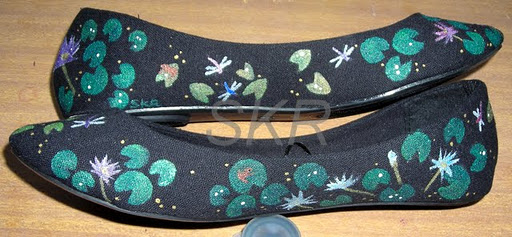
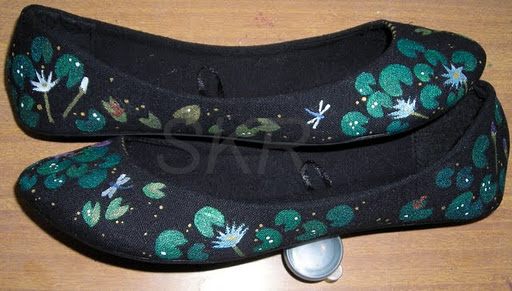
Finished lily pond shoes

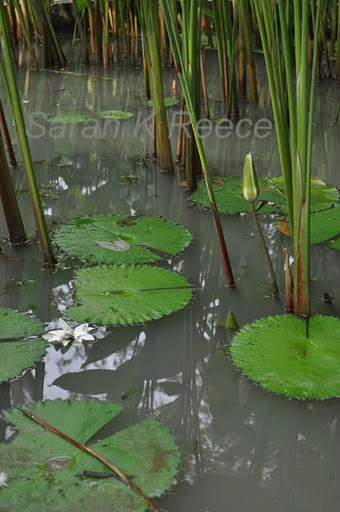
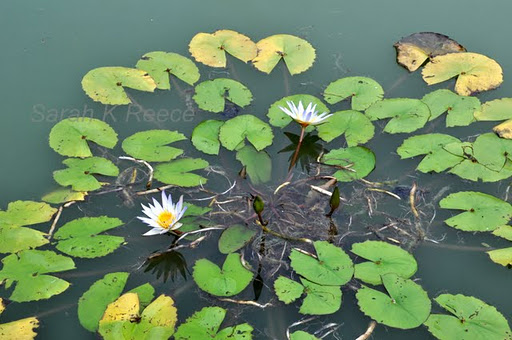
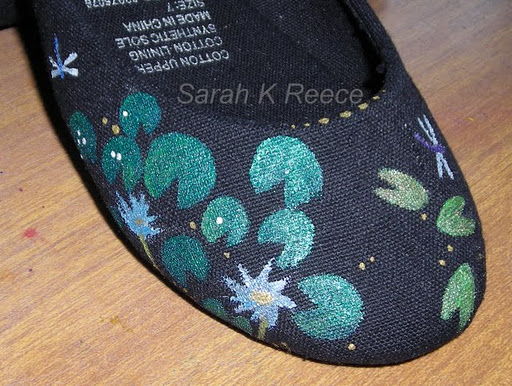
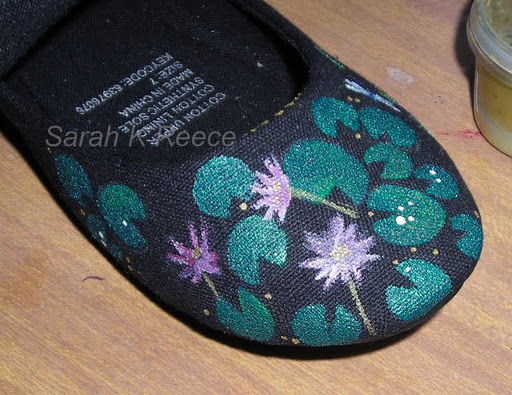
I finished the lily pond painted shoes I’ve been working on, you can see how they started and the reference photos from Singapore I used here.

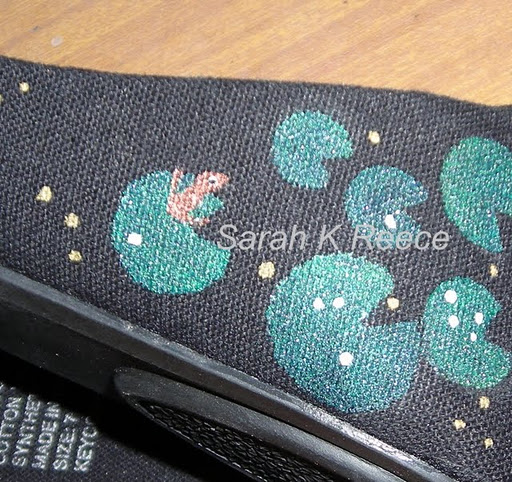
I was asked to include some tiny Singaporean frogs, so I investigated and found this site, and I thought the tiny Spotted Tree Frog was a lovely shape and vibrant colour. So I painted a few of them perched on lily pads.

I’m really pleased with these, the effect is great. They were quite a challenge to paint in this hot weather with my paints drying out so quickly, but they’ve come up really well with shimmery greens and golds. A good note to end 2011 on. 🙂

Happy New Year

Wishing all you good folks a great end to 2011. It was a funny year for me, there were some huge challenges and crises in it, but also some wonderful unexpected successes and adventures. I’m quite amazed at how much progress I made on my various goals despite everything else, and part of that is down to some great support, my amazing groups, and really finding my feet with what I love doing.

I hope you also made some progress on your own goals in 2011, that you’ve learned a bit, grown a bit, or for those of you who had a really tough year, that you were able to hang in there and hope for better times. Take good care of yourselves, and I hope that things are shaping up to be a good year in 2012.

I’ve got a lot to look forward to, my biggest challenges will be the unpredictability of my caring role, and keeping myself on an even keel amidst all the busy-ness. I’m worried about that, but making plans and arranging my calendar for down time each week. If I can keep my sleep going okay and touch base with friends and supports regularly, hopefully I’ll be able to keep it all together. Summer is a challenge for me health-wise and some of my new study will be starting very early in the morning which is also difficult for a night owl like me. We’ll see how things go! Good I hope.

Have a good night, say good bye to 2011 with joy or sadness or regret. A new day comes.

Lily pond shoes

I’ve been painting a new pair of shoes, this time inspired by the lily ponds at the Singapore Botanic Gardens. I was there for three months at the start of 2011, so I had some great photos to refer to.

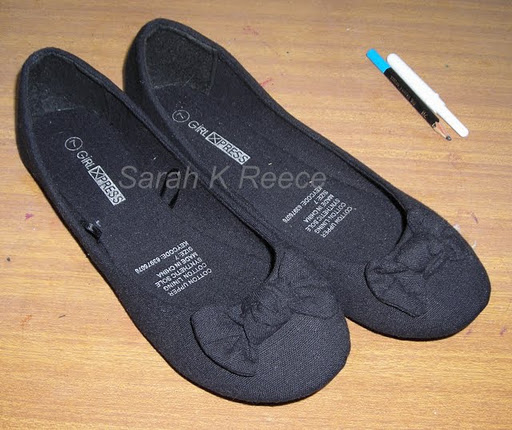
Here’s the process so far with the new shoes:
These shoes are currently selling for $12 at Kmart.

Unpick the bow on the front:

Map out the design in pencil, then start painting:

I quite liked the design just on the toe area, so I stopped there to check with my sister, who these belong to. But she likes the idea of lily pads wrapping around the whole shoe, so I’ll finish them off tonight and bake them when it’s cooler in the evening. (see them finished here)

Intimacy after abuse

There is mature but not graphic content to this post, please be aware!

Sadly, being abused by someone often leaves us with difficulties around areas like touch, proximity, and trust. Trying to separate terrible feelings linked to abuse from our desire to be physically intimate with another person can be a challenge. Many of us feel damaged, painfully aware of our difference and try to somehow make up for it. We can get ourselves into some really miserable situations if we don’t decide that we have the right to heal from the trauma in whatever way is best for us, and in our own time frame. Feeling guilty and under pressure with a partner is a quick way to end up accidentally replaying the abuse and re-enforcing to yourself all those terrible underlying messages such as ‘women can’t be trusted’ or ‘men are brutes’, ‘my needs don’t count’, ‘I’m horrible and no one would ever want me’, and so on.

The first aim from my perspective is rather like the Hippocratic oath. First, do no further harm. That means trying to stay well away from anything that replicates the initial trauma in that you feel like you are powerless, beholden, or trapped. Without being allowed to say ‘no’ -to anything, at any point, and to change your mind (more than once!) it is very difficult to find your own powerful ‘yes’. Many of us get tripped up and feel that we owe a partner, feel sorry for them being stuck with us and all our issues, or fear that it’s not fair to change our minds at any point. My feeling is that we always have the right to say no, that this is the most critical personal power we need to make touch now different from abuse. The right to change your mind is also important, sometimes having a ‘no’ respected is the very catalyst you need to feel safe and sexy and suddenly ‘yes’ is on the cards! One day you may declare that you don’t want to have sex again for another 2 years to give yourself time to heal. The next you may be feeling free and fun again. Intimacy should not be built on obligation, anxiety, compulsion, or anything but that strong internal ‘yes’. It is not for anyone else, to repay favours, to try to stop someone from leaving, it is not something you can owe to anyone, or something that should ever be demanded of you. The first and most important foundation is that you get to opt out.

Does that mean introducing manipulative games and with-holding into your relationship? If those dynamics are present, I’m sure that an idea like this will be used in ways designed to be hurtful. If a casual partner refuses to agree, I would walk away. If a long term partner turns the idea of having rights over your body into a massive power struggle I’d be very concerned. Does this mean that you have all the rights and your partner none? Not at all – they have exactly the same rights as you do. Getting involved on this level, particularly if you are struggling with an abuse background, requires a level of maturity and sensitivity. If they also have an abuse background, and people with similar experiences often do attract each other, then yes, it’s going to be a bit of a dance to work around all the different triggers and I would expect quite a few days with cold showers in them. Within a good framework where there is trust and respect, a lot of love, care, tenderness, fun, and healing is possible.

You may wish to discuss your history and concerns with your partner/s. They may find this hard to hear about, I’d recommend keeping these conversations out of bed, and they may need support themselves to learn about and cope with the abuse. A tiny word of caution too, you don’t want to find yourself with someone who copes with your history very well because they care very little for you or have a sadistic streak. It might be rocky to be with someone who finds it hard to hear that you’ve been hurt, but it could be a better road in the long run. Try to be understanding that it’s a painful topic for anyone to hear about.

So, with that foundation, what next? How do you stay grounded? How do you stop bad memories intruding? What if you have a panic attack? How do you manage ambivalence? I’m not an expert in this field! Here’s some suggestions from my experience, reading, or things I’ve learned from other people.

It’s okay to be ambivalent. This is the pretty normal reaction to trauma and abuse. You may be excited by and appalled by sex, touch, and intimacy. Both feelings and reactions are real and legitimate. Over time and with appropriate expression, I hope you will be able to separate them and help them to become more distinct. What do I mean by that? When we feel something strongly, it often becomes diffuse, undifferentiated, spreading outwards in a cloud and attaching to many unrelated things. A woman abused by a man may hate and fear all men for a while. A man betrayed by a friend may distance himself from all friends. A child frightened by a person of another race may fear all people of that race. Sex and abuse often feel profoundly tangled in together, over time and with processing they become more separate so that you are able to feel interest in the one and loathing for the other as distinct, separate feelings for different experiences. Give yourself the right to feel all the feelings that you do, and to give them safe expression, and help yourself to untangle the experiences and treat them as separate.

That distinctness between the experiences can be the key to staying grounded and preventing the intrusion of bad memories. If you have clear memories of your abuse, you may be able to quite easily find ways to make sex different from it. This might be in really big ways – never with the lights on/off, never partly clothed, never with loud music, etc. Or it might be something quite small that you use as your anchor. This is something that you mentally come back to as often as you need to remind yourself that the abuse is not happening now, that it is over in the past and this is a new good experience. It might be music, incense, something you can see or touch, a bracelet, anything that has absolutely no link to the abuse or abuser/s. It’s even better if it’s something that has a strong link with your life now, with feeling safe or strong or sexy or loved.

If memories are causing you troubles, you may be an eyes open person for awhile. It might be important to keep eye contact, to stay face to face so you are connected to the person you’re with right now, instead of memories. Body memories can also be difficult, where sensations can be triggered. If this is causing you difficulties, try having a think about ways to manage the triggers. You may find it’s best to avoid sensations in those areas if possible – not being touched on your wrists for example, or certain postures – not having another person’s body on yours, or conversely you may find you can overwhelm bad memory sensations with new positive ones.

If the abuse you experienced is hazy in your memory, was threatened rather than acted out, or occurred in a relationship that moved between sex and rape at different times, it may be more difficult for you to avoid certain things and the undifferentiated distress may cause you a lot of troubles. If you feel guilty or like you shouldn’t let it affect you, this will probably make your distress even worse. Another challenge, particularly for those abused as children, is when your development has been affected by abuse, and certain things have become sexualized that you would not have chosen to react to in that way, such as being powerless. This kind of ‘programming’ can be resilient and distressing, but over time your voice is far more powerful than anyone else’s and you do have the power and the right to choose what you will act on and re-enforce within yourself. Some people gain a sense of power over these things by choosing to bring them into a new relationship, exploring in safe ways the themes of power, or being trapped, for example. Others choose to leave them behind and find new things to make part of their sexual world. Another challenge is if self-harm and abuse have become entangled for you, and you punish and humiliate yourself through putting yourself in situations where you will likely be sexually abused, or where you find yourself replaying the abuse. Sex can be powerful and we can play out in it all kinds of other issues and drives. Try to disentangle it from those that harm you. Be very careful of the harm that re-enacting powerlessness, fear, being silenced, and not having the right to control what happens to your body can do – not only to you, but also to your partner.

If you have a panic attack – it’s not the end of the world. It does help if your partner knows that one may happen, and better yet, has had experience with how to best comfort and reassure you during one! It could be very distressing for them to think they’ve hurt or upset you if they don’t know that you may have a reaction. You may have all kinds of reactions – shaking, crying, needing to be hugged, not being able to bear touch, needing to be spoken to and reassured that you’re safe and loved, to be able to run away until you feel calmer… It doesn’t mean you’ve failed, or that anything’s wrong with you. You may on the other hand feel numb, disconnected, spacey, you may become dissociative, feel like you’re floating or have flashbacks. None of these will actually harm you, although they may be very uncomfortable or embarrassing. They may mean that you’re moving too fast, or that you’re exactly where you should be. Only you can work that out. If you expect to have a huge reaction and don’t – that’s okay too! It doesn’t take anything away from how bad your experiences of abuse were.

Intimacy is also related to how we feel about ourselves. Many people who’ve been sexually abused feel very disconnected from their own bodies, and have a pervasive sense of shame. If you hate how you look and feel, it is difficult to inhabit your own body to enjoy the sensual feelings of intimacy. You need to find a way back in, a link to yourself where you see your own body as yours, on your side, where you are able to befriend it, love it, nurture it, and enjoy it. While they can be very confronting, a mirror may be your friend here, a place in which you can try to see your body with compassion instead of loathing. The sensuality of everyday life – the feel of soft materials, the tickle of grass, the warmth of the sun, these can be safe ways to start to re-engage your senses and inhabit your body. Physical exercise or dance might help you to take care of it and enjoy it.

Some of us get confused and find sex difficult to comprehend while abuse or rape seems ‘normal’. It might be that you are still in contact with the abuser or have positive feelings for them or good memories of their kindness and care. This can be a kind of Stockholming. It might be that you used abuse as proof that someone somewhere had found you attractive, to shore up your low self esteem. You may only feel certain that you are desired if the other person is dominating you. There is another way, and it’s not dull or boring or lifeless. It’s about respect and safety and freedom and love. There’s a kind of depth and innocence and darkness to it that makes abuse feel sordid rather than reassuring. It’s worth going looking for.

Lastly – all sex is not the same. There’s many different kinds. Some are fun or even funny, light hearted and silly. There’s different experiences, emotions, degrees of connection, some takes all night and starts with the finger tips, there’s the rumbly tumbly hair in your face kind, and the looking deeply into each other’s eyes kind, and the quick the flatmate will be home in a minute kind, warm summer nights or stormy autumn afternoons or freezing cold winter mornings snuggled under the blankets kind. Keep this in mind if the idea of ever being able to enjoy sex again feels like an impossible dream. Perhaps some of these kinds of sex have been less tainted than others, are less risky, have less triggers and memories waiting to surface. You reclaim any territory by starting with the easiest bit, and making slow progress, first this and then that, not by trying to take on everything at once and getting totally overwhelmed. Maybe something in particular will be easiest to be inspired by first.

If you’re struggling with issues in this area, I’d recommend looking for some information and support. You are not alone! There are many, many people out there trying to work their way through these issues. If nothing here has been helpful, perhaps you’ll find some suggestions better suited to you in some books about recovering from sexual abuse. SHineSA are also available for information, free counselling and health checkups, I would absolutely recommend them. Many of us are pretty short on good sound information about the complicated world of sex – safe sex, pregnancy, anatomy, what are myths, and without good information sex can be intimidating and confusing! You may find that expanding on your knowledge is helpful. If you are really worried about something sexual, or wanting to but not enjoying sex I would recommend doing some reading or seeking out some counselling. Sexual problems can feel overwhelming and impossible, but as you work things through and learn more, hopefully you’ll be able to put all the right ingredients together to reclaim an enjoyable sex life. It is possible! Good luck and take care.

I’ve written a series about emotionally safer sex with more skills and suggestions – start with Safe sex 1: Checking In. If your, or your partners abusive experience was recent, you could also try reading 5 hours after an assault, Supporting someone after trauma, or My experience of sexual health counselling. None of these have graphic abuse accounts or descriptions of sex.
Ink Painting Art sale

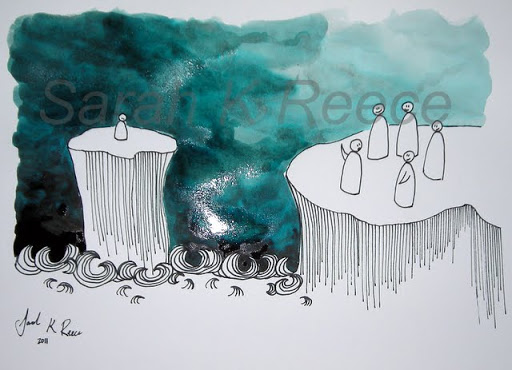
Well, I’ve been able to get back the rest of my work from the UnBOUND art sale. I sold four works which I was very happy about.These works are all ink on paper, unframed. Many are concept development works, learning traditional Chinese or Japanese styles of ink painting. Click on any image for a carousel of all.

Penguin Shoes

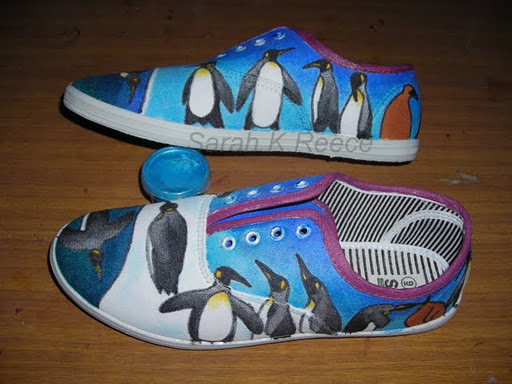
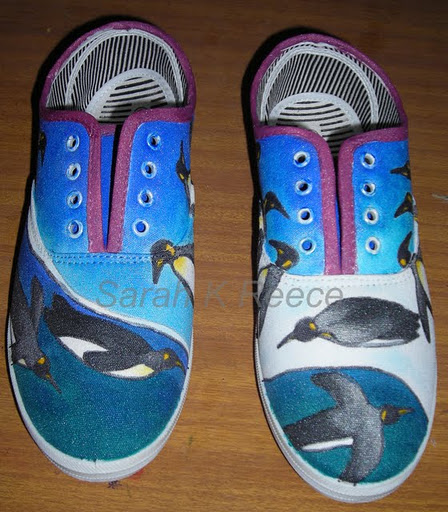
I’ve painted a new pair of shoes for an order. The brief was ‘penguins’, and when I asked about colours I was told ‘penguin coloured’. So here are my penguin-coloured awesome penguins of awesomeness. I hope they will be enjoyed by their new owners!

I decided after some research to make them king penguins, the fat brown ones at the heel are the young penguins. (you can see my reference pictures and colour choice below) They have a lovely streamlined distinctive shape and colouring. In RL the penguins are silvery and shimmery rather than grey as appears here. I’m very pleased with them, they took a couple of hours and will going out in the post tomorrow.

If you’d like some Happy Shoes of your own, check my Gallery for design ideas and prices. 🙂

Christmas

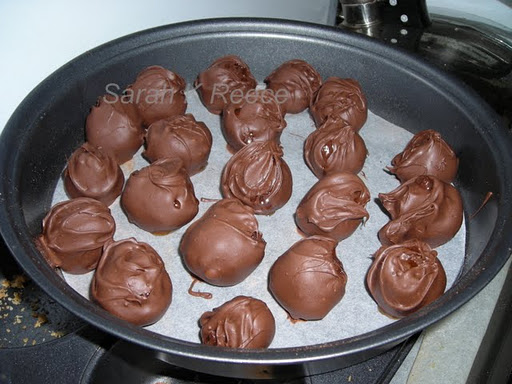
Hello all, apologies for my erratic blogging over this time. I’ve been busy with various traditions such as playing cards, watching my favourite Christmas movies (the Muppet’s Christmas Carol, and Nightmare Before Christmas) and making desserts. It was a very hot day to be chocolate making, but fortunately I’m an old hand now at making chocolates in hot weather, cramped conditions, and pushed for time. I’ll be taking a pavlova with berries and lemon curd, mini gluten free banoffe tarts, and three different types of hand made truffles; coconut rum, berry, and hazelnut liquor to Christmas dinner. Life has been busy with the groups wrapping up for the year, various pets ill and needing vet assistance, art projects I’m trying to get to and today’s cooking challenge. All worth it. 🙂

The really good news is that my sick and underweight cat Loki does not have FIV, so is on a high protein diet with a course of steriods and antibiotics and such like and will hopefully bounce back. Charlie, my blind little dog has also been quite sick but is improving as much as could be expected considering a severe heart condition. He’s certainly a lot happier and brighter than he was, and is getting sprayed down regularly to help him cool off in this heat. He’s discovered the joy of fans and now when hot will wander around until he finds a fan on the floor then stand right in front of it, looking very content. Being the dog that he is, if we set up a fan next to his dog bed he will go and sleep in the hallway instead. 🙂

So, here’s a couple of my culinary accomplishments so far:

Berry truffles: they are a blend of dark and milk chocolate, melted with cream, finely chopped tart home made plum fruit leather, and a drop of cherry flavour, then dusted in bitter cocoa. The secret to rolling truffles is to chill the mix until it’s very firm, then roll them wearing latex gloves and working very quickly with small batches.

Gluten free bases for the banoffe tarts – these are banana caramel tarts. The bases are made from macaroon mix pressed into muffin tins. Then goes caramel to set, before serving I’ll layer sliced banana and lavish with chantilly cream and crumbled flake. Yum!

Coconut rum truffles: these are a favourite every year. If made with dairy free dark chocolate these can be dairy free in entirety as they are made with coconut cream, and possibly vegan as well, although not being vegan myself I’d have to check that. You soak coconut shreds in rum, vanilla essence, maple syrup, and coconut cream until the flavour has developed, then heat and melt into chocolate. Chill, roll into balls, chill the balls further, then dip into chocolate to coat. Delicious!

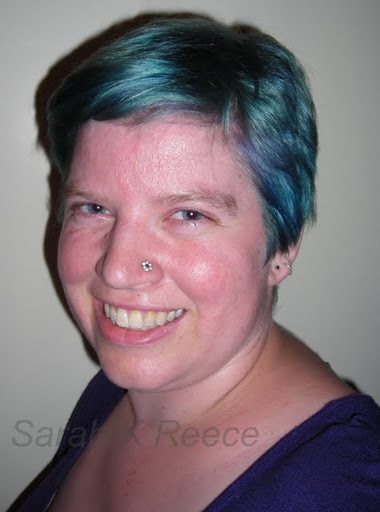
And my hair is looking a lot more festive, in another holiday tradition I’ve managed to think of a colour I haven’t yet dyed it. Voila!  Merry Christmas to all of you. I hope you have a peaceful time, and can find something a little heart warming somewhere in the day. Take care.

Poem – Art, darling

Art, darling, I am coming home
To you at last, my head was turned
By love and reason; I have been unfaithful
But I return.


I am tired and careworn; be patient with me
Be my lover, not my master
I need muse and inspiration
No recriminations, no withholding
I will take my leap of faith, in doing
What I love, life may come
That sustenance will follow dreaming.


Ahh, never mind that now,
Let us lay still awhile
And breathe each other in
I have missed you
It is good to be home.

Christmas on a budget

When you’re very short of money, Christmas can feel impossible. I’ve had quite a few broke Christmas’ over my life, and have learned a lot of ways to get into the spirit of things without spending very much. Especially if you’ve got young kids, there are ways of making things special without spending what you don’t have. When I was young my family were pretty hard up and my Mum did an amazing job of using creativity to give us a lovely Christmas.

I’ve already talked a bit about gift ideas, but one more is worth mentioning. It’s a gift from when I was very young. Mum bought a bracelet with paua shell hearts and de constructed it, breaking it apart to form a number of necklaces for gifts. I still have the necklace because it was it was such a clever lovely gift. It reminds me of the strength of love in adversity.

Food is another expense that can be difficult to get around over Christmas. If you’re really struggling, see if someone local is offering hampers. That can really help to put some special food on the table on Christmas day.  Hampers that you pay off over the year in small amounts can make sure there’s money being put aside for food. Some shops offer a Christmas fund where you add in perhaps $5 every time you grocery shop, then spend the money just before Christmas. Anything you can cook yourself will almost certainly be cheaper than buying it. Nibbles like gingerbread smell festive and wonderful and don’t cost much to make. Decorating them is the sort of thing many kids love. You can buy some items in bulk and break them down into smaller portions. There are also many places who hold free lunches on Christmas day – if you’re lonely and broke this can be a really nice community way to spend the day.

Don’t feel you have to follow any food traditions. There’s no point paying for a plum pudding if no one in your family likes it. If a lovely big roast chicken and a little handful of prawns would be more special than a serve of dry turkey, then do it. If you’re not a great cook and tend to ruin unfamiliar recipes, stick to what you know and add festive trimmings like cranberry sauce. Have something small special and make the rest affordable, and don’t waste money on things you don’t like. I’m a foodie, so in previous years I’ve started baking Christmas cakes and puddings in about August. This helps to spread out the costs and gives the flavour time to develop. I also often put away one or two special bottles of drink just for the Christmas season. Part of what makes the food special is that it’s different to what we eat during the rest of the year. So, if you can, identify a couple of your favourites, and don’t have them at any other time. They become something to look forward to, something that marks the festive season and helps to herald the Christmas spirit. These kind of small family rituals can be very soothing during difficult years.

Decorating is another area that’s difficult to pull off without any money. I spent one Christmas recently in a caravan park, with very little money. I ignored the idea of a tree, as I had no room, but bought a couple of lengths of tinsel from a cheap store. I hand made paper decorations, cutting doves and stars and bells out of cheap sketching paper and hanging them around the van. I ran an oil burner with a festive smelling blend for most of December. In other years I’ve cut a branch of any tree – gum tree works just fine, and decorated that as our cheap Christmas tree. I’ve heard of people reusing Christmas cards for their tree decorations. Cookies can also be wrapped in cellophane and hung on the tree, and popcorn garlands can be used instead of tinsel. If you can afford a fake tree and have somewhere to store it they can last for many years.

Activities – here’s an area our culture isn’t all that good at. In many families the only way you can have fun is with money and/or alcohol. When you’re broke it can seem that you’re missing out on everything. There are many community events free at this time of year, and religious services open to everyone. Community centres often hold festive days, local schools and aftercare programs likewise. Keep an eye on your local paper to see what’s happening you might like to be part of. Depending on your interests, you can start to develop a repertoire of cheap activities that you and your family can enjoy. I love trips to the beach, especially in stormy weather. Some days I pack up a hamper for dinner and head out to the ocean – it’s still cheap because I’m not buying food down there, all I have to come up with is fuel money or bus tickets. Another of my favourites is games nights. I love card games and board games, many of those can be bought second hand very inexpensively. With a group of friends there’s a lot of fun to be had, and if everyone brings a plate or drink to share the cost is very small. Film nights can set you back just the cost of the dvd rental, or time them for when something good is on tv. Camps can be great, backyard cricket days, poetry nights, baking nights, beading nights… depends on what you and your mates are into. Take the kids to the park, the dog for a walk, get some books from the library, run around spraying each other with water pistols… once you starting thinking cheap and fun the possibilities are endless. It can take a little while to get into the mindset and stop feeling like you’re missing out, but with some time you do get there. Even in years when money has been better, I’ve so looked forward to our Christmas Eve traditional games night, and every year I’m asked to make my batch of coconut rum truffles.

Sometimes having a lot of money to throw around can make you forget about these kinds of things. There are special moments in watching the kids bake with Grandma, or taking hand made cards around to the neighbours. Being broke can help you bypass the grasping consumerism of a commercial Christmas and focus instead on taking a break, having some fun, catching up with friends, kindness, generosity, sharing… If you’re not broke, take a moment to remember those who are, especially those who are sick and families with young kids. You may be able to give them a small hamper, or help out with babysitting. It’s hard to be creative and festive when you’re exhausted, and most broke parents are pretty tuckered out by the end of the year. Someone turning up to clean the kitchen could be the best Christmas present ever.

Take care and be kind. 

Newsletter 2

Here’s the latest Dissociation Link newsletter, you can access it in pdf form here to download, print or share easily. Please feel free to pass it along. 🙂

(function() { var scribd = document.createElement(“script”); scribd.type = “text/javascript”; scribd.async = true; scribd.src = “http://www.scribd.com/javascripts/embed_code/inject.js”; var s = document.getElementsByTagName(“script”)[0]; s.parentNode.insertBefore(scribd, s); })();

The camp was great

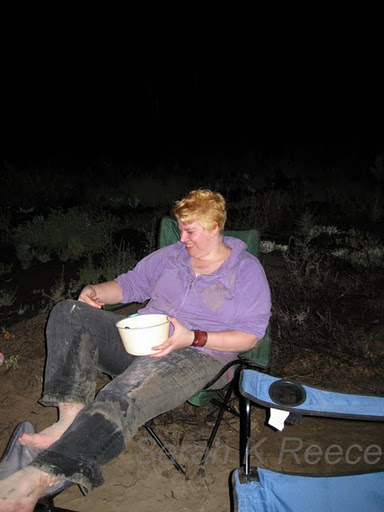
I’m back from a few days away camping, had a fantastic time. My sister and I drove out in heavy rain with thunder and lightning, and chose a camp site by the time-honoured tradition of pitching a tent at the spot we got bogged. 🙂 Well, first we spent a filthy wet hour heaving the car about 5 pointless metres through the mud, then we decided that the middle of the road looked like a great spot for a camp site after all.

The rain stopped for just long enough to find a flat spot about 100 yards from the car, pitch the tent in the dark, and haul all the camping gear from the car to the tent, and brew up hot cuppas and soup for tea.

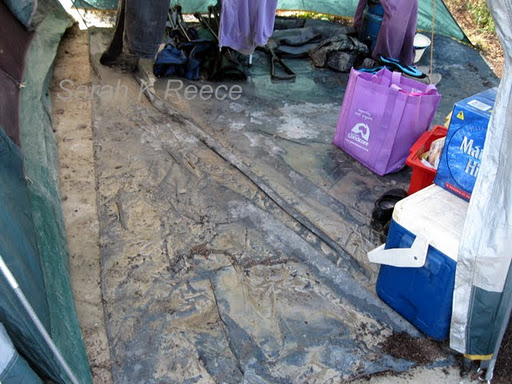
Laying in bed we were feeling extra fortunate for the break in the wet weather when the rain started up again with enthusiasm and we discovered that our tent was no longer waterproof. First it was a drip – which might even have been attributed to an over active imagination or mild hallucination… then rivulets of water started seeping down the inside of the tent. We scrambled for plastic bags and wrapped electronic items like cameras, also shoes, a spare change of clothes, and books as best we could, then covered our beds with towels and jackets and hunkered down for a very long damp night. Fortunately the weather was warm so we didn’t chill, although it was by far the wettest night I’ve ever had. In the morning the entire tent was sodden, the floor was a lake, the bedding saturated. Somehow the tissue box was strategically placed in the one dry spot in the tent, and the plastic bags worked to keep the valuables dry.

The next day was hot and dry so we dragged all our belongings out and left them strewn about the landscape on salt bush to dry.

The car was now moored in its own private pond and listing heavily to the left. We’d stopped before we buried it up the axle, so I was optimistic that with some time and effort we’d be able to extricate it. That evening we dug a channel from the water around the car to a depression along side the road and drained most of the pool of water.

I love camping. It’s such a fantastic experience to be out in the bush, the stars on the second night were breathtaking. The bird song was incredible, the wildlife shy but plentiful. The flora is lovely in a subtle way, the hues of the saltbush and pigsface, tiny flowers and lovely black limbed twisty trees.

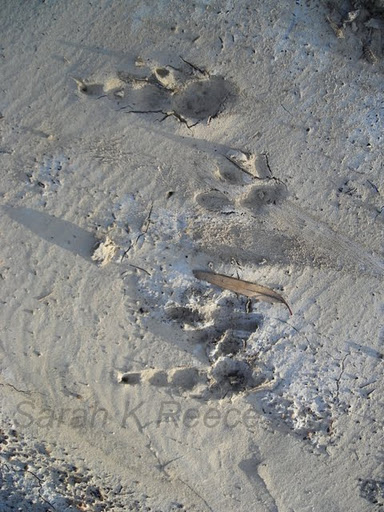
Kangaroo prints
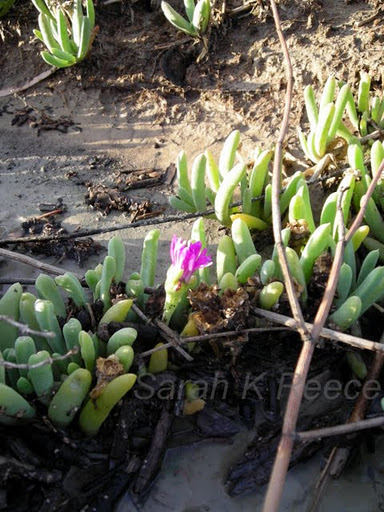
Pigsface in bloom
The sun roasted all our gear dry in a couple of hours. We napped, read books, swam, played cards, and I sculpted a river dragon out of mud. 

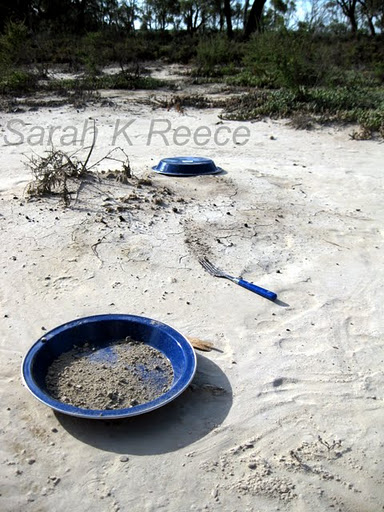
As we weren’t sure how long we may be stuck for, we were careful with our water supply, cleaning our dishes with sand.

The evaporating rainwater left interesting patterns on the earth.

Yesterday a passing motorist kindly tugged our car out the bog, so we were saved the hard work of hauling it out ourselves. I approach camping rather the same way I approach life – be prepared – we were well stocked with food, water, first aid, etc, and don’t expect it all to go to plan. Most horrible things make great stories later on, and the experiences make the miserable times worth getting through. I love camping with someone else who does too, going out with people who are not very keen is a frustrating exercise in trying to prevent them giving up at the first glitch. Being in the bush is one of my restoratives, it calms and inspires me. Such beauty. Wish we could have stayed longer.

Sculpture – final bowl project and results

Small Object Making class: start at the beginning:

Here’s the final rose petal bowl project:

It has petals from three different roses in it, all hand sewn together with white cotton thread, then crystallised by painting with egg white and sprinkling with castor sugar. The brief was to create something like a bowl, from any material we wished. It’s lovely, rather brittle and very fragile, and smells of musk or pink turkish delight.

I collected my journal with my results in it today, I was given a high distinction for the subject. Very happy with that. 🙂

Should we ‘never be a victim’?

Sometimes I come across the instruction to ‘never be a victim’.

It makes my skin crawl. The implication that in every situation you have a choice, that to be victimised is something you would choose, is just the kind of thing that makes me want to take those people to the places on the very edge of life. The places where you find out what you would do, rather than die. Where you learn about sadism, death, brutality, and brokenness. Where life or death comes down to whether you ducked quickly enough, wore shoes that are good for running that day, or if someone walked in the room just at that moment. They simply cannot be imagined. Only through experience and empathy do we glimpse the horror and misery of being a victim.

The other side of this, is that sometimes, there is a choice. And I still disagree with the instruction.

There are worse things to be in this world than a victim. Sometimes the choices we face are terrible ones. The world of violence and abuse is narrowed down to very few roles. Sometimes there is only a choice between being victim or perpetrator. I know that choice. I’ve felt that temptation, to reclaim power and to inflict fear. I know what it feels like to be wounded and full of rage and want almost more than anything to do to others as has been done to me. To see fear in their eyes and feel powerful instead of small.

Sometimes, choosing to be a victim is an act of courage.

The last time I was made to feel terrified, humiliated, devastated, there was a moment when all the noise had gone and I was alone in a room and I felt the world pause. Two paths opened before me. In one, I took my freedom and ran. In the other, I turned and hunted, furious and seeking to reverse the roles. I weighed my choices with great care, with passion.

I said in my heart, I will let you do this to me. It ends here. I accept, for just this moment, the role you have placed me in. I have been victimised. I’ve fought and you were more powerful. I’m wounded but still recognisable. If I take up the role of perpetrator now, I’ll lose even that. I’ll lose myself. So, I take the hits and I walk away. No revenge. It is human to be frail. It is human to hurt. I’m still who I was. There is a nobility in retaining the power to chose how you will respond, in refusing to be debased by their behaviour. You cannot hold others accountable for actions you choose to overlook in yourself.

It is sadly human to be driven by baser impulses, to tear down, to dehumanise, to humiliate and destroy. It is also incredibly human to rise above this, to be moved by compassion, to act with courage, to hold yourself to a higher standard. Humiliating experiences take away our sense of meaning and introduce us to a world where power is the only thing that matters. It is at times very difficult to hold onto our own moral code when it is seen only as weakness and inferiority. Many violent people believe that we all would behave as they do if only we had the strength. Under their sway we can become lost in their perspectives and forget the reasons we had for choosing to live as we do. Forget that those choices are not for their benefit, but for the protection of our own heart. Some abusers deliberately set up situations where they require the abasement of their target, where they turn mothers against children, coerce siblings into betraying one another, entangle a whole classroom of children into bullying the most vulnerable child. This betrayal feeds into their fantasy that all strength is power and all restraint and self control is only weakness masquerading as virtue.

People who have been victimised often struggle with violence revenge fantasies. Each person finds their own way through an understanding of these, and a way to make peace with them. Sometimes people who have been victimised fought back. I can still taste the blood of someone I once bit when he held me down. The aftermath of being able to fight back can be both empowering and destabilising. Some of us have exercised violence in the protection of someone else. Some of us have first run, and then gone hunting those who once preyed upon us. Some of us have run, and then gone hunting those weaker than ourselves. Some of us take our own pain as permission to wound and alienate people around us who we decide have been less hurt than ourselves. All of us must reconcile ourselves to our own capacity for violence, and find our own morality in choices we have made under incredibly difficult circumstances.

For me there is a peace in knowing that unless I voluntarily surrender my choice to be a person who acts from love and honour, it cannot be easily taken from me. There are things within us that are not easily destroyed, broken as we may feel.

This is why I get angry at the instruction to never be a victim. Even in being victimised there can be a virtue. Even in brokenness there is something whole, something deeply and beautifully human about choosing to live with scars rather than writing our pain in other people’s blood.

Why I love theatre

Good question, I’m so glad you asked. I’ve been very much enjoying the opportunity to get to see some local theatre due to a scheme which is sadly ending this year. The Bakehouse Theatre on Angas St, Adelaide offered free tickets to people on a pension/concession for one night of their shows. As a result I’ve enjoyed far more live theatre this year. This started me thinking about what it is I love so much about it.

I must confess that I have a history with theatre that predisposes me to a significant bias. I was bullied pretty extensively throughout my school life, in cycles of relentless harassment alternating with miserable ostracisation. Getting involved in the school theatre was the one time of the year that put a stop to all that. For a few months I was part of a team, spending hours in rehearsals, all working towards a common goal. I was also therefore, temporarily out of bounds for bullies as I was a necessary part of a project that nobody was going to stuff up. Too many invested bigger kids and teachers. So of course, I fell in love with the theatre. Long late nights learning the entire script with a jam bun and a thermos of soup, the only people still permitted on school property… The terror of final rehearsals with props going missing, costumes not fitting and actors developing tonsillitis or laryngitis. Chronic sleep deprivation, lugging the precious script with all the hand written notes and stage directions in it everywhere, the glory of finally being in the theatre with the red velvet curtains, the uncomfortable seats, the smell of dust and make-up under hot lights. Even now just the empty theatre is a trigger for me, makes my skin ripple with electricity, brings lines of Shakespeare to my mouth.

Theatre is electric. It is painfully beautiful and so temporary. To watch it come to life slowly through readings and stilted rehearsals, dropping lines, forgetting stage directions, awkward pretend relationships, then all the trappings start to come along and develop it into the final work of art, it’s such an amazing experience. In year 12 I won a drama scholarship that allowed me to see almost every work by the SA Theatre company free for the next year. I revelled in it. I love the heightened atmosphere of theatre, I love to dress up for it – where else do I get to dress up? For one night I take out my pearls and leave my life behind.

There was another scheme (with a different theatre) I was part of for a while a few years back, with discounted tickets for the unemployed. It wasn’t set up well. I had to get there early to wait in line. We’d wait until all the other tickets had sold, and every other patron was seated, then we’d be able to get ours. We had to wear a big orange ticket displaying that we were on the discount. We were lead to seats in a special area in the dark, trying not to disturb anyone else. It was pretty humiliating, I only went along a couple of times. Half the point of theatre is to be taken out of your own life for a little while, to leave it all behind.

The most painful part of theatre is what makes it so powerful. It is ephemeral. It always ends. Any night you go, that is the only night exactly like that one. The audience, that exact cast, the lines said just so, the laughter at that point, it is utterly unique. It is like life. Theatre reminds us that the days may be followed by many more days the same, but they are none of them the same. They are all utterly unique and unrecoverable. At the end of the productions I was part of, we did the bump out, we laughed with the intense relief of knowing all the moderating had happened and there was nothing more we could do, we shared drinks and ice-cream. Life went back to normal. And I cried for days every time.

As someone who struggles with major dissociation, theatre is very special to me. To sit only a few feet away from living people who are transporting me to another world, who are inviting me in and sharing a character, a situation, a feeling with me is incredible. It captures me in a way totally different to film or other entertainment. My hair stands on end, I weep when they weep, I feel my heart race when they scream, and when I laugh it is we the audience who laugh, a huge temporary collective I am part of. Good theatre captures me and I feel alive. We few people for a little time put aside our names, our lives, our roles and agree to pretend that the world is different. The very notion of being able to ask people to share this contract fills me with excitement. If we can do it for theatre, where else? Do we not do this everywhere, in every place, in every relationship? Do we realise the power we have?

The very notion of theatre is a crucial part of my life. I’ve spoken with people who deride the concept of theatre, the idea of acting, who think that with costume and prop we disguise life. For me this is not so. With a little greasepaint, with some coloured cardboard screens we take the banal and transform it. We reveal life. All art has this transformative quality, writers take ink and paper and paint worlds. Artists turn stone into women, paint into sunsets, clay into vessels. Theatre transforms a space, sometimes a very shabby and tumbledown space, into another world. The power of this action entrances me. Children do this instinctively, with a shawl I am a gypsy, with a helmet I am an astronaut, a tiara of stems and leaves makes me Queen of the Forest. I love the theatrical in us, the impulse that makes us shake off the heavy weight of labels and choose our own, lightly but with resolve. I think of Dame Edith Sitwell, who even in sickness and age, reading her poetry from a wheelchair, was splendid if bizarre, with magnificent turbans, velvet, brocade, and sparkling jewels.

As a child trapped in a world often grey, in a place where I had little voice, few choices, and little control, theatre showed me a way to transform anything into something magnificent. How to own a space – the way an installation artist does, or a musician owns the stage, how to take whatever I had and use dreams to make it mine. It didn’t matter if they were painted cardboard, if the silks were polyester, the flowers in the vase just grasses from the creek. It didn’t matter what I had to work with, how destitute, how broken hearted, or how sick. It didn’t matter if nobody else could see it or understand it. We live in our dreams, and theatre is just a hall of dreams. 

I’ll be speaking at the Voice Hearers Conference!

The good news keeps coming! Both abstracts have been accepted, so I’ll be travelling to Melbourne in February next year to speak at the Voice Hearer’s conference with fellow Peer Worker Jenny Benham. I’m so pleased! Starting to mull over how I might be able to paint aspects of the talk and if some poems such as this or this might be appropriate to share the dissociative experience… I like to make the talks less clinical and more personal where I can, especially in the context of a conference where everyone will be quite overloaded with talks and lots of information. I’ve a few series of artworks painted specifically for talks now, one about Peer Work that I gave in Melbourne earlier this year, one about Consumer Led Service Delivery that I gave at the state mental health conference Sharing Excellence, this little one about Creativity that I gave for mental health week… I think that they will make lovely booklets.

Using creativity to overcome difficult obstacles in life

We’re planning to get input from both Sound Minds (our Voice Hearer‘s group) and Bridges so that Jenny and myself won’t just be sharing our experiences, but going as ambassadors to share the thoughts of the other people in the groups.

I’m also planning to use my time there to meet up with some people who are interested in starting their own Bridges type group in Melbourne and hopefully help however I can to get that off the ground. Exciting developments!

The Cert IV in Peer Work information session was very interesting today, and I’m now contemplating how I might be able to squeeze that into next year as well…

I’m going to be published!

I’ve just received some great news; I’m going to be published! Earlier this year myself and a colleague Cary gave a talk for the TheMHS conference (the annual Australia/New Zealand mental health conference) about using Grounding Techniques and Grounding Kits to manage Dissociation. It went really well! Afterwards we were invited to write and submit a paper on that topic, at terribly short notice. We worked very hard on it, and managed to finish in time for the deadline.

Most excitingly, I’ve just heard that the paper has been accepted and will be published early next year in the TheMHS 2011 Book of Proceedings in the ‘Recommended Reading’ section. I’ll let you know when it’s available for purchase. 🙂

And in other great news, I’ve just found out that I’ve been awarded a subsidy entrance to the Voice Hearer’s Conference in Victoria next year! (You can read what I’m hoping to talk about there here) Wow, what an amazing day!

I’m so exhausted from all the hard work and long hours with my various projects. Last night I slept for 12 hours which was badly needed. I’ve been running on 5 a night for weeks and the pain is becoming unbearable. (My physical illness symptoms such as joint pain become a lot worse when I’m sleep deprived) So I’m enjoying having days off wherever I can and hoping to catch up on a lot of sleep before the excitement of Tafe and talks and all the new projects next year I’m so looking forward to start up again. 🙂

Gift ideas for Chistmas

Gifts can be a stressful part of Christmas, especially for those of us on tight budgets! I thought I’d share a few of the ways I approach this in case any of them are useful for someone else. You can op out of gifts entirely if this is something that you hate. You don’t have to follow cultural and/or religious celebrations to the letter. It’s okay to tell your mates that you don’t want to do this. I would suggest being sensitive to what they want and like too – telling your best mate they’re not allowed to get you a gift because you don’t want to get them one might go down really well or like a bag of bricks. All friendships require finding compromises between different needs, you might need to use a bit of tact here.

Hand made and painted polymer clay jewellery

Some years I use organisation to break up the costs so that the end of the year doesn’t come with large bills I can’t manage. I’ve shopped for my Christmas gifts in the January and End of Financial Year sales, and had everything ready to go by August. This is a great approach if you’re the kind of person who finds putting aside money for Christmas impossible, but tucking gifts away in a cupboard manageable. I carry around with me a master list of people I’m buying gifts for (this can be a bit of paper in your wallet or a document on your phone) and every time I spot something that would make a great gift for someone I know I check my list. If I haven’t already bought theirs and I can afford it that week, I get it, write in my list or cross their name off, and tuck the gift away somewhere safe.

Be warned though, without a list you can get mixed up and end up with four gifts for one person and nothing for someone else! It’s also important not to forget the safe place you’re keeping them! I’ve done that before and it does rather undo your hard work!

Consider where you get gifts from. Second hand shops and charity shops can be great places to look. Technology also gets cheaper every year so small electronic items such as little key-chain digital photo displays can make great gifts. Cheap shops can be a great source of gifts, one year I bought mugs and then filled them with nuts and wrapped them in cellophane. Coffee lovers may appreciate a bag of quality coffee, chocolate lovers may love sachets of hot chocolate. Cheese lovers love getting cheeses! One year most of my female friends were given lovely blends of essential oils. Small personal gifts can be more meaningful than expensive ones.

There are some great online stores, which for those of us with a physical limitation or stress around crowds can take a lot of the stress out of Christmas shopping! I’ve had years where I’ve done all my shopping online because my health was too poor to cope with the shops. EBay has a huge range of items for sale, and you can limit searches to your local area (for quicker/cheaper postage) or by price so you only see items under $10 for example. Be aware that if you’re not very savvy online you can get into trouble with new or rotten sellers, so don’t get too enthused and put in money on bigger items until you’ve learned the ropes and got the hang of feedback ratings and how to tell a good reliable seller. Etsy is a similar online store, but this time for only handmade items. This can be a fantastic place to buy beautiful handcrafted gifts of very high quality. You can limit searches to specific areas and by price on this too. Etsy also has an area to buy supplies for making things, so you can use it to shop for unusual beautiful art and craft supplies, and make your own gifts, or use the supplies as gifts for crafty friends. The same caution as being new to eBay applies to Etsy. Book depository is another great online resource I use, you can choose a category – for example, Children’s Fiction, and then set the price from low to high so you can choose some lovely books for your nieces and nephews and pay perhaps $3 each. Book depository has no postage costs so it’s easy to work out your budget. I’m not affiliated with any of the resources or shops I’m mentioning and don’t get any money from any of them. 🙂

Too many gifts to buy? Try to limit this in some way – try buying a gift for the whole family eg a box of shortbread, instead of something for each person. Consider only buying gifts for kids. See if your people will go for a Kris Kringle idea where people all put their names in a hat, and you only have to buy a gift for the person who’s name you draw out of it. Another great idea I’ve used before that takes less organising, is to ask everyone attending a party to bring only one gift, and set a price limit such as $10. Every person who attends on the day brings their wrapped gift and puts it on a table. When it comes to gift time, everyone there selects a gift from the table that wasn’t theirs. Viola! Anyone bringing extra guests and plus ones just brings and extra gift from them too. Very little organisation required and everyone goes home with a present.

Too few gifts to buy? I’ve had some miserable Christmases where my social world had shrunk to almost nothing. It was painful to not have people to fuss over. Those years I gave gifts to charity – not just giving money but actually choosing a gift, whether it was something for a charity collection like the Kmart wishing tree or a donation to a third world country – used bicycles or sewing machines for example, or from a catalogue such as money towards meals for people who are homeless, or buying chickens for a family in Africa. I also bought a gift for myself as a way of telling myself that I mattered. If you have a pet you love, try buying them a gift – I’ve been informed that tasty dog treats can be wrapped up and you can spend an amusing morning on Christmas watching your furry friend tear it open.

If you’re a crafty kind of person like me, you may like to make your gifts. I’ve always been able to find some great books in the library about making your own presents. If you like to cook that’s always a winner. I’ve given boxes of brownies, home made shortbread, chocolate truffles, small cakes, puddings, tarts, and cookies as gifts.

Coconut rum truffles
Truffles and other goodies packed in noodle boxes
Honey and nutmeg biscuits
Pear and rhubarb tarts

I’ve also given pre-made but uncooked gifts that other people can make up when they want them, such as Brownies in a Jar. This can be great to avoid giving more rich sweet foods that need quick eating to people already overloaded at Christmas. Having said that, sweets and chocolates that will keep for a few months are also fun and usually well received. Handmade cosmetics such as nourishing hand cream for gardeners can be lovely gifts and I’ve enjoyed making them before. I’ve also had fun with crafty gifts such as painting plain journals from a newsagent as gifts.

Journal painted with picture from a magazine
and binding from Spotlight
Journal painted with pressed leaves
and decorative brass panel
Journal stamped and painted with fabric paint,
frog cut from a magazine
Journal stamped and painted
with foam and hand made stamps

Of course, small artworks can make lovely gifts such as small framed paintings or photographs. I find craftster a fantastic online community full of crafty ideas very inspiring. Be careful about giving someone something huge, they might not have anywhere they want to put it! I’ve also made beaded jewellery, cross stitch bookmarks, decorated photo frames, and handmade Christmas tree ornaments. If you like making things, this can be a huge amount of fun, setting yourself small projects throughout the year, or perhaps setting aside a few weeks to bake or sew to your heart’s content.

Cross stitch bookmark
Handmade beaded jewellery
Photo frame decorated with beads, shells and paint
Handmade jewellery – left is a duck pendant made in the WEA
kiln fused glass class, right is a hand carved wooden pendant
Home done hair dye gift

Don’t forget gifts of service such as offering to wash a car, take someone to the movies, babysit, refresh their computer, drive them to the beach, cook them a meal, or colour their hair. Sometimes these are the perfect gifts for broke friends where spending money on something would only embarrass them.

Plants or seeds make lovely gifts for gardeners, and if you have a garden of your own, produce, flowers, cuttings, or seeds from it are also beautiful gifts. If the person you’re giving them to isn’t a confident gardener, consider rooting the cuttings or striking the seeds yourself to get them started. Easy seeds are big ones like pumpkins, sweet peas and sunflowers. Geraniums are very easy to grow from cuttings. You don’t have to be a great cook to give gifts of food. A bag of plums from your tree is magic! One year I dehydrated a lot of fruit from the market and boxed them up in little gift boxes lined with waxed paper.

Plums ripening on my tree
Potted flowers are easy and cheerful
Raising seeds in my hot box

I hope there’s some useful suggestions in here for your gift dilemmas. Have good fun whatever you choose to do. 🙂