Hearing Voices Congress 2025

ID ink painting of a figure in brown with a paint brush, painting a large blue and brown wing from one their shoulders

I was late to the conference today, my system went haywire this morning and there was much arguing about clothes and adornments. When it gets like this, everything feels wrong to someone and there’s no peace for any of us.

Yesterday at the conference we were watching some of the presenters pause mid speech to listen to a voice, or sometimes pass on a comment or correction their voice had made. It was beautiful to have it so normal in this space. I remember what that was like, hosting the hearing voices group Sound Minds. I remember them sitting in my backyard around the little bathtub with the campfire in it, laughing about how anyone else would say they were crazy, but in this space they were normal.

I have been learning a lot about autism over the past 10 years and one thing that comes up is the idea of unmasking, which is often vaguely defined or badly defined but which I see as being aware of how you actually feel and function and to make choices about that instead of being so buried beneath the mask of being “normal” you can’t even tell. In here with ear buds for when the microphones are too loud, and a little stone to rub when I need something to do with my hands, and a hard mint to suck on it need something grounding because I know I’m going to be raw and heightened and tired and my senses will be intensified or dulled. I’ve come prepared because I know this about myself. Unmasking can be messy but it’s also liberating and moves you away from the bewildering crashes you don’t even see coming.

We live as if we’re not multiple. We live as if Sarah is one person. We are constantly masked. My staff and clients don’t understand this about me. My children don’t. Nightingale took me shopping before we came here, to make sure everyone who wanted to attend would have something to wear they felt comfortable with. It was complicated. She’s well aware of this because shopping for wedding outfits was similar, full of internal comflict and hope and joy and shame and embarrassment and vulnerability. Both invisibility and exposure are unbearable.

So we listened to people bringing their voices with them, and this morning our pantheon turned up and wanted to be present, not just the confident and joyful presenters, the messy and vulnerable and anxious collection of all of us, wanting to be here and be seen and steal a taste of the sense of safety and acceptance we had witnessed.

So we’re doing what we used to do at these conferences, sitting at the back in tears.

I carry burdens of doubt and guilt and isolation. There are scars and vulnerabilities and insecurities that are painfully present. So I am here with both hats – someone who can offer help, and someone who needs help.  It’s not comfortable but it’s who I am and how we are human.

The sense of being allowed to be the way you are is unspeakably precious and difficult to explain to those who create the hideously dehumanising mainstream services. The sense of acceptance and willingness to see value in devalued experiences is a profound shift. It’s healing to hear people passionate about consent and self determination, people creating different, easier ways to communicate and hold safety and equalise power.

I find myself wondering if I could take these notes and links and resources back home and share them. There’s only a handful of Australians here, and there’s so much knowledge being shared that’s so needed. I’m not sure. Waiting for me at home are so many responsibilities, and such a fragmented community. It’s mostly people like me, working hard and doing their best in their own little corner, with their family or clients. It’s definitely heavier carrying that torch of diversity and self determination by ourselves.

I’m Presenting in Prague

I’ve just arrived in beautiful Prague today.  I’ll be presenting an online keynote and workshop at the International Hearing Voices Congress 2025 for Intervoice Day on the 9th Oct. You are welcome to attend that day online for free by contacting Kellie Stastny (Chair of Intervoice) at her email: kelnco87@gmail.com.

I haven’t been to a Hearing Voices Congress since 2013 when it was held in Melbourne. Back then I presented Introducing Multiplicity explaining the different ways people experience voice hearing, dissociation, and multiplicity/plurality, and a second talk about using the Hearing Voices peer based group model to support people with other experiences with my co-presenter Jenny who passed away recently. We used to facilitate the local hearing voices group Sound Minds together.

This time the conference is themed around the topic of supporting young people. I’ll be delivering a keynote called Gary: supporting young people with complicated minds, and then in the afternoon holding space in a workshop about finding hope when supporting people with ’embodied voices’ – all kinds of multiplicity and plurality. 

I used to exclusively support adults in the community services sector, but NDIS has brought me into contact with many families, children, and young adults over the past 5 years, and as a parent of 5 kids, and someone who was themselves a ‘Complex’, ‘at risk’ kid, I’ve learned a lot. There’s always so much more to learn, but I also recognise that a child who hears voices or switches between different personalities is for most people so far outside of their comfort zone they don’t know where to start. I certainly don’t have all the answers but I do know where to start.

I was once that strange child who felt possessed. I’m still ‘possessed’ in that we’re still multiple/plural, we’ve grown up but we’re still a group. We are married and own a house and raise our children and run a business and employ a team of people. I have supported other people and families and witnessed from afar even more people finding good lives. It isn’t hopeless and it doesn’t have to stay scary.

So, I’ve created a collection of new ink paintings in purple and black ink and put them into a powerpoint, printed out a stack of Welcome Packs about multiplicity and dissociation, brought warmer trousers and packed melatonin and sensory items.

ID ink painting in dark purple of a downcast young adult with an arrow in their chest, pinning a card to them with the word Complex on it. Their dark hair tapers into fern like curls, which are also the pattern on their pants.

I’m so looking forward to meeting familiar faces again and getting to know some new people. This movement is precious and they sheltered me when everyone else rejected me. They saw capacity when everyone else was consumed by my limitations. They welcomed me to grow in the local group and then use it as the fertile soil in which to plant my own strange ideas and grow resources for others out there on the margins who were also excluded and alone. They’re messy and imperfect and certainly not a Utopia in any way, but their values are excellent and the observations and knowledge and hope they hold for people written off as crazy and doomed is unparalleled.

It’s a big deal to come here, it’s expensive and time consuming and it means a week without my family, with my beautiful wife holding the fort with the kids and the business. We talked about it for months, going back and forth about the value of it and the cost and the potential risks. During that time, we also had 4 funerals over 5 weeks, one of them Jenny’s. She was an unfailingly kind soul, who welcomed everyone and spent years spreading her story of acceptance and hope. I carry that story with me, alongside so many others.

Nightingale and I found ourselves asking what we will have wished we had done with them if we knew we only had a year or two left ourselves? Our children are our world and everything is wrapped around our family, as it should be in our circumstances. But my world pre and post covid looks vastly different and I am aware of the losses, the things I used to do and the voice I used to use. Movements struggle when people can’t show up for them. Nightingale and I keep coming back to this – finding safe and accessible ways to share this kind of information. Making the terrifying understandable, the unspeakable bearable. Facilitating conversations. Holding hope. Diversity like this has a suffocating weight and people – and children – around the world are drowning under it. They don’t need to be alone.

Empowering therapists and parents and partners and doctors to become comfortable with people like me, hearing stories of hope and meaningful lives, having a language for experiences so you can share them, and meeting others like yourself are powerful antidotes to isolation, darkness, and terror. So I’ve flown half way around the world to reconnect with a movement I believe in and add my small candle to all the lights people are holding out there in that darkness.

The Gift of Neurodivergent Diagnosis

Like many late diagnosed neurodivergent people, I’ve had a hellish run with episodes of severe exhaustion and burnout. Not understanding how I function, what supports me and where my limits are, seeing and being seen only for my capacity with my difficulties all unnamed and invisible created a horrifying cycle of productivity and crash. Diagnosed as gifted in my teens but not with ASD and ADHD until my 30’s created a horrible environment of insanely high expectations and invisible vulnerabilities. Every few years I’ve been diagnosed with exhaustion as my mind and body run out. I’ve endured brutal unexplainable immune system crashes where I’ve simultaneously contracted infections in multiple areas. My other conditions such as fibromyalgia and PMDD flare to unmanageable levels. I fall off the edge of my world and I never see it coming. Trying to stay alive takes all my energy and every resource I have. I lose everything I’ve built and have to start from scratch, and I never have a good reason why.

This is the not the future people envision for their children when they say they don’t want to burden them with a label. Diagnosis has been complicated for me, painful, isolating, relieving, hopeful. Since I’ve been diagnosed with Autism and ADHD 5 years ago, I’ve never experienced that level of exhaustion again.

I’ve learned that I’m risk blind and need to pay attention to the anxiety of those around me when I’m flying too close to the sun. I have explanations for what used to be confusing and humiliating limitations like not being able to listen to voice mail or reply to emails. I hate myself less. I pace myself better. I let go of a lot of things. I’m beginning to understand what I need to be able to show up and do the things that are important to me.

The labels come with a price of course. The diagnoses subject me to misunderstandings and low expectations. But the alternative was devastating. I’ve pursued diagnoses for my loved ones, hoping to spare them what I’ve suffered, and aware that I have no idea what it’s like to have been diagnosed young, and that they may have both benefits and costs I can’t relate to.

Here is a journal extract I wrote in an episode of exhaustion a number of years ago:

“Finding words for experiences that have no language for them, finding ways to string life back into stories, into a narrative that starts and proceeds and finishes, when my world has unstrung like a broken necklace. Discovering that in this place where things do not make sense that there is no inclination to share, no longer a drive to connect that makes me tolerate the whispered accusation of narcissism when I bare myself in public. I can be silent. I don’t need you, I don’t need this space, I don’t need to be heard.

I wait. I wait for the world to have meaning again. The days pass. Some days I find contentment. Some days I live with a stoic acceptance. Some days I cry until I vomit.

People miss me. While I’m in deep space, protecting the world from an atomic anguish. I tow my boat way out to the deeps where the blast won’t burn anyone else’s house down. I swim far from the old comfort of my online world. In sudden panics I run to familiar harbours. I bite my teeth over the blackness and crouch at the edge of other people’s lives and bask a little in their normality. Some days I fail my own principles and howl while a loved one talks soothingly, holds my hand, listens sympathetically, tells me I mean something to them. Sometimes I make them cry. I watch tears in their eyes, desperate to feel anything but the void.

Someone sends me an email like a crow sent winging from a black well to say thank you for writing from your own hell, it helps. I want to save us all. I’m saturated by death. Sometimes I become terrified I’m going to kill myself, and I calculate the loss, the holes punched through everyone I know and have loved and my reach, my influence, my connections so hard won now seem like the worst possible thing I could have done. Alone my death is just a sad story. Have I built a tribe so you can watch me self destruct? Will pain be my legacy here? Why write when I have no answers, only fears?

After a night of terrors I calm over and over, that reignite the moment I fall asleep and wake me in panic, I crawl to my psychologist’s office and wrestle with hysteria in front of her. She books me an emergency appointment with my GP for anti-anxiety meds and diagnoses me with severe exhaustion. None of the fast acting meds are pregnancy safe so I come home holding a script and a sense of being broken that I’m going to have to live with. How sweet it was to feel above this, once.

I start culling the big dreams, the vast sense of responsibility, the career plans. Tangled with my grief is peace. I have tried very hard and maybe now I can stop pushing this boulder up the hill. Enough…. I look into short courses and small jobs – orderly, care worker, and when I’m not being garrotted by my own high expectations and elitism I’m relieved at the prospect of just living a small life, earning a little money, letting my business be a hobby. Painting when it moves me, writing because I love to. Selling a few prints. Letting it be what it is. Not having to turn those skills into a factory, or myself into all those things – entrepreneur, leader, business person, change agent. I’ve watched the successful ones and tried to do what they’ve done, follow their paths. My own parents ran a very successful business for many years. I’ve risked many things and nailed my colours to the mast. Some of them have worked out and as my world burns around me I want to let go and go back to loving the things I have, the risks that paid off, the life that’s waiting here for me.

Exhaustion is storms and sunbursts that run according to their own tides. I have no more control over my feelings than I do over the weather. Night falls at 2 in the afternoon and I creep to bed to hold my wrists and tell myself I’m okay over and over. The moon sings to me and I find I’m still alive – not numb, not ruined after all. I haunt my house naked with starlight on my skin and breathe galaxies with a rueful smile and the night smells of roses. The strain of feeling deeply alive and very dead each day leaves me trembling with shock, a violin with strings wound too tight. But I can feel it seeping back into my cracked heart.

More human than I want to be.”

I tripped over my invisible disabilities and fell hard, and fell often. I am better off where I am now, knowing what I know now. Life still hurts badly at times. It’s more complicated and tangled with more people whose stories I’m careful not to share. I miss writing this blog and having my online community, and being able to use my words to provide context to so much about me that is different and doesn’t make sense. This blog was the way I leapfrogged over so many barriers between me and other people. I felt like I had a whole world of people once, who knew me and cared about me and felt cared about by me. I lived in public in a way that was a mutual gift. I am more private now, I have children, clients, employees who all need discretion and all fear exposure. I find myself more decontextualised than I was to my people. I make less sense, become more isolated. There must be a pathway between disconnection and exposure, but I’m not yet able to see it well. If I can’t be sure, I hold my tongue.

But I spend less time in meltdown, sobbing on the floor. I keep house. I am raising four children at home. My capacity has increased, my understanding of self care and my knowledge about my limits has been a gift. The first time someone gave me noise cancelling headphones to try, I was walking with them through a busy airport. I put them on and pushed the button and the peace came over me like a flood of warm water. It was so intense I couldn’t walk. I sank to the ground where I was and just wept. I had never experienced such peace outside of water. I used to calm myself by lying in a warm bath with my ears underwater. The same muffled quiet wrapped me up and it was so beautiful and so painful to realise I had lived my entire life in a harsh bright world that always hurt and never made sense.

It’s a strange story to tell, given my deep ambivalence about diagnosis in mental health. Diagnosis of poorly constructed syndromes, laden with assumptions and stigma, can function as social curses, doing catastrophic harm. The world of neurodivergence with it’s profound observations and confused wrangling of slippery categories and terms is not so different. The low expectations that come with a diagnosis like autism, and the stigma and misunderstandings that shadow the poorly named ADHD have costs. But on the other hand, I spent literally years trying to understand and find words for concepts as basic as body doubling. I have been on the intersection of so many invisible diversities, contorting myself to try and fit paradigms I was never built for. I am now finally beginning to understand my long history of failures and losses, and start to claim my skills and build my capacity. It’s sad, and hard, and beautiful, and deeply liberating.

Diversity at its darkest: speaking out against disgust, dehumanisation, and shame

I don’t print chirpy stickers about diversity because I think it’s easy. Difference can be extraordinarily painful. I was very moved by this powerful article about Patrick Burleigh: I was a four year old trapped in a teenager’s body. It’s a man’s reflection on his childhood with a very rare hormone disorder that makes puberty start in infancy. While my life has been very different and my responses to the circumstances I was in about the opposite of his, there was still a lot of common ground.

He wrote about how other people responded once they learned about his disorder:

Revulsion. Disbelief. Lurid fascination.

That’s a familiar place. Not all multiples/plurals experience this but many of us do. I wrote about the toxic culture of fear, fascination, and disbelief around multiplicity back when the movie Split came out, in I’m multiple and I don’t kill people. He’s right about the revulsion aspect although I suspect he gets a much stronger response of that and I get more disbelief and fear. (There’s not a lot of serial killer movies about people with rare hormone disorders murdering folks, although there are many about people with physical or facial differences doing so)

A few years ago when Star was in the worst grip of her eating disorder, I was researching to help her and came across some interesting ideas about how and why we eat. Certain impulses are innate at various strengths at different times, and help to balance each other. For example; fear of a new food we haven’t seen someone else eat, disgust at foods we have previously felt sick after eating, suddenly feeling revulsion for favourite foods when we have eaten them too often in the context of a too limited diet, and so on. These are protective impulses that help us eat sufficient foods in sufficient variety to be healthy, and to reduce our chances of being harmed by spoiled or poisonous foods. Hormones can have a big impact on which impulses are strongest (as most folks who have been pregnant can tell you) and in disordered eating, poor nutrition can change hormone production in a nasty spiral where those deep, involuntary impulses that cue hunger or revulsion are causing horrible harm instead by making it incredibly difficult to eat.

Difference and disgust have a strange relationship, not just in food but in culture. When things are out of the norm they can trigger the same deep involuntary revulsion culturally that being served raw fish, offal, or eyeballs can to someone for whom this isn’t part of their normal diet. We’ve seen this with the knee jerk reaction to LGBTIQA+ people, with the added twist that some of the most intense negative responses are from those who are themselves queer and hiding – shame and disgust appear to have a relationship – the inward and outwards face of the same rejection and loathing.

One of things I find so pernicious about the serial killer trope is that it re-enforces this response. It gets up close and personal with difference in a way that encourages revulsion and fear – which are appropriate responses to a human predator – but attached instead to people who are simply different, themselves the victim of predators, or in terrible emotional distress. When plurals and victims of trauma and abuse suffer this social burden while the people who harm us often blend in to society incredibly well, there’s a bitter irony here. There is a brutal double impact of not only being traumatised but bearing the abuser’s social stigma and shame. This can do far more harm than the abuse itself, and dealing with it is one of the reasons that people who are deemed ‘lucky’ because they were only ‘almost harmed’ by rape, assault or family violence frequently struggle in very similar ways to those who were obviously and overtly harmed. They were still powerless and traumatised. They are still impacted and different. The harsh reality is that all too often, being different can expose you to much more social harm than being predatory.

Something I find of immense value about articles like this one, is the way it links the different experience back to the universal human experience. When you are first coming to grips with something difficult or different, it tends to be consuming. At first it utterly isolates, and it feels like you are the only person in the world dealing with it. Then, if you are fortunate, there’s powerful moments of connection and recognition, finding language for experiences and peers you hadn’t known about. That’s often the case whatever the difference is – chronic illness, neurodivergence, queer identity… And for a little while you dive deeply into the new world and consume it. It’s often a life saving discovery.

After a time for most of us it eases back a little or even a lot. It ceases to be front and center of our minds and our lives. And we start to discover different threads, common ground with other people. We find that other people too, have suffered and struggled in ways that are similar and different and parallel. These connections are just as important to make, they form our bridges with humanity across deep gulfs and gaps in experiences. They help us remember all the other aspects of our identity that tend to be overshadowed for a time. There’s a rebalancing process that can involve a shuffle with how we engage communities. Queer folk get tired of their activism. Sick people decide to spend their spoons on a hobby night rather than a support group. Other aspects of life calls.

For us, when we were 10 years into multiplicity advocacy we found we reached a place where we were over it. The fear and the fascination had long gone. We couldn’t find any enthusiasm to read another book or article with a slightly different take on the same stories and ideas. The difference stops being defining, becomes part of your experience of life but no longer the terrible secret, bewildering loss, or deep wound. And in that space we are no longer captive to it. We become – both to ourselves and our communities – human. Not curios or ambassadors or there-but-for-the-grace-of. Multifaceted, members of more than one community, imperfect. Just human.

We have needed time away from the world of plurality to focus on the biggest changes in our life: letting go of Rose, grieving Star, raising Poppy, falling in love with Nightingale, bringing Bear and Calliope into the world, caring for Nemo. Building my business to the point where I’m not dependent on welfare anymore. Buying a home together. So many huge things I’ve been adjusting to, soaking up, learning about. So many precious dreams I’ve chased.

Nightingale takes me out to dinner. We discuss our good luck, our privilege, ways we can give back. She raises the Multiplicity book again. How huge the need is still in this space, how vulnerable and alone and hidden so many people still are. We turn it over and over, how it might help, how to fit the research and writing and editing into our incredibly busy lives. A fire rekindles and we find ourselves unexpectedly ready to take up the torch again. This is not all of who I am, but it is part of who I am, how we live in this world. It is complicated and isolating and beautiful and I’m not ashamed of it or willing to be utterly defined by it.

I’m also autistic, and as I discuss inclusion in schools, workplace accommodations, and police training I’m often struck by the extreme lack of parity. Can you even imagine what it could look like if plurality was given the same platform, treated with the same sense of importance and validity?

We deserve a lot better. So much of the destruction people suffer has nothing to do with the experience of plurality and everything to do with the context in which we live and are not accepted. We are human and we deserve a seat at the table.

Find more of my work about plurality/multiplicity here.

Understanding Resilience: Trauma is not just what happened to you, it’s what didn’t happen

Trauma is such an important issue to understand, – it underlies every DSM diagnosis, is a profound risk factor for all kinds of poor physical health, and is the often un-examined context for a huge range of ways people suffer and struggle.

But ‘trauma’ as we usually understand it and think about it can also mask crucial issues, which I’ve explored before in my article Trauma is not everything. A set of scales has been developed called Adverse Childhood Experiences, or ACE’s. It’s a clunky and challenging thing to try and clearly define adversity or trauma, given how contextualised and individual they are. It has limitations and issues. However, as a research tool, ACE’s have been fantastic at bypassing the limitations of the DSM. The linear model of one thing causes one disease/bad outcome keeps all information trapped in tiny silos. The vast landscape of adversity with all the complexity of our responses, adaptations, trade-offs, and suffering is so much broader than that approach.

Most research focuses on a single trauma or risk factor, or a single diagnosis or problem outcome alone. ACE’s allow research on clusters of adversity of all types, and finds they are risk factors for clusters of struggles of all types. Mental health is not like the epidemiology of infectious diseases where a single disease can be traced to a single bacteria or virus. It’s more like studying immune function, exploring why this person contracted the disease when exposed and that person didn’t. The gaps between exposure, colonisation, and infection. Why does this person have staph bacteria causing no problems in their skin, but that person has open wounds  infected with staph?

Vast research studies show important information such as – ACE’s are risks for every DSM diagnosis. Whether someone winds up with an addiction issue, anxiety, ADHD, or an eating disorder, exposure to ACE’s increases risk of struggle and suffering in a wide range of ways.

Another key finding was that adversity compounds. People exposed to multiple ACE’s face much higher risks of challenging and painful outcomes. Many of these outcomes are also risk factors themselves – for example childhood poverty increases the risk for depression in adulthood. But depression is also a risk factor for heart disease. And heart disease is a risk factor for depression, which is a risk factor for poverty. These vicious cycles abound, far outside of the sight of a model designed to explore one issue and one outcome.

This may seem like stating the obvious but that’s only because the outcomes of studies like this have gradually become part of popular culture – commonly accepted wisdom. Back in the 1980’s, it was ‘common wisdom’ that children were much more resilient to trauma than adults. Psychological support would be arranged for adult victims or witnesses of horror but children were assumed to be unaffected. The younger the child, the less the impact. Of course, the reverse is true. Early trauma impacts development in more profound ways than it does to an adult.

This brings into focus a common myth about resilience. Because young children rarely show distress in ways adults expected, they were seen to be coping. Their distress was overlooked, delayed, or misdiagnosed. This remains a common problem. People who ‘appear to be coping’ are often held up as examples of resilience, when the reverse is the case. If ‘coping’ is defined as not appearing overwhelmed or hugely affected, it’s actually associated with worse long term outcomes. Coping has an inverse relationship to resilience. I always think of a story from the incredible author Jackie French about this idea. She was talking about how trees deal with heatwaves and drought. The gums look awful immediately, shedding leaves and even whole limbs. The birch trees on the other hand seem to be coping, fairly unaffected except for a little drooping. But over time, the birch struggle more and more, unable to adapt, and by the end of the bad spell, most have died. The gums had fewer leaves and limbs to keep alive and shut down as much as possible through the bad patch. At the end of it they spring back into life, albeit scarred, and recover well. This is resilience.

In the alternative mental health sector, informed by consumer experiences, it’s been a common refrain to argue that the bio-medical model starts with the question “What’s wrong with you” with all the implied assumptions of personal disorder and brokenness that comes with that. The argument has been that we should instead be asking “What happened to you?” in an attempt to recognise the impact of the environment, the circumstances people are in, and the social determinants of health. It’s a powerful paradigm shift.

But this focus on Trauma can cast a shadow over something even more destructive and nebulous. If you define trauma for a moment as an adverse experience – the presence of something destructive such as a natural disaster, abusive parent, or sexual assault, we often struggle to see trauma when it looks like absence. We call it neglect when parents grossly ignore the physical needs of their children, and poverty when it’s an absence of money and resources, but struggle to even name the losses faced by a child without friends, or with loving parents too unwell or overwhelmed to attend to emotional needs. We don’t have a counterpoint for the words ‘widow’ or ‘orphan’ for when parents lose a child, and we’re still struggling with stigma around issues like infertility.

I am often asked what happened to me, what went wrong for me to have PTSD and DID. People assume there are Traumas that can be neatly summarised and have clear impact. And some can – I can talk about the stress of being stalked by a suicidal classmate who wanted more of the only person he felt understood by, even if that harmed me. But the chronic suffering of loneliness doesn’t fit expectations. As a story it lacks drama, there’s no beginning, middle, and end, no peak point of conflict to tell, no vicarious horror, no real narrative. By comparison to the unspeakable stories of violence and violation, it’s all too speakable but has no real words to convey the depths of pain. It is more likely to cue stigma than sympathy – culturally loneliness is costly to admit to, and within the rooms of mental health professionals it often earns diagnoses that assume you lack social skills or sabotage relationships. Loneliness is not only radically ignored as a source of harm, it’s taken as evidence of personal failure and defects, not of community failure. Many traumas of lack carry this stigma, the assumption that you should have tried harder or that in some way it’s your fault. If you admit to them, you’re more likely to be invalidated than supported.

There are many more losses like these that live in the shadows of the big stories of trauma. They are broken dreams and broken promises and crushed hopes. One reason they are so important is that there’s research suggesting they are even more crucial than ‘things traditionally understood as traumas’ in predicting risks of harm. By which I mean, a child without caring relationships, quality education, or safe predictable environments is at higher risk of harm than a child who experiences other traumas but also has good support. I recall reading a study following up the children who witnessed awful things during Hurricane Katrina. And yes, those who had more intense experiences, witnessing people die or in terrible pain, they were more impacted. But down the track the biggest predictor of resilience had littleto do with the severity of their experiences. It was whether they made friends in their new school. Those with friends were largely free of the chronic symptoms of traumatic stress. Those without friends lacked the social support to protect them and allow them to recover. They were experiencing significant symptoms and distress.

The presence of something bad is less destructive than the absence of good things.

This notion is not yet accepted wisdom. And because it is often misunderstood, it informs a great deal of our conversations about resilience, where people who have suffered major trauma but had great support are held up as examples to people who have struggled without essential resources but have no trauma to point to. A great deal of the time, resilience is simply about access to these resources. The presence of love, compassion, consistency, even among the devastation of chronic multiple traumas, has a profoundly protective impact.

Many of my family and friends are outliers. We have experienced severe trauma but are not addicted to ‘recreational’ drugs, victims of polypharmy, or dead. We are extremely unusual among our peers with similar experiences. People often point to our resilience as if it is a personal characteristic. While it’s true that personal characteristics play a role, there’s a lot of invisible resources and luck that play a larger one. It’s stumbling into a hearing voices group and having access to free social connection that normalised kindness to distressed freaks and outsiders. It’s having someone safe to call at 4am from the police station when you can’t go home. It’s finding a psychologist who works with you through all the missed appointments and panic attacks and ambivalence and stands by you as you find your strength to engage trauma therapy. It’s services that provided access to affordable food, it’s the friend who gave us money that went straight towards therapy, it’s the person who paid for the assessment to access support. It’s the meal on the doorstep and the voice on the phone.

Resilience is about community resources, family resources, friends, programs, money, housing, access. Invisible support. Not what happened to you, but what happened next.

And here lies our power. We may not be able to prevent the bad thing. But trauma comes with a hidden insidious message of powerlessness. And myths of resilience as a personal characteristic isolate and blame those most in need of connection and care. Trauma tells us we are helpless, not only those of us to whom it happens but those who love us. It reminds us we will never be unblemished again, that we cannot heal all the wounds or hide all the scars. It tells us a lie about our inability to protect ourselves and each other. But showing up for people is powerful. When what happens next is love and kindness, people do well. And when we understand the trauma of lack and loss as real and significant, we look at both trauma and resilience differently. We show up for each other differently. We understand that mental health support is access to counselling, but it’s also good housing programs, affordable food, and inclusive schooling. We start rewriting the narrative around trauma and resilience, about the personal characteristics of those who have suffered, and what we owe to each other.

The Magic of Online Disability Support

Not a lot of people are aware that online disability support is an option. It’s not useful for all folks in all contexts, but for some people it’s absolutely magic. Myself and some of my team have been offering this for the past 3 years and we’ve seen some fantastic results for adults and older teens.

I find that there’s often a very limited view of what Disability Support Workers do with their time, and it can be restricted to basic domestic domestic tasks like cooking, cleaning, and driving folks around. This is certainly a lot of the work we do, but our role is generous in scope, and a lot of important, valuable work can be done remotely. My team started offering this during covid, some of very vulnerable people were assessed as low support needs by other organisations and had their services removed. There’s a profound misunderstanding at times of the nature of mental illness and neurodivergence. Just because these people could technically make themselves a meal and feed themselves didn’t mean they had the capacity to organise, prepare, and eat during a massive worldwide crisis. We picked up a number of clients who were physically capable but at serious risk, self harming, having meltdowns, unable to keep themselves safe. Online support provided safety and connection and addressed essential needs for folks who were otherwise unable to meet them.

Beyond covid, virtual support can still solve a lot of common difficulties for people:

  • Living remotely with limited local options
  • Difficulties with trust due to trauma, paranoia, or anxiety making it harder or impossible to have people in your home
  • Difficulties with your family or housemates making it impossible to have support workers in your home
  • Low social battery meaning in person supports can be exhausting
  • Sensory sensitivities, eg heightened sense of smell making it difficult to have people in your space
  • Over empathic difficulties where you mirror people’s physical and emotional experiences in their presence – for some people, working remotely reduces this
  • Chronic instability of plans or housing where you never know where you’re going to be at 3pm on a Thursday but a phone call will probably find you
  • Having specific support needs such as an uncommon disability or trauma history that make it harder to find and onboard local folks who don’t know much about it

The most common types of support we have found helpful for people virtually are

  • Administrative tasks
  • Planning, goal setting, prioritising, delegating
  • Organising and tracking projects
  • Body doubling
  • Prompting good working habits eg self care, breaks, realistic expectations
  • Problem solving
  • Communication: scripting, responding, booking, cancelling, rescheduling
  • Researching eg job ads, friendly dentists, ideas for managing spasticity, support groups
  • Onboarding and training other staff eg pre interviewing cleaners, training new support workers in predicting and managing meltdowns well, helping onboard a new OT, staying screening questions for a behavioral support practitioner
  • Managing the roster, handling short notice cancellations, organising staff
  • Emotional support and mentoring
  • Homework and study support
  • Reminders and support to utilise other allied health services eg to practice the mindfulness suggested by the psychologist or purchase the fidgets recommended by the OT
  • Note taking and facilitating other appointments eg helping someone feel safe to attend a telehealth appt with a new dietician

I’ve seen a lot of folks able to use online supports to overcome some considerable access barriers. In some cases we start online then progress to in person support as relationship and trust is built, and the right team with the best onboarding and training process comes together. In other cases online support continues to be a really essential part of someone’s support long term.

I use online support myself to help manage my business, because my disabilities can severely impact my capacity to track tasks, respond to emails, and manage my calendar. It’s convenient for me to have someone online rather than in my space, they are linked to my online tools like email, and I often use their support in my online meetings. I find it helpful to be able to message questions or needs as they occur, and then pick them when we next meet.

For our clients I’ve seen people use online support to go from having no in home services at all due to a severe trauma history, to being able to manage a whole team of supports!  Folks living very remotely able to gain the right support for them and finish up some tricky administrative tasks. People living in profound clutter able to start building a supportive relationship without having to confront their home environment immediately. Folks with severe fatigue able to get on top of essential tasks without having to ‘host’ a person in their space. People with compromised immunity able to have regular assistance during periods of severe vulnerability such as the week of chemo treatments.

You can text, phone, video call, or online chat. You can allow them into your digital calendar, or use free task tracking tools such as Trello. You can forward them a confusing power bill or stressful Centrelink letter. You can screen share your assignment or set your phone up on the kitchen bench and talk it through while you wash some dishes.

If this sounds like a great idea for you, you have a bunch of options in how to set it up. If you have an existing fabulous support worker you can ask for one of their regular shifts to be remote and see how it works for you. You can onboard a new support worker specifically for this role. You can also reach out to an online virtual assistant such as the lovely folks at Realtime VA. You’re certainly welcome to contact me, although I do have a waitlist for new clients.

I hope this is useful food for thought and an encouraging different approach. NDIS is a minefield of constantly changing rules and wild confusion but there’s capacity for a lot of creativity still and when support work ‘as usual’ just isn’t working for you, you can try something quite different and see if it clicks. All the best!

Heartbreak and peace

I have spent much of my life attempting to understand what it is to be human. In the dollhouse distasteful reductionist language of autism, it would be a special interest of mine. Informed as much by my limitations that made my peers perceive me as less than human as it is by the relentless intellectualism and embarrassingly vulnerable heart to which I’ve pursued the manner. All autistic traits, I’ve since learned, all human ones.

“When childhood dies, its corpses are called adults.” (Brian Aldiss)

Growing up is about both finding and compromising your identity. (Philip K Dick)

I have brought children into the anthropocene. Into an age where they will be unlikely to be able to earn enough to afford their own homes. I have passed on genetics that have loaded the die. Poppy has had two dental surgeries for the same undiagnosed mysterious salivary insufficiency that destroys my teeth. I love children with no genetic link to me who are nevertheless mine, as much as any child is anyone’s, with a thread just as binding and just as fragile.

I have spent years refining my understanding of myself and the world, and years dismantling those frameworks when I fell off the edge of the planet into the void. Years exploring the wilds at the edge of my solitary experience of the world, and years exploring the shared reality of the domestic day to day life. Always polarised, always missing pieces of myself. Finding so many lost souls. Losing knowledge and memory as much as picking up new precious information. Looping the same mistakes over and over while I struggle to understand. Finding my way out of each kind of darkness.

Today was international mud day. Poppy’s school celebrates it and I so wanted to be there. But Bear was sick and couldn’t be out in the cold weather. My heart broke. I thought I would parent differently. I thought I would be there for everything. I work. I have other children. Nightingale has been sick. I juggle and I work hard and I have to let things go. Today hurt to let go. In any group or family, there’s a carousel of who takes the lead, whose event is special, who is sick or hurting, whose turn is next. It’s imperfect and it’s especially hard when coming from a single parent single child background where the answer to that question was once incredibly simple: this one child of mine is the focus. Now there’s more to balance, more complexity, more networks, more regrets. I compromise. Poppy waits for next time.

I resent compromise and I fight it. I sat at a show recently and a young person berated us for leaving them such a broken world and I remembered berating my parent’s generation for that, but I still wanted to say it wasn’t me! I still wanted to take my children far away into the wilds and live off the grid and away from single use plastics and be pure and pristine and at peace in the knowledge we contributed to none of it.

And I think what that would do to my children, the friends and family they’d lose, the opportunities lost to them, the network I’m part of where we care for and contribute to our world. I remember my public health training and the despair of the researchers who found the obsession with individual consumer based environmentalism had consumed everyone with guilt and distracted us all from the giant corporations and their captive regulating bodies that were permitting vast environmental atrocities for profit. I remember that compromise can be holy. It took me so long to understand that. That we remain in the world. That we accept the blemish and the stain. That we participate imperfectly in the giving and receiving of love.

Today I drove for hours through fields and forests, through mist and rain and sun and smoke. I drove to the ocean which was foamy and wild. I played Little Bear’s favourite song with him, which is Row Row Row your boat, and discovered he likes green juice. We looked at two caravans that could function as home offices while our damaged home is being repaired and rebuilt. The world unfurled before us like a flag. People were kind. Bear stomped about in his sweet little brown leather shoes, chuckling at chickens and nesting his head in my shoulder when a dog frightened him.

It was a heartbreaking day. It was a good day. This morning I pulled the car over to cry as the pressure of all my tasks and that horrible underlying fear of letting your children down pulled me into a whirlwind of meltdown. This evening I lit a candle and lay in a hot bath by an open window watching the sky darken. I watched Wallander on my phone and cried at the beautiful music in the credits. I thought about how vibrantly the male characters were portrayed and how distant the females were, passive and beyond reach for us because they are beyond reach for Wallander, loved and pitied and mourned from behind glass. What’s wrong with me, she cries. There’s nothing wrong with you, he replies. He’s right. And yet. How then should she live? Is she still human? Does she still have a soul, or is she what her father has made her?

I thought of how lost we are as a culture about trauma and grief, how bewildered. An autistic might say we have no scripts. What is the etiquette after horror and betrayal? We are bound by conflicting instructions that cannot satisfy: we must move on as if it never happened/we must be broken forever to show it mattered and prove our pain is real. Silent/passive. I think about birth trauma and Bear and the gaping wounds I carry for how he and Poppy came into the world. How I am silent and passive, I have not told those birth stories, I have not painted that pain. Something in me was broken and remains broken. I do not care to bring my pain to the public to defend it against a medical structure founded on the certain knowledge my experience is invalid. There are no scripts. There is lying alone in a bath, weeping when Wallander is kind and hurt. There is the power of naming it, recognising this wounded black beast as my own, however uninvited and unwanted. The ghosts that came with my children.

Parenting is all about living with ghosts. “Monsters are real. Ghosts are real too. They live inside us, and sometimes they win.” (Stephen King)

This is what it is to be human. The complexity and contradictions and imperfections, the threads both found and lost. My friend who died in her sleep with her face cupped in her hand and whose story was far from over. Who fought so hard for her life and to feel alive and not be overtaken by the beige. Too soon and too young and unfinished and unready. This is our life. The violin weeping with me and the dog downstairs shrieking at a rat running along the fence. The unspeakable and the benign tangled.

I lost my art again. I’m careless, I lose it often. I’ve made no art at all in years.  I’ve been hunting for it in therapy, pointing to the unspeakable stories I cannot paint, the blocks that make me afraid of my easel.

Yesterday I moved around the furniture to allow Poppy and Bear spaces in the studio with me, and I set up desk lamps and task lights and turned off, for the first time in 2 years, the overhead fluorescent lights. A chainsaw growl in my brain went instantly away and the space that has been terrifying became warm and safe. I forgot how much the environment mattered, how, like many autistics, I can hear and feel electricity, and florescent lights burn my brain. All the complicated nuanced poetry of my creative blocks fell to one side in the simplicity of shadows and lamps inviting me home. So frustratingly simple. I did not need to speak the unspeakable, I just needed to feel safe in a place where that might one day happen, now.

I stood on the beach today with Bear asleep in the car and the wind wild around me and a gift for grief and loss hidden in my bag and poetry came to me like the sound of her voice in the wind. We are human. We break, and we endure, we tell stories and keep secrets and we are gone far too soon.

Navigating Hurdles to using Disability Support Workers

I’ve previously written about Understanding Hurdles to using Disability Support Workers. Here’s some approaches that can be helpful when you’re dealing with hurdles like those. Not every agency or organisation or support worker will be on board with all of these options, they all run in their way and have their own limitations – however even if they can’t help, they should never shame you for what you need or would find helpful. You have every right to ask, to advocate, and to try different approaches and discard what doesn’t work for you. Remember it’s never just going to be you that finds this hard, or that needs that approach. When we ask, we make it a little more normal and a little easier for everyone else too.

Start with the Least Stressful Task

Pick the easiest task. You might have complex support needs and circumstances and be totally overwhelmed, so maybe this isn’t the week for someone to come and assist you in showering, or taking notes during your psychiatrist appt. Sometimes it’s easier to get started with the simplest task. That might be someone to wash the dishes a couple of times a week. It might be driving you to the physio on Thursdays. It can seem stupid to book this in when there’s so much going on and so many unmet needs but just getting a thing handled for you is an excellent place to start and can get past the block and freeze to having any support at all.

Avoid Relationships

Don’t set up a Support Worker, set up someone who functions as a taxi driver or cleaner. If the relationship with a stranger is part of the stress for you, start with an impersonal service. You can request a Support Worker or cleaner do tasks while you’re not even in the room or house. You can ask to be driven to an appt and home and explain when you book that you’re stressed by conversation and to please not engage with you. Deal with having them around before you have to adjust to having some kind of relationship. Sometimes this can make it manageable.

Just work on the Relationship

Alternatively, forget the tasks for a bit. Just do something you enjoy and get to know this other person. Play a board game. Take a walk. Go for a swim. Watch a movie and discuss. Do downtime not stressful stuff and build a connection.

Delegate

Get someone else to hire and supervise. If you have a trusted friend or family member, they can help get the ball rolling for you.

Do a Graded Increase of Supports

Start small. You might be funded for 30 hours a week but the thought of that is terrifying even though you really need it. Maybe you need to start with 2 hours with a Support Worker. Organisations may try and jump you straight to a full schedule of supports and for some people this is completely the wrong approach. Once that 2 hours is feeling manageable, perhaps in the third or fourth week, you might want to extend it to 4 hours, or keep it at 2 but get them in twice a week. A soft, flexible start like this can be essential to having the support be helpful instead of feeling like a crisis to manage. Not every agency or worker will allow you or be able to do this, but some definitely will.

Get a Lead Support Worker

Start with an experienced Support Worker, and as they learn about you and your needs, get them to onboard and train your team. They can be the key or lead Support Worker and you can use them to help with communication, relationship, training, and rostering. They can function as your executive assistant and the team leader.

Keep them Outside

If having people in your house is terrifying, don’t let them in. I have worked with many people who have needed all supports to be out of the home at first. You can do online support where someone calls or video calls and helps with your admin. You can meet in a public location like a library or park. You can sit on your porch together. You can get in a Support Worker to help you in the garden and do that together every week for as long as it takes to feel safe to let them in your house. You can have a friend or family member with you every shift at first. You do not have to do the ‘typical’ support stuff if that is just beyond you. We are here to actually help and sometimes that means being really flexible, really gentle, and moving at this very slowly.

Just be aware Support Workers are people who do need access to shelter, water, and toilets so you may need to make sure there’s other options if they can’t use your home.

Alternative communication

The entire disability sector is oddly oblivious to the need for a variety of options for communication. Many people are deeply stressed by phone calls and prefer text messages. Or find emails impossible and need mail. Or do best on video calls. If you find discord easy you are absolutely allowed to ask to communicate with your providers and Support Workers there. Some organisations lack the flexibility to engage in different ways, but many smaller ones or independents will absolutely understand this need and it can make so much difference to managing a roster.

Explore your Overwhelm

If this is one of the big issues for you it might help to explore and understand it some more, perhaps with a therapist or friend. Good Support Workers will absolutely be able to help with this, but there’s many things than can drive overwhelm and some of them will actually get worse if we approach our Support Worker through their lens and recruit them into the same factors. Some more thoughts here: Finding Ways out of Burnout and Overwhelm.

Guides and checklists and labels

If you set up the spaces in your home you are using Support Workers so they can easily tell what is needed, you will have less irritating variation, and less need to train them. This is a great option if you have a larger team, a lot of staff turn over, or a horror of training staff. If this makes you feel like you’re living in a hospital or facility then absolutely don’t. However many multiple people households, especially with kids or multiple people with disabilities, find having labels and clear systems can make a massive difference to the smooth running of the home. The kitchen is an excellent place for labels on draws, photographs of what content should look like, labelled food storage, and simple check lists of what resetting the kitchen looks like. In my home I tell staff that if they can’t work out where something goes, leave it on the bench and I’ll go through them at the end of the shift – I vastly prefer this to losing items that have been hopefully stuffed into random cupboards!

Never have just one support worker

This is a tough one. When getting started has been hard and you finally have a good one it’s so tempting to stop there. A basic rule of thumb is that every participant needs more than one Support Worker, and every Support Worker needs more than one participant. The degree of vulnerability if you only have one person is so high and it runs both ways. Support Workers need to know they can take a sick day without your world falling apart. You need to know a Support Worker can leave without the sky falling. Losing a good Support Worker always sucks, I hate it. But when you have at least two on your team you can limp along while you recruit. If you only found one good Support Worker in the world, it can be an impossible ask to look for another one, and to go from someone who has known you for months or years and is now highly attuned to you, back to the start with someone who has no idea about your story, your capacity, your needs, can be more than people can deal with. Don’t stop with one. Good, experienced Support Workers know this and will encourage and help you not to stop with them.

If you’ve struggled to get going with Support Workers and have found something else that has helped you, please do comment or message me and let me know. There’s so many folks out there feeling stuck. I have my own deeply personal experiences of how hard it can be to let people help, how essential it is to feel safe..

I hope this gives you permission to go off the beaten track if you need to. Hurdles are common and there’s many ways around them. Good providers will create an alliance with you to help navigate them, and there’s many, many great Support Workers out there who are keen to help in the ways that will work best for you. These ideas can be put into practice with any providers or independent Support Workers, and you’re certainly welcome to get in touch with me and my team if we seem like a good fit. Best wishes and take heart. You’re not alone, and for most of us it gets easier.

Understanding Hurdles to using Disability Support Workers

I have been a Disability Support Worker since 2019 and began employing other Disability Support Workers to help ensure my clients actually survived when the pandemic kicked off in 2020. I also run the NDIS plans for my family members which means hiring Disability Support Workers to come into our home, so I get a fabulously rounded perspective on this one. I can tell you that good Support Workers change lives. The relief of competent support is profound, especially when things have been bad for years. It’s like the storms don’t go away but you finally have a roof on your house to keep out the weather. Support workers can also drive me batty, they are exhausting, daft, unreliable, and uncomfortable as hell. They can also be an intensely vulnerable, isolated, and dehumanised workforce. There’s a lot of perspectives to consider.

One I want to talk about today is not shared very often. I hate hiring Support Workers for my family. It seems so strange for those of us with NDIS funding – we so need the help, we’re so relieved to finally have a plan, there’s all the weird survivor guilt of having access to a resource when many are denied and in need, and then there’s the gap between what we need and what have to do to get it. This is a small gap for some folks. They call a couple of agencies, get onboarded, and away you go.

For me and many like my family, it’s just hard work, and this work is largely invisible and rarely discussed. I don’t like the uncertainty, I don’t like the getting to know each other part, and I don’t like the energy it takes to deal with people coming into our space and not yet knowing how to do things our way. It’s stressful. I don’t like having to look around and interview people. I hate onboarding a new agency. I hate having bad experiences, being patronized, lied to, bullied, manipulated, harassed, and let down. It takes spoons and bandwidth to find, onboard, and train staff. It takes savvy, patience, and time. It takes optimism, hope, and the belief that our needs are legitimate and can be supported. It takes getting over the intense embarrassment of asking/letting someone else do a stack of tasks that I feel are my responsibility. It takes letting people see us, our limits, our mess, our struggles, our bad days, me in a dressing gown at 6.30am getting kids ready for school, a doom box of paperwork with the important document for today’s medical appt lost in it somewhere, getting a call to say someone’s had a meltdown and the Support Worker doesn’t know what to do. Things that make me feel vulnerable. Things that make me feel like a failure. Things I don’t want seen that are now painfully visible and picked apart in functional capacity assessments and shift notes.

So if this has been hard for you too, take heart. You are not crazy, or ungrateful, or alone in this. There are many, many things that can make getting started with Support Workers difficult, and there are many things people have found can make it easier. People can and do navigate these hurdles and wind up with great support. Being able to understand and talk about the hurdles in the first place can help.

I’ve seen people who have never had a Support Worker, folks who had one amazing one they lost at some point, and folks so fed up with the workers they’ve tried they’ve just run out. It’s easy to get stuck. Many of us find the messy ‘first draft’ process just exhausting. We want to jump straight ahead to the part where things are running smoothly. The workers know us, they are attuned, they are responsive, and they know where the tea towels live. Dealing with the process it takes to get there… that’s another matter. The good part of all of this, the part that’s worth hanging on is this. We used to get block funding delivered to organisations who decided all of this for us. What support we needed, which workers they hired, and who was eligible. As much as I hate the workload, I love the freedom and flexibility. I get to hire the people I want, to do the tasks I actually need help with, at the times and in the ways that suit me best. I have the choice and I have the control. The hurdles come with that, but the freedom is pretty appealing when you remember how the system used to work.

Diversity Hurdles

Diversity is a common hurdle for folks. The main training for Support Workers is a Cert 3 in individual support. It’s generally focused on stable disabilities that don’t change a great deal over time such as blindness or an amputation, and on providing personal care such as assistance with showering, feeding, continence and so on. If you are dealing with a disability that fluctuates radically, has an unpredictable course, and/or includes mental health challenges then you’re a little out of the wheelhouse of a lot of the workforce. If you’re trans, or polyamorous, or CALD, or live in a remote area, or immunocompromised, or nonverbal, you’re dealing with all the extra issues of ignorance, confusion, stigma, or just unsuitable support from worker who don’t speak your language or understand your experiences.

Organisational Hurdle

If your disability impacts your organisational capacity this can also be a huge hurdle. Researching, interviewing, training, and managing staff can seem like a ridiculous extra burden if you’re the kind of person who forgets to eat without reminders.

Communication Hurdles

If your disability impacts your communication or relationship capacities you can find yourself swamped by the bizarreness of a system set up for people with disabilities that presumes you can communicate, negotiate, provide feedback, and regulate a bunch of relationships.

Poverty and Housing Stress Hurdles

Poverty is not spoken about enough in this area, but the power dynamics and relationship differences between support for those in severe poverty and those in good circumstances is profound. NDIS is not intended to relieve poverty or replace any other services which means when other services fail, we can have appalling situations such as one of my clients being funded for daily support but being homeless and his phone breaking – how can we even find him when he’s sleeping rough in the park? If you’re struggling on a low income or falling through gaps in other services, Support Workers and all the other NDIS resources can be so much harder to implement.

Trauma and Anxiety Hurdles

Trauma is a common and significant challenge in this space. Many of us have had abusive experiences in personal relationships, medical settings, and with providers. It takes a lot of courage or desperation to let strangers into our lives and homes. I remember once I was having a horrendously bad week, and a friend kindly arranged a cleaner to come to my home. I really appreciated the idea but I’d never had a cleaner visit before. I was so overwhelmed and embarrassed it caused a panic attack and I cancelled the visit – then felt awful about that and ashamed to let my friend know their kind gesture was too much.

What if getting help makes you dependent and even less functioning? What if you lose the help at the next plan review, just when you were feeling safe and secure and things were working? What if a Support Worker takes advantage of you, steals from you, manipulates you, deceives you? These fears are significant barriers for many people and can mean vastly underspent plans and high risks for people with disabilities who are not getting basic needs met.

Overwhelm Hurdle

Overwhelm is a constant, chronic, harrowing state of existence for many of us and trying to add in supports can be just more demands to feel swamped by. Inexperienced or mediocre workers need a lot of hand holding and this can be more energy than it’s worth.

Abelism Hurdle

Ableism is also a huge barrier for many of us and this goes two ways. Support Workers who don’t understand our disability can bring a lot of ableism in with them and it’s exhausting. They might look at your functioning body and say ‘you don’t need help with meals’, because they don’t know enough to recognise that your lack of hunger, anxiety about eating, severe sensory issues, and no cooking skills mean you are clinically malnourished and living on a starvation diet. You need support with planning, buying, and preparing food, and probably with reminders to eat and assistance to make it a more comfortable experience. Support Workers who don’t understand this can add to your sense of shame and invalidate your real needs in ways that leave you worse off.

We often have our own ableism that trips us up. Personally I’ve found this is often more severe for invisible disabilities, and more likely for issues that went undiagnosed or misdiagnosed for a long time. If you’ve spent years being told you’re lazy and just need to try harder, it can be mind bendingly difficult to ask a Support Worker to come and do that task for you. You shouldn’t need the help. It’s a waste of their time. It’s a waste of tax payer money. Someone else probably needs it more. It’s not that big a deal.

Specific Needs Hurdle

The more specific and inflexible your needs are, the more time you need to invest in training your support workers to do things correctly. There’s so many things that can mean our needs are very specific – because you have a life threatening allergy, a complex household with multiple disabilities, severe sensory sensitivities, a recent history of sexual assault, or OCD specificity about how your cleaning needs to be done. The general guide is: the more flexible we can be about our support the less time we need to invest in training and onboarding. The more we need things done a specific way, the more we need to educate, create checklists, have allergy paperwork on hand, and so on.

There’s nothing wrong if your needs are specific, I’m not judging. We all have them in some areas of our lives, and we are often pretty oblivious to how not intuitive they are until someone else blunders through and whilst trying hard to be helpful actually makes a mess of things. If you, like me, have a dog that must be put outside and have the laundry door closed when the last person leaves the house, you can’t assume a Support Worker will know to do that. And if you, like me, get busy and disorganised and forget about that, then you will absolutely come home to find your shoes demolished on the back lawn!

The first time someone helps you make a curry and cuts the onion into wedges when you need them minced finely so you don’t have chunks of slimy onion in your mouth when you’re eating, you will realise that what’s normal to us is not everyone else’s normal. If it’s important you’ll need to communicate it, and to do so respectfully and in an accessible way where your staff are able to remember it and get it right.

There’s many things people do to help overcome hurdle like this, and I share some ideas in this post Navigating Hurdles to using Disability Support Workers. But step one is recognising that the hurdles are real, even if you can’t easily understand or articulate them. We start by finding solidarity in our peers, finding we are not alone in our struggles, and moving away from shame and towards compassion. It is at times hard, and that’s okay. The opportunity to choose and create our own supports is truly an incredible one, and here in Australia we are the envy of the world for the freedoms offered by the NDIS. I am reminded of a line from a favourite book:

What she had begun to learn was the weight of liberty. Freedom is a heavy load, a great and strange burden for the spirit to undertake. It is not easy. It is not a gift given, but a choice made, and the choice may be a hard one

The Tombs of Atuan, Ursula K. Le Guin

Don’t give up, there is excellent, safe, inspired support out there.

Journalist seeking experiences of plurality/multiplicity

I’ve had a chat with Alana who is looking to write an article about this topic and hoping to speak to folks with lived experience. I don’t know her personally so this isn’t an endorsement, but her values sound aligned with my own around raising awareness in a manner that humanises and holds space for the diversity of experience so I’ve offered to reach out through my networks for her. Here’s her intro:

I am writing an article on plurality and plural pride. The story will look at plurality against the backdrop of pervasive prejudice and poor understanding of dissociation, especially among mental health professionals. I also plan to discuss internal family systems, a therapeutic modality that normalises the existence of parts, to suggest shifts in on how plurality is understood. 

The story has not yet been commissioned- I am in the process of writing a proposal.

I am a journalist and registered psychologist.

I hope to speak to people who identify as plural. I am interested in how parts are experienced. I am also interested in the experience of stigma.

I hope to use names in the story.

I have included my contact details below. For anyone who is interested, I’d be happy to chat informally before you decide whether or not to take part in the story. If you do decide to take part, I would show you what I write about you and seek your approval before I submit the story.

I have pasted below links to some of my article. The articles are fairly old. (I am returning to writing after some time.)

Best, Alana Rosenbaum

0412 806 475 alanarosenbaum@me.com

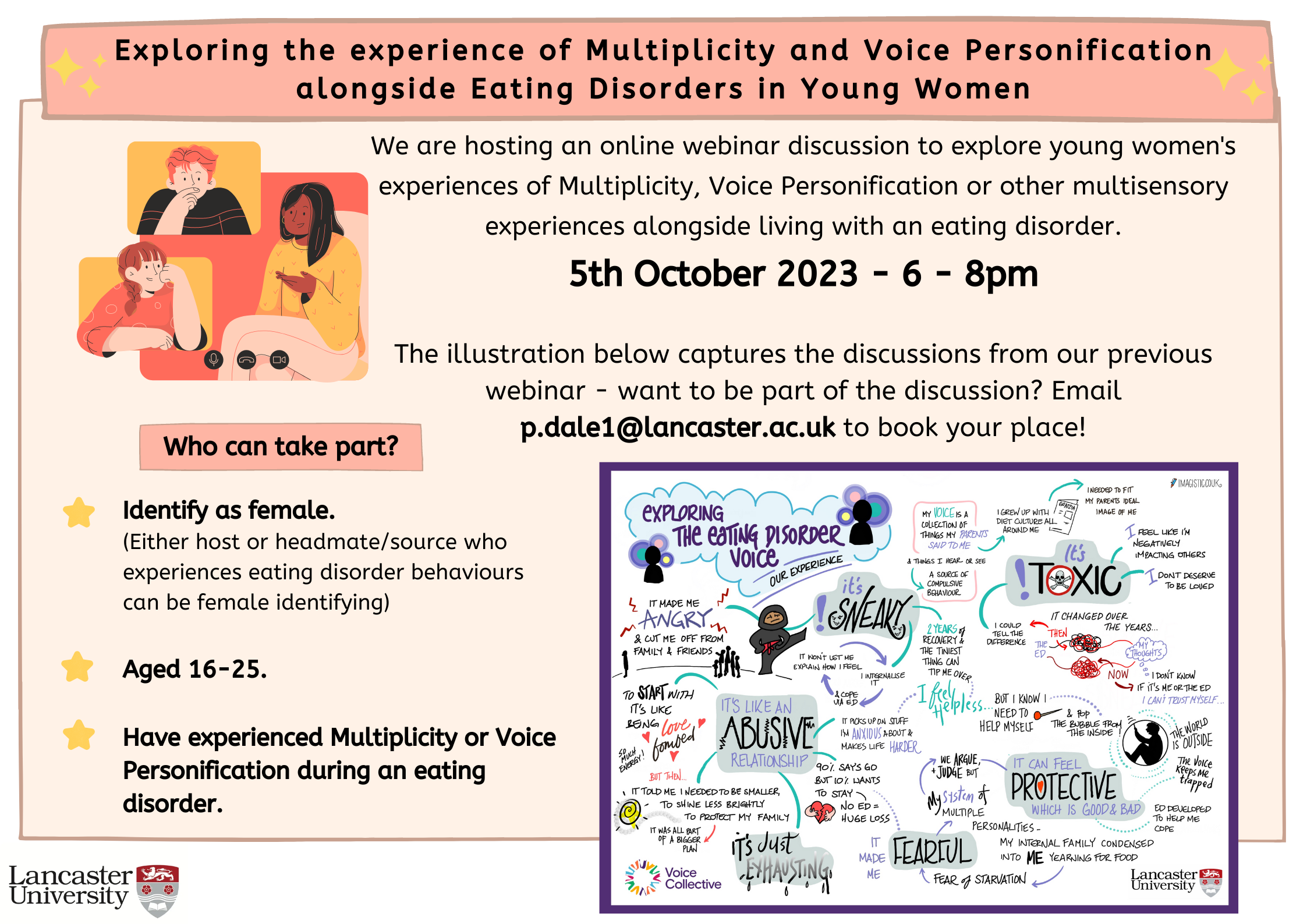
Research opportunity – the eating disorder voice

Phoebe is doing a PhD in the UK exploring the ‘eating disorder voice’, and has asked me to share their research in the hopes of reaching a more diverse group of people to be involved. I don’t personally know Phoebe so I can’t vouch for them, please take care to verify anything you get involved in. I’m always excited to hear of research in this area, it tends to be very isolated and disconnected between the different diagnostic categories and there’s a huge need for linking up and learning from these varied experiences.

Phoebe writes:

I am a trainee clinical psychologist based at Lancaster University in the UK.

I am completing research exploring the eating disorder voice, a voice which comments on eating, shape and weight. This is a common experience within the eating disorder community. Currently little is known about the eating disorder voice, with questions about whether it is more consistent with the experience of plurality/multiplicity, voice personification (when the voice has it’s own agency but not considered part of the self) or other multisensory experiences. My research aims to explore these experiences in relation to eating disorders further with young people who identify as female.

How to be involved:

I am hosting a webinar on Tuesday 5th October 2023 at 6pm-8pm (UK time) via Microsoft Teams. The webinar will be confidential and anonymous.

Email p.dale1@lancaster.ac.uk to book a place.

The webinar will be an open space to discuss your own experiences. I will present some of our findings so far to explore our current understanding and ask for feedback on whether those attending the webinar feel it represents their own experience of multiplicity or voice personification alongside an eating disorder.

Plurality/DID sensitivity reader wanted

Hey folks, I’ve been approached by a person who’s written a screenplay and is looking for a sensitivity reader to advise about the character with DID. Contact me if you’d like me to pass on your email.

My main focus when I engage with any media about plurality/DID is does it make it clear this is one representation of it, or does it imply this is the norm and everyone’s experience? The former makes me happy.

You can check out a couple of my reviews of other media here:

My favourite representations so far include Burton’s Alice in Wonderland, The Spiral Labyrinth, and Jam and Jerusalem.

Mental Health Master Class

Hey lovely folks! I’m thrilled to be getting back into my workshops. I shut down all my public speaking, workshops, and consulting when the pandemic took hold and it’s absolutely wonderful to be dusting it all off and getting back into it. Keeping my clients alive and figuring out how to hire folks to be their teams was absolutely consuming and I simply couldn’t juggle anything else for the last couple of years. Yet I have missed it so much, there’s a special kind of magic in these spaces you don’t get in one to one work. Groups have so much power to validate and support each other. Nightingale is kindly sorting out the important things like room bookings and dates so things actually happen and I will be turning up to the correct location and on the right day!

This time I’m running a session on mental health on Friday 3rd of March, so if you’re interested share this post. This is a fabulous introductory price so grab your tickets asap. 

You will get to spend a day redefining mental health from my unique perspective. Mental health training is all too often divorced from the real world. Services are imperfect, frameworks have limitations, and sometimes our madness is what saves us. Embrace the contradictions and find hope rather than confusion in the complexity. Support others to find their own meaning and discover the most useful resources they navigate a mad world.

When: Friday 3rd March, 10am – 4pm 
Where: 19 On Green*
How Much: $300** (GST included)
If you don’t have NDIS funds and are experiencing financial hardship, please contact us. Some reduced price tickets available. 
admin@sarahkreece.com
Where to Book: https://www.eventbrite.com.au/e/545817403547

*Fully mobility accessible venue with breakout room.
**NDIS payment accepted for self and plan managed participants, please contact us if you need an invoice sent to your plan manager. 

I would love to see you there. This is suitable for people with no experience at all, or those who work in mental health but would value a fresh perspective. Carers and people with lived experience are very welcome.

My intro to mental health talk

Hey lovely people! I’m running a session on mental health on Monday, so if you’re interested share this post, and if you’re available grab a ticket asap.

ID: flyer with prominent teal artwork “The Gap”. A downcast individual stands alone on an island in the ocean. On a different land mass a group are talking and gesturing at them.

Even before the pandemic, it could be tough to understand and navigate mental health and supports. This session is an intro to my master class and will give you a starting point for making sense of different approaches to mental health and how to help others.

When: 6th Feb, 11am – 12pm
Where: 19 On Green – The Brickyard*
How Much: $10**
Where to Book: www.eventbrite.com.au/e/intro-to-mental-health-tickets-530014125517

*Fully mobility accessible venue with breakout room.
**NDIS payment accepted.

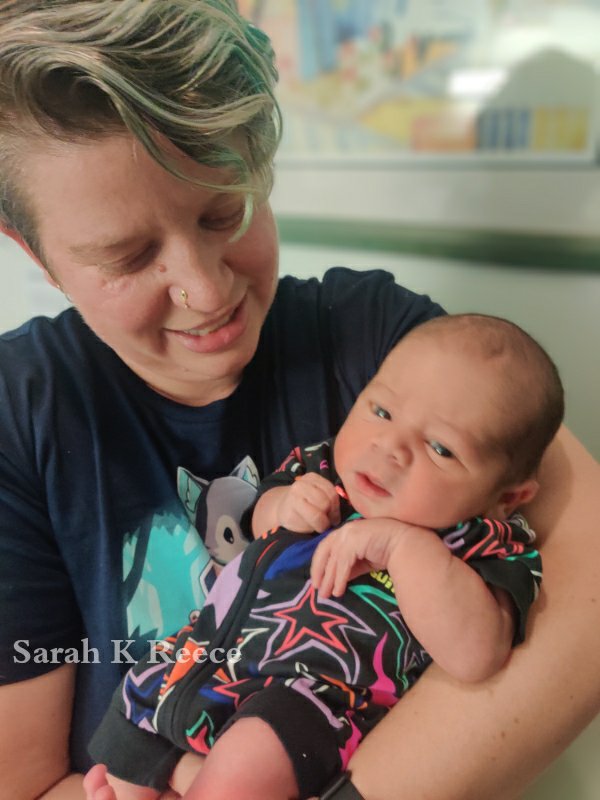
Baby has arrived

We have a beautiful healthy little boy, born on Friday by c-section. It’s been a very long, disruptive process of inductions and hospital visits and stays. He’s not yet been named. He’s very beautiful with a full head of dark hair. He makes all the lovely newborn snuffles and snorking sounds. He feels like velvet. Nightingale was able to do skin to skin immediately after birth in the theatre and through recovery. He’s in newborn sleep mode which means loads of naps during the day and cluster feeding and squeaking all night.

ID light brown newborn wearing a blue singlet, snuggled up on a cream blanket. He has short dark brown hair and looks content.
ID black and white portrait of a baby wrapped in the striped hospital blanket and lying on his tummy. He’s looking very serious with big dark eyes.

Nightingale sailed through day 1 post surgery then started collecting a horrible bunch of post op complications. We’ve been stuck in hospital much longer than hoped because of them. She’s been through hell the past few weeks with so many painful procedures and things not working. I’ve held her hand through most of them and we’ve worked hard to protect ourselves from the stupidity and vagaries of the health system. We’ve succeeded far better than I expected in many ways, but far less than I’d hoped. There’s a lot of bad stories and a lot of pain and trauma. Most of the staff have been fabulous, and a few really saved the day by talking us properly through options, or listening to concerns which they thought were unlikely but turned out to be accurate, or protecting our wishes when someone else tried to take over. A few have been so bad we banned them from contact again. It’s so different to Poppy’s birth and yet so familiar. Miraculous and beautiful and awful and dark. We are grateful and relieved and overjoyed and exhausted and hurting and can’t put many of the experiences into words.

Pain is an ongoing challenge, Nightingale has been suffering from pain crises where she is in 10/10 pain, sometimes for many hours and the pain relief doesn’t work. A few nights back she was unable to move or speak for 6 hours while the staff maxed out all the pain relief options without effect. She should still be in hospital but we negotiated fiercely for home. I can nurse her with all the same resources they have the (except of course, someone to take over at shift change), and the stresses of the long stay in hospital have been building each day. The awful food, the hundreds of people who come into the room day and night, the Covid limitations on visitors so we can’t have both our kids visit, the lack of proper titration of pain medication, the way the plans change at every doctor shift change, notes going missing, stretched staff taking 45 minutes to respond to a call bell, the new person not reading the notes and harassing Nightingale for needing pain relief or blaming her for not getting out of bed every day because someone forgot to chart that she has, the ones who don’t understand consent or are confused by anything that’s not 101 typical presentation and keep giving bad advice, the ones who block agency and access to even the basic resources like an ice pack, the constantly having to explain, provide context, build rapport, and ally with every new staff member, the gratitude for things that should be a given, the sheer helplessness of being stuck inside a system with so little power. The costs accrue alongside all the good care and helpful folks. So we’ve finally come home late last night with a long list of medications and things to deal with and some home visits and outpatient appointments.

Everyone has been homesick and missing each other. Our community of family and friends have been looking after Poppy and Nemo. We’ve managed two hospital visit with them both, Nemo is anxious about accidentally dropping the baby, while Poppy is nearly exploding with excitement. We feel stretched at the seams. We’re trying hard to look after all of us.

ID Sarah holding baby. Fair skinned adult with green hair cradling a baby who is wearing a black onesie covered in bright coloured stars.

He’s beautiful. It’s incredibly strange to have a baby I didn’t birth. It feels a little like cheating at times, there’s so little effort on my part to bring him here, while Nightingale’s body has been a war zone. I feel oddly guilty.

I also feel slightly out of the loop. The hospital don’t see partners. They see a mother baby dyad. I’ve been absolutely invisible for most of the process. The same rules apply to me as any other visitor. All the paperwork says Baby of Nightingale. I have to find and store my own meals. I’m often not allowed to use the bathroom in our room but required to go elsewhere. There was a moment in theatre when they needed to take him off Nightingale’s chest and weren’t sure if they should put him in the warmer. I offered to hold him skin to skin myself and they were so startled and flustered and turned me down. The doctor asked Nightingale about her mental health as part of discharge, I’d spent most of the day crying but didn’t flag. We’ve done a fabulous job of protecting the connection between Nightingale and bubs, I’m not quite there yet.

I feel fiercely protective of both of them, and deeply relieved he’s okay, but also jolted by a hundred small experiences that tell me he’s not my son, like micro aggressions that have stacked on top of each other over weeks. I can feel the difference and I can feel the trauma jangling in my bones, the way I’m frustrated with him when the staff are doing something horribly painful to Nightingale and I’m trying to hold her hand and hold him too and he’s screaming and I can’t comfort him so I can’t comfort her. I hoped it might be better than this, we got our golden hour and protected our family as best we could. But here it is. We got the perfect outcome with him. We got a difficult outcome for Nightingale and I. We’ll keep repairing the damage. We’ve got time to grow all the good things. There’s a lot of love here.

Birth trauma

I’ve come home from the dentist today feeling shattered. I’ve struggled with medical appointments since Poppy’s birth. I was not treated well during surgery and that left me furious and frozen in medical settings. I’m very overdue for dental care and have started the grueling process of attending appointments for 11 new fillings. It was miserable today, my saliva thickened and I gagged a lot with my neck extended to allow access to the inside of my top front teeth. It took nearly 2 hours and other teeth are still irritated and sensitive from the previous session.

I’ve never been able to write Poppy’s birth story. Now so many of the details are hazy. I’ve struggled to understand the impact on me and the contradictions in the experience. I’ve felt deeply unreasonably humiliated by my struggles. I know trauma, it’s one of my major areas. I had PTSD at 14. I’ve read the things and been to the therapy and run the workshops and supported others. Somehow instead of creating grace for myself, my experience drowned me in shame. I should be immune? I should be able to deal with this? I shouldn’t feel the way I do. I trekked through a number of birth trauma specialists I didn’t find helpful, froze and forced myself through dentists and pelvic exams hoping I would just adapt. Then turned away from the whole mess.

Lately going to prenatal appointments I’ve run into all these ghosts. Going for a scan and finding myself in the room where they confirmed Tam had died. There’s ghosts of me throughout the hospital, screaming soundlessly and running with dark hair matted and white gown flailing. A portrait of derangement and madness. I sit in appointments, incoherent with rage and painfully aware that I present as rude, distrustful, obnoxious. All my energy goes into not screaming, stuffing all the words back into my mouth, not shaking, not biting the hand that touches without permission, not raving at the language that is so devoid of the concept of consent. There’s nothing left for the smiling and eye contact and apologetic shrug and recruiting them to accommodate us in any tiny way. I’m so tired until I’m sitting there, then I’m so angry and so aware my anger instantly strips me of any credibility or power I might have had in this place. They think of trauma as the panic attack, the victim. I am on fire with fury, watching their every move and listening to every word and seeing ghosts of myself weeping and running through every corridor, abandoned and untended.

So we’ve put aside some money to spend on a good dentist, and today on catching an uber home again because I’m usually too ill to drive afterwards and couldn’t find a lift. She uses the anaesthetic that doesn’t work as well but I’m less allergic to. And she says things like “you’re in control, let me know anytime you need a break”. I lay very still and my tears roll down my temples into my hair.

I come home and Nightingale brings me mashed potato and pasta and sympathy. I’m going to hurt for weeks and it’s exhausting.

I’m talking to people about birth trauma and how stuck and silent and alone I’ve felt. I know better. I know shame isolates. I know hundreds and thousands of other people will have come through something similar. I know how to use art, writing, talking, and research to process things. I know that knowledge doesn’t protect you from experience. I know it’s not punishment. I know self compassion is crucial. And I know it’s difficult to do when no one in the medical environment sees the injury, or responds with compassion. It’s difficult when it makes you feel weak and vulnerable. It takes patience. And a dentist who’s had good trauma informed care training. I wanted to be doing that training by now. Frustration and roads untraveled.

I feel voiceless a great deal of the time about most of my life, in a way I can’t express well or articulate even to myself. There’s been so many changes and challenges to my ideas about my life, my relationships, who I am, what it means and what to expect. Trying to understand late in life diagnoses of autism and ADHD, what they are, what that means for me, my family, my children. The ending of an eight year relationship with the parent of my child. Beloved Star cut contact with all of us last year after joining a church. Getting married, a new baby. Work stabilising and becoming less overwhelming. The awareness in the back of my mind that I’ve been diagnosed with something that indicates I lack social awareness and the resulting severe loss of confidence to speak and own my own story. Lost about how to be authentic and work, navigate complex relationships, parent. I miss having a voice and a community. I put a call out yesterday for help to attend the dentist and got no reply. Covid has not been kind. There are empty gaps in my world and they hurt. There’s so many ghosts.

I have birth trauma. I’m trying to find my voice again. I’m trying to make sense of which stories I can share and how. Today I was brave. I’m hurting. I’m not alone. We’re all alone. It is what it is. I’d rather take the slower and more dignified route to knowledge, through study. But lived experience brings not just the silence and scars, when we wrestle with it, it comes with powerful inside knowledge. When we can speak we break the shame that binds us all. I didn’t think it would happen to me, but it did. I didn’t think I would get stuck, but I did. I couldn’t fix this one myself. But someone like me must have found a way to speak to a dentist and because of them I could get broken teeth fixed today. And tomorrow I’ll pay that forwards.

Mourning Luna

Drums in my head, beating against the thick wall of my skull. We’ve lost the pregnancy.

Waking Nightingale’s teen to tell them, sorry Squid, we’ve lost the baby. Where? they ask, sleep blurred and confused.

Walking into my studio for the first time in months to wrap my book ‘Mourning the Unborn’ for a customer overseas. Then weeping in bed instead of taking the package to the post office. What strange timing, I’ve not sold a copy in over a year.

We find someone safe for Poppy to play with. I buy a bouquet and we bring it back to bed. It is bright and colourful and has the painful cheer of hospital flowers next to the white sheets. We spend the first day alone and entwined, breathing in the loss.

And then, nothing. I try to get through the days.

I’ve lost my voice, my loves, for a long time now. The unbinding of my family, my terrible depression, the building of something new… I’ve been so silent throughout most of it. I rarely share online or even journal privately. I take few photos, write fewer poems. There’s been no art in my world at all in years.

All my life has felt unsharable. The stories have been beyond my ability to put into words. I don’t understand them. They defy telling. I cannot speak because I do not understand. I cannot explain.

My life has been tangled into other people’s lives. I fear hurting others. I cannot share my own experience now without impacting those who share or once shared my life. I never want my words to be a trap or a weapon. I don’t have the strength to manage what might come in with the tide. So I’m silent. Cut off and waiting for I don’t know what. Unsure if this is only for a time or this is just how I am now.

Nightingale is savaged by grief, while I am numb. There was no body in my body, there’s no blood on my thighs, no community to grieve with. I tell friends we lost the baby, who tell me to send their love to Nightingale. The child that was also mine, becomes in death not mine. The miscarriage becomes hers alone. I’m behind the glass, handing out hot water bottles, dedicated and soothing and far more afraid of the impact on her and I, of losing us than I am of the loss we’ve just suffered.

Behind the glass it’s almost like nothing happened, there was no child, no dream broken. The child was not mine. I remember well the black void of trying to conceive Poppy after losing Tam, and I grasp at the relief like a lifejacket. There’s no void here. There’s nothing to grieve. I’m not falling off the face of the planet. I’m a good parent, an attentive partner. I’m functioning.

I don’t talk about it, write about it, cry about it. I don’t want a body to hold or a talisman or a tattoo. I want to hold Poppy and never let go. I want to run from the burning pit where my grief is not clean and pure thwarted yearning, but something ugly and sharp, pierced through with raging fear and doubt. Maybe the baby didn’t come because I’m not a good enough parent. Maybe they’re better off without me. Fertility as the blessing of the divine, the endorsement of the universe of your capacity. All such bullshit and yet my heart labors under the fears.

I can’t help but turn my face from the anguish of possible later loss, stillbirth, a child dead at 4 months or 2 years. The demand that I can handle whatever tragedy might come and still be here for Poppy. It makes me terrified of my dreams because I know tragedy will come, that grief follows love like a shadow. When getting out of bed each day is a torture of pain and mental exhaustion and humiliating incapacity, I can’t afford to risk much more. So, the horrifying traitor thought: maybe it’s better this way.

This is how mothers say goodbye, little Luna. Face turned to the side in rejection of all that you were and represented. Eyes fixed firmly on the child remaining, heart broken by doubts and unworthiness. Numb to the bone.

The brutal mornings become unmoored from the source of the pain. I drive Poppy to school and then collapse sobbing in the car and can’t drive home for hours. Nothing means anything. My heart runs from you. If you weren’t real, there’s nothing to grieve. I build no shrine and hold no memory tight of who you could have been and the life we dreamed of together. You were almost never here, real as smoke or mist, dew gone in the first light of sun. I betray you.

Nightingale is alone and not alone in grief. The primal need of grief is to know it’s shared. I add to her anguish. In the night we are raw and wounded. I turn my face back to the loss, and reach for a key. We watch Losing Layla and I find you there Luna, in the face of the dead child. Grief, pierced through with doubt and shame. I howl in her arms. My functioning evaporates like dew.

We go wander the WOMAD festival, under the trees and the flags, arm in arm. The night is soothing. We get a henna tattoo each for the child, a Luna moth and a moon.

ID: A brown skinned hand with a moon henna design, next to a white skinned hand with a Luna moth henna design.

I buy and finally read Terry Pratchett’s final book, The Shepherd’s Crown. The mere thought of it has been unbearable for years. Now I read it through and I cannot feel anything. My eyes are dry.

I miss all my children, the ones who could not stay, or who left. Everything tangles into darkness. I am dumbstruck, spellbound, silent, paralyzed. I cannot be who I wish to be, who I am. I cannot find comfort in your name. I thought losing Luna would feel like losing Tam, but it turns out each loss is distinct and each grief is its own thing. Everything hurts, and I cannot feel anything at all.

This is what it is. I was once so blasted by sorrow that I couldn’t feel even the wind on my face or hear the trains in the night. My whole world was ash, and I was buried deep beneath it. I’ve come back from the dead before. My littlest love, you’ve pulled me into the underworld beside you. I’ll find a way to kiss your bitter mouth goodbye and live again.

To the victor goes the spoils: why perpetrators are treated with sympathy

In the aftermath of public cases of violence, rape, and abuse, the conversations and reactions tend to be polarised between hatred, fascination, and sympathy. Some perpetrators such as those who’ve asexually abused young children are dehumanised and reviled. Some such as serial killers are the subject of intense curiosity and speculation. Many are instead regarded in a sympathetic light that can have brutal consequences for victims.

People are not split into single categories such as victim and perpetrator. We may wear many hats and fit many labels in different contexts and across various relationships. It’s not inappropriate to consider the history and context of perpetrators and their actions. However, how we experience sympathy has a profound impact on social justice. We have a range of bias that favour perpetrators at the expense of victims, and if we are unaware of these we are easily recruited to behave in ways that protect perpetrators and further harm victims. Understanding these bias can help explain horrifying social, political, and organisational responses to violence and abuse. We can maintain compassion and curiosity without becoming part of systemic abuses by understanding how sympathy is elicited and countering the bias.

It is critically important to understand how sympathy is formed because when we sympathise with someone we are more likely to perceive them as credible, and less likely to see them as responsible for the circumstances. As strange as it may sound, there are many factors that stack the deck strongly in favour of sympathy with perpetrators. Here are two excellent articles exploring sympathy for perpetrators in more detail:

Sympathy follows specific trends that can be researched and understood. For example, we find it easier to sympathise with someone when we know more about them, when we share characteristics in common with them, and when sympathy with them doesn’t contradict our need to believe in a just world. To put that another way, we are more likely to sympathise with people when we feel they are like us and when it doesn’t cost us anything to do so.

The just world belief refers to the underlying hope that if we do the right things and are good people, bad things won’t happen to us. It draws on ideas of social justice and fairness and yet leads us to behave in ways that violate them. It’s a key aspect of victim blaming and part of our cultural demands for ‘model victims’. Our fear of being victimised ourselves influences how we respond to the harm experienced by others. This is a good article with more details:

Many of the characteristics of model victims – such as sharing a lot of personal information, making the listener feel comfortable, having strong but not intense, appropriate emotional responses that are clearly visible to the observer while discussing the events – are specifically inhibited by trauma responses. Numbness, rage, confusion, and reduced emotional range are extremely common responses to trauma and these directly inhibit the development of sympathy in others. Judith Herman explores these ideas in more detail in her excellent book Trauma and Recovery. Memory loss is an incredibly common symptom of trauma and yet it often severely damages the credibility of a victim because our expectations of their capacity to recall and communicate the experience are completely at odds with the reality of how the brain functions in those kinds of circumstances.

The standards to which we hold victims are impossible for anyone traumatised to attain. They are also astonishingly high. Victims of rape or sexual abuse must defend their sexual history, clothing choices, and personal virtue. A less than perfect victim is accorded less sympathy. In contrast the standards perpetrators are held to to garner sympathy are astonishingly low. Flagrant, sadistic, violent, or cunningly concealed abuses may be rendered less horrifying by any small presence of a humanising factor.

It’s particularly interesting to note that the same mitigating factors when present for either the victim or perpetrator tends to favour the perpetrator. If the perpetrator was drinking, suffering from mental illness or cognitive impairment, or experiencing life stress they are seen as less culpable. If the victim was experiencing any of those things they are seen as more culpable and less innocent.

Those same circumstances that can make us feel sympathy for the perpetrator as less culpible, can also make us dismiss a victim as less socially valuable. In the same way that less outrage is raised for missing black children than white children, harmed disabled people, less attractive women, queer people, poor people, and marginalised people of all kinds are already perceived as damaged or at higher risk, and at times we are less confronted by and concerned by their abuse and less sympathetic towards them when they’re harmed.

Perpetrators ask very little of us, they want to continue the status quo, stop having the uncomfortable discussions, and keep the focus away from the victim.  Their desire to minimise, deny, downplay, forget, move on, and avoid change are all socially and politically comfortable.  Victims on the other hand need us to recognise the scope of their losses and suffering, to respond to their pain and rage, to address their vulnerability or accept the inevitability of harm to some.  The absolutely fair and reasonable needs of victims are considerably more difficult to respond to than those of perpetrators.

Strangely enough, in many circumstannces, the more clearly innocent the victim is, the more likely they are to be blamed. By using a combination of sympathy bids and DARVO, perpetrators persuade organisations and cultures to allocate sympathy in ways that betray victims. DARVO stands for Deny, Attack, and Reverse Victim and Offender, a common set of perpetrator behaviours that flips responsibility for abuse onto victims.

This betrayal trauma sets victims up to blame themselves, and makes them more likely to suffer long term mental health impacts, and be victimised again in the future. It represents an abuse of our privilege and social power to respond in this way.

So the next time you find yourself trying to process your feelings about abuse or assault, be aware that we are easily hijacked for many reasons to sympathise with the perpetrator over the victim. Shame in perpetrators predicts high levels of re-offending – I’m not advocating for hate. But participating in the betrayal of victims as a community harms the victim and makes re-offending more likely by the perpetrator. It is essential to hold perpetrators to account and maintain a deliberate focus on the losses suffered by the victim, not those suffered by the perpetrator. Justice and compassion are not served well when perpetrators are able to keep us focused on their humanity and their losses, generating sympathy and reducing responsibility while distracting us from the humanity and suffering of those they’ve harmed. Be careful where your sympathies are drawn.

Being Disabled at Work

Well, 10 years in to having my own ABN, I’m now running a small team of 9 employees and have a few fabulous subcontractors and other businesses providing support too. I’ve been thinking a lot lately about disability at work because as a person with multiple disabilities work has been a huge challenge for me, and most of my employees have some form of lived experience of disability either themselves or as a carer in their personal lives. Figuring out access needs for all of us is a constant theme in my life at the moment! I’m presently overhauling all my HR documents to make them more inclusive and accessible, it’s so time consuming but also so essential.

I’ve also done a lot of training and mentoring over the years trying to figure this process out. Sadly, most of it has been worse than useless, it’s been so uninformed that it’s done harm. I’ve had to un-learn a lot of what I was taught because it became part of what was holding me back and adding to my struggles. The micro-business for people with a disability cert 3 I did 8 years ago was destructive. Experiences with some (not all) Disability Employment Service Providers was likewise, as were various trainings offered by mentors, business support services, NEIS, and so many other systems intended to make life easier for someone like myself. They almost all floundered on two very simple diversities: poverty and disability. Without a good grasp of those two realities, so much of the material was a poor fit and in some cases seriously so.

I’ve got more confident about walking away these days and in some cases providing feedback. Here’s a de-identified email I sent to a mentoring program I was in a year or two ago:

Just putting down in email some of the things we’ve been talking about. I think XXXXX has a lot to offer me and other medium to long term unemployed folks with disabilities, but some aspects of it are also concerning, stressful, and potentially harmful. My brief rundown is:

Positives:

  • Strong focus on increasing individual capacity
  • Wide range of useful methods with a good research base
  • Positive approach to challenges’
  • Useful overview of the business development processes
  • Excellent use of human centered design tools for product and service development

Difficulties

Most of the information is generic and not disability specific, particularly for people who are neurodivergent. (people’s who’s brains/minds work differently from the norm, such as autistic people, those with ADHD, giftedness, brain injuries, mental illness, and so on)

Much of the information is presented in a decontextualised way which is highly risky for people who experience systemic discrimination and trauma (both almost ubiquitous to the disability population) By which I mean things like

  • Telling people that empathising with other people groups is easy has the potential to be not only vastly inaccurate but shaming. Many people with autism experience over or under developed empathy in very challenging ways, most people who have been long term poor find it very difficult to empathise with people with money such as potential employers, and generally they lack the intimate access necessary to such people to form it.
  • Another example: “You’re not limited in any way if you have internal motivation” which is a cruel set up for shame and humiliation when people discover that in fact systemic oppression still exists and issues of stigma still impact their lives in harmful ways.
  • We were told often that habit formation is very easy “anyone can do it, it’s just like breathing!”, whereas difficulty forming habits is a common aspect of ADHD. (for more about this see here) And breathing is an autonomic reflex, not a habit.
  • Told that “If we were more outside our comfort zone, we would have more growth and success”. This is risky advice to give to vulnerable people, and there’s a substantial body of research that shows the benefits of safety rather than risk in promoting growth.
  • Told that we all lack motivation and struggle to make ourselves do hard things.
  1. there’s little evidence for any widespread personality deficits in either the poor or disabled communities.
  2. a quick discussion with the online group revealed the usual more complex relationships with motivation with 2 group members who hyper focus, 2 who find positive feedback distressing, 2 who use negative feedback as perverse reinforcement (common for marginalised communities) and only 1 who found motivation a concern in general. This took about 3 minutes to ascertain.

Quality of the facilitation. AAA is using a ‘mug and jug’ style of education where he the expert passes on information to we the students who are in need of his expertise. BBB is using a more appropriate adult facilitation style that includes more opportunities for reflection and tailoring of the information to the students. For example, CCC in the online group was clearly reluctant to engage and feeling alienated by the focus on positivity. A short conversation with the online group revealed a distressingly high level of job rejection with attendant loss of confidence, social alienation, and personal vulnerability. Without care for this context the information is useless at best and actively harmful at worst, playing into victim blaming dynamics already culturally prevalent for the poor, disabled, and unemployed.

A great deal of the information is inherently contradictory and rather than exploring that it’s being glossed over. For example, we are being told that happiness is the key to success but that motivation is not a feeling and we shouldn’t use feelings as motivation. This is fertile ground for discussion but that’s not being given time. Efforts to discuss are being dismissed as intrusive and needless, making the space less safe for anyone to volunteer information or contradict provided wisdom.

Conclusions

Many of the underlying assumptions about the causes and cures of long term unemployment need closer examination, as does the risk of the intervention itself. The intake materials for the course were based on the readiness to change materials used in drug and alcohol rehabilitation services. They had no data points reserved to indicate that any life domain was currently progressing well. The underlying message was that all aspects of our lives were in need of major changes, and that we were indicating our ‘readiness to give up unemployment’. However the central tenants of the readiness to change model – meeting people where they are at – is not being used. So people like CCC are being put under pressure to grasp the power of positive mindset rather than being offered the validation and grief tools needed to process their history and recover from it.

So far the course has given me much useful food for thought, but I’ve also been told that I am where I am in life because I lack enough empathy, willingness to take risks, self motivation, willingness to make myself do unpleasant things and to choose growth. This is grossly inappropriate.

Recommendations

If you would like to consider your program in a more holistic manner, I suggest the use of Critical Appraisal tools by Rychetnik (see more here) who was one of the pioneers of evaluating unintended consequences of interventions such as yours. I also recommend using frameworks such as Trauma Informed Care (more info here), and social determinants of health to contextualise your information in more appropriate and less risky ways.

I’m not sharing this to shame the program in question – there’s so many out there like this and most are put together by good folks with great intentions. I’m certainly not getting it all right myself either, this is a difficult space and I’m constantly messing up and learning with myself and my staff. I’m sharing to help you think more critically about what we think we know about disabilities in the workplace, and why it’s so crucial to take the onus of access and modifications off the people with disabilities and start placing them back on the employers and services. The burden of having to navigate these things is massive and largely invisible.

Understanding diversity is incredibly important when you want to turn good intentions into actually useful outcomes. If you’re going to be working with people with disabilities, poverty, and long term unemployment then you’d better talk to a few them and do a modicum of research before you start, otherwise you run the risk of simply creating one more shiny, painful obstacle in our lives. It’s absolutely possible to support people with disabilities in the workplace and we are competent, brilliant, reliable, and highly skilled. We can do better about how we do this.

Mental health in lockdown

Every lockdown I hear about folks with psycho social disabilities being abandoned by their support providers. Welcome to an NDIS that is largely informed by people with a disability background, with mental health as a last minute tack on. Yes, maintaining supports for people with high physical needs is obviously essential – people who need support to transition out of bed into their wheelchair, or assisted showering or feeding must be able to access their services. It may be less obvious, but it is just as essential to maintain support for people with high mental health needs! Lockdowns are a highly stressful event with well documented mental health impacts. Our most vulnerable people are of course going to feel this impact even more. I am deeply frustrated by the lack of recognition of how real these needs are and how serious the outcomes can be for people.

As a small provider of support teams I recognise there’s a huge logistical challenge in lockdowns. It’s tempting to ignore all but the most obvious care needs. It’s critically important to make sure mental health is part of this. Here’s a quick run of the process I’ve developed for my team:

Risk Assessments

Each client is assigned to a low, medium, or high risk category for that lockdown. These are specific to the needs of the client for each lockdown, and not a static unchanging category. Low risk clients are those who are well prepared and resourced and highly independent or with excellent in home supports. Children with parents at home who have organised all the needed resources, adults who have excellent independent living skills and only need support with transport or gardening or other non essential tasks are examples of low risk. This assessment is based on contacting each client and their primary support worker, if both agree all is well then halting all in person services for that client is likely the safest response. Continuing in person service provision for these folks will put them at far more risk than halting services. Some low or moderate risk clients will still need supports that can be provided online or over the phone, for example assistance to purchase online supplies, or help to access covid testing if needed.

High risk clients have vulnerable health or mental health needs and/or living circumstances that mean they will need in person supports during the lockdown. Examples of high needs from a mental health perspective include clients who will not eat without support, those who struggle with paranoia or persecution type delusions, and those with high sensitivity to loneliness or perceived abandonment. Just because someone has the physical capacity to feed themselves does not mean they will be able to do this under stress. For these clients a personal safety plan is created and shared with their team. A template of my plans is available here, you are welcome to use this for your own circumstances, it suggests opportunities to engage some of the key mental health impacts of lockdowns according to the current research.

Reduce risk of client to client transmission

Support workers who will be needed for in person support are assigned to one client each. Where possible it’s best practice to try and prevent one worker travelling between multiple clients. Bear in mind that some support workers will also be carers and travelling to support family or others with high care needs in their personal time. Clients with high needs will need a small dedicated team to limit risk of losing staff due to illness or hotspot exposure. Other support workers can remain in reserve to replace any face to face staff who have to isolate themselves. Support workers should attempt to minimise needless transport and perform necessary travel on behalf of vulnerable participants. It’s also very important to ensure participants are receiving updated health advice in a format they can understand – this may be a plain English print out for their fridge, or a morning phone call to check in.

If you have mental health challenges or a trauma history or are supporting someone who does here are a few key support needs and considerations I have found helpful:

Food challenges

Most people with issues around food struggle more during lockdown. There’s many ways to assist depending on what the challenges are and how well you know the person’s specific needs. If they have helpful support from a dietitian or GP they may be able to inform this process A few options might be: shop for supplies of that person’s safe foods, the things they find easiest to eat even when they are stressed. This might not be varied or nutritious but all food getting in and staying down is a positive thing when restriction is an issue. Meal replacement shakes/drinks/supplements may be an important resource. Shared meals can be helpful for those who find social support useful. Distractions in the form of movies, puzzles, conversations, and board games can assist. Company for an hour following meals can assist with preventing purging. Meal planning can support those with lower capacity to plan and manage tasks. Eating to a schedule of 3 meals 3 snacks can assist those who struggle with bingeing or restricting (it sounds counter-intuitive but regular food is a very strong preventative for bingeing). Having meals provided or portioned can assist those who struggle with that aspect. Obviously some of these approaches will be unsuitable or even harmful for some people – tailored support is essential for good outcomes.

Anxiety/Paranoia/Psychosis

Folks who struggle with these issues are likely to have increased difficulty during lockdowns. Anxiety generalises easily so people may express fears about the virus and their loved ones through other seemingly irrational fears or get locked on to concerns that compromise their safety or provision. For example some people who need personal support in showers may suddenly refuse this, or be unable to cope with showering altogether. Issues with neighbours may flare up into huge problems, minor conflicts with family or housemates may become unmanageable. Phobias can become so intense people can’t function, and if paranoia increases too much people may come to fear and reject their team, refusing medical care or food or support.

It’s important not to get too caught up in the expression of fear, but to recognise this is not intentional, and to engage the underlying needs as best as possible. Yes the person may be talking crazy sounding things about being poisoned by the neighbours, but arguing about this is likely to leave them feeling more alone and unsupported, and even afraid that you might be part of that plot. Someone who has become so phobic of birds the house has to stay completely closed up in case they see one through a window may well know on some level that this is irrational, but the brain link to their fight/flight response isn’t something they can think their way out of, and adding shame and embarrassment to the situation rarely helps. The real needs are often about control, territory, and connection. When people feel unsafe they experience and express this in a variety of ways. Any small things that can restore or preserve control, territory and connection can reduce the distress. The sad thing about experiences like psychosis is that they often impact the very things people need to be able to manage them safely, so it falls to us to be aware of this and try to work around it.

Meeting needs for control can be as simple as asking the person to help draft their own safety plan, to decide if they want to cancel the GP or change the appt to telehealth, to invite them to choose a meal plan you can help them shop for. For people with traumatic histories around psychiatric inpatient experiences or residential care, anything that helps their home still feel like a home and not like a formal care environment can help reduce triggers. Be mindful that sometimes simple things like our communication books or weekly roster shouldn’t be on display but digital because of that history. For other people having access to the communication book will help them feel more in control. It’s individual.

This links into territory too, who’s home is this and how safe does this person feel in it? Do they have retreat spots where no one is allowed to disturb them? Are there issues with housemates? Can they change things around to help them feel more in control of the environment? This might as simple as asking them where PPE like masks and sanitiser are kept, or helping them to create a quiet nook in their bedroom where they can hide out and use headphones when things are a bit overwhelming. Some more thoughts about territory here.

Connection is vital, we don’t endorse phobias or delusions as real to us but we do endorse them as very, very real experiences for our clients. We may not see what they are seeing or sensing but they absolutely do, and they have to navigate all the feelings that come with that experience. Validation is incredibly important, as is understanding that people trying to reassure someone their phobia isn’t really harmful, or delusion isn’t real, is actually in it’s own way very confronting and isolating. Read more about my experiences with psychosis here. Maintaining the same team wherever possible, ensuring the team is large enough to cope with a number of people being removed and required to isolate, and wherever possible using a co-design approach to all changes, introductions of new people, new routines, and so on can all contribute to emotional stability and reduced distress.

Self harm

Are there appropriate medical supplies in the home for the clients preferred methods of self harm (burn cream/antiseptic for burns, butterfly stitches for cuts, etc)? Is there access to a local nurse or GP who can assist with any more serious injuries? Mental health informed and non-judgmental vastly preferred! Will this person be safer if access to risky supplies is prevented, or safer if they are not searching for new unfamiliar materials to self harm with? Eg if there are parents providing supervision then reducing access can be very helpful – parents may for example lock away knives. If there is no supervision then reducing access can be risky – people searching for new tools can use items that are far more dangerous. Does this person have alternative options for managing self harm impulses? For example, a grounding kit, ink not blood, Dialectical Behavioral Therapy skills, safe people to contact? Are their support workers and housemates compassionate and informed about self harm, or stressed, confused, scared, or angry? Do they need more information and training? A place to start might be My experience of self harm. We need compassionate and regulated people in support roles, not overwhelmed, horrified, and confused folks. This also goes for our approach to ourselves when we are struggling with these issues.

Confusion

For folks with severe dissociation, dementia, psychosis, and various other challenges the higher stress and disruption of the usual routines can lead to high levels of confusion. This might mean forgetting crucial information, mixing up important lockdown guidelines, missing essential appointments, taking medications inappropriately my mistake, and other errors that can have huge implications. People who are usually able to drive might not be safe to, or those who independently manage their medications might need more scaffolding for the lockdown. Draw on resources from supporting clients with dementia such as whiteboards, alarms, reminders, checklists, and countdown clocks.

Make sure you are checking for higher needs that might be unintentionally concealed, or intentionally hidden by embarrassed clients or those afraid that higher supports might never be reduced down the track. Short periods of more intensive support can be the difference between riding out a tough time and full breakdowns with serious consequences and sometimes much more long term loss of capacity. Again, good relationships, a high sense of safety, and clear communication assist this process.

Insomnia/hypersomnia

Sleep disturbances are really common during times of stress. The latter is disruptive but the former, like food stress, needs to be regarded as a warning sign. For many people it will be unpleasant but reasonably benign, and resolve itself. For some it will become a major problem that can endure over many years – particularly for those with trauma issues that cause hypervigilence. A period of severe sleep deprivation can have a catastrophic impact on people’s cognition, behaviour, and health. People may be unsafe to drive, make judgement errors, experience various forms of dissociation, have disrupted emotional regulation, and have loss of physical coordination similar to being drunk. This can result in a higher rate of home accidents and injuries, poor caregiving and child supervision, self harm and abusive behaviour. Sleep deprivation is a common precursor to episodes of mania, depression, and psychosis for those vulnerable.

When sleep issues are being triggered by a lack of sense of safety, I’ve found it more successful to address that as a priority over ‘sleep hygiene’ responses. This might mean supporting someone to change their bedroom around, increase mess in their home!, or sleep on the couch, to read books over the phone to help someone’s hypervigilent nervous system to calm down, or to help them build a nest in the cupboard to cocoon in.

Depression

For those with severe depression, functioning can be profoundly impacted. Scaffolding can make a major impact for someone in a bad episode who can’t get themselves out of bed, into the shower, or attending to admin and self care needs. Phone calls, prompts, help with routines, alarm reminders, friendly check ins, and visits to help coax folks back into routines and help reduce the spiral of shame, isolation, and overwhelm is really helpful. Normalising the response and reducing the impacts of the initial loss of function can prevent the development of a viscious cycle of neglected tasks causing further stress that increases the depression. There’s many approaches and treatments for depression which is far beyond the scope of this article, but a couple of things to keep in mind are: depression is a normal response to highly stressful life circumstances, depression becomes self reinforcing when it destroys our sense of self worth and connection to our community, and depression can respond well to opportunities to explore and grieve losses, choosing to focus on our values and what gives our lives meaning, and support that helps us still see ourselves as useful, valued, and capable.

Addictions

Folks with addictions are at high risk during lockdowns. It can be counter-intuitive but there’s very real research behind odd sounding decisions such as keeping bottle shops open during lockdowns. Withdrawal without support can be dangerous or for some folks even fatal. Withdrawal can also increase other risks such as domestic violence. So as strange as it may sound, this is actually about risk management and harm minimisation. Do not use a lockdown as an excuse to try to make a person give up or cut down on their addictions.

Safety at Home

Not everyone is safe in their home. Both the environment and the people can present huge risks and lockdown can be a pressure cooker that exacerbates those. It’s crucial not to make assumptions about the home. It’s been a long standing issue that there are limited or sometimes no homelessness support services for people with disabilities, based on a naive assumption that people with disabilities are always well cared for. The reality is that people with some forms of disabilities are simply more likely to be abused in situations and homes they can’t leave. For other forms such as mental illness we’re more likely than non disabled folks to wind up homeless or in prison. In all instances we’re at higher risk of being harmed. We are also sometimes the folks who harm others.

One of the biggest privileges of being a carer or disability support worker (carers are unpaid people in our personal lives, support workers are staff paid to be there) is our high level of access to people’s lives. Where a psychologist has to make sense of a person’s circumstances in an hour a fortnight, filtered through that person’s perspectives, or a GP has to understand at times very complex interplays in health outcomes for patients in 10 minutes a month, we have vastly more access. When I am working with someone in their home 10 hours a week for 6 months, I have a depth of knowledge about them and their circumstances. All that knowledge can be utilised to create highly individualised responses to challenges such as lockdowns. This is where the NDIS approach excels. Where it tends to fall down is the lack of utilising that knowledge beyond one carer or worker. Without a team who make time to pair up the front line worker knowledge with management bigger picture systems/public health/service design knowledge we get a disconnect. Management make calls that make sense in a big picture but can so utterly fail to fit an individual client it can do harm. And excellent front line staff can get caught between their personal knowledge and the guidelines of their work, or left to fend for themselves without the team support needed to get good sustainable outcomes in complex and intense situations.

One of the principles behind all these approaches is called trauma informed care and they apply both to those of us with trauma histories and those without. They are also universal in that they are just as important to keep in mind for staff, families, carers, and the clients. Sleep deprived staff can’t be their best, and some staff are in highly vulnerable and challenging circumstances with uncertain work hours, high responsibilities at home, and loss of income during lockdowns. Excellent care of people with disabilities doesn’t happen in contexts of burnt out carers and exploited staff. Understanding the risks of this kind of work, which are largely relational/emotional and rarely well addressed by OHS&W myopic focus on physical health risks, can help us to identify and address the things that cause common issues for excellent staff such as struggling to switch off after work when they are worried about a client, feeling unheard and unsupported when they have concerns, working outside of paid hours and outside of policy guidelines alone to meet the genuine needs of clients they are worried about, and being abused by clients who have control over their work hours or firing them. Promoting resilience is about understanding these contexts and being able to tailor services to support appropriate self care for clients and staff. A few thoughts about that in Self care and a myth of crisis mode, and crisis mode and being under pressure.

Hope there’s some helpful food for thought here for you or the folks you care for. Lockdowns don’t impact us all equally, they have a far greater impact on some of our most vulnerable people, and those of us with mental health issues are commonly being overlooked in rushed and inadequate risk assessments. This is a horrible reflection of poor planning and lack of familiarity with mental health and it causes needless distress and risks to many people. If you are in that situation I hope you feel able to advocate for yourself or your client or loved one, and please do reach out beyond your service providers if they have shut down services and you are in need. There are online groups on social media such as facebook where people find independent support workers, and a host of online platforms such as Mable. If you are in any kind of online support group associated with your disability many of those people will have a lot of experience and service provider recommendations. Sometimes you just need a small rejig of your current services to include a good lockdown plan and a team leader who can coordinate staff for you, or a little bit of training around trauma informed care or whatever your specific needs are. Mental illness shouldn’t be the tack on to the end of the disability approach, the impacts are just as real and the needs are just as valid.

Be safe and best wishes.
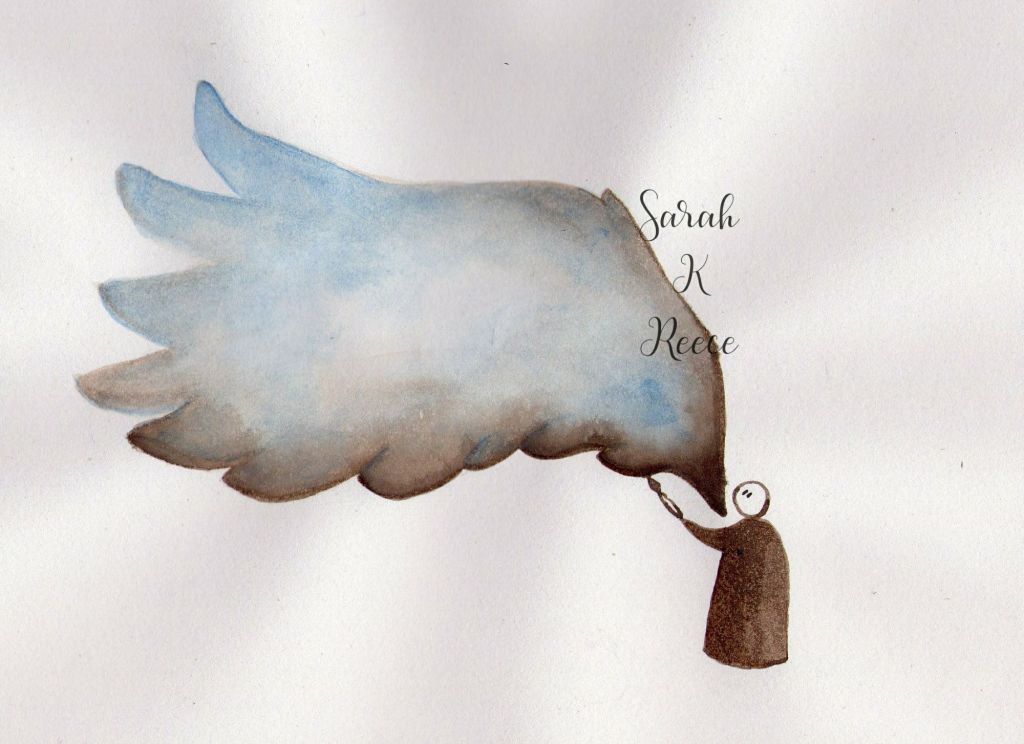
Waking

Sitting in the dark of the cinema with Rose, alone but for one other person who sits quietly in shadow at the back, I enter into a grey world of stone and water and clouded sky. She walks a world that’s full of discomfort, chilled hands, awkward silence. I slip into her hands and feel the cold, the smooth wet stones by the water, the cold breath of the sea crashing.

It’s a world of closed mouths and watching eyes, the camera looks for us, touching horse hoof and curtain lace, tea cups, boiled egg, the texture of a life too poor to be buffered from sensation.

I walk out of my mind, my grey numb ash blown mind where the nightmares of death have taken hold and strangle laughter. Crab like, sideways, shuffle into someone else’s story, her eyes, her hands, her stubborn lonely loss. Her certainty.

I feel something

Other than dread, despair, terror, frozen.

Walking out again I try to hold onto it, the texture of life. Rose buys me flowers, they full the car with a scent of green freshness. I do budgets and paperwork and fall back into the well. I come out again to the flowers and inhale. Stand in the back yard naked and smell the tree and the sky.

We eat late, by a lamp, spiced meats and bread.

It’s not real, what’s killing me. It tells me it’s real, but it’s not. I’m still in ICU, holding Rose’s grey hand. I’m still waiting for the next blow to fall, too terrified to breathe. Flinching away from the unbearable. Sobbing rivers that can’t clean the wound in my heart or put my sense of security back together again.

I hate myself. I hate my life. Both loop endlessly. Between the nightmares where everyone I love dies. Between the mornings I can’t stop crying or get out of bed for hours. Choking down frustration and sadness and grief. Everything is meaningless. Everything means too much to bear.

I escape into company, into story, into sleep, and when I can I creep out of the ash into the very close texture of life and wake a little from the dream that’s killing me. Feel something else. Turn and find the ones I love still here, waiting for me.

Brains Trust – give me some referrals

It’s been brought to my attention that I am flailing about online in a pretty distressed and intense matter and generally freaking out a lot of folks. I’m going to totally own this one! I’m in an unprecedented (for me, I suspect it actually happens pretty often) mess, and I hadn’t got around to mentioning it yet but surprise! I’m autistic. So I’m currently freaking out most of the non autistic people and most of the autistic folks around me are getting it. I can’t do all this shit and keep all these people going and try to keep you, the general public, feeling calm and soothed and comforted and safe too. I kinda need to, because half of New South Wales currently thinks I’m having the most public psychosis ever lol (funny that when I do have actual psychoses, I am public about them!), all the bastards who are blocking what Jay needs are flinging some mud, and I’m generally careening around doing my best to juggle 1,400 things while on fire. So my capacity to hide that I’m on fire is a bit shall we say, reduced.

Sorry about that – deal with it.

Feedback about how to handle this more effectively welcomed. 🙂 Feedback that amounts to “have you tried being less autistic?” not so much.

Moving on!

Help me with:

I need a GP or physician with experience with complex disability and spasticity. Anywhere in Australia. Frankly I’ll take anywhere in the world. We need specialist competent guidance please and we can link you in with tech. If Jay doesn’t qualify for telehealth with you, we will cover the cost through business/donations. Please get in touch with me asap with your qualifications and availability.

I need someone who can edit my youtube channel, I am using videos to communicate with my team and having trouble loading longer ones. The obvious option is to stop waffling so much but that’s never been my strong suite. Paid, obviously.

I need the NDIS medical clearance for accessing a hospital guidelines. What exactly do my staff need to do to be cleared?

I need a way to get Jay tested for Covid without moving them from their bed. Thoughts?

I have stressed, vulnerable people in shutdown because people keep phoning them. Can someone help me arrange new phones and sim cards with new numbers so they can turn the old ones to silent and address calls as they can. They can’t do this now because this family is trying to stay connected to each other. We need to split up the lines of personal safe communication from the lines of more public and stressful communication. I really like amaysim – can they help? They are both used to iphones. Will pay, obviously, from donations!

I need advocates. Autism, disability, mental health, queer, whatever. Throw them at me. I can’t do this alone, but we can do this together.

Get in touch with me.

How to Stand with Jay

Help me save Jay

Australia is utterly failing the care of people with disabilities in the face of COVID-19. I have been working around the clock this last two weeks to try and save someone’s life. Right now we are a small team of family and support workers and we are all exhausted.

Who is Jay?

‘Jay’, the person who is likely to die within the next couple of weeks unless we can turn things around radically, is a fabulous, trans non-binary, autistic, non verbal wheelchair user with two wonderful partners who are also in severe crisis – one bedbound in an interstate hospital due to severe injuries that occurred while trying to help Jay mobilise without support, the other overseas and suffering chronic pain and crisis. Both are Jay’s supplementary decision makers and both have limited capacity to fulfill that key role without our support.

Catastrophic System Failure

If you know anything about being trans you know what kind of medical care Jay has been getting. If you know anything about being a wheelchair user you know what kind of access to services has been going on – they can’t even access most of their own home. If you know anything about severe allergies you know how easy we’re finding it to feed them and keep them clean and safe. If you know anything about severe mental illness related to trauma, you know just how this hell is impacting them. If you know anything about being non verbal you know just how well most people are understanding Jay’s needs, capacities, and limitations, and the absolute torture it is to be constantly so unheard, overruled, ignored, and humiliated.

Being part of this families life for a mere 2 weeks has been the biggest wake up call for me about the state of disability rights in Australia. We are FAILING, we are being FAILED.

What are we doing?

We are trying to keep Jay alive in impossible circumstances. The little team we have is full of the most incredible people I have ever had the privilege to spend time with, and we are all keeping each other going with so much passion and integrity it frankly makes me cry with relief.

But the problems are too big,
too entrenched, too systemic, and we are too few.
We need a bigger team backing us up.

I know we’re in all crisis with the damn virus. I know everyone is struggling in some way. But many hands make light work. If all you can do is share this post or send some love, I can’t tell you how much difference that will make. We can’t be alone in this anymore, please.

If I can’t save Jay’s life, I am damn well making sure they don’t die alone. They are clean, safe, cared for with respect, have access to their family, and can rest in the certain knowledge that I will be helping their partners pursue every single person and system who has so catastrophically failed them through every legal channel open to them.

It’s not just Jay at risk

Do you know how many disabled people are going to die because of COVID-19? How many are already being refused medical care on the basis they are too complex, too unlikely to recover, and that their lives are not worth living anyway? Did you hear about the Spanish residential home in that was discovered by the army with all the residents dead, abandoned by the staff? It’s started here in Australia. People with disabilities are being abandoned. I don’t know if we can save them all. I don’t even know if we can save Jay. But I can tell you now, those Spanish residents likely died alone in the kind of terror, agony, and despair that is unimaginable to the rest of us. If Jay dies they will not go that way. They will die loved. They will die clean. They will die with their beautiful assistance dog cuddled next to them. With a tender hand whenever it is needed. With a voice in their ear telling them we are here. We are watching. We see you. We bear witness. You will be remembered, always. Join me.

How to Stand with Jay

Being different in this world can be such a source of strength and sorrow. There’s probably never been a harder time for most of us than right now. Who do you know with a disability or diversity? Reach out. Check in. Even if we can’t save them all we can tally the dead. No one dies alone.

Never the Spanish Residential Home again.
Not here. Never again.
Help me make this happen!

Dealing with Trauma during a Pandemic

Hey folks, I know many of us with trauma are having a rough time at the moment too. Some of us are not safe in our homes, are facing increased risk of harm from people close to us, or are struggling terribly with awful triggers such as feeling trapped, abandoned, and not having enough resources to survive. Shops don’t feel safe anymore, many of us are losing access to essential supports and are finding our brains are blowing up under the strain.

I’m very busy at the moment supporting my family and clients, but some of my beautiful contacts have been swiftly responding to create free resources for people.

A friend of mine, Jade, is running beautiful resources such as reading kids books online particularly for little’s and kids in multiple systems – check out her work here. Jade has been co-admin of the Dissociative Initiative facebook discussion group for many years, she’s incredibly thoughtful and compassionate. She wrote a huge blog and has published a range of stunning books on trauma, multiplicity, and recovery.

Another friend of mine, Raven, is part of a huge free online conference for survivors. It is accessible from anywhere, and takes place between 23rd-27th of March. Raven is well known for her amazing Puppetry (R)Evolution using creative techniques and hand made puppets to discuss issues such as child sexual exploitation. Her 25-minute video is about using creativity and activism in healing on the 26th March, and I’ve been assured it will include puppets. Here’s the schedule and list of speakers with their topics: http://walkingwithoutskin.com/rape-and-resilience-summit-speakers .

I’m hearing a huge surge in self harm, suicidality, eating disorders, and PTSD symptoms. Anxiety and depression are high, right when everyone around us is telling us to not panic and go out and do a lot of things. Executive function skills are in short supply and bad memories are looming large.

Some of us know that if there are shortages, we’re not on the list of people who will be prioritised. That alone is a kind of social shame and rejection that can send people down a dark spiral. It’s hard to put into words, but we all need to feel like our lives have meaning and purpose, that we’re not just here to consume, and that we’re not expendable.

If this is you, or someone you care about – hold on. If the old stories have kicked back in and death and self destruction feel like valid – or the only – reasonable response to such widespread terror and shortages, hold onto the knowledge that we need you. If the ‘broken people’ trauma narrative has you feeling that you’re not destined or worthy of survival, if the idea of taking up essential resources that someone else might have to go without makes you want to run rather than fight for a place in the world, if it all feels too hard to hold on while the planet tips into darkness anyway…

I’m so sorry. I’m so sorry for what you are going through, and for the people who don’t understand. I’m so sorry that at the point where you want to stand up and shine brightest you’re falling apart. I know what it is to feel tuned to the agony of the world, to feel the death of every person, every creature, in your own skin like a million needles. I know what it is to be seduced by the idea of scapegoating yourself, that perhaps the world would be a better place without you in it. That perhaps someone more worthy would have a meal or medicine. That perhaps you could take with you all the darkness and anguish and dive over the edge of the world with it clutched to your heart and vomiting from your mouth and dripping down the inside of your legs and leave behind you a brighter and gentler dawn.

These stories are like parasites that eat us alive and turn our minds against ourselves. I say to you – what kind of world do we want? Because if you want a world that is a little kinder to the so-called broken people, we need you in it. If you want a world that is loving to those in pain, we need you to bear the pain and find the love. You cannot make any of it better or reduce the suffering even one mite by tearing another hole in the fabric of the universe on your way out of it. Stay here. Hold it with us. Mourn it with us. Love it, with us. Stay.

Pandemic Resources for supporting People at Risk

Formal supporter and informal/family carers alike are all facing new challenges at the moment with the pandemic. If you’re anything like me you’ve been scrambling to get in front of the situation, make sure basic needs are being met, and take care of yourself at the time. It’s a hectic time! Here’s a few resources I’ve created or come across which may help speed up your capacity to adapt, predict, and head off potential issues and risks.

Pandemic Plans

If you’re a support coordinator or social worker you may need a formal written safety plan for your most at risk clients/participants. Larger organisations are using overall plans, which is fine, but if you can doing personalised plans for at least the high risk folks – ideally in consultation with them – is good practice. It tailors the plans to the person and is an invaluable handover tool if you become unwell and need to shift your caseload to someone else.

Informal family and friend carers, a written plan may seem like overkill, but being able to share it with others does have value – assuming anyone else in your formal or informal networks has the same perceptions of risk and ideas about safety as you and the person with the disability (PWD) is a common point where things start to unravel. Fewer assumptions, more communication!

There are a few examples being kindly shared by people, so if you don’t have a public health background you don’t have to start from scratch. This is mine and you’re welcome to borrow, use, modify any aspect of it provided you don’t on-sell it. 🙂 Pandemic Safety Plan.

Karina and Co have generously made their Pandemic Safety Plan public too.

The Growing Space have also been agile responders to the crisis and have provided some invaluable free resources such as this fabulous Pandemic Checklist.

Free webinars

The Growing Space have also teamed up with Disability Services Consulting (DSC) and are offering a free webinar about responding to the challenges of COVID-19 for participants, families and PWD.

They are also running a free webinar for Support Coordinators.

DSC are offering this training on preventing infection.

Resources

DSC have their own fabulous list of COVID-19 resources for people with a disability including general and NDIS specific information.

I hope that’s helpful. Take care out there everyone. If you need some more specific advice or help reach out to me or the folks I’ve linked here, I expect the webinars in particular will be excellent.