
is strong all the time.
is strong all the time.
…and then there’s out to your neighbours… I’ve been having a rough time since I moved in, with one neighbour shouting at me and sending the occasional hostile letter. In the last few months I’ve woken up a couple of times to find some minor vandalism. Last week was a bit special, had one of my windows super-glued shut. 😦
This morning I was busy painting shoes and I could hear this neighbour complaining about me to others in my block which was pretty unpleasant. I turned up the music and kept my head down.
This afternoon I discovered that the local Messenger was running the story about me for Big Circle Arts and Mental Health week. Hence the sudden interest by the neighbours. (the last time I was interviewed by The Messenger, it didn’t run the story in my local area)
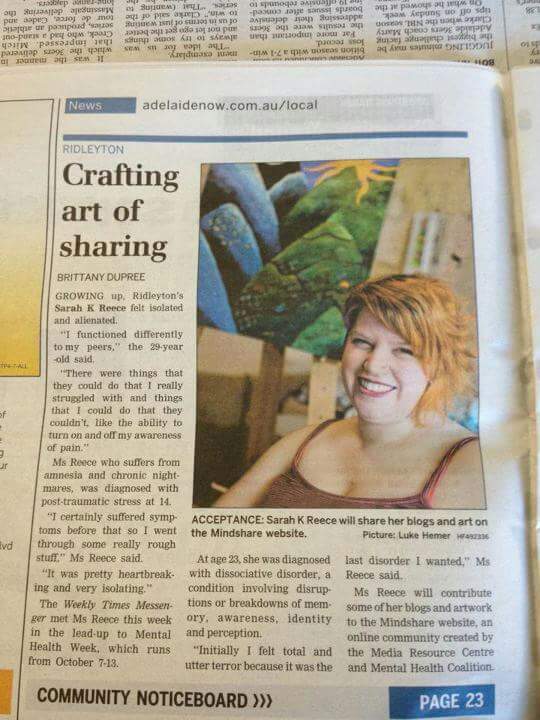
My first reaction is to feel ill. Stressed, exposed, discredited, humiliated, targeted. Feels like being back at school.
My second reaction (thank god for parts, they always have a different view) is defiance. I have nothing to be ashamed of, and nothing to be embarrassed about. I’m a decent person and a respectful neighbour. People can think what they like, I’m holding my head up and I’m happy with my life. Out is where I wanted to be.
The capacity to adapt is one my strengths, and it’s a very common one for dissociative multiples. Chameleon like, we often switch to new parts to manage new environments or situations. People who are rigid and inflexible in the way they approach the world usually struggle during times of change or through experiences of trauma. Adaptation has tremendous power to help us navigate complex circumstances and draw upon different personal attributes in different situations.
However, too much adaptation can become destructive. This is something I have really struggled with. The metaphor I use is of having my feet welded to railway tracks. I am not a free agent who can go where they wish, rather I only travel the tracks laid out for me. What this means practically is that I can really struggle to run my own life when I’m stressed. I lose my capacity to initiate anything. I am adept at coping with adapting to what other people around me choose to do, but making choices of my own has been very challenging. I’ve worked very hard to manage these problems and feel more in control of my own life.
For me, I spent a great many years in various stressful situations where I could not escape, and I could not control what was happening. I did not have the power to make major decisions about my life. I could not choose where or with whom I lived, not to go to school, or to influence any of the decisions the adults in my life made. Because many of my experiences were traumatic, this basically trained me that life is something I adapt to, not something I control. I try to carve enough breathing room from the space that is left after everyone else has made their choices. I have been conditioned to be compliant (or passive aggressive) rather than free.
As an adult, this is a useless framework. It severely limits my freedoms, stops me taking charge of my own life, and has tended to play into abusive relationships. I have had to work hard to retrain myself to be the person in charge of my own life. Even now, when I’m very tired or run down, I feel those old train tracks under my feet, and that sense of being trapped by my choices and unable to make changes.
There are many things I’ve done to break this training. The first step for me has been recognising it. There is a particular grief that I feel when I’m trapped in it, a horrible, paralyzing depression that I have learned to recognise means I have lost control of my own choices. Many things can trigger that loss of control. Some common ones for me have been:
Once we’d started to tease out what sets off this experience, we’ve all started to work on each of the issues. Mandating system wide that no one is to be abusive or disrespectful to anyone else, or to throw out anyone’s belongings was a fairly easy process for us. Learning to say what we really think or feel has been much slower and longer. Many parts have excellent skills in that area and are comfortable and confident. However many are crippled by social anxiety, a desire to please, a fear of abuse, and really struggle to clearly define themselves. We’ve taken a two pronged approach to this – firstly to support all parts to be able to learn these skills as they can, and secondly to switch to more confident parts if they are being overwhelmed and crashing. Both have taken time to develop, and a safe place to retreat back to, to process all the complex feelings associated with it. This process brought up a lot of intense feelings, fear that I was being mean, fear of being perceived as selfish, fear of arguments or hostility, struggling to learn how to disagree in a warm and friendly way, struggling to learn how to set boundaries before I’d become furious and resentful. (or switched to someone furious and resentful!) It was amazing the sense of freedom that came from being able to do very little things like say warmly ‘That’s not been my experience’ in a situation where I felt dominated and everyone else in the room agreed with each other. Just a tiny little sentence like that would lift the sense of crushing weight, of being trapped and owned, and suddenly we were Sarah again, and could breathe.
Most of these issues for me/us have taken a lot of work and a long time, but even very small gains have been powerful. I’m not finished yet, some areas are very strong now and some are much more fragile and rocky, but enough work has been done that I am able to exercise a lot of control in my life now, to make big independent decisions about what I do with my time, who I spend time with, what degree to pursue, how to run my house. I am gradually learning the skills to be the leader in my life, practicing through things like training a strong willed dog, forcing myself to make decisions without checking them out with anyone for their approval, learning how to be more adaptive to internal needs and conflicts instead of accidentally trapping a whole system of parts into choices only a few of us want.
This issue of over-adapting and losing initiative is a very common one for those of us who have been traumatised, particularly through abusive relationships. Breaking the training that making independent decisions is profoundly dangerous can be tricky and take lots of time. But it certainly is possible. If this is a difficult area for you, perhaps a similar approach will be useful – notice what makes it worse and work on those issues. Some days you’ll make progress and other’s you’ll crash and burn, but it’s surprising how it does all add up over time. Everytime you look after yourself, speak up for yourself, make a decision in your own best interest, you exercise a little more power over your own life, you reclaim a little more freedom. And that experience is so thrilling, so liberating, so nourishing, that it all snowballs and becomes easier and easier. If you’re at the start of that process, take heart. 😀
I spent a frantic morning before Bridges yesterday putting up all the artwork for this exhibition. The previous evening I had titled and written a brief description of each work, I dashed off to the library first thing to print these. When I arrived at Fullarton Centre, I found a corridor with newly installed overhead rails from which to hang the art. These are simply awesome, I would love to install them all through my house. The downside was being given a milk crate of tangled line and hooks to hang the art with. 🙂 I was madly rushing up and down this corridor, wrestling with lengths of clear nylon line and trying not to fall over my own feet. I arranged all the work, strung it up, cut out the titles, blue tacked everything discretely, and jumped up and down with excitement before running off to group. It really did look good, something special. I can finally really envisage my first solo exhibition somewhere with loads of new work and a big wonderful launch… I’m not quite there yet but at last it feels within my grasp! I’m tremendously proud of the work, to have created so much under such difficult circumstances, and kept it safe, it’s such a joy to me. There’s so much more still to come, my brain bursts at the seams with new images and ideas!
The descriptions is very new for me, it opens each work up so much more to reveal my personal imagery and symbolism. It was alarming to write because of this exposure! But I also think it is very powerful. So much modern art locks the viewer out, it is incomprehensible and alienating. I want to do the opposite, to invite people in, to be open and share the keys to understanding my work, to communicate through art.
But wow, is it revealing!
Earlier this week a reporter and photographer from the Messenger came by to put a story in the paper about Mindshare and the whole Big Circle Arts Exhibition Trail. I did an interview for the Messenger last year, which was fantastic. At the time I only disclosed that I had ‘a dissociative disorder’. This time I talked about DID, multiplicity, parts, the whole shebang. First time I’ve done that with the media. I felt pretty ill for the rest of the day. But, I’m also proud of myself. One more message that this stuff is real and ‘normal’, not freakish or scary. Nibbling away at the myths and stigma. I’m hoping the art exhibition will do that too. The stress and anxiety and exposure are pretty high, but so is the delight and pride and excitement. I hope I’ve made the right calls.
This post follows on from an earlier one called I am not Sarah.
Some people who have, or work with those who have, multiplicity get very anxious about parts having names. There is an idea that naming parts will increase separation, that it supports the ‘illusion of independence’ and will reduce internal harmony and health.
There’s a lot of ideas tied into this premise that I think are worth examining:
It interests me that each of these ideas are generally ‘accepted truths’, because investigating accepted truth is often fruitful. What do we think, why do we think these things, and how do we know they are right?
Some people read my outing of myself as multiple I am not Sarah, as a declaration that I disagree with allowing parts to have names, forcing everyone to operate under the group name Sarah. Not so!
My system, pre-diagnosis, used to organise itself roughly into a few groups. A handful who thought of themselves as Sarah, and who did a lot of day to day living and surviving. A handful who only turned up in very close relationships and thought of themselves as our middle name, Katherine. A handful who gave themselves no names but were clear that they were not Sarah, and would occasionally write very unhappy poetry about how much Sarah annoyed them. And lastly, the deeply cut off and buried ones who also were without names, without time ‘out’, just buried. Some slept, some screamed.
This is a pretty lousy structure. We’ve re-organised a lot over the years. Part of this process was finding a group name that everyone could shelter under, so that we didn’t have to identify individually. We chose Sarah, and disallowed any individual part from using that name for themselves, and the same with Katherine, because both names had such importance to us, and because the psych approach tends to create a hierarchy according to who has the birth name. The greatest threat to our functioning was now perceived to be the psych system, so we restructured partly to protect ourselves from them.
Everyone in my system (ie, me included) has either a name, or a title, or both. This is what makes it possible to communicate with and about each other. Therapy for example, can become extremely complicated if you are trying to talk about which of 8 Sarah’s you are trying to refer to! We can often deliberately trigger each other out using names or titles – maintaining their presence can be trickier, but calling someone’s name will often make us switch to them. It was engaging this process that was part of convincing us initially that we were multiple. Some multiples discover parts who already have names, so the whole question of whether parts should have names is moot. In my case things got pretty interesting at the point of awareness, with many parts very excited about names or titles (by titles I mean things like “The sad one”, “The librarian”, or “The 7 year old”. none of these are used in my system) Some parts, particularly a couple of younger ones, got very excited and rather confused and chose a lot of names for themselves until we worked out they weren’t remembering their previous choices and were accidentally making system mapping pretty confusing. This was a frightening and confusing time and we were worried that this process might make us ‘worse’.
Now, we’re pretty relaxed about the whole thing. I never give a fixed number for how many parts there are in my system, because I never assume that our system map is completely accurate and finished, and I’m comfortable with that. We have never yet been comfortable about openly identifying as individuals – on many blogs by multiples there will be a page where you can read about their system members – and I’ve always admired that, but it makes us feel incredibly exposed also! Maybe one day.
I don’t share my experiences to suggest that this is the ‘right way’. Everyone’s path is unique, and it can help to hear a variety of ideas about paths to recovery. Certainly in my case, names have not been something catastrophic or something to fear. If you have parts who deeply desire names, perhaps fear is not needed. Perhaps this can be the start of awareness and light in processes that have been happening unconsciously and in the dark. Perhaps if you don’t think of them as symptoms of your illness, you’ll be able to relate to them with more warmth.
For more information see articles listed on Multiplicity Links, scroll through posts in the category of Multiplicity, or explore my Network The Dissociative Initiative.
She wrote this poem, with a little help from one of us.
Unseen and unbidden I’m carried inside
Through fire and darkness and brief times of peace
Without voice without choice without hope without name
No skin for my own to wrap up my dreams in.
Only the void and the places all hollow,
Only the terror the loss and the death
Without resurrection, no golden tomorrow
The failure beyond all hope of redemption.
I was supposed to make it all better
Bring life and give hope and make wings for the broken
Be pure, and good, and holy, and chaste
Unchanged and unchanging, untouched and untouching.
But here in the pit of the brain came the darkness
The place I was left when the light went away
And the monsters they caught me and made me their own
So all my light failed and all my love died.
I’ve never heard anyone discuss this topic. It’s a non topic, like the whole disability sector I think the assumption is that if you’ve got a mental illness, you’re not having sex, you’re no longer even a sexual person. It is a non issue in your life, to the extent that you also have not noticed that other people have sex, so you don’t even have feelings about that. (this is starting to change in disability) There are incredibly thorny issues here that people are struggling to navigate alone, often without information, without language, without the ability to communicate about it. This makes me furious!
Imagine your partner has bipolar. Part of mania can be an increased libido. Is sex during mania ethical? Is refusing it on the basis of your assessment of their manic state rejection? Your partner is a multiple. You have a romantic, sexual relationship with the part who is out most of the time. A different part comes out one night and wants to be sexual. Where do you stand? (more information on Multiplicity and Relationships) Your partner has depression. You want to comfort them. Is sex okay? What about if you have to coax them into it? People everywhere, every day are trying to navigate these kinds of dilemmas, and are doing so in a culture that refuses to discuss any of this. We talk about sex incessantly, but we so rarely get beyond ‘nudge nudge, wink wink’. In mental health we don’t talk about it at all.How do you navigate issues of consent and coercion with people (or as people) who are at times, not in their right minds? How do you even determine when that might be? What about with those who have been sexually traumatised? Who are often so deeply ashamed, feel so profoundly broken and guilty, and desperate to ‘make it up to’ their partner, that the power imbalance makes genuine consent almost impossible to determine? What do you do if they have a panic attack during sex? If a child part comes out? If they dissociate or become catatonic? If they weep? If they pressure you? If they want you to re-enact a sexual trauma with them? (more information on Intimacy after Abuse)
All of these things need communication. For many of these issues, there is not a one-size-fits-all answer, there is a unique and deeply personal understanding between those involved about what constitutes love, fidelity, betrayal. One person coming down off a manic high may feel abused by sexual contact during the mania, while another person may feel patronised and humiliated by rejection. Too many people don’t find this out until after making difficult decisions on the fly. It doesn’t need to be this way, and in mental health I believe we should be starting these conversations. We should be opening that door and helping people to think about these things before they find themselves in a catch-22 situation. We should be talking about meds and libido. About cardio-vascular health and sexual function. About diverse sexuality and gender. About unwanted celibacy, which is an agonising result of chaotic behaviour for some people with mental illness. About sustaining emotional and sexual intimacy through episodes of illness. About the risks of the carer role, parent-child dynamics, the loss of erotic interest in the ‘sick’ partner, and how to reverse it. About sex post-PTSD. These are deep and critical aspects of people’s lives and we have no right to pretend they are not relevant. We deserve honest, open, caring conversations about them.
I’ve now written a series of articles about emotionally safer sex that’s relevent for people with anxiety, trauma, or mental illness struggles. It starts with Safe Sex 1. Checking In.
What’s the difference between voices and parts? Good question. On a functional level (what are voices and parts, how do they form, how should they be engaged with, what are the desired outcomes) they may be very similar. I use a simple delineation between the two, if you hear them and they can speak, influence your thinking or feelings but not your body, they are a voice. (and presumed to be part of a psychotic condition) If they switch out and run the body, they are a part. (and presumed to be part of a dissociative condition) There’s a blurry space of overlap in the middle here despite some very different ideas about how these conditions form and how they should be approached.
The dominant paradigm for parts, once we get over the hurdle of assuming they exist, and are not iatrogenic, is that you must learn to embrace all of them and to integrate them into one person.
The dominant paradigm for voices within the mental health sector is that you must ignore them and refuse to engage them in order to make them go away.
So if you have parts you are not allowed to dislike them or wish them gone, and if you have voices you are not allowed to enjoy their company or miss them if they go.
Some people, like myself, have both. I have a system full of parts who switch. I can hear some as voices when they’re inside. But I also have a voice who is not a part. She never comes out and she doesn’t feel like a part, which is difficult to explain.
I’m always interested in what our forbidden responses are, the minority opinions that we don’t feel safe to share, or even feel. There’s a big difference to me in the paths we choose to walk and the things we can feel. I have found a lot of peace and wholeness by deciding to accept and embrace everyone in my system. We collaborated to ban abuse between us, but we didn’t shut down feelings. Those who were intimidated or baffled by other parts are still allowed to feel the way they do. There are days I wish I wasn’t multiple, that it’s hard or it hurts or it’s scary and confusing. There are also days where my voice has driven me nuts and it feels pretty unfair that when I’m already having a rough day she adds to it with an insistent litany of self loathing. I believe it’s important to do what’s best for you, even if it’s hard. I also believe that it’s okay to feel all the things you really feel about it. Try not to let the dominant ideas get in the way of working out what is actually best for you, or being allowed to feel the way you really do. 🙂
For a wonderful post about working with voices using the framework of seeing them as parts, read Creating a New Voice by Indigo Daya.
For more information see articles listed on Multiplicity Links, scroll through posts in the category of Multiplicity, or explore my Network The Dissociative Initiative.
Today I presented the results of a term’s work in my concept development class at Tafe. The topic was Food and our works had to incorporate food in some way if possible. I wound up making two small sculptures from my research. The first was playing with ideas of elixirs, infusions and preservation. I was very taken by the idea of preserving things other than food – memories, relationships, knowledge… I researched honey which is a fascinating substance and used in both preserving and embalming processes. So for this first work I used honey to preserve the memory of my close relationship with my grandmother, represented by a strand of blue pearl beads.

The contents then become an elixir to be taken during difficult times. The label reads:
Memories of Grandma
Dose: one thimblefull
To be taken: when lonely, afraid, or feeling unworthy
The second sculpture was playing with ideas around the sacred and taboo, particularly around our cultural reaction to the only food we make ourselves: breast milk. I used eggshells to represent new life, and turned them into breasts with the addition of sculpted polymer clay nipples. Blowing the eggs empty was fiddly and time consuming, I spent a lot of the last weekend with egg in my fringe. 🙂 I played with realistic colouring but decided to reference the use of gold leaf in art to signify the divine or sacred instead. The result has an unexpected element of humour to it, which I love. There’s also something a bit cheeky about the work, a slightly flippant take on a serious topic, a wink to fake breasts a la Monty Python, a nod to my own sexuality. Something that makes me smile: breasts in a box.
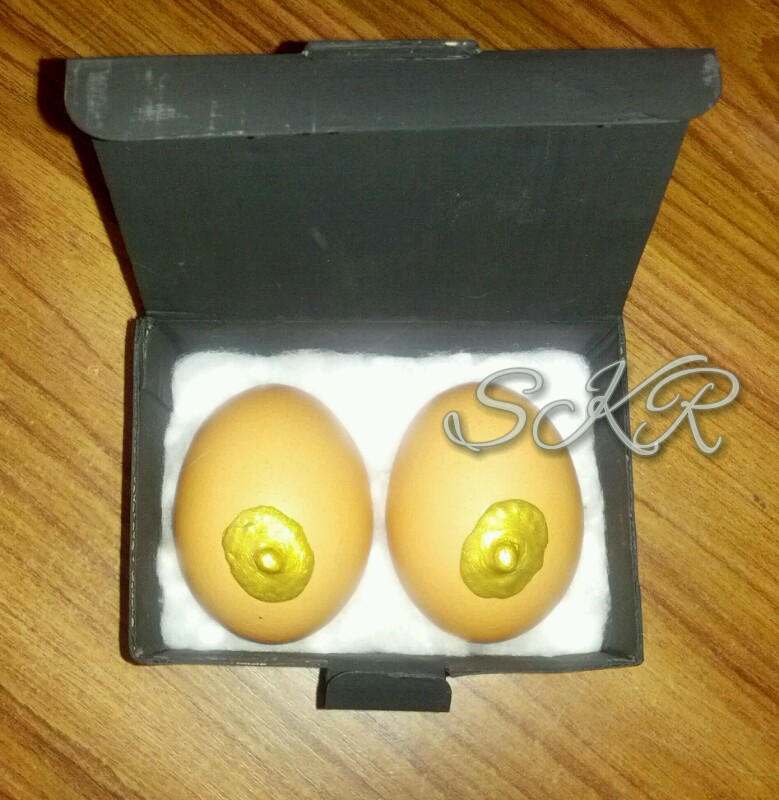
Plus I’m pleased with those nipples! My presentation went well, and I’m very happy to be on holidays from Tafe now. 🙂
To be heard by those with power you must
Strip your insights of
100% rage (bury it deep)
90% pain (show them just a taste so
They can feel proud of their ability to empathise)
Learn their language; use their words (they do not translate, they speak only their own language)
Dress like them (no green hair or tatts on display)
Learn to make them feel comfortable (project warmth, try not to
Flinch when they touch you)
Learn to imitate their casual way of handling power and judgement (vomiting or crying
For private toilets only)
And lastly
Try not to say
Anything they don’t
Want to hear.
For many parts of society, people with mental illnesses are a convenient out group, who can be demonised, humiliated, and treated with contempt. It is becoming less socially acceptable to do this in some circles, which is a step towards reducing stigma and prejudice. But unfortunately for those of us with mental illnesses, we are in constant contact with one of our greatest ‘other’, the staff in the mental health system. Cramped into constant interaction, these two cultures are often at war, and as a peer worker, I’m painfully aware of how little each group understands or respects the other.
I’ve sat in pubs and felt the disgust as a loud conversation at the table over turns to how those crazy people should all be jailed for everyone’s safety. But the level of contempt and loathing within the mental health system has been just as high, if differently expressed. The language changes as the culture evolves, but the contempt remains the same. I hear things like “consumers just want everything handed to them on a platter, they don’t want to have to work for anything”, “they don’t take any responsibility for their own lives”, “refuse to commit to the program”, “clearly don’t want to get better”, “enjoy the attention”, “faking it”, “pathetic”, “just bringing everyone down with them”, “if they were really serious, they’d have killed themselves”, “a drain on the system”, “they think their story is more important than anyone else’s”. In some cases the hostility is more subtle, in others more overt. It’s not everyone in the system of course! But in my experience, there’s a lot of it. Most of these people are not awful people, they are deeply frustrated, they have been told they are responsible for making mentally ill people ‘better’, and they have been trained and now work in a structure that has a powerful them-and-us dynamic going on, where we the educated are here to fix those the sick. I hate everything about this. It utterly repulses me and I find it everywhere. People with mental illnesses themselves, once in staff positions, seem just as likely to pass these kinds of judgements on the ‘borderlines’, complex cases, addicts and traumatised, just as likely to react to the cultural conflict by taking more and more control away from those they are supposed to be helping, while talking about empowerment and having a voice.
People with mental illnesses cast into the consumer role in this relationship can be equally as hostile and divisive. I’ve sat in conversations where people talk about how “doctors just want to keep us sick so they get more money off us”, how staff are “evil”, “twisted”, “parasites”, “control freaks”, “nazis”, “who want us to suffer”.
While I’m drawing a parallel between these similar, dehumanising behaviours, I’m not putting them on the same level. Why? Because the staff group has most of the power, control, and voice in this relationship. If this is a war, they have the biggest sticks. When you have a disagreement with your doctor, your doctor’s opinion is the one that carries weight, in a letter for housing support, for child custody arrangements, for welfare. If you think your doctor is a bigot, and he thinks you’re a drain on the system, your opinion carries no weight in his world. His opinion could see you thrown out of hospital and cut off from services despite being in crisis. And this happens.
So, what’s my point? My point is that we have a massive culture clash that is hurting people. A forced relationship that lacks equality, reciprocity, humility, mutuality. Dehumanising each other is not helping. When you have two groups who dislike each other, one of the most powerful ways to reduce mutual contempt is to create what is called a ‘superordinate group’. This is a larger identity that unites both groups, usually with a common goal where they work together, humanise and develop respect for one another, and overcome the original conflict. I would dearly love to see this in mental health. To have this idea of genuine partnerships between staff and consumers, a superordinate group of people who are passionate about mental health and who work together to create it. For this to happen, respect and equality need to replace control and contempt.
When I tell people I work in mental health, the reaction is often respect for my courage at working with those ‘crazy people’. I tell them, I am those people. I’m ‘crazy’. When I sit among service users and hear their disgust and ridicule of staff who try and fail so dismally at times to create useful services, I tell them I am those people too. I know how incredibly difficult it is to get it right, to create flexible structures that can adapt and respond to the vastly different needs of different people, the challenge to engage and support the most wounded and disillusioned, to cope with the hostility of service users who don’t just get frustrated when you get it wrong but also believe you deliberately got it wrong.
As a peer worker, I am almost always the ‘them’, part of the other, a diplomat on foreign soil trying to translate and inspire and encourage without being seen as a spy in enemy territory. I don’t see my dual citizenship as a challenge, I see it as a necessity, part of my identity as belonging to this whole community of people who are passionate about life, and peace, and easing loneliness, pain, grief, suffering. I’m not just a service user or a service provider, I’m someone who is passionate about mental health.
You know, I read a lot of psych books. And I read a lot of quality fiction, I have my ‘canon’ set that I deeply love, and they get reread every year or so. (The Earthsea set, Across the Wall series, Lord of the Rings, all my Patricia McKillip books, all Ray Bradbury’s novels…) There are huge advantages to being a really fast reader, and some to being fairly dissociative, like really enjoying your favourite book again every year. 🙂 I have honestly learned and gained as much from the fiction as the non fiction. Characters facing terrible situations and struggling to find a moral compass have given me strength. Those who face devastation and horror with compassion and gentleness have helped me to feel that someone out there would understand me, speak my language and care about me – in the dark years where there were so few friends. The stories I love most have a poetry to them, they are about values, what it is to be human. They bring me close to my own heart and beliefs again, help to sustain me. I’ve already written about my favourite author Ray Bradbury and how his works helped me.
Books have even been a place I drew strength from in learning to understand and accept my diagnosis of DID. The following passage gave me courage when I was terrified to start system mapping and really learning about who else was sharing my mind.
“What use are the riddles and strictures of Caithnard, if not for this? You are Sol of Isig, caught up by fear between death and a door that has been closed for thousands of years. If you have no faith in yourself, then have faith in the things you call truth. You know what must be done. You may not have courage or trust or understanding or the will to do it, but you know what must be done. You can’t turn back. There is no answer behind you.”
I gave a talk at Tafe yesterday, it was the same format as last time, one hour of talking about myself… 
This time, as the DI has incorporated and I’m more familiar with talking about multiplicity, I edited out the poems and added in information about parts and the dissociative diagnosis. I told them not one of my parts is an axe murderer and made them laugh. 🙂 It went really well. I used dot points notes to keep me on track with just brief references to short stories about my experiences I could tell to illustrate points. And of course, a power point of artwork. I had to reassure them all at the outset that there were going to be no words on the powerpoint! I know how Tafe is. 🙂 I really liked being able to use the same talk again, I usually write new ones. Even better, the flexible structure made it really easy to tailor on the go. At a couple of points where they started to drift I cut things short and moved on. Other times I saw a couple of people looking teary and was careful to take the heavy stuff gently. I talked about the limitations of my conditions, of the medical model, various obstacles to my recovery, and the things that have helped me recover.
One of the things I said is there are two fundamental needs people have to be able to recover from mental illness. One of these is freedom, and the other is mutual, reciprocal relationships. Many people have both of these taken away from them by our mental health system.
I feel slightly bad about it, a twinge of guilt that doing things to help these, predominantly young people, to see the mentally ill as equal humans will set them up for a lot of conflict in their work lives…
The feedback was really positive, which was great. I was on a high all yesterday, and while I’m feeling slower and quieter today, (or rather, switching from the euphoric to the thoughtful) so far the usual aftermath crash hasn’t happened. I have a sneaky feeling it’s lying in wait for a quiet moment. I’m ready for it.
And isn’t she gorgeous! I’m not sure of her name, I thought she may be Fragrant Cloud but her colour is too pale and pink… Thoughts, anyone? Curse all the house moving, I like to know my plants by name! Glorious weather, I’ve ordered a little greenhouse online, when it arrives I’ll get set up and start sprouting some seeds!
In the meantime I got the house cleaned in my Friday off and wrestled with adobe audition and word press for a Radio Adelaide project. Apart from my email inbox, which is overflowing, the stack of paperwork colonising my desk, and my increasingly futile efforts to stay on top of my cluttered diary, things are going well today!
I reached overload in a big way this week with things of a religious/spiritual nature. I’ve some hot buttons in those areas and wound up having my first panic attack in a very long time! Managed to get home first, which always helps, cried for a couple of hours then dozed on the couch with Zoe. Too many early mornings are not helping, so I’m using the weekend to catch up on sleep, read, and get some serious work done on projects, ready for next week. It seems to be working, I’m feeling a lot better and I’ll just pace myself a lot more in the areas where I’m still raw. I’m not worried, I don’t feel it’s the start of some downward trend, just a bump in the road. We live and learn.
If this title is confusing you, read I am not Sarah first. :)from our journal, June 2011
F***!
It’s good to be alone
Here, I don’t have to be
Anything for anybody
I’m such a f***ing chameleon lately
Instead of the chimera I remember
So bloody adaptive
Being alone is like being able to breathe
And I become familiar again
Old pain and old perspectives return
Bougainvillea tattooed upon my wall
(Tried to save myself, but myself keeps slipping)
There must be a night to howl in
For the poetry to come
And we don’t let them
Out in the day anymore:
The howling ones
No one who actually feels pain
Or has needs
We are now
Everything they want:
cheerful in the face of pain
magnanimous to betrayal
indifferent to despair
No intensity. No bleeding
on their eyes.
Careful to disguise the darkness
Is this who we want to be?
But it’s working, isn’t it?
As long as we all get time –
And as long as
‘They’ know there’s more to us –
more of us – others
who think differently feel different
That the poets and the presenters
may be different entirely
Isn’t that enough?
Isn’t darkness and intensity and anguish and rage and defiance
Something to be saved
for the special ones??
Isn’t this what a team looks like?
F***
I don’t know.
I guess I don’t trust you
To come back for me
To give me my time
I don’t have any goth trash clothes
When are we going out to dance?
My life is left behind
And I fear
You’d leave me too
Except for my poems
I know, I know
I’m trying.
It’s okay to be angry
Remind me you’re here
I don’t want to forget you either.
I’m incomplete, driven and hollow without you
You’re my shadow
I need you too.
Not just for poems
But because
You are part of my soul
You’re my dark of the moon
Stars falling in my sky
I need you to be whole.
So keep banging on my door
Paint me dark things
And force me to remember you.
I feel my lack
I feel my eternal sunshine
My hollow bones
I fly
I fly
But you are
My dark shadow
Always waiting
Upon the earth
For me to return
Angry, bitter, brutal and intense
Defiant, you dance
In the bones of the real world
Where I fly
In the dreams of tomorrow.
We are twins
And I love you
Don’t ever let me
Fly away from you.
For more information see articles listed on Multiplicity Links, scroll through posts in the category of Multiplicity, or explore my Network The Dissociative Initiative.
A couple of months ago I signed up to a phone plan with a gorgeous new phone free of charge. It’s the Samsung Galaxy Nexus and I absolutely adore it. It’s a lot bigger than my old Ideos, a big awkward for fitting into your jeans pocket, and the larger screen drains the battery super fast. However, it’s so fast! So much easier to read email or write blog posts on, and can run all the apps my other phone choked on.
I now run four separate Google tasks widgets on my main screen, moving tasks between the lists as I wish. I am notified whenever library books are due etc. I also have a calendar widget as I use the Google calendar for my diary. I write poems on evernote when they come to me,
Early in the cold
I drag my bag of chittering, vexous, aching bones
Down to the sculpture studio
Like a leper to a sanctuary.
… write blog posts on the bus or in bed. I’ve just downloaded a few grocery shopping apps to test because I’m often ducking into the shops on the way home from work and I never have my list on me. Plus I’m an anxious shopper – I buy food for a three month siege when I’m feeling stressed, so being able to add the talley of my cart will be helpful in prevent those nasty surprises at the checkout.
The navigation app gets an extensive workout, as does Google maps. I can use public transport now I don’t have to read the timetables!
I have a very strong memory of my first night in a women’s shelter. I’m alone in the dark, locked in a strange room, lying on a plastic wrapped mattress, and I am terrified. I curl up on my side and talk to myself soothingly, clutching my mobile phone in both hands. It was my only lifeline back out to the rest of the world. Being in an environment like that: bars on my window, no escape route, no control, was a nightmare for someone with PTSD. I slept all night holding my phone.
My phone still means a lot to me. It is my access point to information, my voice to cry for help, my way to stay connected with far flung friends. It is a string I hold as I walk into the labyrinth, with it I risk things I would not otherwise have courage for. I take buses, walk at night, try new routes. It is my memory, reminding me I need cat food or the car oil needs checking. It is my way of recording so many special moments, documenting the mundane but incredibly precious moments of my life, Zoe chasing her toy, the blossoming trees in the street, a meal I’m proud to have cooked. It’s spoken as a given truth that technology divides us, distracts us, disconnects us. I love technology like my phone because for me it does the opposite. It frees me, connects me, empowers me. I remember the days of driving at night before mobiles, afraid of breaking down. I remember how hard you once had to work to find information. I remember what living with severe memory dissociation felt like before email reminders and phone ‘to do’ lists. I am very old fashioned in some ways, but tech like this I just adore.
Rain drops on my car windscreen catching the light. It’s a beautiful sight and has always enthralled me.
Not enough sleep, dreams full of struggling, waking and sinking back into them. Getting through the day with teeth gritted determination, one foot in front of the other, watching the room gently dissolve, casting around for anchors and grounding, stilling the agitation that rises, waiting for the darkness to pass, the veil will lift, it will lift again.
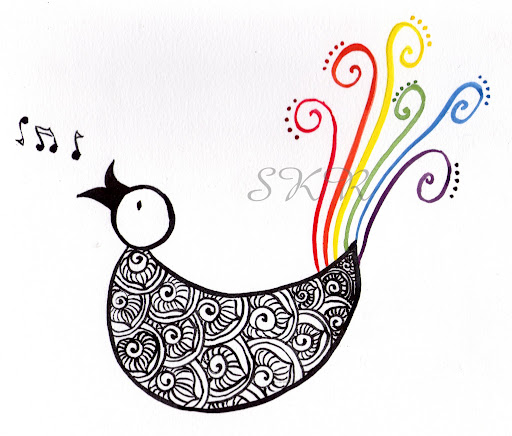
Today I finally bunkered down in my studio for some non-art degree related art making. 🙂 One of my projects was this; to make the logo for one of the groups I co-facilitate. The group is called The Gap, and is for same-sex attracted women aged between 18 – 40. Hence the ‘gay rainbow’ represented in the tail feathers (traditionally using only 6 colours) for this bird of happiness. This work has been made with ink on archival paper, the bright colours are Chinese style ink paints which are beautiful and vibrant. The bird’s body is inspired by traditional henna designs.
Draft one of our postcard advertising the group can be viewed here.
The short answer here is no. Multiple personalities (now called Dissociative Identity Disorder, or DID in the DSM) is classified as a type of dissociative disorder, while schizophrenia is a type of psychotic disorder. Very shorthand descriptions of these types of conditions are:
From the perspective of the DSM they are entirely separate and distinct, with fundamentally different processes involved and treatments. There are certainly huge differences between many of the experiences.
Popular culture often mixes them up, which tends to enormously irritate people with either diagnosis. I have some degree of sympathy for the confusion however, because even the concept of what schizophrenia, or for that matter, multiple personalities, actually is changes quite regularly and I get that folks outside of psychiatry aren’t getting the memo and keeping up.
The longer answer is still no, with some qualifiers.
Schizophrenia roughly translates to split mind. This does not traditionally refer to the idea of split personalities, but instead to divided mental process or a split from reality. Schizophrenia is a fairly poorly defined cluster of symptoms that has changed significantly over the years and since the previous term ‘dementia praecox’. ‘Multiple personalities’ has also been understood in various different ways over the years – as an experience of spiritual possession, a subtype of schizophrenia where the person is in fact suffering from the delusion that they have other personalities, and so on.
Where things get really tricky, even with the current rigidly defined separation between these two conditions, is in the overlap of presentation or experience. And there are a lot of them. Firstly, Schneiderian First-Rank Symptoms, which were once thought to be extremely diagnostic of schizophrenia (and involve experiences such as thought insertion, thought withdrawal, and voices heard arguing) have been shown in some studies to be far more indicative of DID. What this means is that telling the two conditions apart on the basis of observing a person, or even learning what kinds of experiences they are having can be very difficult.
Secondly, psychosis and dissociation often seem to co-occur in my personal experience. Many people with a psychotic condition find that massive dissociation is part of the prodromal (or onset) phase, just prior to a major break. Some people with a dissociative condition, like myself, experience psychotic symptoms such as hallucinations. PTSD is an excellent example of this. Technically classified as an anxiety disorder, people diagnosed with it commonly experience both significant dissociative and psychotic symptoms.
Thirdly the whole area of voices, which I think is what really confuses things in popular culture. The DSM perspective is that voices are hallucinations, while alters are split off parts of personality. The fact that some people who have DID can hear their alters as voices blurs the two categories. Having some people experience their voices as stable personalities who perceive themselves as separate but alive, likewise. There is a considerable space here where people from both diagnostic categories meet. For more on this overlap, see Parts vs Voices. For a lovely description of working with voices as parts, see Creating a New Voice by Indigo Daya.
For some people, the diagnostic labels are very useful and important. It can be a great relief to have a name for distressing or confusing experiences, and I’m not in any way trying to take that away. These frameworks have their uses. But they also have limitations, and when you move beyond the boiled down Psych 101 spin, life is more complex than these discrete packages of symptoms can really capture.
For more information see articles listed on Multiplicity Links, scroll through posts in the category of Multiplicity, or explore my Network The Dissociative Initiative.
One of the topics that came up at Bridges today was parts getting stuck. Now, for some multiple systems, parts are fighting to be out, and sometimes that means that some parts are getting overpowered and stuck inside. This doesn’t just make them unhappy, they are often lonely and unsocialised, not having a voice or getting their needs met, and their unhappiness may well bleed through and cause troubles for the whole system through general distress such as not being able to sleep, nightmares, rashes, the sound of crying or screaming inside and so on.
Another kind of getting stuck can happen when someone comes out and can’t seem to go back inside again. In this case they may be quite overwhelmed and traumatised and not want to be out, or not be able to take on roles being required of them – perhaps they can’t drive, or lack the skills needed at work, or don’t eat. Rather like putting a stick in the spokes of a wheel, what was working gets locked up and stuck and things can get pretty tricky.
I’ve had to deal with both kinds of getting stuck at different times and I’ve learned a few keys to help get things moving again that work for me. The biggest issue for me is always working out what the problem actually is. Before we knew that we were multiple, we still picked a few things that helped with this sense of being stuck. One of them was changing environments – as that often triggers a switch for me. Thresholds of any kind – doorways and windows and the transition from concrete to sand to grass to earth, often have the capacity to draw out of me a different part to engage the new environment. When I am really stuck, I lose my capacity to initiate this change, I spiral down into a dark overwhelmed place where even if I can work out what I need I have lost the power to do it. This is where friends can be really helpful, to help me out of that place.
I can also often call out a different part by using other things that will likely trigger them, such as wearing ‘their’ clothes, putting their music on, going to their favourite places and so on. This was somewhat effective even before I had much information about who was who.
Now that I’ve done more system mapping, most of us can ask for another part by name to trigger them to come out. This is very useful but has the downside of making it difficult to talk about the parts by name without switching.
For me, some switches are automatic – for example in instances where I’ve been physically threatened, there is a particular part who will immediately turn up, without fail (to date). On the other hand, I’ve floundered badly in uni when I’ve ‘lost’ my researcher/study part and the rest of us have struggled terribly because writing essays are not in our skill sets . For us there’s a kind of dance that needs to keep moving for us to keep functioning, of appropriate switching so everyone in the system can be at their best, get their needs met, and use their strengths. We get stuck when this dance stops.
Another approach we’ve found useful to support very wounded parts is to allow them the right not to have to be out or have to try and function. They’re allowed to hide out inside where it’s safe, or to stay in bed. They need rest and peace.
As far as making sure unhappy buried parts get time out, I’ve a couple of approaches that help me. One is to fill my environment with things special to – and therefore triggering of – everyone. My home has to have things in it that represent or speak to every member of the system. Another is to keep a private system map that you check regularly. If you’re co-conscious or can track what you’ve been up to in some way, you can notice if someone hasn’t been around lately and make time for them.
For me, I’m getting much quicker at working out if getting stuck is the problem. Over the past week I’d noticed that although we were getting downtime and rest time overall there was a sense of chronic tension. We figured after a while that probably someone wasn’t getting out to get their needs met and made space for some switching to parts who haven’t been out in a while. That helped a lot.
For more information see articles listed on Multiplicity Links, scroll through posts in the category of Multiplicity, or explore my Network The Dissociative Initiative.
It was an interesting kind of morning.
Of course, the one book that refuses to scan at the self-service checkout is the Lesbian Karma Sutra. I put on my brave face and go up to the librarian and look her in the eye and ask her to scan it through for me. I refuse to be intimidated! I do however, walk to the desk with the older female librarian rather than the older male. Not that liberated yet!
I’m loving spending time with other queer people, especially women. I have gay male friends but very few female. It’s been wonderful to meet other people and flesh out what have been mostly media-informed stereotypes in my mind. My initial sense of being totally out of my depth and uncertain is making way for a new sense of confidence and enjoyment. I love the company of these women, and I treasure feeling accepted by them. I’m also becoming ever more passionate about making safe spaces for queer people.
That’s not to say there haven’t been some interesting experiences. One day recently, I had a huge stressful day at work, dashed home to change and dress up – trying to find that line between just enough to look good and fit in and not so much that it looks like I think I’m on a date or trying too hard… gawd it’s like being a teenager again, worried you’ve got lipstick on your teeth and playing nervously with your hair. I drive off to a group I’m meeting up with. I’m nervous and excited and hypersensitive and jumpy. Watching them watching me watching them… wondering if any of these new friends have read any of my blog and if so what they thought about the crazy new group member or if that’s a conversation yet to happen, wrestling with a bra, my nicest one, whose straps climb off my shoulders every few minutes, and slightly freezing as we’re meeting in a big, cold hall.
A new member turns up with a pet rat tucked in her jacket and I can’t resist – I love rats. I wait patiently for a cuddle of him, he’s big and placid and sweet. He also quietly pees all down my jacket front. So, having gone through the anxious process of trying to dress up but not dress up too much – to work out which part wants to attend (the same one as last time or take turns? – this affects which outfit gets chosen) and the ramifications of that choice, trying to be friendly without over-sharing and fit in without pretending to be anyone I’m (we’re) not… I’m now sitting on the floor with all the carefully made choices about how I present myself to a new group of queer/lesbian friends rather foiled by the fact that I am wearing rat piss perfume.
After some thought, I give back the rat reluctantly, strip off my jumper as if I’m not cold, surreptitiously pat my tee-shirt to check if it’s wet, decide I’ve got away with it and finish out the evening. And laugh half the way home. Life is surreal! 🙂
Things have been going so well lately. Not perfect, (not manic), not without some confusion and struggle, but still; flying. Being ‘out’, especially as bi, is finally not just traumatic. It is liberating. I’m having positive dreams! Beautiful dreams, sad dreams, dreams of how things might have been for me growing up, if it had been safe to fall in love with women. Dreams that make my heart ache, make me cry when I wake up, curl back the curtain and cry in the golden light that spills onto my bed. Dreams of spring, blossoms on tree branches, light falling through orchards and curtains rippling in the cool air. Dreams that heal.
I’ve written before here about having ‘ugly days’, where my self perception is so destroyed I hate and loathe myself with an unbearable intensity.
I’ve been having ‘beautiful days’. Days I love what I see in the mirror, days where I dance, where my heart soars.
I feel like a little battery hen that has come at last to a world of green grass and blue sky and endless horizons.
It’s been a week since the psychosis workshop with Rufus May and my voice has been so quiet, but I can feel her, there’s no sense of absence or loss, I can feel her like a warmth in my chest, like a cat curled up tight around my heart. I am ecstatic.
I’m under no illusions, the work with this voice may not be done, there will be backsteps and bad days and times again of confusion and distress.
But, to make such a giant leap forward, after so many years of struggle… empowered really isn’t a strong enough word for how I feel. Perhaps hope is.
There’s been a lot of work happening over the past few weeks, so much thinking and remembering and making connections. Unpicking locks and following string into labyrinths. Coming to understand the things that trap me, the monsters that savage me, the ties that bind. Moving further into freedom and health. Feeling the sun on my face and the rain on my skin and being able to smell the cut grass in my yard. Washing off layers of secrets and shame like oil slicks. Feeling my system come alive, like a carousel turning with music and lights, that deep dreaming start up again, the wells flow with poems.
 Sarah K Reece