The Dissociative Initiative has Incorporated

We did it. A bunch of us met up again, spent about 5 hours wrangling with the Constitution, then voted the DI, and our first board into being.

What’s it like to give birth to an organisation? Exhilarating. We have come together and made something beautiful, something I love and believe in, something worth all the time and effort and anxiety of the process. Is it over? No. So much if the work is just beginning. We have policies and procedures to write, new groups and resources to create, funding applications to submit, collaborations with other organisations to work on. But we now exist as an entity; a not-for-profit, national organisation. It’s a huge step for something that started several years ago as a frustrated conversation about the inadequacy of supports for people who experience dissociation. We are making a difference.

Friday was very Big

I was at the Rufus May workshop, it was mind blowingly awesome. Fireworks went off in my brain all day and I am now utterly exhausted. It being Friday and the serious sleep shortage I’ve been running this week not much helping matters either. I’m so friggin excited about the workshop and developments in approaches to voice hearing and once I can remember where my head went when it fell off, I’ll tell you all about it. I’ve been meaning to do an ‘Introducing Psychosis’ talk at some point on here and now it’s coming together in my brain.

I got home this evening to find Zoe had climbed onto my study desk and carefully removed a single item from my pin board, a Blue envelope that must have caught her eye, before tearing it into small pieces. Shame it was a gift certificate for Eckersleys art shop! Now I’ll have to go find out how they feel about honouring gift certificates that have been torn into small bits, chewed lightly, drooled on, then sticky taped back together. While I was sorting that out, she tore a knob off the front of the oven and chewed it to bits. Argh!

Yesterday she chewed through the ethernet cable. Tonight I went off to Officeworks, which is dangerous as all out because I have a stationery thing going on and they always end lightening my purse more than I’d planned. I got a new cable on special, some clips to nail the cable to the skirting board, some duct tape to stick the rest of the cable to the floor, a new battery for my kitchen scales (feel super organised) and a free standing microphone for making better quality voice recordings on. Wow, does it ever work! And then I filled a script, bought milk, yogurt, custard, and bananas, because after a week like this I know I won’t be able to eat much, and then crashed out. Saturday is another DI meeting, hopefully to finalise the constitution. Wish us luck!

What is co-consciousness?

Co-consciousness is a term used to describe the experience of someone with multiplicity, where more than part is aware of what is going on. For someone with DID (formerly called multiple personality disorder), they have very high levels of dissociation both in identity and memory, which usually means that they are amnesiac whenever a different part is out. Amnesia can cause distressing experiences such as not being able to recall important personal information (name, date of birth, home address), years of your life, or daily struggles such as ‘coming to’ in an unfamiliar place and having no idea how you came to be there. Some people are really aware that they are losing time or memories like this, others are in a kind of confused fog where until someone asks them a question – where did you get those shoes? when’s the last time you ate? what did you get up to on Wednesday? – they’re actually unaware that they’re experiencing amnesia.

With classic DID, not only is the person experiencing amnesia, but they are confused by evidence left behind while other parts have been out. Obvious things may be clothes in the wardrobe that are unfamiliar and not to their taste, family members upset about arguments you don’t recall having, friends who think they know you by a different name etc. 

Co-consciousness describes switching without this amnesia, so that if one part is out going about their day, another part is aware of what is happening. Multiples with high levels of co-consciousness don’t tend to ‘lose time’ or have blackouts, they’re still aware of what is going on. This is mostly how I function, although under stress my levels of amnesia increase. Multiples who have high levels of amnesia often find that to be one of the most challenging and frightening aspects of the condition, and for most, gaining some degree of co-consciousness is an important part of therapy and recovery work. This process usually starts by working on building self awareness and mapping your system

There is a similar but slightly different called co-hosting or co-fronting, which you can read about here: What is co-fronting and blending?.

Co-consciousness can work practically in a few different ways. For some multiples, it’s like they are seeing and hearing everything that’s going on, even though they’re not the one moving the body. For others, it’s more like being told what happened, or watching a short video of memories. I used to be confused as a kid that so many of my own memories are in the third person rather than the first – that is, I see everything happening as if I’m up by the ceiling, looking down on everyone including me. I’ve since discovered that this is an easy way for me to tell when I’ve personally been out running the body and when I’ve just been watching – co-conscious. My own memories are in the first person, co-conscious memories are in the third. This is different for everyone though! I can really struggle sometimes with new friends or in new environments, especially if it wasn’t me who has met them before or been there before. People sometimes notice me pause as I’m asking inside for the information and if I’m lucky whichever part recognises the person or remembers the event will quickly fill me in, or switch out and take over. 

Co-consciousness is incredibly useful, but there are downsides. One of them for me is the mammoth amount of energy it takes for us to track all the different information and memories and hand them back and forth. It’s like I have a whole house full of filing cabinets in each room, and on a busy day I’m mentally running back and forth between them trying to make sure we can keep up and still function as one. The experience of co-consciousness can often confuse multiples who have only been exposed to the ideas of psychosis or DID and don’t feel they fit either box. It can also be distressing to be aware of what is happening but not in control of yourself any more. As a kid I had a number of experiences that frightened me so badly I became convinced I was being possessed by the devil. I often felt at war with myself, trying to stay out and in control, and when I’d switch we would look in the mirror and I would be terrified at this face that was mine and yet somehow clearly not me. Co-consciousness can make you feel both crowded and painfully alone at the same time. These kinds of experiences are called Schneiderian first-rank symptoms and were once thought to be highly diagnostic of schizophrenia. Now we’re discovering they are actually very common for people with dissociation instead.

The technical stuff aside, what does it feel like to be co-conscious? Well, that’s different for different people. In fact, different parts of my system experience that in their own way. Whoever is out is often aware if they’re running everything by themselves or if other parts are ‘close to the surface’ and aware of what is going on. Sometimes those surfacing parts might comment or advise about what they’re observing, sometimes they might be struggling to switch or being triggered to switch. For example, I gave a talk at a locked ward in a psychiatric hospital a little while ago, and it was going well. We got there on time, with the notes and presentation gear, there was quite a group waiting, and we had the right part out who had written and delivered the talk before. There was a slight hitch in that a sad, lonely song was playing over the radio. Music can be a powerful trigger for me, and a sad lonely part was called to the surface by the song and immediately switched and came out. We were panicking a bit because this part could not deliver the presentation, and they knew that and desperately didn’t want to be there. We kept still and quiet and finally the MC turned off the radio to introduce us. Once the music was gone, that part dived back inside and the right part came back out to deliver the talk. Phew! Being a multiple can be very complicated.

My friend Hope has a wonderful description of her take on co-consciousness over at her blog:

Imagine a Combi Van, grab a handful of people and put them in the van. One of those people will drive the van, one may sit next to them. The passenger may just watch where they are going of maybe give directions. They may even pull the steering wheel to try and get the driver to go where they want. The rest of the people are in the back of the van. depending on where they are sitting and if the can see out the windows they may or may not be aware of what is going on and where they are going. They may yell to the driver to go somewhere or slow down. Then right at the back of the van, you may have one or two fast asleep totally unaware of what is happening and where they are going… (click here to read her full article)

For me, my poetry often talks about wells inside, very deep, or an ocean where we are sometimes at the surface and sometimes in the deeps. Here’s a short extract of a poem that describes co-consciousness:

I feel her surfacing 
like a scream rising
like a knot of tears
in my throat – 
Fingernails into palms
I fight to stay
I can feel her so close.

I catch him
glancing at my eyes
perplexed
and I know he sees her
I know they’re her eyes now
but still my face, hands, body
still me if I can just drop my gaze.

In the car, on the drive home, alone
she steps into my skin
wears it a little differently 
adjusts the mirror, tucks
hair behind her ear
weeps alone in the night
as I fall, like a star, and fade out.

For more information see articles listed on Multiplicity Links, scroll through posts in the category of Multiplicity, or explore my Network The Dissociative Initiative.

Progress on the Dissociative Initiative!

We had a fantastic meet up today!

To catch anyone up who isn’t aware of what the Dissociative Initiative is (for those of you who’ve just tuned in…) I’ve been working for the past couple of years with some colleagues in a small community group. We’re now in the process of incorporating into a not for profit, national organisation. You can read more about the DI here.

The agenda was getting everyone together to assess the draft of the constitution and work on it, to plan for the board and talk about what a board is, and what being on one involves. A lot of this process was about translating the incomprehensible language in which constitutions are written into something we could understand so that it was actually possible to have an opinion about it. So, here’s Draft 3, please feel welcome to read it and offer any feedback!

We plan to meet up again within the week to finalise the constitution and vote in the first board. I am so excited! We’re particularly looking at the following areas (for those who want to spare themselves reading the whole gibberish-y document):

Definitions:
2.15        “Dissociation” means a disconnection in areas of psychological functions which would normally be connected such as memory, time, senses which may or may not be distressing or disabling, but which impact on a person’s experience of the world.

2.16       “Multiplicity” means experiencing dissociative barriers between parts of self, occurring on a spectrum of degree, which may be experienced for example as voices, alters, lost time, a sense of being fractured or divided.

2.17       “Parts” may also be known as “alters”, have a separate sense of self and function independently within the one body, switching with or without amnesia.

2.18       “Voices” can be understood within the context of multiplicity as parts who speak to each other. Not all voices fit within the framework of multiplicity, some voices can be parts who also switch

2.19        “Peer Worker or Peer” means a person who, working collaboratively with a person who is experiencing mental illness, intentionally uses their own personal Lived Experience of mental illness to support rehabilitation and recovery goals; and or, a person who uses their Lived Experience in a formal role associated with policy development, research and or systemic advocacy.

Values:
Query the need to reword to include the 4 group values overtly (Safety, acceptance, respect, recovery) Recovery is included overtly, Safety can easily be added to 4.1.1 avoiding re-traumatising practices, acceptance to the 4.4 social inclusion aspect

Expand/clarify: 4.7 Diversity of the experience and meaning people ascribe to events and opportunities

Objects:
Query grammar for 6.6 To directly address the disadvantage and distress experienced by those who live with dissociation and/or multiplicity, and their effects on health and social inclusion.

Any thoughts you have will be very welcome, please contact me. 🙂 And watch this space!

Rufus May

I’m rather excited, today I got a place in some upcoming training in Adelaide by Rufus May! For those of you who haven’t heard of him, Rufus is a psychologist in the UK, who has also been diagnosed with schizophrenia, and hears voices. He is part of the international Hearing Voices movement, and an advocate of talk rather than drug therapy for the treatment of psychosis. Here is his personal website, and here is a documentary about him, called The Doctor who hears Voices. A place in a whole day of training on Psychosis and Recovery!! I’m very lucky 🙂

Holding my childhood to ransom turns one

This blog is now one year old!On this day, the 1st of August in 2011, I wrote my first post (entry) on this blog. Wow. Since then, I’ve published 410 posts, almost every day of the year and sometimes more often. I’ve had over 46,000 pageviews, mainly from Australia, the US, and the UK. The most common search words new readers use to find this site are about ink paintings or feeling chronically suicidal. My most read posts of all time have been About Multiplicity, followed by Multiplicity and Relationships, then My short film; Regeneration.

I’ve done three major blog make-overs, changing the format, layout, background image and fonts. I’ve added, edited, and deleted pages as I’ve learned what common questions people have. I’ve carefully grown my lists of topics to make it easier for people to find information in a particular area only. I’ve moved over to smart phone apps for most of my day to day blogging and photography. I’ve handed out a lot of business cards, and emailed a lot of links to relevant posts instead of having to type out all the same information over again for many different people. I’ve started to think seriously about writing a book about managing dissociation and mental health.

I’ve met a lot of other amazing bloggers and peer workers, and received some amazing feedback about the value of an online resource like this. I’m very proud of this blog, and I’m continuing to develop, refine, and improve it.

I am sometimes asked if writing this blog helps me. It’s an interesting question. I have certainly benefited in some very definable ways. The most obvious to me is in my writing. I now type quickly, mentally structure content quickly, and edit much, much more efficiently than previously. Setting myself a deadline of a post each day has streamlined my writing process and more than that, it has made me more mindful of my projects and how I’m spending my time. When I have an interesting conversation with someone about mental health I often catch myself starting to mentally write a blog post about it. Days that used to pass by in a haze of dissociation I can nail down to photos and blog entries. I notice things more.

Forcing myself to coherently explore feelings and ideas here on the blog has also been useful. It’s helped me to make the emotional more tangible, clarified my thinking on many topics, helped me to understand my own feelings and reasoning better. Some of the conversations and comments, particularly on facebook where they tend to be livelier, have been extremely interesting and useful. Feeling that I’m helping people, that I’m making progress on goals such as humanising and destigmatising people with poorly understood conditions such as DID has been sustaining. It’s also been a useful platform to explore or explain things to groups of people at once. As a peer worker there are certain questions I am very often asked, such as ‘How can I help someone after a trauma?‘ Writing these into this blog not only frees me from constantly reiterating the same information, it helps to get it out there for those who don’t ask but were hoping someone else might. The internet is an amazing tool to offer support for those who are silently searching for hope at 4am.

I’ve used this blog to broaden my own connections, and recently, to out myself publicly about multiplicity and bisexuality. The blog has been a very useful instrument in helping me achieve my goals of living openly. It’s also saved me a lot of awkward individual conversations with everyone I know, or the bluntness of outing yourself through a facebook status. I’ve made (and occasionally lost) friends through this blog, and I like that new friends can come here and learn about my life and passions.

Perhaps most importantly, this blog is one of the key ways I feel I have a voice. A few years ago I accepted labels like ‘mentally ill’ and ‘consumer’ without rancour. I have experienced some of the best and worst of the mental health system, I know what it feels like to have no power, no voice, no credibility. For far too much of my life, my opinion simply hasn’t mattered. Today, I hate the term mentally ill, and I refuse to be a ‘consumer’ anywhere that doesn’t treat me with respect. I’m tired of being on the bottom of the hierarchy. So I’ve left it behind and created a new life. In my world and my resources, it’s okay to be queer, okay to have a trauma history and some emotional vulnerabilities, okay to disagree without being attacked, and okay to be friends. The values behind the groups I facilitate, such as diversity and acceptance, are those I try to live by in all my life. This blog is my territory, where my values inform it, a place I can explain the reasoning behind all the arguments I lose in my life – that traumatised people are not a minority, that DID is not always iatrogenic, that those of us who struggle with suicide are not merely selfish. Conversations I’ve had where I’ve been dismissed, overruled, or intimidated by those with more social power but perhaps less experience or compassion don’t silence me any longer. I pick myself back up, from the crushing submission to authority or the instinctive rebellion against being belittled and dehumanised, and I gather up my thoughts and piece together the argument and the explanation I was trying to give, and I post it here. Where the other vulnerable people, who are also crushed at times by a ruthless culture or insensitive health system can find a different way of looking at their lives. That means a lot to me. There’s a phrase I keep coming across that captures the massive social and technological changes in our time; ‘We are the Media’. I like it.

The Party

Was an awesome celebration with some of my favourite people in the world. There were incredibly mad hats at the Mad Hatter’s Tea Party in the afternoon.

There was an amazing spread of food:

Including cucumber sandwiches

And an incredible cake sculpted into the shape of a top hat:

That had three rainbow coloured layers inside!

That evening we had potatoes cooked on the fire

With homemade spiced hot chocolates

And when we were briefly rained on, I found my modest umbrella collection and we stuck it out until it fined up.
Our first year of a peer-led support group for people experiencing dissociation and/or multiplicity has not been without challenges. One of the biggest ones is that dissociation is a broad category and often new members are anxious and keen to feel they fit in. If they are the only guy there that week, or the oldest or youngest member there, or the only person struggling with a particular type of dissociation, or they feel they’re the most functioning member in a room full of mentally ill people, or the biggest wreck in a room full people who are miles ahead in recovery, it can be a challenge to help them feel comfortable enough to stay and engage. The mindset shift to that of being comfortable in a diverse group can take some time, and it’s not unless a newcomer is willing to attend and represent a minority of some kind that the next person with those characteristics who comes along will find somebody in the group like them. It takes a lot of courage to be the first!

It also takes a mental shift to embrace that a healthy group is supposed to be a safe place for you, where your needs count, but also a place you contribute to supporting other people’s needs and helping them feel safe too. Some people find that group approach isn’t helpful to them, not what they needed. Some find groups appealing but stressful for various reasons. Some people connect briefly, then drop off the radar, leaving us wondering if they’re okay, if there was something different they needed, if there was anything else we could do for them. Some come while its needed then go on to other things. Some stay on, become family, helping new members and building a strong group. The lack of pressure and open door policy mean members come and go as they need, can be as free or as close as is helpful for them and change their minds as often as they wish.

Some people opposed the idea of a peer led group for people who are considered to have ‘severe mental illness’. The idea that we may have something to offer each other, and that community is crucial to recovery, are fairly revolutionary even today. After a year of running Bridges, I feel very confident and excited that our trial has been a magnificent success. We have built on positive feedback, adapted to negative feedback and the group has grown and adapted organically with the members. We have learned a lot from each other, and perhaps most importantly, none of us are alone anymore. It was a lot to celebrate. 🙂

Bridges Birthday

The Dissociation support group I co-facilitate and helped found has been running for a year now and today we are celebrating. During group we are planning a Mad Hatters Tea Party, with cake and chocolate and cucumber sandwiches. And some pretty incredible hats I might add! In the evening we’ll be having a campfire, I hope, if the weather holds. I’ve been cooking and preparing, I now have a type of rice pudding called arroz con leche made up:


Some lovely mini lemon meringue pies, starting with the pastry shell in my mini muffin tray:


Then filling with homemade lemon curd and piped meringue:


Then finishing in the oven until browned:


I also have ingredients for spiced hot chocolates, smores, and baked potatoes. I may have got a little carried away. 🙂 It’s nice to get carried away from time to time. Shame the kitchen’s trashed!

Another coming out

For a blog that covers some madly personal stuff about my life, there’s a surprising amount of things going on that don’t end up on here. I live a very complicated life, and I’m always mindful of both my own sense of exposure anxiety, and that it is at times difficult to tell your own story without telling parts of other peoples. Who didn’t start a blog or ask to be included in one. So I’m trying to be open but discrete and honest but useful.

When I gave a workshop earlier this year about starting a blog, I found myself explaining to various people, usually of an older generation, what a blog is. A number of them referred to it as an online journal. For some blogs that is true, and some of those blogs are simply amazing. For me, it is not. I keep journals, and I write in them regularly too. For me a blog is an entirely different thing. Everything that is posted here is run through a specific set of filters, and the most important one is “Will this be helpful to other people?” So while I’m doing my best to be honest and honour the dark, painful, and anguished aspects of my journey, I’m careful about how I do that. I don’t write posts about, say, suicide, when I’m feeling deeply suicidal. I write them when I’m stable, have some perspective, and can hopefully write something that is both authentic and uplifting. Raw distress and confusion can go into my journal but usually not my blog. There are certainly glimpses of it at times but I’m very aware that some of the readers are in bad places and I don’t want to drown anyone. Plus I’ve found that sharing about things I’m currently struggling with instead of those I used to struggle with often makes people uncomfortable, and some reduce that discomfort by imposing advice. Which I hate. So I’m cautious about how I engage that whole area.

This year has been a very big year for me. I moved into my own secure, stable unit. My dog and cat died. I got a puppy. I’ve been giving talks locally and interstate. And on my birthday, I came out as bisexual to my family. That is my group identity. As I’m multiple, the reality for me is straight and gay parts.

It feels like such a cliché to be struggling with sexuality. Many years ago I was in a community health centre and saw a poster that initially made my breath catch in my throat. It read “Is being different getting you down?” I went closer to see what they were offering. The small print read “Some girls like other girls. Some guys like other guys. Some like both.” I was so disappointed. It’s been such a long road to work out why I felt so different, what that meant and where I could find peers. Multiplicity and dissociation have dominated that process. Sexuality hasn’t had much of a look in.

I grew up in a highly homophobic, at times violently so, environment. As a young person I deeply buried these feelings that would have marked me for rage and abuse. As a young adult I suffered from chronic nightmares that were creative and horrifying. I described them at the time to a psychologist I was seeing as torture. Every night I went to sleep and was tortured in my dreams. Eventually we realised there was a lesbian part who had been totally cut off, buried, and denied expression. When we reached out to her with acceptance, those particular nightmares immediately stopped and have never returned. They were part of me screaming in the dark totally alone and rejected, who no longer screams.

Accepting the group identity of bisexual has been both challenging and liberating. I deeply fear homophobic reactions from others, and while I kept my own sexuality secret, I could also maintain a distance from the homophobic abuse of others. Now, it is personal. To read about a gay teen being bashed I no longer feel angry and horrified like I used to, I now feel afraid and loathed. That has been a difficult transition. I don’t cope well with feeling loathed. With a history that includes being stalked, I also don’t cope well with predatory advances. Revealing a queer identity as a women can bring out  distressing responses from some straight men. As someone who loves children I’m painfully aware of those who see all differences from the norm as ‘deviance’ and who confuse minority sexual orientations with paedophilia. To be thought of as a monster is horrifying.

Encountering the stigma specifically surrounding bisexuality has also been very difficult. I am afraid of rejection from both the straight and queer community, there is at times a sense of not belonging properly to either. When I go to queer events I am always assumed to be lesbian and find myself constantly correcting people and wondering why I bother. I have been stressed by the discomfort of some of the straight community and find myself constantly assessing my behaviour to make sure I’m not being misinterpreted. Giving flowers or a hug to another women is not simple anymore. It has been a huge process to reconcile the fundamental difference of some parts being attracted to men and others to women, and to work out how we could possibly date and love someone without hurting them or being hurt by them.

The conclusion we have come to for us is that being in a straight relationship is deeply distressing to gay parts at the moment, while being in a gay relationship does not distress the straight parts. Getting into chat rooms online to find lesbians talking viciously about bisexual women has been confronting and painful. To be stating our group identity as bisexual when we are not looking to date men is frustrating and sets me up for stress. But identifying as lesbian when that is not how all of us feel is merely swapping one closet for another, and I am so tired of closets.

I feel deeply resentful that I have both the multiplicity and the sexuality to come out about, that feels too much a burden of mis-perceptions and stigma to handle. I want to be out, that is the kind of life I want and the values I have. But I am also rocky and scared and have needed to break the whole process up into small steps to keep it manageable. I am also deeply frustrated that these characteristics become all consuming, totally defining who I am for some people.

So this year, when I turned 29, I woke up that day and decided I was not going to reach 30 and still be hiding this. I’m tired of secrets and the shame that glues to them. I’ve been reaching out to the queer community and making new friends, which has been wonderful and difficult and left me feeling like the world has turned upside down. I still can’t quite believe that I’m allowed to be attracted to women and no one is going to hurt me for it. I went to a “Rainbow service” at a church over easter and sat towards the back, sobbing my heart out and trying not to show it. It’s been an incredibly difficult process even though it’s what I want, even though I believe no one should be ashamed of their sexuality, and I’ve done it at my own pace. I still find myself lost for words, overwhelmed, remembering the speaker at my Grandmothers funeral using his time at the podium to sneer that in her time “we didn’t have homosexuality”. The ridiculousness of that statement is blatant. So is the contempt, and it makes my heart curl up and wither.

Bizarrely, despite how incredibly difficult this journey has been, accepting my attraction to women feels like somehow taking the easy way out, after having spent so long suppressing it and keeping it secret. It’s such a relief, such a sense of coming home. To have escaped the world I grew up in and navigated my own fear and confusion and the mess of labels and stigma, to be finding a place where I can just exist as I am, it’s like flying.

So here I am. Many of my favourite artists and musicians are bisexual. I’m part of a diverse community. Bisexual is not shorthand for faithless, promiscuous, damaged, or untrustworthy, although bisexual people may certainly be any or all of those – like anyone. As an artist I find bodies beautiful, vulnerable, and deserving of being seen through romantic eyes, not shaming or judging ones. I’m angry that so many people are struggling with things that leave them excluded, secretive, ashamed, and lonely. I do not believe that is right. I now co-facilitate a fortnightly group The Gap, for same-sex attracted women aged 25 – 40, not because I have extensive networks and experience in queer culture but because the group was short a facilitator and closing down. I believe that we all have the right to choose our own words and labels that feel most comfortable and not to be defined by other people, and that we have the right to live whole lives, free from shame, fear, stigma, abuse, and isolation. I want to be free, authentic, to feel like I can breathe, that I am whole, I want to love and live in the sunshine and drink the night and be fully alive. And I want to help other people find those things too.

Using Sensory Supports

Some of us who struggle with chronic dissociation find that we can borrow ideas from those living with autism or sensory processing disorders. Certain types of stimulation of the senses can be grounding techniques that relax us and reduce stress. People with PTSD may also find that some of these approaches can help to reduce symptoms such as hypervigilence.One that I have used with great success is ‘white noise’ when I’m sleeping. I’m very sensitive to sounds and particularly when stressed I cannot tune out my environment. A neighbour a few houses down taking in their wheelie bin will wake me up, a dog barking, birds singing, traffic passing… White noise is any non-rhythmic sound, such as the sound of radio static. You can buy white noise generators such as this one, or create your own. I like to use a fan running by my bed. In summer it blows onto me and cools me down, in winter I point it to the wall and just use the noise to help me sleep. There are also a number of phone apps that generate white noise, rain sounds, or other soothing noises to aid sleep. Some of these such as the white noise one I’ve linked also have beautiful sounds that can aid meditation such as the sound of the wind, or a Tibetan singing bowl.

Smells are often helpful, particularly once they become associated with feeling safe and settled. I have a fairly extensive collection of perfumes, aromatherapy oils, essences, and bath gels. Having my home, clothes, bed, skin, or hair smell familiar and good is calming and comforting, particularly because the smell of strangers is one of the things that makes crowded places like public transport sometimes challenging for me. I have an acute sense of smell and find the scent of a whole bus of people’s perfume, cologne, shampoo, deodorant, and sweat a lot to cope with when I’m stressed. Having my own perfume or scent handy to drown the rest out can really help.

Fidgets are another common tool that can be helpful – that is, something tactile to play with in the hands. Some people find that having something to do with their hands helps them to think more clearly, to focus, or to calm when they’re stressed and dissociating. These can be anything, I know some people who play with sprung clothes pegs, others who keep tiny soft toys in pockets and bags. I used to carry a little purse with three pebbles in it, one smooth and two rough.

Weight in the form of blankets or jackets can be settling for some people. I don’t personally use this approach as I find that prolonged weight tends to just set off joint pain for me, and I tangle in bedclothes especially if I’m having nightmares. However I know other people who find weighted blankets incredibly settling when they’re distressed and dissociative. It’s important to be a little careful about this tool, you don’t want to use a blanket that is too heavy and restrictive, especially for someone young or sick. You can buy these or make your own, this page has instructions for a simple blanket, this page has instructions for a blanket that can have the weights easily adjusted. When you feel like you’re floating or fraying apart being contained under gentle weight can be very grounding and reassuring. Another way of using this technique is having a long full body hug, or a cuddle with a pet who sits on you. Some psychiatric assistance dogs are actually trained to sit on the chest of their owner if they start to have a panic attack, because the weight and warmth and connection can be very calming and reduce anxiety.

I find it sad that because we have these labels to which we’re all very sensitive, often wonderful resources get locked up in an area and so many other people who might benefit from them don’t hear about them. There is an amazing wealth of information, tools, resources, strategies, and ideas out there about how to live more comfortably, manage health challenges, adapt to limitations, and make the most of your abilities. Don’t ever be afraid to dig into something labelled entirely differently from what you are experiencing, you might find a brilliant idea that makes all the difference to your world. 🙂

For more resources around sensory supports:

I am not Sarah

Or at least, not the only Sarah. Sarah is my group name, the name by which all parts go, a tribe name. When you speak to Sarah, you might be speaking to any part. There is no ‘Sarah’ and the parts. Or rather, we are all Sarah, together. This is partly a concession to a world that requires me to function as if we are all one. We have to be able to all sign the name the same way for a credit card use, to present a cohesive sense of who we are or risk people being afraid and unsettled by the changes and differences. This is also a defense against the mental health world, who so love to impose the kinds of internal hierarchy on multiple systems that they themselves are accustomed to living within – orderlies, then nurses, then doctors, then psychiatrists. They don’t really experience any other way of functioning as a group. But I do, and I prefer my way.

That’s not to say there are not leaders, parts who parent and nurture the distressed, stronger who protect more vulnerable and so on. But different roles are now laid over a central premise of equal value, and that choice has led to the kind of trust internally that was utterly unthinkable ten years ago. I used to live in a war zone, parts fighting for dominance, parts afraid of or contemptuous of other parts and trying to suppress them, fear and loathing between parts, overwhelming loneliness, a sense of being incomplete, fractured, ill equipped for life, and in constant turmoil.

When I was diagnosed with DID our first resolution was that we were going to have a fair system inside. It was not going to mimic the worst of my family, the mess of school, painful relationships I’ve had. It was not going to be a place to re-enact abuse, to carry on the cycle of domination and submission, to tear each other to pieces. It was going to be fair, and safe, and equal.

That commitment has brought an internal peace I could not have imagined. It is not a goal I have attained, my system is not perfect. There is always a minority opinion that needs space to be expressed, always we each have to make major compromises about who we are, what we need, how we function, in order to be a group that works together. We over-correct, obsess, struggle, and cry. It’s not a goal we can attain; it’s a direction we are sailing towards. It’s the path we’re on, and because of that, so much of the rest can be tolerated, because there is meaning in our choices and our suffering, because we all pull together in service of values that are deeply held, that means something to all of us. That we all want and deserve freedom, safety, authenticity, and love.

Small changes in language or perspective can make a big difference to how we see ourselves or our world. When I give talks where I share about my multiplicity, or having a conversation with a shrink or friend, the most common way of framing my experience is to say that I, Sarah, have parts, and that they are part of me. I don’t find this helpful. A lot of the literature about DID assumes or creates an internal hierarchy that doesn’t sit well with any of my system. There’s a ‘core self’ and a bunch of ‘alters’ – alternate personalities. Or, even prettier, a ‘host’ – the one usually out, who has turned up to therapy, and a bunch of parts. I really dislike the term host, it evokes for me memories of biology class, parasitic infection of a host. I’m pretty unenthusiastic about the word ‘alter’ too, it also presume a ‘primary personality’ – the ‘real’ one, and a bunch of alters. Some shrinks take this idea so far they refuse to engage with the alters as that is seen as feeding the ‘delusion of multiplicity’, and they only allow the ‘real’ one to come to therapy.

What I have found works much better for me is ignoring a hierarchy of importance entirely. It doesn’t matter who was here first or what role they play in the system. When it comes to having a voice, having needs that should be met, feelings and insights that are legitimate, we are all equal. We all count, we are all ‘real’. None of us are parts that belong to any of the rest of us. We are all parts that together, make up a whole that is much more complex and unusual than any of thought Sarah could be.

I don’t have parts, I am a part. It was difficult for those of us who truly believed that we were Sarah, the only Sarah, to release our tight grip on that identity and let it be expanded to include experiences, values, needs, beliefs, and ways of living in the world that are entirely alien to us. To not be threatened and angry and afraid of this assault on our self perception, but to see that the identity of Sarah was like shelter in a storm, was like a hot air balloon soaring over the sea. To be moved by compassion to share it, rather than fight for sole use, throwing everyone else overboard. To realise at last that we all deserve life, we share one body, we are under one umbrella. When one of us is cut off and alone and rejected and suffering, we all suffer, we are all diminished. So we let go instead of holding tight, and Sarah became more than any of us, a strange chimera, a multifaceted creature of contradictions, united by a set of common values. That has been liberating.

This is not the only way, not the ‘best’ way, not the only language. I don’t share this to impose how I/we function onto anyone else. Other multiples find different language more meaningful, have different ways of resolving conflict and managing life. There is no one right way. I share this in case aspects of it might fit, or spark an idea, be useful in some way, encourage someone still in turmoil that there can peace with parts, or give insight into the inner world all people have to find a way to navigate, even those of you who are not multiples.

For more information see articles listed on Multiplicity Links, scroll through posts in the category of Multiplicity, or explore my Network The Dissociative Initiative.

New blog format

Well, it’s that time again, I’ve been improving the blog format. 🙂 I think it must be a seasonal thing. I love the new colour scheme, it’s similar to the old one but with richer colours, very appropriate for winter. The golden-orange contrast with deep blue is sometimes used in art nouveau and I really love it. I’ve also changed from the flipcard system to this new one – (go to the Home page and you’ll be able to see it if you’re on a PC) this one allows you to read an excerpt from each post. If you want to read the whole post (and see any more pictures in it) you need to click on it to open it up.

I’ll trial it for a couple of weeks and gather feedback. If it goes over well it’ll stay. 🙂 I like that you can now see what date the post is from easily, and the new fonts also add something. One potential downside may be that people unfamiliar with this format don’t realise they need to click on a post to read more. If you preferred the flipcard system you can always reset it to that yourself – these are a style called ‘Dynamic Views’ which means you the reader can actually change the way the blog is set up to what you prefer – try playing with some options on the top left hand side.

If you would like to comment about a post, please feel welcome to come and do so on my facebook page, Sarah K Reece. I link every post I write there as a public status update so anyone with a facebook account can comment on it. There’s also a subscribe option there.

For those of you who are, or aspire to be, bloggers yourselves, I’ve found some great tools that are making blogging easier for me. I recently locked in to a two year contract that allowed me to get a fantastic new smart phone. I’ve spent 8 months with the phone company (Virgin Mobile) using a cheap pre paid smart phone I bought last year, and I’m very happy with the service and love the ease of a smart phone. So when a friend talked about upgrading recently I did some research and decided on the Samsung Galaxy Nexus. It is gorgeous. It has a huge lovely screen, runs incredibly fast (runs ICS) and is making my life easier in so many ways. The sheer accessibility that apps like Navigator provide me is stunning. In regards to blogging, there are some fantastic tools too. My favourite blog app to date is BlogIt!. This allows me to blog directly from my phone, with basic tools to insert pictures, use italics etc, preview my post, save it as a draft, or work on a previous draft, and also to read and reply to comments. I love it. The only feature it doesn’t have that I’d like is the ability to schedule posts. But if you’re desperate you can save a bunch as drafts, then load blogger in your browser and schedule them from there.

Taking and uploading photos directly from my phone is lovely and considerably cuts down time. Originally I take photos with my camera, remove the SD card, inset it into my card reader, insert that into my USB drive, copy the photos to my computer, open them in Picasa, crop, edit, watermark them, upload them to Picasa web, then go into blogger and load them into a post. Now I can upload any photo taken with my phone directly from the phone gallery. The google gallery allows me to very quickly do basic edits like crop or red eye removal. And another app called Add Watermark makes that process extremely simple and will batch edit groups of photos at a time if you need a bunch marked. Typing on the phone is nowhere near as quick for me as on a PC, although I have found that playing about with different keyboard apps can improve things. My current preference is Swiftkey which speeds up my pace on the phone considerably. I still would not like to write a post of this length however!

Pulling my very complex world back into something I can keep track of is huge boon for me, so widgets that allow me to quickly see the next couple of days of entries in my online calendar, or the next couple of days weather forecast are really helpful. Being able to easily blog on the go when travelling or not home much is great. It’s really good to be feeling inspired and excited about blogging again. 

Less than perfect talk

I had an interesting day on Wednesday. I was very excited to have been invited to give a talk to some folks at Victim Support Services. They asked for one of my longer talks, an hour and a half covering dissociation, multiplicity, and strategies for managing each.

I got off to a fantastic start by discovering I’d left my power point at home.

Oh dear lord.

I’m pretty careful about talks because they are under time pressure and being as dissociative as I am there’s a lot to manage. I have to get there on time, navigate successfully, find a close park, bring all my props and notes with me, and not leave them at any of my risk spots along the way – by my front door (done that), in the car, on the bus, or at the facility once I get there. Sigh. Because I do a lot of talks these days I’ve been developing a more comprehensive filing system. I have a talks master folder, with individual folders for every type of talk I’ve developed, and sub folders within them for talks that have been modified for a specific audience. All the development materials and brainstorms for each talk are in a folder within each, which means it’s much easier to find just the final products I need – notes, checklist, poems, and powerpoint, but I can still go back through earlier development materials if I need to.

I am also trying to keep hard copies of each talk with all the printed materials in files so that I’m not unnecessarily printing the same notes each time. This doesn’t always work as my preference is to tailor talks even if only a little bit, to each unique audience. Sometimes the time changes so I need to cut material or can further develop a concept. Sometimes a different audience is far more or less familiar with an aspect of the talk so I need to modify that. I searched through all my files on Tuesday but couldn’t find this talk, so I modified the digital versions and then printed it all up again. Then of course I found the original file. 🙂

I also always check that the powerpoint is the latest version, the thumb drive is not corrupted (had that happen once, went to print an assignment due that day!) and it is also backed up on my secondary thumb drive just in case. Lately after having some software compatibility issues at talks I also create a PDF version of the power point which I can scroll through in emergencies.

This particular talk has many different elements to it, including an example grounding kit of different items, so I have a checklist to ensure I’ve packed every item I will need. I went through it all on Tuesday but forgot to put my thumb drives back in my purse after checking them on my computer.

Embarrassing and unprofessional! I felt terrible. There were a few options – give the talk without the powerpoint, draw the relevant images on the whiteboard during the talk instead, connect to the net and use the images from this blog post, skedaddle home and grab the powerpoint. All the former were a lot less than ideal for one reason or another so I dashed home. Wow am I glad that I have a good grasp of my own grounding techniques because I just wanted to hide in a hole, I was so flustered. I ate extra strong mints, ran the air conditioner on high even though it was a really cold day, and rang a friend to say ‘I can’t believe what I just did! I’m so angry with myself!’ My unhappiest voice kicked in and ran through my brain on a loop, but I was able to ride it all and settle enough to drive safely and give the talk without having a panic attack or stuffing up the delivery. I made a few jokes about it and used how I was feeling as a case in point for how people struggling with stress and dissociation can learn management strategies. The audience were a really lovely bunch which helped enormously. Regrouping when things don’t go to plan is a great skill to have and as a Peer Worker I reckon you’ll use it often. 🙂

The aftermath of giving talks with personal information in them is always pretty severe, the freak factor is still very strong, and that night I was pretty ill. However, I’m very proud of myself, and I’m going to keep on working on creating good systems that help make talks easier for me to manage. I’m still looking for funding to get to the 25th International Voice Hearers Conference in Wales later this year as they’ve accepted my abstract, which will be a tremendous challenge for me but one I would really love to undertake. All these amazing people who are doing what I am doing, exposing their secrets and giving messages of hope and connection, they give me such strength and resolution. I would dearly love to go and be part of this event with them. Either way though, their stories give me hope and courage to keep telling my own. 

Trauma Recovery Resources

While I was at Victim Support Services the other day, I was thrilled to discover their library! Books are free for members to borrow, and membership is free. They had an excellent range of books on subjects such as recovering from domestic abuse, sexual assault, dealing with grief, anger, anxiety, and a small but growing area about dissociation. They also have a number of fact sheets here and links to many other support services here. If you are looking for more books in the trauma and recovery field I would highly recommend dropping in to their Halifax Street office. I wish I’d discovered this a number of years ago when I was trawling libraries trying to find these kinds of resources!

The making of journals

I’ve only a few pages left in my personal journal and need to choose a new one. I have more than 30 of them now. It’s always a challenge to choose one that’s suitable. I like flat spines but spiral bound journals can be flipped back which makes them easier to write in when you’re in bed or other awkward places. I love fancy journals but find they are usually too expensive for my budget. I don’t like them to have too many pages else it takes me more than a year to fill them up, which is a long time to be carrying it around and worrying about losing it. I love lined journals because they’re easier to write in, but I also love blank journals because they’re easier to draw in. I tend to alternate, or sometimes run a visual art journal at the same time as my written one. They can’t be too ‘pretty’ or too dark, all my parts have to feel comfortable writing in them. The paper has to be good enough to be able to write on with a fountain pen without feathering or bleeding through to the reverse side. I alternate sizes between A4, to letter, down to A5. I have occasionally gone smaller. I find my poems sometimes shrink or expand in length to fit the page size, there’s a reluctance in me to go over to a new page by only a line or two. I didn’t used to date every entry, now that I have a mobile phone and can easily check the date almost every entry has a date. I have a very visual memory and can usually remember what poem I’ve written in which journal by the cover. 

I want to start decorating my own as the plan, cheap journals I often use all have the same cover which wrecks my memory system. It would also make life easier if I had the dates down the spines of all the journals for when I’m trying to find something. My very first proper journal was a blue ring folder with transparent plastic sleeves stuffed full of graph paper. To read one, I’d have to pull all the sheets out carefully, turn them over until I found what I was looking for, mark the place and put them all carefully back in the same order. Now I never use lose sheets because they are too easy to damage or misplace. Because I’m a multiple, my journals are full of different handwritings, which used to stress me. Now it doesn’t worry me, in fact I get a little concerned if the handwriting stays the same because it means only one of us is writing. Going quiet in the journal has always been a warning sign for me.

I write nearly every night in my journals, and re-read them when the mood takes me. I learn a lot about myself from them. They’re an important way I listen to myself and allow myself a place to tell an uncensored truth. If I stop writing, I start to crash. They are a place I turn and face myself, my pain, my deepest needs and fears, everything I might want to run from, everything that needs to be said. 

I’m looking forward to making a new one. I’ve been wanting to decorate the journals for a long while. I spent a couple of hours today watching youtube videos about how other people decorate their art journals, and learning about the different products they use. Trying to paint on the glossy paper cover can be difficult. I am hoping that if I emery the paper gently then coat it with gesso my paint will bind well. I’ll find something that works.

I hate hospital

Yesterday, I spent the morning in the RAH Rheumatology department having made the effort to get there on time for a 9.30am appointment. I think they are in cahoots with the horribly expensive carpark out the back because I then got stuck in the increasingly crowded waiting room for a few hours before anything happened. It’s been ages since I’ve had a checkup for the Fibromyalgia and other issues so my doctor wrote a referral. I was surprised to find myself on the verge of a panic attack in the waiting room – as sick, distressed woman after woman shuffled through the doors to be stuck in the waiting area. I remember when this was my world, and that dead end road of hoping that one more test would make sense of it all and give me a treatment that would give me my life back. Nowadays I feel like hospitals are dangerous places, as if I’m going to get beached there and not be able to get out again. The appointment was embarrassing and miserable, I got poked in a lot of painful spots and told my fibro is still active, with a general air of ‘what do you expect us to do about it’ and trying to come up with interesting new symptoms which was all they wanted to hear. I hate hospitals.

Someone asked me where I worked and when I said mental health they told me all about a time they were assaulted by a patient with a mental illness. I really wish people wouldn’t do that. They were also baffled by the concept of peer work, that I was working with ‘sick’ people despite ‘having no qualifications at all’?! Some days I just want to crawl under a rock.

The stupid ticket machines in the carpark both refused to read my credit card, ditto the machine behind the counter with the operator – baffling as I tried it again tonight and it worked just fine. I pulled out my eftpos card only to be told they couldn’t take that and there was apparently no eftpos machine around for miles. I pulled out all the change I had and was two dollars short, which was kindly donated by the gentleman standing behind me in the line, and I felt so embarrassed I couldn’t even look him in the eye when I said thank you and then when I walked away I felt bad about that too.

That kind of set the tone for the day really, I got home too late to try and nap before group, my face and teeth still hurt, and later I went out in the evening to a party where I didn’t fit in and had the most severe anxiety I’ve had in awhile. I’ve done some training with Radio Adelaide, the local community radio, which is awesome, and I’ve been developing some great skills that are very useful in my peer work. But I’ve been struggling to find a program to work with and then horribly sick for weeks and flaking out on them all over the place. It was the stations 40th birthday today and I was really pleased to go along and celebrate, but also feeling stressed from the morning and somewhat of an impostor since I’ve barely done any work with them since graduating from my course. I don’t fit the existing programs that need new people on board very well, so I’ve been feeling guilty and insecure and anxious as hell.

‘I hate myself’ ran on a hideous loop in my head all evening and I spent most of it hiding in corners and trying not to cry. Tonight I felt very limited, painfully aware that I didn’t fit in or feel at ease at all. Several people who had clearly met me before said hello and I didn’t recognise any of them, which was really distressing. I organise a lot of my life very carefully to avoid being incapacitated by awareness of how physically sick or ‘mentally ill’ I am, the reminder this evening that in new territory and among a lot of new people I am completely lost memory-wise was painful and humiliating. Stigma bites hard and I’m trying to hide how stressed I am, afraid of being labelled as the ‘mentally ill’ one, even though in my working role I’m happy to stand up in front of rooms of people and tell them I have a mental illness. I felt like I’ve been able to find a niche in art, where I’m just excited and content, and mental health, where I’m passionate and feel competent, but that out there in the rest of the world I’m still a fish out of water.

I also finally realised that one of the issues that stresses me about volunteering at the station is just about mobility. It’s not on my local bus route, and there’s often no nearby parking available. While I am mobile these days, I still have limitations. On my good days I can walk from my bus stop to the station. On my bad days I can’t. Without an easy access point it is always stressful trying to get there, trying to gauge how much extra time I need to leave early by to get through the door when I’m supposed to be there, or if I’m well enough not just to make it there, but to cope with the walk back again. I don’t think of myself as someone with mobility issues but they do affect my life and in a situation like this I’m stressed and frustrated and taking it out on myself for not being organised or committed enough instead of recognising that mobility issues are a difficulty for loads of people and not something to feel bad about. My poor brain gets all tangled.

So I’ve had a pretty lousy day. I’m glad to be home. I’m glad to have art projects to focus on. It was nice that various people who may or may not have ever met me before were friendly and nice to me at the party. It was a relief that I don’t think anyone picked up how stressed out I was. I feel like I live in a bubble world where how I function is normal, and it’s painful to smack into the rest of the world where hearing voices is freaky or not being able to remember someone is rude as hell. I am so grateful for the bubble though, I didn’t used to even have that. It means the world to me that I feel at home and like I belong and can be the best I am, somewhere on this planet.

Now, to just stay out of hospitals.

And for those of you who seem to get confused about this; sharing these experiences is not an invitation to tell me how I should be thinking, feeling, or managing any of my life ‘better’. To all the rest of you lovely people, especially anyone feeling neurotic – I’m not barking at you. 🙂

Painting shoes!

Yesterday was a very relaxed day. I had a couple of friends over who are passionate about more resources and better care for those diagnosed with Borderline Personality Disorder – a cause very close to my heart. These people experience some of the highest levels of stigma and worst ‘treatment’ within the mental health system. We had a great conversation. If anyone is interested, Judy is facilitating a carer/family support group here in SA, if you contact me I can pass on her details. If you’re a friend, family member, or peer worker interested in being part of a BPD network and resources, feel welcome to get in touch. 🙂

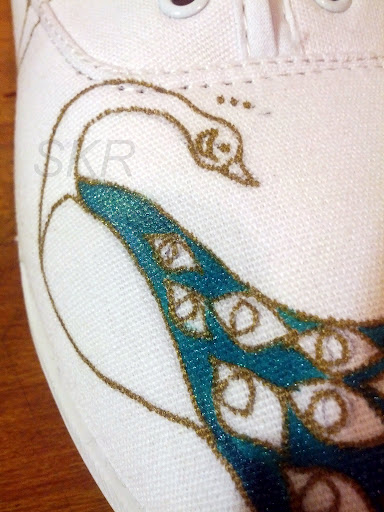
I’m back working on my list of art commissions and today I finally nailed down a design for the next pair of shoes. I’ve been given free reign to design anything I like and a swatch of material it needs to compliment. I decided on peacocks and a gold paint outline for a finer effect than my usual black. I treated myself to a small purchase at the art shop recently and bought some more Pearl Ex pigment colours. I’m using a metallic green pigment added to the paint to create a two-tone shimmer which is working beautifully. Very relaxed and content today, pottering and painting. Here’s a sneak peek of one of the shoes in progress, more photos coming soon! 🙂

To get involved in…

Good news for the poets, two of my favourite competitions of the year are coming up! The Salisbury Writer’s Festival is coming up, and if you like the shorter form, they have a Haiga competition that is always beautiful to view. I highly recommend checking out the Festival, Salisbury have a strong arts community and there are always excellent workshops and events available free or very cheaply.

Secondly, the Mental Health Coalition of SA are also hosting their annual Open Your Mind poetry competition! This is a fantastic event and the night of announcements is good fun. Check out their categories and themes, it might be that you already have a poem that will be suitable. 🙂

Thirdly, Mindshare have just launched a new online resource – interactive Forums! They have already set up a number of different topics such as Mental Health and the Law and the first posts have gone live. Why not go and share your opinions or ideas? They also have a theme every month and will be looking for artistic submissions in July on the topic of Bullying.

Bridges social

The Dissociation support group I co-facilitate, Bridges, had our second ever social catch up on Friday night. (Which ran very late – hence – no blog post on Saturday!) We went to visit a group member to celebrate their birthday and had a wonderful time. There was a lot of talking, laughing, cake, the occasional tears, it was really good to have the time to get to know each other a bit more without having to run off at the end of the group. I am so excited by the growth of a real community, small but very strong and caring of one another.
I had a wonderful time, I’m so happy about it all. We are planning more regular social events which I am really looking forward to. In the meantime I’m going to spend the rest of this weekend resting up because I now feel pretty wiped out.

I’ve been doing a lot of thinking (while I’ve been too crook to do anything else) about ways to develop more resources and I’ve run a few ideas past the groups that seemed to go down well. A number of members in both Bridges and Sound Minds have amazing stories to tell and wisdom to impart, and I’ve been giving a lot of thought to finding ways of supporting people to do that without them having to get into public speaking. Not to say that some aren’t great public speakers, but there’s certainly plenty who would rather chew off an arm. 🙂 This coming week I’ll be doing some training through Mindshare to help people to tell their stories as a short digital film. That’s very exciting and I hope to use those skills to help people in the groups create little digital stories if they want to. Watch this space! 🙂 In the meantime – baths, books, and maybe some art if I’m feeling well enough. The garden is calling to me but I’m in no fit state to wield a shovel yet. Happy to be feeling so much better and content to bide my time and make good plans. 

Sound Minds

Today was a very exciting day, I got to go and spend time with my brilliant voice hearing group Sound Minds. Man, have I missed them! I had to skip more than 15 weeks of the group due to the Peer Work training, and when they changed the dates towards the end of it so I had to miss another 4, I was pretty unhappy. It was so good to be back! What a great bunch of people.

They were all restless and inspired and full of great ideas to improve the group. Sound Minds is the only voice hearers group currently running in SA so we have a lot of need to meet! People were keen for more educational content as well as more opportunities to socialise and get together beyond the group. We’ve booked in another campfire catch-up (assuming the weather holds) and we’re planning a curry day! We also talked about creating some online resources, making some mp3 resources for voice hearers to listen to when reading is too difficult, building our library, and starting an FAQ resource where we could put together our responses to commonly asked questions, for the benefit of other voice hearers or carers or mental health staff. There’s a lot of plans swirling around in my mind. I’d love to help link the group to other groups around Australia or internationally as I know many of the members are not online or getting to go to conferences like I am, so there’s a big supportive community of people out there they haven’t had a chance to be part of yet.

I am so excited about it all, lovely to have some new ideas, so good to be back with the group. I’m not going to be launching into anything yet as I still need a lot of rest and have many other projects on the go in other areas that need attention first. But still, it’s so good to be back. 🙂

Blogging is strange

I’ve been writing this blog, updating daily for more than 10 months now. During that time I have gradually revealed more information about myself, and wrestled with different inclinations about things like being honest vs exposure stress. As I work independently, I’m free to work according to my personal values and beliefs – this means things like I choose to create opportunities for mutual relationships and friendships with ‘consumers’, people the rest of the mental health sector tend to treat as the untouchable ‘them’, against whom inflexible impersonal boundaries must be maintained. This is so important to me. I can’t function within systems that don’t match my values, I crash so fast when I feel I am being forced to be part of processes that are dehumanising. I understand that good people take the harsh edges off bad systems and I am so grateful to those who have done this for me, but I just can’t be one of them. I function in this ‘zone’, this strange tightrope walk where I can do things other people find hard, and can’t do things other people find easy. The downside of this independence, is that every day I make major choices and decisions about who I am and how I will operate. I was at a face painting party recently and someone asked for my card. My business card has this blog address on it. How many Mums looking for someone to face paint their kids are going to choose the artist who talks about hallucinating on her blog? Sometimes I think I’m totally crazy revealing what I have, and sabotaging every career possibility that is open to me. Weeks like this when I’m facing expensive dental work and don’t have enough money for groceries again, the cost of my limitations and my choices really hurts and I doubt everything.

Then there’s the groups – I am so passionate about my groups, and I say ‘my groups’ not in a proprietorial way, they also belong to every single member of them, they are our groups, but they are also ‘my groups’ in that I am also a member, deeply invested and excited and proud and at times exhausted and full of doubt and uncertainty. The government doesn’t fund groups at the moment. They are out of fashion in the mental health world, apparently the concept of groups brings to mind a bunch of confused people whining about their circumstances in a pointless repetitive self-re-enforcing cycle that supports no one. So they are a labour of love, no payment is coming there. The feedback from the people who attend is divided between those who didn’t find it helpful and look elsewhere, those who find it helpful but overwhelming, and those who would lynch me if I tried to shut one down as they love them that much. 🙂

Talks and workshops on the other hand, are taking off. The recent abstract accepted in Wales is a huge boost, really positive feedback that what I’m doing is good quality, professional, useful work. I’m also giving talks locally and being approached by other organisations interstate. This is simply thrilling!

I feel this sense that what I’m supposed to do now, the road in front of me is to work on creating a professional image. It’s critically important to maintain a good reputation for reliability before an organisation is going to front out money to bring over for a talk. They don’t risk this if there’s an even chance you’ll have a psychotic break or drug binge or get appallingly ill out of the blue the night before the big event. I’ve been working on getting myself more set up to make travelling and giving talks easier. I bought an external DVD drive for my netbook (mini laptop) recently so that I can install Microsoft Office 2010 which will allow me to last minute modify a powerpoint presentation or even hook the netbook directly to a projector on the occasion that there are hardware or software incompatibilities. My phone upgrade allows me to access the net, my email, and skype much more easily which helps me stay in touch with those who support me in the stress before or the depression following exposing talks. I have an app that allows me to update in blogger on the go without a computer. You get the picture.

In the meantime, when I’m sick like I have been recently, I write about it on my blog. Instead of creating a slick, professional image I write miserably about how stressed and scared being sick makes me feel. In those days I can feel the whole tone of this blog change, suddenly become more intimate the way personal blogs of people sharing about illness or tragedy are. This scares me. I feel like I’m building a career with one hand and tearing it down with the other. I feel like everytime there’s a clear path in front of my feet I resolutely head off into the jungle instead. I feel like I keep dragging everyone over to the corner and pointing at the terrified little man behind the curtain.

Creating a ‘public profile’ is extremely weird. Going to a conference to give a talk, it is the strangest experience to me when I sit down at a stranger’s table afterwards to be friendly and have them thrilled I did so. I bounce between being a nobody whose opinions don’t count and feelings don’t matter in the worst of the health system, to being a somebody people are excited and grateful to talk to, or hurt and disappointed if I don’t make time for them. It really spins me out and does my head in. It’s scary as hell! And yet I’m doing it. And I doubt that call every week, doubt my motivations, doubt the results, wonder why the hell I’m doing something I find so frightening and challenging, answer that question for myself, and then ask it all over again.

I’ve recently come to the conclusion that I can’t do this process with any kind of dignity. I was hoping the talks would get easier, that I would develop the thicker skin or professional exterior that would allow me to cope with stresses without howling my eyes out on the floor of my supervisors office. I find my vulnerability and sensitivity on the one hand make me good at what I do, and on the other hand are so painfully out of place in a corporate culture, painfully embarrassing. I’ve been waiting for it to improve, but it doesn’t seem to be happening. I just keep pushing myself out of my comfort zone, setting my sights higher. The minute I can cope with what I am doing I add in something else. It feels like training for the olympics, as soon as I can jump that high I set the bar higher. My supportive network appear to be resigning themselves without chargrin to the idea that I quite regularly wipe out into neurotic self doubt and terror, and given some TLC I pick myself back up and get on with it. It’s not a perfect system but it seems to be working.

The process of presenting my ‘best side’ to the world, creating an image of myself that I ‘market’ and ‘manage’ bothers me almost as much as the weird over-exposure and faux intimacy of revealing deeply personal information about myself does. Other people have smuggled personal experience into their professional lives secretly, like Marsha Lineham, who struggled herself with borderline personality disorder as a young person, found some answers, and kept it all quiet as she then worked her way to a PhD in Psychology and developed Dialectical Behavioural Therapy. It has been incredibly difficult to build credibility within the mental health system if you are known to have a mental illness yourself. Lineham is an amazing person who recently ‘outed’ herself at 68. I could have gone down this road. It’s a viable option and one many other amazing people have done. However I’ve rather shot myself in the foot if that was the plan. I have in fact done the opposite and been building my credibility on my lived experience, and not ‘long in the past’ experience but ‘oh last night there were some interesting black creatures scuttling about on my ceiling that only I could see, and how are you?’ kind of experience. I rather resent this; on the other hand people often tell me that it’s a relief to see someone like me being open about my struggles. People feel less alone – which is always what I’ve been trying to do.

Which brings me back to my original point. I guess I keep revealing my vulnerabilities and struggles, even those I feel like I’m not supposed to talk about – like how hard the talks can be, because the alternative, the creation of a public persona that is dazzling and free from all of my limitations, that also feels de-humanising. A different kind of trap to the misery of the ‘consumer’ label I have finally had enough of and turned my back upon, but a trap nonetheless, a place I can’t be who I really am, where secrets lie under all my words and pain is hidden beneath silence and smiles. So I guess I’ll keep muddling along, whether I’m building credibility or shooting myself in the foot. Weeks like this one I remind myself that my backup plan is Frida, who when bedridden with pain, painted onto a modified easel by her bed. I’ve heard of worse plan B’s.

I am on the improve at last. Facial pain is reduced although the skin infections are troubling. I had a rough night full of nightmares and limped out to see my counsellor today. She let me just fall in a heap about everything I’m scared about, overwhelmed by, confused over, and not have to present my ‘functioning side’. It’s a rare gift those people who let you fall apart and still treat you with respect and dignity. I must have drained half my sinus infections, I covered half her coffee table with nasty tissues. (which I threw out afterwards, I don’t hold with the idea that the counsellor has to clean up used tissues!) I came home feeling a 100lbs lighter. It’s so nice to have spaces where I don’t have to know what I’m doing or be competent or calm. I felt like I was drowning without a raft, and no one can take that away really, but it does help to be able to cry about it. Tonight I celebrated feeling a bit better by having a meal that wasn’t blended! Hurrah! A bit of soft fish, mashed spud with garlic, mint peas, and slightly soggy (so I could eat them) sweet potato chips. It was very, very exciting. 🙂

Remembering sickness and loss

I’ve been getting a painful up close reminder of how much being sick takes away from you. I still haven’t got through this pain flair up, I went off to the doctor yesterday who increased various meds, all of which have terrible side effects. I can’t get any decent sleep because the pain wakes me up all through the night and nothing much reduces it. It’s all a bit of a mystery, there’s nothing I’ve done to set it off, it’s not lack of self care or anything like that. There’s no reason I should be having regular flair ups. The usual story.

I find I can be pretty philosophical through a few bad days or weeks, but once it runs on too long or the pain level gets too high I start to run out. I’m spending half my time crying at the moment I’m so depressed and frustrated. Wednesday night was my sculpture class which I had to miss again. I have to cancel the rest of this week to keep medical appointments and have tests done. I remember this world, and even a small brush with it like this is terrifying. There’s so much grief in being ill, such a profound sense of loss.

Watching my peers go off to university while I was too sick to cook my own meals or bath unaided was an excruciating time in my life. Fear, misery, humiliation, and painful empty hope tortured me. Chronic pain is an evil thing that warps you, you notice yourself changing, becoming irritable, angry, losing your joy, and you watch it all happening and fight it with everything you have but you don’t always win. Then comes the shame, the fury with yourself for how weak you are, that if you only tried harder, you would be better.

You watch the toll it takes on relationships. You want to know the divorce rates when one partner has a chronic illness? Want to know the suicide rates? For the first episodes friends don’t take it personally when you cancel on them. After a while they decide it’s simply kinder to stop inviting you. It’s like watching your blood running down a drain from a wound you can’t staunch.

I remember this world. Going through a supermarket in a wheelchair and cringing under real and imagined glances of disbelief when you haul yourself upright to reach an item out of reach. Being taken aside to have whispered conversations “The rest of the students don’t understand why you’re using a scooter when you can walk”. Caught constantly between the pain of walking and the humiliation of assistance. Limping back to the car bent over the supermarket trolley handle to try and take the weight off the hip that is screaming. Biting holes in my lip to distract me. Staying home for so long the outside world became a memory, a dream. Tolerating whatever I had to do to be able to get back out there. But then, the feeling that my chair dominated me, that I didn’t have enough personality to fill it and radiate out beyond it, not enough confidence, that instead it defined me, caged me, engulfed me. I so badly needed another friend in a chair.

The assumption of personal failing, constantly having to deny that you have in some way done something wrong to bring this down on yourself, it’s type A personality, it’s about not enough sun, it’s because you don’t exercise enough, it’s because you exercise too much, it’s about blood sugar, about vitamins, about rare viruses, it’s all in your head.

“I hate myself” has been on loop for days now. I don’t hate myself. I just really, really, don’t want to be sick, I’m very tired and there’s a lot of bad memories in my head.

Abstract accepted!

Well, as I sat about today feeling like I’d lost a round or two with a boxer, into my inbox came a delightful email informing me that my abstracts for a 20 minute talk was accepted for the 25th Annual World Hearing Voices Conference this September! Here’s my abstract:

I hear voices as part of a dissociative disorder, and have done so since I was a child. I was diagnosed with PTSD at 14 and DID at 23. I now co-facilitate groups for voice hearers and people who experience dissociation or multiplicity, and chair a small Australian community group The Dissociative Initiative. Dissociation is often misunderstood and multiplicity especially is seen as rare and bizarre. My experience has been that multiplicity is a spectrum, and some voice hearers are struggling with dissociative issues and experiencing their voices as parts. I will share some of my personal experiences of how dissociation affects me, what it is like to have voices that are parts, and strategies I have used in my own recovery. I will also share a framework for making sense of the array of dissociative experiences, and how to understand ‘multiple personalities’ as a dissociative entity. For people who hear voices that are parts, there can be additional challenges to recovery such as when parts are able to control the body. I will explain some basic principles of working successfully with parts. I hope to inspire people to feel more comfortable and confident in navigating dissociative issues, and encourage people that it is possible to live well with voices who are parts.

The slight hitch is that the conference is in Cardiff, Wales. Which is a bit of swim. I’ve already made a couple of enquiries on the off chance my talk was accepted, but nothing has worked out so far. Now I’ll have to go hunting grants and funds and see if I can find a way to get there. Very exciting!

As I’ve been busy writing biographies which is like pulling teeth, and talk outlines, which are frankly more difficult to write than the talks, I thought I’d also update my pages here on the blog. The articles page is gone, collapsed into the New Here sitemap. I’ve uploaded all the PDF’s of articles into google docs and now just have to update all the links so they go to the right place. My Resources has been spruced up, and About Sarah has been updated. I’ve made a bit of leap in clarifying some of my diagnoses on that page, previously you had to know me or dig into the blog to work things out. Exposure is difficult and I’ve been managing it in staggered doses. Here goes, hey. 🙂