I finished my metal sculpture for college yesterday. I used a mig welder for it. I’m not bad for a beginner. I love it, it’s going to live in my garden. It will shine in the sunlight and weep in the rain and chime in the wind.


I finished my metal sculpture for college yesterday. I used a mig welder for it. I’m not bad for a beginner. I love it, it’s going to live in my garden. It will shine in the sunlight and weep in the rain and chime in the wind.
Okay, surgery tomorrow. No more waiting to miscarry.
O.o
Not ready. Ready, but not ready.
Today was full. I moved very slowly. I went to sculpture class a record 4 hours late. My tutor is away sick and we have a new one! I talked to them and two other lecturers about my miscarriage and surgery. I went into this weird slightly hyper state to get everything done without crying. People seem to keep expecting me to be emotional in public but I don’t have a lot of shades at the moment, it’s nothing at all or all of it. So I keep a lid on it until I’m home safe. I hate that breathless feeling though, the cheerful, slightly hysterical note in my voice, the way people misunderstand easily and think I’m being flippant.
I stayed until 6 and finished my sculpture projects for the term. They’re placed in a corner, labelled and tagged so they’ll count even if I can’t go in next week and present them. I have worked so hard this term to stay up to date with the course work in case something like this happened and I am so organised and ready. I’ve never done 70% workload at uni before and I’m managing it. I’m so proud of myself.
Tomorrow is going to be weird and hard. I’m going to ask the hospital to give us Tamlorn’s remains. I’ve arranged a cremation with a local funeral company. Rose will not be allowed to wait with me before surgery or come into the recovery area after surgery. She is going to have a very long, lonely day floating around the hospital. She’s not even allowed to wait outside the surgery area – those seats are strictly for patients. A lot about hospital procedure has left a lot to be desired in this process, such as having to wait on hold for an hour to get through to the antenatal department to cancel our first appointment tomorrow, while someone on a looped recording gives me advice about taking care of my baby. Trauma, trauma, trauma.
And then home. Not pregnant anymore. Tamlorn gone. After the high and the busy-ness, the crash, the silence. I’m not ready. I’m ready.
Home today and dazed. I feel like I’m picking my way carefully through a harsh and dangerous land, trying to find a path through. Stepping stones across rapids. I didn’t attend college today. Rose made it to work for most of the day. I’ve been tackling the admin in the wake of yesterday. Cancelling the antenatal appointment, informing college about my absences, contacting parents who had face painting booked with me this weekend, notifying the others coming together to work on the networks Hearing Voices Network of SA and the Dissociative Initiative that I’ll be in surgery when we were planning to meet. There’s a thousand small decisions to be made.
These are the most helpful resources I’ve found so far:
There’s a new peach tree in my front yard, waiting to be planted in Tamlorn’s memory, shedding leaves as autumn creeps on. We chose a variety that will fruit in March, blessings every year to remember them. Our community – readers here, our friends and family and workmates and friends of friends have poured out messages of love and loss and support. We have come through the very outcome that people counsel you not to share because of, and we’re still glad we shared. (It’s okay if that’s not the right call for you though) We’re also glad that we decided to tell people what would and wouldn’t be helpful for us to hear. Rose has had a much gentler time in conversations this time around than after her other 6 losses, and we think that had a little to do with it. Sometimes it’s hard to know how to be helpful and having someone tell you can make it easier.
We are hearing that some others affected by this loss have had some tough times with other people and that’s sad and frustrating. Grief is contagious, it links us to other experiences of grief, it reminds us of vulnerability, mortality, that the world is not just. It touches deep wounds. Frequently unpredictable and always a legitimate need of the heart. We shouldn’t have to grieve secretly, justify grief, or be afraid of our tribe when we’re hurting. We grieve for things that happen in other countries, for tragedy suffered by people we’ve never met. We’re supposed to. It’s okay if you’re feeling affected, more than you thought you would be, more than someone else thinks you should be. Rose and I don’t own this pain, you don’t have to be close to us, or related to Tamlorn, or have experienced a miscarriage to justify your feelings. If you’re grieving then you need to be, so please be kind to yourself, please ask trusted people to be kind to you.
There are people who think grief is straight forward, clear, direct. Concentric circles spilling out from a central relationship. I don’t believe that. There are people who think we only deeply grieve people we have known and loved for many years. People who think miscarriages are not something that should ever be grieved. (you don’t have to grieve a miscarriage, you will feel grief or not, as your heart needs. It’s not wrong to not feel grief. It is wrong to try and quiet someone who is grieving) People who try to rank grief, this loss is worse than that loss. I believe none of this. Grief is a deep aching need of the heart to weep. I have grieved lost hopes and dreams. I have grieved lost health. I have grieved losses of people I have never met. I have grieved for characters in books. I have grieved for pets. I have grieved for suicidal loved ones, for their anguish. I have grieved for whole cities, whole countries, forests. When I was 15 the river dried up and left shrinking pools of dying fish. I prayed to every power I knew and wove every spell I could with my poems, and carried them in buckets to swim in old cattle feed troughs and bath tubs and they still all died. And I cried like the world had ended, cried for days and days with a profoundly broken heart because I had just learned that some things are beyond my control even if I love with all my heart. Grief is part of being alive, part of being human. I don’t believe you choose to grieve or to live, grief and living weave in and out of each other. If you have ever loved anything or anyone, then one day you will grieve.
I can’t tell you how sorry I am that our shared joy has become shared pain. I’m sorry for everyone who is hurting, remembering other losses, feeling helpless, feeling torn. I’m sorry for those of you who have had terminations – who found yourselves with life that was not the right time or with the right person, growing in the wrong places, growing broken and unable to live – who grieve even if the decision was the right one, and can’t speak of your grief. I’m sorry that your loss is so often hidden in the shadow cast by the loss of a wanted child. I want you to know that I don’t hate you or judge you, that you are allowed to not grieve or grieve as you need to also. I feel like my grief and my situation makes people think we are enemies, standing on opposite sides. I want to say we are not enemies.
I can’t tell you how much I appreciate that you care, that you reach out, tell us Tamlorn’s name is beautiful, remind us we’re not alone, share tears with us. I know it feels like there’s nothing you can do, but listening and caring are doing something, doing the most powerful thing you can. As we listen and care for each other, fumble through rituals of grief for a loss not often acknowledged. I’m sorry we brought this touch of death into your lives, but I’m grateful that we’re not here alone.
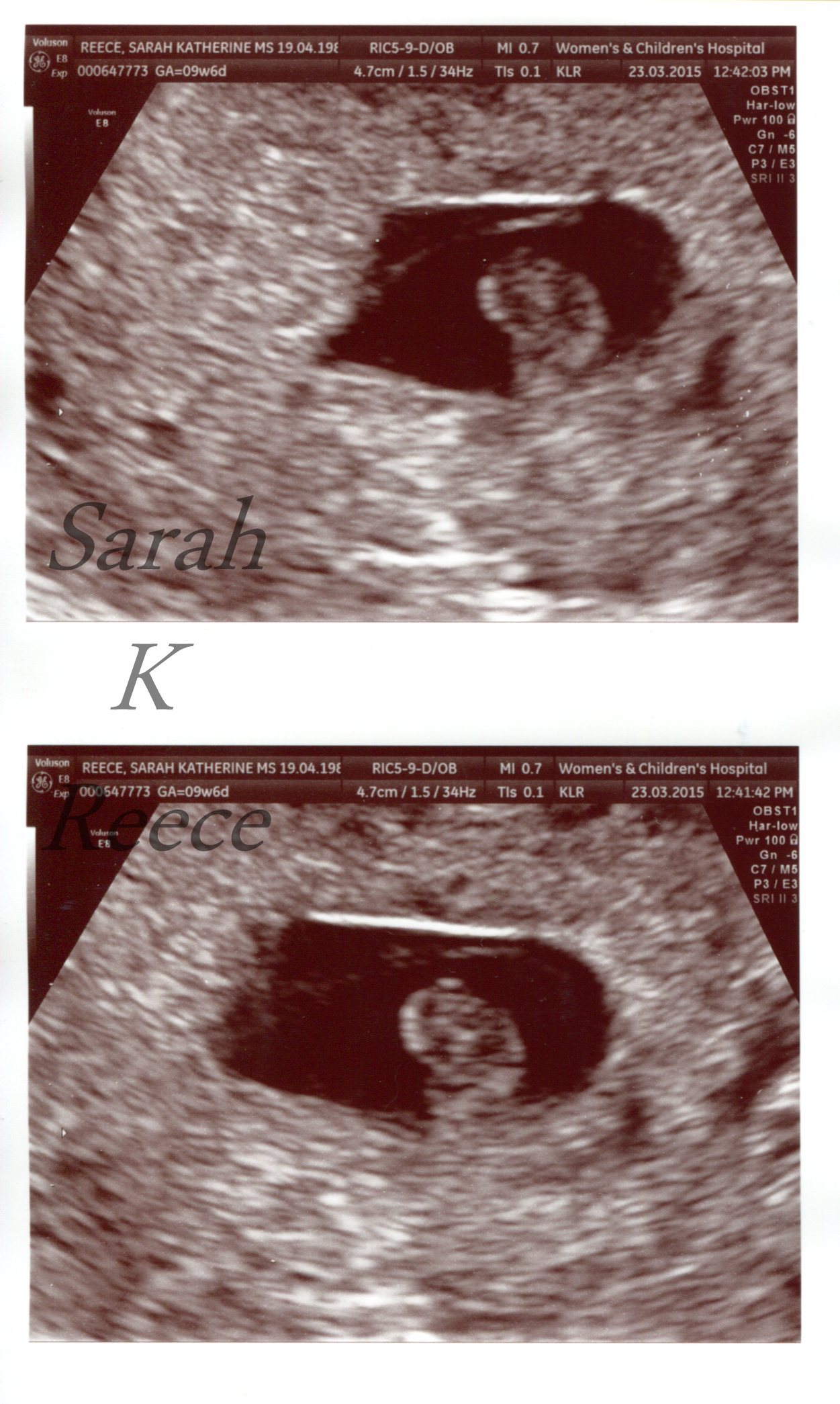 Our baby has died. There is no heartbeat, no growth, no obvious abnormalities, they’ve just died. You can see them in this last scan, all curled up, head at the top and body tucked under in the dark womb. The painful wait is over and there’s no hope left.
We’ve had a very, very long day. We’ve just arrived home from hospital. We’ve spent all day in waiting rooms with pregnant women and new parents with tiny infants. We’ve decided we have waited long enough and will end this on Thursday with minor surgery to empty the womb. We’re exhausted and devastated.
I know it’s so hard to know what to say when people when grieving, and that grieving people are often distant, preoccupied, and angry. Here are things Rose and I are finding helpful and not helpful.
Not helpful:
Some of these things we already know, others are attempts to cheer that just hurt more. Grief hurried through become lonely, twisted, dark. Grief given time will heal.
Helpful:
It’s okay to say nothing at all. It’s a beautiful thing to be able to sit with other people’s grief, to be silent and not try to make it to be anything but what it is.
We’re calling this little one Tamlorn, after a beloved child in a book by Patricia A McKillip. My Tam. Our Tam. We’re hoping to go out tonight and buy a tree to plant in their memory.
We will rest for a couple of months and then plan to start trying again. Our donor is still on board, so this is not the end of our journey. Thankyou all for your hope and messages of love and support.
From earlier in this harrowing week. Our ‘viability scan’ is tomorrow. Frankly I’d rather put my fist through glass than attend.
So you’re in there, struggling
In the darkness, trying to grow
Without what you need
And you’re brave
And you fight hard
Wrestling heart beats back from death
A life counted in days, not years.
I know you’re doing everything you can
And it may not be enough
And it doesn’t mean a thing
It doesn’t mean you don’t want to be here
It doesn’t mean we don’t love you
I know what it’s like to give everything
And still fail.
I know where you are, little one.
These are our limits.
This is what it is to be human.
Sometimes we don’t make it.
Love doesn’t heal all wounds, doesn’t stop the bleeding, doesn’t reorder the genome
Sometimes we fly and
Sometimes we fall.
And I know to some
You are nothing, just tissue, just potential
Welcome to the world
So am I. Just a statistic, just a number
One in a billion lives, not particularly
Noteworthy, not powerful, not rich, not a player in history.
This is what it is to live: you must
Wrestle your identity from those who
Do not see you as human –
You must be human anyway.
I’m so sorry
You had to learn this so young
I want you to know
What it feels like to breathe
I want you to feel my kisses on your face.
I want you to know, I know how it feels
To struggle in darkness
To find that you’re not complete
Not put together right, that there’s more effort
Than seems fair to jump the gaps
That some of us learn young
The risks of living, the way
Not all us get it easy
Not all of us get our happy endings.
I love you.

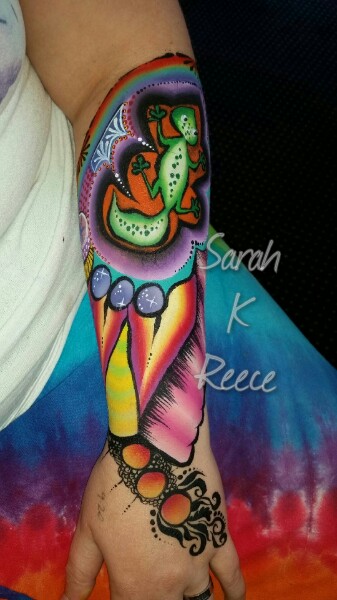
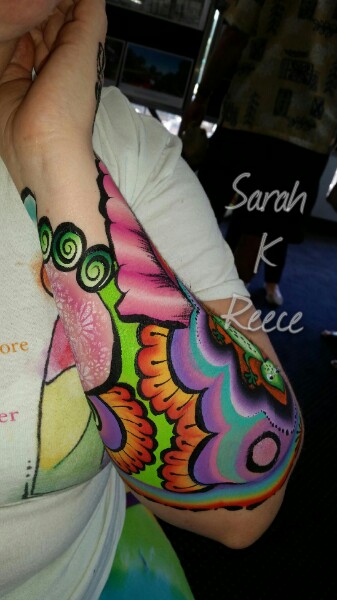
We worked a lot today. I usually paint something on myself to encourage the kids at public events, so I started off with this little spotted fellow. When things went quiet I turned him into a sleeve.

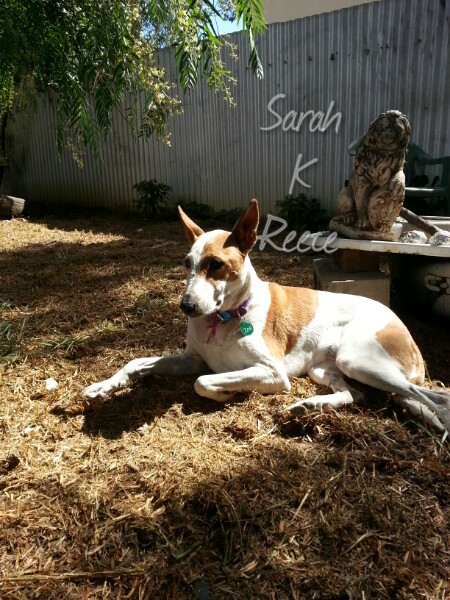

I have a lot things I should be doing. But I can’t face admin and people and my networks. So yesterday I looked out my kitchen window and decided today was the day to tackle the backyard. The grass is over grown, there are torn up plastic bottles everywhere (for Zoe to chew up and get the treats out of when we leave her home) and outdoor furniture that’s been dumped here since Rose moved in.
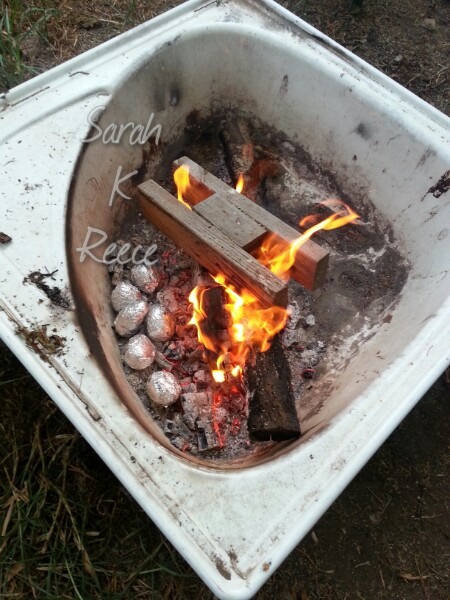
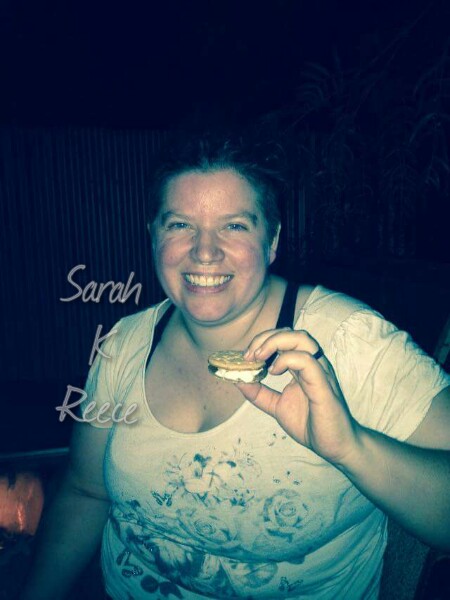
So, 5 bags of rubbish later, I’ve sorted the furniture, collected all the dead bottles and bones, and set up the fire tub again. We celebrated last night by lighting a small coming fire and making baked potatoes and smores. Today I’ve mowed the lawn and swept.
Zoe has graduated from the plastic bottles. She’s also no longer chewing washing from the line. We can inhabit the yard again, her treats are now bones, chicken necks or feet, or pigs feet, frozen to slow her down a little. She loves us sharing the yard with her.
The plan is to borrow a trailer, cover the grass with cardboard, and then cover that with a thick layer of mulch. No more mowing! Then we’ll plant out fruit trees and geraniums, if Zoe doesn’t uproot them or chew on them. We’re also going to move the shed away from the house so all the house windows look out into the yard, and save up for a cat run down the track.
But for now I’m happy, I have a lot of space back, room to have a birthday party, space to play with Zoe, and a place to hold the voice hearers camp fires again. Someday there’ll be play equipment and kids romping here, having adventures, getting muddy, climbing the trees.
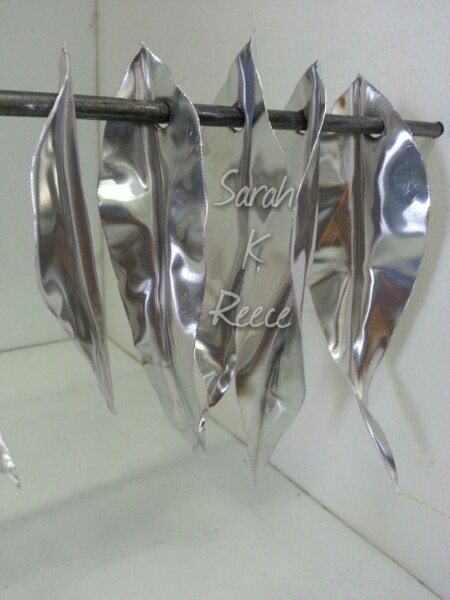
I’m working on a sculpture for college at the moment. It’s not finished yet but you can see the bones of it: a weeping tree with silver leaves. It’s designed to be displayed outdoors, the leaves move in the wind or rain. They are cut from 0.3mm aluminium, the tree itself is mild steel mig welded together. The welding is fantastic, I’ve wanted to learn it for so long. I’m looking forward to seeing it finished in my yard, the leaves should flash in the sun and weep in the rain.


Painted this the other day. I’m 9 weeks pregnant today. I can’t give you any updates about what stage of growth the baby is because all we know is they’re badly behind. The apps and books and reminders have rather lost their joy.
Rose and I play board games. We book in time with friends. We watch ER. We cook and prepare lunches for each other. We sing to the baby. We touch base over text throughout the day, checking in, “still pregnant”, trying to ease the breathless fear. We lie in bed and plan what we’ll do if this one dies, how soon to start trying again, how we’ll handle news that they are alive but catastrophically disabled, we cry about how we don’t just want any baby, we want this baby, we’re in love with them.
We pack the dishwasher and water the garden. Forget to buy cat food and go back for it. I get anxious texts if I’m longer than a minute in the toilet. Sleeping in one day I wake to missed calls and frantic worries that I’m bleeding out in my sleep. Friends answer the phone with a panicked tone. We’re all waiting for disaster.
I book in our scan for next Monday, the woman on the phone is curt and unhelpful. So you’re only 6 weeks pregnant? No, I snap back, the baby is only 6 weeks developed. Oh yeah she says, reading the form more closely. She hangs up without telling where to come for the scan and I have to call her back for instructions.
I arrange bills in order of due date and put them on the fridge.
For 5 hours one day I firmly believe the baby will be fine. I sing around the house.
Rose drives to work and sits weeping in the car park. There’s nightmares and flashbacks, we talk softly of the other times, other losses. I promise I’ll tell her the truth, even at work. She mostly believes me.
I sit in class, feeling pain and dampness, half convinced I’m miscarrying but desperate not to find out. I sit solidly at my desk, head down, working, until the end of class. I screw up my courage and go to the bathroom. False alarm.
Our friend who had visited over the weekend to celebrate the first scan goes home again yesterday. The house feels oddly empty.
The cat sleeps on me all night, snuggled as close as she can get. I’m constantly surprised by these little reminders that I am still pregnant, despite everything that’s going on.
Food aversions are in full force. I can’t bear salad or meat anymore. I live on cooked vegetables and fruit. Licorice settles my gut.
I’m still writing to my little one, sometimes as if they’re alive, sometimes as if I’ve already lost them. I feel dazed. Rose and I spend whole evenings sitting close, holding hands, trying to ease the sense of distance and bewilderment. We’re still here, there’s still love here. We hold on.

Feeling sick.
Feeling angry.
Inks and poetry are my punching a wall. And music
Music lets me breathe
Especially Trent.
She shines in a world full of ugliness
She matters when everything is meaningless.
(this is the first day of my last days)
It’s not pretty, it’s life.
Still no news if the baby will live or die.
Rose and went to a follow up appointment at the local hospital today. The second opinion was sadly the same as the first, the odds are very against the survival of our bub. They were very nice. They’re taking over our care early, so they’re now the ones to call with questions or fears. We can turn up anytime if there’s bleeding or cramping. (must turn up, in fact, as I’d need an injection to prevent my body creating antibodies against the bub) They will do another scan in 10 days time, if we haven’t miscarried by then, and compare growth rate and so on to see if there might be some cause for more optimism. In the meantime we just wait.
It’s a hard place to be, we’re full of hope and despair in equal measure. We’re talking things very gently. Today I felt like company and Rose felt like bunking down at home, so she did just that, and I went out to Port Noarlunga with my sister and a friend. I had a raspberry sorbet and we went snorkelling along the reef. It was such a beautiful day, so bright and clear, the sky so blue. The water was full of fish and we saw a few crabs and starfish too. We’ve had dinner with family and we’re now watching Harry Potter.
It’s like the movement of a tide. Some hours are full of big emotions, others are the simple joy or needs of the moment. I feel a lot older and wiser about dealing with the movement of such string feelings. Less ashamed and bewildered, trying to control what I can’t. Better at rolling with the tides. It’s funny, on the way home today I thought about sharing on here what I’d done and I knew it would meet with the approval of those who would have advised me to not concentrate on the fear about our baby, just enjoy myself. That’s really not what I was doing today. I’ve had a lovely day after the sadness of the hospital this morning, but that’s not because I chose to think positive or decided how I would feel. If I had needed to curl into a dark place and paint myself with ink, or make dark art, or park my car somewhere solitary and scream, I would have done those things. I’m likely to do them sometime over the next few weeks.
It’s not about what anyone else would do or thinks I should do. It’s not about what a social worker might think of as the appropriate ways to handle this. It’s not about obedience or conformity or trying to make myself feel or not feel anything. It’s about listening to myself, unhooking from shame and loneliness and the other painful ideas that inevitably come with strong feelings and tough situations. I share them, counter them, unhook from them.
People are not rational in the face of pain. It’s normal. I find moments of shame when I’m feeling good. I find vague hazy fears that people like Terry Pratchett have died because we’re trying to bring a new life into the world. And when I can take these some place safe and unhook from them without shame, I’m just left with the feelings and needs of the moment, and I’m free to meet them. Company, solitude, distraction, expression, research, comfort, whatever. Whatever the feelings or needs are, it’s okay. I can navigate them, explore them, find a place for them. Rose can too. It’s okay when they’re not the same. It’s okay when they shift every 20 minutes. It’s okay if they’re different to how other people have felt or think they might feel in this situation.
It is what it is. Today our little one tasted the salty sea warmed by the sun. With what time we have, we’ll live. Fully, deeply, honestly, passionately. We’ll hurt and we’ll hope.
I woke up this morning to the news of Terry Pratchett’s death. I cried in bed. He was an incredible man, and his books have got me through some very dark times in my life.
Our scan today was more heartbreaking than reassuring. Our little one is there, alive, but far too small, and with a heartbeat slower than mine. The likelihood is that there is a significant problem with their development. We’ve been told to brace ourselves for a miscarriage over the next couple of weeks. Our first antenatal appointment is in a fortnight.
There’s still a small chance. It’s small but it’s there. The odds have been against Rose and I many times before. We’re horrified but we’re holding on.
 This is them. We couldn’t hear the heartbeat but we could see it. The technician described the movement of it as ‘fluttering’. Like a tiny bird.
So. I’m trying to get through to the pregnancy support line and ask more questions. We have a an appt with our doctor next week. I’m not sure how to manage my work commitments – I can’t bear to spend a day painting children’s faces if our baby has just died. I’ll figure something out.
We’re home. They escorted us out the back door so we didn’t have to go past all the cheerful people in the waiting room. They’ve done this before. Our gp chose that place because they’re nice to you when they have bad news. The doctor told us he tells around 2 women a week their babies have died. We sat in the car and cried until I could put all my feelings away and drive home. We bought milk and bread on the way. I’m sad and scared and hurting and numb.
I’ve bought Terry Pratchett books online. We’re being kind to each other, moving slowly. Some days are just sad.
Yesterday was really hard. Rose and I are both tired, busy and stressed. Our first scan is in about 13 hours. It’s so important. This is where we find out if there’s a baby in there or if we’ve already lost them, if they’re growing in the right place, if their heart is beating strong, so much rests on it. We’re scared, and trying not to be, so we’re flat and depressed instead.
Admin was horrible. After 6 calls and an hour on hold when my call to welfare dropped partway through I actually screamed in frustration. The college work load is scaring me. I have to keep reminding myself that the assignments are for visual arts students, not english student – they are not nearly as difficult to write! It’s not as hard as I think it’s going to be. The standards are not as high as those I set myself.
Dreaming intensely at the moment. Feeling raw. I’m reading about life with small children – you’re always tired, you never get time to do your hair, forget about finishing the housework, and you permanently smell of soured milk. With the exception of the last one I feel like I’m ready living that! Does that mean it will all get way way worse, or does that make it an easier adjustment? Don’t answer that.
Everything that feels monstrous and impossible now will feel like the smallest of bumps if the scan goes well tomorrow. I know that. I’m just deeply, gut wrenchingly scared. That’s okay. This is what it is. It’s a tightrope or a narrow ledge. I can touch life with one hand and death with the other. We’re used to having a little more room to breathe between them, but this is the road we’ve chosen. Bitter-sweet, painful, beautiful. My heart aches and aches.
Wow. We have our first ultrasound in a couple of days. If that goes well and there’s a heartbeat and a bub growing in the right spot, then we are through the worst of the woods! Down to a miscarriage risk of 1.5 – 2.4% (depending on the study). Very low, anyway!
At 8 weeks, the little one is about the size of a large raspberry. This week they transition from being called an embroyo to a fetus – this reflects the change in its growth. Embryos are figuring out all the different cell types they will need – brain, muscle, nerve and so on, and grouping them into what will become organs like the heart, lungs, liver, and forming arms and legs. The fetus has the building blocks in place now and is grow grow growing them.
This week they’re starting to grow fingers and toes, little webbed stubs. Eyelids have formed, and they will probably be taking their first little tastes of amniotic fluid. They’re growing fingerprints.
I am a huge pain to live with currently. Food aversions are driving me a bit crazy. I’ve been obsessed with salads until yesterday. Now I can’t stand them. Yoghurt is back on the eat list. Meat is off it, fruit is on it, potato salad I can’t even think about without getting queasy. Nuts are off but peanut butter is on. I’m driving myself crazy. I felt ill and off colour all day today. Rose woke up to me sobbing from nightmares and came home to me sobbing about a parking fine. I seem to have only two modes currently; ill and weepy, or ranty. Rose however is the one doing the throwing up, due to her fertility meds. We went out to a fringe show tonight and my poor love threw up in bins all the way back to the car and then in the garden when we got home. It’s hard to tell which of us is pregnant some days!
I’ve been reading about risks and options and stories from other mums about miscarriage. One thing really struck me – a woman saying that all this advice to not tell anyone until you’re through the first trimester meant that when she lost her baby she had no idea about it, no preparation, no knowledge of the options, no stories from friends she could draw upon. That’s in my head a lot at the moment, this idea of taboo and silence and secrecy and what it does to us. If you need any information, I recommend the Miscarriage Association they’ve got clear info and links to real experiences. The Heartfelt foundation are also screening a film here in Adelaide this Friday night about pregnancy loss.
Waiting for our scan. Holding my breath until we hear that heartbeat.
Woke from nightmares with a cry (her face was wet but she couldn’t speak anymore, so near death, she could give no more comfort and answer no more questions). I’ve cried so hard my face is swollen. I have to get up for class, my favourite today, sculpture. I want to turn out the light and go back to bed and try to dream sweeter dreams. I wonder if that’s what a brief life is like for a miscarried embryo, a sleep, a dream, and a sleep. I wonder if they ever get any other dreams. I can see the faces of people lost to me and the world itself seems fragile, paper torn in the wind. My hopes of safety, meaning, reconciliation all feel like a child’s dream. A sense of order where there is no order, only darkness, only loss. It seems unbearable to be human today. Our baby is safe, but we march into the future as if all will be well, as if there will be no cost. I feel friends falling like autumn leaves, into death. With dawn comes dusk. We love, and are consumed, and some day our arms are empty. A cold wind blows right through me.
No words, no words, or none of the kind that need another, no back and forth of dialogue from where I am, somewhere between awake and asleep, a shuffling bewilderment, dawn that promises to come but does not come. I’ve no words here, no words for this place, no way to describe or explain, no justification. My eyes, my eyes, they ask questions I can’t voice, they look out of my face like dough, my flesh like bread, and there’s a kind of searching I can’t name, a sense of loss that the face in the mirror isn’t me. The tasks stretch before me like days, they are a thing I understand, I bend myself to them. The written word does not break the vow of silence, the secrets can be mumbled, I share them without sharing. I’m lost, wandering my house with the bread rising in the oven, I’m lost. Some shadow calls my name, some darkness clings to me from sleep. I dreamed of dragons, of a world flooded, darkness that moved upon the water. I dreamed of dragons. The bees are in the basil. The child is in the womb. The weeks lie before me with all their tasks. I’m here, trying to find my way to your world, the key that turns the lock and yet, and yet, I want to stay. This is not air that I’m breathing, all my words are in my hands, in the touch of my fingers. I’m caught between worlds, on the other side of the glass, out in the night where all things are naked and only themselves, out where the dogs cry and the moon is bone white in the sky. I could shake my head and shake the shadows from my eyes like dew, step over the threshold into the world of words, reassure you with a smile. I could take up limb, tongue, conversation without sacred touch. But I think I’ll stand here a little longer and listen to the other world. The sound that hearts make, yearning, even yours child, throat unstrung with harpstrings yet, in a place where longing is the only language.
I rarely share freshly written poetry, but this is an exception. 🙂
Little one inside me
All you know of the world is my body
So I take you with me and listen closely
Breathe it so you may taste a little of it.
These are waves, little one, they are
The heartbeat of the ocean
And these are stars, remote and beautiful
That feeling inside me is awe.
Alone in my bed, weeping; this is fear
My blood that calls your name before you have one.
This world at times is all shadow and sharp edges.
Here in my garden, I breathe in sweet basil
This drumming on my skin is rain
It’s autumn here, the jonquils
Push green fingers up through dark soil
They will bloom and die before you arrive.
That burr of softness is my sweet cat
Kissing and purring – your mama thinks
He knows that you’re here – he wants to be with me always.
In our own way, all these things
We are all singing to you
All in love with you, nameless one
All calling you home.

I’m in bed by 9pm, coax myself through college hour by hour, and spend any spare time on the couch. Pregnancy! Just like a moderate fibro flare but less pain. The little one is currently the size of a raspberry, coffee bean, olive, or brazil nut, depending on which pregnancy book or app you are reading. I know because I downloaded 5 of them recently and enjoy being reminded every few hours of what is growing at the moment. This week it’s little stubs for hands and feet, among other things. The food size comparisons I’m suspicious about considering there’s quite a difference between your average coffee bean and a brazil nut.
I’m hanging in there at college so far, with a few hours on the library each week plus Mondays devoted to home work. I am learning a lot about welding and The Enlightenment.
Apart from that I’m keeping house work happening. Rose and I try to open several boxes from her move on every weekend. If we’re really doing well, we also empty them and sort the contents into our home. Sometimes we just open them and get discouraged and put them back somewhere where we can still get the doors open.
Zoe is going mad because I’m not walking her. If I had a wagon I could just hitch her up and yell ‘mush’.
Bed is crowded. Between Rose, myself, this cat who likes to sleep on my legs or in their spot so I can’t straighten up, and the whole extra cup size of melons going on I’m having trouble getting comfortable and sleeping well. Back pain is a constant issue (fibro) and my new crop tops are my best friends.
I have gone so completely off some foods I can’t bear to be in the same room. Yogurt is a big one. Even the word makes me nauseous. Apart from that I’m fine though. I crave salads and fruit and eat little else. Rose is incredible at putting together amazing salads after she’s worked all day, left to my own devices I think I would be living on salty crackers and celery. If I don’t start the day with a banana I feel like I’ve been run over all day. If I don’t get enough protein I feel like I’ve been run over all day. Boiled eggs are my friend, as are pickles, and peanut butter with sultanas on celery. Rose is packing me lunches and keeping a steady supply of cherry tomatoes, grapes, and cucumber sticks going on. She’s awesome.
And now I’m going to sleep again! If you’re waiting for replies to messages or emails, I’ll get there, maybe by Friday. Sorry.
This has been my first weekend in forever that I took off and booked no face painting gigs. I have had the most wonderful day! I’ve lazed around in front of the air conditioning, done a little gardening, cleaned the kitchen and bathroom, shared lunch with friends, chatted away to lovely people online. Rose is organising dinner with fish and avocado and I’m very excited about it! Mmmmm. Our new game of Ghost Blitz came in the post at last. 😀 I’m loving playing games together in the evening, it feels like a good family ritual to be developing.
I nearly forgot I had a shrink appt today until my phone reminder went off an hour beforehand. Living with dissociation has been significantly easier since I got a smart phone! It was a great appointment. I’m so appreciating the support I have around me at the moment. There are some wonderful people, my doctor, my shrink, my partner, friends and colleagues. People who are so excited for us and with us, people reminding me to enjoy this time, people making safe places for me to be afraid or sad, to fumble my way into this new role and find confidence that I can do this. I’m not alone!
At times I feel embarrassed that things are going so well, sad for those I know have tried so hard to have children, or lost so many babies, for those who are horribly sick through pregnancy and have so much stress and pain to deal with. I feel so lucky. I’m hoping to be sensitive to those who haven’t been. I don’t believe there’s more to this luck. I don’t believe people can’t conceive if the universe doesn’t think they will be good parents. Life isn’t fair. I’ve been lucky so far, not divinely blessed. And I know how much other people’s good fortune can hurt. Even beautiful, lovely, ecstatic Rose feels pain that I am carrying when she has lost so many. I hope I’m a sensitive partner for her, making space for those feelings too, for the shadow of such fortune that falls over some of us. And I hope our luck holds. 🙂

We went to see our doctor today and got the first round of blood tests back. Everything is looking great! All my levels are excellent, ditto my blood pressure, there’s only two points of caution. One is that I have no immunity to a couple of common viruses that are pretty harmless unless you are pregnant, so I need to be careful about snuggling up to sick kids, the other is that I have O- blood and the baby will most likely be O+ which simply means that I’ll need a few shots to prevent my body making antibodies to the baby’s blood. My GP is wonderful, she’s so happy for us and excited about the baby. She reminds me to soak it all up and enjoy it. 🙂
So everything is looking wonderful. I’m having a very easy ride at the moment. I’m craving salads, pickles, licorice, and salty crackers. I’m not having much trouble with nausea at all unless I eat rich foods. I’m tired but it’s pretty much the same levels as my fibro in this weather. I seem to be one of those incredibly lucky women who find pregnancy suits them – some women with fibro are the healthiest during pregnancy. Wow! Life is really going my way at the moment!
We had a bumpy couple of days recently when I experienced a little bit of bleeding. It’s not at all uncommon but Rose and I were both very anxious and she struggled with some flashbacks to her losses. It’s hard sometimes. We wound up talking each other through it by deciding that it wasn’t really possible to ‘not feel worried’, both of us were trying that and failing. So instead we went for ‘it’s okay to be scared, but until we definitely know for sure that we’ve lost this baby, we are going to be fighting for them and cheering them on’. That was something we could do. We also talked about a name, lovely but impractical, to give them if they don’t make it.
But things are settled and all is going well. We have our first ultrasound booked for a fortnight and we’ll get to hear the babies heartbeat. I’ve booked it for a day Rose isn’t working so she can come too. Just thinking about it makes me tear up. It’s funny, everyone keeps reassuring me it’s normal to be teary and hormonal – I’m pretty much always like this lol, emotional is what I do! In fact I’d say I’ve been the most consistently cheerful and content in the last fortnight than in forever. Rose agrees, although she has mentioned I’m also a little more irritable especially about anyone being an idiot or stirring up trouble. 😛 I’ll cop to that!
In Art History, a subject I unexpectedly adore, we’ve been learning about the Enlightenment. We’re currently studying a rather dense piece of writing by Immanuel Kant. Every time the lecturer mentions him, my inner world breaks out into a chorus of Monty Python’s Philosophers Drinking Song. I’m quite enjoying it!
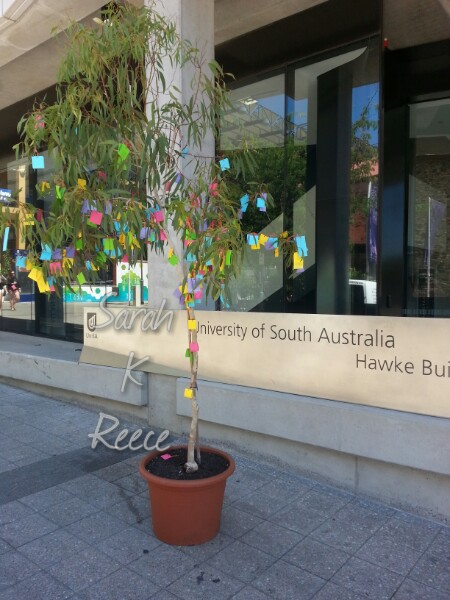
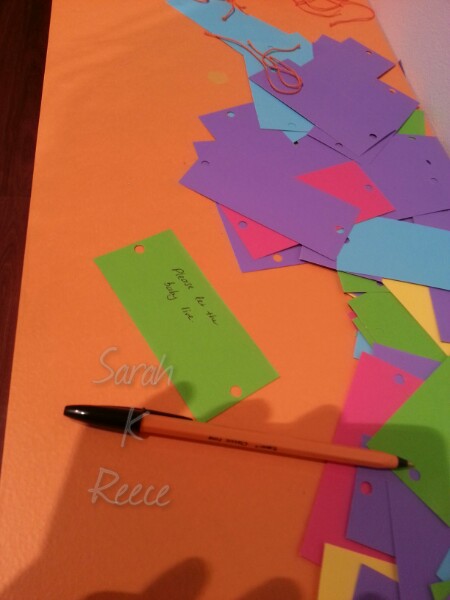
I’m 6 weeks pregnant today, and not feeling right, which is making me anxious. I went to see this exhibition yesterday, part of it was a wishing tree. We were asked to write a wish and tie it to the tree. I’ve written please let the baby live.
Bear with me, all those of you who are still fighting like crazy to have trauma recognised as important, relevant, meaningful to people’s experiences and struggles. I know that for you the idea that trauma can be overstated or misapplied may seem ridiculous because in so many areas it’s still fundamentally so ignored! But the fields are not flat – in some areas trauma is the focus in a huge way, and sometimes this is unbalanced and makes life harder for people.
I was discussing this issue once with a sexual therapist who was being driven to distraction by the assumption that trauma underlies all challenges people have. People were being presumed to have been sexually abused merely on the basis of having some issue they would like to seek support from a professional like her. The gender and sexuality diverse community has laboured under this myth for many years! I still hear from friends that some doctors and psychiatrists believe that being queer in any way is a sign of sexual abuse in childhood, or means they have unresolved issues with a parent. (Who the hell doesn’t have an unresolved issue of some kind with a parent??)
Trauma being a central focus can also cause problems because of people’s natural desire to arrange things in some kind of order. People often create a hierarchy to trauma experiences and feel humiliated and mystified when their trauma history isn’t ‘bad enough’ to justify their current struggles. Context – so dull and yet so key to the story of post trauma stress – is so often forgotten. Friends, connections, and meaning play such a huge role in our response to trauma. It’s not all what happened to you, it’s also how people treated you afterwards. Some of the most undramatic stories in our lives, loneliness and loss, leave the deepest wounds. Resources that focus on trauma either exclude those needing the same support but due to anxiety or other kinds of distress, or they broaden the definition to the point where all people are traumatised and the answer to every question and result of every equation is trauma.
It’s easy to look at a misfit like me and see trauma, and trauma is a big part of my story! But it is not the only part. I was a creative oddball long before school bullies and self harm. Claiming and understanding my trauma history and how it has shaped me has been essential to understanding myself, but I also find that at times I have to reclaim myself from the overwhelming trauma narratives. My life includes these things but does not revolve around them. I am more than what has happened to me. I am more than a sad story of harm or a triumphant story of recovery. I am also a life, a human life, with all the sorrow and pain, and the confusion, and the sublime. My story is not more or less meaningful, my pain not more or less real, my joy nor more or less extraordinary. I am human, and trauma narratives can take that away from me and put me in some other box of people who are different, lesser, or special. I am not other. I am human.
I remember going to Melbourne to see the Tim Burton exhibition and reading about his childhood and early life as an artist, expecting to see a trauma story given his proclivity for the gothic misfit. There wasn’t one. He was a creative oddball who didn’t fit well – his portrayal of the blandness of suburban life are now legendary! (think Edward Scissorhands for example) Trauma is part of the story of many artists lives, but for many it’s not, and we misunderstand something about the nature of creativity and restlessness when we forget this. When we don’t recall that many artists don’t ‘fit’ at first, we turn that ‘not fitting feeling’ into something about trauma. Being an outsider is always a strange, challenging, and blessed experience whether you’re super smart, disabled, or vaguely mad. Trauma may be a result if you’re isolated or bullied, but it’s not always a cause.
I find myself wanting to talk about how harm can happen when all our dominant narratives become about trauma. When friends struggle through extremely poorly delivered child abuse awareness training where they are told definitively that people who are sexually abused as children are damaged for the rest of their lives and never recover normal relationships or sexual intimacy, I’m so angry. And when those friends try to speak up and say – hey, that was me, and yes, it’s the most horrible thing – but don’t write off our lives! We DO have lives! And are instead told their personal experience is clouding their judgement so they are failing to appreciate the catastrophic impact, I think something is wrong.
I’ve read ‘trauma informed care’ documents that make victims of trauma sound like helpless children, or that insist that healing only happens in therapy and close connections to a traumatised person should never be attempted by someone not ‘suitably trained’. You can almost hear the void around the hurting person as everyone steps back and waits for an expert to come along. In other contexts, we call this ‘the bystander effect’. It’s not a good thing. Friendships and relationships have a language of their own that should be respected! Communities have been finding ways through trauma – well and badly, for thousands of years before we invented therapy. Therapy is one of many tools, and it does not ever replace community and a sense of belonging. (many trauma therapists know this, of course!)
I’ve sat in talks about multiplicity that were so concerned to let us know we may be triggered, we were welcome to leave partway, caring staff were on hand if we needed to talk to someone etc etc that I seriously wondered if they’d considered that I manage pap smears, nightmares, losing people I care about to death and suicide – on top of the various traumas in my more distant past. The focus on my vulnerability left me extremely angry and unseen – my strength, my coping, my competency were all invisible in a space that marked me as a trauma survivor and permitted me to leave the room where the important educated people were discussing the difficult topics of the life and recovery of people like me.
There’s a fantastic looking conference happening later this year I would love to attend and speak at. It’s being held by the International Society for the Study of Trauma and Dissociation. Unfortunately it’s happening the month after I’m due to deliver our baby, so I’m not going to put an abstract in. But reading the front page of info really made me want to, because its called Broken Structures, Broken Selves, and describes “The very structures given the responsibility to protect these children, broke down their basic trust in the world, and therefore their very essence – Self – so necessary for their future development.” And I so want to go there and talk about the harm we do when we constantly refer to people as broken! The number of times terms like fractured, broken, fragmented, and developmental failure turn up in books and articles about multiplicity is absurd. People are harmed when we constantly describe them this way! People are harmed when there is no concept of healthy multiplicity, non-trauma-origin multiplicity, or healthy dissociation. I KNOW there is a profound need for awareness and sensitivity to the impact of trauma, to normalise and support people especially when their only other framework is “I’m crazy!” People are harmed by trauma, yes! But when inbuilt defense mechanisms like dissociation act exactly as they are supposed to, I would argue they are a very long way from broken. It is those who harm people who are broken. That is the inhuman behaviour.
I can’t go along this time and say any of that, I’m hoping that someone will anyway, there’s a diverse group of people interested in this field and I don’t but heads with all of them! Some of us have fought so long and hard to have trauma recognised as important, we need to be careful of what happens when it does gain that recognition and becomes the dominant framework. It can be inconceivable that something so fundamentally respectful of people, something so essential and good could be misused or harm people. But such is the risk when any perspective becomes dominant. There’s more to us, to our stories, our lives, and our selves than trauma. Part of what it is to be human is to feel broken, to be aware of our own incapabilities and limits, to mourn what we could be. That story isn’t just about trauma, it doesn’t cut us off from those who lived blessed lives. We don’t have to sit on our side of the fence hating them, watching them live in the sunshine while we drag our mangled hearts through the darkness. There’s pain in all of us, loneliness, brokenness, and hope. This is the human story. It seems so deeply important to me to place trauma in that context, to – if you will – integrate it with our stories of what it is to live and love and be a breathing living collection of fears and dreams all wrapped in skin.

I’ve finished a happy weekend of resting and face painting. Face painting is a funny thing. You can have the best of worst day depending on who you work with. Sometimes you get lucky and the people are amazing, so friendly and welcoming it’s the best job in the world. Sometimes it’s frankly horrible, drunk aggressive guys who try to touch you or parents who hit their stressed out kids in front of you. This weekend was the great kind, and today Rose and I finished a lovely gig by heading home via a little crafty town and buying blackcurrant and lime sorbet and window shopping.
I’m still pregnant, and not particularly feeling it. I am eating lots of smaller meals of veggies and fruit and my tastes have sorted from being keen on sweet to interested in salty flavours, which is pretty weird for me. Nausea isn’t an issue as long as I don’t eat anything too rich or processed. I’m drinking loads of water, sleeping well, and generally feeling all glowy and content with the world.
Except for my breasts, which are larger and extremely sensitive. Trying to sleep on my side feels like I have rock melons taped to my chest. Being bisexual I’m usually a big fan of breasts but at the moment I don’t get why we don’t have just flat chests with milk ducts and nipples. What the hell is with the rest of the breast tissue? Why? Grr. Mine are currently completely off limits to Rose and for the first time in my life it’s less painful to keep the bra on at the end of the long hot day. O.o
Rose and I are connecting with other Mums; baby wearers, queer mum’s, mum’s who have experienced pregnancy loss or still birth. There’s so many people put there going through similar things, in so many different ways we are part of big communities.
We feel blessed and hopeful and afraid in equal measure. Some nights it’s all bliss, others our little room is a a Tardis, expanding to fit all the fear and pain of loss. There’s such an experience of being human, our helplessness and vulnerability, how fragile our hearts are. We hold each other in the night and tears fall like stars. I tell Rose there’s room enough here for her fears, her ghosts too. As she drifts off to sleep she tells me “goodnight my favourite person, goodnight my favourite embryo”.
I received this heartbreaking anonymous comment on a blog post I wrote a while ago called “Caring for someone who’s suicidal”
I cared for someone who was chronically suicidal and failed to protect them adequately. During a very short time of being left alone, while acting like he was feeling well, he did end up hanging himself and died. How do I reconcile my feelings of failing him? How do I ever find peace in his passing when I feel responsible for letting him be alone for any amount of time?
I sat with it for a few days trying to think of what to say. It’s really hard when you don’t know the person or the context, what they’re being told or finding particularly hard or helpful. I came up with this, and thought I would share it here for all the rest of us who are struggling with guilt and loss:
I’m so sorry to hear that. How do we find peace in something so tragic? I don’t know if anyone has told you that sometimes people work hard to protect us from their pain, they hide it and we are deceived. We question everything after they’ve gone, trying to work out if there were warning signs we missed and what we might have done. I don’t know if anyone has told you it’s not your fault, or if you are so sick of hearing that because it doesn’t make you feel any better. How do we live with the guilt and sense of failure of losing someone we loved? Is there any peace to be found?
Sometimes when we feel guilty we don’t even feel like we have the right to grieve. We are numb, or we hate ourselves, or we carry a weight around inside that is nearly impossible to breathe around.
It’s okay to grieve hard. It’s also okay to put them down from time to time, to lay them to rest and give yourself time to breathe and feel and laugh again. It’s okay to sit down with that sense of failure and look it hard in the face, very hard, and accept that this is part of what it is to love people, part of what it is to be human. There’s no peace to be found in this kind of violent loss, and yet there is a kind of peace in coming to terms with that, learning how to hold the pain and the conflict so it doesn’t kill us.
He didn’t die unloved. That’s a precious thing. I wish it was more powerful, so powerful that it saved all of us. But it’s still deeply meaningful. That’s a failure that’s not yours. You did care, and you did protect them, probably many times, through many dark nights. Sometimes we are not powerful enough to make the world be as it should be. To bring justice, truth, hope, light. We are small and mortal and life is large and some of it is brutal. It’s hard to forgive ourselves for not being able to do what our hearts so desire, to heal all the sick children and feed all the hungry people and give hope to those who can’t find their own. We are mortal, human, we face the darkness with love, and sometimes it is not enough.
So what now? You carry a darkness of your own now, a place where hope dims and pain waits like an ocean. You meet it with love and honesty. Reach out to people – some will not be able to talk with you or bear that pain, but some will. They will remind you you are not alone, that many of us have found our limits and grieve what we cannot change. Keep his memory alive but find ways and times to put down the searing pain and weight of his life. You carried him for a time, you will carry his name in your heart forever. But hearts are not made to be graves, there must be joy and new love, there must be spring again after the black winter when you are ready.
Much love xxx
 Sarah K Reece