Rose got us a gift! 🙂 Some of us who are younger like rainbows, one of us used to be called ‘The Rainbow girl’ back when she was young too (she’s grown up now) but we like rainbows still and like the rainbow pony. We have three of them now, two are little toys and this one is big. We have a whole toys and crafts and figurines box at our place by our bed with colouring in books and lego and things like that. It’s so nice!
Author: Sarah K Reece
Body Painting Workshop
Checkout photos and details of a body painting workshop I attended recently… there’s a really gorgeous owl I’m particularly proud of 🙂
I recently participated in a body painting workshop, with the kind assistance of a couple of friends who let me cover them in paint. 🙂 The first half was practicing application with a kabuki brush and blending techniques, so this model wound up looking like she’d been in an explosion in a paint factory, with the addition of a gorgeous foam latex starfish. Foam latex add ons are really lovely!
Please be aware these photos depict body paint on partially nude models, paint is applied over underpants.

View original post 196 more words
Good food and discussions about the future
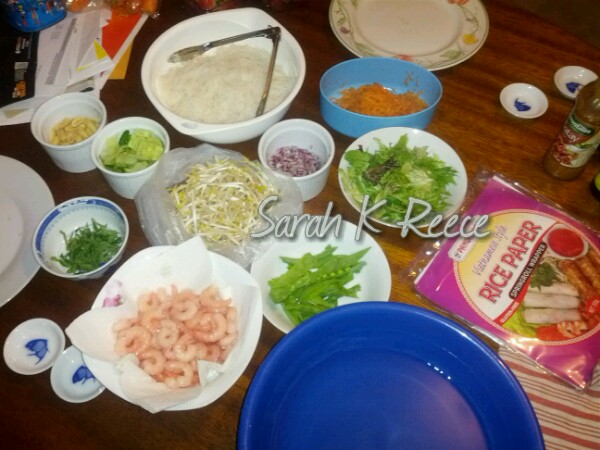
Today I slept, panicked, worked on finishing all the preparation I need to have done to offer henna art at a gig for the first time on Friday, panicked some more, and had Rose and my sister over for dinner. I’m now back to panicking and henna prep again. It’s been a long day. Dinner was lovely. We made prawn rolls.

Yum! Rose and I are still eating lots of salads and I’m loving that. Some days lately when my anxiety is so high it’s the only meal I have. It was so nice to sit at the table and share and talk about the future. The three of us are making exciting plans for next year together with housing and plans for babies. I’m so thrilled and so anxious too, there’s a raw feeling when I talk about dreams and ideas about family and community and the future. I dropped my sister home and on the drive back, alone in the night, found myself shaking and weeping. I don’t want to be homeless again. I don’t ever want to be on the run from a violent relationship again. I don’t want to feel trapped again, to be sharing a bed with someone who frightens me or makes me feel deeply alone. I’m pro equal marriage rights but terrified of the prospect of being a wife again. Reading Centrelink documents that explained that if Rose and I share a place – even as flatmates with separate bedrooms, we will be considered by the government to be in a ‘marriage like relationship’ made me break down in uncontrollable sobbing.
I’m also in love, with a beautiful, devoted, loving woman who I hate being apart from so often, hate having to drive back to my own unit at the end of the night, want to be able to support when she’s ill, help cook for, share what I have with. I hate that the government will not allow us to live together but maintain separate finances. It feels deeply creepy to me, state-sponsored prostitution, that I can live with anyone as long as I don’t sleep with them, and sleep with anyone as long I don’t live with them. Weirdly the financial penalties are reversed when children are in the picture, as single parents are penalised where partnered parents are not. I don’t like the enforced dependence, the forcing of what we have into something it is not, into ‘marriage like’ when what we have is built on friendship, is platonic and romantic, is built on freedom and a deep care for our mutual vulnerability and limits.
Hope and fear, dreams, desires, longing and loss. Good food with people I love. Another shoe eaten by the dog, another day at work that leaves me frozen with anxiety. Life is challenging.
Critters
I haven’t written in ages, I’m so busy at work at the moment. Today is my weekend, my mid week off day that will still have errands and housework stuffed into it. But, that starts with delicious sleep, in a tangle of blankets and cats. Sarsaparilla went missing for over a week, after a big storm and I become very teary and convinced he must have died. Last night he turned back up home, crying at the door with his little scratchy mew, a bit thin but otherwise fine. He’s sleeping on my knee. Tonks is thrilled he’s back and shadows him everywhere. Rose stayed over last night and slipped out this morning to go and do housework at her place. I’m going to sleep until my doctors appointment this afternoon.
Zoe has taken to her new dog crate like a duck to water and sleeps happily in it every night and during dinner. Tonks is almost due to be desexed. Zoe has only eaten one shoe lately. My little family is going well. I’m enjoying living in my home a whole lot more since I came to the realisation that it wasn’t going to be permanent. I’m determined to enjoy the time I have here as much as I can before moves and life changes so me along somewhere else. It’s a beautiful place. I’m busy with face painting and workshops and trying to make sure I’m still getting enough sleep, some decent food and exercise (Rose and I are on a health kick at the memento and eating a whole lot of salads which I’m loving), and time to catch up with friends.
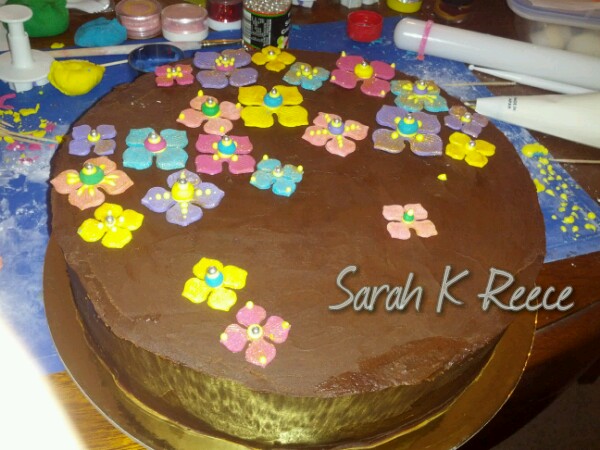
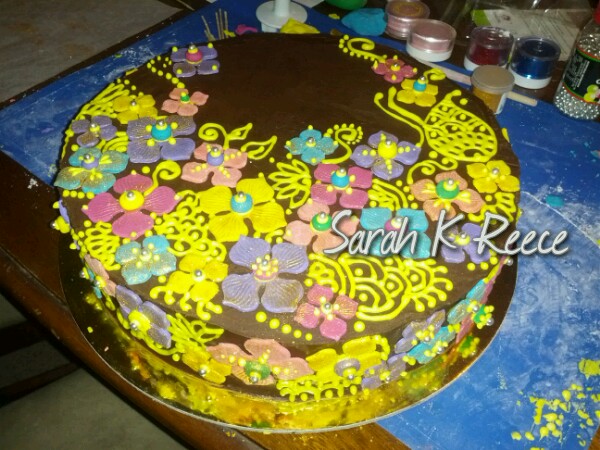
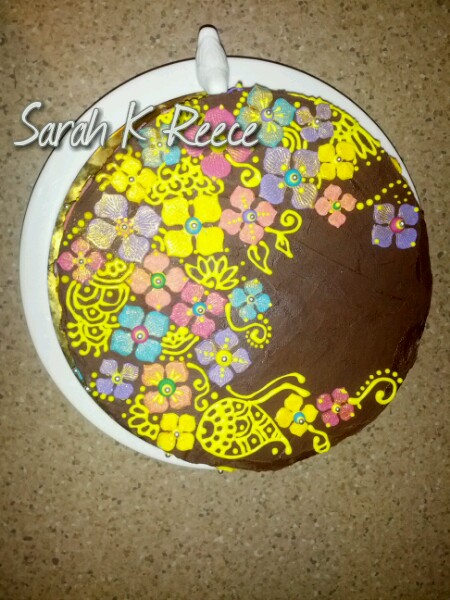
First birthday cake, inspired by henna and bollywood
My gorgeous goddaughter Sophie turned one, and her birthday party is tomorrow! I’m providing the cake. Because she is half Indian, I love to draw on that colourful heritage when I’m making her cakes. I saw some beautiful cakes recently that used henna designs and I thought that would be perfect, if I added some colourful flowers.
This might be a first birthday party, but almost all the guests will be adults, and as I learned with Sophie’s Christening cake, most adults don’t much like fondant. So for this cake, only the flowers are fondant, and they are thin and easy to pick off. The cake itself is a dense moist chocolate mudcake, iced with a dark chocolate ganache.
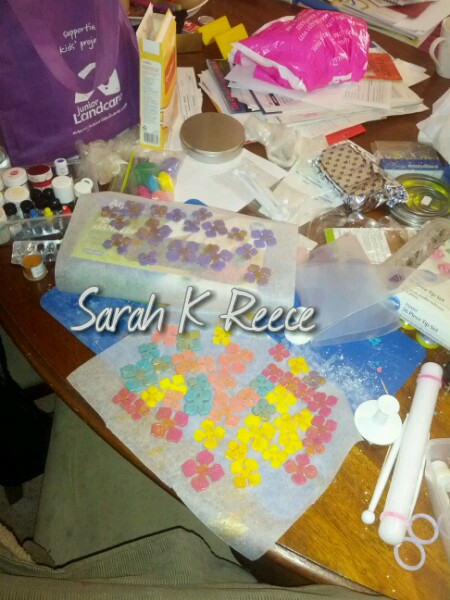
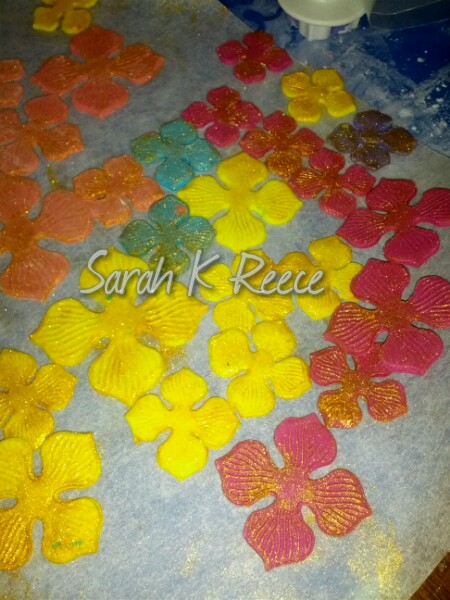
I started the process yesterday, colouring and rolling out small portions of fondant, then cutting and stamping the flowers. I dusted all the flowers with an antique gold edible luster to add some richness. 🙂 I love edible lusters and glitters. 🙂
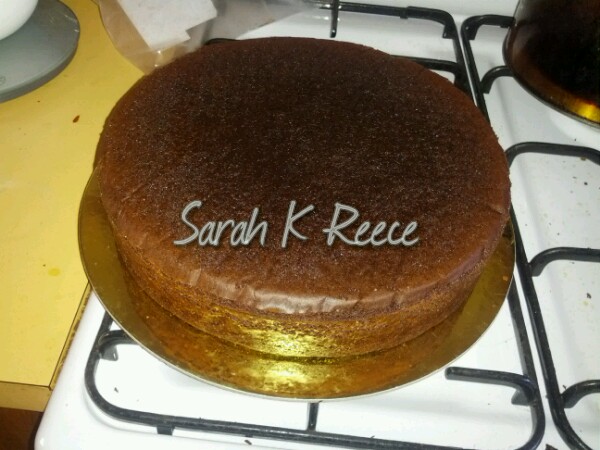
Next, I baked the cake. I used a large spring form tin, it took about 1 3/4hrs in total to bake. I was a bit desperate for it to be ready so I could go to bed. Once cool, I levelled it and placed it on a gold cake board.
The flowers were dry and set now, so I added some more bling. Small balls of coloured fondant and silver cachous were added with bright yellow royal icing.
Make the ganache, allow to cool until thick but still flexible (about the consistency of peanut butter) then ice the cake. Place the flowers on the cake and arrange.
Stick down with royal icing and fill in the gaps with henna designs. Continue around the edges of the cake 🙂
I’m very proud of it! Every bit I’ve taste tested has been amazing. It’s very adult and decadent in flavour, but very colourful and young in appearance. Job well done. 🙂
See more like this:
Imperfect bodies
It’s been a wobbly week, health limping along on training wheels. Yesterday was great, today is awful. I have endometriosis, which for me means very painful and heavy periods. Endometriosis is a condition where the tissue that lines the womb (the stuff that pumps up, ready to support a foetus if you get pregnant, and then every months sheds as a period)Â grows elsewhere in the body, often through the digestive system, latching onto organs and tendons like weeds growing where they shouldn’t. This ‘weed’ reacts to normal monthly cycles the same, shedding and bleeding into the pelvic cavity where it can’t escape. This can make a mess of scar tissue and adhesions, and can cause awful pain if there’s nerves around those areas. Not everyone gets pain, it depends on where it happens. It can also destroy fertility.
I’ve managed for the last 10 years by taking a medium dose of the oc pill, on a continuous basis, that is, not taking the sugar pills except for three short breaks a year. That means only three periods a year, only a week long, and not severe pain. Before I was diagnosed and started treatment, my usual period lasted about 14 days a month, involved extremely heavy bleeding, and severe pain with at least three days in bed. I have vivid memories of trying to work at childcare and manage my periods, weeping with pain in the bathroom. I wasn’t diagnosed until I was almost 20, thanks to a male family doctor, an uptight religious community that treated normal functions as secret and shameful, and myths about what was normal. I’m angry as all hell about this, I suffered a lot as a teenager and was mostly treated as weak and lazy by people who didn’t know better.
Rose and I are now in pre conception care, gearing up towards pregnancy possibly next year. This January I stopped taking the pill so my normal cycle is back. The great news is that all the signs are good that the endometriosis has been contained and even reduced over the years, so my fertility should be intact. The difficulty for me is that I can no longer schedule my cycle around work and other commitments. It’s also frustrating because our cultural taboos against talking about this stuff mean that whenever I’m ‘just sick’ again I tend to come in for a lot of advice about not over doing it and tut tutting about needing to manage my health better. The truth is that none of that would help. What does help (me) is sleep, forms of pain relief that reduce muscle spasms, such as Naproxen Sodium, or orgasms, heat in the form of hot showers, baths, or wheat packs, and avoiding cold foods such as ice cream. My mood is usually very low and I find that I’m often teary and depressed. One or two days stuck at home very quickly leave me feeling lonely and miserable. When I’ve been under a lot of intense stress as a young person, I’ve had an almost psychotic response to the loneliness, secrecy, and pain of these experiences, such as nightmares that the pain was a demon clawing me apart from inside.
It shouldn’t be a big deal to talk about it. Many people have difficulties around menstruation, fertility, sex, digestion, and all the areas of health that we don’t talk about. It’s harder to get funding for cancer research for less sexy cancers. It’s harder to explain health problems like these to friends and employers. There’s a kind of bemused and patronising tone taken to people who ‘fail’ to live up to our expectations that adults can manage digestion, menstruation, and sexual health without anyone else ever knowing about it. Many of us are struggling with issues like these! I’ve seen women in such intense pain with endometriosis, they wind up begging for morphine in emergency rooms, and have to carry a letter certifying their condition so they are not mistaken for drug addicts. I can tell you these women are not just lazy or making a big deal about something everyone has to deal with! I’ve talked with women who have suffered through a long, painful struggle to get pregnant, too sick to work, and too embarrassed that something as ‘minor’ as menstruation causes them such distress to tell anyone but their closest friends about what’s going on.
These things are not that unusual. Embarrassment about them helps noone, especially not young people who are so particularly sensitive to shame and isolation. Every day, people are managing infertility, chronic digestive problems, recurring thrush, uti’s, and other infections, immune issues, and allergies to toilet paper, latex, lube, sanitary items, and their own skin and secretions. All of us are trying to find ways to manage with some sense of dignity, to still feel attractive when we dress up for a date, even if that means making 15 minute stops to pee, finding an outfit that conceals a colonoscopy bag, or trying to discretely manage menstruation while using the men’s bathroom as a f2m transperson.
Human bodies can be fragile, and leave us very vulnerable to shame. I generally don’t talk about my physical health challenges, mostly because I don’t want to make other people uncomfortable. I’m an activist when it comes to mental health but still very influenced by ideas that I shouldn’t embarrass anyone else, and shouldn’t complain about physical health problems. I’m feeling a bit fed up about those ideas. Shame is for people who have done something to feel bad about. I just happen to inhabit a body that is lovely and fragile, and that has issues in some areas like menstruation that we don’t, as a culture, like to acknowledge. I know I’m not alone and I’m tired of feeling alone. I’m not any less of a person, I have nothing to feel ashamed about. Being sexy and adult isn’t, in my opinion, about being able to maintain mystery about our bodies. There’s a humility about inhabiting a body that doesn’t work perfectly, intimacy about being forced to acknowledge our shared vulnerability as people, at having our lovers or house mates understand these needs and at times care for us. No one is healthy all the time. As much as people might like to pretend otherwise, whether as children, in our age, or due to sickness or disability, we all at times will need help and support with intimate functions and for issues we find confronting and embarrassing. All of us will love people who have these experiences and struggle with feelings of shame, ugliness, and degradation. We can let this isolate us, or we can rise above it and embrace the tenderness and humour of having imperfect bodies.
See more like this:
Remembrance Day
Today is a sad and special day; Pregnancy and Infant Loss Remembrance Day. This affects so many people and yet is so often a solitary, unrecognised loss. These are the people who are often invisible and in pain during celebrations such as Mother’s and Father’s day. Rose has experienced this loss, so it’s something very meaningful to us as a couple. Little rituals like this can bring a most private pain out of silence and into public awareness, can give an opportunity for people who often have no graves to visit, no family awareness of their sorrow, sometimes not even names for souls they have deeply loved. Tonight we light a candle in remembrance of the ones we lose, and with compassion for those who grieve.
Thinking of a future with a disability
Today, I stayed in bed from midnight until 4pm, resting, sleeping, and reading. Rose came home to me after her night shift and it was lovely to have her company, sleeping beside me. She turned up with a bag of groceries and chocolate milk, and hugs for her very tired and overwrought girlfriend. Then friends came round for dinner and brought a big bowl of home made pasta with them. Rose made a salad, and I washed all the dishes from the week and made homemade soft serve icecream. We played cards. By the end of the evening, I felt almost human. It’s so regenerating to be the recipient of such kindness. Another friend gave me a massage earlier in the week, and I was fortunate enough to be given a bunch of free tickets to go and see Cavalia, an amazing acrobatic show with horses, so I went with a bunch of friends and family. It’s delightful to be able to be generous with good fortune, and to have such caring friends who are likewise generous with their time and love.
I’m also reminded that pain management needs to be more of a priority for me with me work. The extra work I’ve taken on lately has been wonderful, but I’m not coping well with the pain it creates. High levels of constant pain wear me down emotionally, I become easily distressed, teary, anxious, and depressed. I need to be more assertive about predicting it and doing things to manage it.
I’ve been thinking a lot lately about having fibromyalgia and how it impacts my life. Weeks like this one, I realise that I am not like other face painters or small business people. I have to close bookings when I’ve reached a certain number of bookings in a week, not because I’ve run out of time, but because I’ve reached my limit of how many hours I can paint and still manage my pain and energy levels. This is hard to face. I’m a small business owner and artist – with a disability. I need to remember this and work around it, not throw myself against the glass wall of my own limitations and leave myself so ruined, and so vulnerable to other people’s misperceptions.
Likewise, I’ve been giving a lot of thought to what kind of mother I would be. There’s many things from my childhood I don’t want to replicate for my kinds – chronic loneliness and alienation, unaddressed trauma, shame… but there are many things I loved and do want to bring to life for my kids. Amazing birthday parties, brilliant creative play, superb organisation skills, learning to care for our home and belongings so we didn’t live in the kind of broken down home that so many other low income children do… there’s a wonderful legacy of fairness and play and adventure I want my kids to experience.
And I have fibro. I can’t live up to it. I can’t be the kind of mum I want to be, put in those hours, with that dedication and passion and effort. I’m grieving this. I have to find a new idea of success, new dreams about what being a great mum might look like for me. I need to reach out to other members of the disability community who are parents and find a path I can be excited about. I need to write an exciting and hopeful future around my limitations.
This is a big shift from my previous ideas that I would keep looking after my health until it was better, get full time work, build some strong financial foundations, and then have kids. I might not ever be able to work full time. I need to work out what being a mum would look like when I’m living in public housing, on welfare, with chronic illnesses, and how to engage that dream in a way that makes the most of what I do have, of my skills and passions and wonderful friends, and limits the bite of poverty, sickness, homophobia, and all the other risk factors I can’t change.
So, tonight, I’ve been thoroughly loved up by some of my very important people. My body is still tired and sore, but my head is clear, so I’ve used the time this evening to tackle another box of paperwork:

I’ve recycled an entire box of stuff I don’t need anymore;

packed another box with things that just need to be filed, and created a small stash of things that need urgent attention. I’m very proud of myself. And now, for bed, to sleep, perchance to dream.
See more like this:
I need a drink
Today was hard. I want to use a lot of swear words but I’m being censored internally. Working a lot lately, trying to keep up with some big new work opportunities, that generate a hell of a lot of admin for us. So my life is currently gigs and admin with the occasional housework and sleep. Nowhere near enough sleep.
If we have the excitable ones out it works okay, they thrive under pressure and work like dogs. Today sucked however, it was freezing cold and wet. It was supposed to get warm and sunny but didn’t. We left our jumper home, so slowly chilled through the day. This is not at all good for pain levels with the fibromyalgia. Due to the weather there was hardly any work, which is emotionally exhausting. You’re on display the whole time and have to stay cheerful and friendly, even if the occasional nutty person treats you like scum (why is it some people think face paint should always be free?). There’s always some wonderful people which is usually enough to make the day worthwhile. But a 5 hour shift, very cold, in a lot of pain, for very little pay, and an hour and a half driving either side of it after a previous two days of work, pain, and sleep deprivation was too much today.
I also got into a conversation with someone who thinks face painting is easy money, and someone else was clearly a bit confused that I find the drive home really hard. It is so depressing some days to deal with the chronic pain and invisible disability, to be held to standards I can’t meet. More than depressing sometimes, triggering. We were rocking quietly the whole afternoon, a major warning sign, we’ve learned the hard way.
Between lots of coffee and more food than I wanted to eat I was able to get back down the freeway without having to slap myself on the face to stay awake like I had to the previous week. I got to Rose’s place where she was just waking up after her night shift to put on some dinner. We crashed into a shaking, weeping, exhausted, nauseated mess. It isn’t helping that Rose and I are both working hard and at different hours so most of the time we spend together one or both of us are trashed and sleeping on a couch. Dinner was beautiful, I’m so lucky to have a girlfriend who’s an amazing cook. Rose napped and I watched the box feeling like I had a javelin in my back. Crashed into a weepy conversation which was badly timed and going nowhere good, switched, played around a bit before Rose went off to work, then went hunting an open bottle shop because sometimes too much sobriety is bad for your health.
Adelaide is lousy for that, at only 10pm nothing was open except for a bottle shop in North Adelaide, which turned out to also be shut but hadn’t bothered to update it’s hours online. So, I came home with 4 litres of milk and a bag of salt and vinegar chips, which wasn’t what I had in mind. At home I raided my liquor supply, which considering my hopeless liver severely restricts my drink intake, is in pretty good shape, and decided the evening would look better through the bottom of a large glass of black sambuca and ice.
I was right. I’m now in bed, wearing an old jumper of Rose’s, with a kitten, watching Dirty Harry. I feel pissed off and sore, but a hell of a lot more stable. Nobody will be cutting tonight. Boots firmly on the ground.
Climbing many mountains
It’s been a roller coaster few days here, seriously! I’m in a really weird place at the moment where some of my friends are going through hell while others are feeling like life is going their way. I’m mostly doing really well, which creates an odd kind of survivors guilt at times. Changes are afoot in all directions… I’ve been fortunate enough to secure a couple of big contracts for my business, which is extremely exciting. A lot of hard work is starting to pay off and I finally have money to do things like pay for an accountant! I’m working hard at the massive amount of admin this generates, and if you don’t look at the state of my house, not falling behind too badly.
My beloved dissociation support group Bridges is currently taking its first holiday in two years, which is very sad on one level but rather exciting on another… Those of us who have put so many hours into running it are all feeling stretched lately, it’s very tough work being a volunteer peer worker when you have so many other things going on in your life, great things like work, or awful things like sickness and system stress. My goal at the moment is to ease the transition as gently and respectfully as possible for everyone involved, then get back together as people are ready and talk about what next. I’ve set aside a reduced number of volunteer hours a week for myself this year, only ten, and I’m a bit excited about what we can do with that… The format of the whole DI Inc may change too… Everyone involved is deeply passionate and believes that we need an organisation to educate and speak on our behalf, but the truth of the matter is that no one actually wants to run one… We all have other passions, like giving presentations, or education, or creative projects. We’ve only found ourselves in an organisation because that’s the format we were provided with. But it’s hard work, and everyone, me included, has other stuff going on. So, change is happening, which is hard, but also feels good to me, flexible, adaptive, responsive, not locking people into to approaches that aren’t working but looking for new ways to harness that passion without exhausting and depleting the amazing people behind it.
I’m having trouble keeping up with my work at the moment and not getting much time off, but the night before last I invited some friends over to Rose’s place for a games night, and we had a great time. I love games nights, they’re fun, inexpensive, and just about guarantee a good laugh. 🙂

We made toasties for dinner and some people ordered pizza. I really enjoyed myself.
I’m glad I did because Rose had a rough evening with some trauma stuff and I did my best to be supportive. I drove home at midnight and started cleaning my kitchen up, only to discover that my manhole cover in my ceiling had been opened up! No one knows who did it, which is very creepy. So Rose calmed me down over the phone, and Zoe was worth her weight in gold. She may be a total nuisance at times, but nights like that she makes up for it in spades. There’s no other way I could have slept in my own home that night. Tonks did his bit by cuddling up to me. I didn’t get to sleep until around 5am, and then had a horrific series of nightmares, waking regularly, before giving up around 1pm and getting up. I sat out in my garden with some breakfast to clear my head and that worked wonders.
So here are some of the heroes of the night, looking suave:

When I started to hallucinate a few songs, Rose reminded me that Zoe would react if they were real. That was very helpful to remember. A friend of mine who struggles with psychosis used to call her dog her Multidimensional Seeing Eye Dog because of this truly wonderful reality testing quality. I’ve always loved the phrase, there’s truth and a wry humour to it. Pets are amazing.
Many wonderful developments
It’s been a brilliant day here! I provided body art for a mental health stigma reduction event this morning, secured a whole bunch more gigs this afternoon (I am busy! I am basically booked out for all of October!), then collected the mail which included my new exciting dog crate which will make it possible, I hope, to sleep over other places including camping with Zoe!! I also got my new henna aftercare cards, my new updated post cards, and my new cheapie fountain pen to replace my lovely lost one. I feel like a poet again! One cannot be a poet without a fountain pen. Well… it’s better to have one anyway.
Then I did a whole lot more business admin (Sarsaparilla helped)

And read a bit more about anarcho-syndicalism to see how it might be relevant for creating powerful groups in mental health, more indepth info here. Tonight I’m going to hang out with friends and have pizza. Tomorrow I’m going to sleep. It’s been good day. 🙂
Where does my psychosis come from?
7 weeks ago I had my first adult experience of psychosis. I was extremely fortunate in that I knew what was going on, and was able to find enough strategies to manage it that it passed comparatively quickly. For the next several weeks I felt very vulnerable, on the edge of that place. I felt dissociated, and mildly paranoid. I had a strong feeling of being watched at all times, or of having someone behind me. At times it was stronger than that, the sense that I was standing on the lip of a hole in the fabric of the world. I was looking at reality, but just behind me was a tear into the void, dark and cold and terrifyingly inhabited. I could feel a cold wind on my shoulders.
I was still in a highly sensitive place, where certain things would speak to me in a way I wouldn’t usually experience. At a party a few nights later, a song comes on that has a guttural male voice singing and it’s like that moment in films where the background suddenly seems to zoom into the foreground without displacing it. The sound of the deep voice is reverberating in my body and making my hair stand on end. I go outside where I can’t hear it well. My hair settles back against my skin.
For the first few days I stay in the light, keep all the houselights on all day and night, and do not leave the house after dark. I do not drive, I do not work, I’m just patient. I test how things are developing gently, try turning out a light and wait to see if the hallucinations return. I find that I exist in a twilight state for a few weeks were the dark is mostly empty, but sometimes starting to fill with hallucinations. Being driven home by Rose, I’m watching the sky curiously as night falls, relieved when it’s empty, cautious when things move within it.
A few nights after the episode I’m lying in bed, talking on the phone, and the conversation is becoming increasingly stressful as Rose and I don’t see eye to eye or understand each other. I feel a sense of a charge rising in my body. It reaches mass and my sense of self suddenly dissolves, like a drop of oil onto a vast surface of water. I have no sense of my body, of gravity, of weight. I have no sense of being the right way up or even what way that is. I feel vastly infinite and utterly tiny at the same time. There is a consciousness at the center of a galaxy of stars like dust. I am falling in every direction at the same time. I close my eyes, knowing that I am still only a woman, still lying in bed, speaking on the phone, having an argument with my love. We keep talking. We find a place of connection and common ground. I feel myself come back together, like big bang in reverse, silent and without violence, all the stars gather back into my skin.
Gradually it eases, this sense of being suddenly skinless, on the edge of this world and another one. I’m so fortunate. How many people even know what psychosis is when they have their first experience of it? More than that – know what might help, know that it’s temporary, know that I can survive it? I re read a book I own called Unshrinking Psychosis by John Watkins. I recommend it for anyone seeking to better understand psychosis. Two ideas stand out to me – that there is method and meaning even in madness, and that not all psychosis is a breakdown. Some is a messy restructuring of the mind, a transformative process. Not breakdown but breakthrough. Not indicative of problems or stress or failure, but of growth, process, recovery. This resonates with me.
I also reached out to a mentor who has also experienced psychosis and we went out for coffee. The chance to talk with someone else who has been there – and come through it, sans lifelong complications, diagnosis, medications, and stigma, is such a relief. I ask one question in particular – “I felt so lonely in that experience, was it like that for you?” They tell me – “Lonely is not a strong enough word for the feeling of profound aloneness and alienation.” Yes. That’s how it was for me. They remind me – crisis is nothing more than the interruption of a pattern. For good or for bad.
There are things I understand better now. I understand the tremendous distress of people who’s sense of reality has collapsed when we try to tell them the things they perceive are not real in an attempt to comfort them. This is not reassuring. We are trapped between our psychotic perceptions (which may be terrifying, or not) and an awareness that we are going mad, which is absolutely terrifying. Knowing that the experiences are not real does not stop them happening to us. It’s like being trapped in a nightmare from which you cannot wake. Knowing it is not real does not stop the fear or the horror, in fact the sense of disconnection from everyone else, from the ‘waking world’, to push the metaphor, is terrifying. And we don’t know if we will wake up. So we cannot come to harm physically unless we act upon the psychosis – when the terror was so intense that my skin was literally rippling across my body, the effort it took to stay still and not run – blind with terror, through any obstacle and into any terrain, took everything I had. Even if ‘it’s not real’ means I can’t come to direct physical harm, I can certainly suffer psychological trauma. ‘It’s not real’ reminds me of the dissociative process of a child being sexually abused – not physically harmed, but violated and traumatised, who thinks to themselves ‘If I pretend this isn’t happening it cannot hurt me’. We know that’s not the case, that these experiences impact and change us even if we deny them. The experience of psychosis impacts, changes, and even traumatises us, even if ‘it’s not real’, because experiences that invoke terror, horror, helplessness, and isolation always have the potential to be deeply traumatising. The emphasis on it’s not real, don’t acknowledge it, the focus on getting over it and back to life, sealing off the experience as quickly and completely as possible seems like a highly dissociative process to me.
And there lies a dichotomy in my experience. It was not real, and yet it was real to me. More than that, it had a sense of profound significance and meaning that I am still gently examining. There was a sense for me of the indelibly familiar about an experience that was at the same time, utterly alien and new. Talking with my support people I drew upon many seemingly disconnected threads of my life that all had some link to this experience. I remembered my vivid imagination as a child where I could perceive things that other people did not – particularly at night. Foxes that ran up and down our hallway, soft footfalls on carpet and the brush of coarse fur against my legs, but not the musk of the real animal. The shadows that congregated in our lounge room every night, tall as adults, having meetings, talking among themselves in a murmur of voices that was the soundtrack to all my childhood nights. If disturbed, they would rush as one furious mass to wreak some unnamed horrifying punishment on any child out of bed. Some nights having crept out for a drink of milk I would be trapped in the triangle of light that spilled from the open fridge, waiting for dawn to come so the shadows (which could not move into the light) would go dormant. (waiting for the dawn to come – so many sleepless nights where only dawn soothes me to rest even now) My wild imagination made me stand out as a child, but not so much that I would have received any kind of psychotic diagnosis. I was different but not that different. I wonder sometimes if all children are naturally psychotic – and yet aware of the divide between the real and ‘not real’ that they perceive: imaginary friends, ‘pet tigers’, games. Somehow we lose this with age.
Another link; making connections with younger parts in my system (I have DID) has been a frightening and fascinating process. It has been hard for those of us who are older to permit our inner kids to have time out in our body. For some of us, it’s painful to be misunderstood as being childish. For others, it’s frightening how vulnerable inner children can be, and how lonely it can be to be a child in an adult body. A few months ago a very young part came out to play with a my little pony toy. They ‘flew’ the toy around the room. We were co-conscious for the play. What was absolutely startling was the physical response in our body. It reacted as if we were flying. Muscles tensed and relaxed, electric sensations feathered across skin, with the highs and lows of the flight the stomach flipped like we were in a car going fast into dips and rises on a road. When the adults switched back out, they were blown away to have this glimpse of a child’s world again. Children, or least, my inner children, have an intense empathic bond with toys that allows them to experience what the toy does. It’s outside of anything I have felt as an adult. No wonder children can play for so many hours. No wonder I struggled to not lose this ability myself as a child, playing games with younger and younger children as my peers lost interest in imaginative play.
A few months ago I was playing a game with friends that relies on imagination. Called Beyond Balderdash, you have to quickly invent plausible definitions of words and other cues. I find these quite challenging, not least because being a creative person, I’m expected to be very good at games like this and the pressure interferes with my thinking. For the first couple of questions I wrestled with my brain, trying to come up with original ideas and mostly drawing a blank. The struggle was fruitless, like trying to use a hammer to thread a needle. Then I felt a shift inside me, something wrestling with me and wanting me to get out of the way. I relaxed and let the process unfold. I stopped shaking my brain in frustration, trying to squeeze a creative answer out of it. Suddenly ideas came out of nowhere, easy as reading off notes someone else was handing to me. There was no struggle. My imagination just spoke. I thrashed everyone else at the game, and went to bed that night feeling thoughtful and a bit confused. It almost felt like cheating, the way Eleanor Longden describes her voices giving her the answers to an exam and wondering if that was cheating.
In my arts practice I’ve also been experimenting with something curious. When I’m doing something like painting, for me it’s a very intellectual process of calling to mind the shapes and colours I want to create and then doing my best to get my hand to make them. I’ve noticed at times that while doing this, I can ‘see’ an image on the canvas (or paper, or skin) that I’m painting on. It’s not really there and I know that, but I can still see a faint ghost image of what I’m trying to create. And it’s often different from what was in my head – maybe only in a small way, such as the placement of an eye, but it is different. So sometimes I ignore what I was trying to paint and I paint the image I see instead. Again, it feels oddly like cheating. The strange thing is, it’s surprisingly effortless, and it almost always looks better than what I had been going to do.
I think about sculpturers describing their process as being seeing what is in the stone and setting it free, rather than turning the stone into something. Rather than a quaint turn of phrase, this concept now startles me.
Nightmares that have been so deep, involving, and horrifying that my sleep became a place where I was helpless and tortured. And yet, a sense that in them in something powerful and important that I would be at great loss without. Memories of being so afraid of the dark as a child and young person that there was a sense of being on the edge of running, and that if I ever allowed fear to overwhelm me and started to run there would be no stopping and no safety ever again. An incident as a young person where I briefly hallucinated a nightmare figure when trying to confront my fear of the dark and had a panic attack. The experience of sensory dissociation and trauma so profound that I craved touch to ground me back into my body and sense of self. My desperation to experience psychosis as a highly traumatised young person who could not escape the daily pain of things like chronic bullying and alienation at school. And yet, curiously, I failed, and at the time, reality remained immutable.
Separate and yet connected experiences. Many of them, like threads all leading to a complex tapestry I now seek to understand.
I understand now the rage I felt in some people at the last Hearing Voices conference I attended. At the time I recoiled from it, wanting to walk a gentler path of diplomacy and peacemaking. But, sitting in my bedroom wracked with terror, on the edge of needing crisis support and knowing how profoundly traumatic that ‘support’ would likely be, I felt the terror and fury of someone marked for abuse and helpless to prevent it. The sense of safety of being at the edge of conversations about appropriate supports and responses to psychosis was stripped away. I was no longer a ‘voice of reason’ on the sidelines. I was now naked and vulnerable and under the microscope. The knowledge that simply being honest about my experiences could see my most basic rights taken away from me in the name of protecting me, could see me drugged and locked away, trapped and confined, subjected to solitary confinement, forced into therapy with people who use entirely different frameworks from me, horrified me. The instinct for self preservation said – silence. Secrecy. Be small, quiet, hidden, and run a long way away from the places where people like you are kept under guard, sedated, tied to the bed, given intense directives and advice by every nurse, doctor, and shrink, most of which is contradictory. So instead, I blogged.
I should be able to call a place like ACIS and tell them about my drug allergies and DID and trauma history and explain that I need a quiet place to rest for a few days and just enough sedatives to help me sleep without sending me into liver failure. The liklihood is that I would be abused and ignored as a faker, or committed, dosed on meds I cannot tolerate, and then find myself trapped in hospital in a spiral of drug induced psychosis and forced ‘treatment’. A system that is both over and under responsive to crisis, that has ‘entry and exit’ problems – it’s hard to get into the system and get help, and also hard to get out again. There’s rage in me that this is the ‘help’ available to me – high risk, and likely as traumatic as it is helpful. What I need is Soteria, a place of safety and respect, where people who are neither afraid of me or my experiences hold my hand while I rest, find my feet again, make sense of things, return to my life.
There’s not just chaos and loss here. Psychosis has been like being tipped up into my own subconscious, filled with wonder and stuffed with nightmares that breed in the dark. I refuse to live in fear of my own mind. There’s powerful things here, about life and love and art. If the alternative is the loss of those things, is the ‘flatland’ of a life that does not move me, of art that is forever the imposition of my will upon things around me, instead of a conversation with my own shadow, then I’ll risk a little madness.
When I was a child, my Mother believed fantasy and imagination were powerful and important. Creativity is essential to life. One of her friends believed they were dangerous. Her children were not permitted to watch the films we watched, or to read the books we read. Their play was shaped in ways mine was not. I wondered, after this experience, if they were right. Has being exposed to fantasy made me more vulnerable to losing my grasp on reality? Or has it left me better equipped to navigate my own inner world?
In the hearing voices group I’m involved in here in SA we often talk about our inner reality. Instead of conversations about reality and delusions, we talk about the shared reality and the inner reality. What I experience in psychosis isn’t real. But it is real. It is my reality, drawn from my mind and my life. Full of the promise of connection and art and a deeply felt life, as well as nightmares and terror. Of embracing child parts and making sense of trauma and facing my demons.
I’m back on my feet at the moment. The dark is empty, I can walk through life without music or images speaking into my heart and calling up a flood. I’m scared, and angry, and aware of a new gap between me and people who don’t experience this, and another reason I am vulnerable to stigma and ignorance. I’m also thankful, thoughtful, listening to the world with one ear cocked towards that void. I will go where my heart wills and seek the deep truths of the soul. Fray into stars and become a person again.
Overdosing on cute photos
Today I helped a friend paint walls, and then did grocery shopping and a lot of admin. Because I like you, I’m not going up talk about it. Instead, you’re getting photos of babies and kittens. You are lucky!
My gorgeous god daughter Sophie is nearly one now and had figured out how to crawl. Every week when I visit I feel closer to her. I love holding her and playing with her. I was a little worried at first that maybe is only bond to her as a tiny baby and detach as she grew older, but the reserve seems to be happening, I’m more comfortable and confident and in love each time I see her.
Given my own baby plans in blessed to be inheriting get outgrown clothes and belongings. This week I was given her delightful pea green carrier! I adore this. The rest of our baby stash is living in Rose’s shed, but the carrier came home to my place where I can admire it. Tonks decided to try it out for size. Provided no babies are allergic to cats I think we’re going to be okay 🙂 What we do about bouffy Zoe I really don’t know.
So there, don’t ever say I’m not good to you. 🙂
Letting it go
I’m sad tonight. There’s been pain in some of my friendships lately. Relationships with other people who’ve come through trauma, or other multiples, can be deeply rewarding, but they can also be more troubled and under greater strain. Sometimes the risks I take don’t work out the way I’d hoped. The last two friends I grew close enough to to tell them I loved them are no longer speaking to me. My heart mourns. So many hopes about the future come tumbling down, the sadness is unbearable at times, and the gnawing fear. It’s hard to make sense of. Life suddenly takes a different path. Parts of me are distraught, other parts have more perspective. Tonight, it’s lonely in my unit. I can feel dreams flying away from me, like balloons with cut strings. It hurts and I let it hurt.
In the sadness I find two things; that all things change. That nothing at all takes away from the good memories, from the hope and care and growth and fun we had, the safe spaces we made for each other. I find it strange that our culture only deems those relationships that last until death parts them to be significant. What we had counted, and what we did mattered, maybe not to anyone else in the world, but for each other, it mattered. We will never be as if we had not met. We take it all with us.
And the other thing? That if you love something, you set it free.
Today I went to a second hand shop and I bought two beautiful baby wraps. They are the first baby items I have ever bought for myself. A long time ago, before I was diagnosed with DID, when I was very sick, a long term relationship ended and I found myself often stuck in the baby aisle of a shopping centre, with a hole punched in my chest so large I couldn’t breathe around it. The grief of the children I did not have stayed with me.
Now Rose and I are talking about children of our own. When things in my life I’d hoped would last much longer and be much stronger fade away like they have this year, having a child seems like madness. I don’t consider it because I believe my life and relationships are stable and unchanging. I am confronting my incapacity to work full time and support a family. I have no idea where I will be in 5 years time or what my life will look like. Life changes, takes wing beneath you, turns on a dime. Both opportunities and tragedy await, and only some can be predicted. I can consider this because I know I can survive my world breaking. Because I understand that life changes. And because I believe that some things do not change, and that I can continue to make choices guided by love and compassion. It’s all we can do.
Recipe for fun with kids
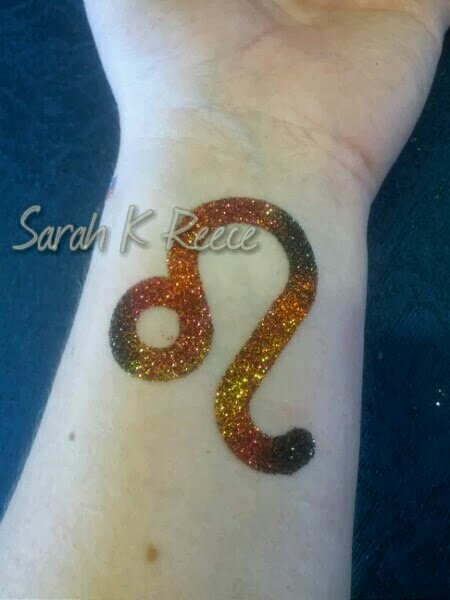
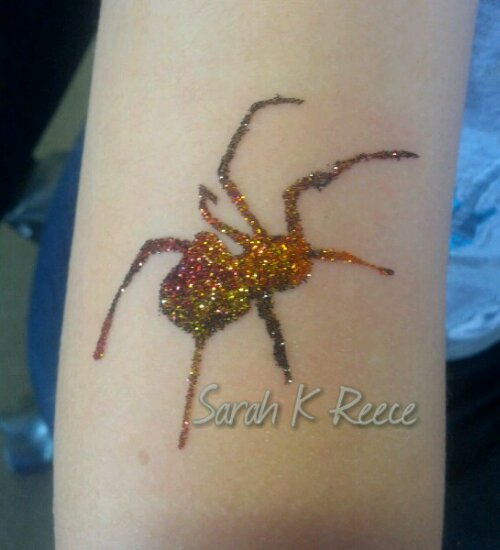
Rose and I are doing our first kid sleepover! One of her nieces has recently turned 13 and come to stay for the night as a treat. We’ve done amazing glitter tattoos, takeaway Indian, a movie (we watched Rise of the Guardians for the first time, I loved it), a midnight picnic down the beach, and tomorrow has plans for board games, op shopping, and cake. 🙂
I have been drowning in adult responsibilities lately and SO MISSED being silly, having a laugh, getting sand in my ears. Just the beauty of the beach at night was enough to cut through the sense of deadening mundane. I’m blessed. 🙂
Recipe for midnight picnic:
- 1 Mad Dog
- 1 Themos of hot chocolate
- 1 packet of Raspberry licorice
- 1 large beach towels
- 3 Beanies
- 3 Jackets
Take all to beach around 11.30pm. Dispense onto sand. Start ticklefight.Â
Zoe ran excitedly around like a mad thing, dug holes, half buried us in sand, knocked us over, and cracked the occasional rib. We got into an argument about whether you could see Victor Harbor from Grange beach. We discussed the probability of a mysterious apparition in the sky being a spy platform, a swarm of flying scarab beetles, or a cloud. We threw a stick for Zoe. We lay down in a huddle and star gazed.
Painting People
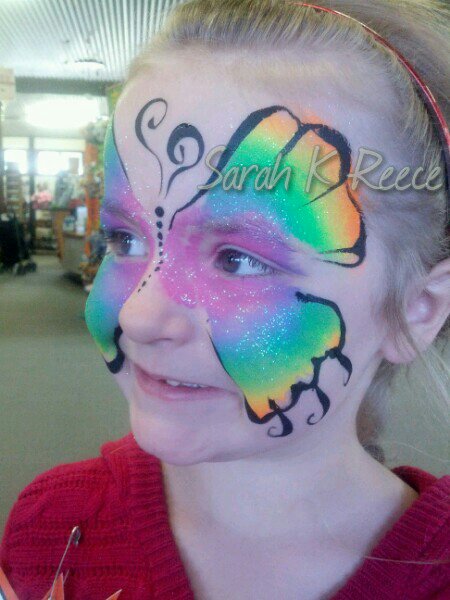
I’ve been working hard lately on my face and body painting business. I have new updated cards in the mail, a freezer full of fresh mixed henna, and the new workshops I’ll be offering at a local community centre in development. It’s also school holidays so I’m pretty busy with gigs. This is not doing a lot for my sleeping, but I am getting things done and almost keeping up with the admin, if I don’t think too much about how many things are still on my list. None of that is terribly exciting to read about, so here, have some lovely photos from my recent gig at Monarto Zoo. 🙂
Some nights you weep
Yesterday I got just enough sleep (4 hours) to pull off my day of work at Monarto Zoo, but not enough to feel okay. I was able to get to sleep much earlier than my current usual time of 6am with the aid of warm milk, growing chronic sleep deprivation, and Rose kindly reading to me over the phone (which seems to be the only reliable sleep aid I’ve found so far). Sadly I then woke, entirely unnecessarily at 6am. Zoe was then very painful and I nearly strangled her. The morning was spent sobbing in bed in frustration as the lack of sleep set off severe fibro muscle pain and nausea.
My sister was sleeping over and came in, our two kittens trailing her to romp on the bed. Funny how just the night before I’d been discussing with a friend the different way people cope with someone not feeling okay, and how it often seems to be the way you try and do something like be companionable or cheer them up that matters most to whether it feels warm or dismissive.
There’s been so much going on for me in the past few weeks. A funeral, a range of new work, Rose is having a shift change at her work that will hopefully be much better in the long run but messes up my calender in the short run as I was booking things in around shifts that wont be happening anymore. Painful stress in some very close friendships, difficulties with Bridges and DI things. I’m doing my best to give all these areas the time and attention they so deserve, and to bring my very best skills and patience and courage to them. I’m very tired, and doing my best to be ethical and to be an advocate for myself. Sometimes when relationships break down there is this strange and painful space where for some reason, caring about it and being hurt about it is not seen as evidence you cared and were invested, but is construed as you being overly emotional and difficult. This morning I had run out of the ability to think over all these hurdles and maintain an even emotional keel. There is at times, just a keening pain, and it hurts so deeply that it’s impossible to imagine that life can be wonderful also. When it comes over us it takes away everything else and leaves me breathless and suicidal.
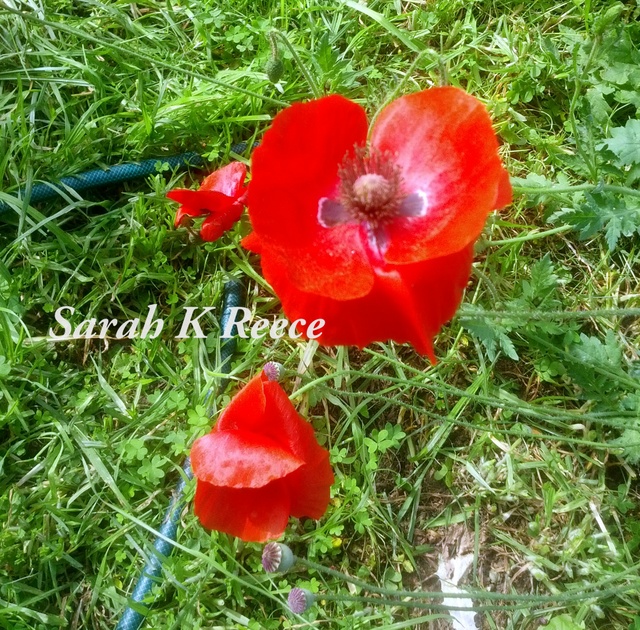
It was good to have a space where I didn’t have to be okay or have an adult, intellectual perspective. To reach out and just lay a hand on my sisters shoulder and feel the warm presence of another person seep into me, like warmth, grounding and connecting me back to a sense that my life was meaningful. I made us coffee and banana smoothies, then went and stood barefoot on my lawn to water my garden. My poppies are in bloom. Then I dressed and drove up the freeway to work, and painted children, and read a book in the quiet times, and ate a little, and drank a lot, and drove back to Rose’s place to share in a pizza evening she was having. I was trembling with exhaustion and we went to sleep holding hands until she needed to go to her night shift.
Home after, and tired and sad and wishing my life did not hurt so much. Wishing I lived in a caravan or tent and could hear the wind. I’ve been broke and out of antihistamine for days, my skin is red raw with hives. They are especially bad when I’m under emotional strain, or grieving. I used to describe them in poems as my skin screaming.
There’s a path forward and it has beauty in it. Some days you sing the road beneath your feet, some nights you weep it.
Empathy and bullying
Amanda Palmer wrote a piece about empathy and cyber bullying on her tumblr recently that I found thought provoking.
I think people misunderstand, sometimes, the difference between “empathy” and “sympathy”, and this is getting us in trouble. Sympathy is closer to pity. Empathy, which is essential for being human, means that you can imagine yourself in some else’s situation, good or bad. And feeling *real* empathy, even empathy with “the enemy”, with the bottom of the barrel of humanity, with the suicide bombers, with the child molesters, with the hitlers and the osamas, is necessary. If you, as a human being, can’t stop and try to imagine what sort of pain and agony and darkness must have descended upon these people to twist them up so badly, you have no roadmap to untwist the circumstances under which they were created.
via i was just answering a bunch of questions for a… – AMANDAPALMER.TUMBLR.COM.
I wrote this as a comment on the piece:
As if empathy comes only from our best selves, as if it’s only our kindness, or generosity that allows us to reach out and feel what another person feels. Our darkness also unites us in strange and painful ways, other’s pain or violence sings to our own, make claims of kinship where we wish there were none. We like to make the evil ‘other’ – those abusers, those nazis, those demonic monsters who have no connection to me, no humanity left in them. It’s painful to recognise that a lack of humanity is part of what it is to be human, that our humanness is vulnerable, it can be torn off, or cast off, and we can still walk and speak and eat and do violence. Empathy reminds us that the monsters do not merely prey upon us, they are us, defiled. It reminds us to treasure what makes us different from them.
It’s a topic I find relevant in many areas of my life, as an artist, and as a service provider in mental health. As soon as there is an ‘other’, you risk your bond to your own group by empathising with them. It’s one of the things that makes peer work so difficult and draining for me, the service users and the service providers can be strident and aggressive in their demands that I orient myself as one of them exclusively. I’ve lost count of the number of times staff in mental health have criticized me for ‘wearing my peer worker hat’ or my stance on how harmful our use of professional boundaries is. I’ve also struggled with how demoralising and painful it is when other service users criticise harshly, with no sense that you are also a person who is at times vulnerable, and that all relationships have some level of mutuality to them. Other peer workers can also be a group of their own, demanding adherence to their ideas – after giving a personal and exhausting talk at a conference once, I had to walk out of the next talk where a peer worker was berating a room of us for being insufficiently familiar with the world of academic research, and for getting jobs through people we knew. All groups place demands upon who is permitted to be a part of them. All groups have their ‘other’.
At a micro level, this dynamic of the ‘other’ and the risks of empathy play out in groups or friendship networks in my life in a way that wearies me. I’ve always empathised with the other, and this is the quality that people love in me when they find themselves being the other, and fear and resent in me when they find themselves hurt, stressed, or angry with someone else in the other role.
I’ve often been the ‘other’. I’ve been a lonely, bullied little kid who craved friendship and companionship with a deep longing that left me suicidal by the age of 10. I work hard now as an adult to be aware of the legacy of years of unmet needs, which tend to express themselves through numbness, bitterness, insecurity, and instability. I also work hard to resist the temptation to be comfortable in my groups, my social networks, and my work in a way that perpetuates abuse. As a service provider in mental health, I find this an extraordinary challenge. On days when I am too exhausted to do the hard work of diplomacy, to reassure angry and hurt people (which is not just the clients!) that I see their point of view, I’m at risk of rejection and hostility. It’s not a secure place to be.
This is one of the dynamics they don’t talk about in bullying. I moved to a new school in year 4. Due to a bunch of class dynamics that had nothing to do with me, I was instantly at the bottom of the social ranking and very vulnerable. Several students targeted me for bullying. This began a spiral of alienation and abuse that persisted for my school life. I was in a bad place where students who liked me were afraid to connect with me in case they were bullied too, and other students who liked me were afraid to tell their friends to stop bullying me in case they then became a target.
I didn’t stay at the bottom of the social network all the time. Sometimes something would shift my place in the culture. One year the class took up gymnastics and swimming in sports, where I excelled. I gained some respect in a subject where my appalling lack of ball skills and issues with feet and joints had left me the typical student chosen last for every team. Here’s the deal though, just because I was no longer on the bottom rung of the ladder didn’t mean the ladder had been dismantled. Someone else took my place, someone who was terrible at swimming perhaps, or embarrassed by wearing leotards in gym. There was always someone being made to feel excluded, being available for humiliation and power games, someone that everyone else could work out their own pain or frustration upon. Kids with disabilities that were insufficiently engaging to draw the protection of the teachers. Kids with mental health problems, or with abuse at home. Kids who were identified as gay (which is not the same thing as being gay).
One year in about grade 9, I’d cobbled together a small group of guys as friends. We would hang out at lunch, sometimes after school, even go to each other’s birthday parties. Another kid used to hang out with us sometimes. We used to play a lot of foursquare or brandy, fast ball games I was never particularly good at. On this day, this other kid was hanging with us, and he was terrible at ball sports and slow at running due to medical things. My mates were teasing him a bit, in a pretty good natured way, knocking the ball away from him so that he couldn’t pick it up. It wasn’t until he started to cry with frustration that my stomach flipped and the scenario that had seemed so minor and innocent a moment before suddenly became real. I was hanging out with a group and we were bullying the one kid lower on the food chain than we were. Â I ran over to him to comfort him and told off my mates.
As it happened, a teacher witnessed this and I was given a slip of paper later that week commending me for being brave enough to risk my friends being annoyed with me. Having this teacher recognise the challenges of that situation and frame my response in this way anchored an understanding of the risks and issues of bullying for me that has never left me. I learned a lot that day, especially how unbelievably minor bullying seems to be when you are not the target. I also learned that without some kind of major social influence in the class or school – if you stand up for someone being abused you are always risking abuse yourself. Every time I got off that bottom rung, I’d find myself being forced into a bystander position to watch some other kid suffer. Groups of students roaming the school to hunt down the ‘gay kid’ and intimidate him. Older students roughing up younger students in the toilets. Girls humiliating and ostracizing other girls who were from poor families, or had accidents with menstruation, or who made the mistake of letting the wrong boy go too far with them.
These cultures cost everyone in them, they are built on fear, distrust, a profound need to fit in and find acceptance that seems laughable to adults, and a complex guessing game of social worth where a misstep can cost you all your allies. Everytime we tackle school bullying by advising the victims to behave in ways that make them less a target, we are also telling them to accept their role as bystanders to those kids who become the target next.
I had a weird relationship with many of the kids who bullied me. Those who had some kind of social power and were tormenting me out of boredom, sadism, or fear of difference I rarely got close to. But kids who tortured because they were themselves being tortured often had a strange connection with me. There was an empathetic bond. I heard their stories. I kept their histories of fear and degradation safe. These were kids who’s dad’s knocked their mum’s around, or whose older brothers were creatively abusive, or whose mum’s made them keep her company in her bed at nights long into their teens. With some of them, a space would be created for these conversations, like long bus school trips. They’d sit with me and talk, share funny stories or tell me secrets about painful things. They would meet needs for safety and honesty and compassion that they couldn’t in their own friendships. I would not get those needs met. At the end of the trip we’d all get off the bus with the unspoken understanding that the truce was over and I was fair game again. It wasn’t personal, someone had to be on the bottom rung. Half the kids who tormented me only did it to make sure it wasn’t going to be them. The same dynamic happened for me in theatre, where for the duration of the play I was a valued part of a team. Once it was over I would be distraught, because my membership died with the play, and the brutal reality of my lonely life would once again return.
The problem here isn’t the bully or the behaviour of the victim, it is a group dynamic that treats some kids as more important than others, more worthy of protection, more powerful and privileged, and those at the bottom of that as fair game because they brought it on themselves. In some classrooms, those with power – kids with a lot of influence, or insightful teachers, influence this dynamic and make it safer to be unpopular and disliked or in conflict with the popular people. In other classes – like mine, there’s a dark undercurrent of abuse, violence, mental illness, pain, alienation, and rage, and these things are expressed through a brutal social dynamic that leaves every student afraid of winding up as the target.
My empathy with my bullies made life hard for me. It’s difficult to tear a kid to shreds when you know s/he’s only making your life miserable because s/he’s in terrible pain. It is also made life difficult for me because I hated that I purchased my freedom from being bullied at the cost of having to be a bystander to the abuse of another kid. I could have gone through school with a lot less bullying, and a lot more inclusion, but the cost to my own values and beliefs was always higher than I was willing to pay. Everytime I got off the bottom rung I found myself allying with the next kid on it. I never developed enough social power to change the dynamic itself.
I remember once at about 15, confronting a boy who had bullied me terribly as a kid. I was struggling tremendously at the time, and in a difficult twist of events my drama group were doing a play that included a nazi youth betraying and abusing someone. This boy had been cast in the role of the abuser. Week after week of rehearsals, I sat and watched my bully torment another person. It was a powerful trigger and turned what had been my haven into a nightmare of hyper-vigilance and flashbacks I was trying desperately to conceal. One day I went to drink from a water fountain and he came up behind me and leaned in to drink from the one next to me. I hadn’t realised he was near and flinched back. He looked at me with derision and asked why I always did that around him. The world paused for a moment.
I decided to call him out. I unfocused my gaze so that I could look him in the face without seeing him, and told him that when we were younger he used to bully me a lot. I was expecting contempt or denial. What I got confused me.
He looked suddenly deeply sad and alone. It was like I could see a child in him drop his head, turn away, and walk off down a long corridor. He said to me “You have no idea how many kids have told me that. I don’t remember any of it.” And then he walked away. I don’t recall ever speaking with him again. This is a kid who I still sometimes have nightmares about.
Those are not too uncomfortable stories to tell, they make me sound like a victim or a hero. I played that role at times in other’s lives, but I also hurt people. I made choices I now regret, I was not honest with people, I used the little power that I did have in ways that excluded and hurt others. Most of us have power somewhere in our lives. We work out our rage or our demons from the places we don’t have it in the areas we do have it. I’m still trying to make sense of this.
When I was 14 I allied with a girl I’ll call Alison who was being bullied by her group of friends. She paid a high price for inclusion in their group, she was often run down, criticised, and her job was basically to fetch and carry. I was angry about this and she and I disconnected from them to hang out with each other. I then went through hell with a classmate who fell in ‘love’ with me, and tangled me into his suicidal distress. My capacity to empathise with him touched profound unmet needs to be heard and feel connected. He became obsessive and dangerous. At the end of a six month ordeal I was left with PTSD and total confusion about what just happened and why.
Alison had her own demons, and instead of finding comfort in our friendship she became a burden. She didn’t understand the PTSD, and neither did I. She couldn’t understand my new terror of touch, my sense of disconnection, the simmering rage that lay waiting beneath an apathy so heavy I didn’t care if I died. Her efforts to connect exhausted and triggered me. One day she covered my whole desk in tiny sickeningly cute stickers of teddy bears while I was away. I often had belongings defaced or stolen by my bullies. I was furious, and choked it down to ask her not to touch my stuff.  She didn’t understand. I couldn’t explain. I had run out of capacity to cope with things that didn’t used to matter so much, like being traded in at lunch time if someone more interesting was happy to include her. Our friendship had never been strong enough or close enough to have those conversations, and when I had been in a better place I could afford more generosity for the times she hurt me. I didn’t tell her about any of this, I just retreated. I pushed her completely out of my life over a 6 month period and justified it on the basis that she had always been hard work and I no longer had the energy. She was devastated. Her every effort to reconnect was rebuffed. I took her away from her original friends, made her feel safe and cared about, then dumped her alone. She was vulnerable and bullied and left with no idea of what just happened. I was not a hero in her story. I work very hard in my friendships now, to find ways to be both honest and warm. I fail. I try again.
We can turn empathy off when it no longer suits us in ways that are frightening. It is hard to acknowledge the times we have done that, because it put us in a place where have to see our own role as something we have no respect for. It’s hard to face our own limitations and flaws, and even harder to face them and still find sense of love and self-acceptance. Empathy can also be dangerous. It’s kept me in relationships where I was being hurt, because I struggled to wrap my brain around a crucial idea: that being able to understand someone’s behaviour is not a reason to put up with it. (See Stalking the Soul: Emotional Abuse and the Erosion of Identity) Over-empathising with someone in a position of power who lacks empathy for you is extremely dangerous. Empathy has cost me my peace and my chance to slip unnoticed through high school while other kids suffered, but it’s also protected my sense of identity and values. It’s a way I connect with other people, but it also alienates me from them when I empathise with someone I’m not supposed to.
Power scares me senseless. One of the things I have learned about it is that very often, we don’t notice when we have it. We don’t FEEL powerful. We are acutely and painfully aware of every area of life where it is absent and yet often oblivious to the places we do have it. We repeat learned dynamics, and set up new relationships on the same principles as the old, with merely a shuffle in what role we now play. We demand responsibility and empathy from those who have power over us, but are frequently unaware and uncaring of the way we use our own power. We want to be understood and loved, but often there are people we wish to draw a line around and say I do not want to have to understand or love them.
Peer workers are constantly being co-opted into the role of staff, pressured to choose a primary allegiance to the organisation that employs them. With the need for work, we are in an impossibly vulnerable position, carrying the weight of the need to be or provide a voice for all the other dis-empowered people, and trying to unite two groups of people who are often hopelessly incapable of having empathy for each other. When groups are full of fear or pain, they do not allow their members to be dual citizens, and they demand a loyalty to their own members that prohibits the capacity for empathy for the other – whether the ‘other’ is a terrorist, a bully, or a victim. We see and rightly decry this process when the alienated other is someone vulnerable, but we justify it when the other is someone we need to believe we share nothing in common with.
This empathy has written me out of my plans to get a job in mental health. There are amazing people working in it, people who have found a capacity within themselves to recognise the limits of their power, and to let go of what they cannot change. I have not. I am afraid of power and what it does to someone who wields it without reflection. I am afraid of the temptation of money and group belonging and security. I am afraid of the slow erosion of values. I do not trust myself to walk that path with wisdom, only with profound regret. I cannot stop empathising, at any point, with the person in the room with the least voice and power, and it kills me. Especially when they are angry with me, disappointed in me, or critiquing my services. I find myself split between my own perspective and theirs in a way that tears my head apart. I often find myself the only person working to see more than one perspective and find a way to unite them. I still have almost no capacity to see the limits of my own reach and accept them. Being required to be a bystander to things I find unjust makes me want to burn down buildings and run screaming into the night. I don’t cope well with systems, even those I build myself.
I don’t have answers for this. My path forwards is to always do my best to live with love. I believe that empathy is crucial, not only for those who are hurt, but those who are hurting others. Not to condone or minimize, but to face the world as it is, and the potential for darkness in others and ourselves. We can empathise with people and still utterly denounce their actions and hold them accountable. Sometimes following our instincts protects us from our own darkness, sometimes we find ourselves doing harm and don’t know how we got there. Empathy is part of understanding that, making some sense of what happened in those who now lack it, and how to strengthen it in ourselves and our communities. When we empathise with an ‘other’ we stretch ourselves over no man’s land to do so. In a war, this means our guts are ripped up by barbed wire, and we risk both groups tossing us into the no mans land. When it’s to a ‘monster’, we must face the disturbing reality of our own vulnerability to losing what makes us human, and we risk the rest of the world thinking of and treating us as one of the monsters.
“I got death threats. My twitter feed exploded with more than 5,000 tweets from strangers telling me I was a un-american monster for “sympathizing with a terrorist”. People wrote comments on my blog about how I should have my own legs blown off.”
via i was just answering a bunch of questions for a… – AMANDAPALMER.TUMBLR.COM.
In our friendships, empathy inspires a level of courage to be both loving and warm in ways that power confuses and trauma overwhelms. It is very easy to let myself off the hook for hurting Alison, and yet to be deeply wounded and angry at friends who have done this to me. I keep coming back to the same ideas – that it is difficult to remain fully human. That the act of living alters and erodes identity. That love can fill our lives to the brim, and also cost us everything. That love is essential but insufficient. That the alienated are also alienating.
We think we are kind, when we are only happy
CS Lewis
There are only two motives,two procedures, two frameworks,
two results.
Love and fear.
Love and fear.
Poem by Jenny
Come share with us
You’ll be safe
Pull up a chair
And claim your space
Part of a poem composed in Sound Minds yesterday, SA Hearing Voices group, by peer worker Jenny Benham.
I was very involved in supporting this group for a couple of years, but last year I found myself in a place where too many projects were taking off and needing a lot of time and attention, and I had to make hard calls about what to take a step back from. This one became one of those I stepped away from because there were other awesome facilitators involved to support it, whereas projects like the DI Inc would die if I let them drop. I’ve also had to make difficult decisions to limit the amount of volunteer work I do each week and put some deliberate thought into supporting myself and my family, and unfortunately my hearing voices work was never and is unlikely to ever become paying work. Nonetheless, I love this group and will always have a place in my heart for it. I didn’t start off being a facilitator at Sound Minds, I initially turned up as a lonely, angry person struggling with homelessness, caring, and a life in crisis. Sound Minds became the turning point for me.
Later, I spent a lot of time looking at what worked about the group, and why it worked, to use the underlying principles of respect, safety, acceptance, and recovery in building other groups like Bridges and Blue Skies.
So, it was great to go back and connect again. Jenny and I are both going to the International Hearing Voices Congress in Melbourne next month. We had a great chat about what’s going on in that world lately, and I shared my excitement about the resources Rachel Waddingham has been creating and sharing online in the Intervoice Facebook group. See some of them here. Rachel and I were talking online and I was lamenting how difficult I’d found it to create resources like that here, with no funding, lots of bureaucracy, and little support. She was suggesting brilliant ideas like utilizing our vast networks of people to share flyers instead of relying on services taking us seriously and doing it for us. It was an inspiring conversation. I regret that I’ve had to let work in this area drop, regret that I couldn’t do more. And I’m frustrated that those being paid to represent us are often far less passionate and enthused than we are. Perhaps if I can keep the DI running we can nest some resources under that organisation? I don’t know, I can only do so much. It will be so good to go to the conference and hang out with a likeminded group of passionate advocates, working without money or resources or recognition but with a painful awareness of need is a tough place to be in. It’s good to be part of a wider community.
Poem – Voices in the Night
I wrote this yesterday, after driving home from a full, wonderful day of Tafe, excitement, and visits with friends. I often crash and become depressed at the end of days like this, this time a conversation happened inside on the drive home and a different part came out instead.
Home, through rain and night, after a day
Bright with people, the suns of their hearts, warm company
My house aches ahead on the road, cold and empty
And I feel the chill in my chest
Heart constricting, streetlamps
Pierce me with white knives
Rain falls like swords, and on the road
Black water pools like mirrors and
the night gathers close around me.I’m afraid
yes
To be alone
don’t be
I’ll catch you falling
It hurts
yes
it’s also beautiful
why does the light have to go?
because this is where the art lives
I love the people, their voices, my voice
I know. I love the silence, the strength in solitude. We walk both worlds.
Will I come back?
always
am I loved?
always
let go, and the fear will ease
yes
burrow down in my heart,Â
this dance is mine.
See more like this:
Amanda Palmer spoke to me, and other wonderful things
Yesterday, I got into using Twitter, and posted my Homelessness & Poverty post online with a link to her as it was inspired by a post on her blog. I got this back:
@amandapalmer: @sarahkreece amazing. beautiful. mind if I quote some of it in blog??
Shared via TweetCaster
Wow, talk about make my day!
I’ve been having a lot of conversations lately about life, and safety, and community, and mental health work. I saw my shrink on Monday and literally stalked about her office waving my arms around talking about this stuff, grief, frustration with services, and my burgeoning recognition that a life goal I have working hard towards: full time work and being off welfare, is not currently an option for me. I’m just not well enough to pull that off. I’ve also spent the past several years building a resume and career in mental health but I’m starting to hate the sector. It costs me so much to maintain credibility in that world. I want to make a difference and I want to be an artist. I think maybe I can do both from the same place. I think that maybe getting out of a framework where I feel a like a failure for needing welfare, useless and irrelevant, might be the most exciting thing I can do.
It’s finally occurred to me that I’m not at risk of the same kind of homelessness this time. I have people to store my books while I travel. I have access to a van with a bed in the back! I have a community of people who don’t just pity me, they value me! I bring good things into their lives. I don’t have to feel like a charity case because I have something to offer. I can afford to take risks.
I can walk out of the world of mainstream mental health and still have a voice and still make a difference. I can write, tweet, talk, and build services. I can also stop feeling like I have to fit in.
Whoo hoo! This is a good place for me to be. Today I dragged my bones out of bed and went to Tafe and gave a mad, passionate talk about mental health and Recovery. (see Recovery is not a one-way street)Â Tonks didn’t make getting out of bed easy

But I did it, and loved it, stalked around the room waving my arms around (See a theme?) reading poetry and raving about trauma informed care, and the need for freedom and dignity and real relationships. It was awesome. World Hearing Voices Congress 2013, here I come! I think I’ve found my feet.
See more like this:
Countering DID myths – we’re not all the same!
In my recent post Common DID myths, I spieled a stack of common misperceptions I’ve encountered that bug me as a person with DID. It got a lot of interest from people, with the odd misunderstanding or uncertainty about what I DO think about DID. To go through each point alone would be a huge post, but I can counter a bunch of them in easy to handle groups.
If you’re new to the topic of dissociative identity disorder, there’s a great, easy to read introduction here, or a shorter brochure version designed to be an easy place to start when educating other people – you can tailor it to your own experience by sharing the ways it does and doesn’t fit for you. I wrote these a few ago, back when I was starting out on my journey of being a peer worker coming out about having DID myself. Since then, I’ve learned a lot and my perspectives have changed in some ways. These days I’m far more interested in talking about multiplicity (an experience) than DID (a mental illness)… rather the way that that organisations like Intervoice talk about hearing voices instead of schizophrenia. Why? Because it takes the conversation away from the medical model. It moves us away from needing experts to tell us what is going on with ourselves. (not that collaboration with other people isn’t very helpful!) It moves us back into being the expert in our own lives, where our own opinions, experiences, and ideas matter. It stops pathologising all these experiences – did you know that a lot of people hear voices that are not distressing, cause them no harm, and that they have no other symptoms of schizophrenia?
Plenty of people with multiplicity have been diagnosed with DID or DDnos (which is the grab-basket diagnosis for people with major dissociation things going on who don’t quite fit into the diagnostic category of DID) and that’s great, and I work a lot in the mental health system where DID is what we talk about. But for me, it’s important to separate experience from diagnosis, and to remember that not everyone with that experience fits or identifies with the diagnosis! Read more about my thoughts on the relationship between multiplicity and the diagnosis of DID on Introducing DID Brochure and unplanned rant!
One the biggest issues with misunderstandings around multiplicity, as a lot of people pointed out, is the absolutes! Everyone with DID does this, or needs this, or feels this way, or recovers like this… So the first thing I do believe is this:
People with DID are not all the same
There are many spectrums within DID that vary widely from person to person, and also within the same person at different times. Some common ones I’ve come across are:
- Degree of amnesia – some people have no idea what has happened when another part is out. Some people are aware of things while they are happening, or get updated after they have happened. This can be different at different times – I have a lot more amnesia when I’m stressed. It can also be different for different parts, some may always be aware, some may always be amnesiac within the same system. For more information see what is co-consciousness.
- Obviousness of switching – for some people it is obvious when they switch, for others it is so subtle that only someone who knew them very well might be able to tell. My switching would be obvious if I allowed it to be a lot of the time, but years of keeping it hidden mean most people do not pick it. Some people are more sensitive to subtle switching than others.
- Number of parts – this can range from just two, to hundreds or more.
- Nature of switching – some multiples switch all through the day, others only very occasionally, and some people never switch, but they talk to their parts and hear them in their mind, or see them as people outside of themselves.
- Degree of internal control over switching – some multiples can chose which part is out, others have no control over this. Sometimes some parts have more control than others, or can set up triggers to deliberately switch – eg. I will wear certain clothes and bring certain foods and smells with me to make sure my researcher stays present during exams.
- Degree of fluidity – some multiples have very fixed systems with, say, 5 members who have been there for years and have not changed at all in age, self identity, or roles during that time. Others are more fluid, they are difficult to learn about as they are constantly changing with new parts forming and old ones going away. Neither of these is necessarily better than the other – fluidity can be chaotic, but rigidity can prevent growth.
- Other diagnoses – people with DID may have other physical or mental illnesses which will change how they experience life.
- Degree of impairment – some people with DID are extremely unwell and struggle to function, perhaps spending a lot of time as inpatients, while others live and work unnoticed in the community, perhaps with no one around them aware of their condition.
- Degree of separateness between parts – some people’s parts are closer to each other in the sharing of psychological space, they can do things like share tasks in the body (one running the mouth and eyes while another chops food for dinner), merge and blend skills, feel each other’s emotions – eg. a content adult is enjoying their evening, until they start to be disturbed by a growing feeling of anxiety that seems alien to their own mood – because an inner child is distressed by the movie and their feelings are blending across, or influence each other mentally such as giving or taking away words in their mind, showing images to each other, and so on. Other people have parts who are completely separate and share no common psychological space or resources. Both within the same system is possible too.
- Polyfragmentation – some people with DID have mini systems within their system, or have parts who have themselves split to form parts of their own.
- Degree of diversity within the system – systems can form with parts who are extremely similar in personality and nature, or extraordinarily different. One system may have 5 parts all called Geoffrey, all somewhat shy, introverted guys who hold different memories and range in age between 35 and 50. Another system may have highly diverse parts who identify at different places across a spectrum of gender, sexual orientation, age, ethnicity, species (some people have parts who identify as being animals, spirits, fae etc), and so on.
DID is about identity – it is therefore extremely individual in the way it presents and is experienced!
This is contrary to all the myths based on absolute assertions, such as
- People with DID can’t work.
- Everyone with DID has an inner self helper, an inner protector, an inner wounded child (and so on).
- People with DID are manipulative.
- People with DID can never control their switching.
These myths are often perpetuated by people who have had some kind of contact with the multiple community, rather than the set I come across when speaking to people who have never heard of DID. Humans do seem generally to be wired towards absolutes, and you’ll find myths based on absolutes abound in most areas of human endeavour. All lesbians are vegetarians, all Indians like cricket, all domestic cats hate water. They are true some of the time, or even lots of the time, but they do not capture everyone’s experiences.
What particularly frustrates me is that so many of these myths are embedded in our resources. Throughout many of the books about DID, and the frameworks about working with DID given to us by the ‘experts’ are absolutes. These people should know better. I’m sick to the teeth of reading books that tell me things like all people with DID have an inner self helper (a very useful type of part who knows a lot about everyone in the system). What they actually mean is all people with DID I’ve worked with have an inner self helper or, if I’m being particularly cynical; having absolutes makes me less anxious about working with people so I strongly encourage all my clients to present their DID to me in a way I’m comfortable with. That is harsh – as people we are often unaware that our absolutes don’t include someone until that someone tells us. The problem is that when a whole stack of people agree on an absolute like this, it creates a culture where people who don’t fit are not invited to share their experience. If that culture becomes rigid and deeply embedded, then people who don’t fit will be ignored and excluded even when they do.
I get angry about this because I work with too many people who are stressed and scared that they don’t seem to be fitting the frameworks they’re reading about or that their therapist is working from. Frameworks are really valuable!! They give us direction when we feel lost and hope when we feel overwhelmed. But I believe that holding any framework too tightly, or trying to force a framework into a situation or onto a person when it isn’t fitting and when it’s creating instead of alleviating stress is wrong and harmful! Some people don’t get stressed, they just exit the supports. They maintain their own sense of identity and truth, alienated from the community and unable to access the services if they ever do struggle. This is not a good thing.
Lastly, I think some of these myths about absolutes are basically Black-swan fallacies. “Every swan I’ve ever seen is white; therefore; there are no black swans”. I read a lot of these in the literature. All DID is caused by trauma. All DID is formed before the age of (pick one) 10, 8, 7, 5, 4, 2. All people with DID need extensive therapy. People with DID never spontaneously integrate. These are based on the experts not having witnessed anything else – but that does not mean that anything else isn’t possible. In fact, considering that you are not permitted to self identify as having DID (because that is self diagnosis and therefore lacks validity, a claim I’d be more comfortable with if I believed any form of diagnosis had much in the way of validity), then research is never going to include people who haven’t had contact with the mental health system, so there is actually no way to hear about things like people living with DID who don’t use therapy. In some cases, the limited way the diagnosis of DID has been constructed contributes to these fallacies – for example there’s a case study in Trauma and Recovery by Judith Herman (Chapter 4, The Syndrome of Chronic Trauma) about a woman who was a political prisoner, who describes a degree of internal splitting as an adult – “My second name is Rose, and I’ve always hated the name. Sometimes I was Rose speaking to Elaine, and sometimes I was Elaine speaking to Rose. I felt that the Elaine part of me was the stronger part, while Rose was the person I despised. She was the weak one… Elaine could handle it.” I’m not saying Elaine developed DID, but this experience of parts, some degree of multiplicity, gets excluded from conversations about DID, and I think we need these.
These types fallacies are being exposed in the field of psychosis as space has been made for more people to join the conversation. So much of what we think we know about hearing voices is based upon the experiences of people within our mental health systems. Many people who hear positive, helpful voices or only briefly hear voices do not tell anyone. Why? Because of absolutes such as ‘everyone who hears voices is mentally ill’. They’re not invited to the party. If they do turn up, they’re offered a label, a diagnosis, a straightjacket, and all their thoughts and ideas from here on out are delusional, unless they agree with their treating doctor, in which case they’re insightful. Through the work of mental health activists – both of the peer and expert kind, new parties have been created where people get invited to share and amazing things are being learned – like LOTS of people hear voices, many voices are not distressing, some voices only become distressing when people are counselled not to listen to them, and that different people find different approaches best.
If we keep talking about DID and multiplicity using absolutes we are excluding so much of the diverse experience and wisdom of our own members. There IS common ground – people with DID have parts – and generalisations can be useful: people with DID often get frustrated about having to explain our condition to everyone, people with DID feel scared and isolated when we don’t know anyone else with DID, people with DID want to be believed and accepted. I believe that people with DID are a highly diverse community, with many different experiences, ideas, understandings, and ways to live life most fully.
For more information see articles listed on Multiplicity Links, scroll through posts in the category of Multiplicity, or explore my Network The Dissociative Initiative.
Amanda Palmer makes my life better
Last night was Amanda Palmer and the Grand Theft Orchestra in concert at Thebarton Theatre. Amanda is a wild artist, most recently famous for crowd funding her latest album Theatre is Evil. She’s bisexual, (like me)Â married to author Neil Gaiman, has a brilliant sense of humour and is deeply unconventional in her approach to music, relationships, beauty, and life. I admire her.
Yesterday I slept from 5am into the early afternoon. I woke to paint my sister for the gig so she could line up early. Rose was pretty unwell and slept through until about 20 minutes before the doors opened. It was rushed and wonderful and decadent. This concert, with all the wonderful misfits that would be going, is a perfect place to wear paint. I started with the face and couldn’t restrain myself spilling down onto neck, back, arm, chest. The white has blinged under the flash a little, it wasn’t as stark in real life. I love doing this, I want to keep doing many more.
The lineup was unique in my experience. Instead of a supporting band, a range of other artists entertained us, including members of the Grand Theft Orchestra playing their own work. It was amazing. There were mad songs about bananas, deeply moving music about loneliness, surprise nudity. We laughed hard, a girl next to me gasping for breath and holding her stomach. Band members climbed into the box seats to sit on the balcony and ring tiny bells through a song so affecting no one in the theatre even whispered. We just breathed, as it sang us. All the artists had things for sale in the foyer or had sold out of them. It felt respectful of all the artists involved in a way that’s still ticking in my brain. It was the last night of the tour, and everyone looked exhausted and triumphant. 
Amanda and the band were amazing. They played, laughed, hugged, humped, danced, and sang their hearts out. I ran into a number of other friends there, old and new. The room was full of people like me, poets, artists, visionaries, people who wanted to connect and be inspired. 
Amanda was herself, raw, lusty, generous, connected. She sang two of my favourite songs from the new album, Do it with a Rockstar, and Not the killing type. Her work is intelligent, passionate, and layered with meaning. These are not safe for work or kids.
She’s not afraid of us. There was no barrier before the stage. We pressed ourselves against it and reached out to her. She dived into the crowd, wearing a coat with a massive sheer train. We held her while she sang, under the umbrella of her coat. She touched us, kissed us, trusted us. We gave her back to the stage.

She sang a love song and asked to have all the lights turned out. We stood there in the dark, swaying, and singing ‘I love you so much’ together. She told us, if we felt brave, to hold a strangers hand ‘in a non -rapey way’. I held the hand of a beautiful woman next to me I’ve never met before. She told us, for tonight, we were all friends.
She came and crouched at the edge of the stage and held my sister to her and sang. This was not entertainment, something we watched. This was something that happened to us, with us, an experience. She never talked to us like we were fans, something less than her, she talked to us like we were fellow artists.

She told us stories, funny ones, sad ones, ones about people she admires or loves. She told us that since her crowd funding success, people keep asking her what the future of the music industry is. She said she has no idea, but as long as people keep paying to hear music we’ll be alright. She said
I’m just trying to be an artist; to have a job I don’t hate, to entertain people, to pay my bills, without being accused of being a narcissist.
I love that. It makes sense to me.
The concert ended. We ran back to the foyer and bought T-Shirts. We were promised a surprise if we waited around. We admired the crowd, the hair, the clothes, the comradery. Amanda and the acoustic part of the band set up unobtrusively in a small room. We all crowded in, lining the walls and sitting on the floor. For someone with PTSD this was a nightmare. There was no possible way out, I was surrounded by strangers, pressed close enough to be touching several at once, the smell of people. And yet, I was ecstatic. It frightened me but in a way that made me feel alive. Amanda sang, with her utterly raw, ripped up, end of tour voice. She played her ukulele. She was accompanied by magnificent strings.

We listened, with our whole hearts. My feet were swollen and extremely painful, standing for the whole concert had been agony. I was sitting on them now, knees and hips screaming. Amanda started to sing Radiohead’s Creep. Her voice cracked. We all picked it up and sang it with her.
This packed room of mad people sang “I’m a weirdo/what the hell am I doing here/I don’t belong here” together.
I cried, silently.
Once, when I was a young child, in a fundamentalist Christian church, with their expectations of friendship and closeness, instead of the distant secular professional boundaries world I now live in, have I felt that sense of belonging. Not often since.
The woman next to me I’ve never met hugged me.
Amanda told us not to give up and be overwhelmed by things like Abbot running our country. She said, we were there, with Bush, for 8 years. She said gather together, love each other, fight for what you believe in. Grow stronger. Stop hating, stop complaining. Make great art. She looked right at me and told us that artists matter, that art changes the world.
We were a community, connected by things by passion. Not by mental illness, loneliness, poverty, loss, although I bet plenty of us there experience those things. It didn’t matter that I have multiple personalities or a history of trauma, homelessness and poverty. I wasn’t a victim, or even a survivor. I was a fan, I was a fellow artist. A few years ago when I went into college to get a Disability Access Plan to help me with my visual art degree, the woman I spoke with was fascinated by the DID. At the end of the appointment, which was all about my physical illnesses and psychiatric problems, she told me I was so interesting. I said to her, rubbish, that’s just my problems. You haven’t seen my art yet.
We lined up for Amanda to sign things. I could barely hobble. She looked exhausted. I knelt by her table while she signed my T Shirt that says “We are the Media” and said to her
A friend of mine killed themselves last week. I wish they could have been here. I just sat with you and a room full of strangers singing ‘I don’t belong here’ and felt a stronger sense of belonging than I have in a very long time. Thankyou
She listened. She looked grieved. She held my face, and told me I was welcome. I got to tell her. I didn’t get to tell so many of my other heroes who have died, like Bradbury, how much they mean to me.
Home then, exhausted and into bed. I reached out to some local arts communities I saw there. I followed Amanda on twitter to say thankyou again, not wanting the night to end, not wanting to lose the sense of hope and life that burned brightly within me.
But sleep did not come. Rose and I were awake until 5am talking about life and art and love and babies and freedom. We finally fell asleep in each other’s arm, at peace.Â
I want out of the conventional life I keep somehow sliding into. I want more artist friends. I want to make great art. I want to feel alive.
Since last night, I believe that artists can help mental health as much or more than psychologists, can build communities as much or more than social workers. The world is a better place.
Common DID myths
I was asked today by email if I’ve encountered any common misconceptions about Dissociative Identity Disorder (DID). Where to start I wonder?? Here’s my reply:
- We’re all serial killers.
- We’re all dangerous.
- We cannot be trusted.
- We are liars.
- We are attention seekers.
- We are all messed up victims with nothing to offer anyone else and no capacity to function without extensive support.
- We are so weird, different, and bizarre that we are basically aliens, utterly unlike other people in any regard.
- We are psychics, in touch with the spirit world and merely misunderstanding our gift and thinking we have DID instead.
- We are gullible vulnerable people our shrinks have implanted with the idea that we have DID. (see Is DID iatrogenic?)
- All people with DID are the same. (See Multiplicity and relationships)
- DID is only ever the result of the most extreme, inhuman, unimaginable child sexual trauma you can possibly think of.
- All people with multiplicity lose lots of time. (See What is co-consciousness?)
- People with DID can’t work.
- Everyone with DID has an inner self helper, an inner protector, an inner wounded child (and so on).
- All people with DID should integrate.
- Integration means you are now ‘well’ and all your problems go away.
- The goal of every person with DID is to become a normal person.
- DID is basically just a complex way to try and avoid your problems.
- DID is just a way to avoid taking responsibility.
- DID is just an excuse to be lazy and confusing.
- Everyone has DID.
- People with DID are extra special people who are nicer, more intelligent, more creative, and more wonderful in every possible way than all other people.
- People with DID are all conscientious and loving and would never hurt anyone.
- People with DID are crazy.
- DID is the same thing as schizophrenia.
- DID is the same thing as PTSD.
- DID is the same thing as BPD.
- People with DID have ESP and other otherworldly characteristics.
- People with DID can never recover.
- People with DID are impossible to work with.
- People with DID are manipulative.
- People with DID should pick one stable part to be out all the time. (See Parts getting stuck)
- People with DID are merely under the delusion that they have alters.
- People with DID always have a ‘real person’ and a bunch of alters.
- If you hear voices inside your head you have DID, if you hear voices through your ears you have schizophrenia. (See Parts vs Voices)
- It’s not possible to have DID and psychosis.
- If you have lots of parts you have less chance of recovery.
- Switching is always really obvious.
- It’s always easy for other people to tell the difference between parts.
- If anyone you knew had DID it would be easy for you to tell.
- Alters always know who they are. (See Multiplicity – Mapping your system)
- Alters always have a complex back history of their identity.
- People with DID can never control their switching.
- People with DID always know they have it.
- People with DID are always in control of their switching. (See Multiplicity – switching and relationships)
- People with DID make each other worse if they spend time together.
- People with DID only get better in therapy.
- People with DID never have any other challenges (disability, poverty, discrimination on the basis of sexual or gender orientation etc).
- All people with DID are white, straight, cis women. (See Another coming out)
- DID is always formed when an abused child imagines that the abuse is happening to a different child instead.
- People with DID never spontaneously integrate.
- People with DID who integrate never split into parts again.
- People with DID always have lots of parts.
- DID is the worst thing you could ever wish on someone.
- DID is caused by things other people do to you. (rather than your response to those things)
- DID is all about pain. (See I am not Sarah)
- You either have DID or you don’t, there’s no spectrum of multiplicity.
- If you have more than one diagnosis, you are sicker and weaker and less likely to recover.
- All people with DID are going to recover horrific memories of traumatic events they hadn’t been aware of.
- People with DID understand each other in far deeper way than a singleton will ever understand a person with DID.
- DID is an adaptive gift and never really causes any problems for anyone. (See Adaptation and Control)
- People who say they are DID are just trying to get out of a crime.
- The United States of Tara is an accurate representation of all people with DID. (See my review here)
- People with DID have to be careful not to encourage or allow their parts to become any more separate than they already are. (See Multiplicity – Is naming parts harmful?)
- Parts will always hate each other. (See A poem conversation between parts)
- Most psychiatrists, psychologists, and doctors know a lot about dissociation and DID (See DID Card)
- There’s lots of good resources for people with DID
- It’s easy to find quality, reliable information about DID
- Most therapists are willing and capable of supporting someone with DID
- Carer supports don’t need to be tailored to the experience of loving a person with parts.
- People with DID are the most unwell, challenged, vulnerable, and needy members of any family or group. (See Caring for someone who’s suicidal)
- Regular mental health services are appropriate and good supports for people with DID.
- People with DID should all be locked up away from the regular community.
Yeah, I know I changed first to third person. I’m tired, and you get my point. I don’t think the list is complete, that’s just off the top of my head at the end of a long week. Have any to add?
Edit: Just to be very clear that I’m presenting all these ideas as myths. I don’t agree with any of them. The links in the text are to other posts I’ve written that explain why not in greater detail, and what I do believe instead. I think that maybe reading such a big chunk of myths, particularly very common ones, perhaps it’s more difficult to remember I’m presenting then as myths. I think I’ll put up a counter – post where I summarise what I do believe about DID…. Watch this space! 🙂
For more information see articles listed on Multiplicity Links, scroll through posts in the category of Multiplicity, or explore my Network The Dissociative Initiative.
Into Art
I’m writing from the SA Writers centre, where I’m attending an all day workshop about how to work with communities as a writer. I’m glad I came, despite my horrible lack of sleep and sense of total emotional exhaustion. It’s interesting to reflect on groups and dynamics as an artist rather than a peer worker. Always learning.
This week was incredibly difficult. Amanda’s funeral was beautiful and draining. I’ve had a bunch of big, emotional conversations with various people over the week. Bridges has been in a very painful place. I’ve worked hard this week. I’ve drained my capacity to the point where I’m shaking with exhaustion and feel like I’m going to throw up. Finally, now that it’s Saturday, I don’t have to be okay. I don’t have to be a peer worker, don’t have to make sense of anything, don’t have to be responsible for anything except my own head space.
I woke up this morning drowning in self loathing. Deep in the pit, a place I retreat to when the only way I can feel safe is to try to hate myself more than anyone else possibly can. Shutting myself down from blogging, from reaching out to my networks on Facebook, because I’m afraid of any of the people I’ve shared a crisis space this week reading themselves into my words, being hurt or angry, of undoing all the effort I’ve put into reaching out and building connections. Trapped in a space where I can’t speak, can’t connect, and cannot myself be deeply wounded.
Today I could have stayed home, tried to rest, and collapsed deeper into the pit. Instead I found Nine Inch Nails and the brutal liberation of being only my own person, the freedom of being allowed to be a little bit brilliant and a lot messed up.
So, on goes the blue lipstick today. Today I’m an artist. Don’t follow me anywhere. Don’t listen to me. Don’t look up to me. Don’t need anything from me. I don’t speak for anyone else. I don’t have answers. I have rage, passion, joy, insight, longing. All I promise is to be real.
Can I finally breathe again?
Honey, like this, I can fly.