I feel such a strange, aching loneliness
company does not dispel.
I think it is not the absence of love
but the presence of strangers.
Through the numbness
the unexpected knife of pain
a joke, a story, a comment
a word that opens that black, suppurating, unhealing wound in me:
we are so different.
I am so different from you
and I feel myself alien
solitary; first and last
member of my species
falling into that void
nothing to reach out to
nothing I can use to draw us
together again as kin.
Poetry
Appreciating the personal
Another day done and I am still improving which is very exciting, although still quite ill. Before I got out of bed yesterday morning, I lay there filled with relief that I had woken feeling improved and wondering if I was well enough to try and get my final sculpture project done in epic time. Then I got up and staggered about the house for a bit and my heroic dreams vanished. That happens a lot with fibro, sometimes I’ll wake and feel quite awesome until I get out of bed.
A few years back I shared a couple of poems with a writer friend for their opinion. They were helpful and complimentary except about a poem I’d written sharing my feelings about what it felt like to be sick and envious of my well friends. They said that one made them uncomfortable and felt like it belonged in a journal and shouldn’t be shared. I was really curious about this reaction. Partly that poem wasn’t written as well, but there was this also this sense of a breach of social norms. Like I was allowed to write poems about heartache but not sickness. Loneliness but not envy. Definitely not wheelchairs. I felt part of an underclass, hidden and secret, not allowed to share these experiences under the guise of privacy. I felt silenced and like these experiences weren’t ‘normal’, weren’t going to be shared with other normal people. I had an image in my minds eye of all us sick people in the shadows, somehow being convinced we weren’t part of normal life and our experiences didn’t get shared. I resolved not to stop writing about them.
Later I came across a style of poetry called ‘confessional’. Simply put this style is painfully personal to the point that it often makes readers uncomfortable, and feels rather like reading someone’s personal diary. Ah hah I thought. So that’s what I’ve been writing! There’s nothing wrong with it, its just a style that, like any other, isn’t to everyone’s taste. I like rawness and intensity, not all the time, not in everything, but certainly they’re qualities I’m drawn to. I like art and poetry that let you find the artist within them, that hold keys and shadows and aspects of them. I like the deeply personal. I guess when I look at it all that way, suddenly its no surprise I’m writing this blog. 🙂
Is DID Iatrogenic?
Working (hah, and living) in the field of dissociation, I often come across the popular idea that multiplicity is iatrogenic, that is, caused by well meaning therapists implanting the idea in the minds of vulnerable clients. It’s almost impossible in the clinical sector to have a conversation about DID without someone raising this concern.
What really interests me is the clinical sector only seem to worry about this possibility with DID. I’ve never heard of anyone worrying about iatrogenic Depression or Schizophrenia. Surely people vulnerable enough to be convinced through suggestion that they are multiples could also become convinced of other symptoms? Iatrogenic mental illness should be a huge concern for the psychiatric profession if this is the case: the whole process of assessment and diagnosis should be done in a way that reduces the likelihood of iatrogenic effects, with deep sensitivity to power imbalances, vulnerability, adaptation, and living to labels. So, is this what we’re doing? No, we have collared the word ‘insight’ and changed its meaning to ‘agrees with the doctor’. People are put in situations where to prove sufficient ‘insight’ to be allowed out of hospital they must agree that they have – whatever, lets say Schizophrenia. Two months later a new treating doctor does more tests and changes the diagnosis to PTSD. Where does that leave the ‘insight’? Where does that leave ‘vulnerable people’ and iatrogenesis?
Secondly, when the iatrogenic argument is used as an attempt to explain that DID or multiplicity do not exist, we find ourselves in an unusual situation where apparently a doctor has the power to create a powerful belief and accompanying symptoms in a patient, but it is impossible for highly traumatised people under stress to create this same set of circumstances in themselves. Is the doctor magic? If doctors can do it, why not the rest of us? Of course, this leaves us with old definitions of multiplicity – that the person doesn’t really have parts, merely the delusion of parts – an approach which categorised multiplicity as a form of schizophrenia and led to therapeutic approaches that centred on denying the existence of parts and was generally pretty ineffective. But that’s down to arguments of cause and cure – the iatrogenic argument is still assuming that a ‘multiple state’ can be created in someone vulnerable, but gifting this act of creation as the exclusive domain of therapists and presuming that no one else in any other context might be able to create this state also. Bizarre.
Do I think that everybody diagnosed as multiple must really be a multiple? Of course not. Mis-diagnosis is so rampart within the mental health system that it is actually the norm. It’s laughable to listen to the spin of the mental health sector about science and support and watch someone be given a diagnosis within a 15 minute assessment during high distress on admission to a psych ward, medicated and treated as if that diagnosis has merit over the next few weeks, and then watch it change as the psych on duty changes, and then again when the roster changes in two months, and then again… I’m not making that up, I’ve supported people through that process. The whole idea that someone can sit in a room with you for a few minutes when you’re at your most incoherent (or drugged) and know better than you do what is going on inside you is laughable to me. I have huge issues with the DSM, with our diagnostic entities such as schizophrenia, and with the power imbalance of our process of diagnosis, where an ‘expert’ tells a vulnerable person what is ‘wrong’ with them.
Does my stance on DID (that multiplicity is certainly real and possible) mean I don’t worry about iatrogenic effects? Not at all. I’m very concerned because research consistently shows that people live to their labels – children treated as smart do great in tests, those treated as truants act out, those treated as caring are kind. We know this and have demonstrated the powerful effects of labels, obedience, authority, and adaptation in research over and over again and yet we pay very little attention to the massive risks of diagnosis, particularly being diagnosed with syndromes.
Let’s compare for a minute the diagnostic entity of Dysthymia with that of Schizophrenia. Dysthymia is chronic, low grade depression. Schizophrenia is a syndrome, a cluster of symptoms such as hallucinations, delusions, lack of motivation, lack of emotional expressiveness, and so on.
What are the risks of living to these labels? With both, there is an assumption of duration, that you will be ‘sick’ for a very long time, with schizophrenia most people are told they will be sick for the duration of their lives. How concerned are we that people who might not have struggled with these experiences for their lives will now live to that prophecy and fulfil those expectations? We should be very concerned about this!
In the instance of schizophrenia however, the labelling risk goes further. You can be diagnosed on the basis of a single experience such as hearing voices. On the basis of that ONE experience, people are told they have a condition that includes many other debilitating symptoms. We have just increased the likelihood that the person will experience all the rest of the cluster, and that when they do they will attribute them to the illness. It’s no surprise to me that many people with schizophrenia lack motivation, between the stigma, disruption, loneliness, and low expectations isn’t it the slightest bit reasonable that lack of motivation might occur? Is that really an ‘illness symptom’ or a reaction to circumstances?
Diagnoses often cluster many different symptoms and also make predictions about duration of experiences. My experience has been that while certain clusters are more common than others, we each of us have our own personal unique cluster. We should never ever be set up to expect that we will develop a whole range of other crippling symptoms if we don’t already have them! And I believe it is appallingly irresponsible to make miserable predictions about duration or quality of life when we have such an excellent evidence base that tells us people are vulnerable to making prophecies come true, however ill-founded they are.
So yes, I consider that DID is both over and under diagnosed. That in no way means that I assess people to try and determine if they are a ‘real’ multiple – it means I take your word for what is going on with you. I believe you are the expert in your own experience. I don’t care what your diagnoses are, if you tell me you’re not a multiple, that’s cool. Right up to the point where you switch and introduce yourself as George anyway. 🙂 I think it is unhelpful when people are not dealing with multiplicity to have therapists trying to frame everything in that way – but not more so than therapists framing experiences as psychotic when they’re not or borderline when they’re not. All frameworks have limitations and that of multiplicity is no exception. It’s only valid if it’s helpful! I find it useful, and I find the notion of ‘healthy multiplicity’ useful and the idea that all of us have ‘parts’, that multiplicity is normal and healthy, merely the dissociative barriers are unusual. I’ve known people who needed to be more multiple, who had lost so many of their parts that they had become less then who they really were, shut down and limited and struggling. I’ve talked with people like this about Jungian archetypes, about the tremendous wealth of information and resources within us, about the need to react to life with a full deck of cards to play, not the same two cards over and over. But part of what makes these frameworks useful is that I have explored and adapted them to myself, not had them imposed on me from outside. (That’s not to say I haven’t been diagnosed, I was, but for me I went through a lengthy diagnosis process for myself to be satisfied that the language was accurate, useful, and not iatrogenic – see How do I know I’m multiple?)
For myself, like many other people, the simplest rebuttal to the iatrogenic argument is that my life, experiences, and journals all evidence significant signs of major dissociation and multiplicity long before I ever sat in a therapists office or came across the concept of DID. Not every multiple has this – and lack of it is not proof of iatrogenesis! Many people do have this; journals with different handwriting, different names used in different social networks, chronic amnesia, voices, and internal wars that predate contact with the mental health system. In some cases, a person’s medical notes carry all the evidence of distinct multiplicity documented many years prior to anyone considering a dissociative diagnosis, even noting the different names, ages, and functioning of parts but failing to consider multiplicity and conceptualising the observed behaviour as psychotic, borderline, or bipolar instead. Iatrogenesis is not a reasonable alternative to the possibility that multiplicity really exists. It is often framed in different ways, outside the west cultures may talk about people being possessed by demons or in touch with spirit guides, or speaking to to their ancestors, but the basic underlying experience of separate parts are what we have termed multiplicity and they certainly exist all over the world.
Oh how I envy you,
who have nothing to suppress
but who are whole;
in this world.
What is this, that cries so plaintively, arcing wings within me?
Whose voice do I hear when the darkness descends?
If you put your head beneath the water, you can hear the screaming.
In dark mirrors my reflection is a strangers face
I cannot remember the sky or the feel of the rain.
For more information see articles listed on Multiplicity Links, scroll through posts in the category of Multiplicity, or explore my Network The Dissociative Initiative.

Poem – Rage of the broken ones
Such sweetness and
a delicate dream of safety.
f**k safety.
I’m a freak
does my nakedness
not terrify you?
don’t tell me
how sacred this is
It can never be free
of darkness
for such as I.
I want to taste your sweat
hold me and
hear my soul screaming
don’t turn away
face it
face the darkness and
the horror of it
the blood and
the shadows under the bed
the memories that
never quite fade
the nightmares like
gin traps waiting each night
stalking and hunting my soul.
Howl with me
paint blood on your face
my demented soldier
come join my war
just don’t try to tell me
it’s all okay
it’s all okay now
it’s all in the past
don’t tell me
you don’t
see it too.
Don’t tell me its pretty
let me see the fire in your eyes
taste the acid of my rage
do I scare you?
do I disgust you?
I will take you down
where the shadows are
where the nightmares sleep
where the broken things
lie in pain.
You cannot make this better.
But you can hold me.
But you can
let me scream.
Poem – into the great Dark
Things swell within me like poems surfacing
to be born into the great Dark
and the silence that has swallowed me.
But all my hourglasses are empty
I have no more time to give
they are words I do not speak
the silence remains
and all my dreams are stained with grief.
Poem – a late moon
A poem for Charlie
Poem – November
The lights below and the sky above
I drive into the evening, into the darkness falling
like soundless rain; like shadows coming down
from a starless sky
and, driving, I am moved to sadness.
It has been a long time since the rain.
Insects worship at the streetlights
like tiny hopeless angels
their wings are made of dust and dust falls from them
as they break themselves to pieces against the lights.
All is lost here.
I am lost, on this familiar road
travelling the old way home, on well-worn paths
but still, I am lost.
I drive on, in the wash of blind traffic
unseeing, unhearing, we each of us drawn through the night
unresisting, on tides and rivers we cannot name.
I drive on, and I think of the rain.
Poem – Evenings [all the world is an ending]
My days are bordered with a fitful melancholy
That sulks and skulks like shadows briefly banished by the sun
How I resent the shackles of my own bed, the limits of my endurance
How I loathe the winding down of the day; I will not die with dignity
But go shrieking, like a child to the little death
That signs the ending of the day, seals it into the past, incomplete, imperfect
And unfinishable.
Vanity, all these vanities I have kept in my bedroom
To fly about the beams. I am mortal walking dust;
I am the shape of a poem in the sand between the last wave and the next
That is all: who am I to glower at the going down of the sun?
Can I prevent the moments from passing with my hissing fury?
Can I paste the leaves back on the trees? But truly: it is only this;
The child who weeps because the party always ends.
The lights go out, the flowers fade, the friends drift
And at the end of every day I go alone to bed,
To lie silent in the dark and breathe my futile dreams
Into the empty night.
Like death; this is a truth I can rely on.
This is the basest foundation of my life, the skeleton
Upon which the flesh of days hangs, and by which my hopes are framed.
Alas, alas, all is futility; there is nothing new under the sun.
Alas, alas, to bed we go, like dying clockwork, like flowers folding down,
We are the ending of a song, whose last notes
Haunts the long drive home,
That makes you sit within the car and refuse the simple truth
Of home, and darkness, and stars that go on singing, long after you are gone.
To bed, to bed.
Poem – The Beast
Being in love
I have a little theory about being in love I thought I’d share. Being in love is one of the most enjoyable experiences we ever have. The intense attachment and bonding we have with our children parallels many of the same processes, but usually through a haze of sleep deprivation and nappy changes. Watching people who are in love is often to gain insight into sides of themselves they don’t usually show. They are lit up, dazzled by their beloved, hopeful, childlike, full of joy, deeply content. When I have been in love I have experienced some of the happiest times of my life.
Leaving aside complicating factors – infatuation, limerence, obsession, conflict, and denial, I think many of the feelings of wellbeing and joy we experience when we are in love come down to three things:
- Connection (or emotional intimacy)
- Validation
- Romance
Deepening a connection with someone often meets unspoken and unacknowledged emotional needs. Our culture esteems romantic love above all our other relationships, writes endless songs about it and the loss of it. Frequently we are given the impression that finding ‘the one’ is all we need to be happy in life. This relationship will have the most closeness, depth, connection, and be the most deeply bonded. Moreover, this relationship is all we need. Speaking as someone who has been very contentedly single for a number of years now, this idea is ridiculous. So many other relationships in our lives offer the opportunity for depth, loyalty, affection, security, and connection. That’s not to say that your lover isn’t a very special person in your life, but that a romantic relationship is not the only opportunity for closeness.
The validation aspect of being in love is incredibly heady. They like you! They agree with you, find your opinions interesting, your body attractive, your thoughts insightful. You lavish each other with praise, compliments, empathic listening, attention to tiny nuances of feelings and behaviours. Suddenly, the way you rub your mouth when you’re nervous is cute, your muscles are gorgeous, your eyes magnificent. To have someone you admire, admire you is incredible. You create a positive feedback loop of support, validation, and affection. Once again, this isn’t restricted to romantic relationships. Good friendships, close family relationships, the adoration of small children can all provide this.
Lastly, romance. This is the aspect I’m most interested in. In our culture we have taken a whole bunch of behaviours and grouped them together in this idea called romance. We have then restricted these behaviours to courtship. My theory is that part of the reason we feel so good when we’re in love, is because this is the only time in our lives we are usually being romantic (and romanced). The kinds of things we do; walking on the beach, watching sunsets, writing poetry, expressing deep and intimate thoughts, stargazing, making love, thinking about our future with hope, going out for good meals, these are all things that feed our soul. We spend a lot of our lives soul-starved, and we mistakenly think we need another person to feed our soul. I’d like to suggest that we don’t! I think we have this all backwards.
We think that you go watch sunsets, write poems, and walk in the rain when you are inspired.
I think that when we go watch sunsets, write poems, and walk in the rain, we become inspired.
You do not need a partner to be a romantic. I keep my soul alive by ignoring our silly conventions and doing those things that nurture and sustain my inspiration. Long ago I decided that for me, inspiration is the opposite of illness. I am most ‘well’ when I am doing those things that feed my own soul. I am contentedly single because I am not waiting for a partner to waken up my soul. I experience much of the intense joy of being in love through my other friendships and relationships, and through being a romantic myself. I romance my own soul, light my candles, burn my own incense, turn cartwheels in the rain, stargaze, write poems, blow bubbles, and walk with the world with wonder and delight. I am in love already. My heart drinks the night.
So, if you are soul starved, heartsick, lonely, and lost in grey ash, start taking care of your soul. Write your deepest desires, find the places that move you and be still within them. Dance, or sing, or lay beneath stars, or watch fire and smell smoke on your skin. The world is full of sensual delight and incredible beauty, it is only that we, through foolish consensus have decided not to notice.
And if you are in love, recognise the power of romance. It isn’t silly to still go on dates, to buy flowers, walk hand in hand, light candles, drink fine wine together. Feeding your souls will keep you nourished and nurtured, not drawing from each other like wells that run dry, but soaking up the miracle of life around you and having abundance in your hearts.
Just a thought from a poet. 🙂
Poem – dream-killer
Mental Health needs better PR
The very first mental health article I wrote on this blog, back in August 2011, was about Managing Triggers. I get frustrated by the pathologising of so many human experiences in mental health, and all that I have ever heard of triggers is how to work to reduce their impact. By the time we have eliminated everything deemed a problem, there seems to me to not be very much life left to be lived. I think mental health should be a freedom, an opening up rather than a closing down. It saddens me when so much that merely makes us human is seen as something to be fixed. So when talking about triggers, I talk about positive triggers also. In the hands of people without creative vision, mental health is so often spoken of in a way that makes me hate it. There’s something gone terribly wrong when so many people, I’m thinking particularly of people with a diagnosis of Bipolar Disorder, would not want to have their condition taken away from them. The version of mental health these people are thinking of is so abhorrent they would choose mental illness over it.
One of the strategies that can be used to try and reduce chronic incapacitating sensitivity to triggers is desensitisation. It can be surprisingly effective when paced appropriately. Take the idea too far and you end up with the kind of emotional numbing and insensitivity to life that can characterise dissociative disorders. Frequently within the mental health services, mental health is presented as nothing more than an absence of symptoms. No more soaring mania, no more anguish, no more blood, no more voices. Mental health is silence, clipped wings, drugged stupor, numb blankness. So many of us would rather soar and crash like Icarus than crawl the face of the earth like insects. What we crave is the wildness, the depth, the creativity and imagination and dreams without the agony and destruction. What is so often offered is a flatland that feels so empty and meaningless we are filled with a despair it is almost impossible to speak of to the social workers and the shrinks.
I feel deeply ambivalent about the way that disabilities are tangled with so much that is positive. To return to Bipolar for a moment, folks talk about the boundless energy of mania, the incredible creativity of so many people with this condition. On the one hand, I read about how people need to find the positives in their conditions to help maintain self esteem and find a balance, and that makes sense. On the other hand, I think that if we define the condition in terms of deficits, then the creativity and energy belong to the person, not the condition. And then, the reluctance to be free of the condition (assuming such a thing is possible) disappears. If you could keep the ecstasy, the brilliant creativity and quickness of thought and empathy for those incapacitated by depression, and leave behind the relationship destruction, months of inactivity, suicidal distress, reckless spending, then would you still prefer mental illness?
Mental health is so often presented as being ‘normal’. A normal life is such a small, bland, meaningless thing that I can’t see it being worth any kind of effort to obtain. The box of what normal is, is so small that I have never met anyone who actually fits into it. Recovery to this normal can be a kind of insanity, like new cult members suddenly parroting the party line and telling you they’re happy despite something terrifyingly empty in their eyes. Radiohead sing about this kind of life in Fitter Happier.
I see mental health as freedom from the things that stop me being human. I mowed my lawn today and I wanted to be able to smell it, the smell of fresh cut grass is one of my favourite in the whole world. But the dissociation is too high today, I smell nothing. I work to create a life with love and grief and passion, not to merely disconnect from pain. I pursue and create something so much grander than ‘normal’, something that is uniquely me and mine, an expression of my own soul. Mental health for me is still about soaring, still about voices and pain, but where I can smell the grass.
When I came across this idea that many people (not all of course) would not want to have their mental illness magically taken away from them, I wondered about myself and my own experiences. If I could go back to my own childhood and wish away the dissociation, would I?
No. Not unless I could also wish away the things that were causing it. If the trauma remains, then the dissociation needs to remain too. As much as it has cost me, I also feel it has saved me. In a way, becoming highly dissociative has been a mentally healthy response to circumstances.
So, when writing about triggers last year, I wrote about positive triggers too, things that move us in ways we do not consider to be problems. I wanted to illustrate the idea with a lovely poem by Gwen Harwood, but I couldn’t find it at the time. Today I found it, and here it is:
Good mental health everyone. For more about information about how to use triggers to support your mental health, go to Using Anchors to Manage Triggers.
Poem – Voodoo
I am a voodoo doll,
stuck all with pins –
somewhere, a great tree is dying.
Cracking Up at the Fringe
I’ve been very busy lately with so many projects on the go and a lot of study to get done. I would like to have written completely new material for this event, but many of the poems haven’t been heard before and certainly the collection has never been put together in this way. I’m a little bit overloaded and have spent half my day crying on the kind shoulders of various people, so I think being able to make it to the performances at all is a pretty good effort. I was very happy with the warm reception my reading was given by the other performers, so I’m feeling more confident about Friday night.
Please feel welcome to come along, you do need a ticket at a cost of $10, all the details are on the What’s On page as usual. 🙂
Ekphrastic Exhibit
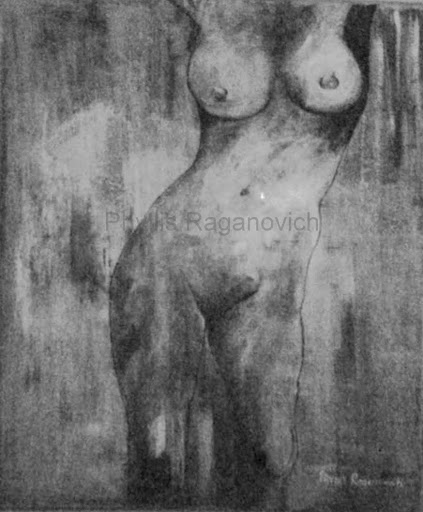
I chose a lovely monochrome nude by Phyllis Raganovich. We talked a little about her feelings and intentions in creating the artwork, and her phrase “how I wish I could have those years again” resonated with me and formed the basis of my poem. Here is her artwork:
And here is my accompanying poem:
Poem – A long day
dark
sad
badly in need
of my own company
here in the shadows
where I hear the wind stir
in the peppercorn tree
here in the silence
a voice almost speaks
on the edge of awareness
I feel something stirring inside
my dusty wings
longing for flight
listening to the night wind
sing a dark song of midnight rain
moonlight on water
owl flight, dog howl, the secret
passageways of mice
the trees that go roaming, roaming
walking the hills under shadows
and the streetlamps, winging
about the cities,
hearing our violence and our dreams.
Such songs, to stir my heart
to wake restless longings in me
the need for poems then…
the need for ink
a great sorrow lies beneath my days
a dark wonder
the lonely passage of the trains
and the wind, the wind
singing in the trees.
News and events
Also, I have heard recently about a retreat for people who have experienced childhood trauma or abuse. It will be in April at Swan Hill in Victoria. There is a cost involved but it’s pretty minimal for the time you’re there being fed and housed. I can’t personally vouch for this, I have never been on it, and I don’t personally know the people running it. I have heard some positive things second hand, and also been assured that at least one of the support people there is familiar with dissociation and DID, so please do some research if you think this might be useful for you. All the details on What’s On.
I have a poem in an exhibition in Broken Hill called Plastic Lives, written for an artwork that will be displayed in the gallery there. The opening is Friday 9th March with a poetry reading on Sat 10th I’d like to be able to get to. If you’d like any details, email me.
In other news, my TMJ pain has settled considerably since I got my night guard from the dentist. This week I’m trialling going off the new meds to see if I can do without them now. As they dry my mouth out (sounds innocuous, but it’s not – causes me severe dental decay) I’d prefer to do without them.
Charlie is…. still in a difficult spot. His ears are dreadful and the new meds haven’t yet done any magic. They are also very expensive, the new regime costs me $80 per 12 days and I’ve been told I may need to keep this up for 3 months. I’m not yet thinking about how I’m going to be able to keep that up. He has stopped howling at night which is a huge blessing, but I can hear him start up as I drive off, so I’m still very concerned about that. I have some sedating pain relief for him which I’m hoping will help. His new meds don’t taste very good as I found out the hard way the other night. Usually I can crush pills, mix them with yoghurt and he’ll gobble them. Not this time!! I had to spoon every last drop into him as he fussed and bubbled and sprayed me and the kitchen with gritty yoghurt. I had to change and mop afterwards!
We’ll get there somehow. Vet checkup next week to see how his ears and eyes are doing. I’m thinking of writing an open letter to my neighbours to let them know what’s going on.
Poem – Poetry
And rain tambourines my roof
I am drunk upon
The wild smell of the grass
The light of the frosted moon
And beneath the dark
The sound of the river running.
Poem – Germination
the sun threads light through the clouds
like a living thing
sweeping broad golden leaves
across the sky.
It catches the white wings
of the birds
that weave their flight
around each other.
They are diamonds
studded on clear cool silk
that kite the air above me.
They are the autumn’s evening flag
sailing over the green blush
of recent rains
calling me to run
arms open with the thrill of living
calling all new green and growing things
to move with the winds.
Poem – Lost and Lonely
Confused by the world
People live and love and die
What does it all mean?
What to do with the time?
Why do we live such small lives?
And is anything else possible?
My teeth ache
My heels ache
My wrists ache
The deep burning pain
That is always with me
My hips like anchors
Of hot iron in my flesh.
I limp up a darkened hallway
To a cold bed
There is no lamp to light my way
All the world is shattered loneliness
And I see no place for me in it
I am lost
On dark tides swept out
To a black sea where no moon shines
The world is full of pain and I
Cannot bear it and I
Cannot blind myself to it.
I know so many don’t live here
In the dregs, cold and dark
But a cold wind blows through me
And their fires do not warm me
And their light does not reach me.
I’m cold, I’m so cold.
Poem – Birthed from darkness
Into stormy darkness
I have waited so long for the sun.
Now, like flowers, my hands open.
Poem – Driving Home
Driving back to where
My home lies in darkness
I feel it all shift around me,
This other world, this night world,
So different from the day, spent
In the company of those who fear darkness.
I feel my poet wings descend
As the streetlamps tease out my buried heart
I laugh as the cold wind hits my face
And for a moment, between worlds,
Wonder what this is, and why, and how to explain it
To anyone other than poets.
Arrived in Broken Hill
So, I found a quiet corner and cried for a while, then dozed quietly on the train. They were a bit draconian on the train, the air con was set at 22 degrees, which I found cold. I hadn’t thought I’d need a jumper, and although they had a stock of nice towels, we were forbidden from using them for warmth. Half way through the trip I admired another travellers lovely plush blanket and she kindly lent me her second blanket, which warmed me up enough to reduce my jaw pain to manageable. Next time – bring the darn tickets, and a blanket!
I’m anxious about the pets in the hot weather, Charlie and Loki are sick so I hope they’ll be okay. Loki doesn’t eat when it’s warm, so I’ve been having trouble getting food down him. The vet have said there’s not much they can do for either, just keep them safe and lots of water and love… One of my lovely neighbours is a pet minder so I know they’re in great hands, I’m just worried!
Now that I’m here, I’m glad I came. The train trip was very relaxing and soothing. The folks here are friendly and welcoming and as it turns out the temperature is much lower here for the next week than in Adelaide. Much happier at the prospect of a week of swimming and poems instead of heat stress and misery in my un-airconditioned unit. Now, if I can just get a few more hours sleep I’ll be much happier. Have to run off now to find some tinned soup at the local shops before they shut. Take care of yourselves in the hot weather!
Poem – Blue coat
This one is also a few years old. Most of the poetry I post here isn’t current in fact. I like to let them sit for a couple of years before sharing, usually.
Taking from the back of the robe
my blue coat, for the first
cold night of autumn
I wonder if it will ever change
this sense of living in
someone else’s novel
badly written at that
The haunting feeling of unreality
as if I am a walking cliché
too improbable to be real.
What is the term for it?
Structural dissociation
Derealisation.
The long words of the new science
trying to pin down the darkness
bring it closer, strip it of terror.
Who am I?
One day I will have to stop
asking myself this.
I will have to live while
there’s still time.