Coping with Nightmares 2

In Coping with Nightmares 1, I’ve written a little about common causes of nightmares and how working on those directly can help. Here I’ve roughly grouped most of my own strategies, the suggestions of other people, or some ideas I’ve read into two different approaches; engaging with the nightmares, or working to reduce their impact. You may find one of these approaches more effective than the other, you may find that some ideas are no help at all to you, or it may be that combining both approaches works best for you. Sometimes it’s not that one approach is or isn’t helpful for you, but getting the timing right, or alternating strategies so you don’t unbalance. I describe this process of picking up and putting down emotionally charged material more here.

Engaging with Nightmares:

Sometimes the most effective way to help your mind stop sending you nightmares is to engage with the content, process, express, or defuse it. I find this is particularly helpful for recurring nightmares on the same themes. One technique I stumbled upon a few years ago is to paint the scene from the nightmare that has the most emotional weight, the most intensity to it. I’ve found that if I get this out of my head and onto the page, I tend to stop having the nightmare. Here’s one of the milder examples of this type of painting.
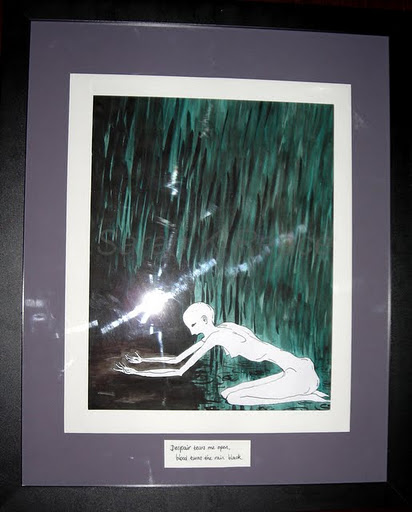
I didn’t need to look at the paintings or hang them anywhere. I found them profoundly disturbing and hated the sight of them. Once they were finished I would put them out of sight and only after a lot of time had passed would I take them out and have a look at them. I found just being able to get this feeling or fear or image out of my own head and safely recorded somewhere else was often enough to stop the nightmare.

For nightmares that aren’t recurring I find I need a different approach. There may be a common underlying theme, like being pursued, but the content of each nightmare is quite unique. In this case I find journalling is more useful. Sometimes I find words most useful to explore and express concepts and feelings, and other times visual images have more power for me. Sometimes I find that having written them, I can see themes and symbols more clearly in the content and make sense of what the underlying fears are. Here’s an example from my journal:

31 October 2007
I had one of my only reoccurring dreams – that the world was ending. I have these fairly frequently. They take different forms by the end of the world is always signalled by all the stars falling from the sky. Sometimes it is peaceful and beautiful, sometimes violent and terrifying, where the earth cracks open and monsters come out and devour everyone. Sometimes the stars take hours to all fall, sometimes they come down in a single storm of light, often there’s some kind of pattern, like all the stars falling in a perfect spiral, starting from the centre of the sky and moving down to those by the horizon. It always takes my breath away and fills me with such awe, such a sense of smallness and powerlessness. It’s the most beautiful thing I’ve ever seen.

In this dream, the stars suddenly started to fall from a dark sky, like huge drops of bright rain, leaving only the black void behind them. But as they fell to earth, they suddenly took off in all directions. The truth is, they were enemy spaceships, all this time, and now they are attacking. I call to my crew and launch my spaceship to fight them but I do so with cold despair because I know there are far too many of them and we are doomed to be destroyed. I am so sad and shocked that the stars we’ve always admired and dreamed about were really enemies, watching and waiting, all this time.

And then I wake… I am realising my dreams are not just an escape from reality, but also a form of communication inside me. I’m not too concerned about what they mean so much as letting myself know I accept them. I’m listening. The dreams about the end of the world might seem to be obviously about fear but I think they’re about destruction as much as change. This is not the end of everything, in the dreams, it is the end of everything I have ever known, of how things have always been… Sometimes this transition is peaceful and sometimes it is violent and terrifying, but it’s always frightening, inevitable, and out of my control.

In this case, this was the last dream I have had so far about the end of the world. The dreams progressed until this final one where the stars were revealed to be enemies, and I’ve never had them again. I had worked through and communicated to myself what I needed to. Journaling can be a powerful way to record and contemplate dreams and nightmares.Developing the capacity to lucid dream may also help you to engage with your nightmares in a productive way. There are some suggestions about how to develop the capacity to lucid dream here. Simply put, lucid dreaming is being able to be aware that you are having a dream while you’re in it, and then to change and affect the dream. Personally I don’t find this so useful. I can lucid dream (not always) but I find that my nightmares adapt to my attempts to control them and my subconscious is far more powerful than I am when it comes to changing a dream. If I can create bridges to escape on, my mind can set them on fire. If I can imagine a safe place to hide in, it floods with black water and drowns me. I am not afraid of being physically harmed, but the psychological stress and trauma that come with living through these mock executions is massive. In some of my worst nightmares terrible things happen to me while I desperately try to scream myself awake or cause myself sufficient pain to wake me and it does not work. But for other people, being able to tell the difference between a dream and real life dramatically reduces their distress and may open the way for many other creative options in engaging a nightmare.

Engaging the content of the dream like this can also be done in real life. If you have painted a nightmare, you can respond to that painting with something that is meaningful and comforting to you. Paint in wings to carry you to safety, a sword or lion to protect you, whatever fits and feels right. You can write the dream out and then rewrite the ending in a way that fits. You can treat these re-visioning of your dreams as a way to talk back to your subconscious and tell it what would happen this time if you were in that kind of terrible situation. If you can make yourself feel heard and then engage with the distress, your mind may stop bringing up the nightmares.

Sometimes dreams speak to us of things we have deeply buried. This suppressed material – memories, knowledge, feelings, fears, hopes, can torment us at night when we cannot keep it contained. Sometimes it is not writing about the nightmares that helps, but writing about the memory or fear or aspect of ourselves we hate that helps. Being able to accept the reality of these things instead of fighting and suppressing them can reduce nightmares about them.

Reducing the Impact

In a completely different approach, these strategies are all about reducing your focus on the nightmares and reducing their power to affect you. For example, if you wake following a nightmare, instead of journalling and contemplating it, get straight out of bed, put on some music, make breakfast, engage in other distracting activities before the dream has settled into your memory. Creating a good bedroom space can greatly diminish the distress that nightmares cause. It needs to be a space that is safe and comfortable. Clutter, frightening pictures or shadows, tangling in bedclothes and sheets can all increase the impact of nightmares. Since childhood I haven’t been able to sleep with a cupboard door open in the room. I experience mild stress-related hallucinations and following a nightmare if the wrong cues are around me I will hallucinate the nightmare content in that dazed state between dreaming and awake. Open cupboards for me are portals that things come through. If your bedroom is setting you off, you may need to sleep elsewhere during bad nightmare cycles. You may also find that some approaches that soothe many people with autism who get easily overloaded by sensory input may help you. An easy one to adapt to the bedroom is a weighted blanket. Many people (and most animals) find being gently but firmly held, or nestled under heavy blankets to be calming and reassuring. Another common one I use is white noise to help me tune out other sounds and stay asleep. You can buy devices like this one, or find your own. I like a fan running by my bed for the sound it makes. This site has many other suggestions and ideas for people who have difficult with sensory overload or crave extra sensory stimulation to help them feel calm.

Many people have a strong preference for sleeping with the lights on or off, follow your own even if you feel a bit silly. I cannot sleep with the lights on because then I feel exposed and vulnerable. Try playing music especially sleep inducing music at bedtime. This kind is designed to gently slow your heartbeat and relax you, it can help when you wake panicked too. Reduce your access to the kinds of things that increase your nightmares such as violent movies. Try adding in some neutral content immediately before sleeping so that your brain has something else to form dreams about instead of your own subconscious. I always read in bed before going to sleep, always no matter what. This is essential to reduce the intensity and amount of the nightmares that I have. It doesn’t stop them but it dials them down a bit. Don’t stay up late working, studying, doing housework or arguing. Make sure the bedtime routine has wind-down time in it, a bath, episode of Blackadder, massage, whatever you find relaxing. Grounding techniques can help a lot before sleep or when waking up from nightmares. Consider sleeping with someone else in the bed or nearby to soothe you, or with a companion of some kind. I have a big hairy toy dog. A pet can also be an incredibly non-judgmental and nurturing companion in the night for those of us prone to waking up screaming and distressed.

If you are waking other people up by screaming or struggling, you can quickly get into a miserable feedback loop where you feel so embarrassed or anxious about the effect you’re having on them that your stress level increases and the nightmares get worse. This especially applies if you have young children in the house who are getting scared. Talk to them about what is going on, let them comfort you, and look after yourself. Any general stress reduction techniques that work for you are a good idea, do more of all of them for yourself and anyone else in your house. You need extra time having fun together in these kinds of situations.

You may want to seek counselling or therapy of some kind if you’re having a lot of trouble with nightmares. PTSD is very responsive to good therapy, hypnosis can be very useful, and good emotional support can make a big difference. I hope you’ve found some useful suggestions in these posts. There are some more ideas about managing nightmares here, and there are many books and websites on the topic. If you’re struggling or my strategies aren’t working very well for you, go have a look at what other people are finding effective and hopefully you’ll come across some ideas that make a difference. Good luck.
Coping with Nightmares 1

In Bridges this week we talked about ways we cope with nightmares. Nightmares can be a big problem for me, something I’ve shared about before on this blog in NightmaresListening to your Dreams, and The Gap. Today I particularly want to share some ideas about how to handle it when nightmares are causing you anguish.Firstly, a little information: nightmares are very common in children and much less so in adults. Some people have no recollection of their dreams or nightmares, most probably because they wake up from a different sleep state. Most dreaming happens during the REM part of your sleep cycle. If you wake up out of a different part of the cycle it is much less likely you will recall your dreams. In real time, dreams can last only seconds or up to about twenty minutes. In dream time, anything is possible. The longest time period I have dreamed was about 4 years. When I woke up I had to reverse my way through those 4 years to work out at what point the dreaming had started. Dreams can be incredibly surreal, or so vividly real that you have trouble distinguishing them from real life. For those of us who find dissociation or psychosis can make our daily lives deeply surreal, dreaming and being awake can be difficult to separate. (one way of viewing psychotic experiences is that they are ‘dreaming while awake’)

There’s a lot of speculation as to why we dream and what dreams mean. Every culture and time has come up with their own answers about these things. Personally I conceive of dreams as a connection point between my conscious and subconscious mind, kind of like my conscious self going diving into my subconscious for a time. There are a lot of myths about the nature of dreams, a common one is the idea that if you die in a dream, you will die in real life. That can add a  lot of terror to nightmare experiences. I’ve died in my dreams many times. It’s frightening but it doesn’t hurt me in real life. If we assume for a moment that dreams are the voice of our subconscious, the language it speaks is not literal. Dreams communicate through feelings, symbols and metaphors.

Causes:
There are a number of things that can cause nightmares. The strategy you use to cope with your nightmares may change depending on what is setting them off for you. Illness can generate nightmares, particularly common is sickness that involves fever. Fevers can also generate hallucinations and other psychotic experiences where the line between sleep and awake is blurred and confused. Some medications and substances are known to increase the likelihood of vivid dreams and nightmares, or some medication interactions can set this off. People who have experienced trauma are typically more vulnerable to nightmares following the incident/s. Nightmares are a common symptom of PTSD. More generally, stress can also increase the incidence of nightmares. So, if your nightmares have suddenly flared following starting or withdrawing from a new medication, you may need to consider adjusting your meds. If you’re going through a lot of stress at work or in a troubled relationship, then stress reduction techniques may be more effective in reducing your nightmares.

Cycles:
Nightmare cycles can leave you really exhausted and distressed. I’ve had trouble with this where intense chronic nightmares can leave me badly sleep deprived. Nightmares that are derived from trauma can have a ‘stuck’ quality to them where they loop on the same theme over and over without resolving. I have trouble with re-occurring dreams that replay the same scenario over and over. I’ve also had trouble with cycles where everytime I fall asleep I have intense nightmares that wake me up. My sleep is very broken and not restful, and after a few nights of this I become frightened of sleeping. Sleep deprivation is a common way to set off dissociation, so my waking hours become more fragmented and confusing, and I also find that sleep deprivation makes me more likely to have nightmares. This can become a horrific spiral that shatters my mental health. Breaking this cycle is really important. One thing I use is a high strength sleeping medication to give me a chance to rest. Sleeping meds are not a good long term solution, most are addictive, lose their potency over time, and can leave you feeling pretty terrible the next day. I use a high strength sleeping pill very occasionally (no more than once a year) to help break out a nightmare cycle that has developed into chronic insomnia and severe dissociation. It leaves me exhausted for several days, unsafe to drive or cook, dizzy, and unsteady on my feet. It does however, get me a nights deep sleep and help me recharge.

Another method I’ve found helpful in breaking out of cycles is to express the distress of the nightmares in another way. If the nightmares are my mind screaming about fear or grief or shame, I have found that trying to suppress this can makes the nightmares more entrenched. I have actually broken out of bad cycles just by letting myself fall to pieces and cry about everything that’s overwhelming me. That’s so ridiculously simple it seems mad that it could work, but in a nightmare cycle I know I’m at high risk and I’m working really hard to keep it all together. Falling apart even temporarily is the last thing I want to do but it can express and defuse some of that intense distress and my dreams settle down.

Part 2 tomorrow 🙂

Finished my Radio Adelaide course!

Hurrah! Today was incredibly long and packed and I didn’t get all that much sleep last night and the nightmares were pretty bad, and it took me forty minutes just to get my head together enough to get dressed this morning. Got pretty wobbly by about 5pm when I couldn’t find a park anywhere near the next event I was trying to get to… shortened the depressingly short list of people I have spoken to for more than 2 minutes BUT not yet cried in front of, dammit! Still haven’t managed to tackle my dishes or tidy or any of the things you try to do before inviting a bunch of folks round to your house, which is happening on Saturday… oh well. Spent most of the day with friends in one setting or another and had some great conversations and really good laughs.

This morning I drove to Radio Adelaide, then realised I’d left my paperwork back home, went back to get them, rushed through a multitrack edit of the interview I’d done, and finally finished all my assessment stuff for the Radio and Online Contributors Course! Hurrah! And I’ve finished the SmART homework and sent that in, my ceramics is finished except for my journal, and Tafe is almost on holidays…. the end is in sight!

What’s the point of therapy?

I get asked this quite a bit. I also get asked the counterpart – can I get better without therapy? I think the point of therapy is to have someone else to support you to problem solve, look at different perspectives, help you access information and resources, to be with you and walk along side you whatever it is you are struggling with or going through. I think that the process of therapy is a craft rather than a science; that is the skills of empathic listening, building rapport, timing, pacing, imparting information, connecting, modelling good boundaries and communication are skills that must be learned and honed. Therapy is a relationship with someone, not something you do to them.

Good therapy comes in many different forms, because different therapists have their own unique personality, skill sets, interests, and communication style. This diversity is a wonderful thing because the people who look for therapy are very diverse and what makes one person feel comfortable and grow is an approach another person may find unhelpful. Having said that, good therapists do their best to adapt to clients and to find an approach that is helpful, or to help people find someone else to work with who has a more appropriate style or better experience. Therapists often specialise in certain areas – childhood development, family therapy, psychotic illnesses, etcetera. There is a common misconception out there that all psychologists know about mental illness for example, but this isn’t really the case. It depends on their interests and training, and it is often more useful to ask when making an appointment to check if that therapist has any experience in the area you are looking for support in. Given a choice though, I would take a caring, invested therapist with no experience in your area over a disinterested, dominating, or inappropriate therapist who is an expert in that field!

Therapists cannot fix people or make pain or mental illness go away. If you are expecting this from your therapist you may become very disappointed and frustrated. It’s pretty common for therapists to have to try and explain that these things are not within their power, that they are not withholding anything from you, they simply cannot do what you would like them to do.

The therapeutic relationship is a very unusual one, probably unlike any other relationship we will have in our lives. It is a rather artificial relationship in that it is constrained by clear boundaries that do not usually change over time, and a high level of intimacy is expected very quickly. This is contrast to most of our other relationships which develop slowly with gradually deepening intimacy and boundaries that change and evolve over time. There are advantages and limitations to the therapeutic relationship. The major advantage is that very little is asked of you to sustain the relationship. In good therapy you make an effort to communicate clearly, to be honest (including about problems and disagreements), to turn up on time, pay your bill, and respect the boundaries (no calling at 2 in the morning). Apart from that, it is entirely about your needs. You never have to listen to the therapists marriage struggles, wriggle out of having to babysit their kids, or worry about remembering their birthday. They are here to support you and help you meet your needs. The boundaries of the therapeutic relationship are designed to protect you, they recognise that being in therapy is vulnerable, that there is a power imbalance inherent in sharing personal information when the other person is not reciprocating, and that you deserve to have the space kept entirely for your interests. They are not supposed to mean that there is no real connection, the therapeutic relationship is supposed to have the capacity for great depth, empathy, respect, and warmth.

These therapeutic boundaries also limit what therapy can provide. Therapy is a very poor substitute for many losses in life. Therapy does not replace friends, family, lovers, meaningful work, community, the affection of children, having stable housing, or being free from sickness and pain. There are many things we need in life that cannot be found in therapy. Good therapy can help us to grieve their loss, to work through trauma, to create healthy substitutes or build new relationships, but therapy in that instance is a bridge back to the things that give our lives meaning and hope. It cannot hope to replace them.

Therapy can help you to

  • Talk about and work through really private things you don’t want to share with other people
  • Learn better communication and relationship skills
  • Get a new perspective on your situation. Sometimes it’s very hard to see things clearly because we are so close to it and so emotionally involved. A second opinion can be really helpful.
  • Learn more about our situation/condition/illness and access resources about it
  • Find hope, meaning, self-worth, a capacity for love and joy when you have lost them
  • Have a safe space to grieve, hurt, be overwhelmed, not have the answers
  • Experience care and kindness
  • Get the push you need to really face and deal with the things that are holding you back
  • Feel heard and validated
  • Hear hard truths
  • Have the courage to tackle difficult things
  • Work towards your goals, recover from mental illness

As you can see from this list, a lot of what is helpful about therapy can be found elsewhere in your life. For a list of 50 benefits of having a therapist, written by trauma specialist Kathy Broady go here. In therapy, you are the one who does the growing, in a sense you are the one doing most of the work. (not to pretend that therapists don’t work hard!) So, if you cannot afford therapy, or find a therapist to work with, don’t be disheartened!

There’s a lot of books and articles that say that you must get therapy if you have DID, that therapy is always long, intensive, and difficult if you have a trauma history. I disagree! I think therapy can be a wonderful blessing, but I also know that so much growth happens in our day to day lives and our regular, ‘natural’ relationships. Sometimes we take into therapy needs that simply can’t be met there, and we’re much better off looking to other areas of our lives.

Personally I am deeply grateful to my groups, especially the first I was involved in Sound Minds. I so badly needed friends, a community, people to talk with, feel heard by, have round for a movie, share birthday celebrations with. I have learned so much from them, developed better relationship skills, and taken those skills and good experiences into other areas in my life. I have been amazed at how many of my symptoms reduced or disappeared when I started to make friends and rebuild my social networks. Things I had been struggling with and making little progress about in therapy resolved as my life circumstances improved. I didn’t need to work on them specifically, they were an outworking of isolation, disconnection, loneliness, a lack of affection, acceptance, respect and support. The beauty of our friendships is the mutual nature of them, we give and we receive. Some days we support them, other days they support us. This kind of relationship is consistently described by people with a mental illness as the most crucial one to aid recovery.

You can to some extent, be your own therapist. There are some good books out there about this, in a nutshell, this is about making time and space to focus on your life, your needs, your own growth instead of suppressing, avoiding, denying and downplaying your struggles. You can read about your condition or experiences, join a self-help group or chat room, start a journal, listen to your dreams, develop your self-awareness, make a big effort to take care of yourself. This is pretty difficult at crisis points, but what I’m trying to say is that all is not lost without a therapist. 🙂 Certainly I would suggest that not having a therapist is a far better option than being on the receiving end of bad therapy. Which I realise begs the question, what is bad therapy? That could be a really long list! Some basic issues are:

  • The therapist violates boundaries; such as breaking confidentially (apart from mandatory reporting or other relationships covered by confidentiality such as their own supervisor), making sexual advances, being physically abusive etc.
  • The therapist pushes their own agenda; they try to convert you to their religion, they coerce, dominate, control, or manipulate you
  • The therapist has no respect for you; they denigrate you, are irritated by you, interrupt you, are scornful of your feelings, dismiss your ideas, call you derogatory names, miss appointments, roll their eyes, fall asleep during appointments, can’t remember your name or any details about your situation
  • The therapist has poor relationship skills; they react badly to conflict, become defensive or hostile, need to portray themselves as a good therapist even if that means making any problems your fault, can’t negotiate, listen, reflect, or communicate clearly
  • The therapist cannot see any of your good points; they relate to you as if you are your illness and have no skills, strengths, abilities, insights or contributions to make, they destroy your self confidence, blame you for your problems, take all the credit for any good outcomes of therapy, or create dependence and fear of making your own decisions
  • The therapist is afraid of relationships; they are cold, distant, brutal, callous or indifferent
  • The therapist is sadistic; they are a predator who uses therapy to access vulnerable people the same way predators get into the boy scouts, or become priests, teachers, or police. The therapist humiliates, abuses, undermines, exposes, or torments
  • The therapist lacks confidence; they allow you to violate boundaries, to manipulate them, humiliate them, abuse them, destroy their reputation, intimidate them, play out all your weaknesses and issues in the therapeutic relationship in a way that is destructive to both of you
  • The therapist is burnt out; they express hopelessness, exhaustion, confusion, cynicism, apathy
  • The therapist is incapacitated by their own issues; your struggles and the therapists are too similar for them to have any perspective, or they are unwell and lacking insight and balance, or temporarily overwhelmed by circumstances in their own life and unable to really concentrate on your situation

‘Bad therapy’ ranges from the therapist is good and other people really love working with them, but their style is not a good fit for you or their speciality is not appropriate for your needs, all the way through to the therapist is extremely dangerous and inappropriate and their behaviour is very destructive to their clients. Fortunately the latter are pretty rare, but like any profession they are out there. It can be really tough to figure out if the therapy is inappropriate or if it is just pushing some buttons or setting off some vulnerabilities you have. If you’re prone to black and white thinking, you will probably have days where you idealise your therapist and sing their praises to everyone, and others where you demonise them and do the opposite. Being uncomfortable in therapy is not always a sign that the therapy is bad!

Some people worry about becoming dependent upon a therapist. A good therapist will allow a close relationship to develop if that is what you want, but not encourage dependence on their perspective or decision making. My observation has been that most of the people who are really concerned about becoming dependent are those who are least likely to be at risk of this. I also find it a little hypocritical that the medical model often expresses concern about dependence on therapy, while telling people they will need medication for the rest of their lives! If you need to see a therapist for the rest of your life (and you can afford it) to keep you stable and coping – who cares! I don’t care if you need to keep a pet hedgehog (and seriously, they are cute!) do ten handstands a day, do six impossible things before breakfast, and wear green nailpolish to feel good about yourself and your life. If that’s working for you, go for it!

Hope there’s been some food for thought in here. As usual, these are just my opinions and experiences, and this is only a blog post, it really isn’t a comprehensive assessment of the topic. If you’re looking for a therapist, I hope this might give you some confidence to work out if the therapy is a good fit. If you don’t have a therapist I hope you feel more encouraged that you can still grow, learn, and recover. If you’re struggling or have struggled with bad therapy, I hope you can talk about your needs and concerns with the therapist and work them out, or walk away if you need to. Good luck!

Ceramics creations!

This post is the fourth about my ceramics class. See the earlier posts here:

1. Ceramics
2. First Ceramics Creations
3. Ceramics class is going well

What a long day! I am so exhausted I am about falling over. I finally took my camera to ceramics class so I have pictures to share! Then off to bed for me.

Really good day! The talk at Tafe this morning went really well. I got a really dry mouth talking for a whole hour, really appreciated that the lecturer had provided a bottle of water. I’m running pretty short of sleep, I was up late the night before putting the power point together. Entirely self-inflicted! I’ve been booked to paint faces at a party coming up, so I’ve got all excited and enthused about updating my painting kit and spent most of yesterday watching youtube  videos of gorgeous new designs, how other face painters set up their gear, and reviews of professional quality face paints. I’m going to be transitioning from my current paint, which are liquid in bottles, to a new brand which is a little more expensive but comes in cakes you activate with water. The major advantage of this type is that they cope better in hot weather and last longer between uses without drying out. Plus, they offer rainbow striped cakes which I’m very excited about!

This afternoon I went off to see a new psychologist today and I am very excited! I felt really comfortable with her and I’m optimistic that we will work well together. Happy dances!

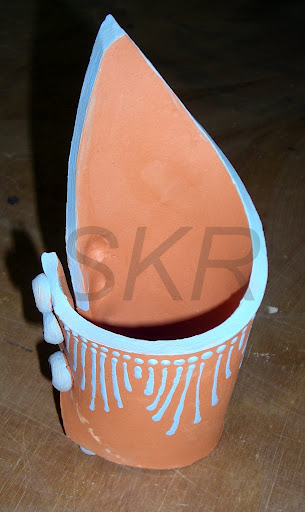
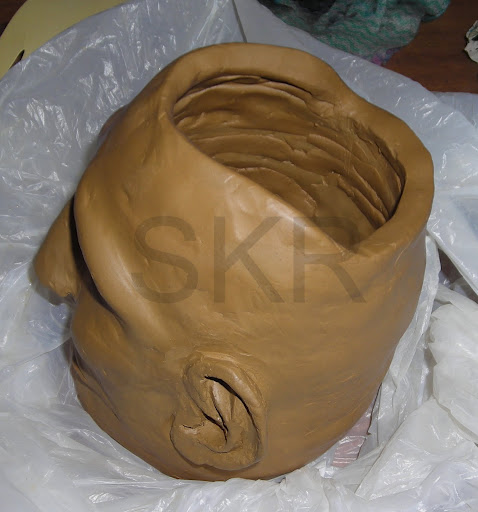
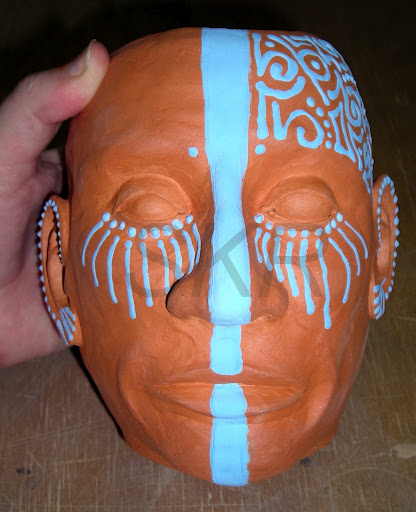
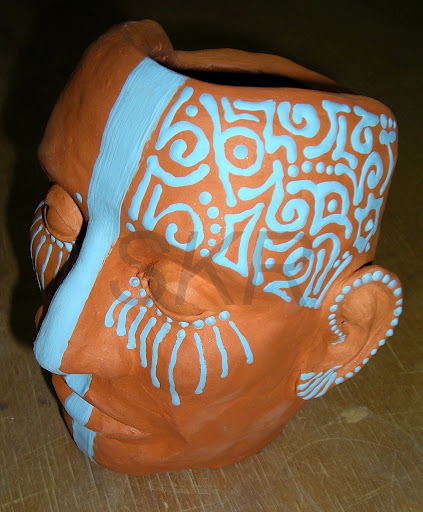
This evening was my last ceramics studio class – next week everything has to be finished so we can present it. My “Dreamer” head has been fired and looks great!

He’s painted in a tribal style, kind of a mix of Aztec and American Indian inspired. I wanted him to have a shaman kind of feel to him.

I also made a pencil holder, partly to practice working with a slab – this is where you roll out the clay and then shape it, and partly to practice my slip technique. (It’s a very unwise idea to trial a new technique on your final project!)

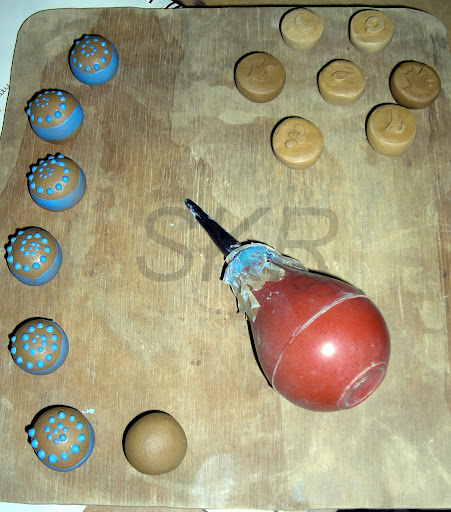
Today I just had to make all the dreams that would rattle around in the head. The design over all is inspired by my first creation of a pomegranate. I decided to try another ceramics technique that has intrigued me – making stamps out of clay to create impressions in other clay. I decided to make a collection of small round balls, about the size of a truffle, and indent dream symbols into them, then decorate them with blue slip lines and dots so they would complete the face paint. Here is one of the little clay stamps, a fish:

Here are the little balls with the stamps indented, they’ve also been textured by rolling them in aida cloth:

And here they are being painted up. The red bulb is full of blue slip (liquid clay) that you squeeze very gently to dot or trail lines, kind of like decorating cakes with piped icing. On the right side is my collection of stamps.

They look a little more like truffles than I had in mind! I expect that wont be so pronounced once they’ve been fired and the colours change to orange and powdery blue. 🙂 I got the last one finished on the dot of 8.30pm which was fortunate. They’ll be fired this week and I’ll be assembling and presenting everything next week. Very happy with my work, I’ve really enjoyed working with clay.

See my final ceramics post here.

Poem – dream-killer

A poem from my 2003 journal:
 
 
i am not a dreamer
i am a dream-killer
that is what this blood is, upon these pages
me, trying to exorcise things from my chest
that cause me pain, dreams that
are breaking my heart, things
i no longer believe in.
i have been
completely unable
to inspire vulnerability.
i walk openly
among the wraiths and men
alone.
i am afraid this dream shall never live
shall gestate tremblingly, over my life
and be still born at my death.
i am afraid i do not hold
the keys to my own deliverance.
i wake and walk among you
with doves and stranger birds
beating at the cage
that is my chest
i wake and walk among you
with the smell
of dreams rotting
in my nostrils.
i am a greenhouse
full of dying orchids
i am sorry you were planted here, lovely ones
i do not know why, you do not know why
we know only
each other’s pain
i cannot ease yours
i am crippled
and the world is indifferent
so let us sit here
weeping to the music
let the fears become as blood
at least, at the end
we have each other
to haunt the streets
so try not
to beat your wings
so fiercely;
you break
my heart
i am sorry
the splinters
stick
in your breast
my loves,
i can taste
your blood.

Talks and interviews!

Busy-ness in all directions! I’m in a very good mood today. Things have been going pretty well lately, and this weekend I actually took a whole day off which is no end of good for my mental health. I had a few friends round for a campfire which was so relaxing. Charlie marred the evening slightly by going to the toilet right in front of where folks were sitting – and his digestive system is terrible! He’s one smelly little dog! Horror horror, guests moved round to the other side of the fire while I cleaned up and thanked my lucky stars I had disposable gloves and paper towels in the house.

Oooh oh, my peppercorn tree Gandalf doesn’t just have a resident possum, he has a family of possums! The other night I watched mum possum climb back up with a little furry baby clinging to her back. Awesome!

Whilst enjoying myself at the campfire evening the other night, I suddenly remembered that I’d agreed to be interviewed live on radio (over the phone) and dashed into the house hoping I hadn’t missed the phone ringing. I was going to be talking about the upcoming Blogging Workshop (see What’s On) so I quickly dug up all the details and wrote them down. Fortunately I hadn’t missed the phone and it rang a few minutes later. I’ve never done a live interview like this, it was quite nerve wracking. The interviewer was Peter, with Radio for the Print Handicapped (RPH), a local community radio. The phone also made it a little bit difficult to hear and near the end I simply couldn’t make out his question and answered what I thought he was asking which turned out to be completely wrong. 🙂 Ah well!

I’ve almost finished my Radio and Online Contributors Course at Radio Adelaide, which is partway towards a Cert III in Media. I’ve enjoyed it so much more than I expected (and I was expecting to enjoy it) and I’m looking forward to doing more training with them. As part of the course we had to record an interview, edit, multi-track, write a promo and all the bits of paperwork associated with a complete piece of radio, ready to be broadcast. We also had to put the interview online. I teamed up with another student, Gary and we each interviewed the other. We were given two possible topics to discuss, our earliest memories, or our carbon footprint. I chose earliest memories and Gary chose carbon footprint. I was slightly surprised by the earliest memory option, considering the rates of childhood trauma that must be a hot button topic for plenty of people! So I chose a few that didn’t reveal too much (my ‘mental health’ problems started in very early childhood) and you can listen to the result here. Gary has done a lovely job with the interview.

I’m going to be giving an hour long talk on Wednesday morning for a bunch of Tafe students, so I’m busy preparing. I’ve been asked to share my personal experience of mental illness and recovery journey. An hour is a darn long time to monopolise a room so I’m putting together a powerpoint of images and I’ll add in some poems. Hmmmmm I can probably use some of the poems I read for the Fringe event recently, they were about Recovery. It’s very very nice to be at the point where I can pull together existing work for some talks instead of taking the time to write or paint completely new material. Not that it happens very often, mostly I find that a new audience means I need to put things together differently, or in some cases my understanding of the topic has grown since I wrote the original powerpoint/notes and I want to update them or frame them in a way that’s easier to understand. Anyway, wish me luck! 🙂

Mental Health needs better PR

The very first mental health article I wrote on this blog, back in August 2011, was about Managing Triggers. I get frustrated by the pathologising of so many human experiences in mental health, and all that I have ever heard of triggers is how to work to reduce their impact. By the time we have eliminated everything deemed a problem, there seems to me to not be very much life left to be lived. I think mental health should be a freedom, an opening up rather than a closing down. It saddens me when so much that merely makes us human is seen as something to be fixed. So when talking about triggers, I talk about positive triggers also. In the hands of people without creative vision, mental health is so often spoken of in a way that makes me hate it. There’s something gone terribly wrong when so many people, I’m thinking particularly of people with a diagnosis of Bipolar Disorder, would not want to have their condition taken away from them. The version of mental health these people are thinking of is so abhorrent they would choose mental illness over it.

One of the strategies that can be used to try and reduce chronic incapacitating sensitivity to triggers is desensitisation. It can be surprisingly effective when paced appropriately. Take the idea too far and you end up with the kind of emotional numbing and insensitivity to life that can characterise dissociative disorders. Frequently within the mental health services, mental health is presented as nothing more than an absence of symptoms. No more soaring mania, no more anguish, no more blood, no more voices. Mental health is silence, clipped wings, drugged stupor, numb blankness. So many of us would rather soar and crash like Icarus than crawl the face of the earth like insects. What we crave is the wildness, the depth, the creativity and imagination and dreams without the agony and destruction. What is so often offered is a flatland that feels so empty and meaningless we are filled with a despair it is almost impossible to speak of to the social workers and the shrinks.

I feel deeply ambivalent about the way that disabilities are tangled with so much that is positive. To return to Bipolar for a moment, folks talk about the boundless energy of mania, the incredible creativity of so many people with this condition. On the one hand, I read about how people need to find the positives in their conditions to help maintain self esteem and find a balance, and that makes sense. On the other hand, I think that if we define the condition in terms of deficits, then the creativity and energy belong to the person, not the condition. And then, the reluctance to be free of the condition (assuming such a thing is possible) disappears. If you could keep the ecstasy, the brilliant creativity and quickness of thought and empathy for those incapacitated by depression, and leave behind the relationship destruction, months of inactivity, suicidal distress, reckless spending, then would you still prefer mental illness?

Mental health is so often presented as being ‘normal’. A normal life is such a small, bland, meaningless thing that I can’t see it being worth any kind of effort to obtain. The box of what normal is, is so small that I have never met anyone who actually fits into it. Recovery to this normal can be a kind of insanity, like new cult members suddenly parroting the party line and telling you they’re happy despite something terrifyingly empty in their eyes. Radiohead sing about this kind of life in Fitter Happier.

I see mental health as freedom from the things that stop me being human. I mowed my lawn today and I wanted to be able to smell it, the smell of fresh cut grass is one of my favourite in the whole world. But the dissociation is too high today, I smell nothing. I work to create a life with love and grief and passion, not to merely disconnect from pain. I pursue and create something so much grander than ‘normal’, something that is uniquely me and mine, an expression of my own soul. Mental health for me is still about soaring, still about voices and pain, but where I can smell the grass.

When I came across this idea that many people (not all of course) would not want to have their mental illness magically taken away from them, I wondered about myself and my own experiences. If I could go back to my own childhood and wish away the dissociation, would I?

No. Not unless I could also wish away the things that were causing it. If the trauma remains, then the dissociation needs to remain too. As much as it has cost me, I also feel it has saved me. In a way, becoming highly dissociative has been a mentally healthy response to circumstances.

So, when writing about triggers last year, I wrote about positive triggers too, things that move us in ways we do not consider to be problems. I wanted to illustrate the idea with a lovely poem by Gwen Harwood, but I couldn’t find it at the time. Today I found it, and here it is:

A Gypsy Tune
Gwen Harwood
Szabolcska once in Paris wept
          aloud in public, in the Grand
Cafe, when a gypsy fiddler played
          a folksong of his native land.
When memory seems a field of graves,
          and youth impossibly remote,
some sobbing air will breathe to life
          pulsebeat by pulsebeat, note by note,
landscapes and lovers, fiends and friends
          long lost, long dead.       Their features glow
with light so absolute you think
they could not join the shades below.

Good mental health everyone. For more about information about how to use triggers to support your mental health, go to Using Anchors to Manage Triggers.

The Dissociative Initiative update

There’s been a lot of work going on behind the scenes lately about the DI. After a lot of thought several of us are going through the process to incorporate the group and turn it into an official association. This involves a lot of paperwork and having to carefully and formally word concepts like Recovery and Peer Work. It’s going to take some time (and funds!) to accomplish, but I’m very excited about this. I’m currently working on a draft of the proposed constitution. I was really inspired by the About Us page for Intervoice, that’s the international Voice Hearing Network. I especially like these values:

Working in PartnershipExperts by training (workers and academics etc) and people who are experts by experience are encouraged to work together, this means that national representatives from the hearing voices initiatives around the world are encouraged to attend our annual working meetings as “pairs” or “groups”. The expectation is that these pairings/groups are ongoing long-term working relationships (as in working together as equals) that continue outside of the meetings and that couple/group prepare their presentations together. The advantage of this arrangement is that the perspectives both the expert by experience and expert by training are included in all discussions and thereby feed into the decision making processes of the organisation.

Bridging the personal and professionalWe believe that we do not need to maintain a worker/psychiatric survivor divide. This has been a very significant contribution to the success of intervoice as an organisation and sets it apart from many other agencies and services working on mental health issues. The process is simple and involved the members (experts of experience and experts by training) committing themselves to bridging the worker/psychiatric survivor divide and developing real relationships with each other, as a result long term friendships have developed. This is more easily accomplished than might be imagined, having common cause and placing a stress of equal value of everyone’s participation tends to breakdown the worker/psychiatric survivor user divide and gives space for a very different way of working and being together.

I’ve asked Ron Coleman, who is a very well known voice hearer and mental health activist for a copy of the constitution of Intervoice and he’s said he’ll pass it on. I’m expecting that to be great reading and good inspiration. There’s quite a few steps in this process yet but I’m excited to have started.

There’s a few reasons I think that becoming incorporated is a good idea. So far everything we’ve done has been as an unofficial community group, and it has been great to have that relaxed environment to discuss ideas and develop resources in. I’m not keen on the corporate, bureaucratic world of paperwork and meetings and in this sentiment I am not alone. Formalising our group does mean having to engage with that world, hopefully while maintaining the informal, friendly and efficient characteristics of a grass-roots group! Becoming an entity will help to raise awareness and network with other organisations, to seek funding to get new projects off the ground, and to maintain our resources and not let valuable work get lost and left behind in busy lives.

I also like the group nature of the process, working together as a board, creating partnerships to work on specific projects etc. This has been the process for the DI since inception. We gave our first talk, Cary and myself, at Mifsa in late 2010. I was so terrified I shook through the whole talk and took about three days to come down off the massive dissociative aftershock. I could not have done this alone. The stigma, discrimination, anxiety, freak factor, and lack of respect for the value of lived experience would simply have been too much. The courage to go forwards has come from groups, and the impetus to persist has come from getting phone calls from distressed, isolated people who’ve been told dissociation doesn’t exist, or nothing will reduce it, from having people weep when they attend Bridges and for the first time meet with other people who have the same challenges, from having people describe these resources as life saving and also desperately insufficient to meet the needs out there. Groups of people are essential to the functioning of the DI and the resources we’ve developed. This is about far more than one person’s ideas or career goals, and it needs to go beyond one person to have any hope of being able to address the scale of the need that is out there.

Bridges Welcome pack

Today folks were all late to Bridges so I got some paperwork done. 🙂 I sorted out my folders for the groups I’m involved in, culled all the out of date stuff, sorted things into plastic sleeves, printed up fresh pamphlets, and created the most comprehensive welcome pack to date for Bridges. I’m really pleased with it! Welcome packs are tricky, to my mind they should not have too much in them, but should answer the basic questions, contain information people might forget and want to look up later, contact details, and references of where to go for more information. I once signed up as a member of a carers organisation, only to be sent a huge plastic folder full of pamphlets and pages. It was so overwhelming I left it for weeks before opening it, read it all through in one sitting, promptly forgot the lot and put it away. That’s not so helpful. Here’s what’s in this one:

  1. The Coping with Hearing Voices A3 poster
  2. The Bridges Flyer (with email addresses on it for myself and Ben)
  3. A brochure about Mifsa’s Services
  4. Fact sheet about Managing Dissociation (the packs contain the Mifsa branded version)
  5. Fact sheet Introducing DID (ditto above)
  6. Dissociation Link postcard (with website address for online resources)
I am so pleased with this, it would have been such a tremendous help to have received a pack like this myself 5 years ago! I am now planning to put together something similar for the Voice Hearing group I co-facilitate, Sound Minds. I print, fold, arrange, and staple the pack together in such a way that it can all be opened and read without having to take out the staple. I couldn’t make these fast enough today, they were being snapped up left, right, and centre. If you would like a pack for yourself or to pass on, please feel welcome to contact me or Ben at Mifsa on (08) 8378 4100 or send an email with your postal address to me at sarah@di.org.au. And if anyone wants to donate an hour to help me fold and assemble some, sing out! 😉

Charlie’s getting better!

I am in a very good mood since I took my dog Charlie to the vet for another checkup. The results were finally good! His bad ear is completely clear on infection now that all 3 grass seeds have come out. His other ear has become slightly inflamed in the meantime, but nothing too severe we hope. This means once I’ve run out of ointment I can stop the twice daily ear cleans and go to drops in each ear (from separate bottles) only once a week! Boy is he going to be happy about that!

His skin infections have also completely cleared up. That means the two medicated baths a week isn’t needed anymore either! We step down to one a week, then one medicated bath a month. Considering the cold weather we’ve been having and that blow drying him takes about 3/4 hr, this is a wonderful thing. 🙂

He can stop the antibiotics, which will give his poor digestive system a chance to rebuild a bit. His eye ointment is currently sufficient, he tested negative for any more eye ulcers. He’s like a new dog, and distinctly more bouncy and happy. Now I’ll be able to go back to walking him instead of spending so much time each day sticking stuff in his ears and eyes!

I still need to sort out a better dog bed situation – when it rains a lot my shed and backyard flood, which makes life a bit difficult. Next fortnight will be the first in a long time where, hopefully, I won’t be seeing the vet! Very happy about this. The euthanasia option was creeping onto the table as he wasn’t improving, in chronic pain, and my finances took a severe beating. Now it’s off again and we can limp on a bit longer. Nothing makes your day quite like discovering you don’t have to put down your dog!

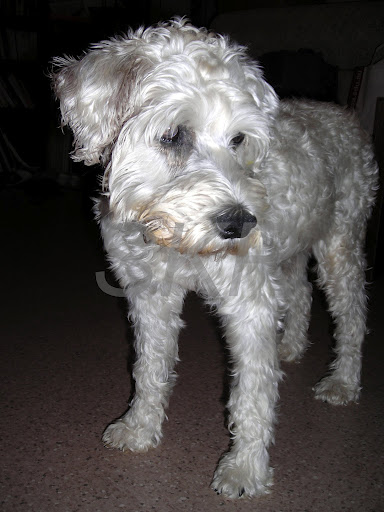
Here he is, looking all woolly in his long winter coat and fresh from a bath this morning:

Charlie says hi. 🙂

Ceramics class is going well

This post is my third about my ceramics class. See my first post here and my second post here.

Feeling very content this evening after a most satisfying day! I trundled off to my counsellor this morning, I’ve seen her a few times now and I’m finding it really helpful. Not without challenges, digging around some childhood stuff is setting off some pretty bad nightmares, but I’m feeling excited and on the right path. 🙂

I was hoping to get lots of homework done this afternoon but ended up chatting to friends, making myself electronic sticky note reminders, thinking about things and hanging out. Then this evening I had ceramics class and it went really well! I have a few dollars this week and treated myself to a chai latte. I have not managed to remember to bring my camera even once yet, so I can’t show you how my ‘head‘ is progressing, but it’s looking great! I finished the eyes today, smoothed the surface, and did tribal style decorations in blue slip on it. It will now be fired at the lowest temperature, next week I’ll have to make the call if I want to add any glaze to it and re-fire at a higher temperature. I also made a pencil holder as today we found out we need at least four finished works and so far all of mine have been pinch pot or coil built, so I made one from soft slab and used it to practice painting the slip on. I know for all you non-ceramics folks I just started talking Swahili. I’ll post pictures later, I promise. I do have an image for a practice plate I made last week, two ways of applying dye-infused slip – through a nozzle almost like cake decorating, or painted on then scratched back.

 I decided on the nozzle decorations and a little brush work for the head. The head now looks really interesting and shamanistic, which is perfect as I’m going to fill it with dreams next. 🙂 I have only one more class to have everything finished by so hopefully nothing explodes in the kiln or gets dropped. Things are going well. 🙂

See my next ceramics post here.

Review of The Flock

I’ve just finished reading a book that was recently donated to the Mifsa library, called The Flock by Joan Francis Casey with Lynn Wilson. I will definitely be adding the book to my own library, it was an excellent read. I was expecting another really dated, sensational, riddled with graphic abuse accounts biography but instead found a really lovely depiction of the challenges and joys of multiplicity and integration. I’ve read so much about this topic now that it is really difficult for me to put myself in the shoes of someone who is new to it all. I’ve been trying to think about the book from that perspective to work out if it is one I would recommend as a place to start reading. At the moment my suggestions are First Person Plural by Cameron West, The DID Sourcebook, Got Parts, and Trauma and Recovery for those who can get something out a fairly dense book that is fantastic but written in more clinical language. These all have good descriptions of multiplicity and dissociation and, aside from the last, are reasonably easy to read. Some of the books out there are painfully technical and difficult to read, some have clearly been written by and for clinicians and are filled with terms like ‘dissociated identity is a failure to achieve crucial developmental goals’ which is a perfectly valid and interesting perspective but worded in a way that makes my teeth ache. I don’t think we need to throw around terms like failure when there’s less painful ways of describing the same process.

The biographies, particularly the early ones, are very interesting to read and I’ve found them very useful to inform and provide background to the current understandings of trauma and dissociation but can be pretty hard going. A couple of them have such graphic accounts of abuse that I nearly vomited reading them. Most are sensational, and rely on the severity of the abuse to try to help a disbelieving public wrap their minds around the idea of multiplicity – I know it sounds way out there but look what I’ve come through, it was so extreme that multiplicity makes sense really. I have a certain sympathy for this approach and it certainly does make sense but it also leaves people with the unfortunate idea that multiplicity is only ever the result of the most extreme and sadistic child abuse imaginable.

When I started reading and gathering information, it was incredibly hard work. Everything had problems. Most of the information was overly simplistic, most of it contradicted everything else I read, some of it contradicted itself, the rest of it was so dense and clinical it was like being beaten to death with a brick. There are squabbles about how to tell ‘real multiples’ from ‘fakers’, horror stories about therapists coercing suggestible people into becoming multiples, things that say hypnosis is useful, things that say hypnosis is incredibly dangerous and totally contraindicated, books that list the ‘types’ of parts every multiple must have (the protector, the inner self-helper, the abused child), sensational descriptions of multiples that seemed to reduce them to circus freaks (not that I have anything against circus freaks!) and ego-massaging depictions of therapists intelligent, courageous, dedicated, and gifted enough to save them. It was a minefield, very difficult to work my through and start to piece together my own framework. Often the books and research left me really drained and depleted, it would take a few days to process them and start to get my head back to (my version of) normal. Fortunately, I’m persistent, and I’m good at working out the underlying principles and themes of books, and linking together information from different books or even different areas of life to build theories and develop frameworks. There’s nothing quite like living a highly dissociative life to make you good at linking up disconnected concepts people don’t usually put together. 🙂

I think I would recommend The Flock, with a couple of caveats. There are some descriptions of abuse – not many, but they are there. They tend to be very contained, you can skip the paragraph and jump past them without too much trouble. The same thing goes for First Person Plural. It is very interesting in that the book is composed of Renee’s memories (one member of the Flock) and the journal entries of her therapist Lynn. It’s great to get an insight into both processes. The most obvious concern I can see that people might have is that the type of therapy that is depicted in it, called re-parenting, is extremely time intensive and not very common. Considering that most of the literature out there subscribes to the idea that multiplicity is always an extremely dysfunctional state and requires many years of intensive therapy, most multiples and their families are already very anxious about their prospects when they can’t find a therapist or afford one. I’ll write more about the role – and limitations – of therapy in my experience shortly, (edit: What’s the point of therapy?) but the short version is that the therapy depicted in The Flock is certainly helpful for them but that doesn’t make it the only way forwards. 🙂

The Flock is essentially focused on the ‘recovery journey’ which is refreshing, and also depicts integration very sensitively. There’s a number of books out there that describe integration as getting rid of all the parts except one. The Flock has an approach I feel is far more ethical – the description of integration as all the dissociative barriers coming down so that all the parts are united – “from that moment on, all of the personalities had all the time, all of the time.” The other biography I’ve read that depicts this understanding of integration is Leah Peah’s Not otherwise specified. Lynn describes herself as “surprised at how comfortable I am with seeing ‘only’ Joan. I don’t miss the separate personalities. Joan’s right. In some miraculous way, they are all there.” Having said that, many multiples feel under a lot of pressure to integrate, often from overzealous therapists who make integration rather than improved quality of life the goal. It’s perfectly possible to create (or at least, simulate) integration without improving quality of life at all. I see no value whatsoever in swapping the diagnosis of multiplicity for diagnoses of bipolar, depression, borderline personality disorder, and so on.

When talking to folks who come for the first time to Sound Minds, the voice hearers group I help facilitate, I often talk about how individual and unique recovery is. Not only is what helps unique to each individual, but what ‘well’ looks like is different too. Some people have no voices when they are well. Some people’s wellness looks like voices with whom they have a positive relationship. Some people still have dreadfully abusive voices even on their best days, but they have learned excellent strategies and coping skills and are not limited by them. There’s not one road out, or one end goal in mind. Sometimes working towards a specific end goal isn’t even all that helpful, just putting one foot in front of the next working to reduce suffering, improve your functioning, find hope, and create a life you can love will take you to goals you could never have imagined or anticipated that are truly wonderful. That’s certainly how I feel about my peer work. 🙂 The same lack of obsessed focus is probably useful when it comes to thinking about ideas like integration.

The last thing I noticed that I’d disagree with or feel concerned about leaving unchallenged is an assertion in the book that DID is always and only ever caused by abuse. Abuse is highly implicated in the formation of DID, but so is neglect, chronic pain, and all kinds of trauma. There’s a lot of people who are afraid that what they went through wasn’t bad enough for them to be DID, or that a diagnosis of DID means some other terrible things must have happened that they are going to remember later. These fears add a lot of unnecessary stress to the situation.

Caveats aside, I’d recommend this book. I found it a beautiful depiction of the Flock’s experience of multiplicity and Lynn’s love and exasperation throughout a challenging but profoundly healing relationship.

Paper has been published!

The TheMHS (The Mental Health Services – a national annual conference in Australia) Book of Proceedings is now published! Cary and myself wrote a paper for this after presenting at the conference in 2011. We only found out about the opportunity to write a paper about four days before it was due, so it was a pretty frantic effort. Cary is an early morning sort of person and I’m an late night sort of person so we worked on it in shifts over a weekend and submitted all 3,000 words of it by 5pm the day it was due… the next morning I got up and anguished over all the errors we hadn’t polished out yet. It’s called Grounding as management of dissociative experiences.

Nevertheless, it was published, and in the Recommended Reading section too! You can read the contents page here. Unfortunately the publication costs $50 to purchase, but as it’s my first published paper I think I’ll try to scrape it together from somewhere and put it on my shelf. Charlie continues to improve ear-wise, although his digestive health is at an all time low – probably due to the high doses of antibiotics he’s on. Hopefully the vet checkup this Thursday will give him a clean bill of health and I can take him off them and the twice daily ear cleans and the twice weekly medicated baths… all of which would give me a little more money to spend on frivolities like the Book of Proceedings. Wouldn’t it be nice if you got a free copy as an author of the paper?

In other exciting news, I am in the complicated process of downloading/purchasing the Adobe Creative Suite 5.5 with In Design – this is the software I will learn to use so I can lay out my booklets for printing. It’s supposed to be a fairly simple process, download the download manager, that sorts out downloading the trial version of the software you want to test. Then just pay for the set you want which activates the trial already loaded onto your computer. A friend has kindly donated the cost for the student version which is fortunately much cheaper than the full price adobe asks, but still too much for my budget to manage.

Yes, well, four days of wrestling with the adobe download manager later, following the instructions in the many online forums full of deeply frustrated people, uninstalling and reinstalling the stupid thing and still not getting anywhere… someone else has downloaded it for me onto their machine, and now we are going to try and transfer it across to mine and see if that works. Pretty please! It’s hard to be patient about this kind of thing, but my frustration is tempered by the knowledge that I really don’t have time to learn how to use it this week anyway. But soon! soon…

Introducing DID Brochure and unplanned rant

I have been busy again today over at Dissociation Link, working on making the pages more informative and easier to read. The Resources page there is in much better shape now and frankly kind of puts my own to shame! (update; not anymore!) I’ve also uploaded another free trifold brochure called Introducing DID.The longer I’ve been involved in mental health, the less interested in the ‘top level’ diagnosis I’ve become. I’m more interested in what we can safely diagnose about ourselves – we know if we hear voices, feel anxious, have nightmares, or suffer compulsions. We might not know the clinical terms or why or what to do about it, but we can self-identify this stuff and go looking for supports. (not that it’s always this simple – took a long time to work out what was going on for me) What’s more, if we don’t get so hung up on the diagnosis, we can share resources and information a lot more easily. Otherwise, people with the schizophrenia label don’t get to benefit from what folks with the eating disorder labels are learning about stress management and relationship developments, for example. Not to mention that the way disorders are classified is often pretty arbitrary; they are syndromes, collections of symptoms and experiences that seem to cluster for many people. For a diagnosis of Borderline Personality Disorder, 5 of 9 possible symptoms must be present. That actually means that 2 people with the same diagnosis of BPD may only share a single symptom in common. The definitions of the eating disorders have become so narrow that most people with an eating disorder do not fit into any of the categories but are instead given the pretty meaningless diagnosis of an Eating Disorder not otherwise specified.

The diagnosis of Dissociative Identity Disorder (DID) requires high levels of dissociation in two areas, identity and memory. People who only have high levels of dissociation in the area of memory get the diagnosis of Dissociative Amnesia instead, but people who experience high levels of dissociation in identity only get stuck with the Dissociative Disorder not otherwise specified label. Why? Multiples who start out DID but go on to develop more co-consciousness would actually have to transition label over to DDnos. In practice this doesn’t happen because the label DID has come to be synonymous with the concept of multiplicity, and the whole point of labels is to communicate a shorthand about what the person is experiencing. As a result, a lot of what we think we know about multiplicity, we know only from the extreme end of the spectrum, from people who exhibit high levels of dissociation in two specific areas. This does not capture or reflect the experience of many people who experience multiplicity with lower levels of amnesia or in a less extreme way. 

This rather resembles the development of knowledge about schizophrenia – originally our entire understanding of the condition was based on the observation of people in psychiatric institutions. Now a much broader picture is emerging – it turns out that many people exhibit only mild symptoms. It turns out that some symptoms, once considered to be sufficient for a diagnosis of the whole bundle of experiences and deficits that make up the schizophrenia label don’t actually go hand in hand with everything else thought to be part and parcel of the condition. For example, there are many voice hearers who meet no other criteria for a diagnosis of schizophrenia. Voice hearing turns out to be common, and not necessarily associated with any of the other symptoms of schizophrenia. 

Schizophrenia as a diagnosis is being enthusiastically questioned all over the world, not least because people seem to do better without the concept of having a life long illness. Capturing experiences like withdrawal and lack of motivation and calling them part of a disorder such as schizophrenia can mean that when someone experiences them they are ascribed to the condition instead of people considering whether they might be the result of loneliness, misery, fear, and grief. 

It is true that certain experiences do seem to go together, that you often find clusters of experiences. It is also true that most of us exhibit a slightly unique cluster, and diagnostic labels cannot possibly capture this. Many of us don’t experience a symptom or two from our own diagnosis, and many of us experience a symptom or two from a different diagnosis, that often goes unrecognised and unsupported. Or, even more depressingly, our cluster gets us several diagnoses and we become badged as complex cases and often feel deeply discouraged about our chances of recovery. Additionally, our unique cluster changes over time, due to growth, stress, better coping, processing, new experiences; or even day to day depending on how tired, stimulated, distracted, nourished, or content we are. This is normal! 

Folks with DID often feel this stress about many diagnoses, because the condition so commonly co-exists with other disorders such as BPD, Posttraumatic Stress Disorder and other Anxiety disorders, Attachment Disorder, Eating Disorders, and so on. It’s common for people with DID to have difficulties with things like self-loathing, chronic suicidal feelings, shame and relationship difficulties, because these are common struggles for people traumatised in childhood, and most (not all) people with DID have been traumatised in childhood. 

All of these experiences occur on spectrums, ranging from ‘normal’ human experiences to those are that quite extreme or disabling or depressing. Many of our diagnoses fail to capture this also precisely because they are giving a label to a condition at the extreme, disabling end of the spectrum, This is often for practical reasons such as ensuring that very disadvantaged people are able to access health care. There are many other problems created by this approach, not least of which is that we lose our spectrum and gain discrete categories instead. You are, or you are not. You have it, or you don’t. Part of what this does is scares the living daylights out of the folks who suddenly find themselves sharing diagnostic categories with people who are profoundly disabled by a severe form of the condition. Someone who experiences comparatively mild stress induced psychosis watches someone else with chronic psychosis and fears they are looking into their own future. The broader culture doesn’t even have the concept of mild psychosis.

The doctors often try to communicate this idea by using the term ‘pseudo-hallucinations’, the hallucinations you have when you’re not really having hallucinations. There’s no evidence to suggest that the mechanisms involved in ‘real’ and ‘pseudo’ hallucinations are any different, merely that in one the ability to reality check remains reasonably intact, while in the other the person loses this capacity and becomes delusional. Once again, these are not discrete categories, there is clearly a continuum between being able to recognise certain stimuli as hallucinatory and losing that capacity. Obviously, under the wrong circumstances it is easy to conceive of someone becoming overwhelmed and pseudo-hallucinations developing into the consuming, delusional kind. 

In the diagnostic categories where severity is the marker of getting the diagnosis, such as Posttraumatic Stress Disorder, we cut off a whole lot of folks who struggle with these issues in a less severe form. (assuming for a minute that people are only given accurate diagnoses which is a pretty ridiculous premise in itself, I realise) All those with moderate struggles around flashbacks, avoidance, and chronic fear have to fend for themselves, and the opportunity for these two groups to meet and share and learn from each other is very rarely offered. This approach cuts off those who are deeply struggling, from those who share the experience but are not as overwhelmed by it. This kind of peer support is incredibly powerful. 

So, I have a brochure called Introducing DID, because that is the kind of thing people are putting into search engines and the language our health professionals are familiar with. But I am frustrated at all the people living in the shadows of this diagnosis, not quite fitting for one reason or another. I am also repulsed by articles and books that talk about ‘pure’ DID, the ‘gold standard’ of DID, and the continual emphasis in written material that DID is the most severe form of the dissociative disorders. If one person is a ‘pure’ DID and someone else doesn’t quite fit the diagnosis, what does that make them? An impure DID? Half-caste? Mudblood? How the heck can a disorder even have a gold standard? And what do we even mean by using the word severe about DID? Do we mean that people with severe dissociation in other areas of their lives aren’t as disabled by it? That they don’t suffer as much? Do we mean that it’s harder to resolve? Where’s the evidence for these ideas? Why is everyone else in the dissociative diagnostic box left feeling as though their struggles and difficulties don’t count? There are people with significant dissociation in identity who are profoundly incapacitated and in chronic pain. There are others who are not even aware of their multiplicity and function in a healthy and unobtrusive way. There are people who experience the most distressing, abusive and overwhelming voices. There are people who’s voices are comforting, amusing, and restorative. I’m not all that interested in DID, I’m interested in dissociation in all it’s forms including multiplicity.

We need to hear more of these stories. We need to recapture our shades of light and dark, the depth and complexity of these experiences. We need to be able to trace our spectrums all the way along their length and link together all those who have so much to offer each other. We need to work on finding all the common ground instead of working on dividing our experiences and our pain into smaller and smaller categories, more compartmentalised and disconnected from each other. We need to speak about experiences and suffering in ways that don’t take away a voice and a sense of legitimacy from those who don’t quite fit the labels we’ve created.

This was going to be brief post, back when I started! Oh well. Apparently I had things to get off my chest. Soapbox packed away, on with my day! The last performance of Cracking Up went well tonight, I got to meet some new people and was given lovely compliments about my work, which I have tucked away in the hope that later I will be able to take them in. I have progressed over the three nights from feeling profoundly humiliated by my work to somewhat indifferent, to occasional small bursts of pride. So hooray for me. 🙂 I have also washed the dog, hung the laundry, eaten three meals, and done a lot more work on Dissociation Link, and that I AM feeling pretty proud of myself about. Hope you had a good weekend too.

Managing Dissociation Brochure

I’ve made some more progress on the site over at Dissociation Link, which is cheering me up no end. There’s now a link to a reworked version of the tri-fold brochure some of you may already be familiar with, called Managing Dissociation. I’ve been able to add in a little bit more information and suggestions, and a friend has kindly proof read it for me, which is awesome because I’m not so good at that!

It’s frankly ridiculous to attempt to justice to such a huge topic in a brochure, even if it does has two sides and small font! But, as I keep reminding myself – firstly, everyone has to start somewhere when learning about this stuff, there’s a huge need for simple, useful information. Secondly, most of us with these experiences get really tired of having to educate people about them all the time, so hopefully some of the usefulness of free resources like this brochure is to be able to print it up and take it along to your doctor, counsellor, partner… whoever, and save yourself one more ‘So what is dissociation anyway?’ conversation.

That’s the theory, anyway! You can check it out for yourself here.

The new, more comprehensive Bridges flyer is also uploaded and linked in everywhere I could find the old link. I’ve tried to answer the kinds of questions people tend to ask me when calling to inquire about it.

Apart from that, the Fringe performance I’m in went well tonight, which was great. We culled a few acts and tightened our performances to make sure we finished on time and it all went well. Nice to be part of theatre again, even if only in a small way with a few poems. 🙂

Cracking Up at the Fringe

The rehearsal tonight went well, which is great. I’ll be reading a small selection of poems about my recovery journey, as the theme for the night is hearing about aspects of mental health we’re not often exposed to. I’ve also painted a very basic ink painting for each poem as all the performances in the Chronicles of Cracking Up have images on a screen to go with them. I only just found out about that so I was busy this morning! Here’s one of them, to go with a poem called Here in my house on a hill by the sea:

I’ve been very busy lately with so many projects on the go and a lot of study to get done. I would like to have written completely new material for this event, but many of the poems haven’t been heard before and certainly the collection has never been put together in this way. I’m a little bit overloaded and have spent half my day crying on the kind shoulders of various people, so I think being able to make it to the performances at all is a pretty good effort. I was very happy with the warm reception my reading was given by the other performers, so I’m feeling more confident about Friday night.

Please feel welcome to come along, you do need a ticket at a cost of $10, all the details are on the What’s On page as usual. 🙂

Coping with medical touch

For those of us with trauma histories, dealing with medical appointments that involve touching can be incredibly difficult. Touch is often an area of great difficulty once it has been used to hurt you in some way. I’ll write more about the whole area later, today I want to talk about medical touch as this was the area we discussed in Bridges recently.

You may feel like you are the only person out there who is so stressed by medical touch that you’d rather have severe infections than go to the dentist, or risk cancer than get intimate checkups at the doctors, but far from it! Most people find these procedures stressful to some extent, and a pretty significant percentage of people are soo stressed and phobic that they avoid them altogether, sometimes with terrible consequences. However alone you may feel, however ashamed and humiliated, you are part of a whole crowd of people feeling the same way. That realisation alone can make a big difference. You are not weak or stupid or pathetic, and being stressed out by these things is nothing to be ashamed of.

You can avoid all the procedures involving touch. The consequences of this choice can range from negligible to catastrophic. This is a very common approach. Many people go down this road, and something I’ve observed is that if this is what you do, you will often stop going back to medical people for anything else either, because you can’t handle the pressure to get your over due extraction/breast exam/prostate check done. Please, don’t do this! If you have to tell your people that you cannot cope with touch but are working on it, please not to harass you, then do it. Unfortunately medical people are not always sensitive to these issues and they may interpret their duty of care as reminding you and pressuring you to have check-ups whenever they see you. Try not to let touch issues cut you off from access to health care in all areas – you need to be able to get medical certificates when you’re sick, pain relief, advice on new symptoms, moles kept an eye on, and so on. Try to limit the possible losses.

If you’re going to have a procedure that involves touch, some planning can make a lot of difference to how you feel about it. Take a bit of time to get to know yourself and work out what will be most calming for you. Will you find it easier to do all the touch things in one hit, or to break them up and spread them out? I’m a n all-in-one-hit kind of person, some of my friends are break-things-up people. Is one gender of doctor easier for you to cope with? Would it help to have a friend drive you home if you’re feeling wobbly afterwards? Are there things you can do to heavily compartmentalise whatever bad memories you’re trying not to stir up before you have the procedure? Can you distract yourself during; by listening to an MP3 player, playing with your bracelet, reciting the periodic table, composing a sonnet (ha ha)? Would it be comforting to take along a soothing item like a teddy, or would that make you feel more childlike and vulnerable? Would having the procedure done by a stranger be easier than going with your regular doctor?

If you’re a multiple, there may be someone in your system who isn’t as bothered about these things. Can you ask them to handle it? Do you need to do or take anything with you to help keep them out? What will you do if they switch?

You always have the right to walk away. Unless the situation is life threateningly urgent, if things start to go badly, say stop, get out, go home, put yourself together and try again another time. If the situation is critical and you are at total overload point, can you use dissociation to dull everything and cope with it? Sometimes creative visualisations can help to disconnect you from intense experiences. This is a little akin to self hypnosis. One I used to use a lot when my pain condition was severe and without relief (I am allergic to most painkillers stronger than paracetamol) is to picture my pain as an oil slick, burning on the surface of water. My body is half submerged and the oil is burning all over me. Then, I would slowly sink deeper and deeper into the water, leaving the burning oil up on the surface. Eventually I would be completely underwater, watching the flames burn on the surface. For me this helped to dull my perception of the pain I was in. It was still there, but a little distant. These kinds of ideas can sometimes help you to pull back from you intense awareness of touch and that agonising sensitivity your skin and body can have when deeply afraid.

Trying things from another angle, sometimes you can reduce the distress by talking yourself through the experience and using intellectual grounding techniques. These are things that help to orient you in time and space, so that you are able to stay in the present instead of getting caught up in flashbacks or emotions associated with bad memories. If  you talk gently and firmly to yourself as if you were a traumatised child, you may be able to start to break the link between touch and painful memories. Explain what is happening to yourself, tell yourself that this person is a doctor/dentist/surgeon/whoever, what they are doing and why. This simply strategy can be surprisingly powerful.

Try to avoid the things that recreate the initial bad memories, whatever they are. The sense of powerlessness that knowing you must have a procedure done even though you absolutely fear and hate the idea can be a strong link to original feelings of powerlessness. Whatever you need to do or say to yourself to break that link will probably help to reduce your stress. You want to try and prevent feeling trapped, helpless, terrorised, violated, overpowered, and abused. You are not going in for a procedure because your doctor is making you (I hope). You are choosing to go in even though you hate it, because you have a health problem that needs taking care of and you are the kind of person who looks after yourself. Same issue, different way of framing it.

You may want to consider recruiting your medical people to help you out in these situations. Hope over at The Road to Understanding DID and Me describes doing this for her recent stressful medical procedure, using a modified letter from the book Got Parts. This won’t always work, depending on the sensitivity of the doctor in question, but it can be very powerful to change the professional involved from a stand in for the abuser, to an ally in helping you get through something difficult as well as possible.

Depending on the procedure and situation, sometimes you may have an easier time if you go to a specialist who does lots of those procedures instead of sticking with a family GP who might do a few a year. Rather the way that blood bank nurses are often the most adept at drawing blood painlessly, the same kind of skill and experience can make things easier for you. For example, for sexual and reproductive health, here in SA we have ShineSA who have doctors and nurses who can perform tests for STI’s, pap smears, and provide information about contraceptive options for you. If the person who is touching you is professional and comfortable with what they are doing, rather than inexperienced and nervous, that can make a big difference to your stress levels.

Anything you can do to create a distinction in your own mind between kinds of bad touch – ‘I’m not very comfortable with this but it is not abuse and is necessary for my good health’ and ‘abuse kinds of touch’ will help. All these different types of touch tend to collapse in together and being able to start to differentiate between them and untangle them from each other can make a huge difference to how you experience and cope with medical touch.

A quick note – sometimes medical people have their own problems, and these are best avoided if at all possible. I mean, drive to the next town rather than let these people touch you. If your doctor is disgusted by touching you, curls their lip in distaste and makes you feel dirty and inferior, don’t let them near you. You do not need anyone who is intimately familiar with you to communicate disgust or revulsion about your body or it’s processes in any way. I mean that even if you have genital warts, scaly infected skin, open sores, whatever. A good medical professional knows you probably feel deeply humiliated and they help you to unplug from that shame and feel more normal about whatever the issue is. They model to you a caring and un-entangled relationship to your body and processes. Some medical folks – like some folks of all professions, have issues around sex themselves. They may behave inappropriately, be flirtatious, drop innuendo, and generally blur boundaries. Don’t let these ones touch you either. Get out, and make a complaint if you can. If you like them, that’s cool – date them, but don’t let them be your doctor! It does not help to collapse and confuse types of touch even further.

Lastly, timing is everything. I once had a doctor ask me about my relationship with my father right before a pap smear. This is not a good thing. If you decide to bring up trauma history or discuss things, try not to do this in the same appointment as the procedure involving touch.

I hope there’s some useful suggestions in there for you, you may have to try a few different approaches before you’re able to find ones that really work for you. Good luck, take care, and go gently.

New dates for your diary

I’ve been updating my What’s On page, there’s some events coming up soon you may want to get along to. This Friday, Sat, and Sunday I’ll be reading poetry on the theme of Recovery and Mental Illness as part of the Chronicles of Cracking Up. Tickets are $10 for an evening of skits, digital stories, comedy and more.

In April I’ll be giving a couple of free talks, one is a workshop about blogging as part of a group at the Writers Centre. The second is a Forum at Mifsa with Cary, we’ll be talking about different strategies for managing dissociation. This will be drawn from the talk we gave at TheMHS last year, but with a lot more detail as we have more time in this setting. It will be suitable for people who are new to the idea of dissociation but in depth enough to be useful to those familiar with working or living with these experiences. That’s the hope anyway!

In other news – I’ve found two manky grass seeds on my floor which I’m pretty sure have worked their way out of poor Charlie’s ear and have been doing happy dances ever since! The poor little guy may actually start to get better now! Fingers, toes, and intestines all crossed. 🙂 

Sarsaparilla

I’m up to my eyeballs in paperwork for the moment, sorry! Have a picture of a cat. 🙂 This is my cat Sarsaparilla,  who has been cleaning up the cobwebs in my garden shed with his face.

Charlie is still limping on, his ear is still really red but seems to be slightly less swollen than it has been. The vet bills are decimating my grocery allowance so I’ve become the worlds greatest mooch, nomming free food whenever I come across it. I’m caught in a loop whereby surely the next intervention will restore some base line of health and my finances will become manageable again… and if I was going to pull out, why do it now and not  $600 ago? Some hard calls are going to have to be made soon if things don’t improve.

But in the meantime I’m not thinking about it, I’m doing homework and cleaning and sorting boxes and other deeply exciting things that make me leap out of bed in the morning, bursting with excitement and joy de vivre. Hard rubbish collections have been fruitful lately, I now have a toaster! And a washing basket! And a pair of two seater couches were left on the verge nearby, so yesterday’s goal list was suddenly changed to ’empty out and sort through boxes in van, collect couches, repack boxes into van’. Feeling rather pleased with myself. They’ve clearly been left out in the rain at one stage because they smell lovely and clean despite being full of hand rolled tobacco odds and ends. The great circle of life continues….

First ceramics creations

This post is my second about my ceramics class. See my first post here.

I’ve brought my various ceramics creations home, partly because I keep forgetting to take my camera in, and partly because a few pieces have gone awol from the studio so better safe than sorry. Here’s my first hand built thingamys:

That’s a pomegranate on the left, a couple of fruit halves on the right, and some kind of gourd thing. I don’t know, it just sort of happened. I was playing around with textures a little, the gourd is all fuzzy and non reflective  because I kept pressing my woollen jumper into the clay as I formed it. Good fun! We had to make small items that could be used to transport something.

Next we have to work on our final project for the class, using one of our creations so far as inspiration. I really liked the pomegranate and riffed off that with a few ideas. In the end, I decided to turn the little seeds into thoughts or dreams or ideas or something like that, and the pomegranate itself into a head. I’m not quite sure what possessed me to try something so fricken difficult, but I guess stretching myself is the name of the game really. I wish I had a bit more time to dedicate to this class, there’s a whole world of ideas and artists waiting to be explored here. At any rate, I also bought my party finished head home to work on it some more before the next class:

It’s been coil-built, made by rolling out snakes of clay and coiling them on top of each other, then smoothing them out. You can still see the coils inside, which I need to fix up. It’s just big enough to get a hand into (we have to make the final product larger), but due to shrinkage in the kiln will probably only fit a petite or child’s hand once it’s fired. I plan to make little thoughts that can also be fired and will rattle around in the head.

I’ve been giving some thought to the best finish, a glaze or oxide or dye infused slip… for some reason I keep coming back to the thought of gold leaf… I may try to do some test runs on my smaller pieces to see what might work.

See my next ceramics works here.

Ekphrastic Exhibit

Last night the Ekphrastic Exhibit opened in Broken Hill, but unfortunately I was not able to be there due to road flooding. This was an unusual exhibition, involving collaboration between visual artists and poets. A number of artists working in different media created artworks upon the theme of ‘plastic lives’, the relationship between women, plastic, and life. Then poets were invited to write something inspired by one of the artworks.

I chose a lovely monochrome nude by Phyllis Raganovich. We talked a little about her feelings and intentions in creating the artwork, and her phrase “how I wish I could have those years again” resonated with me and formed the basis of my poem. Here is her artwork:

And here is my accompanying poem:

Wish
Oh how I wish
I could have those years again
I still dream I’m her
The woman who ran, laughing, for the bus
Danced down sidewalks when the wind blew
Breasts like ripe peaches, firm and soft
The hollow in my hip where my hand lay in sleep.
For you, love, I wish I could be her again
Back before life wrote on my skin
That you could have known me in those years
Met the woman I am in dreams, who still runs
But here, in the night, when you hold my breast
When you lay your hand in the hollow by my hip
I think you feel her beneath my skin
The wind that still blows, the scent of peaches
Still the dance of tender love.

Stress and more stress

This was a difficult day for various reasons, starting off with a trip to the vet for my little dog Charlie. It seems it’s a bit of a case of one step forward, one step back. His ear infection (the antibiotic resistant bacterial one) is slightly improved but by no means better. She was able to get a scope in there to look for the first time, as far as she can see his eardrum is still intact. She also saw at least one foreign body, possibly more. With  myself and a vet nurse holding him as steady as possible, she gently reached in with forceps and took out a grass seed. The poor little guy has had that in his ear at least since I got him in December, and possibly for a lot longer. It must have been incredibly painful. 😦 There may be another one in there but one was all he handle today.

Between the antibiotics and incontinence (about which nothing can be done except to keep him as clean as possible) he now has skin infections too, yeast and bacterial. That means medicated shampoo and extra baths every week. The vet checked his eyes, they are badly scarred but the current regime of eye drops is sufficient for the moment to keep them moist and prevent them ulcerating again. She also shaved any fur in areas that is often wet because this is inflaming the skin and leading to infections. He’s an odd looking little sheep at the moment.

So, I’m a little bit crushed that we haven’t made much forward progress and the vet bills are still far too expensive for me to easily manage. He has to go back in a fortnight to see if there is anything more in his ear, in the meantime I’ll flush it clean twice a day and add the medicated lotion. She was also talking about expensive diets which could push this whole situation into completely unmanageable. Ditto if he needs meds for his heart at some point, I just can’t sustain it. So I’m feeling flat about that.

There’s also quite a lot of stress going on with my neighbours at the moment, I need to padlock my mail box as things are going missing, and I’ve been told that my unit was once doused with kerosene and set on fire when someone local took a dislike to the last lady living here.

So I turned up and cried in Sound Minds today. (the Voice Hearer group I help facilitate) They’re such a good bunch. They looked after me. How ridiculous that the usual response from people when I say “I work in mental health” is something along the lines of “wow, isn’t that difficult, those people are nuts!” leaving me with the awkward – or slightly nasty, depending on my mood, response of letting them know I am one of ‘those people’. So, people were nice to me, I’m feel very tired about it all but I’ll figure something out.

I have at least been able to solve the problem of how to get the tablets into Charlie. Now, I sandwich them onto a milk arrowroot biscuit with a little bit of crunchy peanut butter, and he scoffs the whole lot down without ever noticing them. Phew!