Author: Sarah K Reece
Shifting the furniture
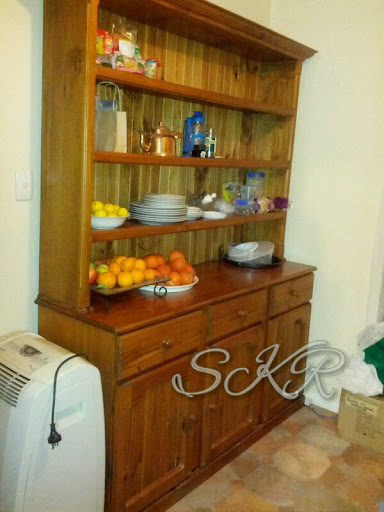
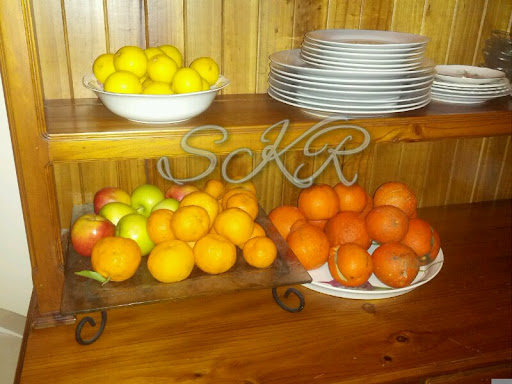
Isn’t it stunning?! Look at all that storage space! Following the DI meet up the other day, a few friends stayed back and helped me move the furniture around. Lovely people. This is my ‘dining room’ space, which I use partly to store everything I can’t fit in the kitchen (there’s not a lot of storage space in the kitchen) and partly as my study area. Lately it’s been a hopeless mess, every surface covered with all the things Zoe would like to eat/chew/hide in the back garden. Now that Tafe has started up again, I really need my study space back so a rearrange was on the cards. I didn’t end up having to get rid of any furniture to fit it in (it is pretty huge), the cabinet that was here was able to be moved into the loungeroom, which has had a big of a spruce up now too. 🙂 Look, somewhere to store all the lovely winter fruit people have been giving me. I love friends with gardens! Before the warmer weather really kicks in, I’ve planned a gardening day for this weekend to get some work done in my own. 🙂
This is the other wall of the dining room now, with a decent study space.
I’m not that happy about not having a dining table. I like dining tables. I like setting them, serving at them, sitting and eating at them, having a conversation over them, and using them to make complicated kitchen recipes that are so time consuming I need to be able to sit down for them. But, space is at a premium here and also I haven’t been able to buy any really nice really small dining tables, it seems I’m not the only one looking second hand. So for now, my study desk there by the window doubles as my personal dining table. I had breakfast there this morning, watching the rain fall on the garden while I ate my scrambled eggs and toast. Down the track I’d like to create a middle eastern style dining suite in my lounge room with pillows and low tables, I love the ambience and not having a whole room dedicated to a table that is barely used (or if it is used, needs to be cleaned off everytime you want to eat a meal there). In the meantime, I’m itching to rearrange my bedroom and studio and looking forward to getting into the garden.Â
I love rearranging things here and there, it sets off a degree of dissociation for me, makes me look at everything with new eyes. I have a home, and a cat, and a dog, and a studio, friends, part of my week spent working towards a degree and part spent doing volunteer work that is deeply meaningful to me… life is pretty damn good.Â
What is co-consciousness?
Co-consciousness is a term used to describe the experience of someone with multiplicity, where more than part is aware of what is going on. For someone with DID (formerly called multiple personality disorder), they have very high levels of dissociation both in identity and memory, which usually means that they are amnesiac whenever a different part is out. Amnesia can cause distressing experiences such as not being able to recall important personal information (name, date of birth, home address), years of your life, or daily struggles such as ‘coming to’ in an unfamiliar place and having no idea how you came to be there. Some people are really aware that they are losing time or memories like this, others are in a kind of confused fog where until someone asks them a question – where did you get those shoes? when’s the last time you ate? what did you get up to on Wednesday? – they’re actually unaware that they’re experiencing amnesia.
With classic DID, not only is the person experiencing amnesia, but they are confused by evidence left behind while other parts have been out. Obvious things may be clothes in the wardrobe that are unfamiliar and not to their taste, family members upset about arguments you don’t recall having, friends who think they know you by a different name etc.Â
Co-consciousness describes switching without this amnesia, so that if one part is out going about their day, another part is aware of what is happening. Multiples with high levels of co-consciousness don’t tend to ‘lose time’ or have blackouts, they’re still aware of what is going on. This is mostly how I function, although under stress my levels of amnesia increase. Multiples who have high levels of amnesia often find that to be one of the most challenging and frightening aspects of the condition, and for most, gaining some degree of co-consciousness is an important part of therapy and recovery work. This process usually starts by working on building self awareness and mapping your system.Â
There is a similar but slightly different called co-hosting or co-fronting, which you can read about here:Â What is co-fronting and blending?.
Co-consciousness can work practically in a few different ways. For some multiples, it’s like they are seeing and hearing everything that’s going on, even though they’re not the one moving the body. For others, it’s more like being told what happened, or watching a short video of memories. I used to be confused as a kid that so many of my own memories are in the third person rather than the first – that is, I see everything happening as if I’m up by the ceiling, looking down on everyone including me. I’ve since discovered that this is an easy way for me to tell when I’ve personally been out running the body and when I’ve just been watching – co-conscious. My own memories are in the first person, co-conscious memories are in the third. This is different for everyone though! I can really struggle sometimes with new friends or in new environments, especially if it wasn’t me who has met them before or been there before. People sometimes notice me pause as I’m asking inside for the information and if I’m lucky whichever part recognises the person or remembers the event will quickly fill me in, or switch out and take over.Â
Co-consciousness is incredibly useful, but there are downsides. One of them for me is the mammoth amount of energy it takes for us to track all the different information and memories and hand them back and forth. It’s like I have a whole house full of filing cabinets in each room, and on a busy day I’m mentally running back and forth between them trying to make sure we can keep up and still function as one. The experience of co-consciousness can often confuse multiples who have only been exposed to the ideas of psychosis or DID and don’t feel they fit either box. It can also be distressing to be aware of what is happening but not in control of yourself any more. As a kid I had a number of experiences that frightened me so badly I became convinced I was being possessed by the devil. I often felt at war with myself, trying to stay out and in control, and when I’d switch we would look in the mirror and I would be terrified at this face that was mine and yet somehow clearly not me. Co-consciousness can make you feel both crowded and painfully alone at the same time. These kinds of experiences are called Schneiderian first-rank symptoms and were once thought to be highly diagnostic of schizophrenia. Now we’re discovering they are actually very common for people with dissociation instead.
The technical stuff aside, what does it feel like to be co-conscious? Well, that’s different for different people. In fact, different parts of my system experience that in their own way. Whoever is out is often aware if they’re running everything by themselves or if other parts are ‘close to the surface’ and aware of what is going on. Sometimes those surfacing parts might comment or advise about what they’re observing, sometimes they might be struggling to switch or being triggered to switch. For example, I gave a talk at a locked ward in a psychiatric hospital a little while ago, and it was going well. We got there on time, with the notes and presentation gear, there was quite a group waiting, and we had the right part out who had written and delivered the talk before. There was a slight hitch in that a sad, lonely song was playing over the radio. Music can be a powerful trigger for me, and a sad lonely part was called to the surface by the song and immediately switched and came out. We were panicking a bit because this part could not deliver the presentation, and they knew that and desperately didn’t want to be there. We kept still and quiet and finally the MC turned off the radio to introduce us. Once the music was gone, that part dived back inside and the right part came back out to deliver the talk. Phew! Being a multiple can be very complicated.
My friend Hope has a wonderful description of her take on co-consciousness over at her blog:
Imagine a Combi Van, grab a handful of people and put them in the van. One of those people will drive the van, one may sit next to them. The passenger may just watch where they are going of maybe give directions. They may even pull the steering wheel to try and get the driver to go where they want. The rest of the people are in the back of the van. depending on where they are sitting and if the can see out the windows they may or may not be aware of what is going on and where they are going. They may yell to the driver to go somewhere or slow down. Then right at the back of the van, you may have one or two fast asleep totally unaware of what is happening and where they are going… (click here to read her full article)
For me, my poetry often talks about wells inside, very deep, or an ocean where we are sometimes at the surface and sometimes in the deeps. Here’s a short extract of a poem that describes co-consciousness:
I feel her surfacingÂ
like a scream rising
like a knot of tears
in my throat –Â
Fingernails into palms
I fight to stay
I can feel her so close.
I catch him
glancing at my eyes
perplexed
and I know he sees her
I know they’re her eyes now
but still my face, hands, body
still me if I can just drop my gaze.
In the car, on the drive home, alone
she steps into my skin
wears it a little differentlyÂ
adjusts the mirror, tucks
hair behind her ear
weeps alone in the night
as I fall, like a star, and fade out.
For more information see articles listed on Multiplicity Links, scroll through posts in the category of Multiplicity, or explore my Network The Dissociative Initiative.
Progress on the Dissociative Initiative!
To catch anyone up who isn’t aware of what the Dissociative Initiative is (for those of you who’ve just tuned in…) I’ve been working for the past couple of years with some colleagues in a small community group. We’re now in the process of incorporating into a not for profit, national organisation. You can read more about the DI here.
The agenda was getting everyone together to assess the draft of the constitution and work on it, to plan for the board and talk about what a board is, and what being on one involves. A lot of this process was about translating the incomprehensible language in which constitutions are written into something we could understand so that it was actually possible to have an opinion about it. So, here’s Draft 3, please feel welcome to read it and offer any feedback!
We plan to meet up again within the week to finalise the constitution and vote in the first board. I am so excited! We’re particularly looking at the following areas (for those who want to spare themselves reading the whole gibberish-y document):
The DI is having a meetup
Adapting to a puppy
The change from having an elderly, ill, blind dog Charlie, to having a young, energetic puppy Zoe, has been quite significant! Zoe chews everything. I mean everything. I came home the other day to find her standing on my coffee table in the middle of the room, trying to chew one of the legs off. So most of my belongings are suddenly being kept on benches, tables, or stuffed into my studio. I bought this shoe rack online the other day and now at last my shoes are safe and off my studio floor. On the plus side, she is basically toilet trained as long as she get outside. We haven’t yet mastered the ‘whining to get outside because the door is shut and she needs the toilet’ aspect. My rugs are in the backyard having rain wash puppy wee out of them, every few days I do a lap of the backyard to rescue whatever items (cutlery, makeup, handbag etc) she has snatched and hidden out there, and most evenings we curl up on the couch and watch tv together. I love tv on the internet, I don’t even have to tape stuff. 🙂 My garden needs some love and I’m itching to move some furniture around inside but it’s good to be making a start on creating a ‘puppy proof’ home. Rufus May
Poem – Not Empty Enough
There’s a creature in the dark, wet hollow in my chest
Chewing my bones.
Holding my childhood to ransom turns one
I’ve done three major blog make-overs, changing the format, layout, background image and fonts. I’ve added, edited, and deleted pages as I’ve learned what common questions people have. I’ve carefully grown my lists of topics to make it easier for people to find information in a particular area only. I’ve moved over to smart phone apps for most of my day to day blogging and photography. I’ve handed out a lot of business cards, and emailed a lot of links to relevant posts instead of having to type out all the same information over again for many different people. I’ve started to think seriously about writing a book about managing dissociation and mental health.
I’ve met a lot of other amazing bloggers and peer workers, and received some amazing feedback about the value of an online resource like this. I’m very proud of this blog, and I’m continuing to develop, refine, and improve it.
I am sometimes asked if writing this blog helps me. It’s an interesting question. I have certainly benefited in some very definable ways. The most obvious to me is in my writing. I now type quickly, mentally structure content quickly, and edit much, much more efficiently than previously. Setting myself a deadline of a post each day has streamlined my writing process and more than that, it has made me more mindful of my projects and how I’m spending my time. When I have an interesting conversation with someone about mental health I often catch myself starting to mentally write a blog post about it. Days that used to pass by in a haze of dissociation I can nail down to photos and blog entries. I notice things more.
Forcing myself to coherently explore feelings and ideas here on the blog has also been useful. It’s helped me to make the emotional more tangible, clarified my thinking on many topics, helped me to understand my own feelings and reasoning better. Some of the conversations and comments, particularly on facebook where they tend to be livelier, have been extremely interesting and useful. Feeling that I’m helping people, that I’m making progress on goals such as humanising and destigmatising people with poorly understood conditions such as DID has been sustaining. It’s also been a useful platform to explore or explain things to groups of people at once. As a peer worker there are certain questions I am very often asked, such as ‘How can I help someone after a trauma?‘ Writing these into this blog not only frees me from constantly reiterating the same information, it helps to get it out there for those who don’t ask but were hoping someone else might. The internet is an amazing tool to offer support for those who are silently searching for hope at 4am.
I’ve used this blog to broaden my own connections, and recently, to out myself publicly about multiplicity and bisexuality. The blog has been a very useful instrument in helping me achieve my goals of living openly. It’s also saved me a lot of awkward individual conversations with everyone I know, or the bluntness of outing yourself through a facebook status. I’ve made (and occasionally lost) friends through this blog, and I like that new friends can come here and learn about my life and passions.
Perhaps most importantly, this blog is one of the key ways I feel I have a voice. A few years ago I accepted labels like ‘mentally ill’ and ‘consumer’ without rancour. I have experienced some of the best and worst of the mental health system, I know what it feels like to have no power, no voice, no credibility. For far too much of my life, my opinion simply hasn’t mattered. Today, I hate the term mentally ill, and I refuse to be a ‘consumer’ anywhere that doesn’t treat me with respect. I’m tired of being on the bottom of the hierarchy. So I’ve left it behind and created a new life. In my world and my resources, it’s okay to be queer, okay to have a trauma history and some emotional vulnerabilities, okay to disagree without being attacked, and okay to be friends. The values behind the groups I facilitate, such as diversity and acceptance, are those I try to live by in all my life. This blog is my territory, where my values inform it, a place I can explain the reasoning behind all the arguments I lose in my life – that traumatised people are not a minority, that DID is not always iatrogenic, that those of us who struggle with suicide are not merely selfish. Conversations I’ve had where I’ve been dismissed, overruled, or intimidated by those with more social power but perhaps less experience or compassion don’t silence me any longer. I pick myself back up, from the crushing submission to authority or the instinctive rebellion against being belittled and dehumanised, and I gather up my thoughts and piece together the argument and the explanation I was trying to give, and I post it here. Where the other vulnerable people, who are also crushed at times by a ruthless culture or insensitive health system can find a different way of looking at their lives. That means a lot to me. There’s a phrase I keep coming across that captures the massive social and technological changes in our time; ‘We are the Media’. I like it.
Hot Chocolate Recipes

Persian Style:
Mild and sweet.Â
250g White Cadbury Melts
1 cup full cream milk
8 cardamom pods
2 Tablespoons of rose water OR 1teaspoon of rose extract
- Pour the milk, cardamom pods, and rose into a saucepan and heat gently. Do not allow to boil. Steep the flavours in the hot milk for at least 30 minutes.
- Turn off the heat, add the chocolate and stir until combined.
- Taste test. Add ground cardamom or extra rose water if desired.
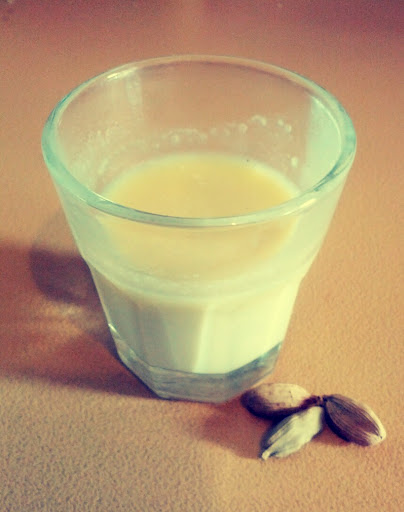
- Remove the pods and serve hot in shot glasses or over desserts as a hot sauce.
Warming:
Perfect on cold nights.
250g Milk Cadbury Melts
1 cup full cream milk
1/4 to 1/2 teaspoon of cayenne pepper (to taste)
- Pour the milk into a saucepan and gently heat until hot but not boiling.
- Turn off the heat and add the chocolate melts and cayenne pepper. Stir to combine.
- Taste test and add more cayenne if needed. I like a gentle tingle at the back of the throat in the aftertaste, but no actual peppery taste to the chocolate.
- Serve hot.
Spiced Chocolate:
Complex and delicious.
250g Dark Cadbury Melts
1 cup full cream milk
3 strips of fresh orange peel
1 cinnamon stick
1 Tablespoon of honey (I used Blue Gum, very strong flavour)
1 teaspoon of quality vanilla essence
1/4 teaspoon of ginger powder
pinch of chili powder
- Pour the milk into a saucepan with the spices, essence, and honey. Gently heat until hot but not boiling. Allow to steep for at least 1/2 hour.
- Turn off the heat, add in the chocolate and stir to combine.
- Taste test. Adjust flavours to your preference.
- Serve hot.
If you prefer a big mug to a little shot glass for your hot chocolate, you can increase the quantity of milk in these recipes. Up to 1 litre of milk to 250g of chocolate is still very rich and delicious. Alternatively, make up the original recipe, then stir a healthy dollop into a mug of hot milk for those guests who prefer mugs.
Rewriting the blog
This blog is almost one year old now, so with that in mind I’ve been doing a bit of spit and polishing. My About Sarah page is completely fresh with a new photo and the up to date info about me so newcomers don’t have to mine into the blog to work out who I am and where I’m coming from. I’ve clarified some things I’d previously left ambiguous and put in links to posts that expand on important areas.
About this Blog is the new name for the old ‘New Here?’ and ‘FAQ’ pages, condensed into one, simplified, and with expanded suggestions for new readers. The topics make it so much easier to search the blog content specifically once people understand how to use them (and where to find them!).
The old Resources page has been renamed What I Do which is more intuitive, and had the content cleaned up and reordered to make it easier to follow.
Three important tasks remain: to clean up all the old articles that still end with a dead link to the articles page I’ve deleted. To add all my latest artwork in to the Gallery for people to view easily. (urg) And to create a master list of dissociation resources for those new to the topic who need to read helpful articles in order from introductory concepts to more complex or tangential ideas. The reverse structure of a blog (reads from latest entry to earliest) in contrast to a book that reads from the start to finish can have downsides in that new readers are coming into the ‘story’ halfway through as it were, and it can sometimes be difficult to follow.
In the meantime however, enjoy!
Ink – Feeding the Monster
The Party
Was an awesome celebration with some of my favourite people in the world. There were incredibly mad hats at the Mad Hatter’s Tea Party in the afternoon.
There was an amazing spread of food:
Including cucumber sandwiches
And an incredible cake sculpted into the shape of a top hat:
That had three rainbow coloured layers inside!
That evening we had potatoes cooked on the fire
With homemade spiced hot chocolates
And when we were briefly rained on, I found my modest umbrella collection and we stuck it out until it fined up. Our first year of a peer-led support group for people experiencing dissociation and/or multiplicity has not been without challenges. One of the biggest ones is that dissociation is a broad category and often new members are anxious and keen to feel they fit in. If they are the only guy there that week, or the oldest or youngest member there, or the only person struggling with a particular type of dissociation, or they feel they’re the most functioning member in a room full of mentally ill people, or the biggest wreck in a room full people who are miles ahead in recovery, it can be a challenge to help them feel comfortable enough to stay and engage. The mindset shift to that of being comfortable in a diverse group can take some time, and it’s not unless a newcomer is willing to attend and represent a minority of some kind that the next person with those characteristics who comes along will find somebody in the group like them. It takes a lot of courage to be the first!
It also takes a mental shift to embrace that a healthy group is supposed to be a safe place for you, where your needs count, but also a place you contribute to supporting other people’s needs and helping them feel safe too. Some people find that group approach isn’t helpful to them, not what they needed. Some find groups appealing but stressful for various reasons. Some people connect briefly, then drop off the radar, leaving us wondering if they’re okay, if there was something different they needed, if there was anything else we could do for them. Some come while its needed then go on to other things. Some stay on, become family, helping new members and building a strong group. The lack of pressure and open door policy mean members come and go as they need, can be as free or as close as is helpful for them and change their minds as often as they wish.
Some people opposed the idea of a peer led group for people who are considered to have ‘severe mental illness’. The idea that we may have something to offer each other, and that community is crucial to recovery, are fairly revolutionary even today. After a year of running Bridges, I feel very confident and excited that our trial has been a magnificent success. We have built on positive feedback, adapted to negative feedback and the group has grown and adapted organically with the members. We have learned a lot from each other, and perhaps most importantly, none of us are alone anymore. It was a lot to celebrate. 🙂
Bridges Birthday
Some lovely mini lemon meringue pies, starting with the pastry shell in my mini muffin tray:
Then filling with homemade lemon curd and piped meringue:
Then finishing in the oven until browned:
I also have ingredients for spiced hot chocolates, smores, and baked potatoes. I may have got a little carried away. 🙂 It’s nice to get carried away from time to time. Shame the kitchen’s trashed!
Art degree started again
Sculpture this time is about making and using moulds, so for the first time I am actually slightly ahead of the class. I used to work in a statue factory, painting the concrete statues. I didn’t make the moulds but I’ve seen it done and have made plaster casts and wax moulds myself before. We’re learning a process using silicon which is really exciting, once you can replicate a sculpture the possibilities are pretty unlimited. I’m looking forward to sinking my teeth into the project. I’ve borrowed some books from the arts library and read a couple already, it’s going to be a good term.Â
Zoe & Sarsaparilla
Both critters are going well. 🙂 They are even starting to get used to one another which is really exciting, as until recently I’ve had to divide time between them on some kind of strange pet share system. Last night I got home very late after an extraordinarily long day and was able to watch Dr Who with both of them curled up on my lap! Admittedly, Zoe went a bit odd and at several points tried to curl up to sleep on my shoulder like a very large excitable parrot, and then when she settled for sleeping on my right arm she’d pretend to accidentally roll over onto the cat, but he was feeling safe enough to give her a hiss and a swipe for the first time instead of bolting so I’m rather excited!
She’s almost due for her last shots and ready to go on walks 🙂 Hurrah! Toilet training is coming along really well and some commands like fetch, toilet, sit, and down, provided she’s not too manic to think straight. It’s been truly wonderful to come home from hard days or be dealing with difficult things and have warm furry bodies to cuddle or sleep by. I feel very blessed.
Another coming out
For a blog that covers some madly personal stuff about my life, there’s a surprising amount of things going on that don’t end up on here. I live a very complicated life, and I’m always mindful of both my own sense of exposure anxiety, and that it is at times difficult to tell your own story without telling parts of other peoples. Who didn’t start a blog or ask to be included in one. So I’m trying to be open but discrete and honest but useful.
When I gave a workshop earlier this year about starting a blog, I found myself explaining to various people, usually of an older generation, what a blog is. A number of them referred to it as an online journal. For some blogs that is true, and some of those blogs are simply amazing. For me, it is not. I keep journals, and I write in them regularly too. For me a blog is an entirely different thing. Everything that is posted here is run through a specific set of filters, and the most important one is “Will this be helpful to other people?” So while I’m doing my best to be honest and honour the dark, painful, and anguished aspects of my journey, I’m careful about how I do that. I don’t write posts about, say, suicide, when I’m feeling deeply suicidal. I write them when I’m stable, have some perspective, and can hopefully write something that is both authentic and uplifting. Raw distress and confusion can go into my journal but usually not my blog. There are certainly glimpses of it at times but I’m very aware that some of the readers are in bad places and I don’t want to drown anyone. Plus I’ve found that sharing about things I’m currently struggling with instead of those I used to struggle with often makes people uncomfortable, and some reduce that discomfort by imposing advice. Which I hate. So I’m cautious about how I engage that whole area.
This year has been a very big year for me. I moved into my own secure, stable unit. My dog and cat died. I got a puppy. I’ve been giving talks locally and interstate. And on my birthday, I came out as bisexual to my family. That is my group identity. As I’m multiple, the reality for me is straight and gay parts.
It feels like such a cliché to be struggling with sexuality. Many years ago I was in a community health centre and saw a poster that initially made my breath catch in my throat. It read “Is being different getting you down?” I went closer to see what they were offering. The small print read “Some girls like other girls. Some guys like other guys. Some like both.” I was so disappointed. It’s been such a long road to work out why I felt so different, what that meant and where I could find peers. Multiplicity and dissociation have dominated that process. Sexuality hasn’t had much of a look in.
I grew up in a highly homophobic, at times violently so, environment. As a young person I deeply buried these feelings that would have marked me for rage and abuse. As a young adult I suffered from chronic nightmares that were creative and horrifying. I described them at the time to a psychologist I was seeing as torture. Every night I went to sleep and was tortured in my dreams. Eventually we realised there was a lesbian part who had been totally cut off, buried, and denied expression. When we reached out to her with acceptance, those particular nightmares immediately stopped and have never returned. They were part of me screaming in the dark totally alone and rejected, who no longer screams.
Accepting the group identity of bisexual has been both challenging and liberating. I deeply fear homophobic reactions from others, and while I kept my own sexuality secret, I could also maintain a distance from the homophobic abuse of others. Now, it is personal. To read about a gay teen being bashed I no longer feel angry and horrified like I used to, I now feel afraid and loathed. That has been a difficult transition. I don’t cope well with feeling loathed. With a history that includes being stalked, I also don’t cope well with predatory advances. Revealing a queer identity as a women can bring out  distressing responses from some straight men. As someone who loves children I’m painfully aware of those who see all differences from the norm as ‘deviance’ and who confuse minority sexual orientations with paedophilia. To be thought of as a monster is horrifying.
Encountering the stigma specifically surrounding bisexuality has also been very difficult. I am afraid of rejection from both the straight and queer community, there is at times a sense of not belonging properly to either. When I go to queer events I am always assumed to be lesbian and find myself constantly correcting people and wondering why I bother. I have been stressed by the discomfort of some of the straight community and find myself constantly assessing my behaviour to make sure I’m not being misinterpreted. Giving flowers or a hug to another women is not simple anymore. It has been a huge process to reconcile the fundamental difference of some parts being attracted to men and others to women, and to work out how we could possibly date and love someone without hurting them or being hurt by them.
The conclusion we have come to for us is that being in a straight relationship is deeply distressing to gay parts at the moment, while being in a gay relationship does not distress the straight parts. Getting into chat rooms online to find lesbians talking viciously about bisexual women has been confronting and painful. To be stating our group identity as bisexual when we are not looking to date men is frustrating and sets me up for stress. But identifying as lesbian when that is not how all of us feel is merely swapping one closet for another, and I am so tired of closets.
I feel deeply resentful that I have both the multiplicity and the sexuality to come out about, that feels too much a burden of mis-perceptions and stigma to handle. I want to be out, that is the kind of life I want and the values I have. But I am also rocky and scared and have needed to break the whole process up into small steps to keep it manageable. I am also deeply frustrated that these characteristics become all consuming, totally defining who I am for some people.
So this year, when I turned 29, I woke up that day and decided I was not going to reach 30 and still be hiding this. I’m tired of secrets and the shame that glues to them. I’ve been reaching out to the queer community and making new friends, which has been wonderful and difficult and left me feeling like the world has turned upside down. I still can’t quite believe that I’m allowed to be attracted to women and no one is going to hurt me for it. I went to a “Rainbow service” at a church over easter and sat towards the back, sobbing my heart out and trying not to show it. It’s been an incredibly difficult process even though it’s what I want, even though I believe no one should be ashamed of their sexuality, and I’ve done it at my own pace. I still find myself lost for words, overwhelmed, remembering the speaker at my Grandmothers funeral using his time at the podium to sneer that in her time “we didn’t have homosexuality”. The ridiculousness of that statement is blatant. So is the contempt, and it makes my heart curl up and wither.
Bizarrely, despite how incredibly difficult this journey has been, accepting my attraction to women feels like somehow taking the easy way out, after having spent so long suppressing it and keeping it secret. It’s such a relief, such a sense of coming home. To have escaped the world I grew up in and navigated my own fear and confusion and the mess of labels and stigma, to be finding a place where I can just exist as I am, it’s like flying.
So here I am. Many of my favourite artists and musicians are bisexual. I’m part of a diverse community. Bisexual is not shorthand for faithless, promiscuous, damaged, or untrustworthy, although bisexual people may certainly be any or all of those – like anyone. As an artist I find bodies beautiful, vulnerable, and deserving of being seen through romantic eyes, not shaming or judging ones. I’m angry that so many people are struggling with things that leave them excluded, secretive, ashamed, and lonely. I do not believe that is right. I now co-facilitate a fortnightly group The Gap, for same-sex attracted women aged 25 – 40, not because I have extensive networks and experience in queer culture but because the group was short a facilitator and closing down. I believe that we all have the right to choose our own words and labels that feel most comfortable and not to be defined by other people, and that we have the right to live whole lives, free from shame, fear, stigma, abuse, and isolation. I want to be free, authentic, to feel like I can breathe, that I am whole, I want to love and live in the sunshine and drink the night and be fully alive. And I want to help other people find those things too.
Projects
I am enrolled in two classes this term and three the next, part of my cunning plan to crowd out my week slightly and prevent the peer work side of things from taking over entirely. Fingers crossed it works and doesn’t just exhaust me considering the rest of my schedule.
I hit organisational overload a few weeks back and got to the hiding under my desk stage so the work on the not-for-profit org the Dissociative Initiative has stalled slightly. I’m planning to get back into the swing of things with that within the next few weeks and actually start answering email/my phone again.
I’ve been working on a project for Radio Adelaide, they have a program called F Sharp which is about women and music. I’ll be a co-presenter/producer for their next two shows on Wednesday at 3pm (101.5FM) which is great because it’s a pretty low key way to brush up my skills a bit and feel more confident in the live studio.
I’m also starting to work on a new network, we do not have an official branch of the Voice Hearing Network here in SA so I’m working on putting together a website and linking in with all the other branches around SA to help people find our local resources more easily.
The group The Gap is starting to grow which is exciting. I’m chuffed to meeting so many new people and making new friends, also through another group Trinity Sistas, which thankfully I am not facilitating.
My work on setting up the studio so it is easier to make ink paintings is paying off, I finished another 4 a couple of days ago which is damn exciting. I have a paper I am loving that is archival quality, torn up into different sizes and shapes and stored in a box. When I feel like painting one I rummage through the box and take out the piece of paper that feels like the right size. It’s almost as easy as painting in a journal except this way I can hang the pages to dry and keep painting on a new sheet if I’m in the mood. It’s a good feeling.
Bridges is almost at the one year mark! I am extremely proud of this achievement, it’s been running almost every week and has grown into a strong, caring group of very diverse people who are very accepting, supportive, and have a great sense of humour together. This week we will be celebrating with a Mad Hatters Tea Party and we are all planning chocolaty treats and outrageous hats.
So, plenty going on as usual, all the groups going strong and in exciting directions and lovely new art projects to sink my teeth into. Hoping it all gets off to a good start this week.
Using Sensory Supports
Some of us who struggle with chronic dissociation find that we can borrow ideas from those living with autism or sensory processing disorders. Certain types of stimulation of the senses can be grounding techniques that relax us and reduce stress. People with PTSD may also find that some of these approaches can help to reduce symptoms such as hypervigilence.One that I have used with great success is ‘white noise’ when I’m sleeping. I’m very sensitive to sounds and particularly when stressed I cannot tune out my environment. A neighbour a few houses down taking in their wheelie bin will wake me up, a dog barking, birds singing, traffic passing… White noise is any non-rhythmic sound, such as the sound of radio static. You can buy white noise generators such as this one, or create your own. I like to use a fan running by my bed. In summer it blows onto me and cools me down, in winter I point it to the wall and just use the noise to help me sleep. There are also a number of phone apps that generate white noise, rain sounds, or other soothing noises to aid sleep. Some of these such as the white noise one I’ve linked also have beautiful sounds that can aid meditation such as the sound of the wind, or a Tibetan singing bowl.
Smells are often helpful, particularly once they become associated with feeling safe and settled. I have a fairly extensive collection of perfumes, aromatherapy oils, essences, and bath gels. Having my home, clothes, bed, skin, or hair smell familiar and good is calming and comforting, particularly because the smell of strangers is one of the things that makes crowded places like public transport sometimes challenging for me. I have an acute sense of smell and find the scent of a whole bus of people’s perfume, cologne, shampoo, deodorant, and sweat a lot to cope with when I’m stressed. Having my own perfume or scent handy to drown the rest out can really help.
Fidgets are another common tool that can be helpful – that is, something tactile to play with in the hands. Some people find that having something to do with their hands helps them to think more clearly, to focus, or to calm when they’re stressed and dissociating. These can be anything, I know some people who play with sprung clothes pegs, others who keep tiny soft toys in pockets and bags. I used to carry a little purse with three pebbles in it, one smooth and two rough.
Weight in the form of blankets or jackets can be settling for some people. I don’t personally use this approach as I find that prolonged weight tends to just set off joint pain for me, and I tangle in bedclothes especially if I’m having nightmares. However I know other people who find weighted blankets incredibly settling when they’re distressed and dissociative. It’s important to be a little careful about this tool, you don’t want to use a blanket that is too heavy and restrictive, especially for someone young or sick. You can buy these or make your own, this page has instructions for a simple blanket, this page has instructions for a blanket that can have the weights easily adjusted. When you feel like you’re floating or fraying apart being contained under gentle weight can be very grounding and reassuring. Another way of using this technique is having a long full body hug, or a cuddle with a pet who sits on you. Some psychiatric assistance dogs are actually trained to sit on the chest of their owner if they start to have a panic attack, because the weight and warmth and connection can be very calming and reduce anxiety.
I find it sad that because we have these labels to which we’re all very sensitive, often wonderful resources get locked up in an area and so many other people who might benefit from them don’t hear about them. There is an amazing wealth of information, tools, resources, strategies, and ideas out there about how to live more comfortably, manage health challenges, adapt to limitations, and make the most of your abilities. Don’t ever be afraid to dig into something labelled entirely differently from what you are experiencing, you might find a brilliant idea that makes all the difference to your world. 🙂
For more resources around sensory supports:
Ink – Moon Aching In Pines
Here is a very small ink painting with a short poem. I love this combination and I’m looking forward to making more in this style.
The poem reads:
Moon
aching in pines
Nightbreeze
kisses my skin.
Zoe At The Beach
Zoe is settling in well. She’s working out the idea behind toilet training, is slowly getting the rules about not chasing cats, and getting as many cuddles as one puppy can manage. However, keeping an active puppy home all the time is hugely challenging and she is chewing everything she can fit into her mouth.
So the other day I took her to a quiet beach with no other dogs around. She was a bit anxious at first.
But it was a beautiful day.
A sea breeze was blowing foam from the water.
She isn’t a water baby at all, the waves freaked her right out. The foam was blowing in big piles onto the sand.
And that she thought was fantastic, she chased it up and down the beach, trying to eat it and getting foam on her nose.
That night she rewarded me by tearing madly around the house at 2am, leaping over furniture and colliding with things. I’m not making as much progress as I’d like on wearing her out! She’s not got the idea of sleeping through the night either, so she’s banished from my room at the moment, she can amuse herself until I’ve had some decent shut eye. It’s going well though, I’m very attached and loving the company, and she’s clearly very happy and feeling at home. 🙂
Baking Day
I went to the dentist again yesterday morning, and had the rest of a root canal done. I never enjoy dental work, although I don’t find it as harrowing as things involving needles. I’ve been trying to work on the needle phobia in therapy lately, there’s a lot of things driving it for me which complicates the process somewhat. But we must be on to something because I was able to relax so deeply at the dentists today I dropped into a light sleep and started dreaming while he was cleaning out my roots. So I’m feeling very thoughtful and interested in learning more. I wish I could afford more frequent appointments but at least medicare covers some.
Anyway, my face is sore and I’m short of sleep so I took the day off. Lounged about, tried to nap, had a bath, did some laundry, then decided to bake. I made double batches of chocolate – banana cupcakes:
tangerine cupcakes:
and coconut cupcakes:
I’m hoping to have enough to take round to all my groups over the next couple of days. 🙂
Looking good so far 🙂 Shame about all the dishes though!
Ink – Dove Catchers
This ink painting contains a short poem, a style inspired by the haiga art form. It reads:
beware
the dove-catchers
and
the
eaters
of dreams
There’s a story that goes with this. One of these days I’ll write it down for you. 🙂
Outfitting the studio
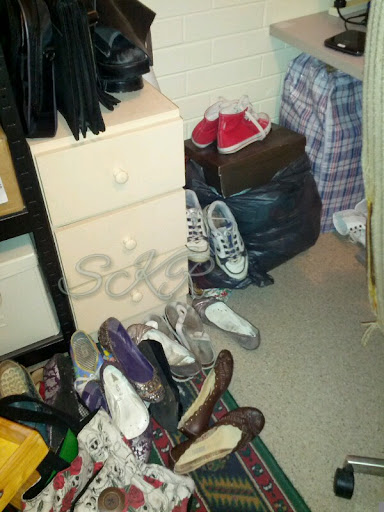
My studio is irritatingly cluttered at the moment. Zoe is chewing on everything at the moment so a lot of my belongings are being stashed in the studio to keep them safe – such as all my shoes:
I had a fairly lousy day, the kind where having a shower is an achievement. I cheered myself by doing some reconnaissance at two local art shops, continuing the work I’ve been doing on getting my inks set up more professionally.Â
I came home with some Arches paper, the big awkward A1 size because it’s the most economical and I like the ragged edges when you tear it down to size, in three different finishes and thicknesses to trial and find what works best with my inks. I also bought this cheap water dish/brush holder, so I can hang my expensive watercolour brushes (which I use for the inks) upside down to dry, which apparently keeps them in good condition for longer.Â
I also bought a couple of different types of portfolios to display/protect my finished works. You can buy these up to A1 in size, but that is expensive. I went for two A4 and an A5. My current system to protect finished ink paintings has been hopeless, I am pretty excited that some of these are not too expensive and will make it much easier to store and find work again.
The 25 ink paintings for my talk “Peer Work: a consumer perspective” now have a home. I am so pleased about this, it’s about time. Once I make some space to store a collection I’ll buy some more and file all my old collection safely away. It will be good to pull out some of my older works and have a look at them again too. I might try and photograph some and load some here on the blog for you.Â
Can’t stay and chat, I have a studio to clean up. Hope your week is off to a good start.Â
Ink – No Freedom
Another recent ink painting. The words read “There’s no freedom here”. I’m excited by the combination of phrases or short poems with artwork. This one will need to be done again as the ink has feathered slightly on the poor quality paper. I’ve been experimenting lately with different types of paper, looking for something archival quality that handles well with the inks. I used to have a paper that worked really well, but it seems they’ve changed the creation of the paper and it is no longer suitable, which is a shame. Still, there’s a lot to be gained from the process of experimenting if you don’t mind a few projects that don’t work out.
I have been working on creating a process for my ink paintings that streamlines everything. At the moment it’s very chaotic, I don’t have a preferred paper that is quality, I paint very different sizes which can make framing the works challenging, I don’t have a proper place to store the works safely, they are all over my studio in different boxes, files, drawers and nooks – which also makes laying may hands on a particular work tricky. I also lack a safe and simple system for transporting them once sold, or to galleries etc. Not good enough, I find creativity happens best for me in the space between order and chaos. I need both in the right quantities to function best, and at the moment inks are being overwhelmed by too much chaos. I want a paper I’m happy with, a storage system, a presentation method, and a transport system that is all simple, inexpensive, easy for me to remember, and where I can stock up on everything I need so when I have an ink obsessive week I can paint, draw, dry, store, present, and transport without needing to interrupt the process to go and buy supplies or problem solve weird sized paintings etc.Â
I am getting very excited because I’ve thinking about this challenge, as well as the making of prints from the ink paintings, for quite some time now, trying different ideas and approaches. I think I am on the cusp of sorting it all out into something that I’m really happy with, that frees me to create to my heart’s content. A few more tests and trials and buying some supplies here and there and I think I’ve got it. Whee!Â
The next challenge will be buying some more pens to use different coloured inks in, some more sample pots to paint with diluted inks, a set of the papers I finally decide on, the materials to store/present/transport the inks, and some full size ink bottles of the colours I’ll use most often – at the very least I need a new Noodlers Black. If I’m sensible and brave I’ll investigate arts grants to see if I can get some help to do that – but admin terrifies me so I’ll just see how things go. Also, to learn how to work the adobe software and create booklets of ink paintings or poems, get the printing of prints down to something I’ve trialled properly and can easily do, and finish my first digital story using ink paintings and a voice over… So much to do! Â How I love it.Â