‘Cascade switching’ is a term I coined after watching someone with multiplicity do an incredibly rapid series of switches over the course of a conversation. I’ve experienced it only a few times myself and I really hate it. Multiples are very different from each other when it comes to things like switching. Some switch frequently, some very infrequently. For some multiples switching a few times in a week would be highly unusual. For others switching a few times an hour is quite normal. I lean more towards the latter. It’s quite normal (hah) for me to switch all through my day, even if one is mostly out over a week, others will tend to peek out here and there, even if it’s just a young one noticing the jar of cookies in the cupboard or being distracted by little kids running around on tv.
Cascade switching is something else. It’s switching so fast and so frequently that it feels and looks something like shuffling through a deck of cards face up, almost too quickly to register what’s on each card. I’ve noticed that it seems to have been triggered in the cases I’ve seen by huge news that impacts everyone in the system (eg news of a death in the family), by encountering a situation that no one in the system can handle, so the switching just speeds up and becomes chaotic, or, as in my case, by the start of a new relationship. I’ve also done this when I’ve been under threat in dangerous therapeutic relationships.
It’s deeply unsettling, I’m switching from one sentence to the next, or even part way through sentences. My ability to track information is overtaxed by the chaos, and breaks down. We can’t tell who is out anymore, what we were doing, who we are with, even what year it is. The dissociation becomes overwhelming and I feel like I’m drowning blind and can’t even tell what way to swim to get to air.
For some multiples this is a common occurance. Their systems are highly fluid, parts constantly changing, disappearing, new ones being formed. Their experience of life is so chaotic and dangerous that their system doesn’t settle into a stable pattern but stays in a state of turbulence. Stability hasn’t served them for survival so they gear towards flux instead. These people are often not diagnosed as multiples because the DSM concept of DID presumes stability.
I’m settling down finally which is great. It’s been a few weeks of cascade switching with the occasional stable day or evening around my girlfriend, but that’s settling more into my usual patterns of at least having someone out for an hour or so. Not to mention that’s making it a bit easier for her to work out what’s going on or have some capacity to predict how I’ll react to her. I’ve been trying to unpick what’s driving it for me and I’ve been able to pin down a few things. One is that most of my system are keen to meet her. Another is anxiety about forming a ‘one-part bond’. Most of my friendships used to be this kind of bond, a few still are – where the connection is only to one part and no one else in my system thinks of that person as a friend, or even recognises them. (this makes life awkward when you run into people unexpectedly, that blank confusion that always makes me feel broken and ashamed) This is not what I want, because we are all parts rather than entirely separate people, we are all missing information about our life, and also missing skill sets. We are vulnerable to bad dynamics and painful relationships when only one part is involved and making decisions. We make much better decisions as a team. For a really important relationship like a romance, it’s even more crucial that everyone in my system is aware, involved, and has a voice in what’s happening. That doesn’t mean that the kind of relationship is the same with all the parts, but that there is a relationship of some kind being developed. So I think anxiety about that has been pushing up the switching – whenever one part is out for a while and things are stable, the anxiety spikes and the switching amps up. The downside is that cascade switching is so stressful and confusing that it’s very difficult to navigate a relationship with someone in the grip of it.
Pacing seems to be helping me get out of it. The obsessive focus you feel in a new relationship is delicious – you want not just to be with them all the time, but to climb under their skin, into their mind, investigate and submerge yourself… But the dating, the meet and part and meet again cycle is helping me settle back into my own cycles. Making the effort to keep the same part around for an hour or the whole night – then making the effort to have another part who wants to connect or communicate be present next time, we’re slowing down and things are becoming clearer. Trying to find a middle ground between adapting to another person where switches are triggered by how they are and what they need, and the kind of switching we do alone where they are entirely generated by our own needs… that’s a huge challenge! I can do one or the other, but trying to meld something between is a complex ask. A whole new kind of dance.
For more information see articles listed on Multiplicity Links, scroll through posts in the category of Multiplicity, or explore my Network The Dissociative Initiative.
 This is my very exciting, brand new portable keyboard! It connects with my smart phone using bluetooth, which means that when I use my BlogIt! app on Android, I’m able to blog and type on a decent size keyboard from my bed, or when travelling! I am very excited about it. I’ve been investigating different types of keyboards online and went into Officeworks earlier today to try a few out and see how they felt to type on. There’s a tricky trade off with a portable keyboard, you want it to be smaller than standard size, because that’s just a pain to lug around, but you also want to still be able to comfortably touch type on it, else what’s the point? You might as well just use your phone otherwise…
 Or rather, the lunch of people who’ve had dental work. My girlfriend suddenly needed to have an infected tooth removed this week so I’ve been putting my considerable experience of dental-pain-appropriate meals to good use! I once spent months on a mushy food and milk shakes diet while waiting to have 5 teeth removed (4 wisdom and a molar) and the post surgery situation was a nightmare of allergies and reactions so it was a very long time before I saw a steak again. Actually that was also the first time we realised that part of my allergic reaction to opiates is liver damage leading to psychosis. I have a very distinct memory of floating out of my body to drift around the room with each dose of digesic, becoming increasingly delusional and anxious that I might float through the window and be blown away by the storm…







 This hurt a lot, but not as bad as my really bad fibro days which was a little sobering when I thought about it. I’ve upgraded from a hop to a hobble which is partly killing my right ankle because I’m carrying a lot of weight on it and leaning on it in a funny way. So walks are right out at the moment, as is the furniture shifting I was planning for this weekend. Grr! It’s been much better today although I’ve also noticed that often my whole foot is numb so I suspect I’m just dissociating the pain and I’m trying to be extra careful of not knocking or hurting it while I can’t feel it.

 I’d heard of these all over the net and always wanted to try one. (some recipes ideas
  Loving the shaved patch over my right ear. Kind of a compromise between the ones who want to go to a close shave all over and those who like it longer. Got to love an asymmetrical haircut. Zoe approves, but then Zoe approves of everything I do except stay out late and forget to walk her. 🙂
 …go for a walk to buy lollies for kids. Happy Halloween everyone!
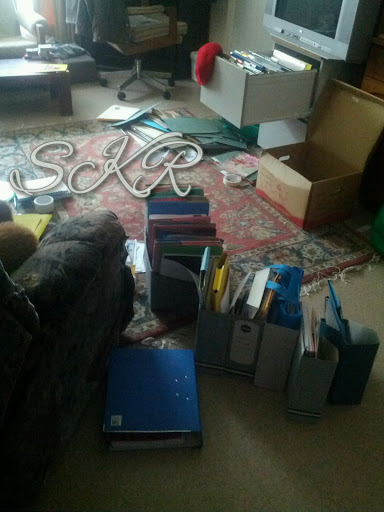 Because, clearly, that’s what you do when you’re feeling pushed for deadlines and rearranging your schedule to fit in new projects… Overhaul your filing system. Then invite around a whole bunch of friends for chocolate chip waffles and ginger beer and monty python skits.
  Sarah K Reece