Improving the blog

Hullo hullo, those who you who come directly to the blog instead of getting the email feed will have noticed some changes! I’ve been working on some improvements, most especially how the archived blogs are presented. Now you can read all the blog titles for every post in a whole month, instead of having to click on each day to reveal the title. I hope this makes it a bit easier to find whatever it is that you’re interested in – poems, DID info, etc. As the blog is growing I expect I’ll also expand and specify my labels a bit more for the same reasons. New background and bigger font – hopefully makes it all a bit easier to read! I’d like to add a search function to help with navigating the site too, but unfortunately bloggers search box widget isn’t working at the moment. Later hopefully.

For those of you looking for information about DID, another blogger Holly Gray wrote about this topic from a personal perspective for over a year, and has just now decided to wrap her blog up for the moment. You can find her perspective on four factors that can lead to DID here.

Please feel welcome to contact me if there’s something you’re really hoping I’ll blog about. I keep a running sheet of ideas for posts and I can’t promise I’ll get to them fast but I’m very happy to hear from you about what you’re looking for or finding interesting or helpful. Please share any posts with people you think might get some benefit from them too. I’m keeping my ‘What’s On’ page updated, so check there if you’re looking for exhibitions, competitions or other events to be involved in. And I shortly plan to add a ‘To Buy’ page with art and shoes available for sale, and another about my Dissociative Disorder Working Group sharing what we are doing and how people can help out. 🙂

Feedback about all and any of these developments is very welcomed! 

Grounding Kits

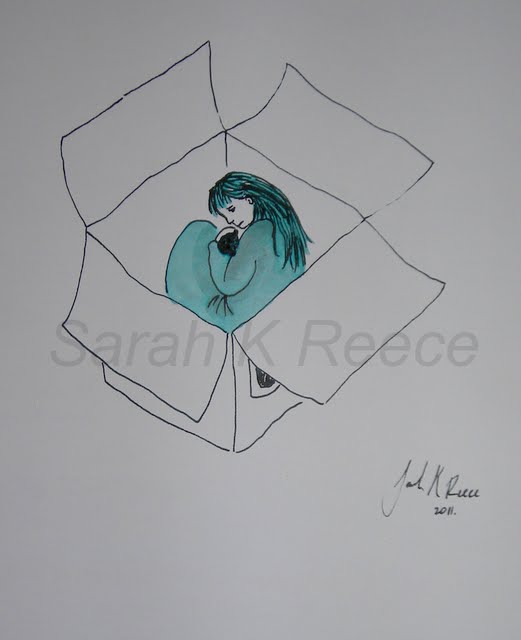
Following on from yesterday’s post, Grounding Techniques, developing a grounding kit is the next step where you pull together all the information you’re learning. What’s important about this? One of the big issues with dissociation is being able to retain information. The point at which you’ll really need your grounding techniques is also the point at which you’re least likely to be able to remember any of them, or even the concept. So, the idea of a grounding kit is to find a way to pull together all your effective grounding techniques and have some way of being able to remember them. Some people literally put together a box of things, a bit like the example kit I took into the TheMHS to explain this idea:

I probably wouldn’t recommend keeping the plant in there though…

People dealing with other issues use a kit like this too, I’ve heard of people who experience depression keeping a kit that has a good book, a block of chocolate, birthday cards with uplifting messages in them, that kind of thing.

But, it doesn’t have to be a literal kit, a list of ideas that you keep somewhere safe can be just as helpful. Many voice hearers who come to Sound Minds love this list of strategies and carry them with them so they can refer to it during stressful times. It’s easy to have a bit of a play about with grounding techniques while you’re not feeling so bad, forget about them, and not have anything to draw upon during a difficult episode. So, a grounding kit is the stage 2 of this process that actually makes sure you have something helpful you can do for yourself the next time your dissociation is bad. This is where self awareness becomes self care – learning what you need, and then actually doing it!

There are two key concepts that help make your grounding kit really effective. The first one is that it must be individualised! That means, specially tailored to you. I tried various techniques for years, like the breathing exercises, really frustrated that other people seemed to find them helpful but they didn’t work at all for me! But, I get given them by doctors, recommended them by ACIS, they’re all around. Now, I think a lot more broadly than that, and I’ve been able to share techniques that do work for me with the people who support me. This means that when they’re trying to be helpful at least now they’re recommending things that have a chance of helping me. The more your kit has been specially tailored to you, the better it will work.

No single technique always works every time. This is kind of frustrating, but it’s important to be aware of. The whole point of working out a bunch of techniques is so that you have lots of helpful options to pick from. Don’t give up on a technique the first time it doesn’t work for you. I find, for example, that some techniques work for me with mild to moderate dissociation, but aren’t strong enough to help with severe dissociation. Many of my techniques aren’t something I only do during the bad weeks, they’re things I do regularly because they prevent chronic dissociation from happening in the first place.

Which brings me to the second key concept that makes grounding kits effective. In order to set up a grounding kit, you have to overcome the denial that you have a problem with dissociation in the first place. The middle of an acute dissociative episode is not the ideal time to be reading up on strategies and trying things out. Ideally, you use the times when you are well to set yourself up for the best care possible when you are struggling. Of course, some of us are dealing with chronic issues and don’t really get weeks or months free of symptoms, but the basic premise still applies. Crisis isn’t the ideal time to be trying to work out your grounding techniques! This means that when you are going along doing pretty well, you should put some time into trying different grounding techniques and seeing how they work on mild symptoms. And, as you collect your grounding kit, you can start to share this information with anyone else in your world who could then better support you through rough patches. Trust me, its a lot easier to explain these ideas to someone else when you’re not in the middle of a panic attack, flashback, or acute dissociation!

You can also have a look at what was going on in your life when you are well, and when you are really unwell to work out what your key grounding strategies may be. So, in my instance, I did no art at all during the years of my most severe dissociative symptoms. Now that was partly the result of how much loss of function the dissociation was causing me. But in my case I’ve also discovered that without regular creative activities, I’m much more vulnerable to dissociation. So these days art/writing is much more a priority for me, because I know now that it’s one of the things that keeps me well. I don’t wait until major dissociation kicks in before I pick up a paintbrush or pen. I build these techniques into my everyday life, and as a result I’ve drastically reduced the degree of dissociation I experience.

When I kick into the denial and get blasé about how important these techniques are for my health, I quickly find my stress level and symptom level stepping up. And I’m learning to pay attention to those early warning signs instead of putting my head in the sand until I’m a complete wreck. But it’s hard work in some ways to keep your worst days in mind when you’re feeling good! It’s tempting to stop looking after yourself, to even feel like a bit of a fraud, as if your bad days couldn’t really be that bad, and maybe if you’d just tried a bit harder you could have pulled yourself through without all the fuss. This is pretty common.

It’s part of the nature of mental illness that it’s episodic. For some of us that means months or years where we travel well, for others the ups and downs are more hour by hour. But all of us feel tempted to put the bad days behind us and dash off into the sunset. There’s nothing wrong with that impulse! It’s great to make the most of those good days, and we all need time off from anxiety about our situation and thinking about our mental health! But, making ourselves spend a bit of time putting in some safety nets just on the off chance we have another bad day – that’s often the key difference between people who live well with even severe mental illness, and those who are always being surprised by it, caught unaware and unprepared. And if it turns out you never need it, that your bad days really are gone forever, that’s awesome, no harm done. But, having a safety net in the form of a grounding kit can make the difference between having another bad day and total catastrophe.

My personal library

is quite extensive, but these are some of the books that I’ve found helpful in dealing with a dissociative disorder and recovering from trauma. I make these available to anyone for a refundable deposit. I am constantly adding to this collection, and donations from my wishlist are gratefully received!

If you’re looking for information about multiplicity, I recommend starting with:

  • First Person Plural, Cameron West
  • The Dissociative Identity Disorder Sourcebook, Deborah Haddock
  • Got Parts?, by ATW
  • The Flock, Joan Francis Casey, Lynn Wilson (my review)
More books about multiplicity or dissociation:

  • Treating Dissociative Identity Disorder, Sarah Y. Krakauer
  • A Fractured Mind, Robert B. Oxnam
  • Breaking Free, Herschel Walker
  • Today I’m Alice, Alice Jamieson
  • Fractured, Ruth Dee
  • Rebuilding Shattered Lives, James A. Chu
  • When Rabbit Howls, The Troops for Truddi Chase
  • Little Girl Fly Away, Gene Stone
  • Katherine, It’s Time, Kit Castle and Stefan Bechtel
  • A Life in Pieces, Richerd K. Baer
  • All of Me, Kim Noble
  • Five Farewells, Liz Elliot
  • The Sum of My Parts, Olga R. Trujillo

Books about PTSD, trauma, or abuse recovery:

  • Trauma and Recovery, Judith Herman
  • Treating Attachment Disorders, Karl Heinz Brisch
  • Victims No Longer, Mike Lew
  • Facing the Wolf, Theresa Sheppard Alexander
  • Man’s Search for Meaning, Viktor E Frankl
  • Sickened, Julie Gregory
  • Stalking the Soul, Marie-France Hirigoyen
  • Stepping out of the shadows, published by Yarrow Place
  • Trauma Model Therapy, Colin A Ross
  • New Shoes, Rebecca Mitchell
  • Understanding Trauma, Roger Baker
  • The PTSD Workbook, Mary Beth Williams, Soili Poijula
  • The Courage to Heal, Ellen Bass & Laura Davis
  • Beginning to Heal, Ellen Bass & Laura Davis
  • The Sexual Healing Journey, Wendy Maltz 
  • Re-Authoring Lives: Interviews and Essays, Michael White
Books about voice hearing, psychosis, or schizophrenia:

  • Unshrinking Psychosis, John Watkins
  • The Voice Inside; A practical guide for and about people who hear voices, Paul Baker
  • Working with Voices II; Victim to victor, Ron Coleman & Mike Smith
  • Living with Voices; 50 stories of recovery, Prof Marius Romme, Escher, Dillon, Corstens, Morris
  • Children Hearing Voices; What you need to know and what you can do, Dr Sandra Escher & Prof. Dr. Marius Romme
  • DVD Knowing you, knowing you, Working to Recovery ltd “Eleanor Logden’s personal story of recovery, her journey through the psychiatric system, to becoming an award winning psychologist working in mental health. Eleanor talks candidly about her experience of abuse, self-harm and voice hearing. This DVD is challenging, inspirational and full of hope.”
  • DVD 1st and 2nd World Hearing Voices Congress 2009-2010, Working to Recovery ltd “Voice hearers, mental health workers and family embers from across the world met to share messages of hope and positive action. Presentations focused on important aspects of the recovery process and discussed difficult issues such as the disease concept and the use of medication.”
  • DVD How to Start and Run a Hearing Voices Group, Working to Recovery ltd “Produced to help anyone interested in setting up or running a hearing voices group. The DVD covers a number of issues that will help facilitators and those who wish to become facilitators.”
  • DVD SET Recovery from Psychosis Conference, Perth November 2008
  1. “Hearing Voices and the Complexity of Mental Health Issues from an Aboriginal Perspective” Dr. Helen Milroy (Australia)
  2. “The Personal is Political” Jaqui Dillion (England)
  3. “Hearing Voices with Children” Dr. Sandra Escher (Holland)
  4. “Voice Dialogue” Dr. Dirk Corstens (The Netherlands)
  5. “Understanding Psychosis” John Watkins (Australia)
  6. “Making Recovery Happen: From Rhetoric to Reality” Ron Coleman & Karen Taylor (Scotland)
  7. “Recovery with Voices: A Report on a Study with 50 Recovered Voice Hearers” Prof. Dr. Marius Romme (Holland)
  8. “Recovery from Psychosis: What Helps and What Hinders?” Lyn Mahboub & Mariene Janssen (Australia)
  9. “Working with Voice Hearers in Social Psychiatry” Trevor Eyles (Denmark)
Books more broadly about mental health or life:
  • Love and Survival, Dean Ornish
  • 8 Keys to Recovery from an Eating Disorder, Carolyn Costin & Gwen Schubert Grabb
  • The Yipping Tiger, Perminder Sachdev
  • The Broken Mirror, Katharine A Phillips
  • Follow Your Heart, Andrew Matthews
  • Panic Free, Lynne Freeman
  • Women and Anxiety, Helen DeRosis
  • Journeys with the Black Dog, ed. Tessa Wigney, Kerrie Eyers & Gordon Parker
  • The Art of Being, Constance Rhodes
  • The Brain that Changes Itself, Norman Doidge
  • There’s Something I have to Tell You, Charles Foster
  • Understanding Panic Attacks and Overcoming Fear, Roger Baker
  • Overcoming Borderline Personality Disorder, Valerie Porr
  • The Dance of Intimacy, Harriet Lerner
  • The Dance of Deception, Harriet Lerner
  • Safe People, Cloud and Townsend
  • Who’s Pushing Your Buttons, Dr John Townsend
  • The Magic of Make Believe, Lee Pascoe
  • I just want you to be Happy, Rowe Bennett Tonge
  • Exuberance, Kay Redfield Jamison
  • Women who run with the Wolves, Clarissa Pinkola Estes
  • The Soul’s Code, James Hillman
  • Raising Real People, creating a resilient family, Andrew Fuller
Children’s picture-books:
  • A colour of his own, Leo Lionni
  • My Many Coloured Days, by Dr Seuss

I’ve found something useful in all of these books as I’ve worked on my own recovery journey, but that doesn’t mean I agree with all or even most of the content of some of them. Some of them are useful to me in that they document the older development of certain perspectives in psychology. Some of the older biographies about DID have graphic abuse histories recounted, some books are from a religious perspective, some promote a particular type of therapy, some are quite clinical in their language, others have only the most tangential connection to mental health, so please exercise judgement in choosing what you wish to read, and avoid those that don’t suit you. I’ve been doing pretty widespread research into dissociation, trauma recovery, mental health, abuse, relationships, group dynamics and all sorts for a number of years, and this collection is only the tip of the iceberg. I draw upon ideas, strategies, and interesting theories from many different places to inform my own opinions or cobble together my personal recovery approach. This works well for me, but may not be quite what you had in mind!

It’s been brought to my attention that my wishlist link isn’t always working. Here’s a list of the books in it, I thought may be a useful addition to my library for the group to borrow (in no particular order) if the link isn’t working for you. Most of these books are available at Book Depository.

  • Standing in the Spaces, Philip M Bromberg
  • Depersonalization, Mauricio Sierra
  • Trauma, Dissociation and Multiplicity, Valerie Sinason
  • Attachment, Trauma and Multiplicity, Valerie Sinason
  • Creativity and the Dissociative Patient, Lani Gerity
  • The Happiness Trap, Russ Harris
  • First Person Plural, Stephen E Braude
  • The Haunted Self, Otton Van Der Hart
  • Trauma and Dissociation in a Cross Cultural Perspective, Vedet Sar
  • Awakening the Dreamer, Philip M Bromberg
  • The Minds of Billy Milligan, Daniel Keyes
  • Living with Intensity, Susan Daniels
  • The Trauma Recovery Group, Michaela Mendelsohn
  • Stop Walking on Eggshells, Paul T Mason
  • Cutting, Steven Levenkron
  • Compassion and Self Hate, I Rubin Theodore
  • Parts Psychology, Jay Noricks
  • The Selfish Pigs Guide to Caring, Hugh Marriott
  • Caregiver’s Path to Compassionate Decision Making, Viki Kind
  • Feeling Unreal, Daphne Simeon
  • Overcoming Depersonalization Disorder, Fugen Nerizoglu
  • Somatoform Dissocation, Ellert R S Nijernaus
  • Betrayal Trauma, Jennifer J Freyd
  • The Gifts of Imperfection, Brene Brown
  • 8 Keys to Safe Trauma Recovery, Babette Rothschild
  • Creating Resilient Families, Andrew Fuller
  • Finding Flow, Mihaly Csikszentmihalyi
  • Dialogues with Forgotten Voices, Harvey L Schwartz
  • The Dissociative Mind, Elizabeth F Howell
  • Understanding and Treating Dissociative Identity Disorder, Elizabeth F Howell
  • Healing the Divided Self, Maggie Phillips
  • The Sum of My Parts, Olga Trujillo
  • Coming Present, Caroline Lighthouse
  • The Plural Self, John Rowan
  • Trauma and the Avoidant Client, Robert T Muller
  • Skills Training Manual for Treating Borderline Personality Disorder, Marsha M Linehan
  • Sexual Orientation and Mental Health, Allen M Omoto
  • Identity, Erik H Erikson
  • The Gift of Fear, Gavin de Becker
  • Internal Family Systems Therapy, Richard C Schwartz
  • Trauma and Dreams, Deidre Barrett
  • The Complete Facilitator’s Handbook, John Heron
  • Unformulated Experience, Stern
  • The Body Remembers, Babette Rothschild
  • The Body Remembers Casebook, Babette Rosthchild
  • Feeling Unreal (Depersonalisation) My Cure!, Steven Batt
  • Beyond Integration, Doris Bryant
  • The Family Inside, Doris Bryant
  • Non-Violent Communication, A Language of Life, Marshall B Rosenberg
  • The Courage to Heal, Ellen Bass
  • Not Otherwise Specified, Leah Peah

If you have any other suggestions, please let me know!

Grounding Techniques

Are ways people manage all kinds of mental health issues. I’ve come across the idea of grounding and being grounded in all kinds of mental health literature, recovering from trauma, handling addictions, managing anxiety, and dealing with self harm issues. It’s an idea that is especially appropriate for people struggling with dissociation of any kind. In this context, a grounding technique is anything you do that helps to reduce your dissociative symptoms. In my experience, anyone who’s been dealing with dissociation for awhile has come up with a few strategies that help them to manage it. They might not always work, or be discrete enough to use in public, and sometimes they can be self-destructive, but if they reduce dissociation for us, we’ll give them a go. It can be really useful to spend some time thinking about what you already use when your dissociation is bad. Do you find mindfulness helpful? Do you look to spend some time with a friend? Do you find regular exercise helps keep you on track?

Everyone is different and people react completely differently to grounding techniques. What is helpful for one person may not work for another, or may even make their dissociation worse! Learning more about yourself and what works for you can make a huge difference in being able to manage your condition and improve your quality of life. This can be a bit of a trial and error process, and at times frustrating especially if you’re trying things other people find helpful that aren’t working for you. So, putting some thought into what you already do that helps can give you a bit of a foundation to work from.

Grounding techniques fall into one or more of a number of categories, and these can make it easier to work out what approaches you tend to respond most to.

  1. Calming – you can find a lot of these techniques in literature about managing anxiety and recovering from trauma. Calming techniques are things like going on a gentle walk, listening to soothing music, doing breathing exercises or yoga, giving your cat a cuddle. Dissociation is often a reaction to feeling stressed and unsafe. Calming techniques work by settling you down so that your stress level goes down, and with it the degree of dissociation.
  2. Intense – some of the self help literature about managing self harm issues have some great suggestions about intense grounding techniques. Intense techniques include things like strong tastes, holding onto ice cubes or taking cold showers, a hard workout at the gym, screaming into a pillow, listening to loud music. Intense techniques work by reaching through the dissociation to reconnect you to your body, feelings, and environment.
  3. Physical – some techniques are about affecting your physical body, a warm soothing bath, the texture of your dog’s soft fur under your hand, grass on the soles of your feet, guitar strings under your fingers. They help to anchor you back in your body and connect you to the environment around you. They can be either calming or intense.
  4. Emotional – these techniques work on an emotional level, they can also be calming or intense. Hugging a stuffed toy that calms you, holding onto a bracelet that your grandma gave you, writing in a journal, watching a film that really moves you, painting your nightmares.
  5. Intellectual – these techniques engage your mind to access information that helps to orient you in the here and now. Examples are asking yourself and answering questions such as “Where am I right now? Who is here in this space with me? What year is it? What can I see, hear, feel, smell around me?” These can be really helpful if you are having trouble with flashbacks or that spacey kind of disorientation where you get confused about what’s happening now and what are memories.

Many grounding techniques work on more than one of these levels – like playing with your dog – it’s physically and emotionally engaging, and if you run around the park and then collapse for a rest it’s both intense and then calming. Sometimes it’s these kind of techniques that affect us on many different levels that are the most powerful. There’s nothing in my world quite as grounding as a lap full of kittens!

So, to give you some examples of what I find helpful, I rarely use intellectual grounding for myself. I do find it useful when waking up sometimes from long complex dreams where I can get disoriented about where reality left off and dreams began. Apart from that, it almost never appears in my repertoire. I’ve found that intense techniques are where I tend to gravitate. Some of the calming techniques, like breathing exercises, actually make my dissociation worse. Whereas I’ve used freezing cold showers to snap out of really bad dissociative episodes quite effectively. Creativity is also really critical for me, I keep journals and basically talk to myself in them. I use them to connect to my feelings and express thoughts and fears that otherwise just knot up inside me. This emotional connection with myself helps a lot to reduce my dissociation. It’s basically a way of telling myself that I’m listening and I care – which is pretty important to make time to do when often you’re getting through your day by ignoring, denying, suppressing, and downplaying your symptoms and feelings. 

Some techniques are much easier to use in public than others, and it’s a good idea to experiment until you find a bunch that are helpful. For example, I use strong tastes a lot. I’ll often order a bitter flavoured drink, something carbonated, or a meal with a vinegar salad or salty olives. Obviously, it helps that I actually like most of these things! But the bitter drinks I didn’t used to like much at all, I just found that the intense flavour helped keep me grounded. Now, they’ve grown on me. 

Another discrete one for me is wearing perfume. I get bothered by strange smells, and at times I hallucinate strange smells simply as a response to feeling really stressed. So, being able to lift my wrist to my face and smell something that is familiar and soothing can be really helpful. 

When sitting down, you can deliberately push your feet into the floor to feel the ground beneath them. When I’m wearing flats, I’ll often slip them off under the table or desk, and rub my soles along the carpet, the sensation is grounding. 

I mentioned self-destructive grounding techniques before – some of us discover by accident that pain can be very grounding, and if we’re prone to dissociation, we may turn to self harm to try and manage it. Obviously, there are many other reasons people self harm, different needs and beliefs that can drive that behaviour. But, this can be one of them, and if it’s that way for you, I’d suggest that you consider some other techniques and see if you can finding something not harmful that also works for you. Sometimes other intense, physical techniques can replace self harming as a way of grounding.

As overwhelming and totally out of your control as it can feel to experience chronic severe dissociation, you can learn to manage it sufficiently to keep safe, feel alive, and get to do things you love. At the outset you may feel totally in the dark, nothing makes sense, your symptoms appear and subside without warning and you are always fighting just to be here. Take a breath. Accept what is going on, and start to investigate it. Knowledge is power, self awareness will give you the keys to better predict, manage and cope with dissociation. You will in time learn what triggers your dissociation, and what your key grounding techniques are that keep your feet on the ground. It may take time, but you will make sense of it and put together your own personal grounding kit, and that puts you back in the driver’s seat.

Things to get involved in :)

Hullo all, well I have a pile of mail inviting me to various exciting events associated with Mental Health Week which is coming up very soon – Sunday Oct 9th to Saturday Oct 15th, with world Mental Health Day falling on Monday Oct 10th. Which I have just realised I have scheduled a dental appt on. Hmmm.

Anyway. You’ve been invited to a ‘Words Evening’ to announce the winners of the ‘Open Your Mind’ poetry competition and the book launch for ‘Mindfields’, an anthology collected from the competition over the past few years. 

There’s also two art exhibitions coming up by Big Circle Arts – which is run by the Mental Health Coalition of SA, aiming to bring awareness of mental health issues in the community through art. One is for established artists, and the other is for emerging artists – which I have a work in! Do consider coming along to the big night with me!

Mindshare is going to be launched shortly also, it’s a new blog for creativity and mental health. Follow the link to see a great little video about the project. I’ve put myself forward to be involved in the project, and apparently sometime soon I’ll be interviewed by someone from my local Messenger newspaper as part of a series of articles they are putting out to promote Mindshare and raise awareness about mental health. 🙂 They are currently looking for submissions for Mindshare – please consider sending something in! They are seeking short stories, poetry, photographs of artworks, photography as art, original musical recordings, information about mental health services, and people interested in becoming bloggers for the site!


And lastly for all you other artists out there who identify as living with a disability of some kind, the ebullient Caroline Ellison would love to hear from you! I spent a thoroughly enjoyable afternoon being interviewed by her over a scrumptious lunch on Wednesday, pontificating about the meaning of art and the frustrating limitations to the kinds of support offered people with disabilities. She’s Senior Lecturer for the Disability and Community Inclusion Faculty of Health Sciences at Flinders University, and is researching the role that art and creativity can play in the life of a person with a disability. So do please get in touch with her to be involved, her details are:
caroline.ellison@flinders.edu.au
(08) 8201 3422

Further details of all of these events and more are available on my What’s On page at the top of this blog. 🙂

The forum went well! And other news :)

The Introducing DID Forum at MIFSA last night went really well. It was great to meet some new people and I was a lot more relaxed with the presentation itself, now that I’ve done it more than once. 🙂 And Bridges, our weekly support group for people who experience dissociation and/or multiplicity, is going really well too! Yesterday we talked about the role that creativity can play in recovering from trauma, and touched on some big issues – like for multiples, how can you know if you’ve discovered everyone in your system or internal family? (short answer – it’s really hard to tell, and many multiples get little ‘surprises’ of discovering another alter after they thought they’d met everyone. Clues that you may not have met everyone yet are if you are still, collectively, missing large periods of memory – eg ages 8-16, if there is a skill set you should have that no one seems to – eg. you know you spent years learning Italian but no one in your current system speaks it, or if there is an entire emotional range that no one in your system handles – eg. anger. On the other hand, you might already be aware of everyone and have some amnesia or other issues that need work just as a singleton would.) But, we also had a really good laugh together, and this is what excited me so much! It’s great that as a whole, the group is feeling more comfortable and relaxed to be able to enjoy a good joke or a funny story. It’s a really good opportunity to practice skills of safe trauma processing, where we talk about some really big heavy things at times, and then put them down and relax into humour and social chit chat. I’m getting so much out of the group myself and feel so privileged to have the chance to meet and share with everyone who comes. Bridges is one of very few peer-led dissociative groups in the world and it’s very exciting to be part of! Hurrah!

And, just to bring me firmly back to reality – my car broke down on the way home, in the middle of a reasonably busy intersection at night. With the help of a couple of passing samaritans, I was able to carefully coast the car backwards down the hill and over to the curb out of the traffic, before the RAA finally came and got me going again. It is however a short term solution, apparently one of my heater hoses has been slowly leaking into my alternator, which is now all crudded up and very unhappy, and as a result my battery doesn’t charge as I drive. So, I’m now entirely on  public transport until I can get that fixed. Bummer!

Today, Cary and I have finished the first draft of a paper based on our talk from TheMHS, Managing Dissociation. We only found out about the possibility of submitting one this week and it’s due on Thursday. If it passes muster, it would be very exciting to have co-authored a published paper! The gist of our message is that having arguments about terminology and the validity of dissociative diagnoses is all very well, but what we need is to help mental health staff to be comfortable and confident in being able to appropriately support individuals who experience dissociation. At the moment, many people with severe dissociative symptoms are given very little support to manage their condition. So, it’s a paper that would potentially have a wide application – we’re saying you don’t need to be an ‘expert’ steeped in the field to be able to assist someone who has a dissociative condition, and there’s simply no need for fear, confusion or reluctance to engage people who experience dissociation. I would be thrilled to get this message out to a wider audience!

I also received an email today saying that my ink painting Homelessness has been accepted by the curator for display at the Bakehouse Theatre during Mental Health week, which also enters it into competition for various prizes! Art is so tricky, I’d never have guessed that would have been selected over the others. Apparently the plan is to exhibit the rest of my submitted work at the Box Factory at the same time. I’ll keep you posted on the details. 🙂

And I am very, very tired after such a huge week, and hoping to get some time to chill out and make some art soon. My happy shoes are calling my name!

Mental Illness and Intelligence

There’s the strangest misconception floating around the place that you can’t have a mental illness if you’re smart. Put that bluntly it seems obvious that it’s daft. But I’ve come across it more than once now, and often from within Mental Health Services, not just the general community. So I have conversations at times that go something like this:

Me: I’m really struggling at the moment.
Services: Okay, what’s going on?
Me: I’m under a lot of pressure and I’m falling apart. I need some help.
Services: So what are you experiencing?
*skips boring description of me on a really bad day – suicidal, paranoid, etc etc
Services: Well, you’re obviously intelligent and have a great deal of insight into your illness. So I don’t see what we can do for you.

That’s kinda stupid. There’s no evidence I’m aware of that being smart makes you less vulnerable to mental illness or suicide. Being able to spell my condition doesn’t mean I’m always a match for it. And insight is awesome, it really is. It gives you a chance to observe and make sense of what you’re experiencing, to plan ahead and learn to predict your condition, to work around it and play to your strengths. But it doesn’t actually take it away. And sometimes, especially when there’s a lot of chaos going on around me – things like relationship breakdown or homelessness, things get too much for me.

I’ve noticed the same dynamic played out with several of my friends who’ve found that in asking for help, being able to use the clinical terminology often excludes you from being able to access support. I wonder if this plays into the high rates of ‘burnout’ and suicide those in the helping professions experience? Where do they go to for help? Mental illness crosses all kinds of boundaries – cultural, socio-economic, level of education, you name it. Smart, educated and insightful people can still get overwhelmed and need a hand, and at times even, protection from the things that destroy human beings – despair, terror, self-loathing, anguish. Books, learning, money, fame, they don’t get you through these. What does help is compassion, simple kindness, and empathy.

WEA – Self Publishing

Well, I was down at the WEA on the weekend, doing a half day course on Self Publishing. I booked in months ago hoping it would give me some tips and hints about how to self publish, but more so, if self publishing is actually the right path for me. It was a great course with loads of information and lots of down-to-earth, cautionary advice. Self-publishing has a pretty terrible reputation due largely to a lot of really poor quality material out there. I’ve seen and read a number of these books myself and they can be really awful! One of the things that is crucial is having – or sourcing – all the skills needed to publish a book yourself. There are a lot! But, I’ve also read some truly awful books offered by traditional publishers, and for certain markets – for example poetry, self publishing is really one of the only ways to get a book of your work out there. Most publishers wont touch poetry because the market is too niche. So, for poets, being self published doesn’t carry quite the stigma it does for novelists.

What I want to publish – or rather, things people are requesting I get in print for them – are poems, prints of my art, and the contents of my various talks. Earlier this year I did a presentation in Melbourne about Peer Workers that was very well received and people would like me to make a small booklet of my talk. I showed some examples of my work to Martina Taeker, the very skilled woman running the WEA course, and she suggested that my particular work was well suited to self publishing, partly because I edit it to a high standard, and partly because I have arts/graphics design skills – people often forget that you have to put the whole layout together yourself and you want it to look good! She’s the third person who has experience in the industry to give me a green light heading into self-publishing now, so I’m going to pursue it, and ‘bad reputation’ be dammed! I like the idea of retaining full control of my own material, especially my art, and being able to update, revise and reprint whenever I need to. I also like the idea of trying to keep booklets cheaper so that people on pensions – like me – can actually afford them if they wish. It would be lovely to print some fancy hard cover full colour books as well. I’m hoping to have something in print and ready to launch next year.

The challenge now is going to be getting hold of the software on which you create the actual book layout – the industry standards are expensive – and then learning how to use it. Patience, patience! Ahh it’s all so painfully slow when you’re starting out! I’m also going to be launching into the digital world sometime soon. I’ve been asked to create a digital version of the Melbourne talk, using the art from my power point and a voice over. (mine, obviously) Which I’m terribly excited about as I’ve never done anything like that before. I would dearly love to explore animating some of my little people in my ink paintings… another whole skill set I don’t have yet… but so many interesting things to look forward to!

In the meantime, this blog is my serious writing project, and I’m thrilled with it! It’s incredibly satisfying to get emails telling me something I wrote was helpful or beautiful or amusing. The mental health posts take so much longer to write and edit to a standard I’m happy with, but they are so important to me. There’s so many people feeling alone, overwhelmed, confused and afraid out there and the internet is such a powerful way to connect us. It’s certainly helped me. So, thank you everyone reading and sharing this blog, it means so much to me. I’d put on my business cards “Artist ~ Poet ~ Writer” and I thought that the writer part was something I’d feel was genuine when I saw my work in print. But, getting emails from people telling me something I’ve written has been helpful or insightful, I’ve changed my mind. This blog isn’t an aside, it’s a major project and the start of something really good. And I am a writer. 🙂

Ink not Blood

I’ve been working on a small series of artworks called Ink not Blood. The work is about using creativity to over come self-destructive urges – both self harming and suicide. This is a darker series of work, touching on topics that are very taboo in our culture. It was born out of my own struggles, and the way I have come to regard ink as a substitute for blood. I survived high school partly by writing poems down my arms. I also mean this in a broader sense. Being creative, not just being an artist, but to create anything draws me away from destruction. Ray Bradbury said it best:

“Those who don’t build, must burn.”
Or to put it another way, the desire to destroy is only the thwarted desire to create. Speak, express, scream if you need, but use ink, not blood. 
Some people who self harm keep a ‘kit’ of their tools. My photo shows an example of such a kit, with a fountain pen in the centre as the alternative option. The blade and the pen mirror one another in length, shape and size. They are very similar in some respects, but the choice between them leads to completely different places in your life.

The Gap

We’ve been talking in Bridges about this concept so I wanted to share it here. For those of us who’ve come through trauma, our experiences can make it difficult at times to connect with people who haven’t. I call this the Gap. Let me explain.

A few years ago I was undertaking one of my ill-fated attempts to get through university, and was keen to make some new friends. I joined the local French society, being in love with French movies and culture myself. One day myself and the group went out to see a French movie and caught up for coffee afterwards. As the group was chatting, the talk turned to nightmares. I quietly dropped out of the conversation.

I have Post Traumatic Stress Disorder, which was diagnosed at 15. The reality is I’ve suffered from severe nightmares for all of my life. This is a common symptom of this disorder, and it can be difficult to explain just how distressing and crippling it can be to people who don’t experience it. So, none of my experiences in this area are the stuff of coffee table conversation with new friends.

One young woman was sharing how she enjoyed her nightmares, that to her they were like horror movies, scary in a fun kind of way. She said that if she ever became too scared, she’d discovered that all she had to do was die in the dream to end it and wake up immediately. So she’d jump out of a window or in front of a car and the nightmare would be over.

The Gap that opened between me and the rest of that group at this point was so big I couldn’t bridge it. I felt sick to my stomach and had to leave early. I crept home and went to bed feeling badly shaken.

Why?

Because people like me often get through our day by pretending that we’re basically the same as all the people around us. In fact we may put a lot of effort into blending in and trying to look normal. We don’t want people to know we have a terrible history that has left marks on us. We don’t want to be different. You can do this by pretending that the things that make you different – trauma history or mental illness, aren’t real. Or, by forgetting that they aren’t universal, that not everyone has experienced these things. I tend to lean to the latter. I muddle through my days in an imaginary brotherhood where we’ve all come through what I have.

So, for this young woman to tell us that she has a had a life where she has been so secure and so stable, that even in her nightmares she retains control, shatters my illusions. It forces me to confront that my experiences aren’t universal. And that brings me face to face with the rage and anguish I work so hard to bury, about what has been done to me. About the monstrous unfairness. About the things other people can take so for granted, like feeling safe, like feeling in control. I become instantly and painfully aware of everything that I have lost.

The Gap opens between me and the rest of this laughing group. In my mouth burn stories of my nightmares, of experiences where I have screamed for hours in my dreams, trying to wake and unable to. Of the sense of being tortured that re-experiencing the worst moments of my life night after night creates. I felt like I was suddenly watching these laughing people from a very long distance away. I felt that they lived in an entirely different world to mine. I felt profoundly alone.

There are many ways this Gap opens up. It can create deep and complex feelings of grief, fury, and alienation. It’s often set off not just by an awareness of difference, but by the way the un-traumatised misunderstand and misrepresent the challenges we face. I feel it whenever someone asks in a dismissive way “Why don’t abused women just leave?”. I feel it when I sit in a pub hearing a loud conversation from another table about how “those schizophrenics” are a danger to society and should be locked up. I feel it when a television program comes on getting hostile about all the dole bludgers on disability support and how we shouldn’t have a welfare system at all. For me, part of the Gap is an awareness of how hard I work just to break even in my life. Just to stay alive, let alone to make progress. And how painful it is when the progress I make is measured against people who haven’t come from where I have, through what I have. Context is everything.

From a trauma perspective, part of this Gap is living in a society that is often hung up on the superficial, chasing happiness, and reluctant to talk about big issues. Silence and being silenced opens the Gap. It becomes difficult to be patient with friends complaining about utterly trivial matters, painful when you try to share your thoughts or feelings about a traumatic experience only to be told to move on and get over it, humiliating to feel judged if you let slip some sign of your wounded-ness like have a panic attack in a crowd.

Some of the work in healing from trauma is becoming aware of this Gap and learning how to live with it. Part of this is forming relationships with people who are on your side of it, who live in your world. Part of this is learning how to bridge this Gap and connect with people on the other side of it. That involves a certain amount of translation, learning how to present yourself and your experiences in a way that can be accepted and understood by people who don’t share them. For trauma, this means learning how to talk a little about experiences and reactions that are visceral in nature. This isn’t easy. Other people who have come through similar trauma will usually instantly understand what you don’t like about that crowded lift. People who haven’t, need you to explain. Trauma reactions are not intuitive if you haven’t personally experienced them. Many people on the other side of the Gap are good folks, some are brilliant even, incredibly sensitive and thoughtful and wonderfully safe people. Some, of course, are awful. The same goes for your side of the Gap for that matter. You can become an ambassador, helping to make that Gap smaller for other people like yourself by educating and raising awareness in general society.

Having said all that, Gaps are tricky things. You can see them even when they’re not there, just because you become used to having them there. It’s easy for us to take each other at face value and conclude that we are the only ones who are struggling, who are anxious, overwhelmed, deeply conflicted, or grief stricken. There is much common ground despite Gaps. Try not to get so focused on the differences that you lose the ability to notice the similarities, that which unites us as human beings. It is often these things that help us to bridge Gaps.

A last important point. There is more than one Gap.

There are many Gaps. People in wheelchairs feel the Gap when the only disabled toilet at the train station is out of order for six months. People who’ve experienced poverty feel it when they hear middle class people sneer at the ‘white trash’ who live in caravan parks. Gay teenagers feel it when they’re forbidden to take their partners to prom. Gaps make us feel alone, irrelevant, unvalued. Gaps make us feel like we don’t count, like we’re not even people. And the thing that nearly everyone craves is to feel human. To have a sense of belonging and value. And for the differences between us not to define us to the exclusion of all else.

So, Shane has a mental illness. Did you know he loves to fish? Jess has cystic fibrosis. Did you know she’s passionate about children’s charities? Damien survived severe burns from a car accident that killed his brother. He loves comics, is an avid football fan, has read all the Harry Potter books six times, and his favourite food is Mexican. Gaps define us by a single characteristic. Reclaiming our humanity is about seeing ourselves and being seen by others, as human beings.


Public Speaking

I recently was invited to participate in some training around public speaking by the Health Consumer’s Alliance. I’m a fairly new member of this organisation, and have been involved in a couple of projects that aim to improve services and/or reduce stigma for people living with a mental illness. The training was a great opportunity considering that I’ve found myself doing quite a lot of public speaking – in fact this month marks my very first public forum held at MIFSA last year. I wish I could say it’s become easier since then – it hasn’t really! The more personal the content the more nerves I get, but I have learned to use the nerves instead of trying to fight them off. So I went off to the training very interested to see if I could get something out of it. It was run by the very genial David Briggs, who was clearly in his element. I very much liked the individual approach – in that instead of teaching a bunch of rules, the aim was to help us find our own voice and the most effective presentation style for ourselves.

The most helpful feedback I got from the experience was to make sure I vary my tone of voice to make it clear when I’m reading poems, and clear when I’ve changed to sharing or educating. I’ve worked more on developing a conversational style of presenting that doesn’t sound too scripted or rehearsed. (and paradoxically, takes much more rehearsal!) So far, the feedback has been good. Here’s the lovely certificate I was given at the end to add to my resume:

I also attended a public speaking workshop run by Andrew Klein at a conference in Melbourne earlier this year. He did an incredible job of MC’ing the whole event, and he gave us some great advice – the two things I really took away from that were, never deliver a presentation anyone could do – ie tailor it specifically to you – he used the awesome talk at the conference by Mary O’Hagan – an amazing consumer advocate from New Zealand as an example of this. And the second was – wherever you can, make it personal. This bit of advice led to my last minute decision to include three poems in my talk at that event, which went over so well that if I’d been organised enough to have them published in a booklet, I could have sold a bunch of them!

I’m really enjoying this rather new role as a speaker and I’ve been reading a bit about presenting and watching people who present to learn from ones I like and the ones I don’t. 🙂 Training opportunities like these ones have been really interesting and given me a lot of encouragement to keep developing my skills in this area. It can be a really powerful way to connect with people to bring about good changes. I never considered doing this kind of role before but I’m surprised to find I’m developing a taste for it. So, may there be many more opportunities to come!

Using Public Transport

Is something a number of people who have a mental illness find challenging. Unfortunately, we often have to rely upon it to get around, either because we’re not well enough to drive, or simply lack the finances to run a car. If we find using public transport impossible, this can contribute to serious problems such as social isolation and lack of contact with our support people such as GP’s. I am fortunate to now own a car and have a license, but I still find myself in situations where public transport is the best option – whether it’s because the trip is a really long one, such as an interstate train trip, or because there’s no parking available at my destination. I’ve been working on being able to cope with public transport better so that these trips are less stressful for me. So, here are a few tips I’ve found helpful.

1. Take it slowly
If you also find public transport a challenge, you need to build up to it with small steps. I’d advise against an interstate train trip if you have panic attacks on trains! Work up to it in small stages. I started by taking a short bus trip to a friend’s house who would drive me home afterwards. I’d only do this in daylight and in good weather, the trip was pretty short, and I had something nice to reward myself with straight afterwards – catching up with a friend. I also knew I was going to be dropped home afterwards, so I wasn’t stressed during the visit. Small successes build up your confidence to manage bigger challenges. Whereas biting off more than you can chew and throwing yourself into a huge challenge where you crash and burn will leave you feeling humiliated and deeply discouraged. Don’t be embarrassed if you have to start small. Slow and steady wins the race here. It’s also okay if you need to just take the bus one or two stops away and then walk home.

2. Reward yourself
Try to create a positive association with public transport by rewarding all your efforts and taking yourself to fun and exciting places. If you are really stressed about it and the only places you ever go on it are to the doctor or dentist – that spells trouble! Go to the local park, visit a friend, go to a cafe for an icecream, down the art gallery or museum, whatever you like. The more enjoyable, the better. You may even find yourself looking forward to the destination more than worrying about the process. I used to take myself to the movies.

3. Trauma Issues
One of the reasons many people find public transport difficult is the closeness to strangers. This has been a big one for me. There’s a couple of ways around this – for starters, try using public transport during the quiet times of the day. Avoid getting on a bus at peak hour! Take a bag with you that you can put onto the seat beside you to discourage company. (obviously, this isn’t fair if the bus is full) Sit near to the door so that you don’t feel trapped by people in the passageway. Use grounding techniques to manage your anxiety. Move away from anyone who intimidates you – go and sit close to the driver if you need to. Try to make eye contact with anyone you find non-threatening and focus on their presence. I often wave to small children or chat to Mum’s with prams. I smile at elderly folks and help people with trolleys on and off the bus. This makes me feel useful and gives me something else to think about instead of focusing on my anxiety. It also helps to remind me that most of the other people on public transport are just regular folk like me, not scary or threatening. I was on the bus the other day and a man was standing in the aisle next to me, when I noticed that he had a big mop of long fluffy white cat fur stuck to his nice dark pants! I suspect he has a lovely white persian cat at home that had been sleeping next to him on the couch. It suddenly flipped how I saw him – from being a threatening man standing too close to me, to just a regular guy with a cat and not someone to feel afraid of.

Night is also an additional stress. Waiting at a bus stop in the dark adds another level of stress to the experience. I’ve been creeping up on this one. Initially I wouldn’t catch any kind of public transport when it was close to dark. Then I moved onto being able to cope if I arrived home when it was a little dark, as long as it had been light when I first got on the bus. Then I started to catch the bus home after dark provided it was from a good stop – lots of light and plenty of other people waiting. The bus stop outside the TAFE is a good one for this. I always have my mobile phone with me, and if I feel scared, I call someone to talk, or I pretend to call someone and talk into the phone anyway. This helps me to feel safer and generally stops anyone else approaching me.

4. Voice Hearers
May also find public transport a big challenge. If you find you sometimes need to talk to your voices out loud, something that may make you more comfortable on public transport is to turn your phone off or to silent, and pretend to be speaking to someone on it. (it’s important to turn it to silent while you do this – it’s pretty embarrassing otherwise if it suddenly rings!) An MP3 player can also provide something else to focus on and may make things easier. If your voices get so loud you can’t hear what other people say to you, you might want to try learning some basic lip reading. One way to start this is to watch daytime soapies on mute. The overacting and lots of face close ups can help get you started. I don’t find this easy but I’ve heard of others who say it takes the edge off a bit. 🙂

5. Dissociation
If you’re prone to dissociation then the combination of a stressful environment plus the rhythmic motion of the vehicle may really have you zoning out. I miss a lot of stops! I leave books, jumpers, and handbags on trains. If you have a phone or digital watch, set it to go off a minute or two before your timed stop to alert you. Then, set it to snooze or to go off again every 30 seconds! If you have to put down belongings, put them on the seat by the aisle so you have to pass them to get out of your seat. Better yet, put them on your lap, or into a bag. Never put things on the floor by your feet. Ladies, use a handbag with a long shoulder strap and put it in your lap with the strap still around you. This makes it a lot harder to leave behind! Guys, use pockets or a student satchel. You can also tie belongings to one wrist with a piece of string or ribbon, esp if they are too big or awkward to put on your lap – eg a guitar. Don’t feel silly – the most important thing is not to donate your precious shopping or other belongings to the transport association!

6. Take a friend
If you have a lovely helpful person with some time on their hands, try taking along a friend while you get used to using public transport again. I was really surprised how much difference this made to me. It can help you create some more positive memories and experiences.

7. Distraction
I love my MP3 player for this. I put in one ear bud so I can hear my music, but I’m still aware of what’s happening around me. This is pretty important when you’re near traffic and roads, your sense of hearing plays a huge part in warning you about traffic and keeping you safe. But trips which felt excruciatingly long seemed to shrink to nothing when I have some of my favourite music to listen to.

8. Weather
This can certainly make a big difference to your travels. There’s not much more miserable in life than being stuck at a bus stop in the rain or in 40C heat. So, check the weather before you go out. Invest in a small fold up umbrella. Always take a jumper even if there’s only a small chance it will get chilly. I’ve found that catching a bus in the evening on hot days can be very cold because the air conditioner is still running even though its now mild outside. Try to avoid long waits for transfers during heatwaves. Take a frozen water bottle with you if you have to go out. This might all sound really silly, but if your stress level is already high things like getting wet or being really hot can be the difference between being uncomfortable and having a meltdown.

9. Smart phones
One of the things that I really struggle with is reading the guides! I have a minor learning disability that means I tend to scramble numbers and have difficulty with some kinds of maths. Bus timetables are basically my worst nightmare, and I frequently end up in the wrong place at the wrong time waiting forever for a bus that isn’t coming. This is incredibly frustrating! I also end up carrying a lot of timetables around so that I can get home. Knowing that I may read them wrong, I always go home a few buses before the last ones of the night even if I was at a function I was really enjoying. I’ve just upgraded to this entry level smart phone, which means I can pay for a small amount of internet and access google maps. In fact some internet data is included on my phone plan, I’ve just never been able to use it before. So, no more carrying around wads of timetables, and it’s much easier for me to be flexible and change plans last minute when I can just google map a new route home. I’ve spent the last couple of days bussing about the place getting used to using the phone to work out my next step. This wont be an option for everyone, but now that basic smart phone prices are down to $50, it is becoming more achievable.

10. Control issues
One of the things that can make public transport more stressful than other forms of transport is the awareness that you are not in control of the vehicle. It requires a certain degree of trust to get on board! If this is an issue for you, stay near the door, try sitting on the left aisle, away from the other traffic, and never forget – if you really need to, get off at any stop, catch your breath, take a small walk perhaps, and then get on the next bus that comes. You may feel trapped, but the reality is you can get off at any stop you need to, and very few bus drivers would prefer to keep on board someone who’s having a panic attack. For longer trips this is more challenging. Using creative visualisation may help you feel less trapped – in simple terms, try going away to your happy place and stay there until the trip is up if you need! If you can read or watch a movie that may help to distance you from your surroundings. Alternatively, mindfulness techniques may help you to adopt a more detached and curious perspective about your circumstances. If at all possible, try to get off public transport before you become overwhelmingly distressed. This will help you feel more in control of your condition. If you hang on until you have panic attacks or meltdowns, public transport will become more associated with these really upsetting experiences, which will only make it harder to use in the future.

11. Use alternatives
On bad days when you know you wont cope – and hey we all have them! – don’t set yourself a task you know can’t achieve. Go for a walk instead, or have a ride on your bide. Get a second hand pair of roller blades. Hitch a ride with a friend or family member. Don’t curl up in a small ball at home and brood forever!

Constriction and isolation are bad for your mental health, and you can easily get stuck in a downward spiral where the more miserable you feel, the less you’re able to cope with public transport, so the more you’re stuck at home, and the more miserable you feel. You deserve the freedom to explore your world. Feeling familiar with and safe in your space can help expand your world and reconnect you to outside events. Having a local park you can walk to if you need some space or to get out of the house for a while is a good thing. I go hop on the swings when I need a breath of fresh air. Check your local messenger for free events such as gallery openings. Find a local pub and make it yours. Make sure your world is bigger than your bedroom.

This article can be found in pdf form here for easy printing or downloading. Feel welcome to share using the buttons below. To read similar articles, click on a label below. To see my copyright policy, go to my About this Blog page.

Kill the Silence event

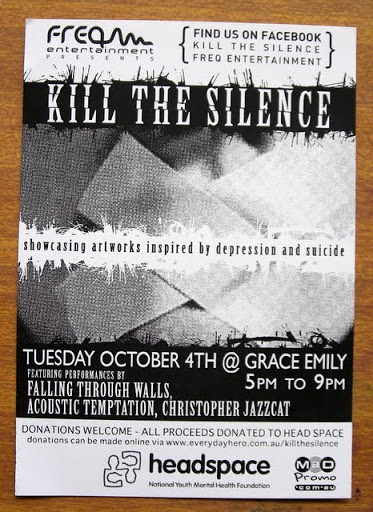
I’ll be reading some of my poetry at an upcoming event called Kill the Silence, which aims to raise awareness about depression and suicide. Friends of some young Adelaide people who lost their lives over the past couple of years have got together to host this evening, showcasing art, poetry and music. I’ll also putting some artworks on the topic together for it.

So, if you have the night free, come and join us. This is a topic pretty close to my heart, one of my family members attempted suicide only a few weeks ago. Fortunately in our case, we were able to get medical help in time. Far too many aren’t so fortunate. It shouldn’t be like this. For all the details, please see my What’s On page at the top of this blog.

On a more cheerful note – I’ve bought some more shoes to paint! Here they are, all washed and ready for paint. Any suggestions? 🙂

TheMHS – Andrew Fuller

One of the speakers at TheMHS I found really inspiring was Andrew Fuller. He has a really warm, friendly manner and approaches his subject with a great deal of gentle humour. He’s another great advocate for a more human approach in mental health. He’s done a lot of work about mental health in kids and teens, and how to build resilience in young people. You can read the points of his talk here on the TheMHS blog. Just a note – he wasn’t saying that everyone struggles at all of those times, he was saying those periods are common stress times that some kids will really struggle with. His website is here, and includes a number of free downloads about topics such as building confidence. He mentions but didn’t go into a concept called Flow, which he says is highly protective against depression. You can read a little about flow here. There’s an interesting article about teenage development here. He’s also published a number of books, such as the gorgeous Tricky Kids, he drew on some of that material for his talk at TheMHS. His basic point was that tricky kids might make you want to strangle them, but they have great skills for adulthood, provided they live that long! And that one of the main factors in kids getting through challenging circumstances was having even just one connection to an invested adult who genuinely liked and ‘got’ them. Makes sense to me. 🙂

Hearing Voices

I’ve been attending, and lately, co-facilitating, a group called Sound Minds for over a year now. This group was started by MIFSA, based on the principles of the Hearing Voices network. I initially went along to support a friend, but found it so helpful for myself I stayed on. I feel very fortunate to have a group like this in my life, it has made a huge difference for me.

Hearing voices is actually a fairly common human experience, but one that has become linked to serious mental illness and major stigma. A lot of people who do hear voices keep this a secret and fear being found out and thought of as mad. Technically, a diagnosis such as schizophrenia require a number of criteria to be met, not just an experience such as hearing voices. But in my experience, if you tell a doctor you hear voices you will likely receive a diagnosis like this whether you have any other symptoms or not.

The standard medical approach to voice hearing goes something like this:

  1. You hear voices because your brain isn’t working properly. You have a mental illness. Your voices are auditory hallucinations.
  2. The cure for this is medication, which addresses the chemical imbalance presumed to be the basis of this illness.
  3. If medication isn’t working, increase the dosage, add more meds, and possibly ECT.
  4. If this still doesn’t work, you are a chronic case, likely to experience lifelong disability.
  5. Talk therapies don’t help, and you should never talk to or about your voices as this will only make them worse. There is no context or meaning to your voices, and hearing voices can never be a neutral or positive experience.

The problem is that for many people, this approach isn’t particularly effective. The Hearing Voices network is a grass roots movement that started in the Netherlands in the 80’s. There’s an interesting article in The Times about how Hearing Voices groups work for people. Some very interesting findings have come out of research into voice hearing, such as-

  • Many people who hear voices do not meet any of the other criteria for a mental illness
  • Many people hear positive or encouraging voices and are not distressed by their experiences
  • Most people who hear voices do so after a particularly emotional or traumatic event
  • Some people only hear voices for a short period of time, then they go away.
  • Some people find that ignoring their voices and constantly trying to distract themselves actually makes their voices worse.

So, the idea behind Sound Minds is having a group that doesn’t use the medical approach to hearing voices. We don’t presume to tell each other what their voices mean or how to manage them best. We each share our journey, our understanding of our own voices, what helps us and listen to each other and borrow strategies to help us manage our experiences. All newcomers to the group are given this printout, and told that it’s been written by other voice hearers, not by ‘experts’. We encourage them to notice if there’s anything listed they’ve already tried, and if it was a helpful approach or not.

The emphasis is upon individuality – how each person understands their voices is legitimate, and what works for each person is often different. Group members are encouraged to be accepting of a diversity of experiences and approaches to voices, and to share ideas without pressuring each other to see things their way. Some people find the biochemical model most helpful and have found medication and/or ECT to be lifesaving, but wish also to be able to talk about their experiences with people who understand. Others have a spiritual framework for their experiences, or link hearing voices to trauma. Some people find telling the voices to be quiet can restore a sense of control, while others find it escalates them. Some people find that the right approach leads to their voices going away, others find it helps them learn to live with them.

I’ve just been listening to a presentation from an International Conference about Recovery from Psychosis. The talk was called “The Personal is Political” by Jacqui Dillon. This would have been an incredible conference, the talks are available quite cheaply (compared to the cost of attending the conference!) on DVD here. Jacqui’s understanding of her own voice hearing experience is closer to DID than schizophrenia, she considers her voices to be parts of herself. This approach has clearly worked well for her and she presents about her experiences in an articulate and deeply moving way. You can hear a different interview with her here.

So, if you hear voices, or know someone who does, take heart. It is still possible to lead a wonderful meaningful life, even if your experience is one of those around learning to live with, rather than being cured of. If what you’ve tried or been told to try so far hasn’t worked, perhaps there’s some suggestions in these links that may help you to look at your situation from another perspective, and find a new approach. It’s important to keep in mind that even your best strategies may not work all the time in all situations, so don’t give up, keep looking, learning, and discovering those keys that help to give you back a sense of hope.

The Australian Hearing Voices network have a website here, with some of the groups listed. They don’t update it very regularly and so far we haven’t been able to coax them into including Sound Minds in their listings, but we’re working on it! If you’re in SA and you’d like to come to Sound Minds, the details are all here. The group runs every week but there’s no pressure to attend, people come as often or as little as they wish. You are also welcome to bring along a friend for support if you wish. If you’d like to print a flyer to keep or share, there’s a pdf here – and that’s my artwork designed in consultation with the group and donated for the flyers. 🙂

For more support, see the community I founded: The Hearing Voices Network of South Australia: www.hvnsa.org.au

First shipment of business cards

They finally arrived! The postie delivered them to a neighbour a couple of doors down and he kindly passed them on this evening. The colour isn’t quite what I was expecting. As you can see from this online version, it’s supposed to be a fairly bright strong blue with a slight lean towards teal. The cards I’ve received are a very dark navy/purple instead.

One possibility is that this is the result of the matt finish. I ordered some fridge magnets too which have printed much closer to the true colour:

They have a glossy finish instead so perhaps that’s the key. So next time I’ll consider a glossy finish or a paler background colour keeping this effect in mind. I also think I’ll bump up my font sizes. I can read it okay but I have friends who wouldn’t be able to, at least not without glasses or a magnifier! Things we learn. 🙂 All in all, I’m pretty happy. And they’re here in time for Friday – I’m always asked for cards after a presentation and now I’ll have some to hand out! – you watch I bet now nobody will ask. 🙂 I’m celebrating with black jelly beans.

Sing out if you’d like a card or magnet the next time we meet, or I can pop one in the post for you. 

Disclosure

This is a tricky topic that comes up for anyone with a diagnosed mental illness. Who to tell, and how to do it? There are so many levels to the issue of disclosure – do you tell family members? Do you put it on your Drivers License? Does your insurer know? Your boss? Your kids school? People manage the issues around disclosure with reactions ranging from – ‘I’m completely and utterly out’, to ‘no one but my doctor knows’ and all kinds in between. There isn’t a right answer here. It is a question I have grappled with for years. There are pros and cons to both being out and playing your cards close to your chest. The worst of it, is that it’s difficult to trial being out and then take it back if you don’t like how it’s all turned out. And there’s a whole host of secondary issues – lets assume for a moment you do want to tell so-and-so. How? When? How much information?

For me, the issue of disclosure has, and continues to be thorny. Learning more about what I was experiencing (and the clinical terms connected to those experiences) in therapy put me in a strange bind. The more I learned about myself, the more secrets I was keeping from other people in my life. I didn’t like this feeling at all. I found it very challenging to continue with the goal of self-awareness, when it seemed to so badly be compromising my other goal of being an honest and authentic person. The alternative – of being out, was firstly unthinkable when I was in the long stage of ‘we’re not quite sure what diagnosis fits you’. And that was a long stage. And secondly, the massive stigma attached to mental illness made me extremely leery. I was bullied a lot at school, and one of the terms that particularly stuck was being called a freak. Putting my hand up to say “I have a mental illness” felt like voluntarily branding myself a freak. When I didn’t have to! If you don’t have to wear the dunce hat and sit in the corner, why do it?

Mental illnesses can have an attraction/repulsion dynamic, where people are both repelled and fascinated by them. I find this deeply uncomfortable. Mental illnesses can be glamorized, treated as a discrete category of more interesting people who have genuinely experienced life in the way mere mortals cannot comprehend. I’m not particularly comfortable with this either. Mental illnesses often make people really afraid. They lose trust, they no longer feel like they can predict you. Sometimes people will assume you’re dangerous. And lastly, mental illness can quickly become your defining characteristic. The thing people first think of when they hear your name. Not, Sarah K Reece, artist. Poet. Friend. Funny person, quirky character, cat-lover, great cook, but mentally ill. If I was killed in a car accident tomorrow, and somehow ended up with a newspaper article about it, it would read Sarah Reece (because everyone always drops the middle K damn their eyes!), mentally ill woman killed in collision. And that sucks. I’ve already experienced this, a little while ago I went to Parliament to give a talk about how my mental illness has impacted upon my education and career. To my surprise, I was quoted in an article in the Sydney Morning Herald. They didn’t do too bad a job, for the media. MIFSA was referred to as a support group which was a bit daft. But still, the shock of seeing my name in print about mental illness – not as a clinician, not as an interested party, but as a person with a mental illness and frankly no other credentials to hide behind except for the true but slightly lame ‘I read a lot’, it was a shock.

There’s a terrible vulnerability to putting this kind of information in the public sphere. I’ve been doing a fair amount of public speaking over the last year, and as terrifying as that can be, at least you are choosing what and how you say things. Having other people write and say what they wish is a whole extra level of feeling vulnerable. And there’s always that nasty accusation – that you are motivated by a craving for attention, or that you are trading on your condition, hoping to somehow cash in on the sympathy factor. When you’re screwing up all your courage to give out information like this in the hope that it will help to raise awareness, decrease stigma, and humanise what is too often feared and misunderstood, this attitude is deeply discouraging.

But, returning to the personal field – when do you tell someone you’re dating? Which friends know? How much do they know? Which family members? What about the ones you don’t get along with? The road I’m walking is of slowly moving towards a place where I keep less secrets. For me, the stress of feeling I’m hiding something, and the unreasonable sense of shame that accompanies it, is a huge cost. I want to live in a world where it doesn’t matter that much. And the only way that’s ever going to happen is if people like me start talking. If people who are afraid discover that, yes, I may hallucinate when stressed, but did you know we both loved that new movie. That mental illness does not define me, is not the only thing you ever need to know about me in order to know me. That it is one part of a whole life of loves, fears, hopes, hobbies, and licorice allsorts.

So, assuming for a minute that you have someone you want to tell, what then? For me, I’ve moved slowly. I’ve laid a lot of groundwork with the people who’s reaction was really, really important to me. I’ve done a lot of quiet educating about mental health in general conversations, and moved us slowly towards that final step of revealing my own issues. There are of course, many other options! This is just what’s worked for me (so far). I found two books in particular to have some helpful advice about the issues of disclosure and relationships, The Dance of Intimacy by Harriet Lerner, and There’s Something I Have To Tell You by Charles Foster. In particular Chapter Nine – Very Hot Issues in Dance had some really thoughtful points in it. For example:

…you cannot learn to swim by jumping off the high dive. This is particularly true when it comes to emotionally loaded issues. Before bringing up a big one, we need to practice bringing up the small ones.

In other words, work on building intimacy, connectedness, and good communication before dropping a bombshell and hoping for the best! Something had some excellent advice about when and why to share information, how to have realistic expectations and actually having the big conversation.

This entire book is based on a simple principle that can help people navigate among all their duties. It’s the Principle of Responsible Honesty:
     Something is hard to say because it creates needs in you and in the other person. You tell the truth most responsibly and effectively when the way you tell takes into account the needs your truth creates and goes some distance towards meeting those needs.

Food for thought.

Surfacing from dissociation

In Bridges last week we shared the incredible experience of surfacing from chronic sensory dissociation. Sometimes people experience short episodes of dissociation, lasting hours to days. Some of us experience chronic dissociation that can last for years, sometimes punctuated by little episodes of reconnecting. When this happens, it is a very precious experience and important to make time to treasure. I’ve experienced chronic dissociation where for months my sight has been dim, colours seem dark and dull to me, my hearing is poor, my taste and smell are dulled, and my skin doesn’t perceive touch clearly. Everything is dulled, far away, darkened. It feels like being a zombie, alive but dead.

Coming back to life, even if it’s only brief, is glorious. To taste, smell, or feel things clearly, sharply, is intense. Being numbed by dissociation can be like walking about muffled in a huge overcoat. Taking this off and feeling the breeze on your skin, the sunlight, the smell of gum trees or grass, is an intense and sensual experience. Chronic dissociation can leave you raw, like feet kept in shoes all winter long, they are tender when you first walk barefoot in the spring. If you experience chronic dissociation, treasure any moments it subsides. Take time to touch life, to breathe it in, to remind yourself what it feels like to be alive. These are the memories that keep us going when our world goes dark again. This is what we are fighting for.

After the weeks made dim
By fear and stress,
incessant storms,
bloody foam
on the black water

A day like today
is so strange and welcome
To wake, and find the devils gone
No shades at my bed – misery,
loneliness, hopelessness, and bleak 
despair
All mysteriously called away
And instead the day is mine, to fill with my own things
Bliss.

The anxiety and the wrenching pain
Drive me before them,
bound and bruised,
Resentful and unable to escape
Burning with black dreams
Enslaved to brutal masters
On whom I wish evil ends.

To be free of them – is to fly!
I enjoy everything, the sunlight through the windows
Bare feet on carpet, the colour of my dress,
Smell of my skin
My mind is clear, clean as snow melt
My fingers are alive; I perceive and create
I soak it all up
To get me through
When the haunting starts again.

Competitions and Resources

Just a reminder – the Open Your Mind Poetry Competition is on again this year, accepting entries until Sept 9th. I’ve been invited to be one of the speakers at the ceremony announcing the winners later this year. 🙂 For more details about that, see my new Upcoming Events page.


The competition is run by the Mental Health Coalition of SA, who are also the awesome and very busy people running the Big Circle Arts Collective, arranging the Mental Health Week art exhibitions and the TheMHS exhibition, and setting up Mind Share – which will be an online blogging community, showcasing creative projects with mental health information and resources. You can still submit art, poems, and short stories to them, or offer to become a regular blogger. As you can see, I love all their projects and jump in with nearly everything they run!


The other folks behind the Open Your Mind poetry competition are the SA Writers Centre who host the event. I went for a visit the other day and met up with the absolutely lovely Jude Aquilina to ask for publishing advice about my various presentations and projects. I am working on converting some of these into a printed form and trying to decide between various publishing opportunities. Jude was very encouraging! If you are also inclined in the literary area, I highly recommend introducing yourself to this wonderful resource. They have a regular newsletter full of information, competitions, opportunities and advice. 

Business Card

So I’ve finally ordered some business cards, instead of forcing interested people to write my details down on scraps of paper or the back of their hand! I’ve decided on a two sided card, one in blue and white with my arty details, and the reverse in black and white with my Peer Worker details. You can see the front side here. I’ve paid for the cheapest postage, so they’ll probably take three weeks to arrive. I’ll try to contain my excitement! It’s been a number of years since I’ve needed a business card, and previously I bought packs of make-it-yourself and ran them through a printer or stamped my details by hand. These are going be pretty amazingly professional by comparison!

I was originally waiting until I had myself completely set up with a website etc. But I felt guilty the last time a nice lady was scratching my details onto a scrap of paper and decided to print up what I’ve got now, and print some more when and if I decide to set up other business-y things.

If you’re looking to print your own, I’d recommend Vista Print. If you wait and watch you can usually get 250 business cards free – just be aware that as you’re getting excited ordering free items, your postage costs are accumulating. So check your final costs before placing the order! But you can certainly have a lot of fun playing around with different designs. I do feel that being an artist, I should probably have an artwork on my card… but on the other hand my style is so eclectic that nothing is exactly representative. I like the swirls, they’re pretty but neutral in that respect. I liked one with poppies on it too, but the black and white reverse wasn’t so pretty.

Recovering from Trauma – Object Constancy

At Bridges this week we talked about ways people recover from trauma, beginning with the area of Object Constancy. Simply put, object constancy is something children generally develop as they grow. It is about attachment, and means that – when Mum is out of the room, the child understands that she still exists, and is able to be comforted by the thought of her. Children who do not have object constancy have an ‘out of sight – out of mind’ kind of experience, where if Mum isn’t in sight, she ceases to exist entirely, which is frightening and upsetting. A lack of object constancy in adulthood can be a painful part of a number of different mental illnesses. Many people with dissociative disorders have difficulties in this area.I’m no exception. I’ve discovered that managing chronic dissociation is often about finding creative ways to help information cross dissociative divides. So, I have learned that I need reminders of my important relationships around me, such as photographs. I wear perfumes that have links to people that are special to me, such as my Grandma, or my lovely neighbour Marie when I was a child. I have had to write the names of my friends on paper and pin them somewhere I can read them regularly, or when I am stressed, I forget that these people exist and care about me.

That sounds cosy and simple. The reality is more complex. Sometimes there are no relationships to draw comfort from. Sometimes there are relationships, but they are cold, or distant, or abusive. None of these qualities inspire attachment. There’s no point in trying to overcome dissociation to be more connected to an existence that is painful and destructive. There’s often a reason it’s there in the first place. Sometimes relationships can look and seem close, but be missing essential qualities that create connection. Sometimes, feeling lonely in a relationship can be indicative not of attachment problems, but of a relationship that is disconnected on some fundamental level. I once had a close relationship with someone like an aunt in my life. Increasingly discontented and confused by my sense of distance I tried to rebuild a closeness between us, sending gifts and cards and calling by. Eventually when confronted she told me that she had stopped loving me years before, but still maintained the semblance of a friendship so that I would not make a fuss. Having attachment issues does not mean that all your relationships are good and any problems are always you.

But, when there are good caring people around you, having them cease to exist on an emotional level the moment they leave your side is a horrible and frustrating experience. So, carry pictures of your children with you. Keep tokens that remind you of your loved one. I have a candle I burn at Christmas in memory of my Grandma. She’s still with us every Christmas. I wear jewellery given to me by people special to me. I keep cards on display for months. This is the place I’m trying to stay out of:

I can’t feel you

or see you
everything is dark here
and you are
only a story told to me
so alien and lovely
I try to believe
That the world is not empty
That other hearts beat in the dark
But it is difficult
On the edge of my vision, you blur into the night
Becoming only shadows and whispers
The wind speaks cruel things to me
And I wonder
If there is any love left in the world.

Introducing DID

In our group Bridges this week, I gave a talk introducing DID (Dissociative Identity Disorder). We are planning to present a forum on the topic in about 2 months time. It’s a very big topic and there’s a lot of misinformation and confusion out there about it. This talk is by no means comprehensive, but it is I hope a good introduction and overview of the condition.

What is Dissociation?

I’m going to start with a quote by a psychiatrist, Judith Herman:

The psychological distress symptoms of traumatised people simultaneously call attention to the existence of an unspeakable secret and deflect attention from it. This is most apparent in the way traumatised people alternate between feeling numb and reliving the event. The dialectic of trauma gives rise to complicated, sometimes uncanny alterations of consciousness… which mental health professionals, searching for a calm, precise language, call “dissociation.”

What does that mean? Dis-association is the disconnection between things that are normally associated. In simple terms, dissociation is to be unplugged in some way. 

Most of us have experienced a small degree of dissociation. One common example is called highway hypnosis, which is where you may drive say, home from work, and arrive not able to recall any details of the trip. You’ve been driving on autopilot probably thinking about other things. Another example is daydreaming, or getting ‘lost’ in a good book. These are common experiences, and do not indicate a problem of any kind. Dissociation only becomes a disorder when it is severe, distressing or disabling. It can be difficult to imagine what severe dissociation might feel like, but if you have ever stayed awake for a night or two, perhaps studying, then you have some idea. You may have felt confused, foggy, your sense of time might have been different, perhaps the room appeared fuzzy or spun around you, you may not have felt your feet upon the floor. Remembering this experience can help you imagine what someone who experiences severe dissociation may feel like.

Dissociation and Mental Illness

Dissociation is a symptom of a number of different mental illnesses, such as Post Traumatic Stress Disorder, and Borderline Personality Disorder. There is also an entire category of disorders where dissociation is the primary issue, just like the category of anxiety disorders groups different mental illnesses where anxiety is the underlying feature.

Dissociation can happen in may different areas. It depends which area has been ‘unplugged’ as to which symptoms a person experiences. People who suffer from chronic dissociation may struggle with symptoms such as:

  • Emotional numbing – where someone cannot connect to their own feelings, feeling flat, empty or numb instead.
  • Amnesia – ‘zoning out’/blackouts/lost time, when dissociation occurs in the area of memory, for example suddenly discovering that it is Thursday, and having no memory of Wednesday.
  • Time speeding up or slowing down – if you have ever been in an accident you may have experienced this common dissociative symptom.
  • Losing sensations – not being able to feel your own body, or feel sensations such as heat, cold, pain, hunger. Dissociation can unplug someone from their own senses, dulling or even removing altogether their sight or sense of hearing or ability to feel pain for example.
  • De-realisation – this describes someone’s experience when they are unplugged from the world around them, it may feel like being in a dream, or that they are living in a film. Nothing feels ‘real’. This may not sound so bad but it can be very distressing to experience.
  • Depersonalisation – describes being unplugged from yourself, where someone may feel unreal, like being a robot or living in a dream. They may not recognise their own reflection in a mirror, and may have out of body experiences where they seem to be watching themselves.

Many people experience one or more of these without having a mental illness. And people who do have a dissociative disorder may experience only one or all of these. Some people struggle with chronic symptoms, while others experience episodes and then recover.

What is DID?

DID is one of the Dissociative Disorders. In DID, Dissociation occurs primarily in the areas of memory and identity. DID used to be called Multiple Personality Disorder. The name was changed in the DSM to reflect a different understand of the condition. DID is not someone having more than one personality, it is one personality that is divided into parts through dissociation.

Dr Warwick Middleton, an Australian psychiatrist who is the Director of the Trauma and Dissociation Unit at Belmont Hospital in Queensland wrote “It is inaccurate to conceptualise a patient with DID as having ‘multiple personalities’. A more helpful conceptualisation is that such individuals have access to less than one personality.” (at any one time)

We all have parts

We all show different sides of ourselves with our workmates, children, and friends. We play different roles in our lives. We know what it feels like to be “in two minds”, we say things like “part of me wants to go out tonight, and part of me wants to stay  in”. For a person with DID, these things are true in a literal way. 

Parts Divided

For someone with DID these parts are separated from each other by dissociative barriers. As a result, they develop separately and can be very different from each other. For example, they may have different ages, gender, skills, interests and beliefs.

There are some common terms associated with DID it may helpful to know the meaning of.

  • Part or Alter – commonly used to describe the different personalities in a person with DID.
  • System – this describes the group of personalities that make up the whole person with DID. Many people prefer other terms such as family, tribe, or community.
  • Switching – one part going ‘inside’ or away, and another one coming ‘out’ and inhabiting the body. This may be slow or quick, obvious or very subtle.
  • Trigger – is anything that makes a switch between parts happen.
  • Coming out/Going in – used by people with DID to describe times where they are in control of their body and times where another part of their system is.
  • Kids/Littles – refers to any parts that are children or young teens. It is quite common for people with DID to have younger parts, but not everyone does. A person with DID may talk about their ‘kids’ to mean not biological children but their children parts.
  • Multiple – a shorthand way of describing someone who has separate parts. People without dissociated parts may be called Singletons.
  • Co-consciousness – means that more than one part is aware of what is happening at the same time.

Why does it happen?

The development of DID has a very high association with childhood trauma. In childhood the identity is still forming, and trauma during this time can result in dissociation in this area. It’s important not to make assumptions here, trauma may involve abuse, but there are many other ways children may be traumatized. For example a very ill child who must undergo many painful medical procedures may develop DID. Not everyone who has DID has come through childhood trauma, and certainly many people who are traumatized as children do not develop DID. It is also important to note that while some people with DID have come through extreme abuse, others’ experience was less severe yet they have still developed DID. 

Whilst DID is considered a mental illness, it can also be thought of as a defence mechanism, a way to survive. Psychologist Deborah Haddock writes “Many people with DID baulk at the use of the term disorder. When every ounce of your being comes together to fight for survival, having it termed a disorder can feel discounting to say the least.”

How do people survive trauma?

1. Containment

There are, among many others, two key abilities that all  people may draw upon to get through a traumatic situation. One of these is containment. This is about being able to compartmentalise experiences. If you have ever put aside your feelings to assist at an accident, then after everyone was safe, gone home and shaken and cried, you have used to containment. You have contained your overwhelming feelings to do what needed to be done, and then felt them later on.

Someone with DID uses containment in an even stronger way, where different parts contain different skills, memories, or emotions. One of the advantages of this is that damage is contained, and healthy areas of functioning are preserved rather than the whole person being overwhelmed and unable to function. An analogy is the way a flock of geese flies. The goose at the front encounters the most air resistance, it has the hardest job while the rest of the flock rest in the slipstream. When the front goose tires, it drops back and another goose takes the lead position. The parts in a DID system may do this, where one part is out, then goes away inside to rest while another comes out.

2.Adaptation

Another way people get through trauma is through our ability to react and adapt to new situations and environments. We’re all capable of drawing on different strengths and skills in different environments. For someone with DID, this ability to adapt can be life saving. For example, a child may develop a part that copes with physical pain by numbing and not feeling anything. They may have another part who goes to school, has none of the bad memories, and is able to behave normally. They may also have another part tucked away inside who keeps fragile characteristics safe from being destroyed by a harsh environment, for example hope, self esteem, or optimism.

Theories

There are two main frameworks used to describe the way separate parts form in a person with DID.

The Smashed Vase theory is that every part of a system is a piece that together makes up the whole person. This explains the way systems can divide up basic characteristics such as emotions, one part manages anger, another expresses joy.

The Alternate Selves theory is that every part is one possible version of who the person could be, given their experiences and history. This explains the way DID systems can continue to split and form new parts, there seems to be no upper limit of how many parts can form. Also the way parts can un-form, meld into each other, and disappear.

The reality for a person with DID may be an overlap of both processes.

Challenges

There are some huge challenges facing a person with DID. Deborah Haddock writes “Most DID patients see several therapists and have an average of seven diagnosis before finally finding someone who understands the dissociative aspect of their behaviour… Confirming the diagnosis of DID is not easy, however. One of the difficulties lies in the nature of dissociation, which compartmentalises behaviours and experience that would normally be connected. Also, the dissociative personality system is usually set up to avoid detection.” In a nutshell, DID generally only works as a defence mechanism if it is hidden and secret. Otherwise, being divided may make someone more vulnerable to abuse.

Dr Middleton writes “For dissociation to be an effective mechanism in protecting individuals from being overwhelmed… it is necessary for the individual to a fairly large degree to dissociate the fact that they dissociate. If they are fully aware of the extent of their dissociation, they they are very close to being overwhelmed by the underlying reasons for it.” DID can be extremely confusing to experience, and even finding the words to express what is happening can be extremely difficult. It is not a very common diagnosis, and not many professionals specialise in the area of dissociative disorders. Even once diagnosed, finding a competent and caring professional to work with may be difficult. 

People with DID are not all the same

We tend to think in absolutes, something is black or white, someone is crazy or sane. The reality is less concrete. Dissociation is more a continuum, with normal, healthy experiences at one end, and severe mental illness at the other. Likewise, within the realm of multiplicity, there are a number of continuums, and the result is that there is a lot of variation between one person with DID and another. For example, the degree of amnesia varies considerably. Some people with DID have total amnesia for the times when other parts are out. Others are aware of what is happening, which is called co-consciousness. Some multiples don’t experience the level of amnesia needed to fit in the category of DID, and they may receive a diagnosis of DDNOS (Dissociative Disorder Not Otherwise Specified) instead. Some other differences between people with DID are

  • Obviousness of switching – for some people it is obvious when they switch, for others it is so subtle that only someone who knew them very well might be able to tell.
  • Number of parts – this can range from just one, to hundreds.
  • Switching – some multiples switch all through the day, others only very occasionally, and some people never switch, but they talk to their parts and hear them in their mind.
  • Degree of internal control over triggers – some multiples can chose which part is out, others have no control over this.
  • Degree of fluidity – some multiples have fixed systems with, say, 5 members who have been there for years. Others are more chaotic, they are difficult to learn about as they are constantly changing with new parts forming and old ones going away.
  • Other diagnosis – people with DID may have other physical or mental illnesses which will change how they experience life.
  • Degree of disability – some people with DID are extremely unwell and struggle to function, perhaps spending a lot of time as inpatients, while others live and work unnoticed in the community, perhaps with no one around them aware of their condition.
  • Polyfragmentation – some people with DID have mini systems within their system, or have parts who have themselves split to form parts of their own.

DID is about identity – it is therefore extremely individual in the way it presents and is experienced.

How can I help a friend with DID?

One of the most important things a person with DID needs is acceptance. It can be very stressful and discouraging to have a condition that is uncommon and often misunderstood. Media representations of DID are often dramatic and frightening. It is also important not to be invasive. Some people with DID are comfortable sharing details about their systems, others are not. Asking questions like “who is out now?” or “what are all your names?” can be confronting. It helps if you are willing to cope with inconsistency. Someone with DID may one day love apples and the next hate them, may tell you on different occasions about a film they saw and give you completely different impressions of it. Often, this is misunderstood as lying, when it is just parts with different tastes.

It will also help if you are willing to cope with confusion. Dissociation is extremely confusing by its nature. It may take a long time to work out what is happening. It may take a long time even to determine if the symptoms are dissociation rather than something else. Try not to pressure the person to know more about what is going on for them they can. Learning about this is a process, and the diagnosis of DID often carries a lot of stress and fear for people. Being safe is very important, if you have a friend with DID it is vital that you never take advantage of their multiplicity. If they have child parts, treat them as you would treat children for example. And lastly, although you may have a strong friendship or relationship with one part, do your best to embrace and welcome their whole system, and recognise that your friend is part of a community.

Is there hope?

Yes!

Connections that have been broken can be rebuilt. Trauma can be healed. It is important to find good caring support people, friends or family or professionals. As much as possible, work on learning about your system, increasing communication, self awareness, and self acceptance. Reducing denial, and learning how to ground yourself can also make a big difference. The goal is to come together to function as a team, all protecting and looking out for each other instead of fighting and pulling in different directions. This goal can be reached through cooperation, and/or through integration, which is where the dissociative barriers between parts dissolve, so every part is out all the time.

People with DID can be very vulnerable, but they are also incredibly resilient!

Cameron West, who has DID, writes:

I desperately want to feel like I’m part of this world and somehow connected to the people in it. I guess that’s why I’m here today. I’m hoping that somebody will look into my eyes and tell me they see somebody there, tell me they see Cameron West there. And if they see other people in there, well that’s okay too. It has to be okay. I’m through being disconnected from me. I am who we are, and it’s got to be okay, or I’ve got no chance of a better life.

For more information see articles listed on Multiplicity Links, scroll through posts in the category of Multiplicity, or explore my Network The Dissociative Initiative.

Art online

Last year I sold the digital images of three artworks to a group who were putting together a new website called bipolarcaregivers. I love selling pictures of my work instead of the originals! Selling art is completely different to publishing writing. You hand over your baby and someone else walks off with it and never comes back! It’s wrenching! However, on the plus side you no longer have to find room to store it, which is a very handy thing. Either way, I’m more careful these days to document my work and keep a record of what I’ve made. I’m keen to explore the local options for producing high quality prints for sale too, there’s plenty of people who love the images but don’t have the cash to buy originals. At the moment, my art related to mental health is being purchased by professionals and staff, but isn’t really accessible to people with mental illnesses getting by on pensions. Which I’m not happy about.

Back to the website! They purchased three artworks, (click on the links to see them) Netting Stars, Finding Hope, and I see you falling. The last one is echoed by my latest ink painting using masking fluid. Same theme but a different response.

Nightmares

Are a common symptom of Posttraumatic Stress Disorder (PTSD). In my case, it was hoped I would grow out of them. I haven’t, they are something I live with. I go through phases where they are comparatively benign, and others where they are so severe I can’t, and don’t want to, sleep. At the moment, I’m going through a bad phase. I painted this ink picture the other day. This is how it feels.


Managing Triggers

I led the discussion in our group Bridges yesterday, on the topic of managing triggers. I thought I’d share it here for the benefit of a wider audience. 🙂 Just brushing the surface of what can be a very big topic – What are triggers? Anything in our environment that ‘triggers’ a reaction so quick or so strong it bypasses our conscious control is a trigger. On a simple level, touching something hot and recoiling without thinking about it is an example of a trigger. When we use the term in mental health, we’re usually talking about things that trigger strong emotions, strong memories or flashbacks, dissociation, or for those with DID/DDNOS (Dissociative Identity Disorder or Dissociative Disorder not otherwise specified), perhaps alters. Really, anything can be a trigger. Some of my triggers are certain smells, such as a particular brand of cologne associated with bad memories for me, sounds such as certain songs or music, places – such as my old school ground, and situations such as encountering someone aggressive or violent.

Everyone has some things that trigger a reaction in them, and triggers are not necessarily a bad thing. It isn’t just strong bad memories or strong negative emotions that can be triggered. Positive memories and emotions can also be triggered by things in our environment. Hearing ‘our song’ on the radio, being present at a birth, smelling something that we associate with a loved one – great grandma’s perfume. All these things can trigger a strong, even overwhelming reaction in us, and this is a good thing. To be moved by things is part of what it means to be human. So for those of us who find triggers difficult to cope with, it can help to remember that the goal is bringing them back to something manageable, not getting rid of them altogether.

I’ve pulled out of my journals this poem I wrote about being triggered in a positive way. At this time in my life I was suffering from severe dissociation. Most of my senses were dulled severely, I could not taste, my sight was limited and colours were dull. My sense of touch was reduced, a hand on my arm felt faint and far away, I couldn’t feel my feet touching the ground. It was a very bad time and very distressing. On that evening I was coming back from an event, being driven through the city. As I came along King William Street, the bells of St Peter’s Cathedral rang out. And the sound triggered me, I surfaced through the dissociation and suddenly felt alive again, for a brief moment.

The Fire
Yesterday I woke with a fire in my chest.
All the leaves of autumn burned.
My thoughts were sharp and clear
The night was sharp and clear
I awoke
From where I had been lost
In dream-haze, in exhausted slumber.
I reached out
To the sound of bells that rang
Through the city.
I tasted the air and felt my mind inhabited
I turned and looked with eyes that turned and looked with me.
Like a vault opened to the light
Like a moth from a cocoon I awoke
The fire stirred me.
And beneath the clarity like diamond-fire
Was the little tightness
The knowledge that fatigue, like wolves
Would return when the flame was ash.
This respite from the haze that is my life
Was brief. For a glorious moment I touched the night.
I knew myself familiar.
Stranger! I cried
I had missed you
Lost you
Loved you
And I know you will not stay.

However, triggers can make life very difficult! If, like me, you find that you are very reactive and struggling to manage many triggers, here are some starting points on ways to try and calm things down.

One of the first options most of us try is to avoid. It’s worth mentioning because it is a legitimate option! If the trigger is something easy to avoid, like a particular location you don’t need to go near – for me, my old school, then avoid it! Easy. This option falls apart a bit if you have lots of triggers or triggers that are really common in your everyday life. Then you end up not being able to get out of bed. But there’s no prizes for stressing yourself out trying to make yourself cope with a bad trigger you don’t need to confront.

Desensitisation is another approach. This comes from treatments for anxiety and phobias. The idea is that you gradually build up your ability to cope with a trigger, until it gets to the point where it no longer affects you. For example, for awhile there the smell of rosemary was a trigger for me. It would immediately make me feel extremely nauseous. So, I used to occasionally put an oil blend containing a tiny amount of rosemary in an oil burner on days I was having a good time, friends over, feeling good. It would bother me a little bit but not much. Over time I increased the amount slowly, and kept linking the smell to good, fun experiences. Now, it doesn’t bother me at all and own a rosemary plant I cook with all the time. This concept of association is what gives triggers their power to affect us – they have been associated with a strong feeling or memory. Sometimes you can in time break down that association and create a new one.

I often cope by trying to overpower triggers. Smell is one of the most potent memory triggers for all people, and I use my perfumes to help me cope with other triggers in my environment. I find the smell of strangers upsetting, so in situations like public transport I can become very distressed. If I am wearing my own perfume, a smell that is comforting and familiar, I can breathe this in and literally overpower the other triggers. But it can also work on other levels – for example, I have a ring that reminds me of my sister, which is a comforting thing to me. I wear it to work on days I know will be stressful, and I touch it and look at it to ground myself and remind me I am safe and loved. I use it to overpower those things in my environment that are triggering fear and threat in me. Another way of putting this is that I use the strength of a positive trigger to help me deal with a negative one. I call this anchoring and I’ve explored the idea more in

If you find yourself jumping at shadows and reacting to everything, then going through each trigger one at a time is probably going to be time consuming and frustrating. In that case it may be a better idea to work on lowering your reactivity. If your baseline stress levels are really high, you are much more sensitive to triggers. What do I mean by that? Your baseline is what you return to after stress. So, in this picture, those red spikes are periods of massive stress, while the green zone done the bottom is you feeling all chilled out and okay with the world.

As you can see, for some of us, when we go through major stresses, we don’t ever quite get back to as chilled out as we used to be. Each episode leaves us more stressed and anxious and highly strung than the last. Our baseline – how we feel when nothing is actually happening to stress us out, gets so high that we feel permanently stressed out. When we’re in this space, we are highly reactive. Nearly everything is a trigger. The idea is try and recover better from stressful events, so our baseline looks more like this:

When we’re getting good time cruising along in that green space, we’re less reactive and will find triggers easier to manage. For more ideas about how to get back to the green space see:

Something else to bear in mind if you’re having troubles in this area, is that you may find taking some time to process your stuff can help. If, like me, you get through the day by burying a lot of what you’re feeling and thinking – this can come back to bite you. Sometimes triggers are the price you pay for using suppression to cope. It can be like trying to hold a beach ball under water – at some point it will get away from you and come hurtling up! If you have grief or trauma to work through, making some space for that in your life can help to reduce your reactivity to triggers. This doesn’t necessarily have to be intense, anguished and time consuming. It can be as simple as starting a journal where you write about some of those feelings, going to a counsellor to talk about grief, or putting up a photo in memory of someone you’ve lost. Sometimes very small things that signify to yourself that you are listening and paying attention to your own needs can make a big difference with how well you cope in other areas of your life. For an example of this see

And lastly, for the multiples, if the big issue you’re having is trying to prevent things that trigger alters, then you can try everything listed above – and it may indicate you have some system work to do. If you’re functioning by suppressing everyone else in your system – some of them are going to fight you. And they can gang up on you, be very persistent and wear you down. Working to make some safe time and space for everyone to get a little of what they need – which sometimes is just to be acknowledged that they exist – can make a big difference in coping with triggers. If your team are working together instead of fighting each other, then things that trigger switches aren’t such a big deal. You can also learn about how to use triggers to generate useful switching, see

I continue talking about the management of triggers and the risks and benefits of the way we think about them in Mental Health needs better PR.