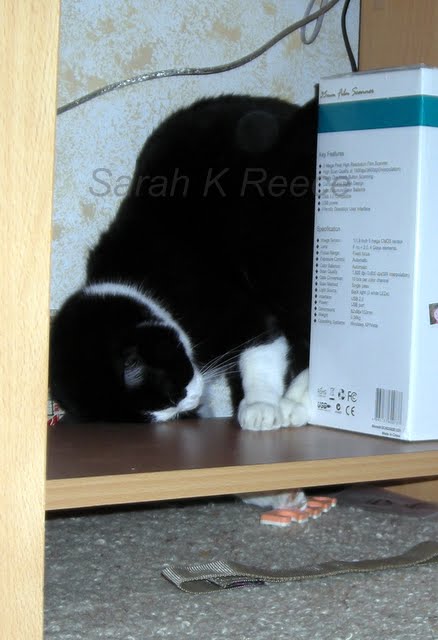
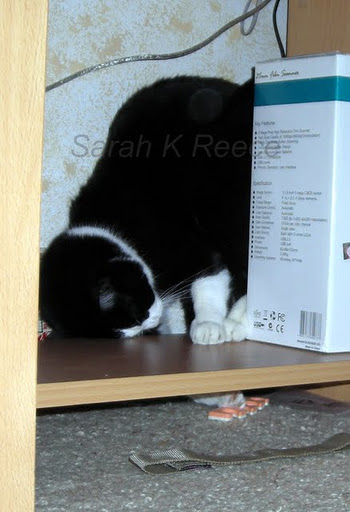
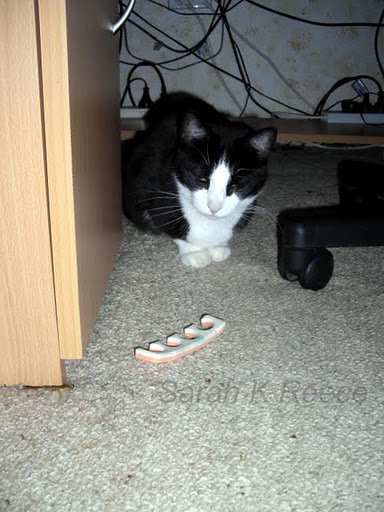
Whilst older than Tiger, Cleo still has her kitten moments. 🙂 Recently she found my toe separator (used for when you paint your toe nails) and spent a good 20 minutes pouncing on it and tossing it about, and then pretending to look innocent when I went to see what she was doing…
Poem – She falls
Camp fire
This year it’s become a bit of a tradition with some of my friends, we get together every so often and bake potatoes in the fire. Everyone brings drinks or toppings for the spuds. The taste is fantastic, they are creamy and smoky and delicious! Today we also did baked bananas with chocolate sauce, and it isn’t a camp fire without toasted marshmallows. I am so very busy at the moment with work and study and volunteering, art projects, the blog, and all the reading and writing I do. Taking a whole day off to put out chairs and set a fire, water the garden, find room in the fridge for the drinks… it’s so peaceful! My skin smells of smoke, there’s leftover tabouli in my fridge, I’ve lent a book of poetry to a friend who’s new to poems, and all is right with the world.
Tea light candles in glasses to light the table I’ve put under the apricot tree:
I hope you’re having a relaxing weekend too.
Preparing the garden for summer
Poem – Night
I’m going to Broken Hill
As you can see, I loved the massive stone sculptures. The countryside is harsh and wild and stirring.
There’s surprising beauty:
And interesting galleries to visit:
Or if your tastes run in a different direction: a Mad Max exhibit:
and at The Tourist Lodge this January, there will be poets by the pool.
What more could you ask for? Email me if you’d like all the details. 🙂
Getting gung-ho about treatment
There’s a lot of room for different approaches to recovery from mental illness. Some people love affirmations, others write journals, some use humour… Something I’ve noticed doesn’t seem to work well very often is an aggressive approach to getting rid of dissociation. Some folks, once they’ve discovered what it is, get very keen about helping people to never dissociate. This dubious goal rather concerns me. Firstly, my personal approach to mental illness is about focusing on what I want rather than what I don’t. I mean, (one of) my goals is to have a passionate, meaningful life, one in which I can participate as fully as possible. My goal is not to get rid of dissociation. They sound similar but really they’re not. Certainly, being crippled by aspects of mental illness is something to work on, but it’s in pursuit of a higher goal. It is never the focus in and of itself. What does this mean? It means whenever my dissociation is low enough for me to enjoy life, I’m not sitting in therapy trying to get rid of the last of it, I’m painting! I’m down at the beach, out with friends, reading books, having a life. Every chance I get. These experiences give me the sustenance I need to get through bad times, they build my self esteem, give me hope, a sense of control over my own life, great comfort and joy. This is what it’s all about. I don’t mind limping a little, and I know that a great deal of the healing and recovery we need happens in normal life, in everyday relationships, in art and running and writing and standing in the rain.
Focusing on getting rid of a symptom like dissociation sets the stage for power struggles, for making assumptions about what is healthy, and for a ‘Russian roulette’ of symptom swapping. Dissociation for many people serves as a protective mechanism. Think of it as a fuse blowing in a house with dangerous wiring. You don’t wire over the fuse, or you risk burning down the house. You sort out the wiring problems so the house is safe, then you work on resetting the fuse. Good therapy always starts with helping people feel safe, and swapping out harmful coping mechanisms with healthy ones. You don’t just start kicking crutches out.
Therapists can become very frustrated with highly dissociative clients, thinking that if they could get rid of the dissociation, then they could get some ‘real’ therapy done. Trying to beat down dissociative defenses with an anxious client is likely make them worse. If therapy is perceived as a threat, the mind will continue to put all it’s energy into disconnecting as much as possible, using any method it can come up with.
Not only can dissociation be protective, but the current definitions are so broad that getting rid of it entirely doesn’t sound like a good goal to me. If any form of disconnection from the present moment is defined as a form of dissociation, then we need some. We need space to daydream, time to get lost in our thoughts, in books or films. This is not black and white ‘dissociation bad’, ‘connection good’. In order to focus deeply, we disconnect from distractions around us. Creative people often describe this lack of awareness when they are deeply involved in their work. It’s healthy, inspiring, magic. This can be called ‘flow‘, or being ‘in the zone’, absolutely immersed in your task. Experiences of flow are thought to be highly protective against depression and anxiety. Some theories about hypnotic states are that we are all going into and out of different states throughout our days, without even noticing. We disconnect from events around us to ruminate and process thoughts and feelings, drive on auto-pilot, focus intensely during a stressful conversation, warm to friends and ‘come out of ourselves’ in their company, all the time changing our level of awareness of things going on around us and inside us. There can be a natural kind of rhythm to this process, we can have our own cycles of energy and focus, times when we are most focused externally and others when we are most aware of our inner lives. In some of these states we are very receptive, taking in deeply the things we say to ourselves, at others we have all our psychological defenses up.
The thought of holding up a life where none of these things happen as the goal to strive for is horrifying to me. I value being able to disconnect from the day to day to find a place my heart soars. While I loathe being lost in severe dissociation, unable to see, feel, smell or taste, I also hate the ‘flatland’ of a totally symptom free life that somehow keeps being set up as the goal for people like me. A little madness is not a bad thing, a little dissociation that frees us to dream, likewise. The goal is about freedom, hope, peace, meaning, love, connection, art… being human. Even our weaknesses and limitations can be part of that goal.
What I need when I’m lost and trying to find my way back isn’t someone trying to carve dissociation out of me like a tumour. I need to find a way back, like coaxing a small terrified creature to come out of the dark. The right person holding my hand can be enough to bring me home. Standing in a thunderstorm can be the intense sense of connection I need for a mind in flight to re-inhabit my body. Sometimes everyday life doesn’t have a strong enough call, it’s the song of the sublime that reminds me of who I am. It’s poems that make me cry and music that makes me feel safe and books that are paper receptacles for my shattered heart. These things that remind me that I am human, that I want to be alive, and that the world is deeper, sadder, richer and stranger than we think.
Broken City
Here she is at last, my Broken City:
Next, planning how the compartment beneath will house the components:
Then cutting out the box that will contain them. Jigsaws aren’t ideal for this, it’s fiddly, and you need more practice than I’ve had to get everything perfectly straight. 🙂
Installing the switch – it’s horribly ugly so I decided to inset it discretely beneath. The wires will go through the small drilled holes into the switch. The dremel is fantastic for fiddly jobs like this.
Coming together, I’ve also drilled a notch out of the frame by the light to accommodate the housing.
Gluing and clamping. I toyed with a few different ways of joining everything and decided on a liquid nails type product. I’m no carpenter, that’s for sure!
Decided the battery would be taped beneath. This keeps it from moving around but means it can still be replaced when it expires.
I tried using hot glue to inset the glass but it didn’t bind well. Scraped it out and used the same liquid nails. The clean up is tricky because of the confined space, but with a tiny screw driver I was able to clear away excess.
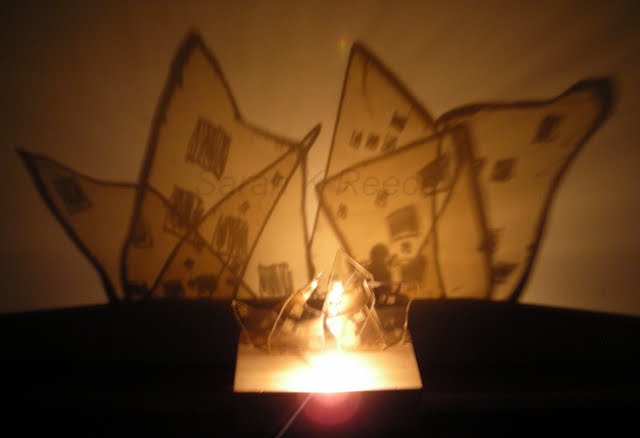
Turning it back on – fantastic shadows 🙂
I’m really happy, it’s lovely to look at when the light is on or off. The size of the shadows are controlled by how close you put the sculpture to the wall.
Glass and wood
Small Object Making class: start at the beginning:
Well, despite setbacks all over the place, I’ve been making major progress with my shadow sculpture! I got into Tafe last week with all my bits of glass, a large panel of wood from Bunnings and the only vaguely suitable light source I could find after far too long looking – a small LED torch, expecting to gets lots accomplished. Alas, on testing it turned out the small torch was completely unsuitable. It had about 9 tiny LEDs, which cast multiple overlapping shadows blurring the image. So I spent the time fixing up my new wood vice (this is for clamping wood projects firmly so I can carve into them with chisels safely – you don’t want to hold in one hand and carve with the other when it comes to chisels!) and finishing off my journal as far as I can. My sculpture tutor loved the glass design so I’m pretty happy about that too. Here’s my new wood vice:
The inset panels I cut and drilled myself to fit, they are lovely oak from scraps at the studio, and will protect any project clamped in there.
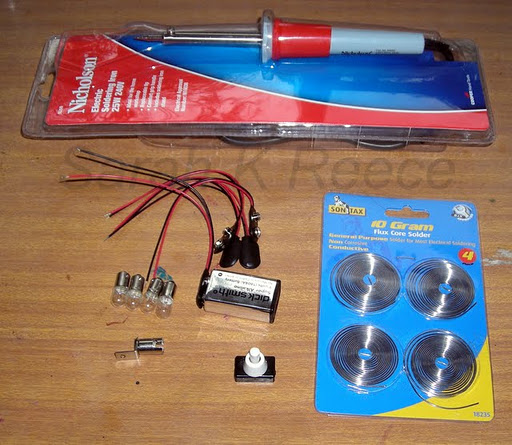
I trundled off to Dick Smiths and bought some basic bits and bobs to wire in a light globe myself. I remember rows and rows of fascinating little thingammy bobs in Dick Smiths when I was a kid, but these days it seems they mostly stock finished electrical items rather than components. No kit sets, no instruction books. I did do a little electronics when I was a lot younger in school, but that is many years ago and I don’t recall it. Very helpful store employees at Dick Smiths and Bunnings sent me home with this:
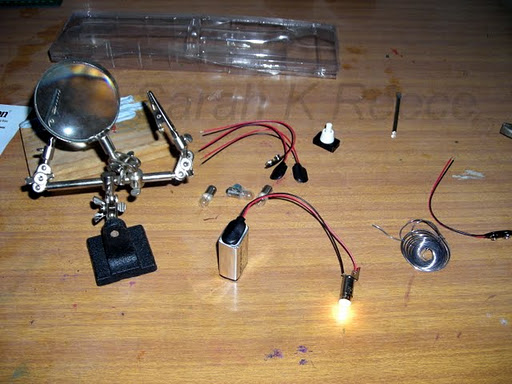
I looked up some Youtube clips about soldering as I’ve never done that before either. It’s both nerve wracking and exciting to be right out of my comfort zone like this! The most nerve wracking part I think is the possibility I’ll now have another entire set of tools and components to crave… I wired it up and soldered a join. It’s quite tricky!
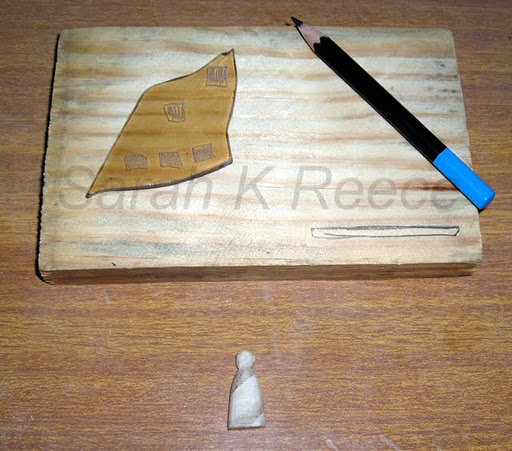
Then I carved my little figure out of wood and drew a template to set the glass into my wooden plank (testing the process on scrap first):
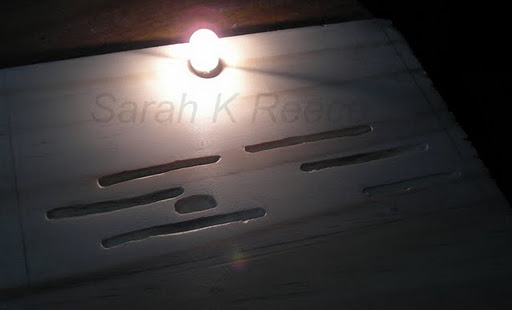
And carved some channels for the glass in my good wood:
Set everything in place:
Then took it all out again to drill a hole for my light bulb:
Hurrah!
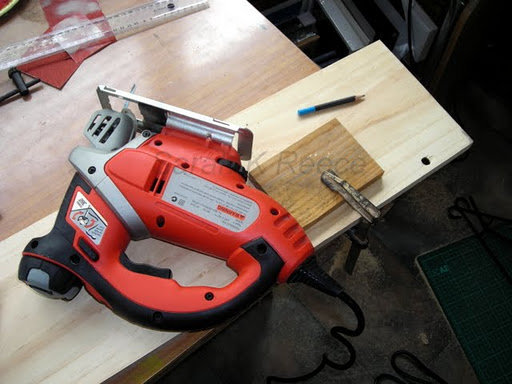
Next step – buy a jigsaw and cut out the wooden panel, and create a box beneath it to contain the light fitting, wires, and battery, and inset the switch. Then sand, wax, glue in all the components, and come up with a way to make the battery secure but removable, and I’m away laughing.
To see the next post in this series
- Broken city glass – final
Voice Hearers Conference
So, here’s my biography, which had to be under 80 words:
I experience voices as part of my dissociative disorder. I co-facilitate two groups at MIFSA, Sound Minds and Bridges, and love delivering talks about mental health. These groups have made a tremendous difference in my life, I’ve learned so much and been able to better manage my own conditions and find ways to ‘pay it forward’. I’m also a poet, artist, and blogger, passionate about educating, inspiring, and reducing stigma around experiences such as mental illness.
And here’s the abstract, under 200 words:
I will share my personal experiences with ‘mental illness’ and voice hearing. I was diagnosed with Posttraumatic Stress Disorder when I was 14, and later a Dissociative disorder, although my troubles started much younger. I now co-facilitate groups, one of them for voice hearers. I will share the experience of voice hearing from a dissociative perspective, other troubling experiences associated with this, and how my recovery journey is unfolding. I will explore the critical role of creativity in my health, and how I’ve worked to develop greater self-awareness and self-compassion to reduce conflict with my voices. Dissociation is an often misunderstood and feared experience, I will explain common dissociative symptoms, how they feel and affect me, and what I find helpful. For many people who hear voices as a part of a dissociative disorder, the classic episodes of wellness and sickness don’t apply, and identity is tangled with the experiences in a way that can make ‘me’ difficult to separate from the ‘illness’. I hope to inspire people to feel more comfortable and confident in navigating dissociative issues, and while the recovery process is very individual I want to encourage people that it is possible to live well with voices.
I’ve also teamed up with a friend, Jenny, we’d love to present a talk together about how successful our voice hearer’s group Sound Minds has been, and how Bridges has developed from it. Here’s her biography:
I am currently employed at The Mental Illness Fellowship of SA as a peer facilitator of ‘Sound Minds’ a group supporting people who experience voices and as a Community Educator. My voices started at about 5yrs of age. At 22 following a car accident these voices came to the attention of the hospital staff. Psychotic illness was diagnosed. I am now learning the power of living beyond illness. It’s my passion to share this knowledge and help others.
Jenny also contributes to Mindshare, you can see her work here. We had a quick chat to both groups this week to see what they thought of the idea of Jenny and myself not talking so much from our own experiences but going to the conference as ambassadors of the groups, putting quotes and thoughts of group members into the talk. They sounded excited about that so that’s what we’ll do. Here’s our abstract for a joint presentation:
Jenny and Sarah each experience voices and are both peer facilitators of a SA Voice Hearer’s group called Sound Minds. We will share the development of this group from inception in 2009 to now. Sound Minds has encountered challenges and difficulties such as months of low attendance, and the instability of being an open group with regular new members. Over time, the group has grown and developed into a strong, caring community of people with very diverse experiences. We are thrilled with the success of this project and will share members experiences of the difference Sound Minds has made in our lives and our ability to manage our voices. This format has been so successful that in July 2011, after much planning, Sarah started a sister group called Bridges. Bridges runs on the same principles as Sound Minds but specifically with people wanting support for experiences around dissociation and/or multiplicity rather than voice hearing. The principles have translated well and Bridges is also developing into a strong, useful resource. We’re very excited by the benefits both groups are providing to their members, and will share how the voice hearing group format has broader relevance in mental health.
Fingers crossed! Even if this one isn’t our time, I’m excited about doing talks about these topics and I’m sure we’ll give them somewhere.
Poem – My Beautiful World
See more like this:
Trauma recovery – traumatic replay
If you’ve read a previous post of mine, about Territory, you may have concluded that I sound like a pretty fragile kind of person. And, to a certain extent, you’d be right. However, if you’ve ever seen me stand up to someone twice my size who’s screaming into my face, you might have to revise your opinion. I’m also really strong.
One of the difficult things about trauma is that it can leave you feeling so weak and powerless. To be in situations where your 100% best efforts could not stop terrible things from happening is crushing. Part of you goes dead inside. The hypervigilence part of PTSD, where you feel on ‘red alert’ all the time, just watching for the next terrible thing to happen, is incredibly exhausting. In some ways, it’s actually worse than having terrible things happen.
Let me run that past you again.
When awful things are happening I feel awful. I feel numb. I feel furious. I fight like hell. I feel strong. I feel helpless. I feel vindicated. And other people say things to me like “How are you still going?”, with respect.
When nothing awful is happening I still feel awful, numb, furious, but I have nothing to fight. I feel weak, helpless, stupid, pathetic, and full of self loathing. And other people say things to me like “What is wrong with you?”, with contempt.
There’s a really tricky effect of trauma called traumatic replay, where sometimes people keep somehow putting themselves in terrible situations. This in NO way means they are responsible for abuse! The person doing the abuse is always responsible for it! I shouldn’t have to say that, but the inclination to blame the victim is so strong that we all need reminding. Trauma can upset your mental wiring, your internal dials and alarms about safety and danger can be a bit unreliable. We try to walk straight and look out for ourselves but find ourselves listing to the left and drifting off course. This article is about some of the things that can drive that, so we can be aware of them in ourselves and override it. It’s not an excuse to blame us for accidentally drifting into dangerous territory and getting hurt.
There’s a few different things that can drive traumatic replay, and the above dynamic is one of them. To some extent, I’m ‘built’ to handle crisis, it’s the come down afterwards that kills me. I sometimes have to fight my own impulse to put myself in dangerous situations or spent time with aggressive people simply because they make me feel strong. I have all my psychological armor on, and suddenly I feel like I can handle anything. This can be pretty appealing. It’s also phenomenally dangerous, and difficult to understand if you haven’t personally experienced it! In a way, its like grief, everyone turns up in the first few weeks full of care. You’re so blasted numb with grief at that point you probably can’t even recognise most of them. Six months down the track you’re crying yourself hoarse and everyone else has moved on. People harmed by trauma are often told to move on. Terrible things can fragment you, part of you lives in the here and now, and part of you stays trapped in a dark place. Traumatised people trying frantically to move on are sometimes tearing themselves further away from a piece of themselves. Finding a way to balance that need to honour the past with the equally important need to connect to the present can be really difficult. But it can be done!
Another dynamic that feeds into traumatic replay is the refusal to accept that you were genuinely powerless to make that situation come out any better. That is really hard to accept. Blaming yourself can be easier because it preserves the illusion that if you had just done this or that, things would have been okay. So you get back into it, in one form or another, hoping that this time you will make it work out right. You can lose a lot of your life testing that theory.
You can be hurt because you’ve been so strongly conditioned to be obedient and compliant that you shut down and obey when threatened, because that’s how you’ve always survived before.
You can also seek out terrible things because waiting for them to happen – and being absolutely certain that they will, can be more distressing than having them happen. This is similar to the domestic violence cycle where the abused partner starts to trigger the violent reaction just to get out of the exhausting stage where tension is rising and violence is imminent and inevitable.
Really twisted up thinking that you deserve nasty things to happen to you can have you seeking them out. Self harm takes many forms and some of us are adept at finding other people who are more than willing to hurt us. Obviously, abusive people tend to foster this kind of self loathing in the people they hurt.
Familiarity can make you choose awful situations or relationships because sometimes it takes us a while to work out that ‘feels comfortably familiar’ actually may mean ‘is toxic’. Good environments can feel weird, we can feel out of place and awkward, it’s almost like culture shock, we don’t know the ‘rules’ here. I had an odd experience like that once, a man I was close to had some bad news suddenly and went quiet. I read the quietness and disappeared as quickly as I could. He was surprised and confused by my behaviour and later called me out on it, telling me how uncaring I’d been. That really surprised me, in my life, men getting upset and going quiet meant get out the way as quickly as possible, or they will blow up. I was applying a social norm to a different environment where it wasn’t the norm. Miscommunications such as this abound, and opportunities for the Gap to open up are everywhere. So people stick to what they know, even if it’s horrible.
Sometimes, limping around the ‘normal world’ feeling like a broken person is just too hard when we can feel like somebody significant in the trauma underworld of abusers and abused. We’d rather eat and be eaten than face innocence lost and the appalling misconceptions about how victims ‘ask for it’, ‘deserve it’, ‘let it happen’, ‘enjoy it’, or should ‘just choose not to be victims‘. Abusive people can be adept at making us feel special; we are the centre of their world even though their attentions are painful.
The last thing I’ve noticed can feed into traumatic reply is a driving need to deny that a trauma has had an impact upon us. Being victimised can be such a terrible thing to process, that we were made a victim can be so painful and overwhelming that we deny it entirely. We go out of our way to flaunt our lack of fear. We deliberately do dangerous things to prove that we’re not a victim. We ignore all our warning systems that say ‘that person feels creepy’, ‘that car park is pretty dark and deserted’, ‘I don’t like the way they touch me’, and in an attempt to prove how unaffected by trauma we are, we can put ourselves in the kinds of dangerous situations that no one else would.
It’s worth mentioning too, that some awful stuff happens in life. Just because you get a double dose doesn’t necessarily mean any of these are in play. Storms happen, sometimes we’re just unlucky.
Psychiatry used to assess these kinds of issues as masochism. Now there’s a better understanding of the kind of damage trauma can do to someone. Pain may be the result of these behaviours, but the desire for it is not usually what drives them. We’re seeking strength, a sense of undamaged identity, to feel like we control our own lives, to feel loved or powerful or right. It’s just that sometimes these desires take us to dark places.
I feel the pull of some of these. My thinking gets twisted, I want to feel strong even if it means I’m being torn apart, I want to be proved right even if it means that another horrible thing happens, I want to get it over with because I know it’s coming anyway, I want to be possessed by them even though they make me hate myself.
I fight it because I try to believe – even when I can’t feel it – that I don’t deserve this. Because I believe in a life that’s richer and deeper than the roles of abuser and abused. Because I feel such compassion for other people, and you can’t really help when you’re trapped in the underworld yourself. Because amazing people like Judith Herman have written books in which I see myself reflected without hatred or humiliation, and I find hope, and I want other people to find hope too. I try to find ways to accept the brutal lessons without letting them destroy me, and to grow beautiful things out of anguish and degradation. I know my own damaged wiring. I know the lure of self destruction. On the bad days I cry, “protect me from what I want”. And I hold on, and I hold on, until it eases.
Auslan at the WEA
I’d love to see Auslan or at least the basics being taught in schools. Many of us will experience some degree of hearing loss as we age, and already knowing the rudiments of sign language would help us to maintain communication. Some people experience hearing and sight loss, Auslan can be signed onto someone’s hand to overcome these significant barriers to communication. Knowing the basics also helps to connect with the Deaf community and include them.
I’m writing pretty cautiously because issues around rights, culture, choice and communication in the Deaf community have become pretty hot topics. There’s a lot of strongly held beliefs and politics that I am not in a position to make an informed call about. I am aware there’s been a lot of conflict and tension between Deaf people and medical professionals, and that sadly, the Deaf community seems to have a poor reputation for being unfriendly and elitist.
My background is chronic physical illness and mental illness. I have personal experiences in areas like the difficulty of having an invisible disability, the stigma of ‘madness’, the shame of trauma and abuse… my lovely Grandma was legally blind so I grew up attending craft groups at the RSB with her, I’ve spent a couple of years in a wheelchair when I was very unwell myself. I also used to babysit a child who had an intellectual disability and I did work experience at the special school he attended. I’m pretty passionate about disability issues and I have pockets of knowledge, but about other disability areas I’m quite inexperienced. I have very little contact with the Deaf community, but on the street where I live now I have a Deaf neighbour, and I’d like to be able to communicate with him. He came around one evening to let me know that I’d left my car lights on, and we wave at each other but I’m embarrassed that I can’t ask him how his day is or if he’d like some mandarins from my tree.
This class has been the most wonderful introduction to the Deaf community. The instructor is Barry, you can see him here on the home page of Deaf Can Do. He is wonderful, very friendly and funny with fantastic communication skills. I’ve so enjoyed this class I’m considering taking on Auslan as a second language. I bet there are some Deaf folks out there who could do with some good mental health information too. It does help to remember that behind arguing and politics are people, and that few of us like being defined by our ‘group’ – however passionate about it we are – to the exclusion of all else.
So, if you’re looking to learn something new and stretch yourself a little bit, consider this class! And while I’m spruiking for the WEA, Lee Pascoe, international hypnotherapist, will be back again to do three classes in January 2012. I did three of her classes at the beginning of this year and found them very helpful, I’d highly recommend her. She’s a wonderful woman full of vibrant energy.
A little story to finish on… I’m doing Auslan with a friend who attends the voice hearer’s group Sound Minds with me. At the first Auslan class we were looking through the notes and saw an instruction that we were to ‘leave our voices at home for these classes’… that gave us a bit of a private giggle!
Newsletter!
It’s taken me a couple of hours of reading through forums to work out how to embed the newsletter on this blog, but here we are! You can also go directly to the document here to download it, print or email it if you wish. Please feel free to pass it on to anyone who may find it of use. 🙂
(function() { var scribd = document.createElement(“script”); scribd.type = “text/javascript”; scribd.async = true; scribd.src = “http://www.scribd.com/javascripts/embed_code/inject.js”; var s = document.getElementsByTagName(“script”)[0]; s.parentNode.insertBefore(scribd, s); })();
So, there you go. I think I’m just a glutton for punishment, making extra work for myself! I’d love to hear any feedback or constructive criticism you may have about it. 🙂
UnBOUND Art Sale
The work will only be on display for two days, 10 & 11th December, with new art works being displayed as others sell.
Juxtapose Studio Gallery
Shop 6, Cinema Place
Adelaide
MAP
I have a lot of painting to do! Tonight I’ve been collecting a list of short poems that might work in a painting. Wish me luck.
Here’s one of the short poems I’m thinking of painting into a modern haiga:
My skin tells lies
Conceals worlds
Bears no trace of tears.
Glass and shadow
Small Object Making class: start at the beginning:
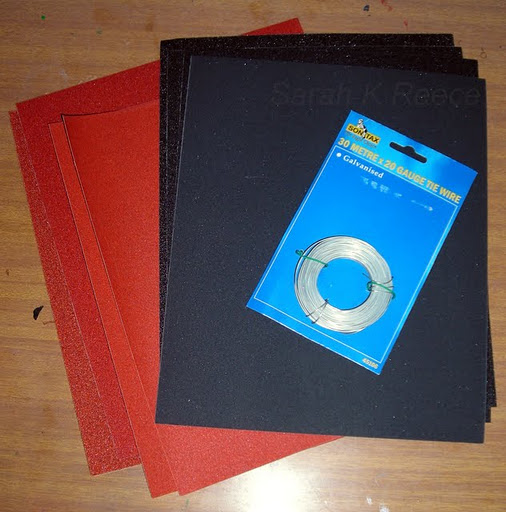
My glass project is finally coming together! I am feeling so much more relaxed about getting everything finished in time, it was all hanging over my head and feeling stressful. At last the experiments have paid off and I’ve found a design I’m really happy with. I’ve gone from tense to very relaxed overnight. 🙂 I went to Bunnings and bought sandpaper and wire. The orange papers are for wood, the black ones are wet and dry papers suitable for glass.
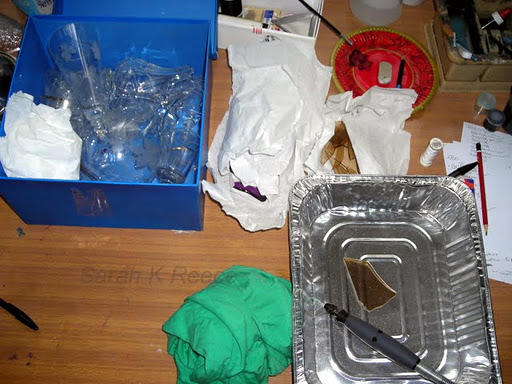
I did a lot of experimenting with my Dremel too, there was no way to get hold of a cement mixer cheaply (you can use it to make sea glass) but I needed a way to work the glass faster than the hours of work with wet fingers that the sandpaper takes. The dremel has a grinding attachment that works great after some fiddling with it. The key is to keep the speed fairly low so it doesn’t chip into the glass, and wear lots of safety protection! Glass dust is nasty.
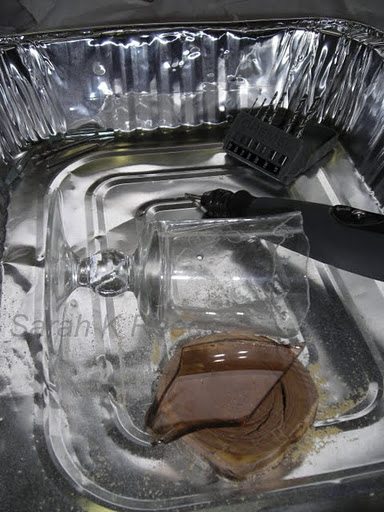
I also tried out my two diamond tips for the dremel, they are supposed to work on glass for cutting, engraving and such. I had a number of different end designs in mind, some of them involved hanging the glass and I wanted to try and drill holes in it. You can see etchings and one hole in this broken glass:
Unfortunately, this was hard on my diamond tip, it actually stripped the tip completely rendering it useless. 😦 They’re quite expensive so I was pretty disappointed. All part of the process unfortunately. I loved the effect of carving this purple glass, the purple is in a layer on one side, so engraving it is very effective.
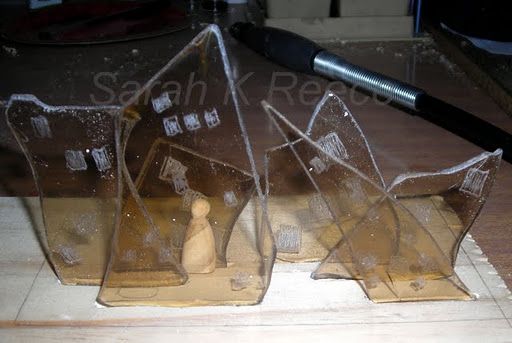
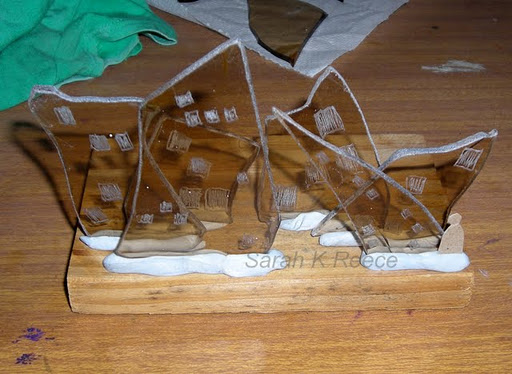
This was my final design however – using the curved smoky glass shards from a light fitting to represent a broken city. The shards are ground smooth and then have little windows etched onto them.
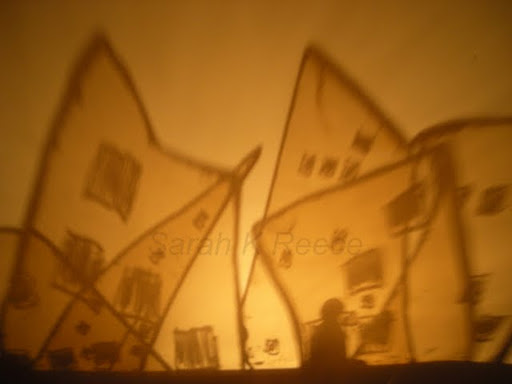
Here they are roughly assembled. The final project will obviously be properly finished, not just tacked on with blue tack, but this is the design. I experimented shining various light sources through it and the effect is fantastic (although difficult to capture on camera). With the right light in a dim room, the buildings are projected as huge shadows onto a wall, with the little dark figure walking through the broken city. It’s beautiful and evocative and I’m stoked. You can see a little of the shadow cast here because of the flash:
So the next stage is to look at incorporating different light sources – their distance from the glass is important because it brings the shadow into focus when you get it right, then choosing an appropriate base and fixing everything to it. I’m thinking of carving the figure (far right) out of wood to replace my little cardboard person too. The inspiration was a few lines of a poem from my 2002 journal:
I catch the midnight ferry
and sail from the broken heart of this city
Far out of town I stand by a broken wall
and warm my hands at the dying of the sun.
To see the next post in this series
- Broken glass city – development 2
Trauma Recovery – Territory
The idea of territory can be a big issue for some people who’ve come through trauma, particularly the ‘interpersonal’ kind – that is caused by other people rather than natural disasters or accidents. It can be a little difficult to describe the kind of chronic anxiety that people can struggle with. Certain kinds of environments can become really stressful such as crowded events, places that are similar to the place where something bad once happened to you, or new places. I’ve had big troubles in this area myself, which is pretty common for someone with PTSD. In my case, I’ve found trying to take on environments like a university campus really challenging and stressful. I’ve found that thinking of this stress in terms of territory has been helpful for me.
On bad days, I don’t feel safe anywhere. It’s hard to even remember what it was like to feel safe. On slightly better days, there’s pockets of the world where I feel like I’m allowed to exist. These spaces feel like my territory. I know them well, I’m comfortable in them, I know where to retreat if I need to, where the exits are, the quiet spots. I feel much more comfortable in these spaces. Home, all being well, is a place like this. I feel much more relaxed because the space is mine, I’m very familiar with it, and I feel like I have the right to enforce my own wishes and preferences. These two aspects are key to my concept of territory; being very familiar with a place, and feeling like I have the right to be there as I am.
When I’ve been really struggling, my territory has shrunk down to nothing and nowhere has felt like my space. Over time, I’ve gained ground, partly by removing myself from some bad environments. I’ve worked on making some spaces feel like my own, such as my own home. The key then has been to try and expand my territory so that there are other environments I feel comfortable in, otherwise my world gets very small. One of the places I was first able to do this was public libraries. Libraries have traditionally been my haven, they are fairly quiet, not usually frequented by bullies, and full of books and information – and internet access, which was pretty important before I had my own computer and connection! One of my local libraries had an indoor garden which I immediately fell in love with. Another had comfy chairs and one of those vending machines with $1.80 nestle hot chocolates. I quickly felt at home. These places became pockets of new territory, like a chain of islands I visited. My goal was greater freedom so I kept adding new places over time, the local supermarket once I’d become really familiar with it, the walking track at the nearby park, a community center.
I’ve moved house a lot over the past 5 years, and I find this very disruptive. The dissociation means it takes a while for information like that to be processed. In a new house I’ll wake in the dark and not know where I am, get disoriented and lost easily when trying to navigate, drive back to my old place when I’m tired. One of the things I do is thoroughly explore a new area. I walk to the nearest parks, find fast food places for emergency meals, the chemist, go read all the community notice boards, collect the information at the local library, read the council pamphlets about community events. Knowing an area well helps me feel more comfortable in it and reduces that sense of permanent disorientation.
In tackling a new environment I take a similar approach. Let’s imagine a new community center. I’d go there sometime there weren’t many people, and investigate. Where are the toilets? The kitchen? The exits? Is there any quiet nook I could retreat to if I needed? Any garden or outside area to escape to? Is the physical environment welcoming or really challenging? Welcoming environments for me have open spaces, comfy seats, and lots of natural light. I’m less comfortable in squeaky clean corporate environments, and poor lighting, cramped space, closed doors and barred windows set my teeth on edge. Then there’s the issue of my place in this environment. How will it function? Are there areas I can’t go? Is it pretty relaxed? Would I get in trouble for ducking to the kitchen for a drink or sitting with my feet on the couch? The more rules and restrictions an environment places on me, the less it feels like my territory, and the more I’m a guest – in some spaces a barely tolerated guest. Where these rules are things I’d never do anyway – please don’t break the windows, it causes me less stress. Where they impinge on my ability to relax and function independently – I have to ask permission to go to the toilet, a staff member will bring me a glass of water if I ask for one, the less comfortable I am in that environment.
If I feel pretty comfortable to be myself, that taking the initiative or operating independently wont get me into trouble, then another thing I do to help myself cope with a new place is turn up early. If there’s an event on at 2pm I want to attend, but I’m feeling anxious, I might turn up at 1.30pm. It may be enough to just sit in my car, or I might be allowed to go and wait in the space. Not walking into a room already full of people but being one of the first to arrive helps me to feel I have a right to be there and that the space is part of my territory. This isn’t a dominating thing, I very much want other people to feel at home there too!
Volunteering helps me a lot with this issue too. Being part of the behind the scenes where you may be there at funny hours or when the place is normally closed, you often have access to screened areas and will spend downtime having a giggle with other volunteers after projects have been completed really help me to feel at home in a difficult environment. When you know where the glasses are kept, that the study door has to be bumped with your hip because it sticks in the heat, and that the third armchair is in that spot to cover a stain on the carpet you feel a much stronger sense of belonging and territory.
It’s not just difficult rules and hierarchy that can derail my ability to feel at home somewhere, rudeness or bullying can also derail me quickly. At one place I was starting to feel more comfortable in, I had an incident one afternoon that was quite minor but affected me strongly. There was a free resource in a particular location that I wanted to access, and another person was in the space. When I asked if I could get past them they were hostile and claimed the space as theirs, with no intention to move any time soon. I wasn’t expecting this and was suddenly unsure if I would be supported by staff in my reasonable request or if the other person would be supported as having the right to occupy it. Because I was only new to this location and my anxiety was pretty high, I felt the impact of this minor conflict. I went from feeling somewhat safe and at home to feeling intensely nauseous and distressed. I suddenly wanted to escape the environment as quickly as possible, but I also knew that if I walked out it would be incredibly difficult for me to come back. In this situation I was able to find a caring staff member to sit with me in a quiet space and let me express my distress. They didn’t tell me I was over-reacting or should be more assertive, they just gave me a glass of water and some sympathy for how upsetting it can be when you encounter a conflict like that you weren’t expecting. This quickly calmed me down and left me in a place where I certainly felt uncomfortable with this other person, but not generalised outwards to the whole environment. I was able to go home and I was able to come back and keep working on making that place part of my safe territory.
Being listened to and respected even if you’re not making much sense or speaking their ‘language’ goes a long way to helping me feel safe in new environments and that my needs and wishes will count and if I stand up for them I’ll be supported. I like to know what the rules are, written and unwritten, feel I could anticipate the reaction of the people running the place to any situation, and have enough space to breathe as my own person within it. Any opportunity to occupy it on an even playing field, to become more familiar with it, or to build connections with caring people there all help me to expand my territory and be more involved in the world around me.
Rose petals and glass
Small Object Making class: start at the beginning:
Working on my two final projects for my Tafe class Small Object Making, one will be a bowl made from rose petals, the other will be a sculpture made from broken glass. I’ve only a couple of weeks left so I’m working hard on both. I’d love to have carved something from wood but I lack the tools at home to do it safely.
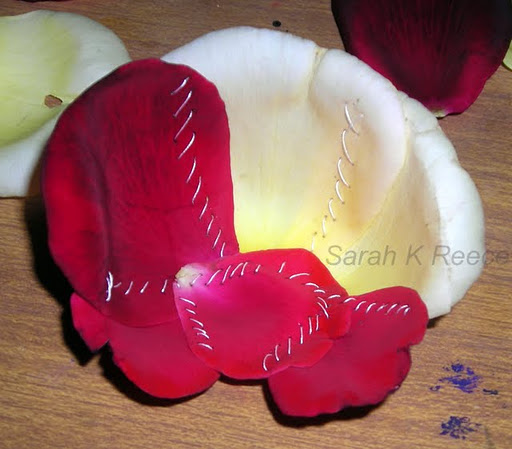
The rose petal bowl is going to work well although my various experiments have forced me to the conclusion that the final project must be completed entirely in one sitting then crystallized and baked slowly being turned often to dry evenly. The hardest part is the sewing, which is so fiddly that my hands start to fatigue after an hour and shake, which is a nuisance in needle work but catastrophic when working with rose petals as they tear so easily.
I’ve been sanding the sharp edges of the glass by hand but it’s very time consuming and a bit hard on my fingers. I’m thinking of either polishing the whole lot with sand or leaving them sharp and just being very careful about how I assemble the work… so, anyone have a cement mixer I can borrow?
To see the next post in this series
- Broken glass city – development
Rose Petal Pendant
It’s made of 9.25 sterling silver with freshwater pearls. The tiny engraving is a line from one my poems, “I drink the night”. I was given a high distinction for the subject. 🙂
If you missed the development and you’d like to see it in progress, have a look at these:
1. Starting up at Tafe again
2. Tafe Jewellery Fundamentals
3. Tafe Pendant
4. New art projects – happy shoes and pendant
Small Objects Making continues to be both fascinating and time consuming…
Poem – Doubt
I sit by your bed in hospital and say
I love you, don’t go
and say – endure!
and say – it will get better!
I sit by your bed and hope
you wont make a liar of me.
I sit by your bed and beg
for one more day
of the screaming pain
the nightmare you can’t wake from
and the darkness
strangest thing – they tell me
it is you who is selfish.
How do I know I’m multiple?
At Bridges, my group for people who experience significant dissociation and/or multiplicity, sometimes people express anxiety about their diagnosis. In fact, this area is surrounded by an intense anxiety that can make it very difficult for people to think clearly or feel okay about whatever is going on for them. Obviously we don’t diagnose each other or try to answer that question for anyone one way or the other, but to let people know they’re accepted and their experience counts whatever it turns out to be.
Some people develop serious mental health troubles, get referred to a psychologist or psychiatrist, and are quickly given an accurate diagnosis that fits their experience well. Some people have a much rockier path to working out what’s going on for them, and in the areas of dissociation and multiplicity, diagnostic uncertainty are pretty common. This can be really tough! Spending long periods of time struggling with diagnoses that don’t really fit, collecting many diagnoses, or having doctors trade them in for a new one every few months can be really confusing. For many people with a dissociative disorder, this is what happens. They may spend many years and receive many different diagnoses before a doctor identifies a dissociative condition.
If you have a psychologist, they can do certain tests where they ask you questions to determine if you experience a lot of dissociation. They may also be observing the kinds of changes in you that suggest multiplicity. Sometimes other parts will communicate with them directly and clear up the uncertainty. Books about DID generally list the obvious amnesia based indicators such as finding clothes and belongings you don’t recall purchasing that aren’t your taste, being approached by people who know you by another name, losing time, finding yourself in places and not being able to recall how you travelled there. If you don’t experience severe amnesia, it’s likely you won’t get these kinds of clues.
Dissociative Identity Disorder (DID) in particular is often treated as sensational, fundamentally different from any other mental illness or condition. There is considerable debate among professionals about how to identify and treat it, and whether the condition even exists. To be fair, every other mental illness in the DSM, and a few that aren’t, also have these kinds of debates. But the sensational way DID is often treated can mean that considering it as a diagnosis carries an extra anxiety. Many people who are diagnosed with DID feel incredibly anxious about this, afraid it may be true, and also afraid it may not be. So how can you know?
Firstly, by bringing the whole concern back down to earth. DID is not special, having it does not make you special, not having it does not make you special. Unlike a medical condition where x bacteria can be shown to cause y disease, the realm of mental health is far less clear. Dissociation occurs on a continuum from normal common experiences, right through to severe disruptive mental illness. Multiplicity likewise, is not black or white, you do or you don’t. Most multiples are actually diagnosed with Other Specified Dissociative Disorder (OSDD, formerly called Dissociative Disorder Not Otherwise Specified or DDNOS) as they don’t quite meet the rigid criteria for DID. Identity instability is a common symptom of several disorders, such as Borderline Personality Disorder, and Posttraumatic Stress Disorder. There is a continuum here also, from the usual human experience of being a person with different sides or parts, different facets to their personality, through to issues around identity instability, an uncertain or absent sense of self, distinct ego states especially related to strong emotion or trauma that can be suppressed or triggered, issues with being susceptible to engaging in expected roles, through to splitting of the personality into distinct parts that perceive themselves as separate and contain their own skills, needs, hopes and memories. This isn’t black and white, and if you’re struggling somewhere on this spectrum it can take a while to work out exactly where.
That’s okay! People with psychotic symptoms may be diagnosed with schizophrenia, then schizoaffective disorder, then psychotic depression. Because none of these conditions is treated in a really sensational manner, having the label change isn’t such a big deal. It should be that way for these issues too. In the end, the label doesn’t matter. What matters is finding a framework that makes sense for you and that helps you move in the right direction. If you’re feeling really anxious and uncertain, these questions may help clarify things a little for you.
- Do your symptoms/experiences take energy to sustain, or energy to suppress? What happens when you’re tired and worn out – do they get worse or better?
- Do your experiences predate therapy? For example, very different handwritings, hearing voices, a complex history of mental health problems that disappear and reappear, extensive amnesia.
- Does the framework of multiplicity make sense to you?
- Does it help? Is it reducing or increasing stress? (it’s okay if it’s doing both)
- What happens if you trial the idea that you’re not a multiple? Do members of your system fight to get your attention, or does the internal stress settle down? Do you function better or worse? Is there still things going on you can’t explain?
- Do any other frameworks fit your experiences? Identity instability rather than switching between parts, trauma related ego states? Do they fit better, worse, or as well as the idea of multiplicity?
- What do your ‘other parts’ think is going on? Do you agree or disagree?
The thing is, certain types of therapy, such as family systems therapy, parts therapy, schema therapy and so on can be useful for anyone at any place on this spectrum. The basics of trauma recovery (where appropriate) also remain the same. Issues like needing to feel safe, to build your self-awareness, learn more about how to take care of yourself and listen to yourself are also the same. The format may be a little different, but the underlying issues of developing a good, loving relationship with yourself, learning how to manage ambivalence, dealing with triggers and reactivity, reducing dissociation, calming intense distress, reconnecting to buried parts… they’re all the same. I think one of the reasons the condition of multiplicity does fascinate people is because it is just normal human functioning writ large. We can all relate to the themes, although not usually the extent of the divisions. Some (by no means all!) theories of personality are that all people function as a collective, with sub-personalities managing different life areas.
So, from these perspectives, nailing down the exact label becomes less important, it may not even change the focus of therapy or recovery. There are people who hear voices and have a psychotic diagnosis who find a multiplicity framework useful and consider their voices to be parts of themselves. They don’t switch or experience amnesia and their diagnosis remains the same, but a multiplicity framework is useful to them. I’ve also read of other people who are encouraged to view their experiences as multiplicity who feel pushed into that perspective without good cause, and determine that their situation is about abrupt mood changes rather than switching, for example.
The heart of this is that chronic denial can do terrible harm. Anxiety around accepting what is really going on for you can leave you refusing to listen to or look after yourself. It is helpful to find frameworks that fit and work, and hanging onto one that doesn’t – whether you’re a multiple hoping you’re not, or someone with something else going on who’s feeling forced into the multiple label, can be another way of denying what’s really happening with you and what you actually need. Many people, even those at the far end of the multiplicity spectrum, with taped evidence of other parts, just don’t want to know about it. It’s frightening to contemplate sharing your body, not always being in control, not being able to drug or get rid of symptoms quickly, and having to work on something as fundamental to you as your own identity.
Add to that mix fear, ignorance, and huge stigma about these issues even within the mental health community – for example, I know of many people with these concerns who have been denied treatment from mental health facilities and told they were faking their condition for attention- it’s no surprise that people want to put their head in the sand and hope it all goes away. A lot of the pain and stress about multiplicity is about how poorly it is understood and responded to by our wider community, which is an unfair extra burden on those of us trying to find the courage to deal with it. Another aspect of the pain and distress of multiplicity is that for many of us there are deeply destructive trauma histories we are struggling to deal with – and that is the case for many people whether it turns out multiplicity or something else is going on.
There’s often a misunderstanding that the choice is between “I have multiplicity” and “I’m fine”. Whatever is going on that you and your doctor are wondering about DID, it’s often happening in a context of a lot of pain and confusion. Things are going on that are causing you some troubles and for which you’re looking for support. On the other hand, I’ve also heard from people who turned up to a local counsellor for some help with a relationship issue or something else fairly common who found themselves with a question mark about multiplicity because the counsellor thought that feeling like you are younger around your parents means you are switching to child parts. Which caused a whole lot of needless confusion and stress. Everything boils down to this, really:
Whatever is going on, you deserve to have help and assistance to learn about it, work with it, and get on with your life.
So really, the whole question becomes a very simple case of asking what works. What helps you function better, what gives you greater freedom, what makes sense, what moves you forwards and helps you have a life? Hopefully, you’re not trying to work all this through by yourself, but have a good doctor of some kind on board, who isn’t afraid of or fascinated with the idea of multiplicity. Confirmation bias can feed into both over and under diagnosing conditions – this is where we look for information that supports our theory, and disregard anything that doesn’t. If you’re worried this is at play, perhaps you could try and keep two lists – one of anything that suggests you are a multiple, and one of anything that suggests you aren’t, or of alternative possible explanations for what you’re going through. See how it plays out over time and what you end up with. Or, forget about the labels and just go with the framework that’s getting you results. Good luck, whatever is going on for you, you still deserve love and support and you will still be okay!
For more information see a list of my other articles in Multiplicity Links, scroll through posts in the category of Multiplicity, or explore my Network The Dissociative Initiative.
Cataloguing
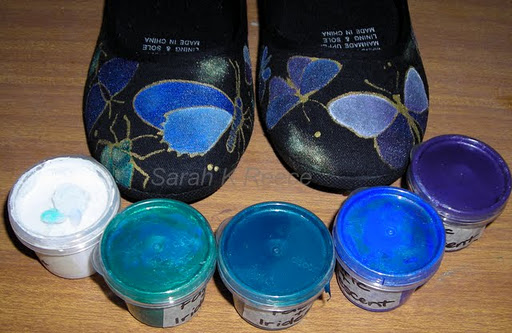
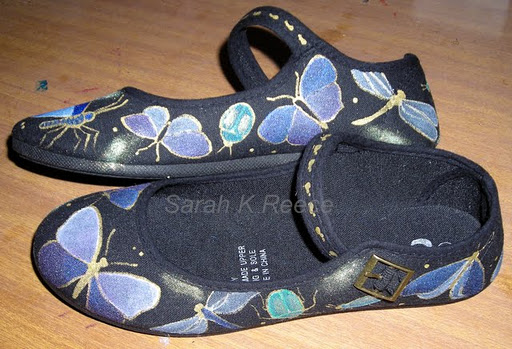
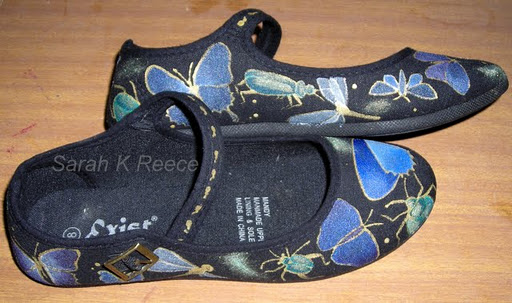
New butterfly shoes
Now, they need a day or two to dry completely before I heat set them to make them water fast.
Those of you who want to order painted shoes as a Christmas gift, I need you get your shoes to me within the next few weeks or I wont be able to get them done in time. There’s no promises after December 1st!
Sculpture – wood and paper
Small Object Making class: start at the beginning:
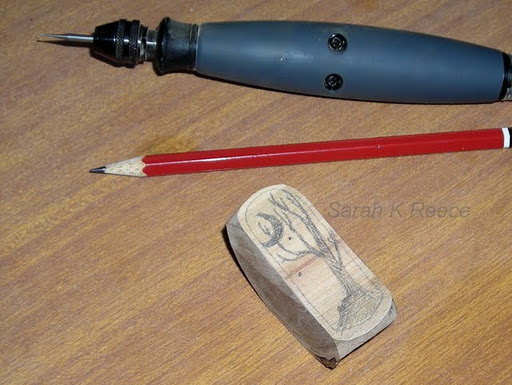
I had a pretty productive day working on my Tafe homework. I’m having a hard time knowing when to stop and how much material experimenting is sufficient. I still have to finish two projects and have only three weeks to go. Wow, that flew by fast! I’m expecting a rose in my garden to be ready for picking in the next two days so I can get to work and sew my final rose petal bowl. I also need to buy some wet and dry sandpaper so I can work some glass at home and get my second project moving along. In the meantime I’m trying to get my journal finished. Today I made my last wooden work for my journal, another chop – I just can’t resist them!
Here’s the design, a bare tree with a crescent moon.
Another lesson learned – it’s most inconvenient if you make your chop larger than your tin of pigment. I had to ink this using my finger, hence the under-inked seals. But I’m very happy with the design, I can see myself making a few more of these!
I also needed to do some experiments with paper, as this was the topic the first week that I missed. I made two little forms, one a flower:
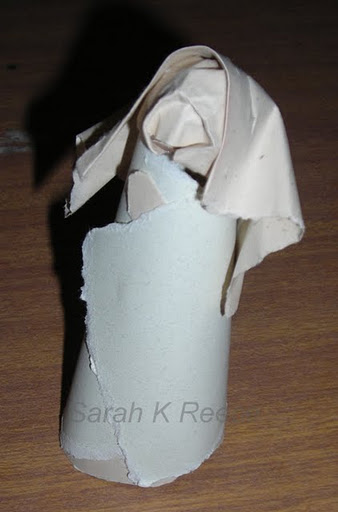
The other a little figure in a robe:
I made these using torn paper and a hot glue gun – these are one of the most useful inventions in the history of DIY. I highly recommend buying one with a cordless feature and a stand if you can, they have a tendency to glue themselves to any surface you lay them down on otherwise.
Lastly, look what I found in my garden – the first ladybug of the season! Hope you’re having a wonderful weekend. Don’t forget the Vegan Festival Sunday!
- Rose petal bowl – development 2
November events
There’s an Art Exhibition coming up soon, Peter Goers will be opening the Diamond House exhibition Shine on you Krazee Diamonds on Nov 25th. The art work will continue to be on display for another two weeks. I think I’ve one work in this, but things have been a little hazy with the details so I’m not making any promises!
See What’s On for all the details. 🙂