The forum went well! And other news :)

The Introducing DID Forum at MIFSA last night went really well. It was great to meet some new people and I was a lot more relaxed with the presentation itself, now that I’ve done it more than once. 🙂 And Bridges, our weekly support group for people who experience dissociation and/or multiplicity, is going really well too! Yesterday we talked about the role that creativity can play in recovering from trauma, and touched on some big issues – like for multiples, how can you know if you’ve discovered everyone in your system or internal family? (short answer – it’s really hard to tell, and many multiples get little ‘surprises’ of discovering another alter after they thought they’d met everyone. Clues that you may not have met everyone yet are if you are still, collectively, missing large periods of memory – eg ages 8-16, if there is a skill set you should have that no one seems to – eg. you know you spent years learning Italian but no one in your current system speaks it, or if there is an entire emotional range that no one in your system handles – eg. anger. On the other hand, you might already be aware of everyone and have some amnesia or other issues that need work just as a singleton would.) But, we also had a really good laugh together, and this is what excited me so much! It’s great that as a whole, the group is feeling more comfortable and relaxed to be able to enjoy a good joke or a funny story. It’s a really good opportunity to practice skills of safe trauma processing, where we talk about some really big heavy things at times, and then put them down and relax into humour and social chit chat. I’m getting so much out of the group myself and feel so privileged to have the chance to meet and share with everyone who comes. Bridges is one of very few peer-led dissociative groups in the world and it’s very exciting to be part of! Hurrah!

And, just to bring me firmly back to reality – my car broke down on the way home, in the middle of a reasonably busy intersection at night. With the help of a couple of passing samaritans, I was able to carefully coast the car backwards down the hill and over to the curb out of the traffic, before the RAA finally came and got me going again. It is however a short term solution, apparently one of my heater hoses has been slowly leaking into my alternator, which is now all crudded up and very unhappy, and as a result my battery doesn’t charge as I drive. So, I’m now entirely on  public transport until I can get that fixed. Bummer!

Today, Cary and I have finished the first draft of a paper based on our talk from TheMHS, Managing Dissociation. We only found out about the possibility of submitting one this week and it’s due on Thursday. If it passes muster, it would be very exciting to have co-authored a published paper! The gist of our message is that having arguments about terminology and the validity of dissociative diagnoses is all very well, but what we need is to help mental health staff to be comfortable and confident in being able to appropriately support individuals who experience dissociation. At the moment, many people with severe dissociative symptoms are given very little support to manage their condition. So, it’s a paper that would potentially have a wide application – we’re saying you don’t need to be an ‘expert’ steeped in the field to be able to assist someone who has a dissociative condition, and there’s simply no need for fear, confusion or reluctance to engage people who experience dissociation. I would be thrilled to get this message out to a wider audience!

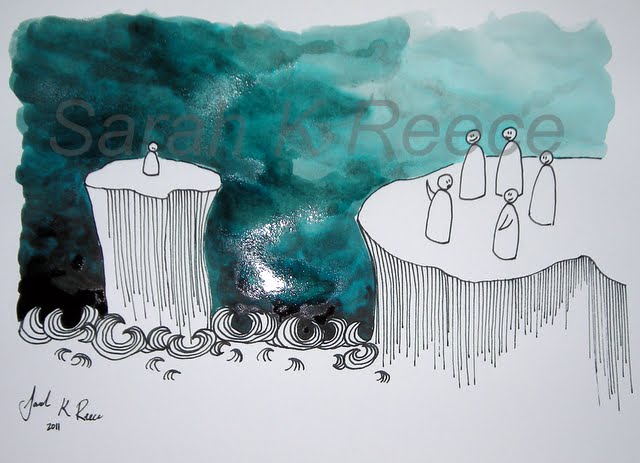
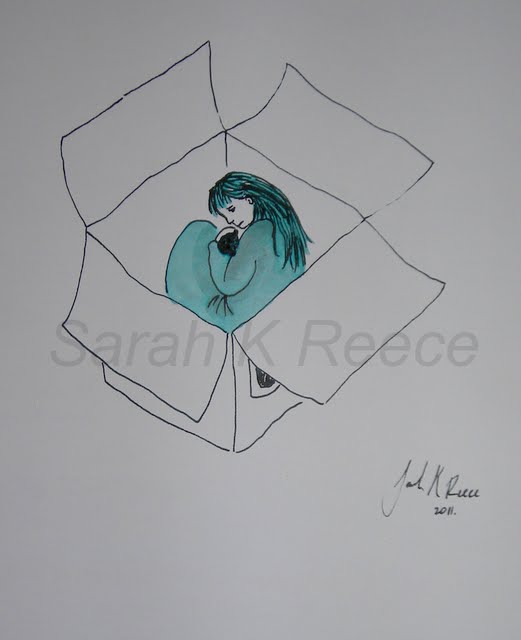
I also received an email today saying that my ink painting Homelessness has been accepted by the curator for display at the Bakehouse Theatre during Mental Health week, which also enters it into competition for various prizes! Art is so tricky, I’d never have guessed that would have been selected over the others. Apparently the plan is to exhibit the rest of my submitted work at the Box Factory at the same time. I’ll keep you posted on the details. 🙂

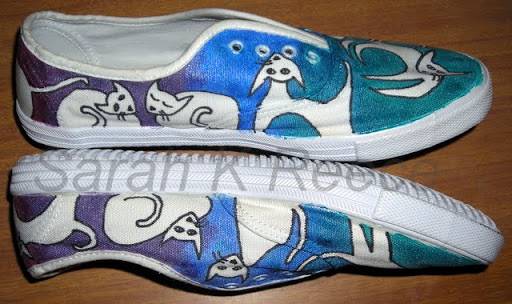
And I am very, very tired after such a huge week, and hoping to get some time to chill out and make some art soon. My happy shoes are calling my name!

General newsy stuff

Argh! That last post came in after midnight meaning I technically missed yesterday. I protest that it can’t be a new day yet as I haven’t had any sleep. It shouldn’t clock over until after sleep has happened. So have another post to make up for it. In my defence – today was manically busy. Back to back appointments all the way through to my last TAFE class for the term tonight, didn’t get back home til 9.15pm – and I finished everything! Hurrah! And I didn’t think to take my camera and had to hand it all in on the spot so I can’t show you until after I collect it after assessment. 😦 But it was awesome. I aced the really scary bit, which was engraving my rose petal pendant without chickening out for fear of ruining it. Whee! And then I discovered that we had to submit it on a chain/string/suspension of some kind. Whoops. How did I miss that? I thought we just had to decide on our preferred method and journal about it. Fortunately I was pretty organised last night and threw some ribbon and various colours of cotton thread into my bag along with a bunch of different coloured freshwater pearls (yes, cause I’m the kind of person who always has a bag of multicoloured freshwater pearls lying around just in case). So I made up something on the spot and then added it to my journal to look like I’d put loads of thought into this and deeply planned the final result. In true student style. 😀


So, I hung the pendant on green satin ribbon and threaded pale green cotton stitching through it, with lovely pearls of different sizes and colours tied in along the ribbon. And one large white one dangling over the pendant itself. The poem line I finally chose was I drink the night. Which has multiple layers of meaning to it referring both to the rose and myself the wearer. 🙂


I got a lovely phone call from the Big Circle Arts people this morning asking if I minded if they used one of my artworks on their invitations to the exhibitions at Mental Health Week this year. Of course I said yes! On the proviso that they send me one. Which they will, I’ll post it on here when it arrives. How gratifying! (smug mode engaged)

And, the Persian poetry last night was awesome! Beautiful Persian poets reading melancholy, angry, serene or erotic poems. So different from my own work, and so inspiring. A bunch of us went out for dinner afterwards and ate at a lovely Lebanese restaurant on Hindley Street. Great night out, really enjoyed myself.


And a final reminder – Friday night is our free Forum at MIFSA – Introducing DID. Pass it on. 🙂
Then I’m going to come home and pass out. 

Mental Illness and Intelligence

There’s the strangest misconception floating around the place that you can’t have a mental illness if you’re smart. Put that bluntly it seems obvious that it’s daft. But I’ve come across it more than once now, and often from within Mental Health Services, not just the general community. So I have conversations at times that go something like this:

Me: I’m really struggling at the moment.
Services: Okay, what’s going on?
Me: I’m under a lot of pressure and I’m falling apart. I need some help.
Services: So what are you experiencing?
*skips boring description of me on a really bad day – suicidal, paranoid, etc etc
Services: Well, you’re obviously intelligent and have a great deal of insight into your illness. So I don’t see what we can do for you.

That’s kinda stupid. There’s no evidence I’m aware of that being smart makes you less vulnerable to mental illness or suicide. Being able to spell my condition doesn’t mean I’m always a match for it. And insight is awesome, it really is. It gives you a chance to observe and make sense of what you’re experiencing, to plan ahead and learn to predict your condition, to work around it and play to your strengths. But it doesn’t actually take it away. And sometimes, especially when there’s a lot of chaos going on around me – things like relationship breakdown or homelessness, things get too much for me.

I’ve noticed the same dynamic played out with several of my friends who’ve found that in asking for help, being able to use the clinical terminology often excludes you from being able to access support. I wonder if this plays into the high rates of ‘burnout’ and suicide those in the helping professions experience? Where do they go to for help? Mental illness crosses all kinds of boundaries – cultural, socio-economic, level of education, you name it. Smart, educated and insightful people can still get overwhelmed and need a hand, and at times even, protection from the things that destroy human beings – despair, terror, self-loathing, anguish. Books, learning, money, fame, they don’t get you through these. What does help is compassion, simple kindness, and empathy.

Good things in inboxes

Eeeeee! Finally my long awaited 6th and 7th books of Garth Nix 7 part Keys to the Kingdom series have arrived! I’ve nearly gnawed my own arms off in anticipation, I was hoping they’d be here last week. Now to pace myself and not read them both through on the bus today.

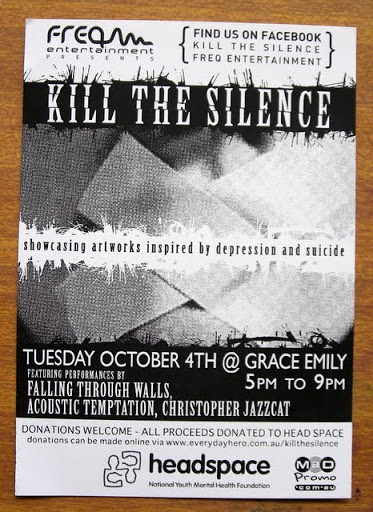
And I’ve received an email saying that my photo series Ink not Blood has been accepted for display at Kill the Silence, the event being held in October. I’ll also be reading poetry during the evening – see my What’s On page for details.

And this evening I’m going to Words @ the Wall, a poetry event held in the State Library on North Terrace. Tonight will feature Persian poetry, so if you’re wandering the city at 5.30 feeling curious about culturally diverse poetry – please join us, entry is free. 🙂 All the details are here. Now back to my Tafe homework…

New art projects – happy shoes and pendant

This post is the fourth in a five part series. To see earlier posts, click on
1. Starting up at Tafe again
2. Tafe Jewellery Fundamentals
3. Tafe Pendant

I’ve had one of those stressful days where, for one reason and another, I’ve spent most of it feeling like I can’t catch my breath. So, when a friend suggested catching up at art group at MIFSA, I was pretty happy to schedule in some chill-out time. And I got a new pair of shoes started! These ones are for me, after this pair I’ll set up a new page on this blog and open for orders. 😀 

The paints have an iridescent medium mixed in so the colours are all awesome and sparkly. I can’t wait to have them done and wear them out! 


My TAFE final project – worth 70% of my grade, is also coming along well. I only have one more studio session left to finish it in, but I think I’ll make it. I also have to finish off the journal and backup work sometime  before Thursday… feeling the pressure a little bit! 

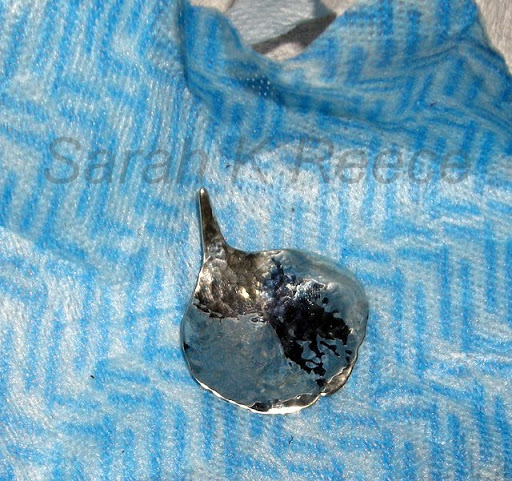
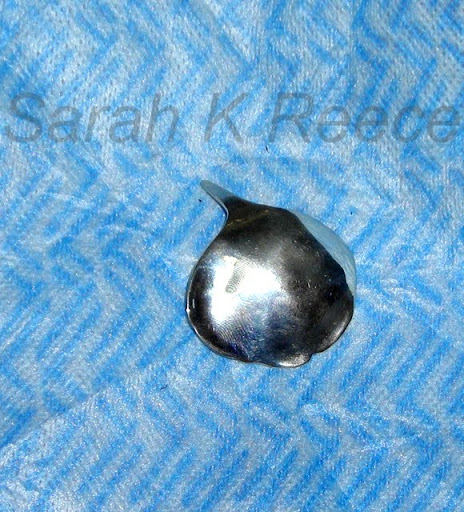
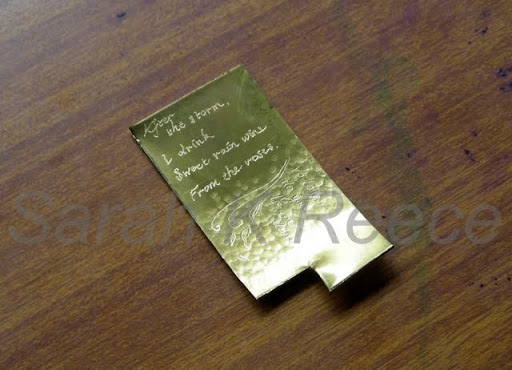
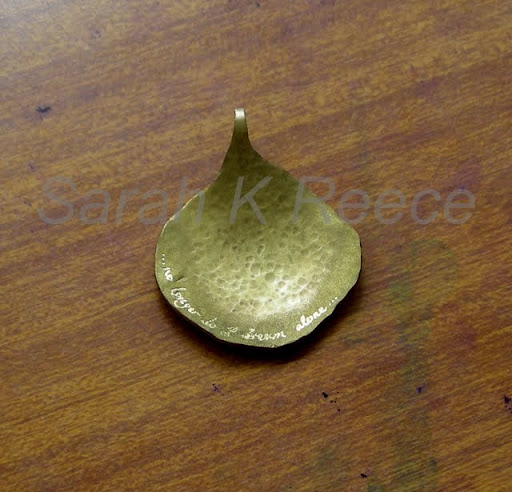
Here it is: a rose petal in silver. The long ‘tail’ on it will be pulled to the back in a curl, the chain will go through that loop to suspend it. The surface has been polished and then hammered to give it that lovely ripple effect – I think it looks like light catching ripples on water. One edge has been curled down and the other curled up, and a little fluted to give it a natural look. 

The reverse I spent an hour emerying all the tool marks and scratches out of it and then polished to a mirror shine. We have to have one highly polished surface at least to show that we have learned this skill. So, this Thursday I will be bending the loop, engraving a line from a poem – that’s proving difficult to choose! – and then repolish and clean the whole piece until it’s blindingly shiny and I can submit it for assessment. Nothing to it!


See the final product here!

WEA – Self Publishing

Well, I was down at the WEA on the weekend, doing a half day course on Self Publishing. I booked in months ago hoping it would give me some tips and hints about how to self publish, but more so, if self publishing is actually the right path for me. It was a great course with loads of information and lots of down-to-earth, cautionary advice. Self-publishing has a pretty terrible reputation due largely to a lot of really poor quality material out there. I’ve seen and read a number of these books myself and they can be really awful! One of the things that is crucial is having – or sourcing – all the skills needed to publish a book yourself. There are a lot! But, I’ve also read some truly awful books offered by traditional publishers, and for certain markets – for example poetry, self publishing is really one of the only ways to get a book of your work out there. Most publishers wont touch poetry because the market is too niche. So, for poets, being self published doesn’t carry quite the stigma it does for novelists.

What I want to publish – or rather, things people are requesting I get in print for them – are poems, prints of my art, and the contents of my various talks. Earlier this year I did a presentation in Melbourne about Peer Workers that was very well received and people would like me to make a small booklet of my talk. I showed some examples of my work to Martina Taeker, the very skilled woman running the WEA course, and she suggested that my particular work was well suited to self publishing, partly because I edit it to a high standard, and partly because I have arts/graphics design skills – people often forget that you have to put the whole layout together yourself and you want it to look good! She’s the third person who has experience in the industry to give me a green light heading into self-publishing now, so I’m going to pursue it, and ‘bad reputation’ be dammed! I like the idea of retaining full control of my own material, especially my art, and being able to update, revise and reprint whenever I need to. I also like the idea of trying to keep booklets cheaper so that people on pensions – like me – can actually afford them if they wish. It would be lovely to print some fancy hard cover full colour books as well. I’m hoping to have something in print and ready to launch next year.

The challenge now is going to be getting hold of the software on which you create the actual book layout – the industry standards are expensive – and then learning how to use it. Patience, patience! Ahh it’s all so painfully slow when you’re starting out! I’m also going to be launching into the digital world sometime soon. I’ve been asked to create a digital version of the Melbourne talk, using the art from my power point and a voice over. (mine, obviously) Which I’m terribly excited about as I’ve never done anything like that before. I would dearly love to explore animating some of my little people in my ink paintings… another whole skill set I don’t have yet… but so many interesting things to look forward to!

In the meantime, this blog is my serious writing project, and I’m thrilled with it! It’s incredibly satisfying to get emails telling me something I wrote was helpful or beautiful or amusing. The mental health posts take so much longer to write and edit to a standard I’m happy with, but they are so important to me. There’s so many people feeling alone, overwhelmed, confused and afraid out there and the internet is such a powerful way to connect us. It’s certainly helped me. So, thank you everyone reading and sharing this blog, it means so much to me. I’d put on my business cards “Artist ~ Poet ~ Writer” and I thought that the writer part was something I’d feel was genuine when I saw my work in print. But, getting emails from people telling me something I’ve written has been helpful or insightful, I’ve changed my mind. This blog isn’t an aside, it’s a major project and the start of something really good. And I am a writer. 🙂

Cleo and Tiger make themselves at home

Both gorgeous foster cats have settled in happily since arriving a little over two weeks ago. How the time flies! They’ve been getting a touch of hay fever with the spring weather as the garden goes into bloom. My backyard is awash with blossom and both cats spend a lot of time toasting themselves in the sunny spots by the doors, right where the breeze brings in all the pollen…

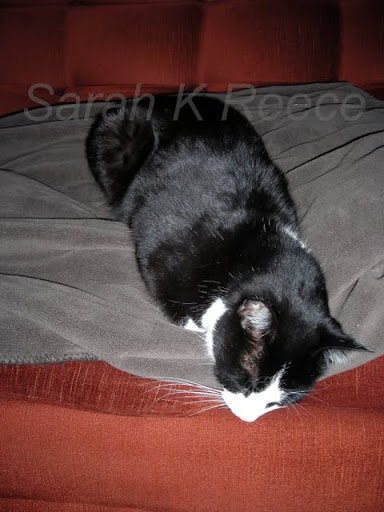
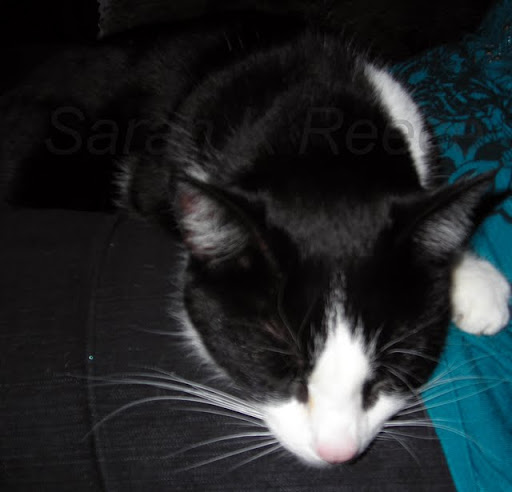
I’m hoping down the track to create a cat shelter for them in the backyard so they don’t need to be confined to the house. They follow the sunlight about like devotees, shifting from place to place as the sun moves. They are both such good natured cats, getting quite bouncy in that funny way animals do when it’s spring, dashing randomly about the house. I’ve a little cat toy which is a fluffy heart on a string and I can keep them amused for hours with it. I’ve snapped off some pictures in a quieter moment, here’s Cleo nesting on a blanket on the couch. She has a funny way of sleeping where she lies her head right down, most unusual in a cat:

She’s settled in well, no more frantic doing laps! She loves a cuddle, preferably right up close to your face where she can gaze into your eyes. She still likes high places and can often be found asleep on top of my wardrobe or a bookshelf somewhere.

Here’s Tiger, curled up happily on his favourite green rug:

He’s a big smoochy cat, not so keen on being picked up but he does like to lay across your lap or sleep at the foot of the bed. He’s always up for a chin scratch and is still a kitten at heart, playing with bits of string or balls of scrunched up paper or the dreaded green bug cat toy – that still has the power to make him run to the other end of the house! 

Ink not Blood

I’ve been working on a small series of artworks called Ink not Blood. The work is about using creativity to over come self-destructive urges – both self harming and suicide. This is a darker series of work, touching on topics that are very taboo in our culture. It was born out of my own struggles, and the way I have come to regard ink as a substitute for blood. I survived high school partly by writing poems down my arms. I also mean this in a broader sense. Being creative, not just being an artist, but to create anything draws me away from destruction. Ray Bradbury said it best:

“Those who don’t build, must burn.”
Or to put it another way, the desire to destroy is only the thwarted desire to create. Speak, express, scream if you need, but use ink, not blood. 
Some people who self harm keep a ‘kit’ of their tools. My photo shows an example of such a kit, with a fountain pen in the centre as the alternative option. The blade and the pen mirror one another in length, shape and size. They are very similar in some respects, but the choice between them leads to completely different places in your life.

The Gap

We’ve been talking in Bridges about this concept so I wanted to share it here. For those of us who’ve come through trauma, our experiences can make it difficult at times to connect with people who haven’t. I call this the Gap. Let me explain.

A few years ago I was undertaking one of my ill-fated attempts to get through university, and was keen to make some new friends. I joined the local French society, being in love with French movies and culture myself. One day myself and the group went out to see a French movie and caught up for coffee afterwards. As the group was chatting, the talk turned to nightmares. I quietly dropped out of the conversation.

I have Post Traumatic Stress Disorder, which was diagnosed at 15. The reality is I’ve suffered from severe nightmares for all of my life. This is a common symptom of this disorder, and it can be difficult to explain just how distressing and crippling it can be to people who don’t experience it. So, none of my experiences in this area are the stuff of coffee table conversation with new friends.

One young woman was sharing how she enjoyed her nightmares, that to her they were like horror movies, scary in a fun kind of way. She said that if she ever became too scared, she’d discovered that all she had to do was die in the dream to end it and wake up immediately. So she’d jump out of a window or in front of a car and the nightmare would be over.

The Gap that opened between me and the rest of that group at this point was so big I couldn’t bridge it. I felt sick to my stomach and had to leave early. I crept home and went to bed feeling badly shaken.

Why?

Because people like me often get through our day by pretending that we’re basically the same as all the people around us. In fact we may put a lot of effort into blending in and trying to look normal. We don’t want people to know we have a terrible history that has left marks on us. We don’t want to be different. You can do this by pretending that the things that make you different – trauma history or mental illness, aren’t real. Or, by forgetting that they aren’t universal, that not everyone has experienced these things. I tend to lean to the latter. I muddle through my days in an imaginary brotherhood where we’ve all come through what I have.

So, for this young woman to tell us that she has a had a life where she has been so secure and so stable, that even in her nightmares she retains control, shatters my illusions. It forces me to confront that my experiences aren’t universal. And that brings me face to face with the rage and anguish I work so hard to bury, about what has been done to me. About the monstrous unfairness. About the things other people can take so for granted, like feeling safe, like feeling in control. I become instantly and painfully aware of everything that I have lost.

The Gap opens between me and the rest of this laughing group. In my mouth burn stories of my nightmares, of experiences where I have screamed for hours in my dreams, trying to wake and unable to. Of the sense of being tortured that re-experiencing the worst moments of my life night after night creates. I felt like I was suddenly watching these laughing people from a very long distance away. I felt that they lived in an entirely different world to mine. I felt profoundly alone.

There are many ways this Gap opens up. It can create deep and complex feelings of grief, fury, and alienation. It’s often set off not just by an awareness of difference, but by the way the un-traumatised misunderstand and misrepresent the challenges we face. I feel it whenever someone asks in a dismissive way “Why don’t abused women just leave?”. I feel it when I sit in a pub hearing a loud conversation from another table about how “those schizophrenics” are a danger to society and should be locked up. I feel it when a television program comes on getting hostile about all the dole bludgers on disability support and how we shouldn’t have a welfare system at all. For me, part of the Gap is an awareness of how hard I work just to break even in my life. Just to stay alive, let alone to make progress. And how painful it is when the progress I make is measured against people who haven’t come from where I have, through what I have. Context is everything.

From a trauma perspective, part of this Gap is living in a society that is often hung up on the superficial, chasing happiness, and reluctant to talk about big issues. Silence and being silenced opens the Gap. It becomes difficult to be patient with friends complaining about utterly trivial matters, painful when you try to share your thoughts or feelings about a traumatic experience only to be told to move on and get over it, humiliating to feel judged if you let slip some sign of your wounded-ness like have a panic attack in a crowd.

Some of the work in healing from trauma is becoming aware of this Gap and learning how to live with it. Part of this is forming relationships with people who are on your side of it, who live in your world. Part of this is learning how to bridge this Gap and connect with people on the other side of it. That involves a certain amount of translation, learning how to present yourself and your experiences in a way that can be accepted and understood by people who don’t share them. For trauma, this means learning how to talk a little about experiences and reactions that are visceral in nature. This isn’t easy. Other people who have come through similar trauma will usually instantly understand what you don’t like about that crowded lift. People who haven’t, need you to explain. Trauma reactions are not intuitive if you haven’t personally experienced them. Many people on the other side of the Gap are good folks, some are brilliant even, incredibly sensitive and thoughtful and wonderfully safe people. Some, of course, are awful. The same goes for your side of the Gap for that matter. You can become an ambassador, helping to make that Gap smaller for other people like yourself by educating and raising awareness in general society.

Having said all that, Gaps are tricky things. You can see them even when they’re not there, just because you become used to having them there. It’s easy for us to take each other at face value and conclude that we are the only ones who are struggling, who are anxious, overwhelmed, deeply conflicted, or grief stricken. There is much common ground despite Gaps. Try not to get so focused on the differences that you lose the ability to notice the similarities, that which unites us as human beings. It is often these things that help us to bridge Gaps.

A last important point. There is more than one Gap.

There are many Gaps. People in wheelchairs feel the Gap when the only disabled toilet at the train station is out of order for six months. People who’ve experienced poverty feel it when they hear middle class people sneer at the ‘white trash’ who live in caravan parks. Gay teenagers feel it when they’re forbidden to take their partners to prom. Gaps make us feel alone, irrelevant, unvalued. Gaps make us feel like we don’t count, like we’re not even people. And the thing that nearly everyone craves is to feel human. To have a sense of belonging and value. And for the differences between us not to define us to the exclusion of all else.

So, Shane has a mental illness. Did you know he loves to fish? Jess has cystic fibrosis. Did you know she’s passionate about children’s charities? Damien survived severe burns from a car accident that killed his brother. He loves comics, is an avid football fan, has read all the Harry Potter books six times, and his favourite food is Mexican. Gaps define us by a single characteristic. Reclaiming our humanity is about seeing ourselves and being seen by others, as human beings.
 

Public Speaking

I recently was invited to participate in some training around public speaking by the Health Consumer’s Alliance. I’m a fairly new member of this organisation, and have been involved in a couple of projects that aim to improve services and/or reduce stigma for people living with a mental illness. The training was a great opportunity considering that I’ve found myself doing quite a lot of public speaking – in fact this month marks my very first public forum held at MIFSA last year. I wish I could say it’s become easier since then – it hasn’t really! The more personal the content the more nerves I get, but I have learned to use the nerves instead of trying to fight them off. So I went off to the training very interested to see if I could get something out of it. It was run by the very genial David Briggs, who was clearly in his element. I very much liked the individual approach – in that instead of teaching a bunch of rules, the aim was to help us find our own voice and the most effective presentation style for ourselves.

The most helpful feedback I got from the experience was to make sure I vary my tone of voice to make it clear when I’m reading poems, and clear when I’ve changed to sharing or educating. I’ve worked more on developing a conversational style of presenting that doesn’t sound too scripted or rehearsed. (and paradoxically, takes much more rehearsal!) So far, the feedback has been good. Here’s the lovely certificate I was given at the end to add to my resume:

I also attended a public speaking workshop run by Andrew Klein at a conference in Melbourne earlier this year. He did an incredible job of MC’ing the whole event, and he gave us some great advice – the two things I really took away from that were, never deliver a presentation anyone could do – ie tailor it specifically to you – he used the awesome talk at the conference by Mary O’Hagan – an amazing consumer advocate from New Zealand as an example of this. And the second was – wherever you can, make it personal. This bit of advice led to my last minute decision to include three poems in my talk at that event, which went over so well that if I’d been organised enough to have them published in a booklet, I could have sold a bunch of them!

I’m really enjoying this rather new role as a speaker and I’ve been reading a bit about presenting and watching people who present to learn from ones I like and the ones I don’t. 🙂 Training opportunities like these ones have been really interesting and given me a lot of encouragement to keep developing my skills in this area. It can be a really powerful way to connect with people to bring about good changes. I never considered doing this kind of role before but I’m surprised to find I’m developing a taste for it. So, may there be many more opportunities to come!

Using Public Transport

Is something a number of people who have a mental illness find challenging. Unfortunately, we often have to rely upon it to get around, either because we’re not well enough to drive, or simply lack the finances to run a car. If we find using public transport impossible, this can contribute to serious problems such as social isolation and lack of contact with our support people such as GP’s. I am fortunate to now own a car and have a license, but I still find myself in situations where public transport is the best option – whether it’s because the trip is a really long one, such as an interstate train trip, or because there’s no parking available at my destination. I’ve been working on being able to cope with public transport better so that these trips are less stressful for me. So, here are a few tips I’ve found helpful.

1. Take it slowly
If you also find public transport a challenge, you need to build up to it with small steps. I’d advise against an interstate train trip if you have panic attacks on trains! Work up to it in small stages. I started by taking a short bus trip to a friend’s house who would drive me home afterwards. I’d only do this in daylight and in good weather, the trip was pretty short, and I had something nice to reward myself with straight afterwards – catching up with a friend. I also knew I was going to be dropped home afterwards, so I wasn’t stressed during the visit. Small successes build up your confidence to manage bigger challenges. Whereas biting off more than you can chew and throwing yourself into a huge challenge where you crash and burn will leave you feeling humiliated and deeply discouraged. Don’t be embarrassed if you have to start small. Slow and steady wins the race here. It’s also okay if you need to just take the bus one or two stops away and then walk home.

2. Reward yourself
Try to create a positive association with public transport by rewarding all your efforts and taking yourself to fun and exciting places. If you are really stressed about it and the only places you ever go on it are to the doctor or dentist – that spells trouble! Go to the local park, visit a friend, go to a cafe for an icecream, down the art gallery or museum, whatever you like. The more enjoyable, the better. You may even find yourself looking forward to the destination more than worrying about the process. I used to take myself to the movies.

3. Trauma Issues
One of the reasons many people find public transport difficult is the closeness to strangers. This has been a big one for me. There’s a couple of ways around this – for starters, try using public transport during the quiet times of the day. Avoid getting on a bus at peak hour! Take a bag with you that you can put onto the seat beside you to discourage company. (obviously, this isn’t fair if the bus is full) Sit near to the door so that you don’t feel trapped by people in the passageway. Use grounding techniques to manage your anxiety. Move away from anyone who intimidates you – go and sit close to the driver if you need to. Try to make eye contact with anyone you find non-threatening and focus on their presence. I often wave to small children or chat to Mum’s with prams. I smile at elderly folks and help people with trolleys on and off the bus. This makes me feel useful and gives me something else to think about instead of focusing on my anxiety. It also helps to remind me that most of the other people on public transport are just regular folk like me, not scary or threatening. I was on the bus the other day and a man was standing in the aisle next to me, when I noticed that he had a big mop of long fluffy white cat fur stuck to his nice dark pants! I suspect he has a lovely white persian cat at home that had been sleeping next to him on the couch. It suddenly flipped how I saw him – from being a threatening man standing too close to me, to just a regular guy with a cat and not someone to feel afraid of.

Night is also an additional stress. Waiting at a bus stop in the dark adds another level of stress to the experience. I’ve been creeping up on this one. Initially I wouldn’t catch any kind of public transport when it was close to dark. Then I moved onto being able to cope if I arrived home when it was a little dark, as long as it had been light when I first got on the bus. Then I started to catch the bus home after dark provided it was from a good stop – lots of light and plenty of other people waiting. The bus stop outside the TAFE is a good one for this. I always have my mobile phone with me, and if I feel scared, I call someone to talk, or I pretend to call someone and talk into the phone anyway. This helps me to feel safer and generally stops anyone else approaching me.

4. Voice Hearers
May also find public transport a big challenge. If you find you sometimes need to talk to your voices out loud, something that may make you more comfortable on public transport is to turn your phone off or to silent, and pretend to be speaking to someone on it. (it’s important to turn it to silent while you do this – it’s pretty embarrassing otherwise if it suddenly rings!) An MP3 player can also provide something else to focus on and may make things easier. If your voices get so loud you can’t hear what other people say to you, you might want to try learning some basic lip reading. One way to start this is to watch daytime soapies on mute. The overacting and lots of face close ups can help get you started. I don’t find this easy but I’ve heard of others who say it takes the edge off a bit. 🙂

5. Dissociation
If you’re prone to dissociation then the combination of a stressful environment plus the rhythmic motion of the vehicle may really have you zoning out. I miss a lot of stops! I leave books, jumpers, and handbags on trains. If you have a phone or digital watch, set it to go off a minute or two before your timed stop to alert you. Then, set it to snooze or to go off again every 30 seconds! If you have to put down belongings, put them on the seat by the aisle so you have to pass them to get out of your seat. Better yet, put them on your lap, or into a bag. Never put things on the floor by your feet. Ladies, use a handbag with a long shoulder strap and put it in your lap with the strap still around you. This makes it a lot harder to leave behind! Guys, use pockets or a student satchel. You can also tie belongings to one wrist with a piece of string or ribbon, esp if they are too big or awkward to put on your lap – eg a guitar. Don’t feel silly – the most important thing is not to donate your precious shopping or other belongings to the transport association!

6. Take a friend
If you have a lovely helpful person with some time on their hands, try taking along a friend while you get used to using public transport again. I was really surprised how much difference this made to me. It can help you create some more positive memories and experiences.

7. Distraction
I love my MP3 player for this. I put in one ear bud so I can hear my music, but I’m still aware of what’s happening around me. This is pretty important when you’re near traffic and roads, your sense of hearing plays a huge part in warning you about traffic and keeping you safe. But trips which felt excruciatingly long seemed to shrink to nothing when I have some of my favourite music to listen to.

8. Weather
This can certainly make a big difference to your travels. There’s not much more miserable in life than being stuck at a bus stop in the rain or in 40C heat. So, check the weather before you go out. Invest in a small fold up umbrella. Always take a jumper even if there’s only a small chance it will get chilly. I’ve found that catching a bus in the evening on hot days can be very cold because the air conditioner is still running even though its now mild outside. Try to avoid long waits for transfers during heatwaves. Take a frozen water bottle with you if you have to go out. This might all sound really silly, but if your stress level is already high things like getting wet or being really hot can be the difference between being uncomfortable and having a meltdown.

9. Smart phones
One of the things that I really struggle with is reading the guides! I have a minor learning disability that means I tend to scramble numbers and have difficulty with some kinds of maths. Bus timetables are basically my worst nightmare, and I frequently end up in the wrong place at the wrong time waiting forever for a bus that isn’t coming. This is incredibly frustrating! I also end up carrying a lot of timetables around so that I can get home. Knowing that I may read them wrong, I always go home a few buses before the last ones of the night even if I was at a function I was really enjoying. I’ve just upgraded to this entry level smart phone, which means I can pay for a small amount of internet and access google maps. In fact some internet data is included on my phone plan, I’ve just never been able to use it before. So, no more carrying around wads of timetables, and it’s much easier for me to be flexible and change plans last minute when I can just google map a new route home. I’ve spent the last couple of days bussing about the place getting used to using the phone to work out my next step. This wont be an option for everyone, but now that basic smart phone prices are down to $50, it is becoming more achievable.

10. Control issues
One of the things that can make public transport more stressful than other forms of transport is the awareness that you are not in control of the vehicle. It requires a certain degree of trust to get on board! If this is an issue for you, stay near the door, try sitting on the left aisle, away from the other traffic, and never forget – if you really need to, get off at any stop, catch your breath, take a small walk perhaps, and then get on the next bus that comes. You may feel trapped, but the reality is you can get off at any stop you need to, and very few bus drivers would prefer to keep on board someone who’s having a panic attack. For longer trips this is more challenging. Using creative visualisation may help you feel less trapped – in simple terms, try going away to your happy place and stay there until the trip is up if you need! If you can read or watch a movie that may help to distance you from your surroundings. Alternatively, mindfulness techniques may help you to adopt a more detached and curious perspective about your circumstances. If at all possible, try to get off public transport before you become overwhelmingly distressed. This will help you feel more in control of your condition. If you hang on until you have panic attacks or meltdowns, public transport will become more associated with these really upsetting experiences, which will only make it harder to use in the future.

11. Use alternatives
On bad days when you know you wont cope – and hey we all have them! – don’t set yourself a task you know can’t achieve. Go for a walk instead, or have a ride on your bide. Get a second hand pair of roller blades. Hitch a ride with a friend or family member. Don’t curl up in a small ball at home and brood forever!

Constriction and isolation are bad for your mental health, and you can easily get stuck in a downward spiral where the more miserable you feel, the less you’re able to cope with public transport, so the more you’re stuck at home, and the more miserable you feel. You deserve the freedom to explore your world. Feeling familiar with and safe in your space can help expand your world and reconnect you to outside events. Having a local park you can walk to if you need some space or to get out of the house for a while is a good thing. I go hop on the swings when I need a breath of fresh air. Check your local messenger for free events such as gallery openings. Find a local pub and make it yours. Make sure your world is bigger than your bedroom.

This article can be found in pdf form here for easy printing or downloading. Feel welcome to share using the buttons below. To read similar articles, click on a label below. To see my copyright policy, go to my About this Blog page.

Kill the Silence event

I’ll be reading some of my poetry at an upcoming event called Kill the Silence, which aims to raise awareness about depression and suicide. Friends of some young Adelaide people who lost their lives over the past couple of years have got together to host this evening, showcasing art, poetry and music. I’ll also putting some artworks on the topic together for it.

So, if you have the night free, come and join us. This is a topic pretty close to my heart, one of my family members attempted suicide only a few weeks ago. Fortunately in our case, we were able to get medical help in time. Far too many aren’t so fortunate. It shouldn’t be like this. For all the details, please see my What’s On page at the top of this blog.

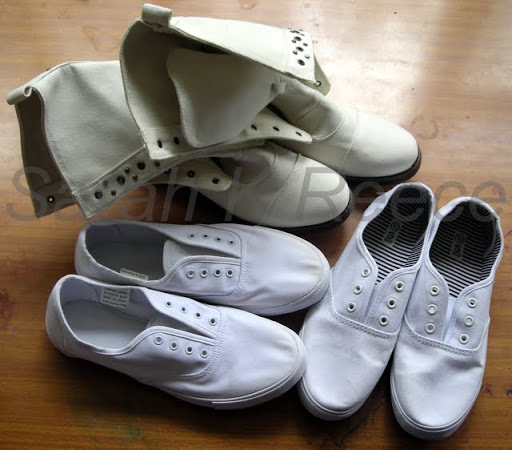
On a more cheerful note – I’ve bought some more shoes to paint! Here they are, all washed and ready for paint. Any suggestions? 🙂

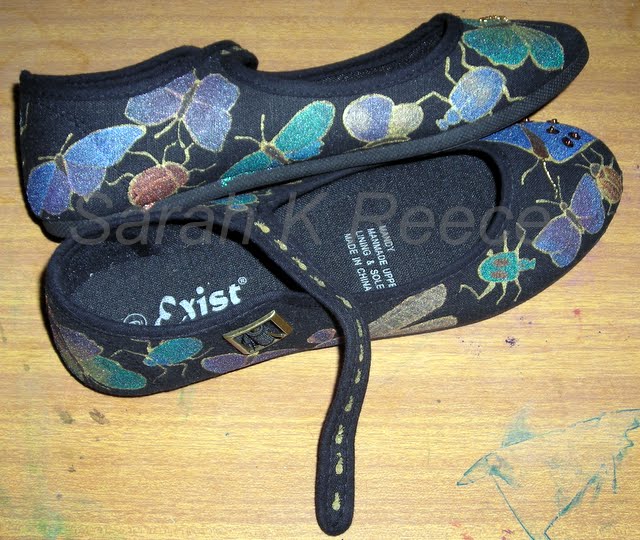
Completed butterfly shoes

I’ve finished my second pair of painted shoes tonight! These ones have a few beads and sequins added for a little extra sparkle. I must get a thimble, I have holes in my finger tips from pushing the beading needle through the heavy shoe canvas.

I’m very pleased with the result, although I prefer painting on the white canvas, as the colours as brighter and easier to control.

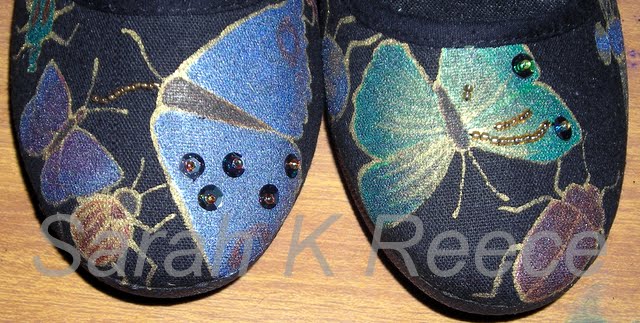
And a close-up of the toes:

So there. I’m going to submit these for display in the ‘Celebration of Life Exhibition’, which showcases the lives of carers like myself. It will be open from the 4th to the 13th of October, with an official opening on the morning of the 7th. For more details, please see my What’s On page at the top of this blog. 🙂 

TheMHS – Andrew Fuller

One of the speakers at TheMHS I found really inspiring was Andrew Fuller. He has a really warm, friendly manner and approaches his subject with a great deal of gentle humour. He’s another great advocate for a more human approach in mental health. He’s done a lot of work about mental health in kids and teens, and how to build resilience in young people. You can read the points of his talk here on the TheMHS blog. Just a note – he wasn’t saying that everyone struggles at all of those times, he was saying those periods are common stress times that some kids will really struggle with. His website is here, and includes a number of free downloads about topics such as building confidence. He mentions but didn’t go into a concept called Flow, which he says is highly protective against depression. You can read a little about flow here. There’s an interesting article about teenage development here. He’s also published a number of books, such as the gorgeous Tricky Kids, he drew on some of that material for his talk at TheMHS. His basic point was that tricky kids might make you want to strangle them, but they have great skills for adulthood, provided they live that long! And that one of the main factors in kids getting through challenging circumstances was having even just one connection to an invested adult who genuinely liked and ‘got’ them. Makes sense to me. 🙂

Hearing Voices

I’ve been attending, and lately, co-facilitating, a group called Sound Minds for over a year now. This group was started by MIFSA, based on the principles of the Hearing Voices network. I initially went along to support a friend, but found it so helpful for myself I stayed on. I feel very fortunate to have a group like this in my life, it has made a huge difference for me.

Hearing voices is actually a fairly common human experience, but one that has become linked to serious mental illness and major stigma. A lot of people who do hear voices keep this a secret and fear being found out and thought of as mad. Technically, a diagnosis such as schizophrenia require a number of criteria to be met, not just an experience such as hearing voices. But in my experience, if you tell a doctor you hear voices you will likely receive a diagnosis like this whether you have any other symptoms or not.

The standard medical approach to voice hearing goes something like this:

  1. You hear voices because your brain isn’t working properly. You have a mental illness. Your voices are auditory hallucinations.
  2. The cure for this is medication, which addresses the chemical imbalance presumed to be the basis of this illness.
  3. If medication isn’t working, increase the dosage, add more meds, and possibly ECT.
  4. If this still doesn’t work, you are a chronic case, likely to experience lifelong disability.
  5. Talk therapies don’t help, and you should never talk to or about your voices as this will only make them worse. There is no context or meaning to your voices, and hearing voices can never be a neutral or positive experience.

The problem is that for many people, this approach isn’t particularly effective. The Hearing Voices network is a grass roots movement that started in the Netherlands in the 80’s. There’s an interesting article in The Times about how Hearing Voices groups work for people. Some very interesting findings have come out of research into voice hearing, such as-

  • Many people who hear voices do not meet any of the other criteria for a mental illness
  • Many people hear positive or encouraging voices and are not distressed by their experiences
  • Most people who hear voices do so after a particularly emotional or traumatic event
  • Some people only hear voices for a short period of time, then they go away.
  • Some people find that ignoring their voices and constantly trying to distract themselves actually makes their voices worse.

So, the idea behind Sound Minds is having a group that doesn’t use the medical approach to hearing voices. We don’t presume to tell each other what their voices mean or how to manage them best. We each share our journey, our understanding of our own voices, what helps us and listen to each other and borrow strategies to help us manage our experiences. All newcomers to the group are given this printout, and told that it’s been written by other voice hearers, not by ‘experts’. We encourage them to notice if there’s anything listed they’ve already tried, and if it was a helpful approach or not.

The emphasis is upon individuality – how each person understands their voices is legitimate, and what works for each person is often different. Group members are encouraged to be accepting of a diversity of experiences and approaches to voices, and to share ideas without pressuring each other to see things their way. Some people find the biochemical model most helpful and have found medication and/or ECT to be lifesaving, but wish also to be able to talk about their experiences with people who understand. Others have a spiritual framework for their experiences, or link hearing voices to trauma. Some people find telling the voices to be quiet can restore a sense of control, while others find it escalates them. Some people find that the right approach leads to their voices going away, others find it helps them learn to live with them.

I’ve just been listening to a presentation from an International Conference about Recovery from Psychosis. The talk was called “The Personal is Political” by Jacqui Dillon. This would have been an incredible conference, the talks are available quite cheaply (compared to the cost of attending the conference!) on DVD here. Jacqui’s understanding of her own voice hearing experience is closer to DID than schizophrenia, she considers her voices to be parts of herself. This approach has clearly worked well for her and she presents about her experiences in an articulate and deeply moving way. You can hear a different interview with her here.

So, if you hear voices, or know someone who does, take heart. It is still possible to lead a wonderful meaningful life, even if your experience is one of those around learning to live with, rather than being cured of. If what you’ve tried or been told to try so far hasn’t worked, perhaps there’s some suggestions in these links that may help you to look at your situation from another perspective, and find a new approach. It’s important to keep in mind that even your best strategies may not work all the time in all situations, so don’t give up, keep looking, learning, and discovering those keys that help to give you back a sense of hope.

The Australian Hearing Voices network have a website here, with some of the groups listed. They don’t update it very regularly and so far we haven’t been able to coax them into including Sound Minds in their listings, but we’re working on it! If you’re in SA and you’d like to come to Sound Minds, the details are all here. The group runs every week but there’s no pressure to attend, people come as often or as little as they wish. You are also welcome to bring along a friend for support if you wish. If you’d like to print a flyer to keep or share, there’s a pdf here – and that’s my artwork designed in consultation with the group and donated for the flyers. 🙂

For more support, see the community I founded: The Hearing Voices Network of South Australia: www.hvnsa.org.au

Tafe Pendant

This post the third in a five part series. To see the earlier posts, click on
1.Starting up at Tafe again
2.Tafe Jewellery Fundamentals

Sooo, jewellery making is going really well! I’ve been playing about coming up with a million different designs and holding off making anything until I found one that really inspired me. I trekked in and bought as much silver as my budget can take this week:

That’s 1mm thick and costs $35. The matchstick is there to show you the size. Silver is expensive at the moment! Smaller, finer pendants are actually trickier than larger ones where holes are large enough to fit a needle file for finishing and so forth. So I’ve really had to think hard about how I’m going to come with something I love enough to justify the time and cost put into it, that isn’t so intricate and insanely complex that I’d be in the studio every day of the week trying to get it done in time.

I narrowed my selection down to three possibilities, a two tone sleeping cat, a jellyfish with dangling legs, and a hammered rose petal.

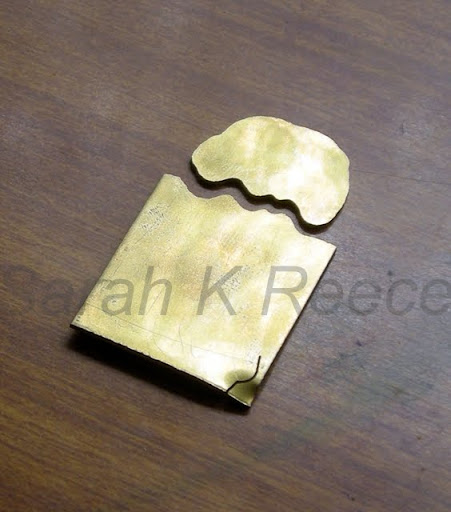
I started brass practice versions of each. Here’s the jellyfish mock-up partly cut out:

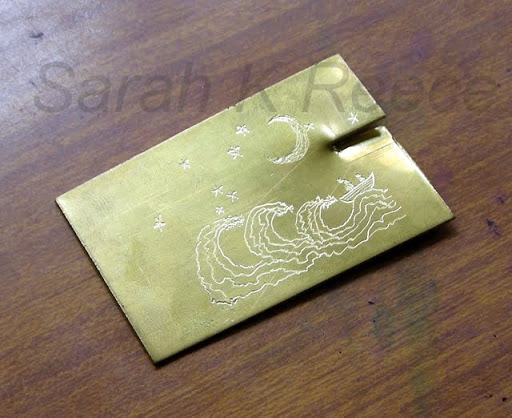
I’ve been experimenting with different surfaces to see what I like the best. The hammered surface is really lovely, it has a handmade feel which is much more my style. I also had a play with an engraver for the first time, and fell in love with it! Here’s my first try, a tiny sea scape:

Then I tried text, as it’s much more important to be able to get that exact so it’s readable.

Pretty happy with that! Next, seeing how it turns out using a couple of different backgrounds as contrast. Here is engraving on a hammered background:

Here it is on a sandblasted background:

I was stoked at how well this turned out! Then I tried an even finer engraving tool:

Before playing with my rose petal mock up:

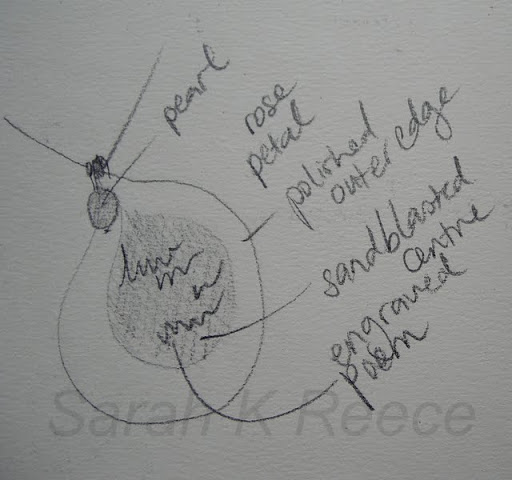
Which I am pretty happy with! So my final project is now to make a hand beaten and shaped rose petal from the silver, twist a loop at the top, engrave it with a line of poetry, and string it with a pearl. That’s a piece I’ll be happy to keep and wear forever. 🙂

To see the next step, read here.

TheMHS is over for 2011

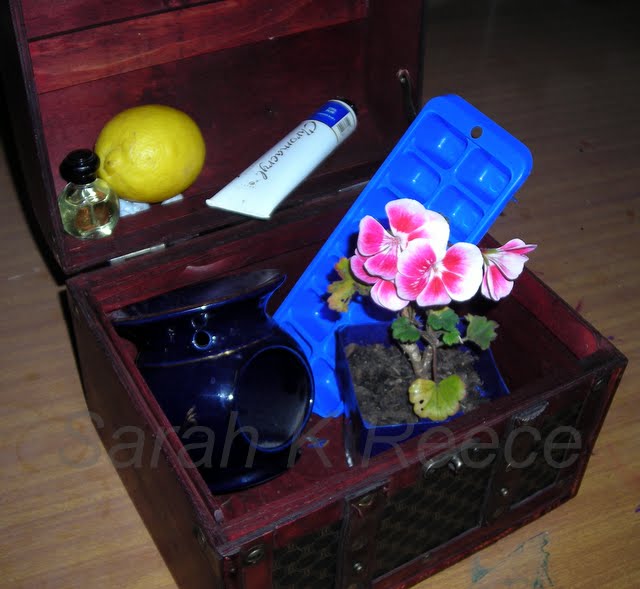
And it was amazing! Cary and I did our talk this morning, Managing Dissociation. They accepted our abstract but carved our time allotment from the 1hr 20 min workshop to a 20 minute presentation. So we were sadly forced to drop most of the theoretical framework and deeper issues, and focus really on two things – what dissociation is, and some symptom management strategies, using as examples some Grounding Techniques from our own personal Grounding Kits – that’s mine in the photo above. With a good dollop of encouragement that these things can be understood and recovered from thrown in! This was in contrast to a few of the optimistic speakers I listened to whose approach to an impending time limit was to speak faster. 🙂

It was a mixed audience, which is always tricky. About half put their hands up as being familiar with/working in the field of dissociation. We often find that many of those individuals will be well read with a sophisticated knowledge of the topic. And the other half were entirely new to the field. So the task was to try and engage both groups. I always worry that I’m oversimplifying complex issues and have to stop myself adding in far too much and overloading the audience. We got good feedback so I don’t think anyone was bored. 🙂 I gave out business cards to all and sundry, which was very exciting and terribly organised. In fact I was so excited about handing them out I’m pretty sure I foisted them on a few people who didn’t really want them. 😛 We continued with our approach of making connections with people in other states to build networks and resources and pass on information.

I actually managed to bring that grounding kit in with me and not leave it on the bus, which for someone as dissociative as I can be, was a pretty amazing feat. And then, I even remembered to collect it from the cloak room when the conference finished. Awesome! I very nearly tied the box to my wrist with ribbon to prevent me leaving it somewhere! I am very bad with leaving things on buses and zoning out and missing my stops too. I quite liked the irony that we were giving a talk about dissociation using our grounding kits, which is a situation that tends to make me pretty dissociative… handy having the kit right there! Cary had a can of soft drink in hers and drank it once we were done. I have to bring something more exciting than my lemon next time, I was terribly jealous! Maybe salt and vinegar chips?

I have now passed through the pseudo mania that hits me following a talk, and am deep in the sluggish marshes of complete exhaustion and thank-god-its-friday. I’m starting to learn what I need to do to be able to cope with the intense stress I feel around public speaking and this level of exposure, which is pretty exciting and I’m looking forward to doing more talks. I must say, today the post-talk debrief was particularly excellent, a good chat with an old friend and a celebratory french macaroon! I don’t think it gets any better than that. 🙂

Next year, it’ll be in Queensland in August, and the topic will be Recovering Citizenship… I just have to find sponsorship to get there! Mmmm sunny Cairns!

auto spell fails again!

Editing a couple of poems for Open Your Mind – I nearly send this in when I discover the auto spell function has somewhat altered the wrap up of my first stanza…

I see you leaving
Hour by hour
I see the pain in you
an agony that does not endocrinologist
!!! 🙂

Poem – Home

Whee! Tafe tonight was amazing and I’ll post pics and tell you all about it as soon as I have a moment I promise! I’m finalising my talk for the big conference tomorrow and putting in my entry to the Open Your Mind poetry competition at the moment. So, in lieu of a real post, have a poem!

Home

Walking one afternoon I take a different turn
And find that secret other world
Hidden behind the houses
Lanes that lead to abandoned lots
Where kids ride bikes over dirt hills
Old rope swings hang from trees
Ducks explore the drains.

The plants, they may all be weeds
And the river may be bricked
Full of bamboo and plastic bottles
Foam and oil slicks
But it’s so beautiful to me.

Cleo & Tiger settle in

Both cats are doing well. They have such different personalities, but get along well. Cleo has a fondness for high places, while Tiger couldn’t care less. He’s happiest lounging about on the rugs, dozing on beds, or lazing about on the armchairs. Cleo perches on top of bookcases, nestles on the shelves in the kitchen with the saucepans, watches the world from the wardrobe, the laundry cupboard, and the tv cabinet. Here they both are, demonstrating their very different sleeping preferences:

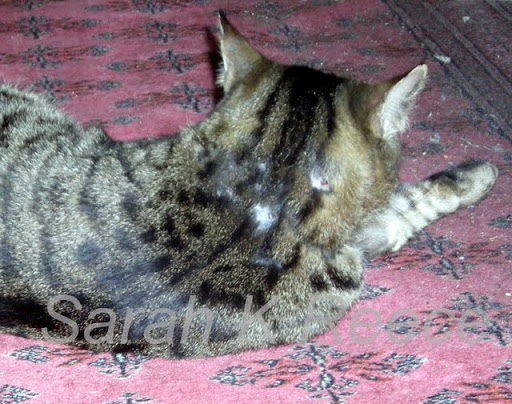
Tiger’s scabs and scratches are healing up well and he’s regrowing fur over the patches that were missing. He’s incredibly confident and nothing much fazes him at all. He’s very cuddly and loves to lay on your lap while you read or watch tv. He sleeps on my bed at night by my feet, very patient and settled. He really does not at all like the cat scratching post I’ve bought. He was clawing one armchair and one rug in particular, but I’ve rolled up an old rubbish rug and encouraged him to use that instead and I’m really surprised at how quickly he’s taken it up! He really loves it, he stands on it, reaches out to his full length and claws it with great enthusiasm.

He also gets into restless moods, where he plays coy and rolls onto his bowl, mewing and pretending to  be cute. Don’t be fooled! It means he wants to play fight and if you tickle his tummy he’ll chomp your arm. I throw him a little green bug that vibrates when you pull a string, he really hates it and attacks it with a vengeance then runs away and dashes down the other end of the house. He also likes to stalk his rug, he sneaks up on it from behind an armchair then bites and claws it. Then, feeling most pleased with himself, he takes himself off to the laundry for a snack. Here he is on his rolled up green rug:

Cleo has been more nervous being moved to a new house. She can’t sit still when she’s anxious, she moves in circles instead. So the other night, I was blogging away at my computer and she wanted a cuddle. But she was feeling too anxious to stay on my lap. So she lapped me for an hour instead. She’d jump up onto the computer desk, rub her face against mine, stomp all over my keyboard, on one occasion spill my drink, and then straight off the other side of the desk. Only to circle around behind me and do it again! She was making good time too, I think the whole circle took about 10 seconds to complete and she kept it up for the hour! I tried cuddling her but she’d jump straight off. I tried sitting with her on the couch but she’d just do a new circle of the couch instead. She was purring earnestly the whole time!

She’s feeling more at home now though, yesterday she circled for about 20 minutes before she could settle down onto my lap where she stayed for the rest of the night. She also sleeps on my bed, but she likes to be either up by my face, or sometimes underneath it, where you can hear her washing herself and purring, like a kind of reverse beneath-the-bed-monster. She’s more restless than Tiger though and hops up all night long for drinks, snacks, toilet stops, and presumably, just to check that the lounge room furniture hasn’t gone anywhere. 🙂 She’s also allergic to me reading in bed and gives sleeping on any open book a really good shot!

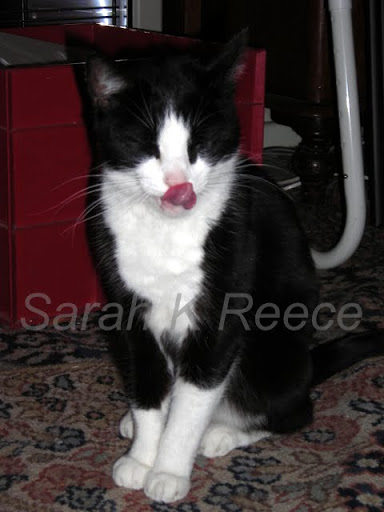
Here she is licking her lips after dinner tonight:

They’re both such sweet cats. I hope we can find good homes for them. I’ve had to rethink the litter tray with both cats indoors, it’s just not big enough for two, and the kitty litter is very expensive! So I’ve borrowed an idea from another cat owner, and I’ve got a big low sided plastic box and put half a bag of potting mix in it. This should accommodate them both a lot better, and can be put straight out in the garden compost so they’re actually contributing to my garden and I’m putting one less thing in my bin which always makes me happy. The slight downside is that the potting mix does cling to their feet a little more so it gets walked around the laundry. But I can live with that, they were kicking the litter all over the laundry anyway. I hope that’s got that problem solved. 🙂

TheMHS and an upcoming Forum

Whoo hoo! I had a ball at TheMHS today. I think I like conferences. It started with breakfast at Higher Ground this morning, with lots of other carers and consumers about, who I really enjoyed meeting. Then various thought provoking talks happened, with regular breaks to ply us with delicious food, and an awesome comedic interlude by peer worker Kylie Harrison! (you can see some of her story here) It’s really fun to get out of my own little box for awhile a get to meet all these other people, all passionate about making mental health services better. Tomorrow night I’ll be there for the launch of the Art Exhibition, which I’m really looking forward to. I wish I’d been sponsored to go to the talks during the next 2 days though! So much to be missing out on. I’m really hoping that this time I wont be so buzzed after my Friday talk that I can’t take anything else in. It’s not too long or too personal so I have my finger’s crossed a bit that I’ll be able to sit in on some of the rest of the talks that day and get the most out of my day’s registration. 🙂

And in other news, myself and my colleague Cary will be giving a free talk on Friday, September 23rd, Introducing Dissociative Identity Disorder. There’s more information under the What’s On tab at the top of this page. 🙂 For those who came along to this talk last year, the content will be the same. We were asked to hold it again outside of 9-5 work hours so that people could invite working spouses or school age children along. So we are!

First shipment of business cards

They finally arrived! The postie delivered them to a neighbour a couple of doors down and he kindly passed them on this evening. The colour isn’t quite what I was expecting. As you can see from this online version, it’s supposed to be a fairly bright strong blue with a slight lean towards teal. The cards I’ve received are a very dark navy/purple instead.

One possibility is that this is the result of the matt finish. I ordered some fridge magnets too which have printed much closer to the true colour:

They have a glossy finish instead so perhaps that’s the key. So next time I’ll consider a glossy finish or a paler background colour keeping this effect in mind. I also think I’ll bump up my font sizes. I can read it okay but I have friends who wouldn’t be able to, at least not without glasses or a magnifier! Things we learn. 🙂 All in all, I’m pretty happy. And they’re here in time for Friday – I’m always asked for cards after a presentation and now I’ll have some to hand out! – you watch I bet now nobody will ask. 🙂 I’m celebrating with black jelly beans.

Sing out if you’d like a card or magnet the next time we meet, or I can pop one in the post for you. 

Disclosure

This is a tricky topic that comes up for anyone with a diagnosed mental illness. Who to tell, and how to do it? There are so many levels to the issue of disclosure – do you tell family members? Do you put it on your Drivers License? Does your insurer know? Your boss? Your kids school? People manage the issues around disclosure with reactions ranging from – ‘I’m completely and utterly out’, to ‘no one but my doctor knows’ and all kinds in between. There isn’t a right answer here. It is a question I have grappled with for years. There are pros and cons to both being out and playing your cards close to your chest. The worst of it, is that it’s difficult to trial being out and then take it back if you don’t like how it’s all turned out. And there’s a whole host of secondary issues – lets assume for a moment you do want to tell so-and-so. How? When? How much information?

For me, the issue of disclosure has, and continues to be thorny. Learning more about what I was experiencing (and the clinical terms connected to those experiences) in therapy put me in a strange bind. The more I learned about myself, the more secrets I was keeping from other people in my life. I didn’t like this feeling at all. I found it very challenging to continue with the goal of self-awareness, when it seemed to so badly be compromising my other goal of being an honest and authentic person. The alternative – of being out, was firstly unthinkable when I was in the long stage of ‘we’re not quite sure what diagnosis fits you’. And that was a long stage. And secondly, the massive stigma attached to mental illness made me extremely leery. I was bullied a lot at school, and one of the terms that particularly stuck was being called a freak. Putting my hand up to say “I have a mental illness” felt like voluntarily branding myself a freak. When I didn’t have to! If you don’t have to wear the dunce hat and sit in the corner, why do it?

Mental illnesses can have an attraction/repulsion dynamic, where people are both repelled and fascinated by them. I find this deeply uncomfortable. Mental illnesses can be glamorized, treated as a discrete category of more interesting people who have genuinely experienced life in the way mere mortals cannot comprehend. I’m not particularly comfortable with this either. Mental illnesses often make people really afraid. They lose trust, they no longer feel like they can predict you. Sometimes people will assume you’re dangerous. And lastly, mental illness can quickly become your defining characteristic. The thing people first think of when they hear your name. Not, Sarah K Reece, artist. Poet. Friend. Funny person, quirky character, cat-lover, great cook, but mentally ill. If I was killed in a car accident tomorrow, and somehow ended up with a newspaper article about it, it would read Sarah Reece (because everyone always drops the middle K damn their eyes!), mentally ill woman killed in collision. And that sucks. I’ve already experienced this, a little while ago I went to Parliament to give a talk about how my mental illness has impacted upon my education and career. To my surprise, I was quoted in an article in the Sydney Morning Herald. They didn’t do too bad a job, for the media. MIFSA was referred to as a support group which was a bit daft. But still, the shock of seeing my name in print about mental illness – not as a clinician, not as an interested party, but as a person with a mental illness and frankly no other credentials to hide behind except for the true but slightly lame ‘I read a lot’, it was a shock.

There’s a terrible vulnerability to putting this kind of information in the public sphere. I’ve been doing a fair amount of public speaking over the last year, and as terrifying as that can be, at least you are choosing what and how you say things. Having other people write and say what they wish is a whole extra level of feeling vulnerable. And there’s always that nasty accusation – that you are motivated by a craving for attention, or that you are trading on your condition, hoping to somehow cash in on the sympathy factor. When you’re screwing up all your courage to give out information like this in the hope that it will help to raise awareness, decrease stigma, and humanise what is too often feared and misunderstood, this attitude is deeply discouraging.
But, returning to the personal field – when do you tell someone you’re dating? Which friends know? How much do they know? Which family members? What about the ones you don’t get along with? The road I’m walking is of slowly moving towards a place where I keep less secrets. For me, the stress of feeling I’m hiding something, and the unreasonable sense of shame that accompanies it, is a huge cost. I want to live in a world where it doesn’t matter that much. And the only way that’s ever going to happen is if people like me start talking. If people who are afraid discover that, yes, I may hallucinate when stressed, but did you know we both loved that new movie. That mental illness does not define me, is not the only thing you ever need to know about me in order to know me. That it is one part of a whole life of loves, fears, hopes, hobbies, and licorice allsorts.
So, assuming for a minute that you have someone you want to tell, what then? For me, I’ve moved slowly. I’ve laid a lot of groundwork with the people who’s reaction was really, really important to me. I’ve done a lot of quiet educating about mental health in general conversations, and moved us slowly towards that final step of revealing my own issues. There are of course, many other options! This is just what’s worked for me (so far). I found two books in particular to have some helpful advice about the issues of disclosure and relationships, The Dance of Intimacy by Harriet Lerner, and There’s Something I Have To Tell You by Charles Foster. In particular Chapter Nine – Very Hot Issues in Dance had some really thoughtful points in it. For example:

…you cannot learn to swim by jumping off the high dive. This is particularly true when it comes to emotionally loaded issues. Before bringing up a big one, we need to practice bringing up the small ones.

In other words, work on building intimacy, connectedness, and good communication before dropping a bombshell and hoping for the best! Something had some excellent advice about when and why to share information, how to have realistic expectations and actually having the big conversation.

This entire book is based on a simple principle that can help people navigate among all their duties. It’s the Principle of Responsible Honesty:
     Something is hard to say because it creates needs in you and in the other person. You tell the truth most responsibly and effectively when the way you tell takes into account the needs your truth creates and goes some distance towards meeting those needs.

Food for thought.

Tiger & Cleo

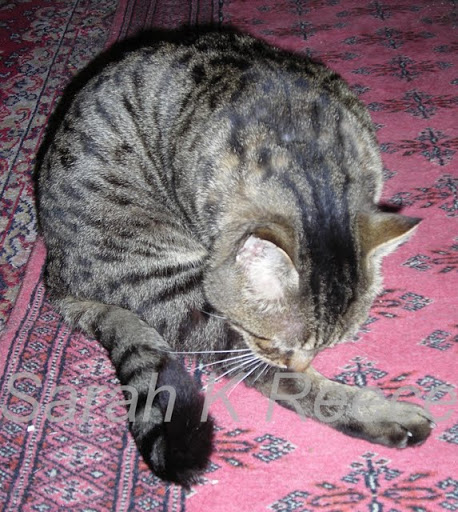
This morning two new foster cats arrived. This is Tiger:

He’s aptly named, a huge magnificent cat with tremendous presence. He’s about 18mths, and unfortunately has FIV –Feline Immunodeficiency Virus – the cat version of HIV. This can’t be passed on to people or any other animal except other cats, usually through a bite. So, he’s now an indoor only cat so he wont infect any other cats. Cleo has been vaccinated so she’s protected. At this stage his health is good. He’s a bit sneezy which isn’t much to worry about. Early warning signs of sickness are loss of appetite and weight loss, and there’s certainly no problems there! He weighs at least 6kgs by my reckoning, he’s a huge head, big feet, no neck at all, and a solid barrel of a body. And he eats with great gusto! We may need to feed Cleo separately…

Today he polished off her lunch and his. His coat is in excellent condition, soft, thick and shiny. He’s fastidiously clean and have given himself about 4 baths so far today. His markings are gorgeous, the black spots remind me of an ocelot, well that and his size! His paws are all black and his nose is a dusty pink.

He’s obviously been in at least one major scrap, his ears are ragged and his neck is covered in scabs and missing bits of fur.

He has loads of personality. He wasn’t at all intimidated being in a new house. He’s tried lying on all the furniture, sunned himself on all the warm spots on the rugs, admired some box opening and furniture moving, and demanded many cuddles.

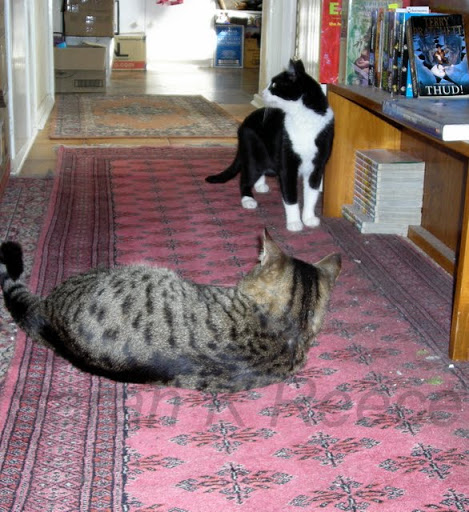
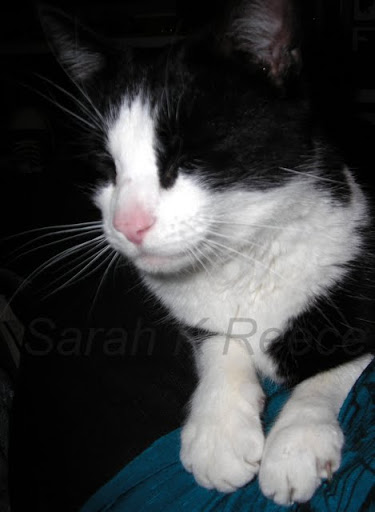
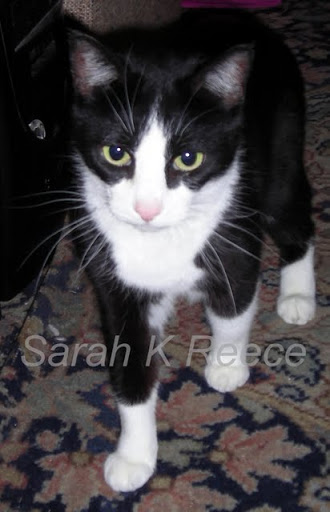
Here he is with Cleo, look at the size difference! I’d bet he was the only kitten in the litter. (and yes, that’s our burgeoning Pratchett collection on the shelf there – got to love Book Depository) And now to Cleo, she’s about 4 years old, slender and on the petite side. She’s a gorgeous tuxedo cat with no health issues.

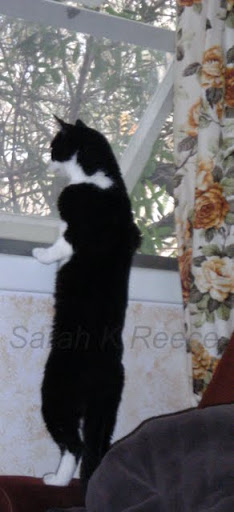
She’s far more timid and antsy. She’s spent a lot of time hiding behind the couch, behind the TV cabinet, under the dresser, behind the washing machine… I’m getting used to the hiding places now which makes life a bit easier. It’s very nerve wracking when a new cat disappears for hours. Here she is looking out the living room window. 🙂

Tiger doesn’t talk at all but Cleo does if she’s confused or upset. She has a really unusual trait in a cat – when she’s very anxious or excited she holds her tail straight up and shakes it, a bit like a rattlesnake!

Her white markings are uneven, she has a white curl over her right shoulder, like she’s thrown over the tail of her scarf. 🙂 She’s also very affectionate, she likes to kiss your face and ‘pumps’ with her feet.

They’re both asleep on the floor of the living room rug at the moment, so the house is quite and contented once again. I’m neurotic about keeping the doors shut and have to be careful not to fall over new furry bodies sleeping in the hallway.

We did get some more information about Abbie after all. She was suffering from kidney failure, likely caused by extensive neglect and malnourishment. It doesn’t show up on blood tests, so that’s why no one knew what was going on. So, there was nothing else we could have done, kidney disease is irreversible in cats. She was loved and safe and kept as comfortable as possible. As will Tiger and Cleo be until we can find them new permanent owners. 🙂

Tafe Jewellery Fundamentals

We’re over halfway through my TAFE class now and I’ve been putting in some hours to catch up a bit. (catch up on my first class here) All the other projects on the go at this time of year – Mental Health Week and TheMHS – have been a bit of a distraction. But I’m making progress. Here’s the first three mini projects all done and ready for assessment:

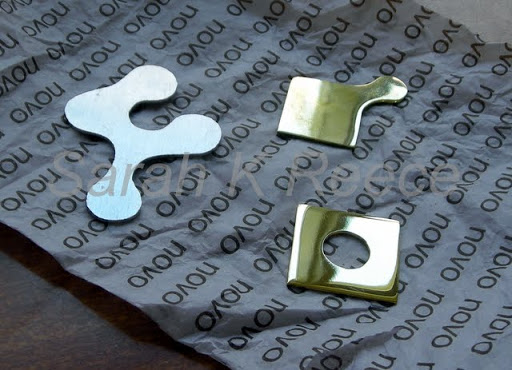
The dull looking silver one is aluminium, and was practice for hand cutting skills. The shiny ones are brass, we’ve scored the design onto the surface, cut, filed, emery-ed, polished and cleaned. I’ve been told that they are fine for a beginner.

It’s funny, jewellery making can on the one hand be quite organic and experimental. On the other it can have the kind of insane precision a clockmaker needs. Lots of maths and right angles and things that need to fit exactly. That aspect of it I’m not so keen on. I’m not that big a fan of modern minimalist jewellery, I quite like the handmade look where the angles aren’t exact or there’s hammer marks or other small imperfections. That’s not to say that I don’t admire the time and craftsmanship that goes into a bowl polished to a mirror shine with exactly the same thickness of metal at every point, I just can’t see myself spending my career doing it. But the organic, the bizarre, the experimental, the art nouveau… now that has appeal. I would love a jewellery workshop in my shed. The material costs are prohibitive however! The cost just for the silver for this project is about $50.

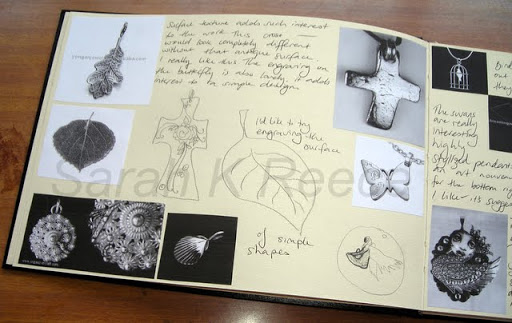
So, now I move onto the next piece which must be my own design, may be riveted but not soldered, must be a pendant, and must contain at least one polished surface. We are also being assessed on a studio journal so I’ve been putting some time into that:

I asked about using other sources of metal and I’ve been given permission to use old silver spoons if I can find any, genuine silver only though, not silver plated nickel as that’s a common skin irritant. Hmmm, always looking for the recycle option…

See what I made at my next class here.