Psychosomatic part 1

Is a term that is often used to mean it’s not real. In much the same way that someone presenting with unexplained chronic digestive troubles may be told “You’ve just got depression” when tests come back normal, people with physical pain or problems who have normal test results may be informed “There’s nothing wrong with you, it’s psychosomatic”. Quite understandably, people suffering from chronic, painful physical problems find this pretty hard to take. Using the term psychosomatic in this way is terribly unhelpful and inaccurate. For the person rushed to hospital afraid they were having a heart attack, the news that they are experiencing panic attacks is good news or bad news, often depending on how it is delivered. The good news is that hopefully, their ticker is going well, and they don’t require invasive surgery or procedures. The bad news is discovering they are dealing with a debilitating mental health problem, which can be very embarrassing and stressful. When mental health problems are presented as if they are insignificant, we feel humiliated by how difficult they can be to manage. Sometimes in a very busy medical setting, a diagnosis of a mental health problem is given is very offhand and dismissive way – you’re no longer their problem. This can leave the poor person involved actually wishing they had been having a heart attack! Sometimes people are referred for information and support, sometimes they are just sent home to try and deal with the problem by themselves.

Anyone who has a mental illness knows that just because it’s in your head, doesn’t mean it isn’t real. Your head is actually pretty important and a lousy place for an illness to be! Mental illnesses can be extremely disabling and in sadly too many cases, terminal. Having them treated as if they are less important than ‘real’ physical problems can cause so much distress and embarrassment that people don’t go for help, don’t get support, don’t learn how to manage it appropriately, and become very overwhelmed and hopeless.

I have a couple of chronic health problems that are of unclear origin (as well as others with a clear physical origin). As a result, medical and psych doctors have been debating with enthusiasm whether they are physical or psychological problems. This happens with every health problem while the cause is uncertain. It’s my understanding that tuberculosis was linked to having a type A, driven and high achieving personality until the bacteria responsible were identified. This can cause a huge amount of stress for people with these conditions, as they bounce between specialists with different theories and opinions.

One of the tricky things about health and sickness, is that to some extent, they are both psychosomatic. Now, let me be super clear here – I’m NOT saying that you get cancer because of feeling bitter, or demeaning rubbish like that. But, our emotional state does have an impact on our health. Feelings of grief, fear and anguish can be measured in changes in our bodies. One of the areas we’ve done the most study on is the effects of fear. Because feeling fear is geared to keep us safe, the effects are often really fast. Hormones kick in quickly, we feel changes such as our heart rate increasing, our blood flow restricts somewhat to stay around our brain and vital organs so our hands may feel cold or tingly, energy is diverted away from non-essential functions like digestion, so we feel our mouth go dry. These responses are all geared for the fight-or-flight response so we defend ourselves or get away as quickly as possible from whatever is frightening us. And they could all be called psychosomatic, because they are caused by how we are feeling.

Psychosomatic simply means that the problem you’re dealing with is being caused or exacerbated by your emotional and psychological state, rather than purely physical issues. In some cases, emotional pain is being expressed as physical pain, or psychological blocks are expressed as physical disability. If this happens in a really severe or disabling way, you may be diagnosed with a Somatoform Disorder. If it happens in milder forms, such as sleeping problems, disturbances in your senses, rashes clearly related to emotional distress etc., you may be diagnosed with a Dissociative Disorder. The line between these kinds of conditions is rather blurry and difficult to distinguish. It may be that the psychosomatic disorders are more severe forms of the kinds of distress seen in dissociative conditions, at least in some cases. It’s such a difficult area to make sense of because we don’t know all the causes of physical sickness yet, and because our emotions always impact on our health. Most of us get some kind of physical symptoms when we’re stressed – headaches, back pain, a sore mouth from teeth grinding, flaring of skin problems like dermatitis. On a mild level, that’s a psychosomatic reaction. Most of us have also experienced how our psychological state affects how we cope with physical problems. Have you ever been in pain from a tummy bug or headache and suddenly received some great news? The pain recedes to the back of your mind and you feel warm and happy and like you can cope.

For a while, some doctors thought that people with mental health problems would need less physical care because their issues were psychological. Lately it’s being shown that people with chronic mental health problems often have chronic physical issues that are not being attended to. Some of these are a direct result of the mental illness; for example some people with an anxiety disorder suffer from chronic dry mouth and as a result need extra dental care. Sometimes they are the result of unfortunate side effects of treatment, such as increased cardiovascular problems due to weight gain associated with certain medications. Also, physical health problems can cause mental health problems like depression to develop as people struggle to cope with the demands of chronic pain and disability. So the divide between mental and physical is not very clear. Our head is attached to our body, and stressors and problems in one do affect the other.

part 2 of this discussion can be found here. 🙂
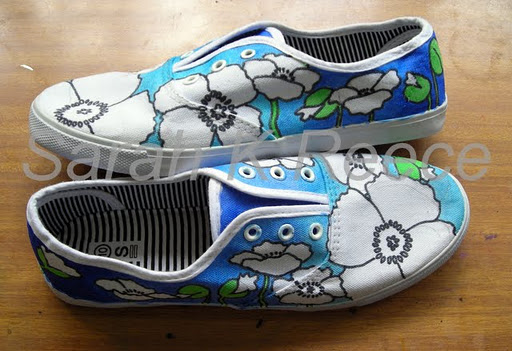
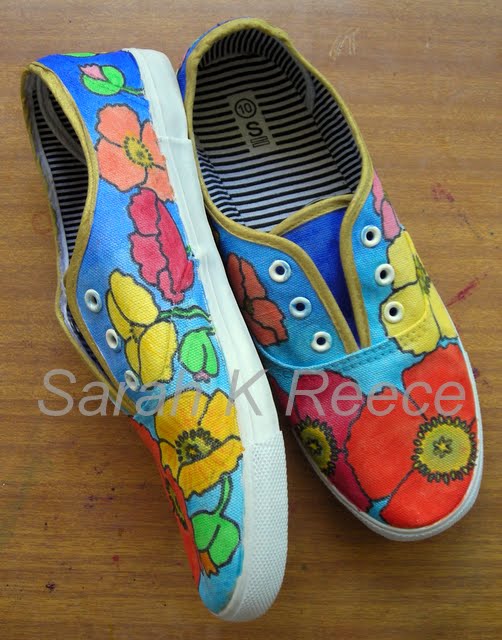
Painted poppy shoes

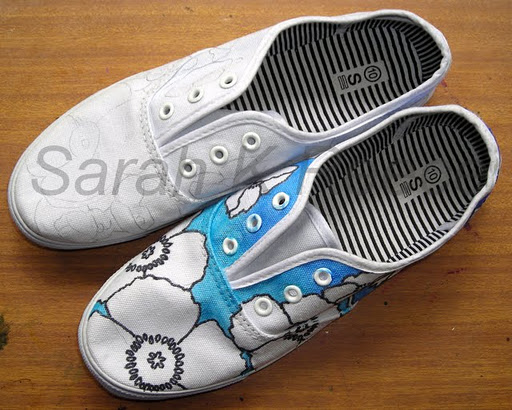
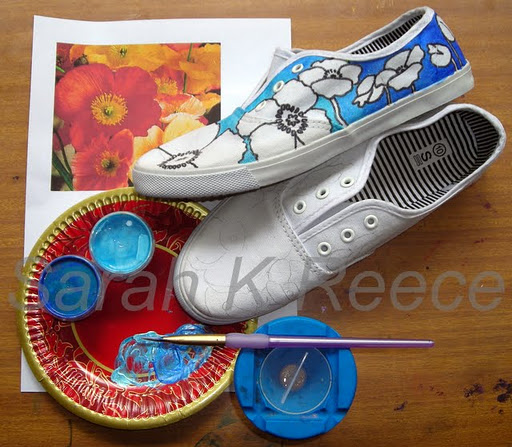
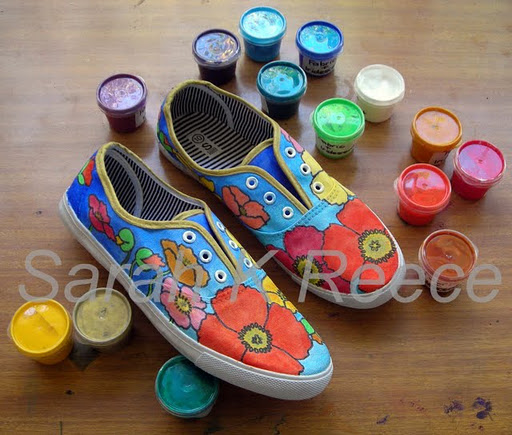
My newest painted shoes are just drying now, waiting to be heat set and beaded. Nice way to spend a Saturday afternoon, especially after a heavy post yesterday.

As of this morning they looked like this:

I really like the blue and green together, I think waterlillies or lotus would look really nice too. The poppies I had in mind were Iceberg, they’re often grown here in and around Adelaide. They’re a nice single frilly poppy with a range of colours. The result is very bright and cheery and just perfect for this Spring weather. They’d look awesome too with a single colour poppy as well I think. Next time…

Looking forward to wearing them out somewhere!

Building Self Awareness

Why bother? Well, self awareness is one the many skills that help you manage life in general. We had a great chat about this at Bridges today. When you’re dealing with something as complex and difficult as a mental illness, self awareness can be one of the keys that help you cope and recover. Learning who you are, how you function, what you need, what keeps you well and what sets off your symptoms are all part of being able to better predict and manage a mental illness. Knowing more about what’s going on for you can help put you back in the driver’s seat. Instead of feeling helpless, overwhelmed, and like the illness is running the show – which it certainly does in those really bad times, you can gather information and feel more like you’re in the driver’s seat. I hope that you may find something useful in my experiences with self awareness.

I confess I have come from a place where I had very little self awareness. I collected information about the people around me, when their birthday was, what their favourite flowers or food were, if they like company when they’re struggling or if they prefer to be left in peace. I was proud of being able to remember all these details so I could tailor how I responded and try to be as good a friend as possible. In contrast, I felt blind to myself, like when I tried to look inside myself everything was in shadow. My head felt full of fog and mist. My mental illness felt totally unpredictable and unmanageable, good days or bad days seemed to come out of nowhere without warning. Nothing made sense to me. I felt like I was in a tiny boat at sea, storms came or went and I just tried to survive.

A few years ago I received the diagnosis of a dissociative condition, and I changed gears. I was desperate to fix the problem and get myself back on track. I firmly resolved to be one of those inspiring patients who faces things squarely, works really hard, and gets everything sorted. I decided that I would be completely cured of my condition within a year.

So, for the first time in my life, I basically made myself my own research subject. Once I started to get past my denial of my mental illness, I studied myself. I looked for patterns. I lay awake at night for hours asking myself questions that I was, frankly, terrified of getting answers to. I wrestled with myself, deeply frustrated and strongly driven to be able to sort everything out immediately. I derailed very quickly. When I faced either driving myself into a suicidal breakdown, or backing off my aggressive approach to self awareness, I realised that what I was doing was actually destroying my ability to function. So, very confused, I backed off a bit and had to re-think my approach.

In my case, I’ve discovered that self-awareness has to be underpinned by two different things. The first is the ability to cope with what you learn. In the case of a dissociative disorder, the dissociation is often playing a protective role. It is buffering you from feelings, memories, information, and awareness that you might find pretty difficult to cope with. So, I was digging around for answers, but also terrified of what those answers might be. This isn’t a great way to learn about yourself. I had a whole bunch of fears about what it meant to have a mental illness: would it be permanent? Was I going to get worse? Could I be dangerous? I desperately wanted information but I was also really scared.

As I read more and educated myself more about my conditions and mental health in general, some of those fears started to calm down. I discovered that mental illness labels are basically a shorthand way for one doctor to communicate with another about the kind of struggles a person is having. No one ever quite perfectly fits a diagnosis, and that’s normal. I spent some time with other people with mental illnesses and found that they were still people. We could find something to talk about, some common ground, some interest or concern we shared. I discovered that statistically, people with mental illnesses are actually less likely than the general community to be violent. My intense fears began to calm down. I learned that there’s a lot of grey area in this field, that sometimes it takes a lot of time to work some things out, that others may never be known. I started to realise that this was going to be a process. I began to engage that process in a more gentle and curious manner, instead of frantic.

The other component to developing my own self awareness has been working on accepting myself. Self-acceptance is another key to recovery, and it’s never been my strong point! I was not treating myself well in the process of trying to learn more about myself. I was harsh, angry, hostile, and contemptuous. I demanded answers to questions, I was furious at the very dissociation that was actually buffering me from overwhelming distress and hopelessness. I was angry at my own weaknesses, driving myself hard to cope better. I would constantly ask myself “what’s the matter with you?”. My self talk was nasty “You’re so pathetic, you’re weak, stupid, ugly, disgusting, no one likes you and they’re right not to”. My self esteem withered and my relationship with myself was like being sandblasted.

I had to develop more compassion for myself. I had to work on building a better, more gentle and caring relationship with myself. Learning about who I am and how I function has been more like tending a garden, or coaxing a hurt animal to care than undergoing a military inquiry. Less about asking the questions and more about just listening to myself. The more I’ve been able to be okay with the answers, and to be gentle with my own limitations, the more I have learned. While I railed and screamed, my mind remained shut tight, closed down. Now, I’ve been slowly able to gather and build up information. I’ve unpicked the dynamics that have fuelled my illness and learned what the keys were to those good days.

Self awareness makes a huge difference to my ability to function. I’ve learned some of my triggers, developed my own grounding kit, learned my early warning signs and what to do about them. This doesn’t mean that I can always prevent the bad days. There’s a lot in life I can’t control, and overwhelming circumstances can bump my stress level past the point I can cope with. But these days I can at least see that coming most of the time. So I set in place strategies – I ask for help, I increase my grounding techniques, I don’t spend time alone if it’s going to be dangerous. It gives me more control to predict and manage my illness and my life. This doesn’t mean it’s something I’m finished with! Still very much a work in progress, and probably always will be. We change, develop, acquire wounds and hurts, and grow over a lifetime. So self awareness is always going to be a process, listening to ourselves and learning our needs, desires, fears, and dreams as they change with us over time.

News and events

Well, I turned up to Tafe tonight, all excited to start my new Small Object Making Fundamentals course, and I couldn’t find it! In fact, the whole building was being closed up and no subjects were being held there tonight. So I trundled across the road to the other Tafe building hoping the student services would be open, but everything shut early. Library, student support, cafeteria, the whole sheebang. I managed to find some staff working late and knocked on windows. They were very helpful and spoke with security at both campuses, but no one could help. So, I sat out the front of my building for 1/2 hour on the off chance someone I knew would turn up. I ate my peanut butter and jam sandwich, gave up, paid for my parking and came home. No idea what went wrong there!

But my group Sound Minds was awesome as usual, so I’m feeling pretty good!

There’s an exciting training opportunity called SmART, for artists with a disability, or people who work with us here. Places are very limited so get in quick!

Cleo is still pretty unhappy but she’s opening her sore eye a little more so I think that’s a good sign.

My new poppy shoes are looking awesome, I’ll post pics of them tomorrow. 🙂

And, I’ve found out when my interview will  be aired on Radio Adelaide! There will be one each from four of us who’ve been working with HCA, here’s the schedule:

  • Tim – Breakfast – Friday 14th, 6.45am
  • John – Breakfast – Tuesday 11th 7.10am
  • Steve – Barometer – Tuesday 11th sometime between 6pm and 7pm
  • Sarah – Arts Breakfast – Saturday 15th sometime between 9am and 11am

Radio Adelaide is our local community radio station, listen in on 101.9 FM, or online here.

The Feast Festival is coming up in November, check out all the events here.

And the next MIFSA Forum is also coming up – free event – Oct 26th, 1-2.30pm on The Benefits of Mindfulness, so if you want to learn more about this technique for enhancing your mental health, make sure you RSVP to reception@mifsa.org or call on 83784100.

And a reminder that the LAUNCH of the Celebration of Life Exhibition is on tomorrow morning – see my What’s On page for all the details. Free event, everyone is invited! I’d love to see you there. 🙂

Hope you’re having a good evening too!

Ink not Blood full details

Ink not Blood is a series of artworks about using creativity to overcome self-destructive urges, both self harming and suicide.

Content warning, some may find the images upsetting. There are no real wounds, scars, or blood depicted. There are images of blades, and blood or wounds simulated with ink.

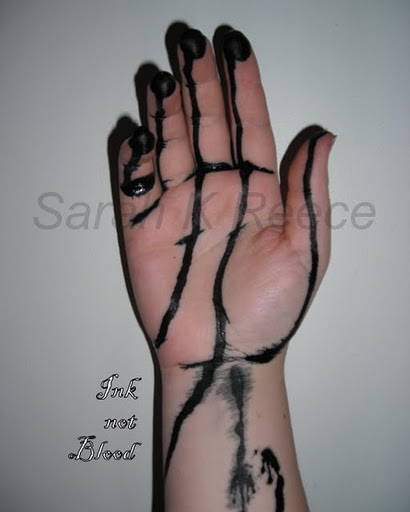
This is a darker series of work, touching on topics that are very taboo in our culture. It was born out of my own struggles, and the way I have come to regard ink as a kind of substitute for blood. I have been using ink to battle these feelings for many years, as a teenager I coped with high school partly by writing poetry on my arms. But I also mean the use of ink in a much broader sense, to refer to any creative act. Being creative, not just being an artist, but to create anything helps to draw me away from destruction. For me, Ray Bradbury said it best:

Those who don’t build, must burn.

Or, to put it another way, the desire to destroy is only the thwarted desire to create. I’m most at risk of destructive impulses when I’m not using my hands to create. So, speak, express, and scream if you need to, but communicate your pain using ink, not blood.

Self harm and self destruction are complex issues, driven by different fears and needs. I’m not proposing that the issues I explore are universal, or that this is the complete list! These are just some of the ways I experience and overcome my own self destructive impulses, and I hope that something here may be useful or inspiring for others.

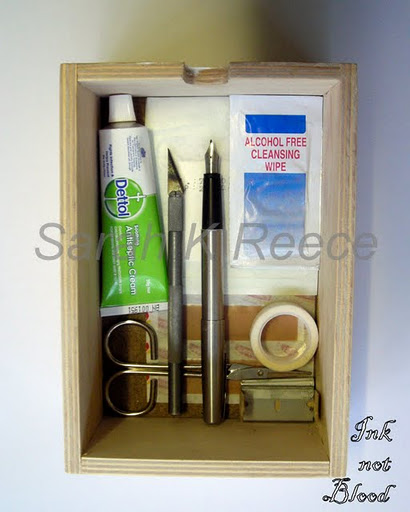
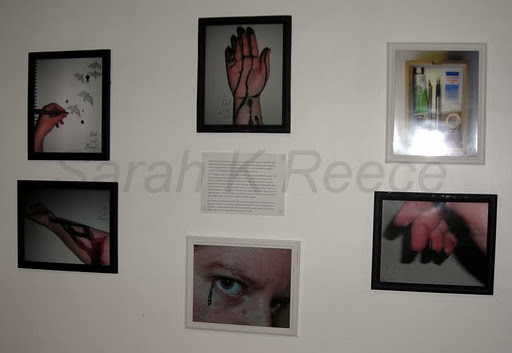
1. The Other Choice

Some people who self harm keep a ‘kit’ of their tools. This photo shows an example of such a kit, with the fountain pen in the centre as an alternative option. The blade and the pen mirror one another in size, shape and colour, but the choice between them as ways to express pain, leads to completely different places in your life.

2. To See My Pain

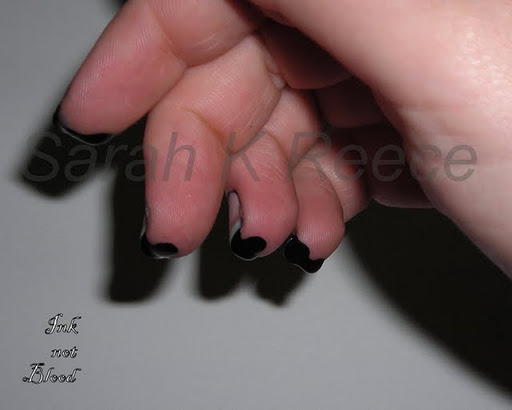
Part of what can drive the urge to self harm for me is a need to see my pain. Emotional anguish is invisible and at times I need something that shows I’m hurting. I use my art and writing to fulfil this need where I can, and I paint my arms on days when that is not enough. Someone I care deeply about tried to kill themselves recently. I painted this as a response to the torment I was feeling. It’s only ink, drawn on with pen and painted with brush. It lasted about a week then faded away. There are many ways to see your own pain that don’t harm you, I hope you can find your own ways to meet that need.

3. To Touch My Pain

Sometimes bringing pain from the emotional to the physical world helps us to feel more in control of it. We can touch it, reassure ourselves that it’s real. We can also heal it far more easily, we can nurture and tend to the wounds. We are brutal with ourselves in ways we would never be to another hurting person. This need to touch pain is about feeling silenced and not being believed for me. Now in my life I have people who don’t dismiss my pain and who don’t sneer at the sorrows I’ve come through. I feel more that I have a voice, and less that I have to find a way to prove I’m suffering. Don’t get caught in that trap – people who don’t believe you’re hurting will be just as dismissive if you try to use self harm to prove it. If they are not listening now, they won’t be persuaded by physical scars either. Find other people who listen, and other ways to touch your own pain and nurture your wounds.

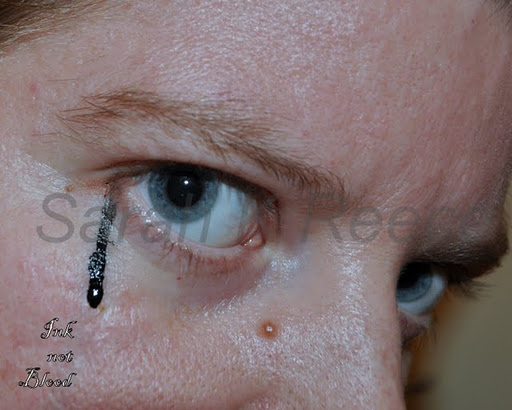
4. To Weep Ink

I use art and writing to express grief and fear. For me, part of self harming is the need to leave a mark that I can’t deny later on. To be forced to wake up the next day and face that I’m not coping. It’s a way of overcoming denial. Writing a poem or painting a picture can fulfil that need. I don’t have to play out the war of self awareness on my skin. I can weep tears in ink that last and leave me with a page where I must confront my own distress and face my own woundedness.

5. Freedom

To use ink instead of blood frees me from the shame and self loathing that accompany self harm. In writing journals or making art there is a liberation, here represented by the written birds flying through ink tears. When I write my pain in blood I add to it. I trap myself in a spiral of shame and hatred where my pain only increases and intensifies. I stop listening to myself and take my rage out on my skin. I become an abuser to myself, seeking peace and healing through degradation and contempt. Using ink instead does the opposite for me, it eases anguish from my head and heart onto the page. I now try to write my pain with ink, not blood.

6. To Bleed Ink

Some days, I feel like I’m emotionally bleeding. Sometimes there’s a driving need to make myself look the way I’m feeling. Having an invisible disability like a mental illness can fuel this for me. I feel like I’m fighting invisible monsters in my head, and because no one can see how hard I’m working, I feel humiliated by my limitations. I feel less than other people, ashamed of how hard some things are for me. Trying to catch up and never quite making it. These feelings can drive self destructive urges. But the thing is, if I do self harm, I’m so deeply ashamed of myself I hide it. So it doesn’t actually make my struggles any more visible. I try to find somewhere to talk about how I’m feeling, and some other way to deal with my pain. These days I try to bleed black, not red.

Poppy shoes and Mindshare

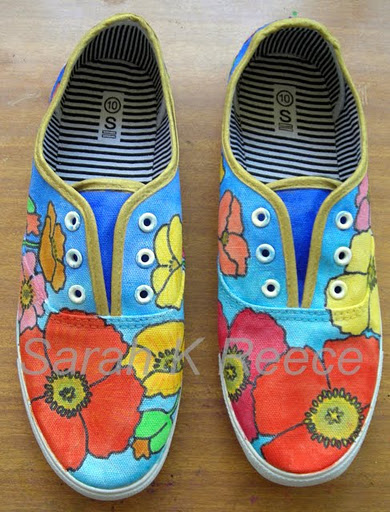
Here’s my latest painted shoes, coming along well.

I’m really pleased with the design, I really love poppies!

Plan to work on them more today. Apparently I’ve missed out on something happening at MIFSA with Kelly Vincent and Borderline Personality Awareness, which I am most unimpressed about! Still, I’m really enjoying painting these, so not at all a bad way to spend the afternoon. The shoes may or may not appear in the photo that will accompany the article in the Messenger next week, depending on which one gets picked. 🙂

I’ve found where all the Messenger stories are being shown online! You can go here to read all the different articles celebrating overcoming mental illness and the launch of Mindshare. Each person is featured in their local Messenger paper so this is the only place where all the stories and gorgeous photos are together. Apparently mine will be up at the end of next week! Really looking forward to the launch of Mindshare. Can’t wait to see the new website all up and running.

Cleo is a bit sick

She’s developed an eye infection which is all swollen and sore.

I’m bathing it regularly with salt water to help kill off any bacteria, and she’s being really good about keeping it clean. She’s feeling rather miserable and wanting lots of cuddles at the moment. I’m keeping a close eye on it and if I think it’s getting worse I’ll get a vet involved, but at the moment I think she’ll get over it herself.

Tiger is going really well, he’s been very healthy despite the FIV and no trouble at all. He’s a lovely friendly fellow, with a funny penchant for eating odd things! I’ve had to hide the cotton tips as he seems to think they’re cat snacks, and when he’s happy he licks whatever is nearby… the chair, pillow, blanket, or my fingers! Good exfoliation I’m sure, but I am having to use a lot more hand moisturiser!

The two have been all energised by the spring weather and when they’re not sleeping in patches of sunshine they enjoy chasing each other about the house. It seems to be pretty fair about taking it in turns who chases and who runs away which I’m happy about. They’re not closely bonded like litter-mates often are but they certainly seem to enjoy each other’s company. 🙂

Buy Art Shoes

You can now buy your own pair of Art Shoes from me!

Cat shoes
Here’s the process: you need to contact me to arrange getting to me a pair of plain canvas shoes in your size. I don’t buy the shoes myself because I really don’t want you to discover after they’ve been painted that there’s a size issue. You go out and buy some that fit from places such as Kmart, Spendless Shoes, or Target, and get them to me to paint. You should be able to get some cheaply, I pay between $5 and $15 for mine. If you need to post them to me, I’ll re-use the bag to send them back when they’re done so you’ll know exactly how much postage to add to the cost. These measures allow me to offer the shoes to you at a lower price and confident they’ll fit. 🙂
Prices:
  • Standard adult pair: $50
  • Infant or children’s pair: $20
  • Fancy boots that go right up your leg – contact me 🙂
  • Add a little beading (see below): add $10 to the overall cost. 
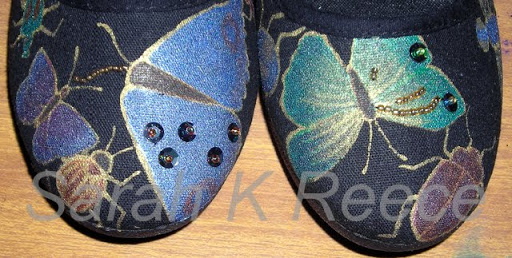
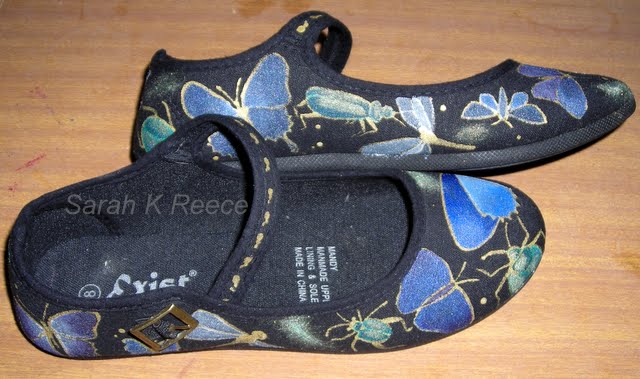
Butterfly and beetle shoes with beads
Will they last? Absolutely! How well they wear depends a lot on how well you treat them. They are water fast, painted with fabric paint and then heat set. So no need to worry when walking in the rain, they hold up fine. Hand wash them if needed, I DON’T recommend putting them through your washing machine as it’s pretty hard on them and the colours will fade. Black and white are the most vulnerable colours, they both age to grey, so I recommend choosing a design that doesn’t include much of either, or not wearing them through mud and dirt if you do.
Cat shoes

Every pair that I paint is entirely unique and one off, but as you can see I do paint themes so please feel welcome to ask for cat shoes etc. I’m also happy to work with your design, so if you want pandas on a pink background we can do it. You can see the style I paint these and yours will look similar. If for some reason you don’t like the end result you don’t have to purchase them. I’ll keep the shoes to sell elsewhere. This helps me cover the cost of my paints as it will likely take a long time to find someone else with the same tastes and shoe size! I also retain the right to use pictures of your shoes, for example to post here on my blog. 🙂 

Happy shoes are truly awesome, they always make me want to dance!
Poppy shoes
Butterfly shoes
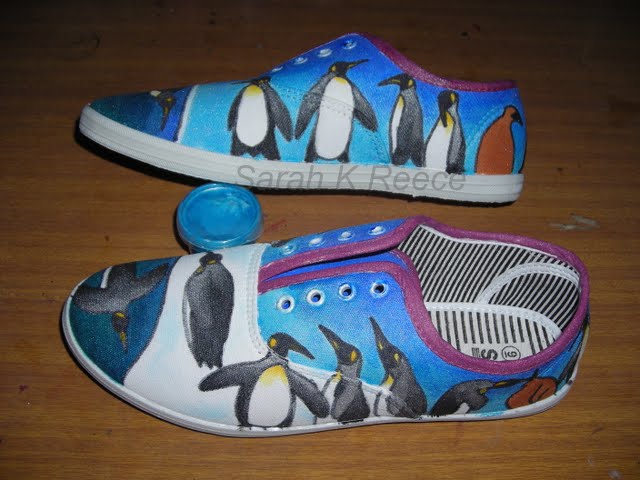
Penguin shoes
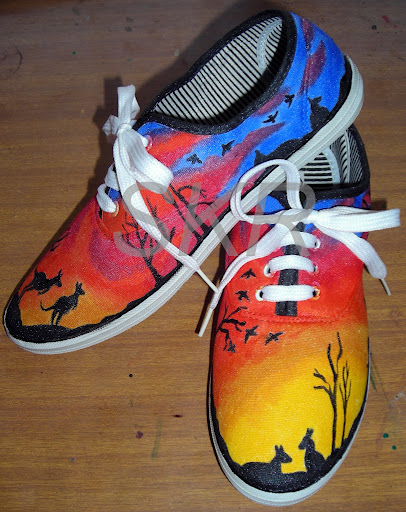
Sunset kangaroo shoes
Bug and beetle shoes

Rainbow boots

Peacock Shoes

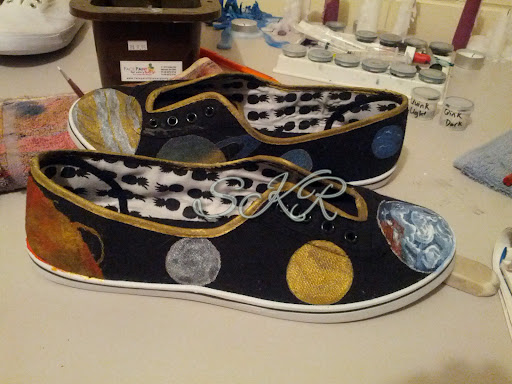
Solar System Shoes

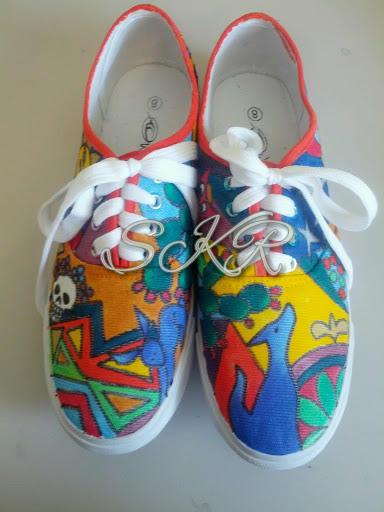
Mexican Folk Art Shoes

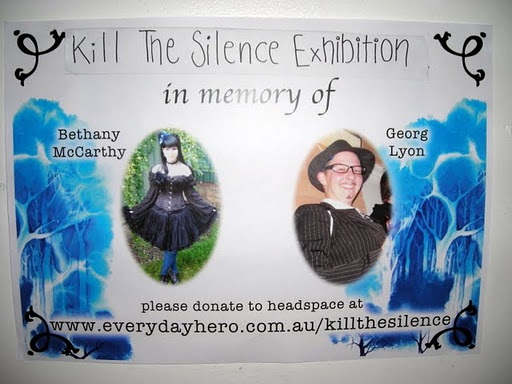
Kill the Silence went really well

It was a great evening, very heartfelt and a nice atmosphere.

I didn’t know almost anyone there, and turning up at 4.30 to hang art, but not having my poetry reading on until 8.30 made it a bit of a long night for me. Here’s my Ink not Blood display:

I hope other people will find them inspiring too. I had to explain to a few people that I wasn’t trying to incite self-harm, these works were aimed at other people like me who have issues with self-harm already and were trying to find ways to overcome it. You will be able to buy an 8×10 print of any of these photos from my To Buy page soon.

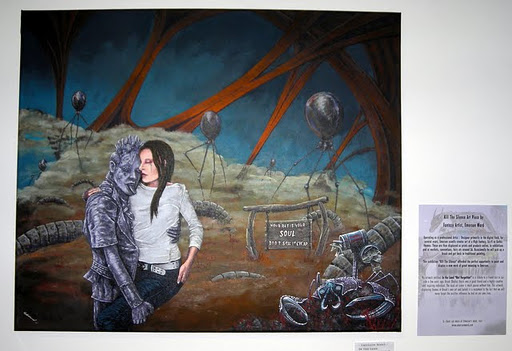
There was a small collection of art around themes of loss, mental illness and suicide, some painted as tributes to lost friends, such as this beautiful painting by Emerson Ward, an artist who’s work is often displayed at the Medieval Fair.

The sign in the painting reads “Your art is your soul, don’t sell it cheap”.

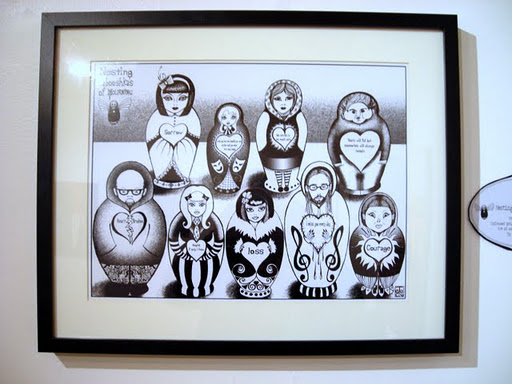
I also really liked this one, “Nesting Babooshka’s of Mourning” by Jackie Reichstein.

Myself and one other poet read a few poems about recovering from mental illness or caring for someone who’s struggling with mental illness, and they were well received. A friend suggested recording it and pod casting, which I think is a great idea. I’ll work on getting some voice recordings included here as I figure out the process. 
I love to express a full range of emotions and experiences through my art, and I appreciated having a venue where darker, confronting works had a home too, even if only for a night. It was a really thoughtful, positive, and creative way to remember lost friends. 
*If you are one of these artists, and do not wish for your work to appear here, please contact me and I’ll remove it immediately.

Interview and Exhibition

Hurrah! I’ve had the interview and photos taken by two lovely ladies from the local Messenger paper. I’m glad they took the photos first, I was all pink after the talking bit! We did pics in various poses in my studio, I can’t wait to see which one they choose. I will of course link here when it’s out. I coped with the anxiety using a little-known technique called painting a new pair of shoes! They are looking awesome. 🙂 And now that my hands have stopped shaking a bit, I’m off to deliver my Ink not Blood series to the Grace Emily hotel for tonight’s event. I am all organised, everything’s framed, and the frame where the glass broke earlier today when I was stapling a ribbon across the back to hang it from has been replaced. (See? I hate framing!) And I have my folder of poems to read out tonight, so do join us for an hour or two if you have the evening free. I will be there with poems in one hand and a gin and tonic in the other… aaaaahhhh.
Peer Work – How to share your story

Telling my story is something I do a lot of now through talks, group work and in this blog. I’ve been asked a few times how to go about it, especially for people who are getting involved in Peer Work. Peer Workers are people who have a personal experience with mental illness, and who use their experiences to connect with and encourage other people dealing with mental illness. Knowing how to share those personal experiences safely and constructively is really important! It’s one of the most powerful things you can do, and it can also be one of the most stressful! I certainly find it so.

First of all, although it’s often called “Telling your story” I never think of it as that. If I tried to tell my story we’d be here all night! Any time I feel that sharing part of my personal experience would be helpful, there’s a point I’m trying to make, or an outcome I’m hoping for. I may be aiming to humanise mental illness, to encourage someone who’s feeling hopeless, or to share a strategy that works for me. Once I decide what it is that I’m trying to do, I will then draw upon a few incidents in my life that will best accomplish that. I’m not trying to tell all of my story, or to sum up my life – because frankly I can’t! I’m just using a few personal experiences to communicate something important.

Never share anything you can’t handle. All of us deal with a certain level of stress around feeling exposed. Some of cope better with this than others, and some things are easier to share about. Some audiences are also safer to share with than others. Similarly, some things are easier to hear about. Be really careful with including highly sensitive personal information when you tell your story. You should never feel under pressure to share anything you don’t wish to. This is about keeping yourself safe. And you need to be mindful not to overwhelm your listener – this is about being constructive.

Now, I’m not talking censorship here, and I’m not at all trying to stop you from sharing the real heart of your story, the black places that make accomplishments and recovery so much more remarkable. But I am saying that in most times and places, you shouldn’t be sharing gory details. Too much detail can actually traumatise your listener, especially if they are another person with a mental illness who is already feeling stressed. A lot can be alluded to without giving out more information than is needed. You can say things like “I had a difficult childhood”, “My teenage years were rough”, “I was abused by someone outside my family”, “I was in an abusive relationship”, “I tried to kill myself”, “I developed issues with self harming”, “I became aggressive and frightened my friends”. No more detail is needed or helpful in most instances. We get it, and we fill in the blanks.

Arrange a time as soon afterwards as possible to debrief. You may not need it – and it’s always great when that happens. It’s also great to have it already arranged if it turns out that you do. I almost always do! It’s hard to predict how telling your story will be received. Sometimes people ask awkward questions. Occasionally people are inappropriate and you will have to tell them you’re not going to respond. Sometimes people share very personal information in return, and that can be overwhelming. There’s a lot that can happen that can leave you feeling a bit wobbly! I find I’m wobbly after sharing my story, and that’s true for times it goes incredibly well, and for times it’s harder work with left-field questions or challenges. So I always schedule in time afterwards to touch base with someone I feel safe with. I have a drink with a friend, chat with my supervisor, call my sister. This really helps me cope with the ups and downs and feeling exposed.

Play to your strengths. If you’re telling your story to an audience, learn about public speaking, and find ways to make your talks interesting and unique. I share art or poems in mine. You have talents and skills that can help you share your story in a really unique way. Experiment until you find a style that suits you and your audience responds to. If you’re sharing your story one-to-one, most of those approaches wont be appropriate. But story telling skills will be. Good story tellers have a point, they stick to it. They don’t get bogged down in tiny little details or irrelevant aspects. They notice if they’re losing their audience and tailor their talk to keep the audience interested. And they use layman’s terms and metaphors to make ideas easier to understand.

Consider other Peer Worker training too, Beyond Blue has an Ambassadors program, The Peer Work Project by MIFSA and Baptist Care does a 6 week training course that I have done and recommend.

Great Peer Workers are passionate, empathic, and really good listeners. You can’t take away what another person is going through but you can walk along side them so they don’t go through it alone. Great Peer Workers are human, people we can relate to. They share their challenges and skills, but are always mindful that everyone has to find their own path, so they don’t push what works for them onto others. You can be a fantastic Peer Worker, all of us who are willing to share our stories, we show that just as there are many different mental illnesses, and many different paths that lead to our darkest moments, there are also many different ways that we find hope and healing. Thank you to all of you who also share your own struggles to inspire hope.

Mental Health Week Preparation

Hurrah! I’ve taken off to the Box Factory the artworks that have been eagerly waiting their turn for weeks. 🙂 As soon as it’s open to the public I’ll post the details here. I’ve also received my latest shipment of business cards in the mail!
This is a large print version which is easier for some of my friends to read, and has a blank reverse – I can punch a hole in them, thread with ribbon, and use them as price tags or gift cards. I’m really pleased with them! If you need business cards for yourself, I’d recommend Vista Print. If you’re patient and don’t pay for quick postage they cost very little. 🙂

I’ve done very little this weekend, which has been great. I was feeling pretty under the weather and the break has done me good. I have an interview with a photo shoot tomorrow for the  messenger, trying not to get too anxious about it! Thank goodness for antihistamines, or I would always have nervous hives in these official photos!

Upcoming Art Exhibitions

I’ll be running around today buying frames, printing photos, and delivering art to two upcoming exhibitions – one on this Tuesday night called Kill the Silence, in which I have six photographs from my Ink not Blood series. The second one will be opening for Mental Health Week and staying on through to November at the Box Factory. Art from both will available for purchase. See my ‘What’s On‘ page at the top of the blog for all the details – I’d love to see you there!

I spoke with the PM!

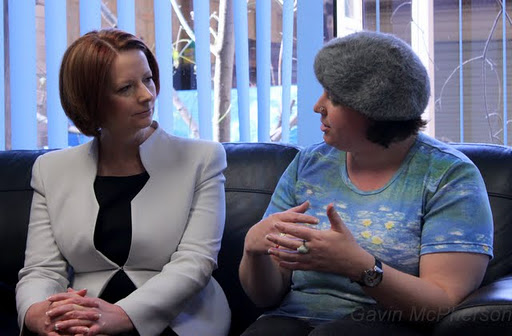
Earlier this year I found myself in the most unexpected position of being invited to talk with the Prime Minister! Ms Gillard and various other Very Important People came to visit MIFSA (Mental Illness Fellowship SA) and have a chat to some of us participants. Someone thought of me and I found myself with an invitation to one of the most nervous and awkward afternoon teas I have ever been a part of! There were a small group of us, sitting in the staff room on the comfy black lounges, with all the media people standing on the other side of the room with very big camera equipment. I kicked off the conversation and talked about how much the PHaMs program had helped me out, and how difficult I’d found things like continuing at university with my mental illness. It was unbelievably nerve wracking, I tend to talk with my hands and I was super anxious that I might wave them about and hit her by accident. She was very down to earth and polite and easy to talk to, with the kind of formal, upright posture that suggested that she too was painfully aware of all the cameras and taking care not to put a foot wrong or scratch her nose or anything.

This experience was quite thrilling, and really launched me into the advocacy and education role I now find myself playing more and more. I’m tremendously appreciative of being given opportunities like this, they’ve increased my confidence and really helped me to believe that I have something to contribute to discussions about mental health.

There’s a really lovely photo of the both of us having a laugh here, (see – no eyes visible!) along with an article about the event. Photo by Gavin McPherson.

Improving the blog

Hullo hullo, those who you who come directly to the blog instead of getting the email feed will have noticed some changes! I’ve been working on some improvements, most especially how the archived blogs are presented. Now you can read all the blog titles for every post in a whole month, instead of having to click on each day to reveal the title. I hope this makes it a bit easier to find whatever it is that you’re interested in – poems, DID info, etc. As the blog is growing I expect I’ll also expand and specify my labels a bit more for the same reasons. New background and bigger font – hopefully makes it all a bit easier to read! I’d like to add a search function to help with navigating the site too, but unfortunately bloggers search box widget isn’t working at the moment. Later hopefully.

For those of you looking for information about DID, another blogger Holly Gray wrote about this topic from a personal perspective for over a year, and has just now decided to wrap her blog up for the moment. You can find her perspective on four factors that can lead to DID here.

Please feel welcome to contact me if there’s something you’re really hoping I’ll blog about. I keep a running sheet of ideas for posts and I can’t promise I’ll get to them fast but I’m very happy to hear from you about what you’re looking for or finding interesting or helpful. Please share any posts with people you think might get some benefit from them too. I’m keeping my ‘What’s On’ page updated, so check there if you’re looking for exhibitions, competitions or other events to be involved in. And I shortly plan to add a ‘To Buy’ page with art and shoes available for sale, and another about my Dissociative Disorder Working Group sharing what we are doing and how people can help out. 🙂
Feedback about all and any of these developments is very welcomed! 

Grounding Kits

Following on from yesterday’s post, Grounding Techniques, developing a grounding kit is the next step where you pull together all the information you’re learning. What’s important about this? One of the big issues with dissociation is being able to retain information. The point at which you’ll really need your grounding techniques is also the point at which you’re least likely to be able to remember any of them, or even the concept. So, the idea of a grounding kit is to find a way to pull together all your effective grounding techniques and have some way of being able to remember them. Some people literally put together a box of things, a bit like the example kit I took into the TheMHS to explain this idea:

I probably wouldn’t recommend keeping the plant in there though…

People dealing with other issues use a kit like this too, I’ve heard of people who experience depression keeping a kit that has a good book, a block of chocolate, birthday cards with uplifting messages in them, that kind of thing.

But, it doesn’t have to be a literal kit, a list of ideas that you keep somewhere safe can be just as helpful. Many voice hearers who come to Sound Minds love this list of strategies and carry them with them so they can refer to it during stressful times. It’s easy to have a bit of a play about with grounding techniques while you’re not feeling so bad, forget about them, and not have anything to draw upon during a difficult episode. So, a grounding kit is the stage 2 of this process that actually makes sure you have something helpful you can do for yourself the next time your dissociation is bad. This is where self awareness becomes self care – learning what you need, and then actually doing it!

There are two key concepts that help make your grounding kit really effective. The first one is that it must be individualised! That means, specially tailored to you. I tried various techniques for years, like the breathing exercises, really frustrated that other people seemed to find them helpful but they didn’t work at all for me! But, I get given them by doctors, recommended them by ACIS, they’re all around. Now, I think a lot more broadly than that, and I’ve been able to share techniques that do work for me with the people who support me. This means that when they’re trying to be helpful at least now they’re recommending things that have a chance of helping me. The more your kit has been specially tailored to you, the better it will work.

No single technique always works every time. This is kind of frustrating, but it’s important to be aware of. The whole point of working out a bunch of techniques is so that you have lots of helpful options to pick from. Don’t give up on a technique the first time it doesn’t work for you. I find, for example, that some techniques work for me with mild to moderate dissociation, but aren’t strong enough to help with severe dissociation. Many of my techniques aren’t something I only do during the bad weeks, they’re things I do regularly because they prevent chronic dissociation from happening in the first place.

Which brings me to the second key concept that makes grounding kits effective. In order to set up a grounding kit, you have to overcome the denial that you have a problem with dissociation in the first place. The middle of an acute dissociative episode is not the ideal time to be reading up on strategies and trying things out. Ideally, you use the times when you are well to set yourself up for the best care possible when you are struggling. Of course, some of us are dealing with chronic issues and don’t really get weeks or months free of symptoms, but the basic premise still applies. Crisis isn’t the ideal time to be trying to work out your grounding techniques! This means that when you are going along doing pretty well, you should put some time into trying different grounding techniques and seeing how they work on mild symptoms. And, as you collect your grounding kit, you can start to share this information with anyone else in your world who could then better support you through rough patches. Trust me, its a lot easier to explain these ideas to someone else when you’re not in the middle of a panic attack, flashback, or acute dissociation!

You can also have a look at what was going on in your life when you are well, and when you are really unwell to work out what your key grounding strategies may be. So, in my instance, I did no art at all during the years of my most severe dissociative symptoms. Now that was partly the result of how much loss of function the dissociation was causing me. But in my case I’ve also discovered that without regular creative activities, I’m much more vulnerable to dissociation. So these days art/writing is much more a priority for me, because I know now that it’s one of the things that keeps me well. I don’t wait until major dissociation kicks in before I pick up a paintbrush or pen. I build these techniques into my everyday life, and as a result I’ve drastically reduced the degree of dissociation I experience.

When I kick into the denial and get blasé about how important these techniques are for my health, I quickly find my stress level and symptom level stepping up. And I’m learning to pay attention to those early warning signs instead of putting my head in the sand until I’m a complete wreck. But it’s hard work in some ways to keep your worst days in mind when you’re feeling good! It’s tempting to stop looking after yourself, to even feel like a bit of a fraud, as if your bad days couldn’t really be that bad, and maybe if you’d just tried a bit harder you could have pulled yourself through without all the fuss. This is pretty common.

It’s part of the nature of mental illness that it’s episodic. For some of us that means months or years where we travel well, for others the ups and downs are more hour by hour. But all of us feel tempted to put the bad days behind us and dash off into the sunset. There’s nothing wrong with that impulse! It’s great to make the most of those good days, and we all need time off from anxiety about our situation and thinking about our mental health! But, making ourselves spend a bit of time putting in some safety nets just on the off chance we have another bad day – that’s often the key difference between people who live well with even severe mental illness, and those who are always being surprised by it, caught unaware and unprepared. And if it turns out you never need it, that your bad days really are gone forever, that’s awesome, no harm done. But, having a safety net in the form of a grounding kit can make the difference between having another bad day and total catastrophe.

My personal library

is quite extensive, but these are some of the books that I’ve found helpful in dealing with a dissociative disorder and recovering from trauma. I make these available to anyone for a refundable deposit. I am constantly adding to this collection, and donations from my wishlist are gratefully received!

If you’re looking for information about multiplicity, I recommend starting with:

  • First Person Plural, Cameron West
  • The Dissociative Identity Disorder Sourcebook, Deborah Haddock
  • Got Parts?, by ATW
  • The Flock, Joan Francis Casey, Lynn Wilson (my review)
More books about multiplicity or dissociation:

  • Treating Dissociative Identity Disorder, Sarah Y. Krakauer
  • A Fractured Mind, Robert B. Oxnam
  • Breaking Free, Herschel Walker
  • Today I’m Alice, Alice Jamieson
  • Fractured, Ruth Dee
  • Rebuilding Shattered Lives, James A. Chu
  • When Rabbit Howls, The Troops for Truddi Chase
  • Little Girl Fly Away, Gene Stone
  • Katherine, It’s Time, Kit Castle and Stefan Bechtel
  • A Life in Pieces, Richerd K. Baer
  • All of Me, Kim Noble
  • Five Farewells, Liz Elliot
  • The Sum of My Parts, Olga R. Trujillo

Books about PTSD, trauma, or abuse recovery:

  • Trauma and Recovery, Judith Herman
  • Treating Attachment Disorders, Karl Heinz Brisch
  • Victims No Longer, Mike Lew
  • Facing the Wolf, Theresa Sheppard Alexander
  • Man’s Search for Meaning, Viktor E Frankl
  • Sickened, Julie Gregory
  • Stalking the Soul, Marie-France Hirigoyen
  • Stepping out of the shadows, published by Yarrow Place
  • Trauma Model Therapy, Colin A Ross
  • New Shoes, Rebecca Mitchell
  • Understanding Trauma, Roger Baker
  • The PTSD Workbook, Mary Beth Williams, Soili Poijula
  • The Courage to Heal, Ellen Bass & Laura Davis
  • Beginning to Heal, Ellen Bass & Laura Davis
  • The Sexual Healing Journey, Wendy Maltz 
  • Re-Authoring Lives: Interviews and Essays, Michael White
Books about voice hearing, psychosis, or schizophrenia:

  • Unshrinking Psychosis, John Watkins
  • The Voice Inside; A practical guide for and about people who hear voices, Paul Baker
  • Working with Voices II; Victim to victor, Ron Coleman & Mike Smith
  • Living with Voices; 50 stories of recovery, Prof Marius Romme, Escher, Dillon, Corstens, Morris
  • Children Hearing Voices; What you need to know and what you can do, Dr Sandra Escher & Prof. Dr. Marius Romme
  • DVD Knowing you, knowing you, Working to Recovery ltd “Eleanor Logden’s personal story of recovery, her journey through the psychiatric system, to becoming an award winning psychologist working in mental health. Eleanor talks candidly about her experience of abuse, self-harm and voice hearing. This DVD is challenging, inspirational and full of hope.”
  • DVD 1st and 2nd World Hearing Voices Congress 2009-2010, Working to Recovery ltd “Voice hearers, mental health workers and family embers from across the world met to share messages of hope and positive action. Presentations focused on important aspects of the recovery process and discussed difficult issues such as the disease concept and the use of medication.”
  • DVD How to Start and Run a Hearing Voices Group, Working to Recovery ltd “Produced to help anyone interested in setting up or running a hearing voices group. The DVD covers a number of issues that will help facilitators and those who wish to become facilitators.”
  • DVD SET Recovery from Psychosis Conference, Perth November 2008
  1. “Hearing Voices and the Complexity of Mental Health Issues from an Aboriginal Perspective” Dr. Helen Milroy (Australia)
  2. “The Personal is Political” Jaqui Dillion (England)
  3. “Hearing Voices with Children” Dr. Sandra Escher (Holland)
  4. “Voice Dialogue” Dr. Dirk Corstens (The Netherlands)
  5. “Understanding Psychosis” John Watkins (Australia)
  6. “Making Recovery Happen: From Rhetoric to Reality” Ron Coleman & Karen Taylor (Scotland)
  7. “Recovery with Voices: A Report on a Study with 50 Recovered Voice Hearers” Prof. Dr. Marius Romme (Holland)
  8. “Recovery from Psychosis: What Helps and What Hinders?” Lyn Mahboub & Mariene Janssen (Australia)
  9. “Working with Voice Hearers in Social Psychiatry” Trevor Eyles (Denmark)
Books more broadly about mental health or life:
  • Love and Survival, Dean Ornish
  • 8 Keys to Recovery from an Eating Disorder, Carolyn Costin & Gwen Schubert Grabb
  • The Yipping Tiger, Perminder Sachdev
  • The Broken Mirror, Katharine A Phillips
  • Follow Your Heart, Andrew Matthews
  • Panic Free, Lynne Freeman
  • Women and Anxiety, Helen DeRosis
  • Journeys with the Black Dog, ed. Tessa Wigney, Kerrie Eyers & Gordon Parker
  • The Art of Being, Constance Rhodes
  • The Brain that Changes Itself, Norman Doidge
  • There’s Something I have to Tell You, Charles Foster
  • Understanding Panic Attacks and Overcoming Fear, Roger Baker
  • Overcoming Borderline Personality Disorder, Valerie Porr
  • The Dance of Intimacy, Harriet Lerner
  • The Dance of Deception, Harriet Lerner
  • Safe People, Cloud and Townsend
  • Who’s Pushing Your Buttons, Dr John Townsend
  • The Magic of Make Believe, Lee Pascoe
  • I just want you to be Happy, Rowe Bennett Tonge
  • Exuberance, Kay Redfield Jamison
  • Women who run with the Wolves, Clarissa Pinkola Estes
  • The Soul’s Code, James Hillman
  • Raising Real People, creating a resilient family, Andrew Fuller
Children’s picture-books:
  • A colour of his own, Leo Lionni
  • My Many Coloured Days, by Dr Seuss

I’ve found something useful in all of these books as I’ve worked on my own recovery journey, but that doesn’t mean I agree with all or even most of the content of some of them. Some of them are useful to me in that they document the older development of certain perspectives in psychology. Some of the older biographies about DID have graphic abuse histories recounted, some books are from a religious perspective, some promote a particular type of therapy, some are quite clinical in their language, others have only the most tangential connection to mental health, so please exercise judgement in choosing what you wish to read, and avoid those that don’t suit you. I’ve been doing pretty widespread research into dissociation, trauma recovery, mental health, abuse, relationships, group dynamics and all sorts for a number of years, and this collection is only the tip of the iceberg. I draw upon ideas, strategies, and interesting theories from many different places to inform my own opinions or cobble together my personal recovery approach. This works well for me, but may not be quite what you had in mind!

It’s been brought to my attention that my wishlist link isn’t always working. Here’s a list of the books in it, I thought may be a useful addition to my library for the group to borrow (in no particular order) if the link isn’t working for you. Most of these books are available at Book Depository.

  • Standing in the Spaces, Philip M Bromberg
  • Depersonalization, Mauricio Sierra
  • Trauma, Dissociation and Multiplicity, Valerie Sinason
  • Attachment, Trauma and Multiplicity, Valerie Sinason
  • Creativity and the Dissociative Patient, Lani Gerity
  • The Happiness Trap, Russ Harris
  • First Person Plural, Stephen E Braude
  • The Haunted Self, Otton Van Der Hart
  • Trauma and Dissociation in a Cross Cultural Perspective, Vedet Sar
  • Awakening the Dreamer, Philip M Bromberg
  • The Minds of Billy Milligan, Daniel Keyes
  • Living with Intensity, Susan Daniels
  • The Trauma Recovery Group, Michaela Mendelsohn
  • Stop Walking on Eggshells, Paul T Mason
  • Cutting, Steven Levenkron
  • Compassion and Self Hate, I Rubin Theodore
  • Parts Psychology, Jay Noricks
  • The Selfish Pigs Guide to Caring, Hugh Marriott
  • Caregiver’s Path to Compassionate Decision Making, Viki Kind
  • Feeling Unreal, Daphne Simeon
  • Overcoming Depersonalization Disorder, Fugen Nerizoglu
  • Somatoform Dissocation, Ellert R S Nijernaus
  • Betrayal Trauma, Jennifer J Freyd
  • The Gifts of Imperfection, Brene Brown
  • 8 Keys to Safe Trauma Recovery, Babette Rothschild
  • Creating Resilient Families, Andrew Fuller
  • Finding Flow, Mihaly Csikszentmihalyi
  • Dialogues with Forgotten Voices, Harvey L Schwartz
  • The Dissociative Mind, Elizabeth F Howell
  • Understanding and Treating Dissociative Identity Disorder, Elizabeth F Howell
  • Healing the Divided Self, Maggie Phillips
  • The Sum of My Parts, Olga Trujillo
  • Coming Present, Caroline Lighthouse
  • The Plural Self, John Rowan
  • Trauma and the Avoidant Client, Robert T Muller
  • Skills Training Manual for Treating Borderline Personality Disorder, Marsha M Linehan
  • Sexual Orientation and Mental Health, Allen M Omoto
  • Identity, Erik H Erikson
  • The Gift of Fear, Gavin de Becker
  • Internal Family Systems Therapy, Richard C Schwartz
  • Trauma and Dreams, Deidre Barrett
  • The Complete Facilitator’s Handbook, John Heron
  • Unformulated Experience, Stern
  • The Body Remembers, Babette Rothschild
  • The Body Remembers Casebook, Babette Rosthchild
  • Feeling Unreal (Depersonalisation) My Cure!, Steven Batt
  • Beyond Integration, Doris Bryant
  • The Family Inside, Doris Bryant
  • Non-Violent Communication, A Language of Life, Marshall B Rosenberg
  • The Courage to Heal, Ellen Bass
  • Not Otherwise Specified, Leah Peah

If you have any other suggestions, please let me know!

Grounding Techniques

Are ways people manage all kinds of mental health issues. I’ve come across the idea of grounding and being grounded in all kinds of mental health literature, recovering from trauma, handling addictions, managing anxiety, and dealing with self harm issues. It’s an idea that is especially appropriate for people struggling with dissociation of any kind. In this context, a grounding technique is anything you do that helps to reduce your dissociative symptoms. In my experience, anyone who’s been dealing with dissociation for awhile has come up with a few strategies that help them to manage it. They might not always work, or be discrete enough to use in public, and sometimes they can be self-destructive, but if they reduce dissociation for us, we’ll give them a go. It can be really useful to spend some time thinking about what you already use when your dissociation is bad. Do you find mindfulness helpful? Do you look to spend some time with a friend? Do you find regular exercise helps keep you on track?

Everyone is different and people react completely differently to grounding techniques. What is helpful for one person may not work for another, or may even make their dissociation worse! Learning more about yourself and what works for you can make a huge difference in being able to manage your condition and improve your quality of life. This can be a bit of a trial and error process, and at times frustrating especially if you’re trying things other people find helpful that aren’t working for you. So, putting some thought into what you already do that helps can give you a bit of a foundation to work from.

Grounding techniques fall into one or more of a number of categories, and these can make it easier to work out what approaches you tend to respond most to.

  1. Calming – you can find a lot of these techniques in literature about managing anxiety and recovering from trauma. Calming techniques are things like going on a gentle walk, listening to soothing music, doing breathing exercises or yoga, giving your cat a cuddle. Dissociation is often a reaction to feeling stressed and unsafe. Calming techniques work by settling you down so that your stress level goes down, and with it the degree of dissociation.
  2. Intense – some of the self help literature about managing self harm issues have some great suggestions about intense grounding techniques. Intense techniques include things like strong tastes, holding onto ice cubes or taking cold showers, a hard workout at the gym, screaming into a pillow, listening to loud music. Intense techniques work by reaching through the dissociation to reconnect you to your body, feelings, and environment.
  3. Physical – some techniques are about affecting your physical body, a warm soothing bath, the texture of your dog’s soft fur under your hand, grass on the soles of your feet, guitar strings under your fingers. They help to anchor you back in your body and connect you to the environment around you. They can be either calming or intense.
  4. Emotional – these techniques work on an emotional level, they can also be calming or intense. Hugging a stuffed toy that calms you, holding onto a bracelet that your grandma gave you, writing in a journal, watching a film that really moves you, painting your nightmares.
  5. Intellectual – these techniques engage your mind to access information that helps to orient you in the here and now. Examples are asking yourself and answering questions such as “Where am I right now? Who is here in this space with me? What year is it? What can I see, hear, feel, smell around me?” These can be really helpful if you are having trouble with flashbacks or that spacey kind of disorientation where you get confused about what’s happening now and what are memories.

Many grounding techniques work on more than one of these levels – like playing with your dog – it’s physically and emotionally engaging, and if you run around the park and then collapse for a rest it’s both intense and then calming. Sometimes it’s these kind of techniques that affect us on many different levels that are the most powerful. There’s nothing in my world quite as grounding as a lap full of kittens!

So, to give you some examples of what I find helpful, I rarely use intellectual grounding for myself. I do find it useful when waking up sometimes from long complex dreams where I can get disoriented about where reality left off and dreams began. Apart from that, it almost never appears in my repertoire. I’ve found that intense techniques are where I tend to gravitate. Some of the calming techniques, like breathing exercises, actually make my dissociation worse. Whereas I’ve used freezing cold showers to snap out of really bad dissociative episodes quite effectively. Creativity is also really critical for me, I keep journals and basically talk to myself in them. I use them to connect to my feelings and express thoughts and fears that otherwise just knot up inside me. This emotional connection with myself helps a lot to reduce my dissociation. It’s basically a way of telling myself that I’m listening and I care – which is pretty important to make time to do when often you’re getting through your day by ignoring, denying, suppressing, and downplaying your symptoms and feelings. 

Some techniques are much easier to use in public than others, and it’s a good idea to experiment until you find a bunch that are helpful. For example, I use strong tastes a lot. I’ll often order a bitter flavoured drink, something carbonated, or a meal with a vinegar salad or salty olives. Obviously, it helps that I actually like most of these things! But the bitter drinks I didn’t used to like much at all, I just found that the intense flavour helped keep me grounded. Now, they’ve grown on me. 

Another discrete one for me is wearing perfume. I get bothered by strange smells, and at times I hallucinate strange smells simply as a response to feeling really stressed. So, being able to lift my wrist to my face and smell something that is familiar and soothing can be really helpful. 

When sitting down, you can deliberately push your feet into the floor to feel the ground beneath them. When I’m wearing flats, I’ll often slip them off under the table or desk, and rub my soles along the carpet, the sensation is grounding. 

I mentioned self-destructive grounding techniques before – some of us discover by accident that pain can be very grounding, and if we’re prone to dissociation, we may turn to self harm to try and manage it. Obviously, there are many other reasons people self harm, different needs and beliefs that can drive that behaviour. But, this can be one of them, and if it’s that way for you, I’d suggest that you consider some other techniques and see if you can finding something not harmful that also works for you. Sometimes other intense, physical techniques can replace self harming as a way of grounding.

As overwhelming and totally out of your control as it can feel to experience chronic severe dissociation, you can learn to manage it sufficiently to keep safe, feel alive, and get to do things you love. At the outset you may feel totally in the dark, nothing makes sense, your symptoms appear and subside without warning and you are always fighting just to be here. Take a breath. Accept what is going on, and start to investigate it. Knowledge is power, self awareness will give you the keys to better predict, manage and cope with dissociation. You will in time learn what triggers your dissociation, and what your key grounding techniques are that keep your feet on the ground. It may take time, but you will make sense of it and put together your own personal grounding kit, and that puts you back in the driver’s seat.

Things to get involved in :)

Hullo all, well I have a pile of mail inviting me to various exciting events associated with Mental Health Week which is coming up very soon – Sunday Oct 9th to Saturday Oct 15th, with world Mental Health Day falling on Monday Oct 10th. Which I have just realised I have scheduled a dental appt on. Hmmm.

Anyway. You’ve been invited to a ‘Words Evening’ to announce the winners of the ‘Open Your Mind’ poetry competition and the book launch for ‘Mindfields’, an anthology collected from the competition over the past few years. 

There’s also two art exhibitions coming up by Big Circle Arts – which is run by the Mental Health Coalition of SA, aiming to bring awareness of mental health issues in the community through art. One is for established artists, and the other is for emerging artists – which I have a work in! Do consider coming along to the big night with me!

Mindshare is going to be launched shortly also, it’s a new blog for creativity and mental health. Follow the link to see a great little video about the project. I’ve put myself forward to be involved in the project, and apparently sometime soon I’ll be interviewed by someone from my local Messenger newspaper as part of a series of articles they are putting out to promote Mindshare and raise awareness about mental health. 🙂 They are currently looking for submissions for Mindshare – please consider sending something in! They are seeking short stories, poetry, photographs of artworks, photography as art, original musical recordings, information about mental health services, and people interested in becoming bloggers for the site!


And lastly for all you other artists out there who identify as living with a disability of some kind, the ebullient Caroline Ellison would love to hear from you! I spent a thoroughly enjoyable afternoon being interviewed by her over a scrumptious lunch on Wednesday, pontificating about the meaning of art and the frustrating limitations to the kinds of support offered people with disabilities. She’s Senior Lecturer for the Disability and Community Inclusion Faculty of Health Sciences at Flinders University, and is researching the role that art and creativity can play in the life of a person with a disability. So do please get in touch with her to be involved, her details are:
caroline.ellison@flinders.edu.au
(08) 8201 3422

Further details of all of these events and more are available on my What’s On page at the top of this blog. 🙂

Finished paper!

Oh man I am sooo tired! We finished and submitted our 3,000 word paper, Grounding as Management of Dissociative Experiences tonight and emailed it in. I was up til 2am working on it and Cary got up at 5am to continue, very short of sleep the last few nights! It would be awesome if it gets accepted for publication, but I’m pretty proud of our efforts even if it doesn’t. I’d have loved a few more days to polish and nit pick, but to pull it all together in such a short time frame is fantastic.

Frustratingly, I found out this afternoon that my next TAFE subject is being started a fortnight early – tonight! But I’m running too short of food, sleep and down time to be driving home safely after tacking a whole evening at TAFE onto my day. Very annoyed to be missing it, it’s Small Object Making (kind of sculpture in miniature). Being sensible at home with a bowl of soup and some painkillers instead.

Poem – darkness behind my eyes


darkness behind my eyes
I know you can smell it
can see the taint in me
the freshly turned earth
new graves
for dead hopes
I’m trying
to hide it
to fit in
to protect you
I do my best
to follow the script
to make you comfortable
to show no scars
but
in my mouth
beneath
all my words
is a scream
and under
my platitudes
a raging despair
I reassure you
I’m doing okay
but tonight
I want
to claw
the nightmares
from my brain.


Writing a paper!

Cary and I are still frantically working on our paper – due tomorrow. We had a last minute re think and decided to change the category and double the word count. I’ve just got home from MIFSA now, and that’s simply because a packet of gummi snakes from the vending machine can only keep me going for so long. So I’ve come home for my staple working-late dinner – tinned soup. We’ve got about 3,400 words, to be edited back to 3,000, and we’re still at that point where not all the sentences end, and random words such as “iatrogenic” are standing in for entire paragraphs. All good so far!

In other news, my car is running again, and the hot water service has been given a stern talking to and is limping along albeit leaking about 1/2 litre an hour… not ideal, but warm showers are back on the menu. 

Radio Adelaide Interview

So, yesterday I trundled down to Radio Adelaide to be interviewed by the fun and funky Nikki Marcel. The HCA arranged a number of these, to be edited and aired during Mental Health Week. The idea is to interview some folks like me with mental illnesses as part of working to reduce stigma in the community. So, I was quite excited and a bit nervous. Interviews make me quite a lot more anxious than writing, because I’m not the one asking the questions! Plus, the think-on-your-feet factor. Well, it went well! I took in a favourite song, and talked about why I chose it and what it means to me. Nikki had actually come here and read parts of my blog so she asked questions about various of my projects and pet passions. I sped right up like I do when I’m nervous or excited and talked a mile a minute. And even then, we still managed to turn a 7 minute interview into a 15 minute one. Whoops! Good fun for the editor to prune down, that one. That’s because answering questions about recovery from mental illness or the difficulty of managing invisible disabilities in a very very short amount of time is not something I’m good at! But I think I did a good job, hopefully they’ll tell me when it’s airing and I’ll let you know. 🙂

Actually, getting involved in community radio is something I’ve been thinking about for awhile. So I took the opportunity to have a chat about that and have signed up for some training there next year. 😀 I think it could be a great opportunity to meet some new people, learn some exciting new skills, and continue to find fun and creative ways to get good messages about mental health out there. Because I have so much spare time on my hands…

In other developments, I was very politely asked if I have any other profile pictures for an event I’ll be in shortly. I’ve been using the one posted on my About Sarah page because it is a) recent b) close up c) has a nice plain background and d) just me in it and I’m actually all done up with nice hair etc. Why is it people get cameras out on the days I’m lazing about in my PJ’s? But, you can’t really see my eyes, and I was asked if I had any others. This is a persistent problem for me. Everyone’s eyes close up a bit when they are giving a genuine, happy, you-just-tickled-my-funnybone, pleased to be alive smile – as opposed to the kinds we give for photographs and in job interviews, where we flash teeth in a kind of grimace. Some of us however, have eyes that vanish entirely when we’re feeling happy, pop inside the head for a quick cup of tea and a scone. Honestly, if I ever won the lottery I probably wouldn’t be able to see at all for weeks! Well, actually I guess that might not just be me… But yes, in my case, you get eyes or teeth, but not both at the same time!

Isn’t it strange the kind of odd requests you have to try and be prepared for when you’re building a career out of nothing? When and how would someone like me, on my income, have a bunch of appropriate recent profile pictures? I don’t know, life is a strange and marvellous thing. So, I went through the last few years photos looking for anything remotely suitable, and sent out a couple that might be. And, because I was feeling tickled by the query, then I sent in this one from New Years Eve a couple of years back:

No news yet on which picture they’ll use. 🙂 You can see my eyes though! (and, this was taken at the end of the night – my facepaint held up really well! Black lippy instead of paint next time though)

New happy shoes!

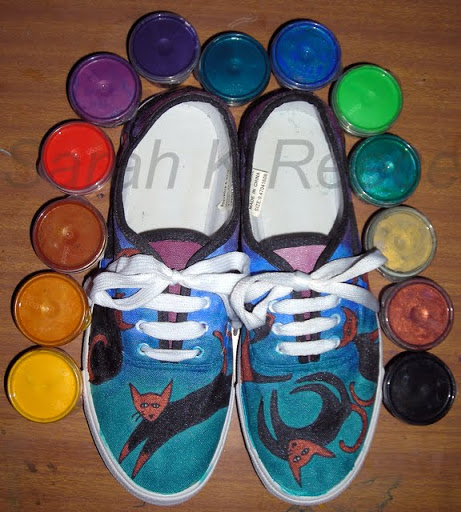
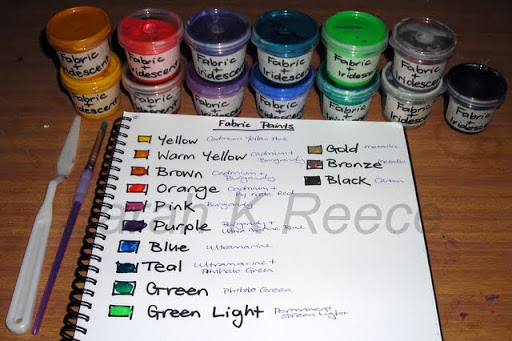
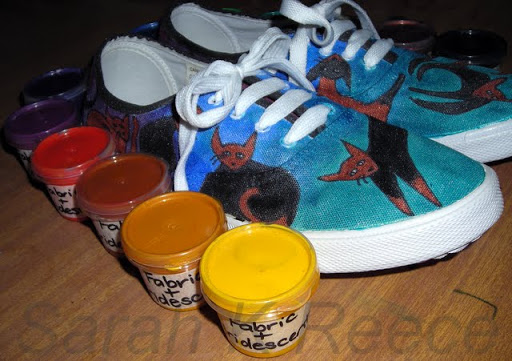
Last night I spent some time mixing up my fabric paints. I use the Derivan Matisse range of acrylic paints, and add a Fabric Medium to convert them to heat set, water-fast fabric paints. I also add an Iridescent Medium to make them sparkly and tweak the consistency with water and Acrylic Medium to get it all just right for painting shoes. And then mix a range of in-between colours so that I can paint the blends blue-teal-dark green-mid green-light green for example. 🙂 Mixing the teal from the blue and the dark green I use means the teal matches these two just right and all the colours harmonise. It’s a bit of a time consuming process though, and you need everything properly labelled and and a chart detailing what colours were mixed so that you can replicate the process when you need more. Man, does this cut down on the frustration factor later on when you’re trying to colour match that purple and can’t remember which pink or red or blue it contained and in what quantities. Preparation saves a  lot of fuss later!

It was also very soothing. I was surprised how much I enjoyed myself just sorting out my materials even though I didn’t get to any painting yesterday. Seeing all those lovely tubs of sparkly paint lined up on my art table and waiting for me just gave me a happy buzz and definitely capped off a stressful weekend in a good way.

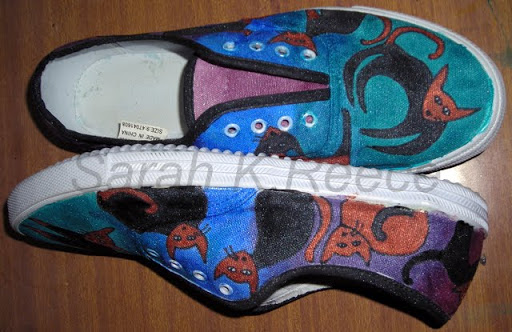
Today, I got back to my shoes – did some humming and aahing about what colour to paint my cats on these… silver and black? yellow and orange? decided in the end on bronze and black, nice contrast to the teal without being garish. Aren’t they gorgeous! I love them!

I can’t wait to paint more! It’s quite fiddly, takes me several hours per pair from start to finish, and that’s not being too stressed about going over a line here or there. I don’t want them to look ‘factory finished’, I like a product that looks great but clearly hand made. That’s one of the things I love about bead embroidery – to my knowledge no one can yet do this on a machine. So whenever you see beads sewn to something, you know a person did that with needle and thread.

Look at all my lovely fabric paints!

The best part of all? After allowing these to dry and heat setting them, I then put them through a whole wash cycle in my washing machine, and nearly died waiting to find out how water fast they are… the result? Completely! Apart from being wet and crumpled, they looked the same coming out they did going in. The paint has held up completely. So no worries walking in the rain in these babies. I’m not promising anything about hot water because I’m thrifty and only ever wash my clothes in cold water. Plus by the time it’s raining hot rain you have bigger problems than the paint on your shoes!

I’ll shortly be putting up a new page that will tell you how to arrange buying a pair for yourself, once I’ve worked out the details. 🙂

3am adventures…

Hmmm. So it appears the universe didn’t get my memo about the planned weekend off to relax… at 3am this morning I was on the phone to the emergency plumber as our hot water system was gushing litres of hot water down the drain and steam was pouring off the unit. The really depressing thing is that a faint noise had been bothering me for hours, which turned out to have been the sound of water gurgling down our outside drain. Wish I’d investigated that sooner! Thought it was my computer humming (one of the fans is pretty noisy). So, it turns out that the whole system is apparently probably dead. If we’re really lucky, perhaps just some valves and suchlike. But probably the whole sheebang. I wonder if it’s responsible for our inexplicably increasing gas bills?

So, I was trundling round the property in the dark in my dressing gown, getting snagged on rose bushes and strange spiky plants the previous owner for some incomprehensible reason of his own had decided to plant all around the hot water system and the electricity meter box. Maybe he really disliked the meter man? My little torch running low on batteries, and the helpful plumber – who didn’t even sound sleepy, giving me instructions on how to shut down the system and close off our water. There are various taps attached to the heater and none of them are moving a micron for me. In the end I pulled the front off the whole unit and turned it down so low it turned off. We are now without hot water until we get a plumber out here – going to making calls first thing on Monday.

And my car isn’t drivable until the heating hoses have been replaced and the alternator fixed. The van is even more expensive, the head needs to be taken off and seals replaced and piston checked for corrosion and possibly replaced.

Weeks like this really make you rethink career decisions like “I’m going to be an artist”!

So, what have I done to manage the situation so far? I have walked to our nearest shops with my trolley and bought food for the week, and hauled it all uphill back home. My cunning plan is that whatever other money I spend repairing things, we have stuff to eat, cat food, and plenty of toilet paper. Much else in life can be temporarily lived without – even hot showers, but it helps to be stocked up on the essentials! Otherwise by day four, you and the pets start eyeing each other in a calculating kind of way…