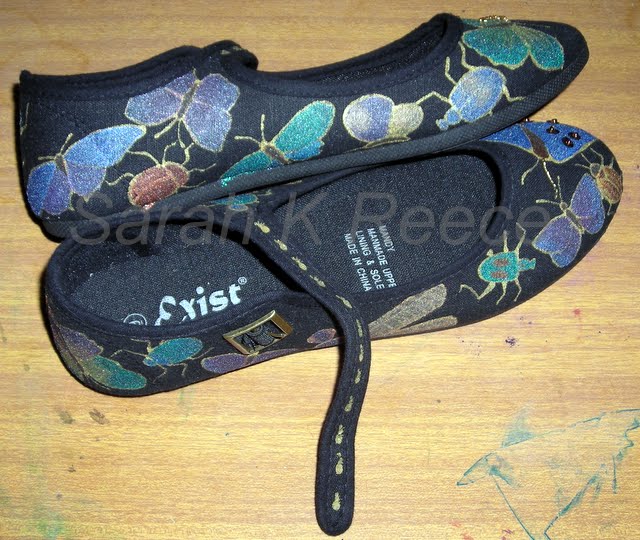
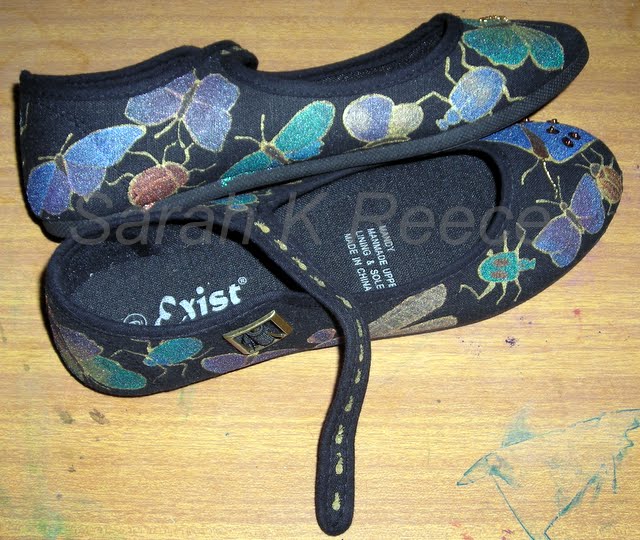
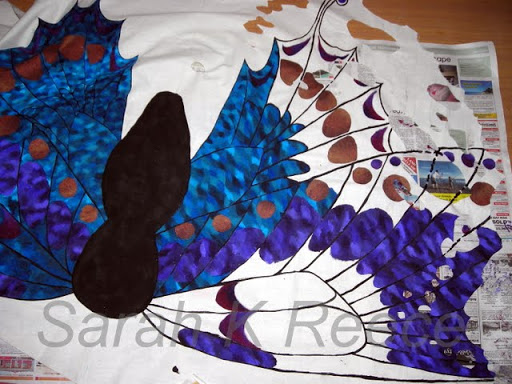
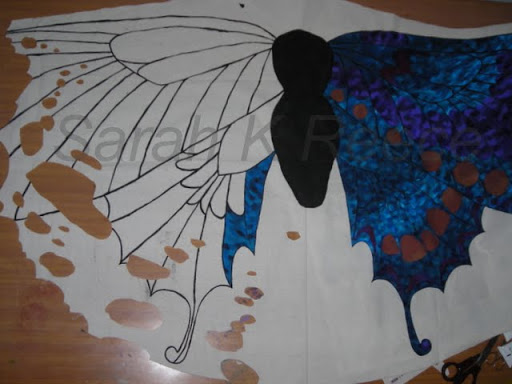
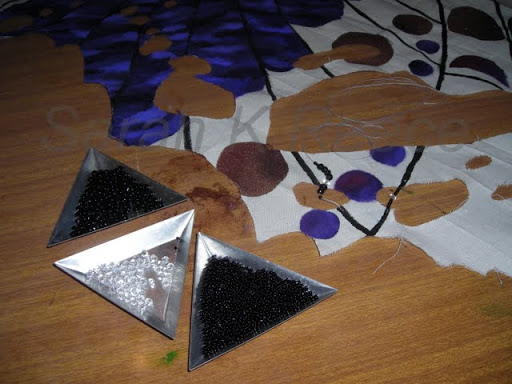
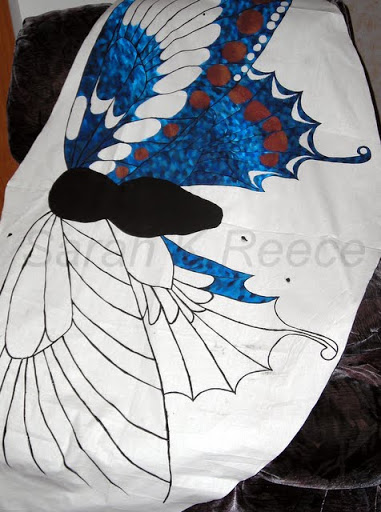
Completed butterfly shoes

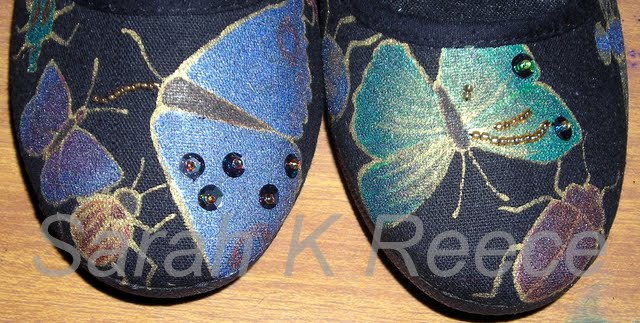
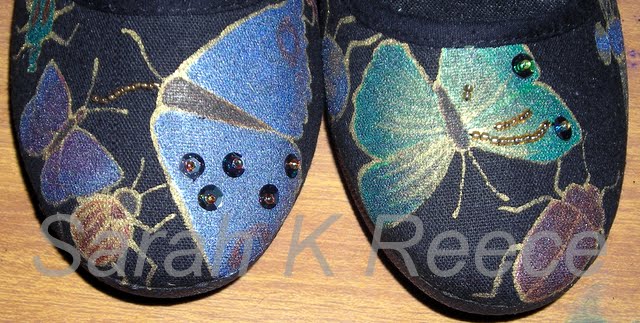
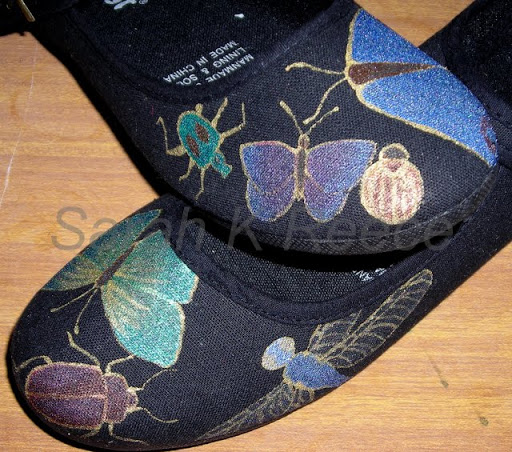
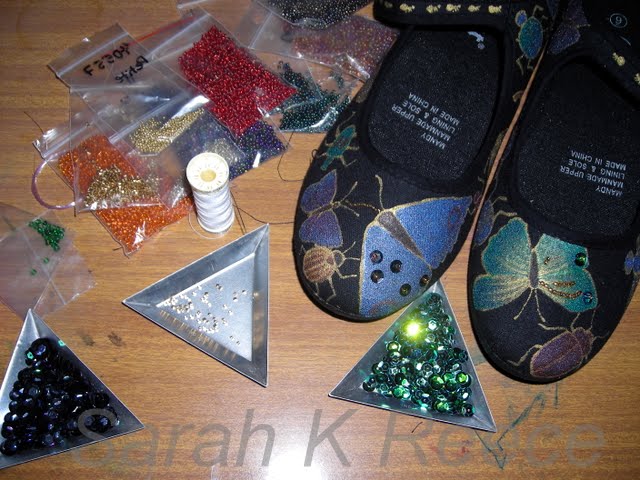
I’ve finished my second pair of painted shoes tonight! These ones have a few beads and sequins added for a little extra sparkle. I must get a thimble, I have holes in my finger tips from pushing the beading needle through the heavy shoe canvas.

I’m very pleased with the result, although I prefer painting on the white canvas, as the colours as brighter and easier to control.

And a close-up of the toes:

So there. I’m going to submit these for display in the ‘Celebration of Life Exhibition’, which showcases the lives of carers like myself. It will be open from the 4th to the 13th of October, with an official opening on the morning of the 7th. For more details, please see my What’s On page at the top of this blog. 🙂 

Tafe Pendant

This post the third in a five part series. To see the earlier posts, click on
1.Starting up at Tafe again
2.Tafe Jewellery Fundamentals

Sooo, jewellery making is going really well! I’ve been playing about coming up with a million different designs and holding off making anything until I found one that really inspired me. I trekked in and bought as much silver as my budget can take this week:

That’s 1mm thick and costs $35. The matchstick is there to show you the size. Silver is expensive at the moment! Smaller, finer pendants are actually trickier than larger ones where holes are large enough to fit a needle file for finishing and so forth. So I’ve really had to think hard about how I’m going to come with something I love enough to justify the time and cost put into it, that isn’t so intricate and insanely complex that I’d be in the studio every day of the week trying to get it done in time.

I narrowed my selection down to three possibilities, a two tone sleeping cat, a jellyfish with dangling legs, and a hammered rose petal.

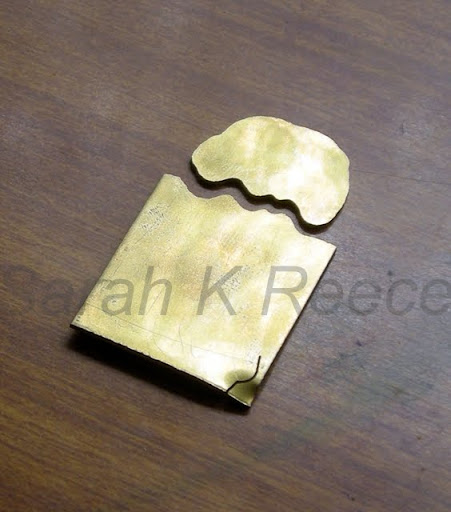
I started brass practice versions of each. Here’s the jellyfish mock-up partly cut out:

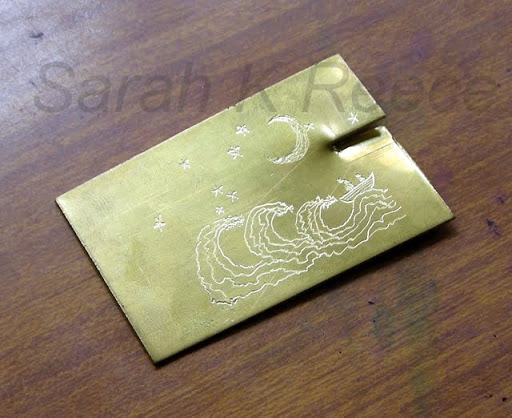
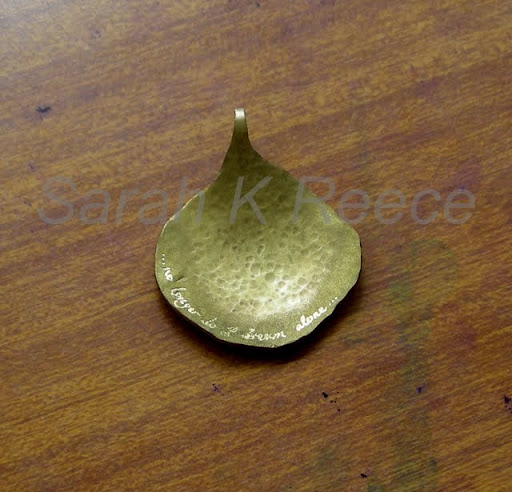
I’ve been experimenting with different surfaces to see what I like the best. The hammered surface is really lovely, it has a handmade feel which is much more my style. I also had a play with an engraver for the first time, and fell in love with it! Here’s my first try, a tiny sea scape:

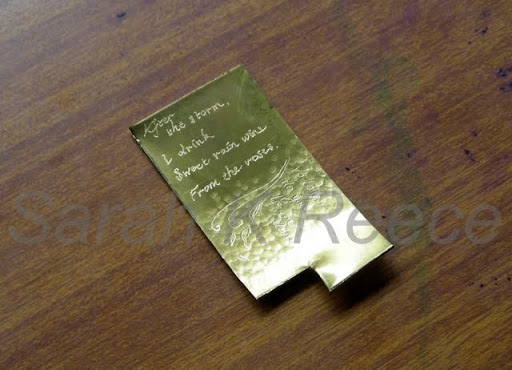
Then I tried text, as it’s much more important to be able to get that exact so it’s readable.

Pretty happy with that! Next, seeing how it turns out using a couple of different backgrounds as contrast. Here is engraving on a hammered background:

Here it is on a sandblasted background:

I was stoked at how well this turned out! Then I tried an even finer engraving tool:

Before playing with my rose petal mock up:

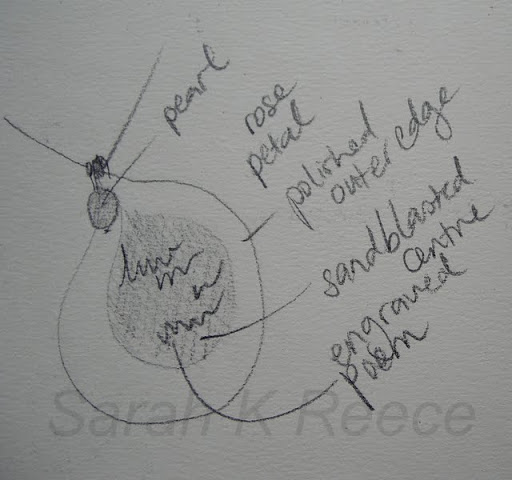
Which I am pretty happy with! So my final project is now to make a hand beaten and shaped rose petal from the silver, twist a loop at the top, engrave it with a line of poetry, and string it with a pearl. That’s a piece I’ll be happy to keep and wear forever. 🙂

To see the next step, read here.

Tafe Jewellery Fundamentals

We’re over halfway through my TAFE class now and I’ve been putting in some hours to catch up a bit. (catch up on my first class here) All the other projects on the go at this time of year – Mental Health Week and TheMHS – have been a bit of a distraction. But I’m making progress. Here’s the first three mini projects all done and ready for assessment:

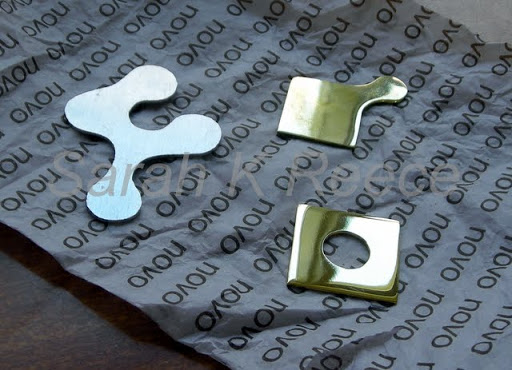
The dull looking silver one is aluminium, and was practice for hand cutting skills. The shiny ones are brass, we’ve scored the design onto the surface, cut, filed, emery-ed, polished and cleaned. I’ve been told that they are fine for a beginner.

It’s funny, jewellery making can on the one hand be quite organic and experimental. On the other it can have the kind of insane precision a clockmaker needs. Lots of maths and right angles and things that need to fit exactly. That aspect of it I’m not so keen on. I’m not that big a fan of modern minimalist jewellery, I quite like the handmade look where the angles aren’t exact or there’s hammer marks or other small imperfections. That’s not to say that I don’t admire the time and craftsmanship that goes into a bowl polished to a mirror shine with exactly the same thickness of metal at every point, I just can’t see myself spending my career doing it. But the organic, the bizarre, the experimental, the art nouveau… now that has appeal. I would love a jewellery workshop in my shed. The material costs are prohibitive however! The cost just for the silver for this project is about $50.

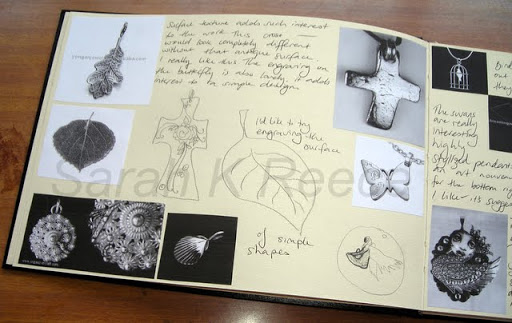
So, now I move onto the next piece which must be my own design, may be riveted but not soldered, must be a pendant, and must contain at least one polished surface. We are also being assessed on a studio journal so I’ve been putting some time into that:

I asked about using other sources of metal and I’ve been given permission to use old silver spoons if I can find any, genuine silver only though, not silver plated nickel as that’s a common skin irritant. Hmmm, always looking for the recycle option…

See what I made at my next class here.

The kite is complete

This post is the last of eight, showing this artwork develop from start to finish. See the first parts:
1. Mental Health Week Exhibition
2. Progress…
3. Painting painting
4. The kite progresses…
5. Theatre and kites
6. Wood carving
7. Finishing the kite and an Award!

At last, she is all done and ready to go. The really good news is that Big Circle Arts extended their deadline until this Friday – so she’s going to make it in! This also means I can get down to the TAFE homework I’m supposed to be doing. 🙂

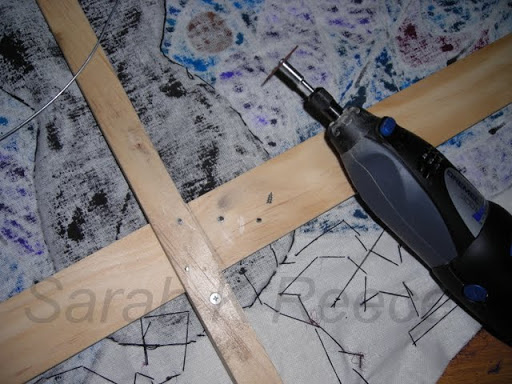
The finishing was a little tricky and time consuming – which is usually the case. It’s not the most exciting part of making art but it’s important to do a good job or you let the whole piece down. I cut off the sharp ends of protruding screws with my trusty little Dremel (I love this tool!), then dabbed them with a little hot glue to remove any chance of scratching a wall when the kite is hung for display.

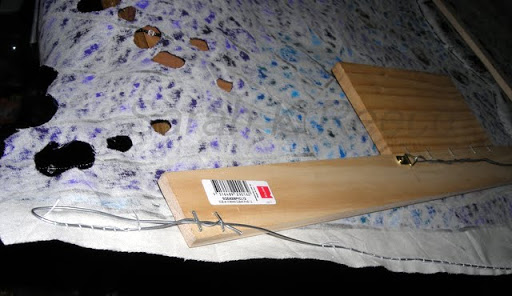
I also added a piece of wood to the shorter kite arm to balance the work so that it will hang straight from the centre. I added the wire to hang it from and also strung an additional line of wire across the top edge of the kite and sewed the kite to it to give it strength and prevent it folding over. This was fiddly but I’m happy with the end result.

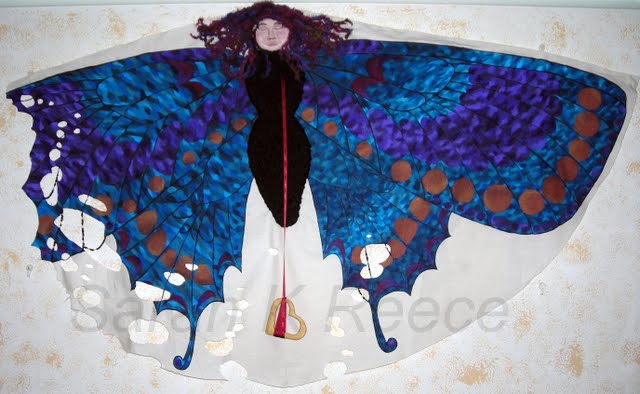
And here she is at last, a bit bruised and tattered, but beautiful nonetheless:

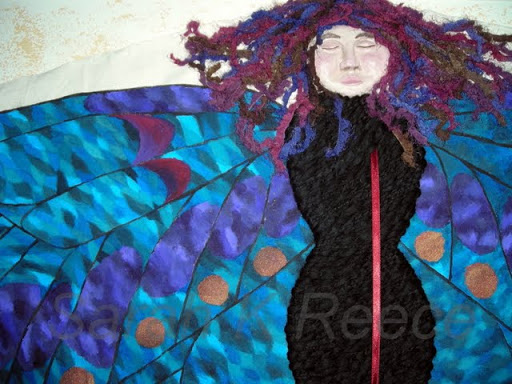
As you can see I decided the right wing needed a few holes and little embroidery also for balance. And here is a close of up of her face, all nestled in hair now:

So now I can rest easy. What a huge project this has been! I conceived of the idea, planned all the details and purchased all the supplies more than a year ago and have since carried the folded partly painted fabric and the bag of materials and backup work around with me through all kinds of upheaval and two house moves. It is most satisfying to have her finished at last and ready to go on display. May there be many, many more to come!

Finishing the kite and an Award!

This post is the seventh of eight, showing this artwork develop from start to finish. See the first parts:
1. Mental Health Week Exhibition
2. Progress…
3. Painting painting
4. The kite progresses…
5. Theatre and kites
6. Wood carving

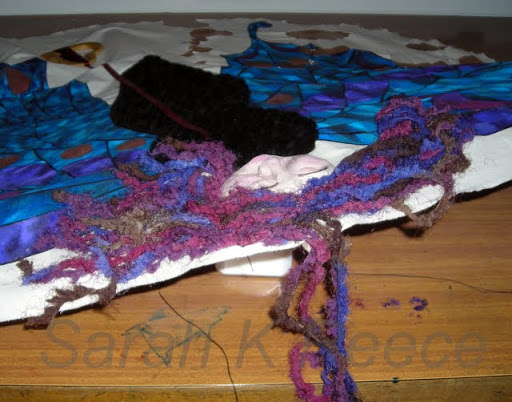
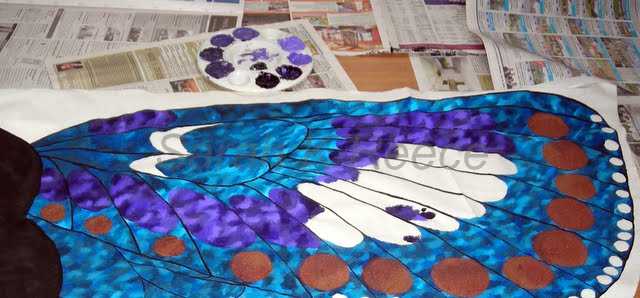
My kite is nearly done now. I’ve finished the butterfly body and now I’m stitching in the hair. Here she is propped up on a pot of paint so I can reach underneath to stitch.

And here you can see I’ve finished half of the hair. Doesn’t she look so much more feminine now? 🙂 I brought the yarn with all the other supplies before I started any painting, so the colours match well.

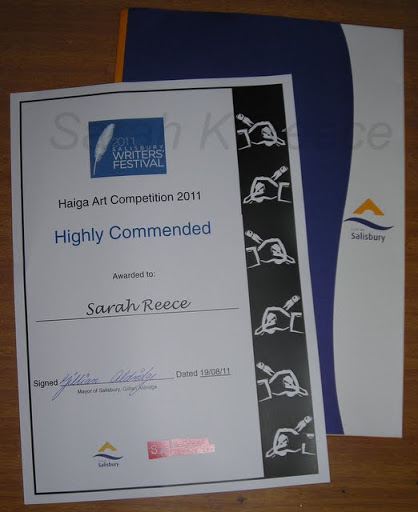
And lastly, something nice came in the post, my certificate for one of my haiga, that received a highly commended in the Salisbury Writer’s Festival competition. I’m pretty pleased about this considering it was my first haiku and my first haiga:

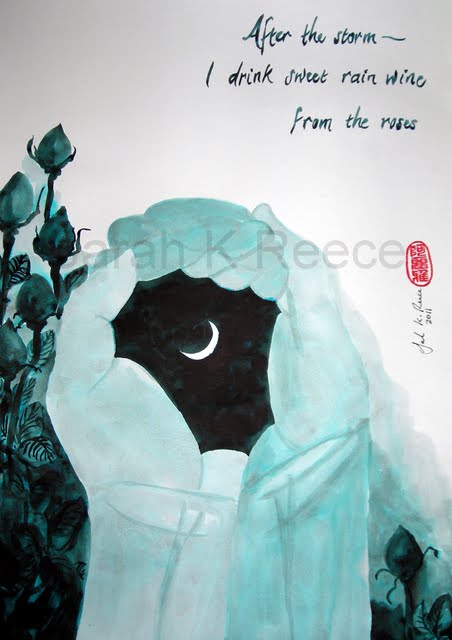
And here is the haiga:

See the finished kite here!

Wood carving

This post is the sixth of eight, showing this artwork develop from start to finish. See the first parts:
1. Mental Health Week Exhibition
2. Progress…
3. Painting painting
4. The kite progresses…
5. Theatre and kites

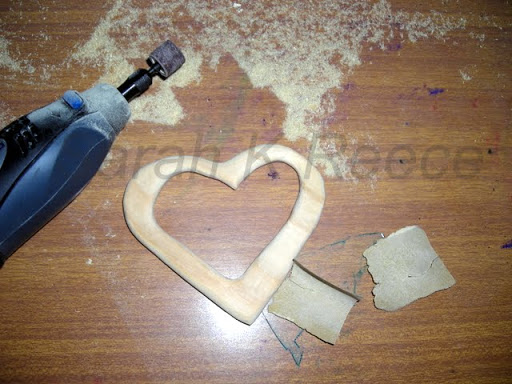
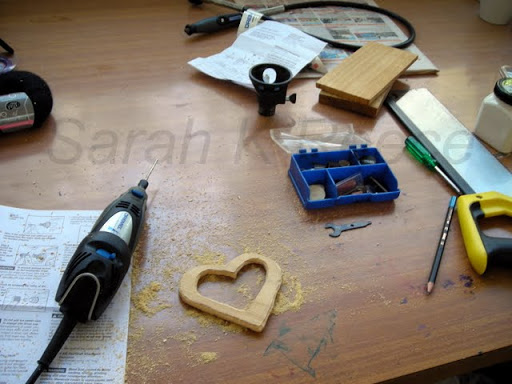
I like it just as much as I thought I would! Here’s my heart kite handle, being shaped by further sanding. I used the coarse then fine sander on the Dremel, then finished with extra fine grain sand paper by hand.

Finely sanded wood has the most lovely feel, very soft to the touch. Most tactile, I just want to hold it and turn it over and over in my hands. I finished it by giving it a light polish with a beeswax product. Doesn’t it bring out that gorgeous golden colour!

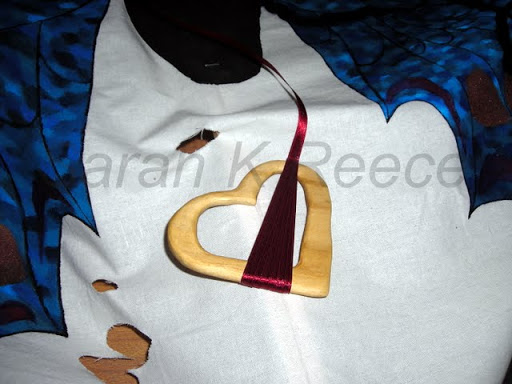
And then attached it to the kite with double sided red satin ribbon, the other end of the ‘string’ is coming from her chest, where her heart would be.

And this, ladles and gentlespoons, is why we are not supposed to use even tiny little power tools in the house:

The mess!

See the next step here.

Theatre and kites

This post is the fifth of eight, showing this artwork develop from start to finish. See the first parts:
1. Mental Health Week Exhibition
2. Progress…
3. Painting painting
4. The kite progresses…

Tonight I went to see a play Also a Mirror, by Urban Myth Theatre of Youth. It’s been far too long since I’ve been in a theatre. I enjoyed it immensely. It explored memory and the loss of memory in a lyrical poetic way. I’m sure some members of the audience have a personal connection to Alzheimer’s or Dementia, and for them the celebration of love, and the anguish of such personal losses cut deep. I saw more than one person in tears at the bittersweet end. It was very beautiful. So, if you are looking for something to do over the weekend, I’d recommend a night at the theatre. Details here.

My kite is coming along really well, I’m on track for finishing the whole project very soon! Here she is:

And I’ve been working on the kite handle:

That was a flat piece of pine just like those on the right hand side when I started. Whee! I’ve always wanted to get into wood carving. The tool is a Dremel, an awesome little multipurpose hobbist machine. The body is a motor, and you can add all kinds of attachments, cutting, grinding, sanding, engraving etc. You can work with woods, metals, plastics, ceramics, glass… I love it! Just the thing to distract me from fretting about Abbie. I went to Bunnings the evening I had to leave Abbie at the vet, planning to buy various hand tools to cut and carve the kite handle. But I realised that the price of all the tools I needed individually was comparable to the price of this awesome set where I get many many tools and the speed to produce work very quickly. So I brought home the Dremel instead, then watched a few youtube videos about how to use it. Youtube is a fountain of skills based knowledge and every craftperson’s friend! Here I’ve carved and shaped my heart handle, next to sand and polish it. The kite just needs the body finished being embroidered with black yarn, the string and tail attached, the hanger and counterweight at the back, and her hair sewn on. Almost there! 🙂
See the next step here!

Competitions and Resources

Just a reminder – the Open Your Mind Poetry Competition is on again this year, accepting entries until Sept 9th. I’ve been invited to be one of the speakers at the ceremony announcing the winners later this year. 🙂 For more details about that, see my new Upcoming Events page.


The competition is run by the Mental Health Coalition of SA, who are also the awesome and very busy people running the Big Circle Arts Collective, arranging the Mental Health Week art exhibitions and the TheMHS exhibition, and setting up Mind Share – which will be an online blogging community, showcasing creative projects with mental health information and resources. You can still submit art, poems, and short stories to them, or offer to become a regular blogger. As you can see, I love all their projects and jump in with nearly everything they run!


The other folks behind the Open Your Mind poetry competition are the SA Writers Centre who host the event. I went for a visit the other day and met up with the absolutely lovely Jude Aquilina to ask for publishing advice about my various presentations and projects. I am working on converting some of these into a printed form and trying to decide between various publishing opportunities. Jude was very encouraging! If you are also inclined in the literary area, I highly recommend introducing yourself to this wonderful resource. They have a regular newsletter full of information, competitions, opportunities and advice. 

The kite progresses…

This post is the fourth of eight, showing this artwork develop from start to finish. See the first parts:
1. Mental Health Week Exhibition
2. Progress…
3. Painting painting

Making major progress on the kite. I’ve finished painting all the blue areas at last!

I’m so glad that part’s done with! And here is why it took so long:

See that tiny brush? Yes. Lesson for next time – use a bigger brush! In the middle is my old palette which I used to colour match exactly my new palette of blues. I keep these for weeks by misting them with water and wrapping them in cling wrap. Next, painting my PMC face, takes a few layers for good coverage.

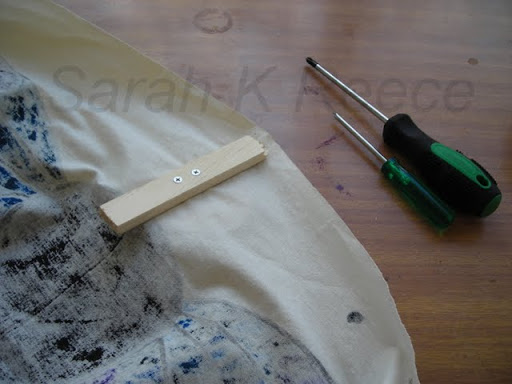
I attach her face with screws to a piece of dowel that will become part of the frame at the back that hangs the whole piece. (as needing to be pegged to the curtains is not a hanging method widely accepted by galleries, sadly)

Now, time for some more sewing… at last, something I can do and watch a movie at the same time. I’ve been listening to movies that are primarily dialogue driven while painting this, which rules out my subtitled foreign film collection. Coupling and Spooks episodes work well, Bladerunner of course is great as I know every scene by heart anyway. Robin Hood – the Disney version, is very sing-a-long-able, as is Labyrinth. Igby goes down was great except it kept making me cry. And one night I packed it all in and curled up on the couch with Cyrano de Bergerac, one of my all time favourites, which needs full attention due to rapid subtitles. So there you go. This weeks recommendation for inspiring movies to paint to.

See the next step here.

Scattering Stars

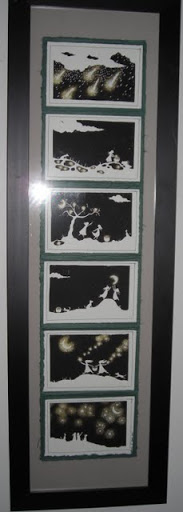
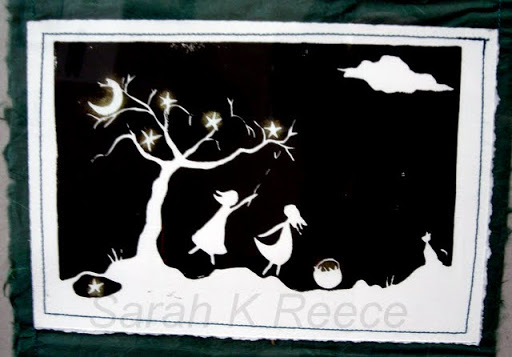
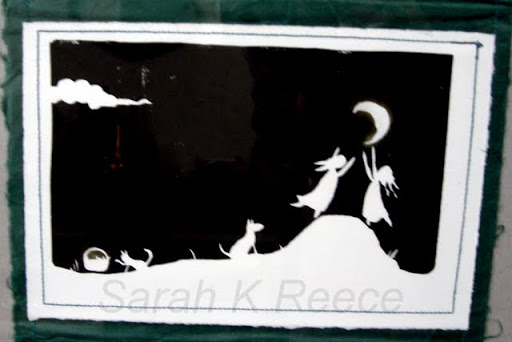
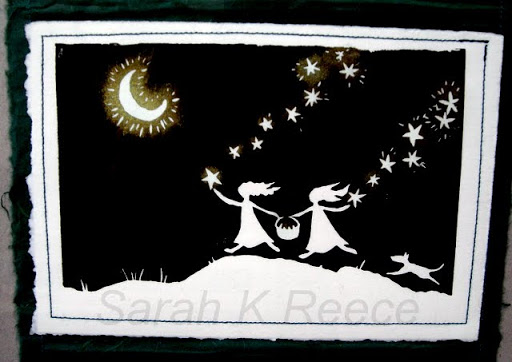
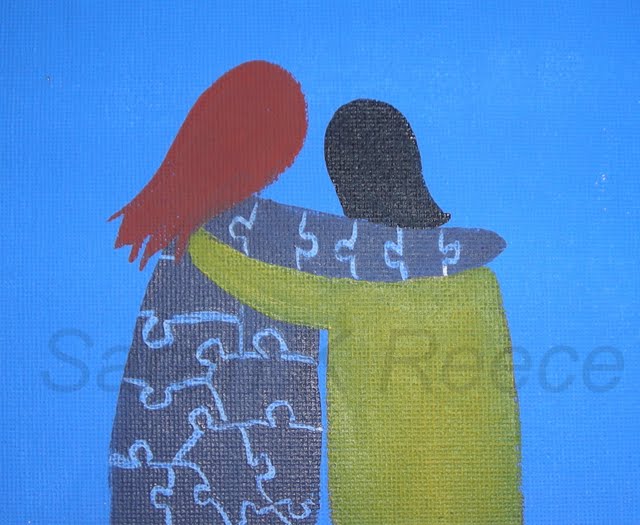
I’ve framed and submitted for exhibition a linoprint series I made in Printmaking Foundation last year at TAFE. The theme was a narrative of any kind. Here they are, all together – the story goes from top to bottom.

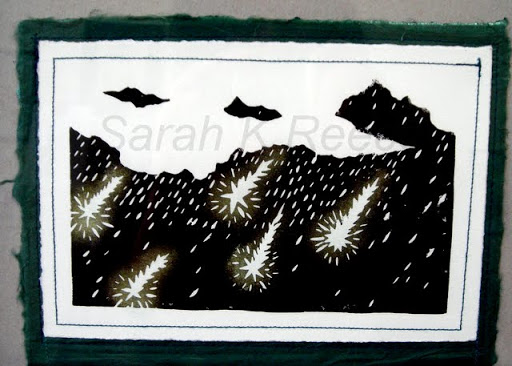
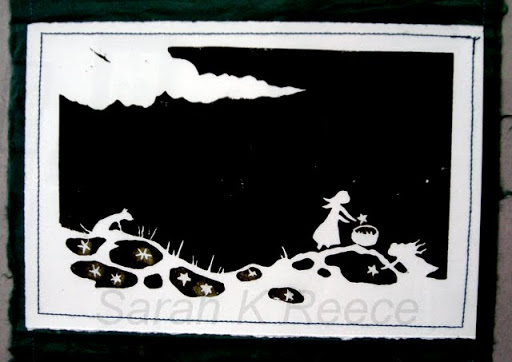
I know that’s not easy to see, so I’ve taken a photo of each print individually. Sorry about the quality of these photos, I didn’t think to take them until after I’d framed them, so the reflection off the glass has made things tricky. Here’s the little explanation of the story I’ve included with  my submission to the Mental Health Week Exhibition:

This artwork is in honour of my friendship with my sister. As children we played together at night in the backyard. The world was full of magic and wonder, and our pets were our companions on all our adventures. In the little story, a storm washes the stars and moon from the sky. The little girls collect them and scatter them back into the heavens. My sister still helps put the stars back in my sky after storms.

Submission to Mental Health Week Exhibition

Well, I have sent off my submission, so I’ll stop boring you all with a blow by blow description of a life in the week of a mad artist. And hopefully catch up on some more sleep. I hate this part of the artistic process – the framing is painfully time consuming especially when you don’t have any of the right tools (on my wish list) and are too short of money to pay for those nice mats and large bits of appropriately coloured card to mount the work. Everything must have a wire for hanging across the back of the frame – which is a lot of extra time nailing/screwing/gluing all as carefully as possible so you don’t stress the glass too much and bust it – been there done that.

And paperwork! I spent an hour filling in the damn form, it’s a docx download which I don’t have the software for. I converted it and filled the whole thing in, saved it and tried to attach it to my email to submit – and discovered the converter had crashed and corrupted the file so badly it couldn’t be opened anymore. This was at midnight. I cried. I then filled out everything again – they want up to 100 words of what each artwork is about, plus mind numbing details such as the exact size of each frame. And as it’s a word document, you have to keep reformatting it as you add information and deleting pages of little dots. I could print, complete by hand, then scan and email, but that means manually counting the words in each category. Grrrrrr.

In the end, I submitted 5 works, three ink paintings – 2 I’ve already posted here, this is the third:

It’s called Homelessness, something with which I am all too depressingly familiar. Instead of a description of my experiences, I included this short poem:

I only want a home
a small safe place to bed
a burrow to hide in
a pillow to catch my tears
an oven to cook my meals
windows to keep out the rain
so precious
so precious when you have lost them
I want so much
a place to call my own.

I also included a linoprint series and a pic of my kite in progress, and offered if they were happy to let me submit it I’d keep working on it and finish it up asap. No reply yet, we’ll see what they think about that.

Painting painting

This post is the third of eight, showing this artwork develop from start to finish. See the first parts:
1. Mental Health Week Exhibition
2. Progress…

Okay, today I managed to spend another hour in the cold in a car park waiting for the RAA… drove in that heavy rain we had this morning and forgot to turn my lights off when I parked. That was after turning up to the wrong venue for my appointment! My stars are not aligning this week.

But, I have managed to make more progress, one of the tricky parts has been re-matching the paint colours from earlier portions. I started this project over a year ago – but I did keep an aid – my old dried out paint palette to help me colour match. Still took about 1/2hr to mix all the blues up correctly. I think they’re harmonizing well though, I don’t think anyone will be able to tell old work from new.

Finished the beading work, hoping to get the blues all done tonight and maybe even the face painted and stitched on too. Then the frame, fringe and embellishments, and everything photographed, framed, and the application form completed. Getting there!

See the next step here.

Progress…

This post is the second of eight parts showing the development of this artwork from start to finish.
See the start here.

Okay, tea break. My lovely kite is progressing well. Now, don’t scream, but as its a representation of coming through life with attendant issues such as mental illness, it was never intended to look perfect. She’s come through a few wars.

And then another couple of hours of painting later, I’m up to the embroidery part – stitching in the missing skeleton structure of the wings with beads and crystals.

Next, back to the paint to finish off all the blue. That should keep me occupied for a while yet!

See the next step here.

Mental Health Week Exhibition

This post is the first of eight showing this project developing from start to finish.

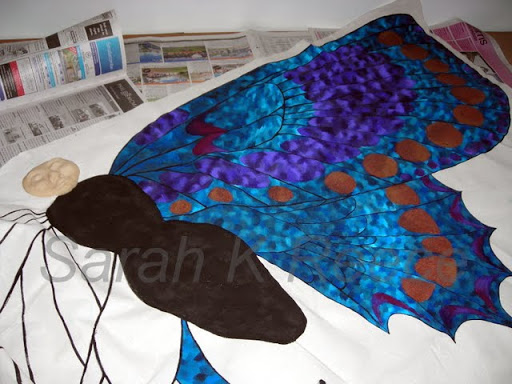
The final date to submit artwork for this exhibition is this Friday, so I am frantically painting. I have some smaller works, ink paintings and a set of linocuts all done and ready to be framed. But I also have a major project I’m trying to get done in time. As of 4am this morning I’d got this far:

And also sculptured her face, ready to be fired in my oven.
Then, a few hours sleep, and back to it.
I’m just having a break for breakfast and to do my daily post. 🙂 I’ve finished one wing finally. Here she is:


Now I’m going to run off to the shops to buy frames and hanging supplies. By the time I get back that wing should be dry enough that I can fold it up to start on the other wing without smudging the paint. I also have to paint the face, add hair, other embellishments, and mount the whole kite onto a frame for hanging. Hopefully by the end of today. Wish me luck!

See the next step here.

Introducing DID

In our group Bridges this week, I gave a talk introducing DID (Dissociative Identity Disorder). We are planning to present a forum on the topic in about 2 months time. It’s a very big topic and there’s a lot of misinformation and confusion out there about it. This talk is by no means comprehensive, but it is I hope a good introduction and overview of the condition.

What is Dissociation?

I’m going to start with a quote by a psychiatrist, Judith Herman:

The psychological distress symptoms of traumatised people simultaneously call attention to the existence of an unspeakable secret and deflect attention from it. This is most apparent in the way traumatised people alternate between feeling numb and reliving the event. The dialectic of trauma gives rise to complicated, sometimes uncanny alterations of consciousness… which mental health professionals, searching for a calm, precise language, call “dissociation.”

What does that mean? Dis-association is the disconnection between things that are normally associated. In simple terms, dissociation is to be unplugged in some way. 

Most of us have experienced a small degree of dissociation. One common example is called highway hypnosis, which is where you may drive say, home from work, and arrive not able to recall any details of the trip. You’ve been driving on autopilot probably thinking about other things. Another example is daydreaming, or getting ‘lost’ in a good book. These are common experiences, and do not indicate a problem of any kind. Dissociation only becomes a disorder when it is severe, distressing or disabling. It can be difficult to imagine what severe dissociation might feel like, but if you have ever stayed awake for a night or two, perhaps studying, then you have some idea. You may have felt confused, foggy, your sense of time might have been different, perhaps the room appeared fuzzy or spun around you, you may not have felt your feet upon the floor. Remembering this experience can help you imagine what someone who experiences severe dissociation may feel like.

Dissociation and Mental Illness

Dissociation is a symptom of a number of different mental illnesses, such as Post Traumatic Stress Disorder, and Borderline Personality Disorder. There is also an entire category of disorders where dissociation is the primary issue, just like the category of anxiety disorders groups different mental illnesses where anxiety is the underlying feature.

Dissociation can happen in may different areas. It depends which area has been ‘unplugged’ as to which symptoms a person experiences. People who suffer from chronic dissociation may struggle with symptoms such as:

  • Emotional numbing – where someone cannot connect to their own feelings, feeling flat, empty or numb instead.
  • Amnesia – ‘zoning out’/blackouts/lost time, when dissociation occurs in the area of memory, for example suddenly discovering that it is Thursday, and having no memory of Wednesday.
  • Time speeding up or slowing down – if you have ever been in an accident you may have experienced this common dissociative symptom.
  • Losing sensations – not being able to feel your own body, or feel sensations such as heat, cold, pain, hunger. Dissociation can unplug someone from their own senses, dulling or even removing altogether their sight or sense of hearing or ability to feel pain for example.
  • De-realisation – this describes someone’s experience when they are unplugged from the world around them, it may feel like being in a dream, or that they are living in a film. Nothing feels ‘real’. This may not sound so bad but it can be very distressing to experience.
  • Depersonalisation – describes being unplugged from yourself, where someone may feel unreal, like being a robot or living in a dream. They may not recognise their own reflection in a mirror, and may have out of body experiences where they seem to be watching themselves.

Many people experience one or more of these without having a mental illness. And people who do have a dissociative disorder may experience only one or all of these. Some people struggle with chronic symptoms, while others experience episodes and then recover.

What is DID?

DID is one of the Dissociative Disorders. In DID, Dissociation occurs primarily in the areas of memory and identity. DID used to be called Multiple Personality Disorder. The name was changed in the DSM to reflect a different understand of the condition. DID is not someone having more than one personality, it is one personality that is divided into parts through dissociation.

Dr Warwick Middleton, an Australian psychiatrist who is the Director of the Trauma and Dissociation Unit at Belmont Hospital in Queensland wrote “It is inaccurate to conceptualise a patient with DID as having ‘multiple personalities’. A more helpful conceptualisation is that such individuals have access to less than one personality.” (at any one time)

We all have parts

We all show different sides of ourselves with our workmates, children, and friends. We play different roles in our lives. We know what it feels like to be “in two minds”, we say things like “part of me wants to go out tonight, and part of me wants to stay  in”. For a person with DID, these things are true in a literal way. 

Parts Divided

For someone with DID these parts are separated from each other by dissociative barriers. As a result, they develop separately and can be very different from each other. For example, they may have different ages, gender, skills, interests and beliefs.

There are some common terms associated with DID it may helpful to know the meaning of.

  • Part or Alter – commonly used to describe the different personalities in a person with DID.
  • System – this describes the group of personalities that make up the whole person with DID. Many people prefer other terms such as family, tribe, or community.
  • Switching – one part going ‘inside’ or away, and another one coming ‘out’ and inhabiting the body. This may be slow or quick, obvious or very subtle.
  • Trigger – is anything that makes a switch between parts happen.
  • Coming out/Going in – used by people with DID to describe times where they are in control of their body and times where another part of their system is.
  • Kids/Littles – refers to any parts that are children or young teens. It is quite common for people with DID to have younger parts, but not everyone does. A person with DID may talk about their ‘kids’ to mean not biological children but their children parts.
  • Multiple – a shorthand way of describing someone who has separate parts. People without dissociated parts may be called Singletons.
  • Co-consciousness – means that more than one part is aware of what is happening at the same time.

Why does it happen?

The development of DID has a very high association with childhood trauma. In childhood the identity is still forming, and trauma during this time can result in dissociation in this area. It’s important not to make assumptions here, trauma may involve abuse, but there are many other ways children may be traumatized. For example a very ill child who must undergo many painful medical procedures may develop DID. Not everyone who has DID has come through childhood trauma, and certainly many people who are traumatized as children do not develop DID. It is also important to note that while some people with DID have come through extreme abuse, others’ experience was less severe yet they have still developed DID. 

Whilst DID is considered a mental illness, it can also be thought of as a defence mechanism, a way to survive. Psychologist Deborah Haddock writes “Many people with DID baulk at the use of the term disorder. When every ounce of your being comes together to fight for survival, having it termed a disorder can feel discounting to say the least.”

How do people survive trauma?

1. Containment

There are, among many others, two key abilities that all  people may draw upon to get through a traumatic situation. One of these is containment. This is about being able to compartmentalise experiences. If you have ever put aside your feelings to assist at an accident, then after everyone was safe, gone home and shaken and cried, you have used to containment. You have contained your overwhelming feelings to do what needed to be done, and then felt them later on.
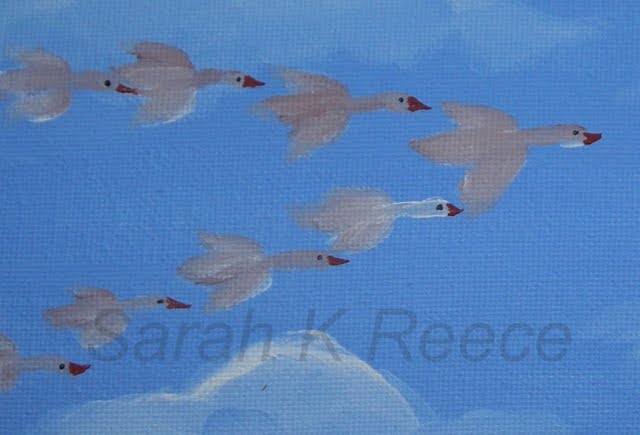
Someone with DID uses containment in an even stronger way, where different parts contain different skills, memories, or emotions. One of the advantages of this is that damage is contained, and healthy areas of functioning are preserved rather than the whole person being overwhelmed and unable to function. An analogy is the way a flock of geese flies. The goose at the front encounters the most air resistance, it has the hardest job while the rest of the flock rest in the slipstream. When the front goose tires, it drops back and another goose takes the lead position. The parts in a DID system may do this, where one part is out, then goes away inside to rest while another comes out.

2.Adaptation

Another way people get through trauma is through our ability to react and adapt to new situations and environments. We’re all capable of drawing on different strengths and skills in different environments. For someone with DID, this ability to adapt can be life saving. For example, a child may develop a part that copes with physical pain by numbing and not feeling anything. They may have another part who goes to school, has none of the bad memories, and is able to behave normally. They may also have another part tucked away inside who keeps fragile characteristics safe from being destroyed by a harsh environment, for example hope, self esteem, or optimism.

Theories

There are two main frameworks used to describe the way separate parts form in a person with DID.

The Smashed Vase theory is that every part of a system is a piece that together makes up the whole person. This explains the way systems can divide up basic characteristics such as emotions, one part manages anger, another expresses joy.

The Alternate Selves theory is that every part is one possible version of who the person could be, given their experiences and history. This explains the way DID systems can continue to split and form new parts, there seems to be no upper limit of how many parts can form. Also the way parts can un-form, meld into each other, and disappear.

The reality for a person with DID may be an overlap of both processes.

Challenges

There are some huge challenges facing a person with DID. Deborah Haddock writes “Most DID patients see several therapists and have an average of seven diagnosis before finally finding someone who understands the dissociative aspect of their behaviour… Confirming the diagnosis of DID is not easy, however. One of the difficulties lies in the nature of dissociation, which compartmentalises behaviours and experience that would normally be connected. Also, the dissociative personality system is usually set up to avoid detection.” In a nutshell, DID generally only works as a defence mechanism if it is hidden and secret. Otherwise, being divided may make someone more vulnerable to abuse.

Dr Middleton writes “For dissociation to be an effective mechanism in protecting individuals from being overwhelmed… it is necessary for the individual to a fairly large degree to dissociate the fact that they dissociate. If they are fully aware of the extent of their dissociation, they they are very close to being overwhelmed by the underlying reasons for it.” DID can be extremely confusing to experience, and even finding the words to express what is happening can be extremely difficult. It is not a very common diagnosis, and not many professionals specialise in the area of dissociative disorders. Even once diagnosed, finding a competent and caring professional to work with may be difficult. 

People with DID are not all the same

We tend to think in absolutes, something is black or white, someone is crazy or sane. The reality is less concrete. Dissociation is more a continuum, with normal, healthy experiences at one end, and severe mental illness at the other. Likewise, within the realm of multiplicity, there are a number of continuums, and the result is that there is a lot of variation between one person with DID and another. For example, the degree of amnesia varies considerably. Some people with DID have total amnesia for the times when other parts are out. Others are aware of what is happening, which is called co-consciousness. Some multiples don’t experience the level of amnesia needed to fit in the category of DID, and they may receive a diagnosis of DDNOS (Dissociative Disorder Not Otherwise Specified) instead. Some other differences between people with DID are

  • Obviousness of switching – for some people it is obvious when they switch, for others it is so subtle that only someone who knew them very well might be able to tell.
  • Number of parts – this can range from just one, to hundreds.
  • Switching – some multiples switch all through the day, others only very occasionally, and some people never switch, but they talk to their parts and hear them in their mind.
  • Degree of internal control over triggers – some multiples can chose which part is out, others have no control over this.
  • Degree of fluidity – some multiples have fixed systems with, say, 5 members who have been there for years. Others are more chaotic, they are difficult to learn about as they are constantly changing with new parts forming and old ones going away.
  • Other diagnosis – people with DID may have other physical or mental illnesses which will change how they experience life.
  • Degree of disability – some people with DID are extremely unwell and struggle to function, perhaps spending a lot of time as inpatients, while others live and work unnoticed in the community, perhaps with no one around them aware of their condition.
  • Polyfragmentation – some people with DID have mini systems within their system, or have parts who have themselves split to form parts of their own.

DID is about identity – it is therefore extremely individual in the way it presents and is experienced.

How can I help a friend with DID?

One of the most important things a person with DID needs is acceptance. It can be very stressful and discouraging to have a condition that is uncommon and often misunderstood. Media representations of DID are often dramatic and frightening. It is also important not to be invasive. Some people with DID are comfortable sharing details about their systems, others are not. Asking questions like “who is out now?” or “what are all your names?” can be confronting. It helps if you are willing to cope with inconsistency. Someone with DID may one day love apples and the next hate them, may tell you on different occasions about a film they saw and give you completely different impressions of it. Often, this is misunderstood as lying, when it is just parts with different tastes.

It will also help if you are willing to cope with confusion. Dissociation is extremely confusing by its nature. It may take a long time to work out what is happening. It may take a long time even to determine if the symptoms are dissociation rather than something else. Try not to pressure the person to know more about what is going on for them they can. Learning about this is a process, and the diagnosis of DID often carries a lot of stress and fear for people. Being safe is very important, if you have a friend with DID it is vital that you never take advantage of their multiplicity. If they have child parts, treat them as you would treat children for example. And lastly, although you may have a strong friendship or relationship with one part, do your best to embrace and welcome their whole system, and recognise that your friend is part of a community.

Is there hope?

Yes!

Connections that have been broken can be rebuilt. Trauma can be healed. It is important to find good caring support people, friends or family or professionals. As much as possible, work on learning about your system, increasing communication, self awareness, and self acceptance. Reducing denial, and learning how to ground yourself can also make a big difference. The goal is to come together to function as a team, all protecting and looking out for each other instead of fighting and pulling in different directions. This goal can be reached through cooperation, and/or through integration, which is where the dissociative barriers between parts dissolve, so every part is out all the time.

People with DID can be very vulnerable, but they are also incredibly resilient!

Cameron West, who has DID, writes:

I desperately want to feel like I’m part of this world and somehow connected to the people in it. I guess that’s why I’m here today. I’m hoping that somebody will look into my eyes and tell me they see somebody there, tell me they see Cameron West there. And if they see other people in there, well that’s okay too. It has to be okay. I’m through being disconnected from me. I am who we are, and it’s got to be okay, or I’ve got no chance of a better life.

For more information see articles listed on Multiplicity Links, scroll through posts in the category of Multiplicity, or explore my Network The Dissociative Initiative.
Art online

Last year I sold the digital images of three artworks to a group who were putting together a new website called bipolarcaregivers. I love selling pictures of my work instead of the originals! Selling art is completely different to publishing writing. You hand over your baby and someone else walks off with it and never comes back! It’s wrenching! However, on the plus side you no longer have to find room to store it, which is a very handy thing. Either way, I’m more careful these days to document my work and keep a record of what I’ve made. I’m keen to explore the local options for producing high quality prints for sale too, there’s plenty of people who love the images but don’t have the cash to buy originals. At the moment, my art related to mental health is being purchased by professionals and staff, but isn’t really accessible to people with mental illnesses getting by on pensions. Which I’m not happy about.

Back to the website! They purchased three artworks, (click on the links to see them) Netting Stars, Finding Hope, and I see you falling. The last one is echoed by my latest ink painting using masking fluid. Same theme but a different response.

Butterfly shoes

Work on progress, have started my next pair of shoes. The brief was – black shoes, butterflies, jewel tones. This time I’ve painted the outlines by hand instead of using a sharpie – as my only sharpie is black that would be rather pointless. You can get other colours, including a strong white, which is tempting. But on the other hand I think a white outline would be stark and unappealing. Hand painting works well, it’s just more time consuming. And the pencil outlines don’t show up as well either, so it’s more freehand. I wouldn’t suggest trying black shoes for your first painting experiment!

Here they are, sitting on my printed reference sheet of beetles and butterflies. 🙂

And a close up:

I’m pretty pleased with how they’re turning out. I’m also considering embroidering little beads or accents on in places. 🙂 Because I’m mad!

Masking Fluid

I’ve made my first artwork using masking fluid now. It has a different effect from the ink painting I did recently using wax, the edges are sharp and perfectly defined. It’s also considerably easier to apply! But I do like the way the wax interacts with the paper and the ink to give a batik effect. I’ll continue to explore both I think. To work further with wax, I’d like to get a tjanting tool, which is sort of like having a fountain pen that emits melted wax instead of ink. The traditional forms look like this, or there are modern versions like this, that heat the ‘pen’ to keep the wax flowing easily. This is also the traditional way of creating lovely designs on silk, something I’ve not yet tried, but would very much like to.

Anyway! I used the masking fluid to mark out areas I wished to remain white, and painted my image with ink and a watercolour brush. Once dry, I rubbed away the masking fluid, and added fine details with a tiny brush and very light ink. (those details haven’t shown up well in the photo I’m afraid) I’m looking forward to making more art using the masking fluid.

Tutorial for painting shoes!

I’ve had a go at publishing a tutorial of how to paint canvas shoes on Craftster, using photos from the painting of my ‘happy shoes’. You can view it here. 🙂

What do you think – is it easy to follow? I’m in the process of seeing if I can get permission to set up a once off workshop at MIFSA to teach people there how to make their own.

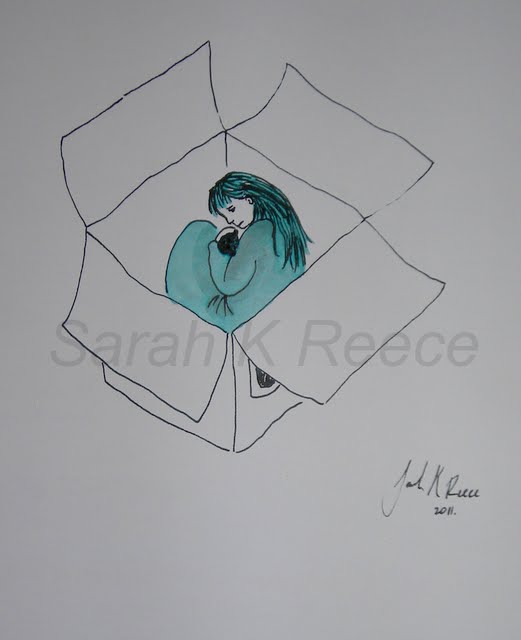
Nightmares

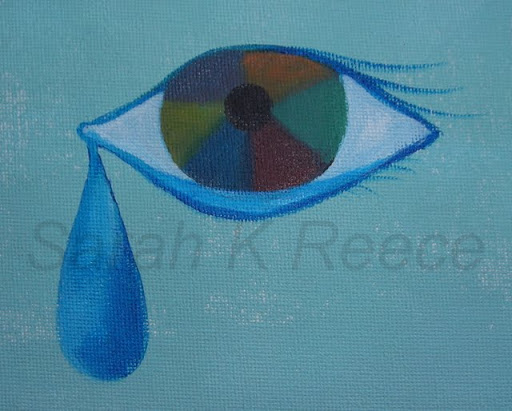
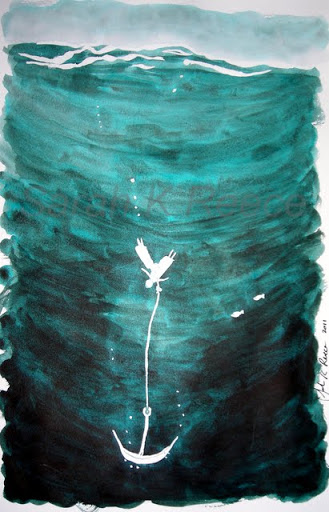
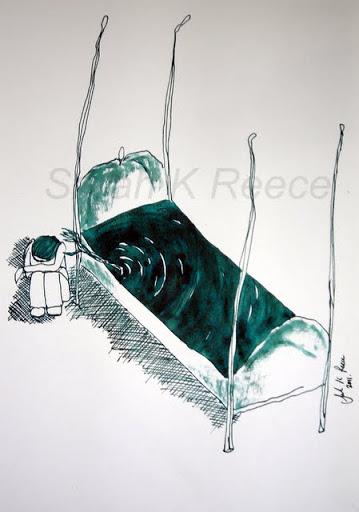
Are a common symptom of Posttraumatic Stress Disorder (PTSD). In my case, it was hoped I would grow out of them. I haven’t, they are something I live with. I go through phases where they are comparatively benign, and others where they are so severe I can’t, and don’t want to, sleep. At the moment, I’m going through a bad phase. I painted this ink picture the other day. This is how it feels.


Planning new shoes

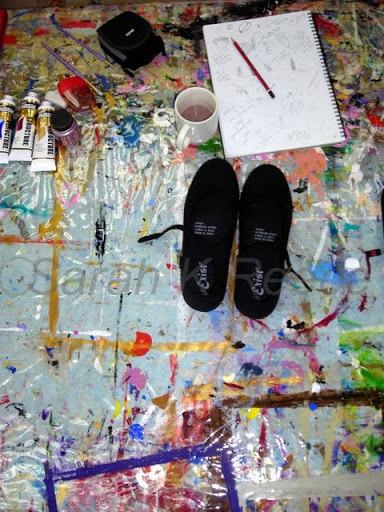
I spend a fair amount of time at a local psychiatric ward at the moment. Lately, I’ve discovered they have a great art room, so I’ve started taking along some of my things to work on there. Helps to keep my stress level down a bit when I’m visiting. I’m getting better, I used to be frantic in one of these places. I’m not a locks on doors kind of person. So, here’s my workspace with the awesome coloured table cloth. I’m drafting designs for my next pair of shoes.

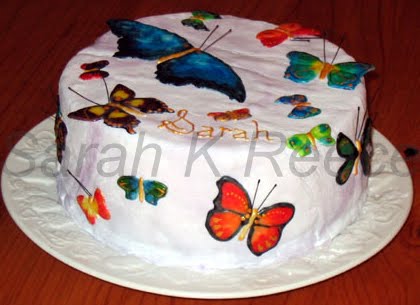
They will have multicoloured butterflies on them, somewhat like this birthday cake I made for myself a number of years ago. (yes, these butterflies were icing, I made them and we ate them)

Looking forward to trying the new acrylics with them. (shoes, not cake) I think I’ll accent in gold instead of black for these. And maybe include some coloured bugs, shiny Christmas beetles and the like.

The other day I was watching someone use their smart phone as a reference for a picture they were making in art. That’s so handy, I’d love to be able to do that. I print mine out at the moment, but its painful as the ink costs a lot. Mind you I guess you get the tracing option when you print – can’t imagine that would be easy with a phone!

New art supplies

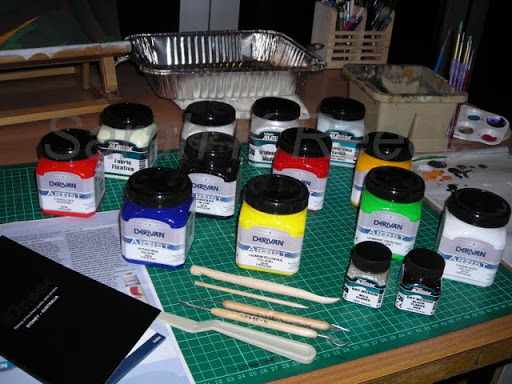
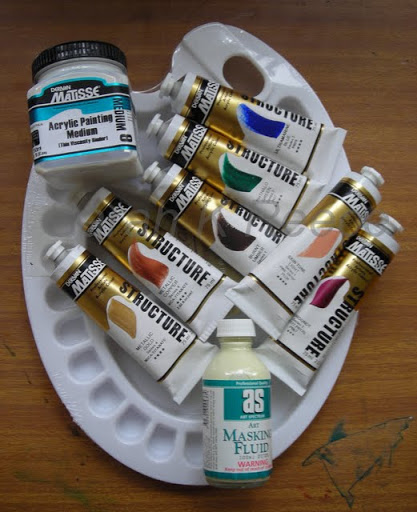
Everyone lately, it seems, has been buying new art supplies except me. Paying upfront for my Tafe subjects has left me pretty skint, but I was desperate to extend my acrylic colour range to paint my next pair of shoes. I bought paints last year when I came into a little bit of money, and they are gorgeous! But a number of crucial colours are missing – such as a magenta colour which cannot be mixed from the primaries, skin tone, which just makes life a lot easier, and burnt umber which is also unmixable. I have always used student grade acrylic, but I was becoming very frustrated with how many coats I was having to apply to get good coverage. Last year I was involved with a painting workshop where they supplied lovely pots of thick paint from the Derivan range. I was sold and started my new collection:

This week the need for more colours was too much! I went down to my favourite local shop, Art to Art and quickly found my carefully planned budget in trouble! This range I’ve bought here is the mid range that Derivan offer, better quality than student but not as good as the professional artist range. The difference is in a few factors, one of the big ones is the range of colours available, another is the amount of pigment to binder in the paint. The pigment is what gives the paint colour, the binder is what glues it to paper or canvas. Lots of binder and only a little pigment gives you a paint that you need several coats of before you can’t see through it.  So the mid range is good value for what I do, the pots are good in that you get a lot of paint and they store really neatly being squared. The downside is that as you use the paint up, there’s more air in the pot and you need to make sure you add a little water now and then to stop the paint starting to dry out.

The other big downside is that you have to pay for a whole pot at a time – which is fine if you’re just buying one colour or replacing one you’ve used up. But painful when you’re starting a whole new range! Whereas the professional quality paint comes in a couple of size options – these size pots, huge pots for the really keen, and 75ml tubes. Although it’s more expensive per ml than the middle range, the tubes themselves are mostly cheaper to buy than a whole pot of the middle range. So I could come home with only a couple of pots, or I could come home with a number of tubes. I went the tubes option! After much deliberation. Here they are:

That was my grocery money for the fortnight! I bought milk, $1.34 loaf of bread from a service station, and yoghurt. Apart from that I’m living off what I find in my cupboards. I went to heat an instant chicken rice meal recently, then discovered it had expired in 2006 and changed my mind. Went for homemade risotto instead – yum – much safer!

So, I am very excited about the quality of these paints, I’ve never used anything like this before and I can’t wait to try them. They are very thick – more the consistency of oil paints, so I also bought the Acrylic Painting Medium. This means I can make them more liquid – which is what you need to fabric paint, without using so much water that I reduce the content of the binder to the point where the paint becomes water sensitive. That’s the theory anyway!
And the masking fluid I have been craving for a long time. I’m really keen to try it out for techniques like this. I use a lot of white space in my ink paintings, and at the moment I just paint really carefully and really quickly, which is fine as long as the white space is large, thick, and clearly defined. If I wanted to paint in a dark cloudy sky with white branches weaving across it, I would be in a lot of difficulty. But this product means I can push that a lot further!
And the palette underneath is to try my hand at some Chinese water colour paints I brought back from Singapore this year. Watercolours I have found, are very difficult to use if you don’t have an appropriate palette, or at least a good supply of jar lids or something. So I’m looking forward to having a play with this soon too! Ahhh, the anticipation of exploring new art ideas, just warms the soul. And now I can stop feeling madly jealous and go back to being on speaking terms with everyone else who bought art supplies this month!

Starting up at TAFE again

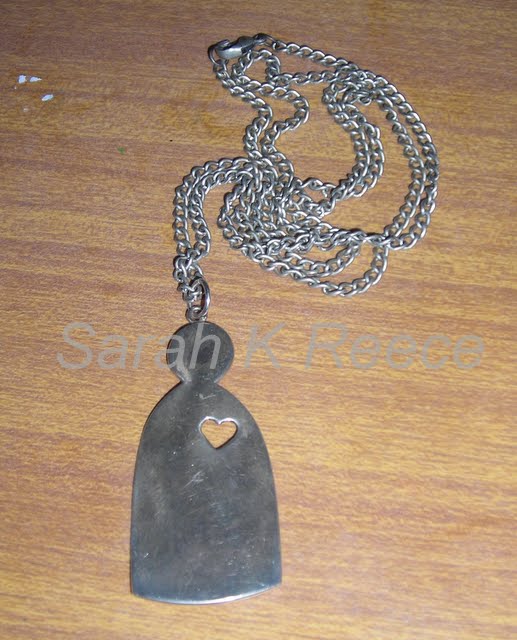
I’ve booked back into TAFE, one subject each in Terms 3 and 4. It’s very exciting! Term 3 is Jewellery Fundamentals, and Term 4 is Small Object Making (sculpture in miniature). I have very little experience with jewellery making, but I find it fascinating. I did a short WEA introductory course last year and made this lovely pendant:

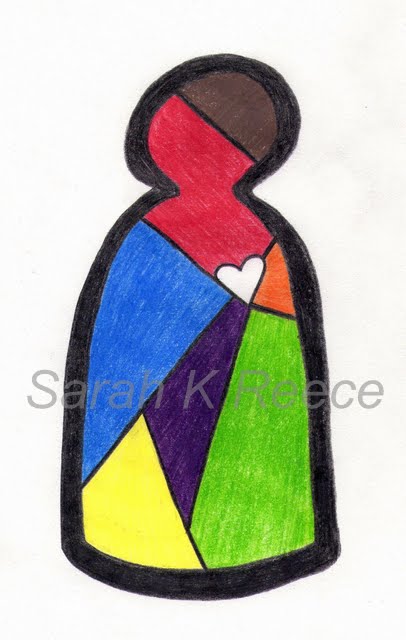
I later took the concept and used it to develop a logo for the Therapeutic Group I facilitate at the Mental Illness Fellowship. (MIFSA) The group is for people who experience dissociation or multiplicity, such as those with Dissociative Identity Disorder, hence the stained glass window effect with different parts making up a whole.

I was worried about how I’d get to the campus – I’m doing, painfully slowly, a bachelor degree in Visual Arts at the Adelaide College of the Arts, which is the Tafe arts building on Light Square. One of a number of reasons I chose it is that the campus is literally a building – which is about the size I can cope with. Less strangers, less getting lost, less adjustments. And everyone there is a strange arty person. The downside is the lack of available parking. I’m in at MIFSA on Thursdays, so last year’s option of catching in a bus from home is not at all convenient. I was trying to come up with some clever plan whereby I parked outside of the city and bussed in. Nothing was working, so late the night before hand I decided I would just have to park in a UPark this time round and try and find a more financially viable option next week. I found there was a UPark on Light Square, which is fantastic. Even better, I discovered they charge a flat rate on weekdays after 4pm! So I was able to park nearby, cheaply, out of the rain. No waiting in the wet and the dark at the bus stop! Stoked!

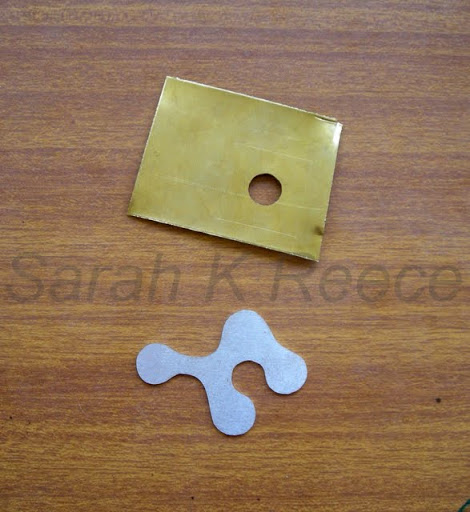
Walking back into the AC Arts after so long I was hit by this awesome smell – hard to identify, paints, inks, clay… the smell of art. I felt myself relax instantly and feel at home. That’s a pretty huge achievement for someone like me, when I’ve only done one class there so far. This great start was slightly marred when I realised that in my food prep that morning I’d packed lunch, dinner and snacks but forgotten something to drink. And then the vending machine ate my money and didn’t give me a drink. 😦 Without some liquid pick me up I was falling asleep during the talk part of our class, but once I got my hands on some metal I woke right up and had a great time sawing and using the drill for the first time. Something else for my wishlist… I want a jewellery drill. Then I could make all kinds of objects into beads and turn them into jewellery or sew them onto things. I’m really glad to be back there, it’s something great to look forward to every week now. Products of my first lesson? Not all that exciting yet:

See what I made at my next lesson here.

Happy shoes

Yes, I have a slight shoe fetish, being female it seems to come with the territory. Frankly, it doesn’t stand out that much as it has to vie for space and time with my slight rose fetish, weird perfume fetish, umbrella fetish, and so on and so forth. But, for several years now I have had a secret, unrealised wish. And it was this: to one day, paint my very own pair of shoes. I love clothes/shoe modding! (modifying) Why spend weeks making the item from scratch when I can recycle something perfectly hideous from the local op shop in a fraction of the time and make something completely unique? I have been very inspired by Craftster in this respect. Craftster is this incredible site full of mad people like me who just have to make things. I found these amazing shoes all prettied up, and also these incredible painted shoes. Which put me in mind of another favourite thing of mine – iridescent medium. This is awesome stuff. It looks rather dull, white paint in a pot. But it makes every acrylic colour you add it to turn into sparkly shimmery jewel tones.

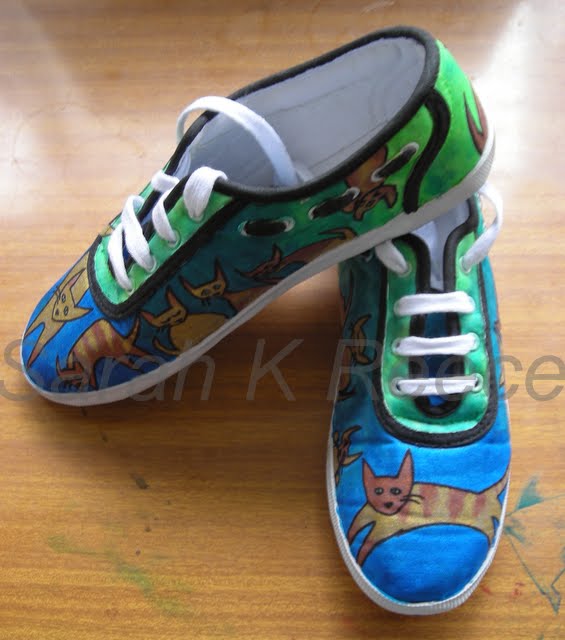
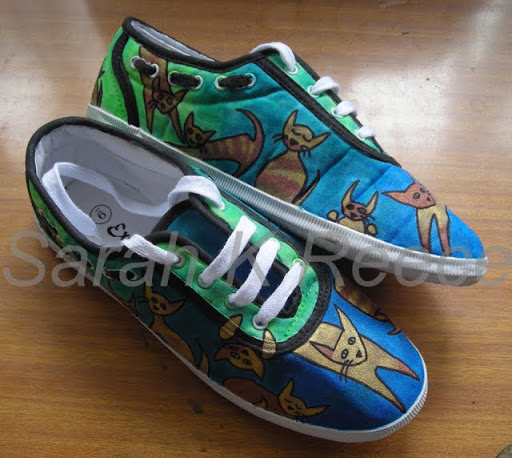
So, I took the plunge recently and decided to murder a cheap pair of white fabric shoes bought specially for the purpose. Instead of buying a set of fabric paints I bought a fabric painting medium which when mixed into acrylic paint turns it into fabric paint. All you need to do to make it set permanently (water fast), is to heat set it once you’re done. And here they are, my first pair of painted shoes!

I adore them! They are shimmery in real life, and the cats are metallic gold and bronze – the photo doesn’t really capture it. I want many, many more. And I love that the shoes themselves are inexpensive, canvas shoes can be bought for $5 at some stores. I’ve been wearing a $12 pair of canvas shoes all year and apart from all the white bits going a bit grey (which is why I’ve painted all the white on these) they are still in great nick. I can see my shoe collection expanding significantly over the next year. 🙂 I’ve also had a quite a bit of interest from potential customers! But the next pair are mine – these are a gift for someone who loves cats. The big test will be when she wears them out in the rain and we find out how well my heat setting worked!

Haiga!

Ahhh busy busy. I’ve spent several days condensing a number of longer poems down to something resembling a haiku or senryu. Let them all percolate for another couple of days, then sat down to start painting today. (well, yesterday now) I chose two that brought to mind a clear visual image that was linked to the content without just directly illustrating it. I feel the art aspect of the haiga should add something more to the poem. It is a tricky balance though, a direct illustration can help make the poem’s meaning more clear… I worked fairly quickly in that I didn’t let myself over think the topic too much or I knew I would buckle to nerves and not be able to make anything. It was a glorious day, I threw wide all the windows and just basked in the sunshine. First day I’ve sat in my studio to make art barefoot and in a t-shirt! Very bohemian, I like it. Might even find a nook to put the little heater away instead of falling over it all the time.

So, here they are, my very first ever haiga: After the storm

This is all ink painting with a single watercolour brush. The hands are mine, but upsized – they wanted the art in A3 size. This is my favourite colour for inks at the moment, it’s Air Corp Blue Black, which is one of Noodler’s inks. It dries water fast so you have to work very quickly because once a layer dries you cannot blend it. It’s rather unforgiving! But I just love the shades you get from it, I have my ink pots lined up, 6 of them from almost completely water through to almost completely ink and I often load my brush with more than one at a time to get that lovely gradient of colour in a single brush stroke.

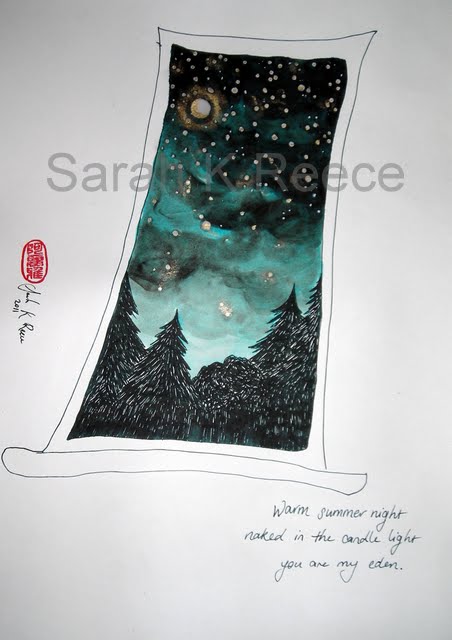
And the second haiga: Warm summer night:

This is done with both brush and pen – Noodler’s ink is designed for use in a fountain pen, as you can see it writes very dark, almost but not quite black. I had a lot of fun with this painting, the window and trees are all pen, and then I decided to use a wax resist for the stars in the sky. I dotted candle wax all through the sky – more where it is darker, added a moon, then painted the sky in ink. I ironed off the wax into hand towels afterwards, and added the gold ink. I particularly love the halo around the moon. I also like the contrast with the poem – the image feels quite ‘cold’ for a warm summer night – although I was thinking very late at night, after midnight. I also like that I’ve shown what the lovers would see rather than painting them, it connects with the direct ‘you’ in the poem – we are in that place, not observing someone else in it.

One of the things I really like about haiku and senryu is their immediacy. You can’t write them without practising mindfullness, being entirely in the present moment. So both images put the viewer into the situation described – looking down at hands full of rainwater, or out of the window at night. I don’t think I’ve tried that approach before, of putting the viewer into the work; it quite tickles me.

I’m also thrilled to have the chance to appropriately use my new Chinese seal from Singapore. I chose the Chinese name 阿丽雅 (Aaliyah) because it has the same meaning as my English name – Princess. The red seal is so strong and striking. When I first saw it used on work, I used to feel it was unbalanced and harsh. But now it’s grown on me, there’s a lovely contrast between the red and the blue black. It’s always a difficult decision about where to place it, traditionally it is not hidden away like a signature generally is at the bottom of a painting. I’ve placed it quite prominently in both of these, but added my signature and the date, considering that my audience is likely to be predominantly English and may not be familiar with the use of a seal.

And emailing it all off! Always a nerve wracking process. I checked everything five or six times, re read all the instructions several times over very carefully – it’s depressing how often I discover some important thing I’ve missed doing this. The specifications are for the images to be suitable to be reproduced at A3 size – which gives me some trouble as if it was A4 or smaller, I’d just print and check! I did some net trawling looking for advice about pixels and dpi and generally became more and more confused about it all and seriously worried that my photos weren’t up to standard. Then I finally found a photo print shop which kindly had the general specs listed. According to them, I’m okay! As I don’t have any way of taking any higher resolution images, I’m choosing to believe that and have sent everything off. Several days early too, I think that has to be a first!